SHERER ARCHITECTS

Categories
Uncategorized

Historic Preservation Tax Credits Your Guide to ROI

So, you're standing in front of a beautiful old building, one with character, history, and incredible potential. But when you start running the numbers on a renovation, the costs can feel overwhelming. This is exactly where historic preservation tax credits come into play, turning what seems like a daunting project into a smart financial move.

Turn Historic Buildings into Profitable Ventures
A man in a cap stands on a street with a grand historic building behind him.

These credits aren't just some minor tax break; they are powerful incentives that can dramatically lower your project costs. This guide will walk you through how combining federal and state programs can unlock the full financial potential of a historic property. It’s more than just restoration—it’s a strategic business decision that can seriously boost your return on investment.

Think of it this way: a tax credit isn't a simple deduction that just lowers your taxable income. It’s a direct, dollar-for-dollar reduction of the taxes you actually owe. It’s like having a financial partner in the project, making the restoration of architectural treasures not just possible, but often highly profitable.

A Proven Engine for Economic Growth

The ripple effect of these incentives goes far beyond a single project's bottom line. Since it kicked off in 1976, the Federal Historic Preservation Tax Credit (HTC) program has become a true powerhouse for community revitalization. It has sparked over $235 billion in private investment to bring more than 48,000 historic properties back to life.

For developers working with experienced firms like Sherer Architects, this program is a key tool for turning fading landmarks into thriving, profitable assets.

What’s really compelling is where these projects happen. A staggering 78% are in economically distressed areas, 50% are in low- to moderate-income neighborhoods, and 29% are in small communities. This isn't just about saving buildings; it’s about directly tackling urban decay and breathing new life into rural towns.

More Than Just Preservation

At its heart, this is a program about smart, sustainable development. By using historic preservation tax credits, you’re doing much more than just fixing up an old building. You can:

  • Boost Your ROI: The credits directly lower your project costs, which naturally increases your final return on investment.
  • Enhance Community Value: Revitalized buildings create jobs, bring energy back to neighborhoods, and adapt unique structures for modern commercial use.
  • Access More Capital: When you walk into a bank with approved tax credits, your project instantly looks more financially sound to lenders and investors.

To get the most out of these opportunities, it's wise to weave these credits into a broader set of real estate investment tax strategies. By understanding how to navigate the process, you can transform architectural treasures into profitable, community-enhancing assets.

Combining Federal and State Tax Credits

The real magic in financing a historic renovation isn't just finding one tax credit program; it's learning how to stack them. Think of it as building a financial engine with multiple, powerful parts. You don't just use the federal program or the state one—you combine them to create a much more substantial, profitable outcome for your project.

This strategy is especially potent here in South Carolina. We have a fantastic state-level program that dovetails perfectly with the long-standing federal credits. By understanding how these two systems work together, developers and property owners can dramatically cut their out-of-pocket costs and tax burdens, turning what might seem like a passion project into a truly smart investment.

The Foundation: The Federal Historic Tax Credit

The bedrock of this strategy is the Federal Historic Tax Credit (HTC). This is the big one, but it’s designed specifically for income-producing properties. If you're bringing a commercial building back to life, converting an old warehouse into lofts, or renovating a rental property, this is where you start.

The federal program offers a 20% tax credit on your Qualified Rehabilitation Expenses (QREs). And let’s be clear: this isn’t a deduction. It's a direct, dollar-for-dollar reduction of what you owe in federal income taxes. If your project has $1 million in eligible costs, that’s a $200,000 credit in your pocket. That kind of number can completely change the financial viability of a project right from the get-go.

Of course, this incentive comes with high standards. You have to follow the Secretary of the Interior’s Standards for Rehabilitation, but for those who plan carefully, the financial reward is more than worth the effort.

South Carolina's State-Level Power-Up

While the federal credit is a game-changer on its own, South Carolina’s own incentives are what make stacking so incredibly lucrative here. The state actually offers two different historic tax credits, which opens the door to more than just commercial developers.

  • For Income-Producing Properties: For these projects, South Carolina adds a generous 25% state income tax credit on top of the federal one. This stacks directly with the 20% federal credit, giving you a combined 45% of your costs back in credits. That synergy is powerful enough to make almost any historic project financially compelling.
  • For Owner-Occupied Homes: Here’s where South Carolina really stands out. Unlike the federal program, our state also offers a 25% state income tax credit for homeowners who rehab their personal historic residence. This is a fantastic opportunity for individuals to preserve their own piece of history and get a significant financial benefit for doing so.

This dual-pronged approach makes South Carolina one of the best places in the country for historic preservation. The combined federal and state incentives create a financial package that’s tough to beat.

Imagine you're a developer in Charleston or Columbia looking at a $2 million rehabilitation. Stacking the 20% federal credit ($400,000) with the 25% state credit ($500,000) gives you $900,000 in tax credits. That’s nearly half the project cost covered, which is often the key to getting a "yes" from lenders and investors.

Federal HTC vs South Carolina State Historic Tax Credits at a Glance

To really get a handle on how these programs work together, it helps to see them side-by-side. They’re designed to be partners, but they have their own distinct rules about property use, credit value, and ownership terms that you need to understand for smart project planning.

Feature Federal Historic Tax Credit (HTC) South Carolina State Tax Credit
Credit Percentage 20% of Qualified Rehabilitation Expenses. 25% of Qualified Rehabilitation Expenses.
Eligible Properties Income-producing only (commercial, industrial, rental). Both income-producing and owner-occupied residential properties.
Minimum Investment Rehab cost must exceed the building's adjusted basis (the "Substantial Rehabilitation Test"). A minimum investment threshold applies, which varies by property type.
Recapture Period A 5-year holding period is required to avoid credit recapture. A 5-year holding period is also required for the state credit.

This table really drives home the opportunity we have here in South Carolina. For commercial developers, the ability to combine these credits creates an incredible financial synergy. It maximizes the total return on investment and transforms the preservation of our state's beautiful historic architecture from a noble cause into a sound, profitable business strategy.

Does Your Renovation Project Qualify?

Figuring out if your project qualifies for historic preservation tax credits can seem daunting, but I always tell clients to think of it as a simple, three-part checklist. Before you get lost in the details of floor plans and budgets, we need to make sure your building and your project tick these fundamental boxes.

Think of it like this: there are three main gates you have to pass through to unlock the financial power of these credits. Each one looks at a different piece of the puzzle—the building's official status, the size of your investment, and the quality of the restoration work itself. Nailing these three things from the get-go is the most critical step you can take.

Is Your Building Historically Significant?

First things first, the building has to be officially recognized as historic. It's not enough for a building to just be old or have character; it needs a formal designation. This is the absolute, non-negotiable starting point for both the federal and state tax credit programs.

So, how do you know if your property makes the cut? It needs to meet one of two conditions:

  • It’s individually listed on the National Register of Historic Places. This is the clearest path, meaning the building is considered significant all on its own.
  • It's a contributing structure within a Registered Historic District. This means your building is a key piece of the neighborhood's historic fabric, even if it isn't a standalone landmark.

We can quickly help you verify your property’s status. If it's not yet certified as "contributing," we have experience guiding clients through that process.

Passing the Substantial Rehabilitation Test

Once you've confirmed the building's historic status, the next gate is all about the money. These programs are designed to reward major, transformative investments, not just a quick coat of paint or some minor updates. To qualify, your project has to pass the “Substantial Rehabilitation Test.”

It sounds technical, but the logic is straightforward: you have to spend more on the renovation than the building is currently worth.

The official rule is that your Qualified Rehabilitation Expenses (QREs) must be greater than the "adjusted basis" of the building. In simple terms, the adjusted basis is usually what you paid for the building (minus the land value), minus any depreciation you’ve claimed, plus the cost of any capital improvements you’ve already made.

Meeting this financial bar proves your project is a serious, significant undertaking. It's the government's way of ensuring the tax incentives go to projects that are making a real commitment to bringing these old buildings back to life.

Following the Secretary of the Interior’s Standards

The final gate is about the quality and sensitivity of the renovation itself. All the work you do must adhere to the Secretary of the Interior's Standards for Rehabilitation. A lot of people hear "standards" and think of rigid, stifling rules, but that’s not the case at all.

These ten standards are really just a set of best-practice principles for making smart design choices that honor a building's past while preparing it for a modern future. They guide everything from repairing old brick and windows to designing new additions, always emphasizing repair over replacement and ensuring new work complements the old. This is where an architect's experience is absolutely crucial. A firm like ours, that lives and breathes historic preservation, knows how to design a project that achieves your business goals while effortlessly aligning with these standards.

The ripple effect of these projects is incredible, often breathing new life into areas that need it most. It's no accident that half of all historic tax credit projects are in low-income communities and 78% are in economically distressed areas. These credits are a powerful engine for community growth. Exciting proposals are even on the table to make it easier for nonprofits to get involved, potentially allowing these credits to be combined with Low-Income Housing Tax Credits. You can learn more about how these incentives drive inclusive growth from this fact sheet from Preservation Action.

Navigating the Application Process Step by Step

Chasing historic preservation tax credits can feel like navigating a maze, but it's really just a straightforward, three-part journey. Think of the application as a story with a beginning, a middle, and an end. Each part builds on the last, and you have to complete them in the right order.

It’s a lot like building a house. You can't frame the walls (Part 2) until you've poured the foundation (Part 1). And you certainly can't get the final sign-off (Part 3) until the work is done. An experienced architect acts as your guide, making sure every document is filed correctly and on time, keeping the whole project on track from start to finish.

This timeline breaks down the three main checkpoints you’ll need to clear.
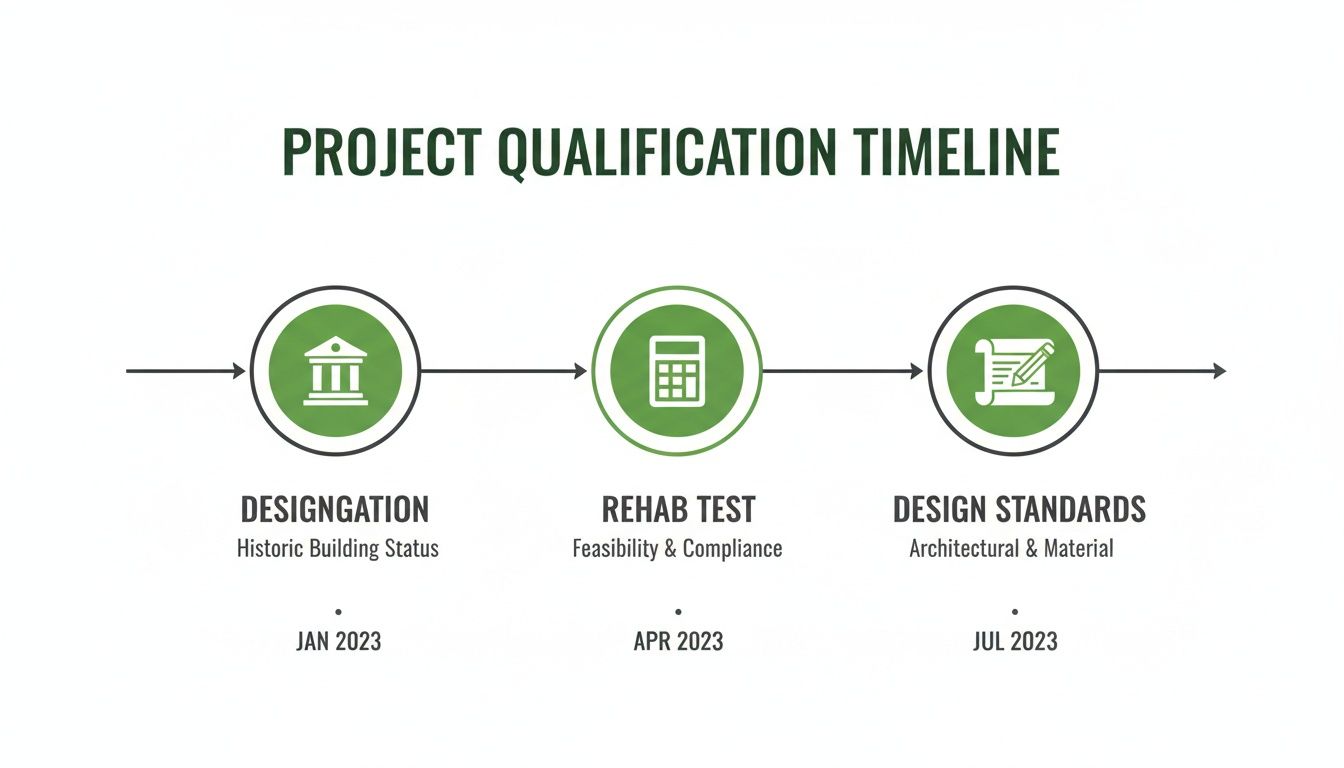
Project qualification timeline for historic buildings showing designation, rehab test, and design standards stages.

Each stage—proving the building's historic Designation, passing the Rehab Test, and following the Design Standards—is a non-negotiable step on the path to securing these credits.

Part 1: Certifying Your Building’s Historic Status

The whole process kicks off with the Historic Preservation Certification Application, Part 1—Evaluation of Significance. This is where you officially prove your building is worth preserving. Even if the property is already listed on the National Register, this step is required to get it formally recognized for your specific tax credit project.

Part 1 is all about documentation. You'll need to pull together:

  • Photographs: Clear, current photos are a must. They need to show the building's overall condition and highlight its important architectural details.
  • Historical Information: You'll write a narrative explaining the building's history and why it matters to the local historic district (if it’s in one).
  • Maps: A simple map showing exactly where the property sits within the historic district.

Your architect will take this information and weave it into a compelling story for the reviewers at the State Historic Preservation Office (SHPO) and the National Park Service (NPS). Getting Part 1 approved is the green light that confirms your building is a deserving candidate.

Part 2: Getting Your Rehabilitation Plan Approved

Once your building's historic status is locked in, you’re ready for Part 2—Description of Rehabilitation. This is the heart of the application and, frankly, the most intensive phase. Here, you submit your full architectural plans and project details for review before you start any major work.

Let me be clear: this is a forward-looking step, not a look back. You're asking for permission, not forgiveness. The goal is to get the SHPO and NPS to sign off on your proposed work, confirming it follows the Secretary of the Interior’s Standards. Nailing Part 2 prevents expensive do-overs and frustrating delays later on.

A rock-solid Part 2 submission is your best insurance policy against project headaches. When it's put together by an architect who knows preservation inside and out, it shows reviewers you have a smart, respectful plan for bringing the building into the 21st century.

Part 3: Certifying the Completed Work

The final step is Part 3—Request for Certification of Completed Work. After the last nail is hammered and the paint is dry, you submit this application to show that the finished project matches the plans approved in Part 2. This is the finish line—where your project gets its final certification and the tax credits are officially unlocked.

This last package includes "after" photos that mirror the "before" shots from Part 1, plus a formal statement confirming everything meets the program's requirements. The NPS issues the final certification, which you then file with your income tax return to claim your credits.

Getting through these three stages takes foresight, an expert understanding of preservation rules, and constant communication with state and federal agencies. It’s a process where having the right professional in your corner isn't just helpful—it’s what protects your investment and turns your vision into a financial success.

How These Credits Impact Your Bottom Line

It’s easy to talk about percentages, but to really understand the power of historic preservation tax credits, you have to see what they do to a project's budget. These aren't just a nice little bonus; they completely reshape the financial DNA of a renovation, often turning a project that’s on the bubble into a fantastic investment. By directly cutting down your tax bill, these credits free up an enormous amount of capital and can seriously boost your return.

A miniature house model on grass with a calculator, financial documents, and a pen for real estate planning.

Let’s walk through a real-world example. The numbers really tell the story of how stacking federal and state credits can be the deciding factor between a project that just breaks even and one that’s a home run.

A Practical Case Study

Let's imagine a developer who has just purchased a historic warehouse in a part of town that's seeing new life. The purchase price was $800,000. The vision is to convert it into a mixed-use commercial space, and the budget for the full rehabilitation is $1,500,000.

First, we need to figure out the Qualified Rehabilitation Expenses (QREs). Think of these as the "hard costs"—the money spent directly on the building itself. This includes things like structural work, restoring original windows, or putting in new HVAC and electrical systems. In our scenario, the entire $1,500,000 budget qualifies.

Now, let's do the math on the credits.

  • Federal Historic Tax Credit: The federal government offers a 20% credit on the QREs. For this project, that’s a $300,000 credit ($1,500,000 x 0.20).
  • South Carolina State Tax Credit: Our state program offers an even more generous 25% credit. That adds another $375,000 to the mix ($1,500,000 x 0.25).

By combining these two programs, the developer gets a staggering $675,000 in total tax credits. And remember, this isn’t a deduction that just lowers your taxable income. It's a true, dollar-for-dollar credit that erases what you owe in future taxes.

Analyzing the Financial Impact

The effect of these credits goes way beyond that initial $675,000 figure. That savings changes the entire financial picture, making the deal far more secure and appealing from every possible angle.

Right off the bat, the project's net cost plummets. That $1.5 million renovation now effectively costs the developer only $825,000 out of pocket once the credits are accounted for. This drastically reduces the capital they need to raise and lowers the overall financial risk.

A project with nearly half of its rehabilitation costs covered by tax credits is fundamentally different from one financed entirely with debt and equity. It allows for a more conservative capital stack, better loan terms, and a faster path to profitability for investors.

This stronger financial footing creates a positive ripple effect. When you walk into a bank with approved tax credits, you're essentially showing them a form of secured equity. It signals that the project is not only financially viable but also has the backing of both federal and state preservation programs. This adds a layer of credibility that lenders love, often leading to better financing terms.

In the end, these historic preservation tax credits turn abstract ideas into tangible cash. They make projects more attractive to banks and investors alike, proving that saving our architectural heritage isn't just a good cause—it's smart business.

Why Your Architect Is Your Most Valuable Partner

When you kick off a project involving historic preservation tax credits, it’s natural to see your architect primarily as the person drawing up plans. But in this very specific arena, they are so much more. Think of them as your strategic partner, the person who safeguards your investment and makes sure your vision actually pays off.

Their job goes way beyond the blueprints. They’re your guide through the red tape, your advocate with review boards, and your quality control expert, all wrapped into one.

An architect who’s been down this road before—like our team at Sherer Architects—knows the process is a delicate dance. It’s about fitting modern needs into a historic shell in a way that checks all the boxes for the tax credit programs and for you. That kind of experience is what stops expensive mistakes before they happen and keeps the whole project on track.

Masters of Meticulous Documentation

The application for historic tax credits is a mountain of paperwork. And I mean a mountain. Every single detail is scrutinized. Your architect is the one responsible for creating the exhaustive documentation that the State Historic Preservation Office (SHPO) and the National Park Service (NPS) demand.

This isn’t just a set of floor plans. It’s a deep dive into the specifics:

  • Detailed Drawings and Specifications: These aren't your average construction plans. They have to outline the exact methods and materials that will be used to repair or bring back historic features, from window glazing to masonry techniques.
  • Comprehensive Photographic Records: A thorough “before” and “after” photo survey is non-negotiable. An experienced architect knows precisely what angles and details to capture to tell a compelling story of rehabilitation for the officials reviewing your file.

Getting this documentation right from the start is your first line of defense. It shows the review boards you’re serious and professional, leaving no room for questions or doubt.

Navigating the Secretary of the Interior’s Standards

The entire historic tax credit world revolves around one thing: The Secretary of the Interior’s 10 Standards for Rehabilitation. These are the commandments of preservation. A good architect doesn't just know them; they know how to interpret them creatively to solve real-world problems.

For instance, how do you install a modern, high-efficiency HVAC system without tearing apart the historic fabric of the building? How do you upgrade the electrical wiring to meet today's code while respecting original plaster walls? This is where an expert's guidance is absolutely essential to getting your historic preservation tax credits.

An architect’s true value is in being a translator. They translate your project goals into a language the government’s preservation requirements can understand, ensuring your design gets approved without killing your vision or your ROI.

This proactive approach to design saves you from soul-crushing (and budget-busting) revisions later.

Finally, your architect acts as your professional go-between. They handle all the communication with the SHPO and NPS, speaking their language and building the kind of rapport that makes the review process go smoothly. This constant advocacy protects your timeline and your bottom line, making sure your project successfully qualifies for every last credit it deserves.

Got Questions About Historic Tax Credits? We've Got Answers.

Jumping into a historic renovation project is exciting, but the financial details—especially tax credits—can feel a little daunting. It's completely normal to have questions as you try to line up your budget and timeline. We hear them all the time from developers and property owners just like you.

Let's clear up some of the most common points of confusion. Think of this as your go-to cheat sheet for navigating the process with confidence.

What Renovation Costs Actually Qualify?

This is the big one, right? It all comes down to what the government calls Qualified Rehabilitation Expenses, or QREs. Generally, this covers the hard costs of bringing the building back to life—things that are integral to its structure and function. We're talking about work on the walls, floors, roof, windows, and major systems like plumbing and electrical.

What's not included? Costs for buying the property itself, building a brand-new addition, or doing site work like paving a parking lot or landscaping. This is where an architect who knows the ropes is invaluable; they can help you meticulously categorize every expense to make sure you're maximizing every dollar of your potential credit.

What if I’ve Already Started the Renovation? Can I Still Get Credits?

Timing is absolutely critical here. Your entire rehabilitation plan needs the green light from both the State Historic Preservation Office (SHPO) and the National Park Service (NPS) before you finish the project. If you start swinging hammers and doing major work before getting that approval, you could lose your eligibility entirely.

It's a hard and fast rule: start the application process at the very beginning of your planning. The system is designed to approve a plan before work happens. Trying to get approval after the fact is a recipe for disappointment and a very expensive mistake.

How Long Do I Have to Own the Property?

Both the federal and state programs want to see long-term investment, not just a quick flip. That's why they have a five-year recapture period. If you sell the property within five years of completing the renovation (also known as "placing it in service"), you may have to pay back some or all of the tax credits.

The good news is that the amount you'd owe is prorated. It decreases by 20% for each full year you hold onto the property. After five years, you're in the clear.

Can I Get These Credits for My Own House?

This is a really common question, and the answer depends on which credit you're talking about. The Federal 20% Historic Tax Credit is designed specifically for income-producing properties. Think office buildings, retail storefronts, or apartment rentals.

But if you live in South Carolina, you're in luck. The state offers a separate 25% state tax credit just for owner-occupied historic homes. It's a fantastic incentive that helps homeowners invest in preserving the character of their own primary residence.


Ready to see how historic tax credits could make your next project's numbers work? The team at Sherer Architects, LLC lives and breathes this stuff. We can guide you through every single step, from figuring out if your building qualifies to getting that final certification. Let's talk about your project—get in touch with us today.
Categories
Uncategorized

A Guide to Historic Building Restoration Grants

Historic building restoration grants are, quite simply, financial awards designed to help preserve, rehabilitate, or restore buildings that have a significant story to tell. These aren't loans—the money is yours to keep and does not need to be repaid. For property owners, this can make all the difference in covering the often-steep costs of a restoration project.

Why Historic Restoration Grants Are So Important

There's a certain magic in bringing a historic building back to life, but let's be honest: the financial reality can be daunting. The right materials, specialized craftspeople, and the need to follow strict preservation guidelines all add up, and the price tag can quickly become overwhelming. This is exactly where historic building restoration grants come into play.

Think of these grants as more than just a check. They represent a powerful partnership between public preservation goals and private development. By injecting critical capital into a project, programs at the federal, state, and private levels can dramatically lower the financial hurdles that stop many incredible restoration projects before they even start. They’re the key to turning an ambitious vision into a tangible, community-enhancing reality.

Fueling a Growing Preservation Movement

The interest in restoring historic properties isn't just a passing trend; it's a booming global market. In fact, the global restoration market is expected to grow from $15 billion in 2025 to a staggering $28 billion by 2033. This surge is driven by a renewed appreciation for cultural heritage and a rise in historical tourism, underscoring the economic power of preservation. You can dig deeper into these trends and market drivers with this report from Data Insights Market.

Historic building grants are the catalyst that turns a potential liability into a celebrated asset. They empower owners to tackle the high upfront costs of restoration, ensuring these meaningful buildings can continue to serve their communities for generations.

This guide is designed to help you navigate this complex but rewarding world. We'll walk through the main sources of grant funding and share the insights you need to successfully secure the money for your project. With the right support, you can transform a piece of history into a valuable modern asset.

Here’s why this kind of funding is so crucial:

  • Bridging Financial Gaps: Grants can cover very specific, often expensive, work that traditional financing might shy away from, like intricate facade repairs or restoring original windows.
  • Encouraging Best Practices: Most grant funding is tied to meeting high-quality preservation standards, which ensures the work is done right and truly honors the building's character.
  • Boosting Local Economies: Restoration projects are job creators, hiring skilled tradespeople and often sparking a wave of revitalization in the surrounding neighborhood.

Where to Find Restoration Grants: Mapping the Funding Landscape

Trying to find grants for a historic restoration project can feel like you've been sent on a treasure hunt without a map. But here's the good news: there are plenty of funding sources out there. You just need to know where to look. Understanding the different types of grants and who offers them is the first real step to getting your project off the ground.

Think of the funding world as having a few different layers. At the top, you have the big federal programs. Below that, you find state-level opportunities. And at the base, there's a huge variety of local and private sources. The most successful projects I've ever seen almost always pull from multiple layers. It's a strategy we call a funding stack—layering different grants and financial incentives to cover as much of the project cost as possible.

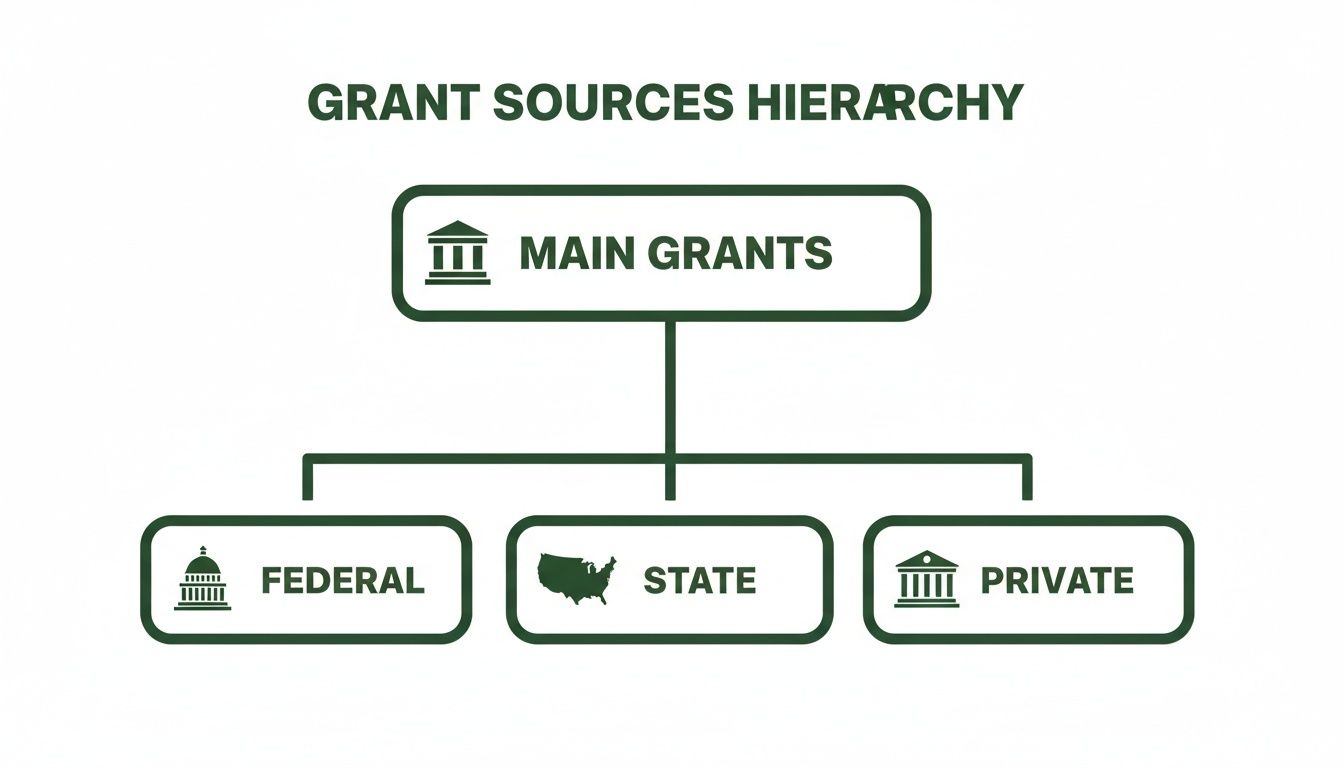
This chart gives you a quick visual breakdown of the main grant sources you'll be dealing with.

A hierarchy chart illustrating main grant sources divided into Federal, State, and Private.

As you can see, money flows from federal, state, and private entities. This gives you a few different avenues to explore as you start your search.

Federal Grant Programs

At the very top of the funding pyramid are the major federal programs. These are the ones that really set the national standard for preservation work.

The biggest player by far is the Historic Preservation Fund (HPF), which is managed by the National Park Service. Now, you don't apply to the HPF directly. Instead, the HPF gives money to each State Historic Preservation Office (SHPO), and those offices are the ones who distribute it through their own state-level grant programs.

These government-backed funds are absolute game-changers. The HPF alone has fueled over 51 standout projects in every single state and D.C., helping to kickstart revitalization in both rural towns and big cities. You can see the real-world impact of these HPF-funded projects across the nation to get a feel for what’s possible.

A few other key federal grants to know about include:

  • Save America’s Treasures: This one is for preserving nationally significant historic properties and collections—think major landmarks.
  • National Maritime Heritage Grants: As the name suggests, this fund is specifically for maritime projects, like restoring historic ships or lighthouses.

Be prepared, though. These grants are incredibly competitive and are usually reserved for projects of major historical importance. This is where having a great relationship with your SHPO becomes non-negotiable.

State and Local Funding Opportunities

One level down from federal programs, state grants are often much more accessible for a wider variety of projects. Your SHPO is, once again, your go-to resource here. They're the gatekeepers for the federal HPF money, and they also manage any grant programs funded directly by your state's legislature.

These grants can be really versatile, covering everything from the initial planning and documentation phases all the way to the actual brick-and-mortar work. Don't stop at the state level, either. Many cities and counties have their own funding pots for things like façade improvements, code compliance upgrades, or downtown revitalization efforts. These local programs are designed to directly boost neighborhood economies and can be a fantastic piece of your overall funding stack.

A successful funding strategy is rarely about finding one perfect grant. It’s about skillfully layering multiple sources—federal, state, local, and private—to build a financial foundation strong enough to support the entire restoration.

Private Foundations and Nonprofit Grants

The foundation of the funding pyramid is made up of a huge network of private foundations and nonprofit organizations that are passionate about preservation. These groups often have very specific missions. Some focus on a particular type of building, while others are dedicated to a certain region or a specific chapter of history.

For example, the National Trust for Historic Preservation offers several different funds, including its African American Cultural Heritage Action Fund, which targets a very specific need. You can also find highly specialized funding streams, like grants for church repairs, that might be a perfect fit for your project.

The key to unlocking this funding is research. You need to find the foundations whose mission aligns with your project's story. When you piece these varied sources together, what once looked like a daunting restoration project starts to look like a smart, achievable investment.

Major Grant Sources at a Glance

To help you keep these sources straight, here is a simple breakdown of the main funding players.

Funding Source Governing Body Typical Project Scope Ideal Applicant Profile
Federal National Park Service (NPS) Projects of national significance, disaster recovery, maritime heritage Nationally recognized landmarks, major non-profits, government entities
State State Historic Preservation Office (SHPO) Planning, documentation, "brick-and-mortar" restoration Non-profits, municipalities, owners of state-registered properties
Local Municipal or County Governments Façade improvements, main street revitalization, code compliance Downtown businesses, local non-profits, individual property owners
Private/Nonprofit Foundations, National Trusts Niche projects (e.g., cultural heritage sites, endangered places) Organizations with a mission that aligns with the funder's specific goals

Understanding these distinctions will help you target your efforts and focus on the grants where your project has the best chance of success.

Understanding Grant Eligibility and What It Takes

Trying to get a grant for a historic building isn't like buying a lottery ticket; it's more like meticulously assembling a complex model kit. Every single piece has to be in the right place. Granting agencies aren’t just handing out cash—they're making strategic investments in projects that meet a very strict, non-negotiable set of rules designed to protect our shared architectural history.

Before you even dream of writing a proposal, the first, most critical step is to figure out if your project is even eligible. Honestly assessing this upfront can save you a mountain of time and money. It means taking a hard look at your building's official status, your own financial situation, and whether you're truly prepared to follow some incredibly rigorous preservation standards.

The National Register: Your Golden Ticket

For most federal and state grants, one thing matters more than anything else: your property must be listed on the National Register of Historic Places. Think of this as the ultimate seal of approval. It’s the official certification that your building is significant to American history and is worth saving.

Generally, a building makes it onto the Register if it’s tied to important historical events, connected to significant people, or is a prime example of a particular architectural style. Without that listing, most of the big-money grant programs are simply off-limits. It's the first and most important hurdle you have to clear.

Getting on the National Register isn’t just some bureaucratic checkbox. It’s the formal acknowledgment that your building has a story worth telling. To funders, it’s a clear signal that your project is a serious contender aligned with national preservation goals.

The Reality of "Matching Funds"

Here’s a crucial piece of financial reality: very few grants will ever cover 100% of your project's costs. The vast majority work on a cost-sharing model, often called "matching funds." You have to understand this from day one, because it directly affects whether you can actually afford to see your project through.

A match requirement means you, the grant recipient, have to put up a certain amount of the project's total cost. For example, a common 1:1 match on a $100,000 grant means you have to bring another $100,000 to the table, making the total project budget $200,000. This money doesn't have to be sitting in a single bank account; it can come from a few places:

  • Your Own Capital: Cash on hand from your business or personal funds.
  • Bank Loans: Standard financing you’ve secured for the project.
  • Other Grants: Sometimes, you can use funds from a different (non-federal) grant.
  • In-Kind Donations: Properly documented donations of professional services or materials can count, too.

Grant agencies aren't just being difficult. They see matching funds as proof of your commitment. It shows you have real "skin in the game" and are a dedicated partner, not just someone with their hand out. Always, always check the specific match rules, as they change from one program to another.

Playing by the Rules: The Secretary of the Interior’s Standards

At the very core of every federally funded restoration project, you'll find The Secretary of the Interior’s Standards for the Treatment of Historic Properties. These aren't gentle suggestions. They are the official rulebook for ensuring a building’s historical integrity isn't compromised during renovation. If you fail to follow them, you could be forced to pay the grant money back.

The Standards lay out four different ways to approach a historic property. Your project has to fit neatly into one of these.

  1. Preservation: This is all about maintenance and careful repair of what’s already there. It’s the most conservative route, focused on keeping the building in its current state as it has evolved over the years.
  2. Rehabilitation: This is the go-to for most projects, especially those involving "adaptive reuse" (like turning an old factory into apartments). It allows for alterations and additions to meet modern needs, but only if the key historic and architectural features are protected and maintained.
  3. Restoration: This approach is more like a time machine. It aims to make a property look exactly as it did during one specific, significant period in its history. This often means removing additions or changes made in other eras to get back to that "pure" state, like taking a Victorian home back to its 1880s glory.
  4. Reconstruction: This is the most dramatic and rarely used option. It involves re-creating a building that no longer exists, using all-new construction. It's only considered when the original building is absolutely vital for understanding history and there's enough documentation (photos, blueprints) to do it accurately.

Choosing the right approach is foundational; it will guide every decision you make, from the architectural plans and material choices to the actual construction techniques. For almost any commercial project looking for historic building restoration grants, Rehabilitation is the name of the game, as it strikes that perfect balance between preserving history and creating a functional, modern space.

How to Craft a Winning Grant Application

Securing a grant for your historic building isn't about luck—it's about strategy. Think of your application as the ultimate sales pitch. You have to convince a review committee that your project is more than just a worthy cause; it's a smart, responsible investment in your community’s heritage. It's where you build a powerful business case for preservation.

A winning application is a story, meticulously told. It needs to clearly articulate your vision, prove the project is feasible, and demonstrate the positive ripple effect it will have. This takes a special blend of reverence for the past and sharp, modern-day business sense. Funders need to see both the cultural heart and the economic value of what you’re proposing.

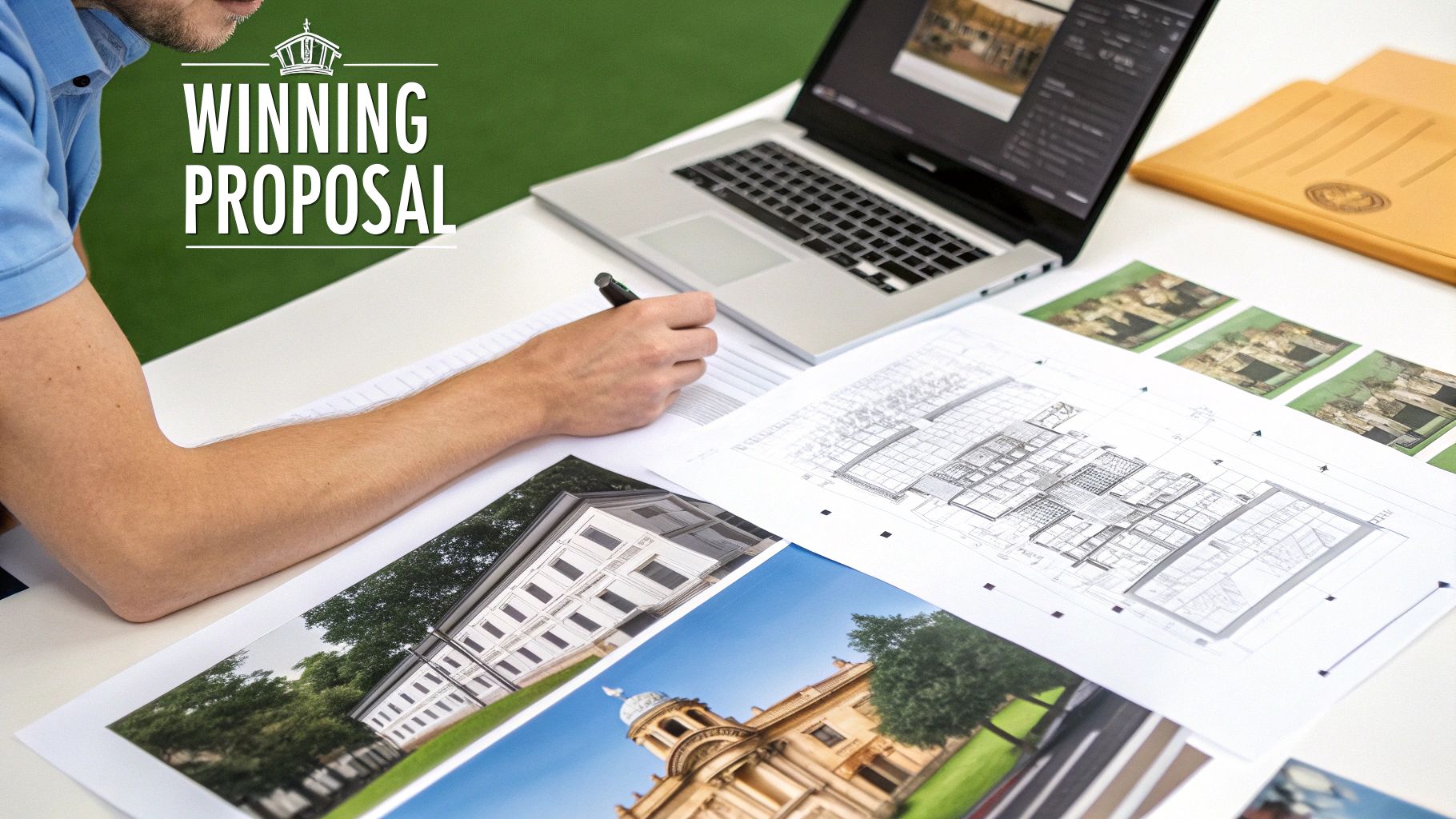
A person works on a winning architectural proposal, surrounded by blueprints, building photos, and a laptop.

This is more important than ever. With government policies and major incentives fueling heritage conservation, the restoration sector is booming. Projections show it growing from $5.79 billion in 2025 to $9.78 billion by 2034. A standout proposal is your ticket to accessing a piece of that growing pie. You can learn more about the growth of the historic building restoration market on Proficient Market Insights.

Assemble Your Core Application Components

While every grant has its own specific requirements, most applications are built from the same set of core documents. Nailing these from the get-go makes the whole process run a lot smoother.

Here's what you'll almost always need:

  • A Compelling Project Narrative: This is your story. You need to explain the building's history, its current problems, and your vision for bringing it back to life.
  • Detailed Architectural Plans: Professional drawings and specs are non-negotiable. They must clearly show how the work will follow The Secretary of the Interior’s Standards.
  • A Meticulous Project Budget: Itemize everything. From materials and labor to consultant fees, a detailed budget shows you've done your homework and are financially responsible.
  • Documentation of Historical Significance: Pull together National Register forms, old photos, and anything else that proves the building’s importance. This is your evidence.

The Power of Meticulous Research

A strong application is built on a foundation of deep, thorough research. This is about so much more than just stating the building’s age. You have to dig into its past to make a compelling case for its future.

For example, digging up historic photographs can give you the proof you need to restore lost features, like an original storefront or a specific window design. A materials analysis helps you specify the correct, historically accurate materials for repairs—a make-or-break detail for many grant programs. This level of detail screams competence and commitment to the review committee.

A grant proposal without deep historical research is like an architectural plan without measurements. It might look good on the surface, but it lacks the substance and credibility needed to build something real and lasting.

Start Early and Build Relationships

Grant cycles are long. I mean, really long. It can easily take a year or more from the day you submit to the day you see any funding. Procrastination is the single biggest enemy of a successful grant application. Always start the process well before you hope to break ground.

Starting early also buys you something incredibly valuable: time to build relationships. One of the smartest things you can do is get in touch with your State Historic Preservation Office (SHPO) right away. They're not gatekeepers; they're your partners. Their guidance can be invaluable in strengthening your proposal.

Finally, don't underestimate the power of local buy-in. Compelling letters of support from city officials, neighborhood groups, and future tenants can completely change the game. They turn your application from a simple funding request into a community-backed vision for the future.

Real-World Examples of Grant-Funded Success

Knowing the theory behind historic preservation grants is one thing. Seeing what they actually accomplish is another. These aren't just abstract financial programs; they're the fuel that turns decaying buildings back into beloved community landmarks. These success stories show how a smart "funding stack" can transform an overwhelming project into a sustainable, often profitable, reality.

So, let's look at how this works on the ground. These examples show how developers, nonprofits, and property owners have successfully navigated the grant process to save buildings that were once on the brink.

From a Vacant School to a Cultural Hub

Imagine a beautiful old public school, empty for decades and slated for demolition. The building’s bones were good, but it was suffering from a leaky roof, shattered windows, and ancient mechanical systems. Everyone knew it was historically important, but the cost to fix it was way too high for a private developer using only traditional loans.

A local nonprofit, however, saw its potential as a much-needed cultural center and museum. Their first big step was getting the building on the National Register of Historic Places. That single action unlocked a whole new world of funding possibilities.

Their funding stack was a strategic blend:

  • A state historic preservation grant from their SHPO paid for a new, historically accurate slate roof.
  • A Save America's Treasures grant was secured to restore the building’s magnificent but crumbling exterior stonework.
  • Local municipal funds set aside for community revitalization covered critical accessibility upgrades like ramps and elevators.

The project pulled together over $2.5 million in grant money, which was combined with private donations. Today, that old school is a vibrant cultural institution, proving how historic building restoration grants can save a landmark while serving the public.

Adaptive Reuse: The Mill District Transformation

In another town, a developer took on a massive, abandoned textile mill complex—a perfect candidate for adaptive reuse. The vision was huge: convert the sprawling industrial buildings into a mixed-use village with apartments, shops, and artist studios. But the scale of the project, not to mention the environmental cleanup needed, was daunting.

The most successful restoration projects view grants not as a simple handout, but as a strategic partnership. Funders invest in projects that promise a clear return—whether that's economic revitalization, community engagement, or the preservation of a shared story.

Working closely with us at Sherer Architects, the developer created a phased plan that followed The Secretary of the Interior’s Standards for Rehabilitation to the letter. This careful, compliant planning was the secret to unlocking a sophisticated mix of financial incentives. The funding stack was a masterclass in financial creativity, layering federal historic tax credits with several grant sources.

One of the key pieces was a grant from the Environmental Protection Agency's Brownfields Program, which helped pay for cleaning up old industrial contaminants on the site. They layered that with a state-level grant designed to spur development in former industrial areas. The result? A breathtaking transformation that kept the mill’s historic industrial vibe while creating over 150 apartments and dozens of new businesses, turning a derelict property into the heart of a new neighborhood.

Finding an Architectural Partner for Your Project

Trying to navigate the maze of historic building restoration grants can feel overwhelming. It’s not just about filling out paperwork; it’s about mastering a complex world of historical standards, building codes, and the unique priorities of each funding organization. This is precisely where bringing in an experienced architectural partner becomes your greatest advantage.

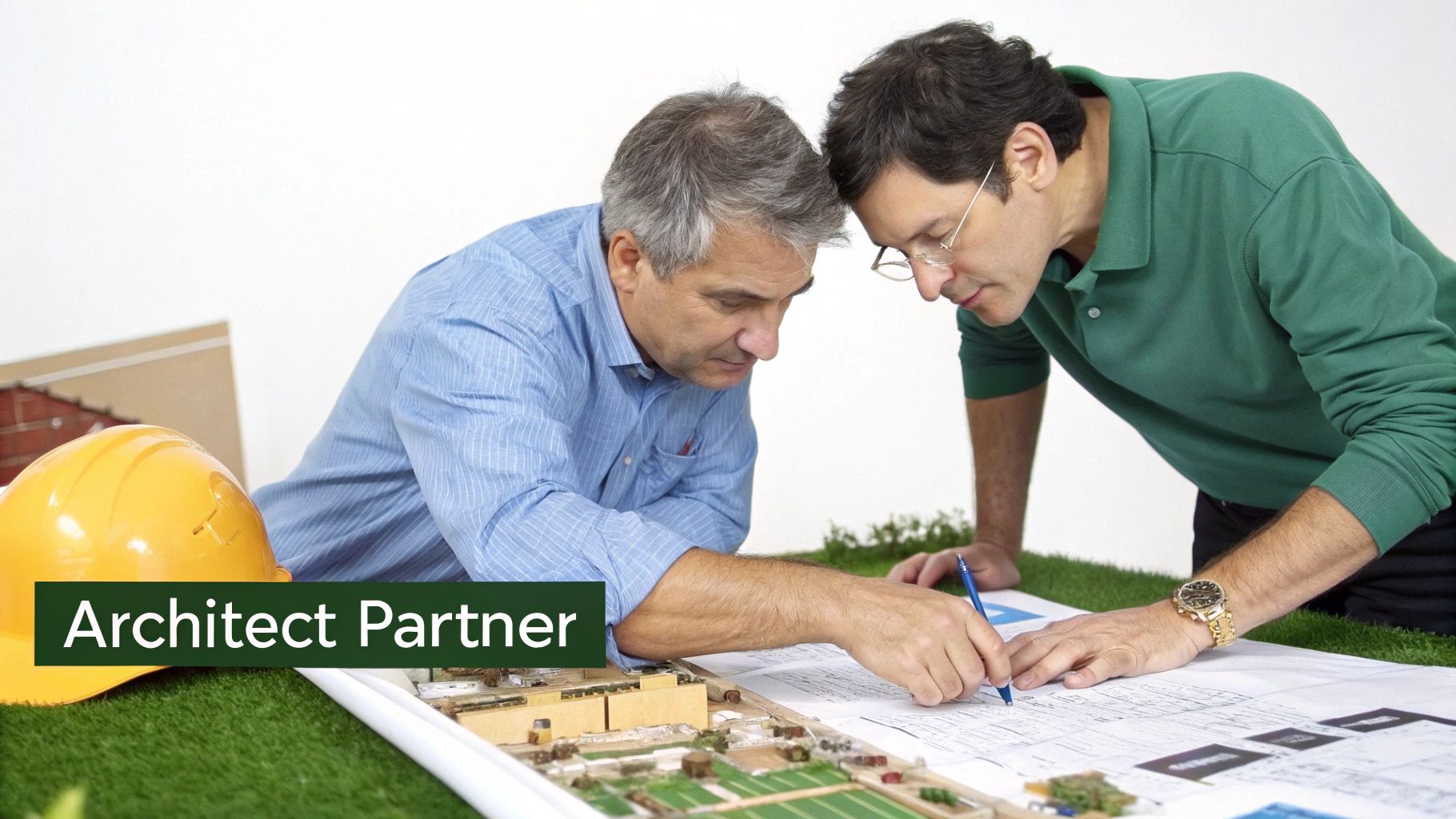
Two architects collaborate on blueprints and a building model, with a yellow hard hat nearby.

Think of your architect as part creative visionary, part strategic guide. A firm that lives and breathes historic preservation doesn’t just design buildings—they map out a realistic path to getting your project funded. They know the landscape and can pinpoint the best grant opportunities, from major federal programs down to obscure local funds that are a perfect fit for your building.

Getting them involved from the very beginning is absolutely key. The right partner will ensure your plans are built from the ground up to meet The Secretary of the Interior’s Standards. For most grant funders, this is non-negotiable.

More Than Just Blueprints

The architect's job goes well beyond the drawing board. They become the central hub for the entire complex approvals process, serving as your expert liaison in discussions with State Historic Preservation Offices (SHPOs) and local review boards. This role is often the difference between a successful application and a rejected one.

An experienced firm will handle the heavy lifting:

  • Prepare all the required documentation, from detailed condition assessments and historical research to the compliant architectural drawings that grant committees demand.
  • Weave a compelling story that clearly shows your building’s historical importance and its future value to the community.
  • Build a detailed and justifiable budget that accounts for every dollar, proving to funders that your project is not just a dream but a viable plan.
  • Oversee compliance during construction, making sure the work on-site strictly follows the grant requirements and protecting you from the nightmare of having to repay funds.

Choosing an architect is like picking a co-pilot for a long flight. You need someone who doesn’t just know the destination but can read the maps, navigate the turbulence of regulatory approvals, and land you safely with your funding secured.

Maximizing Your Investment and Minimizing Risk

At the end of the day, partnering with a preservation-focused architect is a direct investment in your project's success. Their deep expertise helps you sidestep common mistakes, like submitting a flawed application or designing something that accidentally violates preservation rules. This proactive guidance saves you from costly delays and significantly boosts your odds of winning the grants you need.

By handing off the intricate details of the grant and approvals process, you're free to focus on the big picture. With a skilled architectural partner by your side, you can confidently turn a challenging historic property into a valuable, lasting, and profitable asset for both your portfolio and the community.

Answering Your Top Questions About Restoration Grants

If you're new to historic restoration, the grant process can feel like a maze of rules and paperwork. It's totally normal to have a lot of questions. Let's walk through some of the most common ones we hear from property owners and developers, clearing up the confusion along the way.

Can I Combine Historic Grants with Tax Credits?

Yes, and you absolutely should! This is one of the smartest ways to finance a historic restoration project. Think of it as “stacking” your funding—grants give you upfront cash for specific work, while tax credits slash your tax bill later on, reducing the total project cost.

This combination is a cornerstone of historic redevelopment. For instance, you might use a state grant to cover the painstaking restoration of your building's original wood windows. At the same time, the Federal Historic Tax Credit could give you a 20% credit on the entire qualified cost of the rehabilitation. An experienced architect is key here; they can help you structure the financing so you get the most out of both programs without running into compliance issues.

Why Do Grant Applications Get Rejected?

It’s a competitive world out there, and grant applications often get turned down for a handful of recurring reasons. The biggest showstopper? The building simply isn't eligible, most often because it’s not listed on the National Register of Historic Places. That’s the first gate you have to pass through, and there’s no way around it.

Beyond basic eligibility, other common mistakes trip people up:

  • A sloppy or incomplete application. If it’s missing details or doesn't tell a compelling story, it's going in the "no" pile.
  • The project doesn't match the funder's goals. Every organization has priorities, and if your project doesn't align, it won't get a second look.
  • A flimsy budget. A budget that seems poorly planned or unjustified is a major red flag for any review committee.
  • Not showing you have matching funds. Grantors want to see you have skin in the game; failing to prove you have your share of the funds secured suggests the project isn't on solid footing.

The best way to sidestep these pitfalls is to work with someone who’s been through this process countless times. They know what each grant program is looking for and can help you put together a polished, persuasive proposal.

How Long Does It Take to Get Grant Money?

This is where you need to practice your patience. The timeline for grant approval varies wildly depending on the source. For most federal and state programs that run on an annual cycle, you could be waiting anywhere from six months to over a year from the day you apply to the day the check clears.

This is exactly why you can't wait until the last minute. You need to map out your grant strategy and start the application process well before you ever plan to break ground.

Private foundations can sometimes move faster, but the core principle is the same. Planning ahead is the only way to successfully weave grant funding into your timeline without throwing your entire construction schedule into chaos.


Navigating grant compliance and crafting an application that stands out takes a specific kind of expertise. The team at Sherer Architects, LLC has spent decades helping clients secure the funding they need to bring historic properties back to life. Contact us to discuss your project today and let’s get started.

Categories
Uncategorized

A Developer’s Guide to Warehouse Theater Greenville Projects

Turning an old Greenville warehouse into a living, breathing theater isn't just a construction project—it's an act of urban alchemy. This is how you transform a relic of our industrial past into a vibrant cultural hub, revitalizing a neighborhood and creating a landmark that pays dividends for the community and your bottom line.

From Industrial Grit to Theatrical Grandeur in Greenville

Greenville is hungry for unique cultural experiences, and the idea of a warehouse theater taps right into that demand. It’s about more than just a renovation; it's about crafting a destination. Those old industrial bones—the high ceilings, the sprawling open floors, the raw brick and steel—they aren't limitations. They're the perfect blank canvas for creating the kind of immersive performance space that modern audiences flock to.

This guide is your practical roadmap. We're going to skip the fluff and get straight to the real-world, actionable steps you need to take. This is about turning a raw, cavernous building into a profitable and culturally essential venue. Adaptive reuse isn't just a buzzword for preservation; it's a smart, sustainable strategy that extends a building's life and often proves more cost-effective than building from the ground up.

The Value Proposition of Adaptive Reuse

So, why a warehouse? The advantages are huge, touching everything from your budget to the fabric of the community itself.

  • Inherent Character: You can't fake the authentic industrial vibe of a historic warehouse. Integrating that character into your design creates a memorable atmosphere that a new build could never replicate.
  • Economic Catalyst: A new theater doesn't exist in a vacuum. It becomes an anchor, pulling in crowds that spill over into local restaurants, bars, and shops, creating a ripple effect that lifts the entire area.
  • Smart Money: Many of Greenville's older warehouses are prime candidates for historic preservation tax credits. Tapping into these federal and state programs can dramatically reduce your rehabilitation costs.

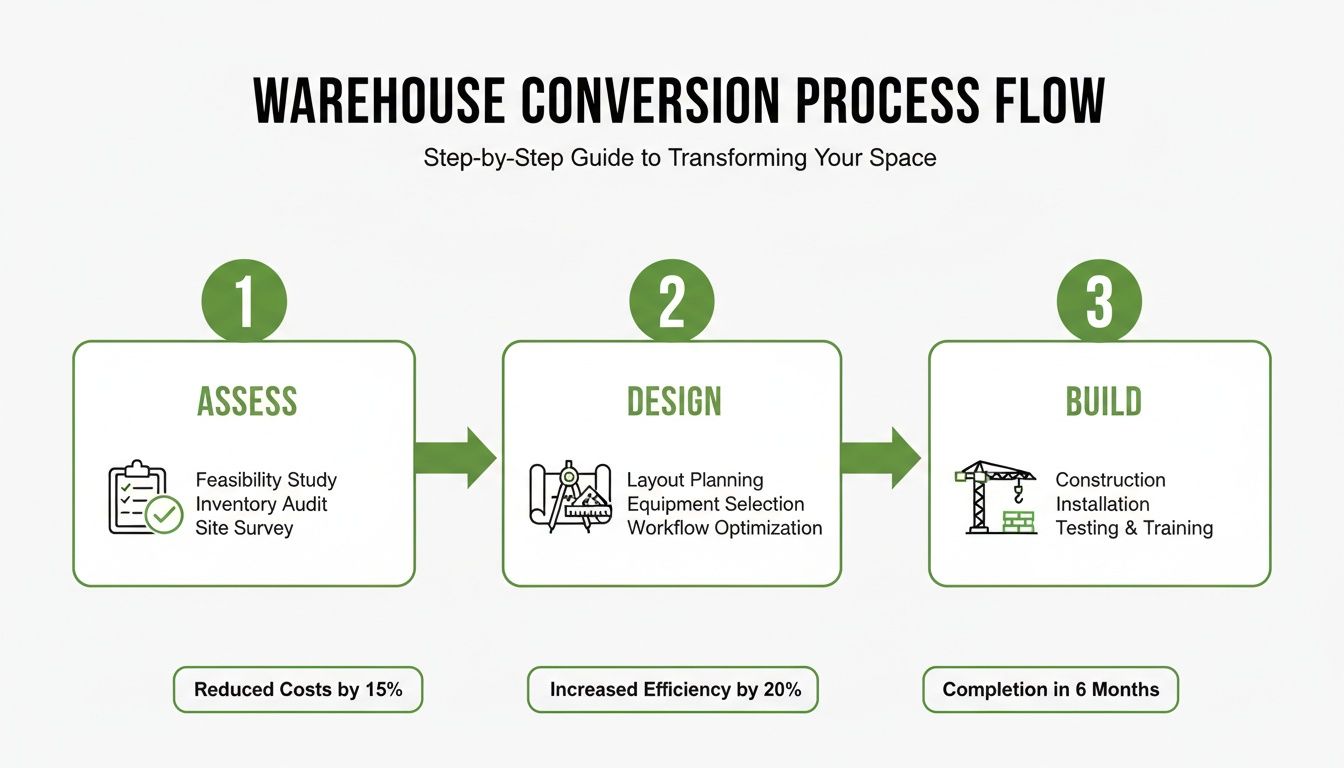
The process might seem complex, but it follows a logical path: you assess the potential, design with purpose, and then build with precision.

Warehouse conversion process flow diagram showing three steps: Assess, Design, and Build, with associated benefits.

This journey from a forgotten industrial space to a celebrated cultural landmark is built on a foundation of careful assessment, thoughtful design, and precise execution. Each stage sets up the next, ensuring the final venue is not only a creative success but also a sound, viable business.

By embracing adaptive reuse, you're building more than just a theater; you're building a community asset. It becomes a landmark, a gathering place, and a testament to Greenville's creative spirit—driving both cultural and economic growth for years to come.

Getting Through Greenville's Zoning and Regulatory Maze

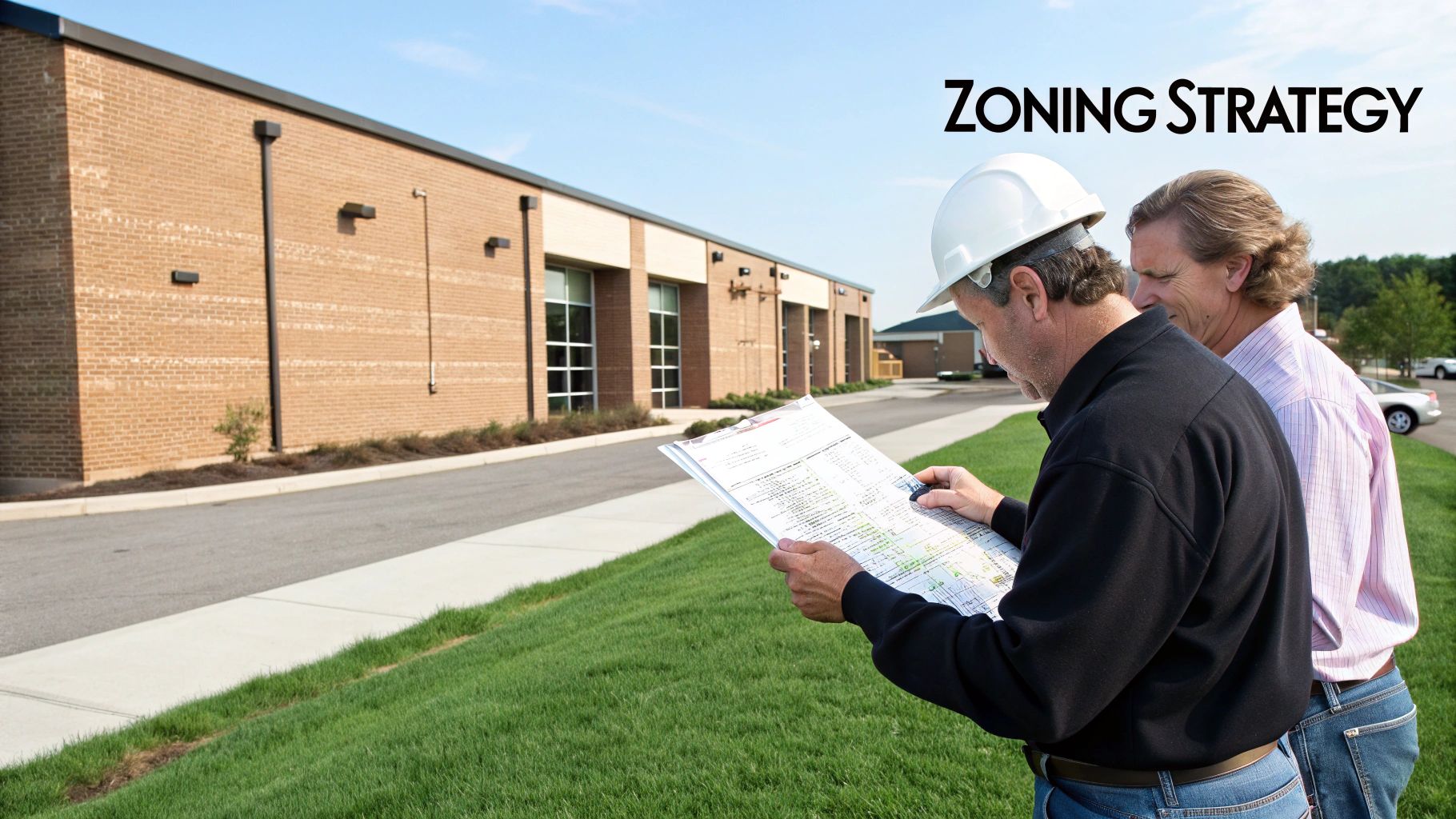
Two men, one in a hard hat, review zoning plans and blueprints for a commercial building project.

Let’s be honest: the biggest thing standing between your vision and opening night isn't finding the perfect old warehouse. It’s the bureaucracy. Before you can even think about hanging lights or building a stage, you have to navigate Greenville's complex web of zoning ordinances, land use rules, and building codes. This is where dreams get a solid legal foundation—or get stopped in their tracks.

Many of the best warehouses for this kind of project are in areas zoned for industrial use, usually I-1 (Industrial, Light) or maybe S-1 (Service District). Your first big mission is to change that designation to one that allows a "place of public assembly." This is a major change of use, and it opens up a whole new level of much stricter requirements.

This isn't just about filling out a form. It's a strategic process that demands clear communication with city officials and a solid understanding of what they need to see to give you the green light.

Land Use, Rezoning, and Making Your Case

The journey starts with a deep dive into the property's zoning. You need to figure out if you're looking at a full rezoning, a special exception, or a variance. In Greenville, that often means pleading your case before the Planning Commission and, eventually, City Council.

Let's walk through a real-world scenario. Say you’ve found the perfect brick warehouse just outside the Village of West Greenville. It’s zoned I-1, which was great for its old life as a textile distribution hub but is a non-starter for a theater.

Your architect's first job is to put together a comprehensive application. Think of this less as a request and more as a compelling argument for why your warehouse theater in Greenville is a win for the community. It should include:

  • A Detailed Site Plan: Show them everything—parking, landscaping, how the building fits in with its neighbors.
  • A Traffic Impact Study: Get ahead of the inevitable questions about increased traffic and show you have a plan.
  • A Statement of Intent: Clearly explain the cultural and economic value the theater will bring to the neighborhood.

By doing this work upfront, you show city planners you’ve thought through the impacts and have credible solutions. That alone can make the approval process go a lot smoother.

The Design Review Board and Historic Districts

If your dream warehouse happens to be in one of Greenville’s historic districts, like the iconic West End, you've got another layer of oversight to deal with: the Design Review Board (DRB). The DRB’s entire job is to protect the area's architectural character. Any changes you want to make to the outside—from new signs to different windows—will be looked at with a magnifying glass.

Your presentation to the DRB has to strike a delicate balance. You need to respect the building’s history while making a strong case for the changes needed to turn it into a working theater. This means proposing modifications that feel compatible with the original materials and design.

The secret to a successful DRB review is to show how your project enhances the historic fabric of the neighborhood, rather than detracting from it. Frame your plans as giving a historic building a vibrant, sustainable new life.

This is a conversation, not a fight. Bringing on an architect who has experience presenting to the Greenville DRB is invaluable here. They know how to turn a potential roadblock into a productive dialogue.

Meeting South Carolina's Tough Building Codes

Once you clear the zoning and design hurdles, the focus shifts to the South Carolina Building Codes, which are based on the International Building Code (IBC). The rules for a public assembly space are worlds away from what's required for a simple warehouse.

The code governs everything, from the number and width of your emergency exits to the fire-resistance rating of the walls. Your maximum seating capacity will be determined by occupancy load calculations, which in turn drives dozens of other design choices. And when it comes to the complex stage lighting and sound systems you'll need, it's critical to build a control panel to UL standards to ensure you meet all safety and regulatory codes.

Here are the big-ticket items you absolutely have to nail:

  • Egress: You must have clear, unimpeded exit paths from every single seat. This often means cutting new doors and building dedicated emergency corridors—a major structural and financial task.
  • Fire Suppression: A full sprinkler system is pretty much a given for a theater. This is a significant plumbing project that requires close coordination with the local fire marshal.
  • Accessibility (ADA): From the parking lot to the restrooms to the seating, every inch of your venue must be fully accessible. This is non-negotiable and needs to be baked into your design from day one.

Getting through this regulatory maze is all about having a methodical, expert-led plan. It’s the critical phase where a building with potential becomes a fully compliant, legally sound project, clearing the way for the real fun of design and construction to begin.

Getting to Grips with the Building's Bones: Structural and MEP Systems

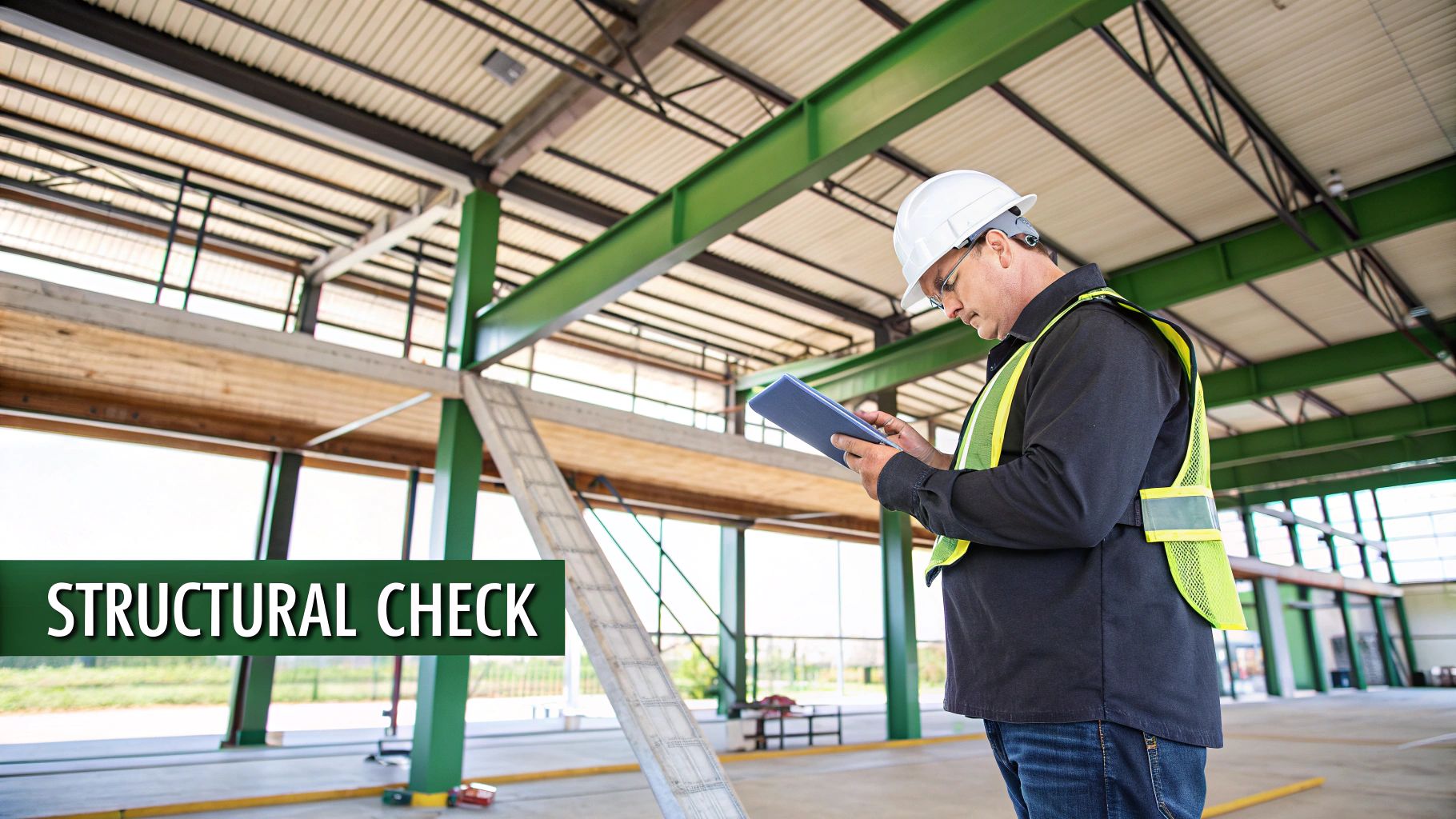
A construction worker in a hard hat and safety vest performs a structural check with a tablet inside a building.

Alright, you've got the city's blessing. Now, the real work begins. This is the point where theoretical plans collide with the raw, physical reality of your building—its steel skeleton, concrete floors, and ancient utility lines. A warehouse isn't a theater in disguise; turning it into one demands a deep, often complex overhaul of its core systems.

Your first order of business is getting a structural engineer to give the place a thorough shakedown. Warehouses are designed for static, evenly spread loads, like stacks of pallets. A theater, on the other hand, concentrates immense, dynamic loads in spots the original builders never dreamed of.

This isn't just a quick look-see. It's a forensic investigation. The engineer will scrutinize every column, beam, and roof truss to figure out exactly what it can handle. They're trying to answer one critical question: can this frame safely hold up everything a modern performance venue needs?

Can the Skeleton Handle the Show?

The new weight you're adding is no joke. We're talking about a theatrical rigging grid hanging from the roof, heavy lighting bars, massive speaker arrays, and potentially one or more catwalks for your crew. Each one of these elements puts a tremendous amount of stress on very specific points in the structure.

Your engineer will be running a lot of calculations and might even need to do some on-site stress tests to be sure. Based on what they find, you should be prepared for some significant structural upgrades.

  • Beefing Up Roof Trusses: This could mean welding extra steel plates or angles onto the existing trusses to boost their strength.
  • Adding New Support Columns: Sometimes, the only way to handle the load from the rigging grid is to add new columns that transfer that weight straight down to the foundation.
  • Strengthening the Foundation: If you're adding new columns, you'll almost certainly need to pour new concrete footings underneath them.

There's no cutting corners here. A structural failure isn't just a catastrophic safety risk; it's a project-ending, bank-breaking disaster. Get this part right from the absolute start.

Think of the structural upgrades as the unseen star of your production. The audience will never notice the reinforced steel beams, but they are what makes the entire theatrical experience—from the lighting to the sound—possible and, most importantly, safe.

Powering the Performance: MEP Systems

Once you're confident the building won't fall down, the focus shifts to its lifeblood: the mechanical, electrical, and plumbing (MEP) systems. Frankly, a warehouse's MEP setup is a joke compared to what a theater needs. This part of the project is almost always a complete gut-and-replace job.

The electrical system is probably the biggest leap. A standard warehouse has basic lighting and a few outlets. A warehouse theater in Greenville needs a massive power upgrade to handle the incredible draw from stage lighting, professional audio equipment, and digital projectors. More often than not, this means getting a brand-new, higher-capacity electrical service hooked up by the utility provider.

Following strict electrical wiring standards is non-negotiable for safety and reliability. You’ll also need to plan for separate, isolated circuits for your sound and lighting gear. It’s a classic rookie mistake not to, and the resulting electrical hum and buzz can completely ruin a performance.

Climate Control and Crowd Comfort

Next up is HVAC. Warehouse heating and cooling systems are built for big, empty spaces with a few workers. They are loud, clunky, and utterly unsuitable for a theater, where a silent background is essential.

You'll need a new system engineered for a packed house that is also whisper-quiet. This means sourcing HVAC units with very low decibel ratings and tucking them away from the performance space, usually on the roof or in a dedicated mechanical room. The ductwork itself needs to be oversized and lined with acoustic insulation to kill any noise from the airflow.

Finally, let's talk plumbing. Your warehouse might have a couple of basic toilets in a back corner. A theater needs multi-stall public restrooms for men and women, plus fully accessible facilities, all designed to handle the mad rush during intermission. This means running extensive new plumbing lines. Map all this out before you pour any new concrete for tiered seating or lobby floors. Getting that sequence wrong is a surefire way to waste a ton of time and money on rework.

Designing for the Audience: Acoustics, Sightlines, and Accessibility

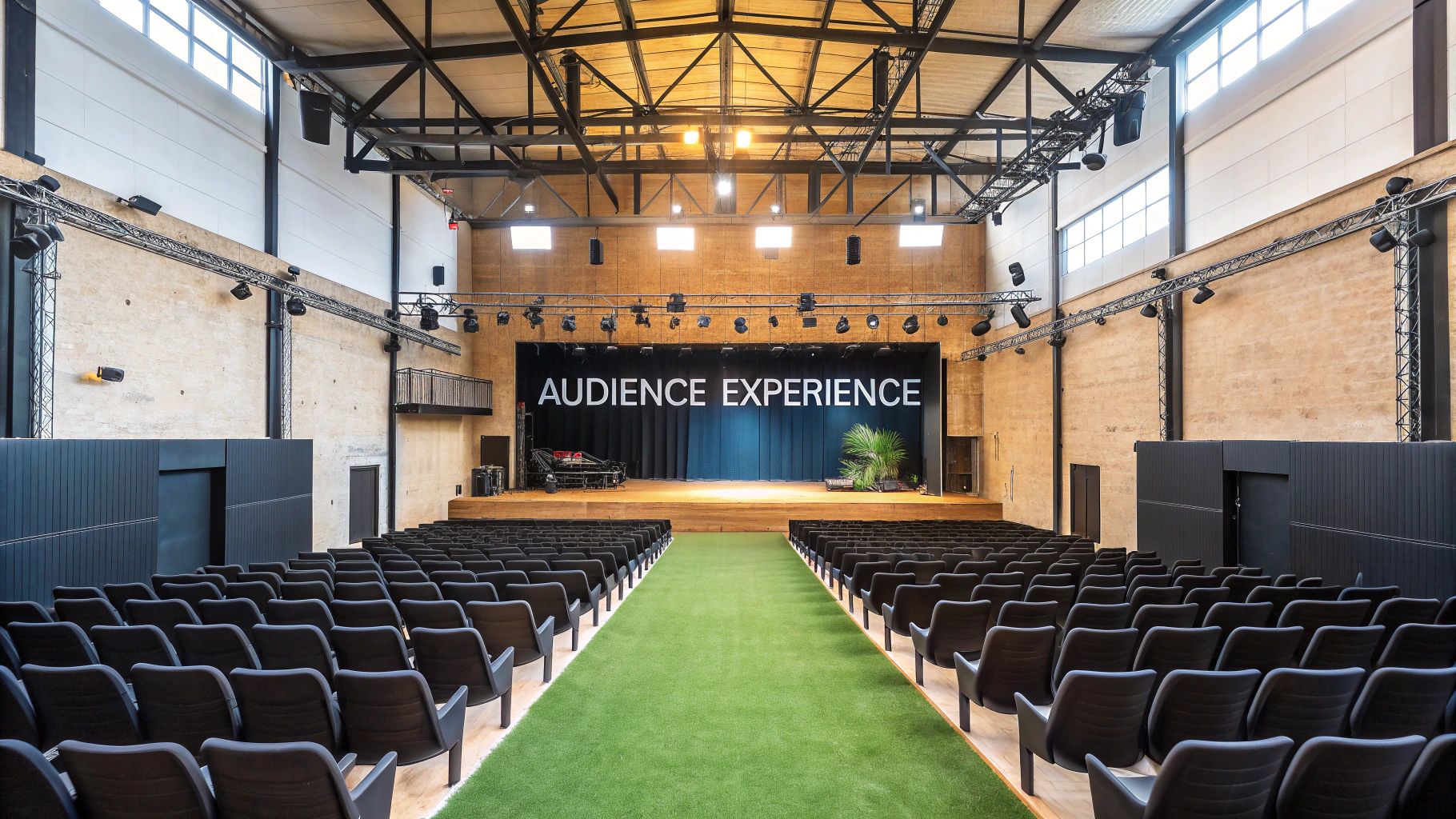
Modern empty theater with black seats, green aisle, and 'AUDIENCE EXPERIENCE' on stage.

Once the structural bones are sound and the MEP systems are mapped out, we get to the fun part—the phase where a raw building starts to breathe and feel like a real theater. This is all about shaping the audience's experience, a delicate blend of art and physics where every decision impacts what people see, hear, and feel.

Ironically, a warehouse's greatest assets—its soaring ceilings and vast open space—are also its biggest acoustic headaches. Left untreated, these spaces are echo chambers. Sound waves will ricochet off concrete floors, brick walls, and steel trusses, turning crisp dialogue into an indecipherable mess. Taming that reverberation is your first and most critical design challenge.

Taming the Echo for Pitch-Perfect Sound

You can't just hang a few curtains and call it a day. This requires a serious, strategic approach to sound absorption and diffusion. You’ll absolutely need an acoustical consultant on your team to model how sound will behave in your specific space and then prescribe the right treatments.

Your main goal is to achieve acoustic clarity. You want every word, every note, every subtle sigh from the stage to reach every single seat with pristine quality. This usually means a multi-layered strategy.

Here are some of the tools of the trade:

  • Acoustic Wall Panels: These are the workhorses. Fabric-wrapped panels filled with sound-absorbing material go on the walls to soak up all those pesky mid- and high-frequency reflections.
  • Ceiling Baffles or Clouds: You have to do something about that massive, flat ceiling. Panels suspended from above, known as baffles or clouds, are perfect for breaking up that surface and stopping sound from bouncing straight down.
  • Heavy Velour Curtains: More than just decoration, strategically placed heavy drapes can help "tune" the room's sound while adding that classic theatrical feel.
  • Sprayed Acoustic Insulation: For huge, hard-to-reach surfaces like the underside of a metal roof deck, a sprayed-on cellulose insulation can work wonders for sound dampening.

Remember, the aim isn't to create a dead, anechoic chamber. A little natural life in the room feels good. The key is to control it precisely so the focus always remains on the performance.

Every Seat, a Great Seat

After you’ve solved for sound, you have to tackle sight. Nothing ruins a show faster than a bad view. That big, flat warehouse floor is your enemy here—anyone sitting more than a few rows back will spend the night staring at the back of someone's head.

You have two main ways to fix this and create great sightlines for everyone.

  1. Tiered Seating: This is the most common solution. You build a permanent, multi-level structure (called a riser) where each row of seats is elevated higher than the one in front of it. It’s a significant construction job that needs careful engineering, but it guarantees a clear view.
  2. A Raked Stage: The other option is to leave the audience floor flat and build the stage on an incline, sloping it up toward the back. While less common today, a raked stage can be a smart, flexible solution, especially for smaller or more experimental venues.

Your architect will run a detailed sightline study, using 3D models to simulate the view from every single seat. This is non-negotiable. It lets you tweak riser heights and stage angles with incredible precision, catching any potential blind spots long before a single 2×4 is cut.

"A truly great theater is democratic—it offers a compelling experience from every seat, not just the expensive ones. Investing in proper sightline design is a direct investment in your audience's long-term loyalty and satisfaction."

Designing for Everyone

A modern warehouse theater in Greenville must be a welcoming place for every single person in the community. This means going far beyond the minimum ADA requirements and embracing the principles of universal design. The goal is an environment that’s intuitive and easy for everyone to use, no matter their age or ability.

This philosophy should touch every part of your design.

Accessibility Feature Design Consideration Why It Matters
Wheelchair Seating Integrate wheelchair-accessible spaces throughout the seating banks, not just shoved in the back. This provides choice and a far better, more inclusive experience for patrons.
Assistive Listening Install a modern assistive listening system (like an induction loop or RF system). It ensures patrons with hearing impairments can fully enjoy every moment.
Accessible Routes Make sure the path from the parking lot to the seats, restrooms, and bar is clear and obstruction-free. This creates a seamless, stress-free visit for everyone from the moment they arrive.
Low-Profile Counters Design the box office and concession counters with lower sections for wheelchair users. It’s a simple touch that promotes independence and dignity for all your patrons.

This commitment to inclusive design is what separates a good venue from a great one. A fantastic local example is The Warehouse Theatre. Its evolution from a cramped storage annex into a professional 150-seat venue is a masterclass in adaptive reuse. The project not only transformed the theater's footprint—earning it an AIA Greenville Merit Award—but also helped anchor the West End's revitalization as a true arts district.

By carefully weaving together acoustics, sightlines, and accessibility, you do more than just renovate a building. You transform an industrial shell into an intimate, professional, and genuinely welcoming home for the arts.

Breathing New Life into Old Walls: Historic Preservation and Financial Incentives

When you're looking at an old warehouse, the exposed brick and aged timber are what catch your eye. But for a savvy developer in Greenville, the real magic—and the real money—is in the building's history. Choosing a historically significant warehouse for your theater project isn't just about aesthetics; it's a strategic financial move that can completely change your project's economics.

These aren't just small grants we're talking about. These are powerful programs designed to reward the reuse of historic buildings. They can slash a massive chunk off your total rehab costs, often making a project that seemed out of reach suddenly very possible. The trick is knowing how to play the game from the very beginning.

This means you can't just slap a design together and apply for funds later. It's a process. You have to weave historic preservation principles into your plans from day one, making sure every decision you make aligns with what the state and federal gatekeepers are looking for.

The Power Couple: Federal and State Historic Tax Credits

The biggest financial levers you can pull are the Federal and South Carolina Historic Preservation Tax Credits. Using them together is a game-changer for your budget. The federal program alone offers a 20% income tax credit for the certified rehab of a historic, income-producing building. Then, South Carolina jumps in with its own state credit, sweetening the pot even more.

Of course, not every old building qualifies. Your warehouse has to be a "certified historic structure." That means it's either already on the National Register of Historic Places or it sits within a registered historic district and is considered a "contributing" building to that district's character.

The renovation work itself also has to get the stamp of approval from the National Park Service, which works closely with the South Carolina State Historic Preservation Office (SHPO). This means your entire project must follow the Secretary of the Interior's Standards for Rehabilitation—a set of ten principles that are all about respecting the building's original character while adapting it for modern use.

A word of advice from the trenches: Think of the SHPO as your partner, not your adversary. The single best thing you can do is bring them into the conversation early in the design phase. A collaborative, open approach will save you from expensive redesigns and agonizing approval delays down the line.

They'll help you figure out how to preserve what makes the building special while still creating a modern, functional theater.

More Than Just Tax Credits: Finding Grants and Rallying the Community

While tax credits are the heavy hitters, don't stop there. A well-planned warehouse theater Greenville project has the potential to pull funding from several other places, creating a much more resilient financial foundation.

  • Local Arts Grants: Don't overlook organizations like Greenville's Metropolitan Arts Council (MAC). They often have project grants that can help you pay for specific things, like a new lighting grid or a public art piece for your lobby.
  • Public-Private Partnerships: If your theater is poised to become a major community asset, the City of Greenville might be interested in a partnership. This could look like help with infrastructure, parking, or other forms of public investment.
  • Community Fundraising: A theater is something people get excited about. It's a natural rallying point for local pride. Launching a capital campaign can bring in a surprising amount of money from local residents and businesses who want to be part of creating a new cultural landmark.

This last point is especially true in Greenville, where the arts scene is incredibly vibrant and well-supported. We’ve seen local arts groups achieve stunning results here, with individual giving jumping by as much as 109 percent in a single year. A new theater with a budget pushing a million dollars, employing hundreds of local artists each season, becomes an economic engine people are eager to get behind. You can see just how dynamic the scene is in this report on Greenville's arts and culture milestones.

By stacking federal and state tax credits with local grants and genuine community buy-in, you build a financial plan as solid as the old-growth timber beams above your head. This isn't just about saving a building; it's a smart investment strategy that delivers a great ROI while giving Greenville a cultural gift that will last for generations.

Your Next Act: Partnering for a Successful Conversion

Bringing a Greenville warehouse from a raw, industrial space to a stage set for standing ovations is no small feat. We've walked through the whole process—from untangling local zoning laws and engineering the structure to designing incredible audience experiences and chasing down financial incentives. It's a complex performance, and every scene requires a specialist.

Navigating all of this really calls for an architectural partner who’s been there before. You need someone with deep expertise in commercial adaptive reuse, a genuine passion for historic preservation, and a practical understanding of South Carolina's specific regulatory hurdles. Our firm lives and breathes this work, ready to guide your project from the first napkin sketch all the way to opening night, making sure every detail fits your vision and your budget.

A great warehouse theater becomes more than just a venue; it’s a cultural engine for the community. Just look at how some local theaters run educational tours or produce incredible free programming like the Upstate Shakespeare Festival. They make professional art accessible to everyone and, in doing so, weave a stronger creative fabric for our entire community. You can see this kind of impact firsthand on the Warehouse Theatre's website.

Your vision for a new cultural landmark in Greenville deserves a team that understands both the art of design and the brass tacks of development. The right partnership doesn't just solve problems—it turns potential roadblocks into strategic advantages.

If you're a developer, property owner, or investor with a vision, let's talk. We invite you to connect with our team for a consultation. Let's start the conversation about making your Greenville warehouse theater a celebrated success.

Common Questions About Turning a Warehouse Into a Theater

If you're thinking about a warehouse-to-theater conversion in Greenville, you probably have a million questions running through your mind. It’s a big undertaking. Let's tackle some of the most common ones I hear from clients to give you a clearer picture of what to expect.

What's a Realistic Budget for This Kind of Project?

This is the big one, isn't it? The honest answer is: it depends entirely on the building you start with and the vision you have for the end result.

That said, a good rule of thumb for a full conversion is anywhere from $250 to over $500 per square foot. That range covers just about everything—major structural work, all-new MEP systems, the specialized theatrical gear, seating, and the final fit and finish. The only way to nail down a truly accurate number for your project is to bring in an experienced architect for an early feasibility study.

How Long Does This Process Actually Take?

Patience is key here. From the first sketch to opening night, you're realistically looking at 18 to 24 months. It's a marathon, not a sprint.

Here’s a rough breakdown of how that time gets spent:

  • Due Diligence & Early Design: 3-6 months
  • Detailed Construction Plans: 4-6 months
  • Getting City Permits: 2-3 months
  • Construction: 9-12 months

And a word of caution: if you're chasing historic tax credits or need a major rezoning, you'll need to build extra time into that schedule for navigating the required boards and agencies.

Don't mistake a simple-looking structure for a simple project. Turning an industrial space into a place for public assembly adds layers of regulatory and technical complexity. You have to plan for that and give yourself a realistic timeline.

What Kind of Warehouse Makes the Best Theater?

Not all warehouses are created equal. The best candidates for a theater conversion have a few things in common.

You'll want to look for buildings with impressive height—a clear height of 20+ feet is a fantastic starting point. A wide-open, clear-span interior with as few columns as possible is also a huge plus. Solid concrete foundations are a must.

Beyond the structure itself, think about the audience experience. Is there ample public parking nearby? Are there restaurants and other attractions to make it a destination? Finding a property in a district already zoned for commercial or mixed-use can also be a massive head start, saving you significant time and headaches with the city.


At Sherer Architects, LLC, we specialize in guiding developers through every stage of complex adaptive reuse projects, from initial feasibility to final construction. Start the conversation about your next project with us today.