Choosing the right architect for your commercial project is a critical decision. It starts with defining your project inside and out, building a targeted shortlist, digging into portfolios, and conducting sharp interviews. Ultimately, you'll compare detailed proposals to find the firm whose skills perfectly match the unique demands of your project—whether it's a new build, an adaptive reuse, or a historic preservation.
Before You Even Think About Architects, Define Your Vision
Before you start looking for an architect, you need to become the undisputed expert on your own project. This is the bedrock. It’s less about architectural drawings and more about translating your business goals into a clear, actionable roadmap.
Honestly, a well-defined project brief is the most powerful tool you have. It attracts the right talent and saves you from expensive missteps later. It acts as a filter, making sure only firms who get what you're trying to do even make it to the table.
Think of it this way: you're defining the problem. An architect's job is to solve that problem with creativity and skill. If you can't articulate the problem clearly, even the best architect in the world will be flying blind.
Getting Specific: Articulating Your Project's Core Needs
You need to move past fuzzy ideas and get down to specifics. This isn't just a wish list; it's a strategic outline of what this project must accomplish to be a success. A developer planning a new retail center has completely different priorities than an investor turning an old warehouse into loft offices.
Start by hammering out the fundamentals. I always break it down into three key areas:
- Functionality: How will people actually use this space every day? Think about workflow, how many people it needs to hold, accessibility (ADA compliance is non-negotiable), and which spaces need to be next to each other. For example, a restaurant kitchen has incredibly specific health code and equipment requirements that will dictate a huge part of the design.
- Aesthetics: What's the vibe? Are you going for a sleek, modern look for a tech company's headquarters, or a classic, warm feel for a historic hotel? Don't just pull images from a magazine; try to define the feeling you want the space to evoke for your employees, customers, or tenants.
- Long-Term Goals: Look beyond day one. What's the building's bigger purpose? Are you aiming for LEED certification to attract high-value tenants? Is the goal to create an iconic landmark, or is it purely about maximizing leasable square footage on a tight budget? These big-picture goals will drive major decisions on design, materials, and systems.
Nailing this down clarifies your project's DNA, which in turn informs everything from scope to budget.
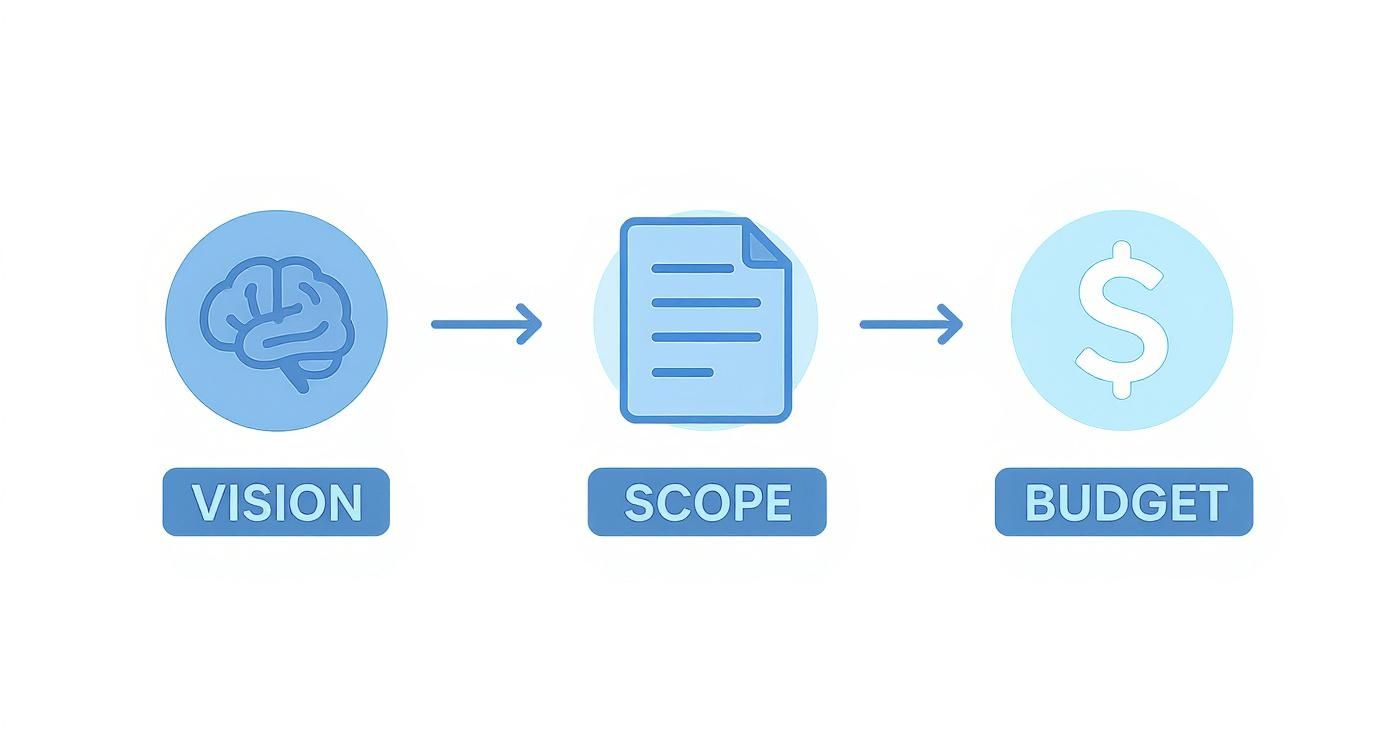
This process shows you can't just jump to the budget. A clear vision defines the scope, and only then can you build a realistic budget. Get the order wrong, and you're setting yourself up for failure.
Tailoring Your Brief for the Type of Project
A generic brief is a waste of time. It won't attract the specialized expertise you need for complex projects like adaptive reuse or historic preservation. You have to tailor your "ask" to the challenge at hand.
Here's a framework to help you think through the specific criteria for your project type before you even speak to an architect.
| Key Project Criteria to Define for Your Architect |
| :— | :— | :— | :— |
| Criteria | New Commercial Build | Adaptive Reuse | Historic Preservation |
| Primary Goal | Maximize ROI, efficiency, and brand identity on a clean slate. | Unlock hidden value in an underutilized structure; blend old with new. | Faithfully restore and protect a building's historical character. |
| Key Challenges | Site constraints, zoning hurdles, entitlement process, new utility infrastructure. | Unknown structural issues, hazardous materials, integrating modern systems. | Strict material/method requirements, navigating review boards, sourcing rare materials. |
| Architect's Role | Visionary creator, master planner, and entitlement navigator. | Creative problem-solver, building detective, and repurposing expert. | Historian, materials scientist, and skilled diplomat with preservation agencies. |
| Must-Have Info | Market analysis, pro forma, desired tenant mix, branding guidelines. | Existing building survey, structural assessment, history of the property. | Historic designation reports, list of character-defining features, SHPO guidelines. |
This table should give you a starting point. By being this specific, you're not just outlining a building; you're setting the terms for a successful partnership and finding a firm that can actually deliver what you need.
For an adaptive reuse project, your brief needs to be all about investigation. What are the structural skeletons in the closet of that old textile mill you want to convert? Is there asbestos or lead paint? The architect you need is part detective, skilled at uncovering a building's secrets and finding creative ways to turn its quirks into strengths.
A great architect for an adaptive reuse project doesn't just see the old building; they see the new building dormant within it. Their expertise lies in unlocking that potential while navigating the constraints of the existing structure.
On the other hand, a historic preservation brief is about authenticity and strict compliance. Your document has to detail the property's historical significance and pinpoint the specific elements that must be preserved. It also needs to acknowledge the governing bodies—like the State Historic Preservation Office or local landmark commissions—whose approval is everything. The right architect for this job is part historian, part diplomat, and part materials expert.
This upfront clarity is your single best asset in finding a firm that will turn your vision into a profitable, lasting reality.
Okay, you've done the foundational work—you know what you want to build, what the constraints are, and what the budget looks like. Now it’s time to find the right architect to bring that vision to life. This isn't about a quick Google search; it's about building a highly curated list of real contenders.
The goal here is to narrow the field to a solid shortlist of three to five firms. These should be architects who don't just have a great portfolio but are genuinely a good fit for your specific project's DNA.

Where to Find Qualified Architects
Finding the best talent means tapping into established professional networks. A warm referral from a trusted source is worth more than a dozen slick websites.
- Industry Peers and Referrals: This is your first stop. Talk to other commercial developers, general contractors, or property managers you respect. Who did they love working with? Who actually delivered what they promised? You want to hear about the architects who solved problems, not the ones who created them.
- Professional Organizations: The American Institute of Architects (AIA) is the industry's gold standard. Local AIA chapters are fantastic resources, often with searchable directories you can filter by specialty. Need someone with deep expertise in historic preservation? This is the place to look.
- Real Estate and Development Circles: Don't overlook the experts on the ground. Commercial real estate brokers and land-use attorneys are in the trenches every day. They have firsthand knowledge of which firms are skilled at navigating the local entitlement process and who has a reputation for being reliable.
Once you have a handful of names, the real detective work begins.
How to Critically Review a Portfolio
An architect’s portfolio is their resume, and you need to read between the lines. It's easy to be wowed by glossy photos, but your job is to look past the surface and evaluate their work through the lens of your own project.
Think relevance above all else. If you're tackling an adaptive reuse of a 1920s warehouse, a firm that only showcases new-build suburban office parks probably isn't the right partner, no matter how beautiful their work is. You're looking for demonstrated experience with projects that share your project's scale, complexity, and typology.
Don't just look at the glamour shots of the finished building. Dig into the project descriptions. Look for clues about how they handled tight budgets, navigated tough zoning challenges, or solved unique structural problems. That’s where you’ll see their real-world problem-solving skills in action.
You should also get a feel for their design philosophy. Do their projects feel thoughtful? Do they consistently prioritize things you care about, like sustainability or creating flexible commercial spaces? Their past work is the single best predictor of what they’ll do for you.
Essential Due Diligence Checklist
Before you even think about picking up the phone, a final background check is non-negotiable. This step protects you and your investment by verifying every firm's professional standing.
Make sure you confirm these details for every candidate on your long list:
- State Licensure: Is the firm and its principal architect licensed to practice in your state? This is a basic, must-have legal requirement.
- Professional Liability Insurance: Ask for their certificate of Errors and Omissions (E&O) insurance. This is critical—it protects your project from financial losses if a design mistake happens down the road.
- Disciplinary History: A quick check with your state’s architectural licensing board can reveal any public complaints, sanctions, or disciplinary actions. Better to know now.
- Geographic Reach and Capacity: Can they actually handle a project in your location? It’s an interesting time in the industry; while the total number of licensed architects in the U.S. is around 116,000, the number of reciprocal (out-of-state) licenses has soared to over 150,000. This trend means many elite firms are expanding their reach, which could be a huge plus for your project. You can dig into more of this data on the National Council of Architectural Registration Boards.
Completing this vetting process leaves you with a powerful, pre-qualified shortlist. Now you're ready for the most important part: the interviews.
How to Conduct an Insightful Architect Interview
The portfolio got them on your shortlist, but the interview is where you decide if they're the right partner to build your vision. This is your chance to get past the polished images and see the real-world chemistry, problem-solving skills, and communication style of a potential architect. Think of it less as an interrogation and more as a strategic dialogue.
A successful commercial project is a long-term relationship. You'll likely be working together for years, navigating high-stakes challenges along the way. You need to know, without a doubt, that you can collaborate effectively with this team, especially when the unexpected happens.

Go Beyond the Standard Questions
To really understand how a firm operates, you have to ask questions that reveal how they think, not just what they've done. Generic questions will only get you generic, rehearsed answers. Instead, frame your inquiries around real-world scenarios that relate directly to your project.
Let's say you're planning an adaptive reuse of a historic downtown building. Don't just ask, "Have you worked on historic projects?" That's a simple yes-or-no question.
Instead, try a more probing approach: "Our project involves converting a 1930s textile mill with known structural unknowns. Can you walk me through a similar project where you uncovered unexpected conditions, and how your team navigated the technical and budgetary fallout?" This kind of question forces them to tell a story, revealing their process, transparency, and problem-solving grit.
Structure Your Interview for Clarity
A well-structured interview ensures you cover all your bases and can compare firms apples-to-apples later. By organizing the conversation into distinct phases, you respect everyone's time and get the specific insights you need.
A smart interview flow might look something like this:
- Project Grasp: First, see if they've truly absorbed your project brief. Do they understand the core business objectives driving the architecture?
- Process and Philosophy: Next, dig into how they work. This is where you explore their design philosophy, project management style, and communication habits.
- Team Dynamics: Get a clear picture of who you'll actually be working with day-to-day. Who is the project manager? Who will be your primary point of contact?
- Real-Time Problem-Solving: Present them with a hypothetical challenge specific to your project. Their response will be incredibly telling.
This framework moves the conversation from the general to the specific, helping you build a comprehensive picture of each candidate.
The goal of the interview isn't just to validate their portfolio; it's to simulate the working relationship. You're looking for a partner who listens intently, communicates clearly, and demonstrates a genuine enthusiasm for solving your project's unique puzzles.
To help you get the most out of this critical conversation, I’ve put together a table of key questions. Think of this as a checklist to guide your interview and ensure you don’t miss anything important.
Key Interview Questions to Ask Potential Architects
A checklist of essential questions, categorized by topic, to help you conduct a comprehensive and effective evaluation.
| Category | Sample Question | What to Listen For |
|---|---|---|
| Project Understanding | Based on our brief, what do you see as the biggest challenge and the greatest opportunity for this project? | Do they grasp the core business goals? Do they offer a fresh perspective or just repeat your brief back to you? |
| Experience & Expertise | Walk me through a past project that faced significant zoning hurdles or community opposition. How did you resolve it? | Look for strategic thinking, diplomacy, and a realistic understanding of the approvals process. |
| Design & Philosophy | How do you balance your design vision with the client's budget and functional requirements? | A good partner prioritizes the client's success. Red flags are architects who seem fixated on their own "vision" at all costs. |
| Project Management | Describe your process for managing the project budget during the design phase to avoid surprises in construction. | Listen for specific methods like cost estimating at key milestones, value engineering, and transparent reporting. |
| Collaboration & Team | Who from your firm will be my primary point of contact, and who will be leading the project day-to-day? | You want to meet the people you'll actually be working with, not just the firm's principals who handle sales. |
| Technical Skills | What software and technology (e.g., BIM, project management tools) do you use to coordinate with engineers and contractors? | Look for a modern, efficient workflow. Proficiency with BIM (Building Information Modeling) is a strong plus for complex projects. |
These questions are a starting point. Tailor them to your specific needs, and don’t be afraid to ask follow-up questions to dig deeper into their answers.
Probing for Project Management and Communication Style
Beautiful design is only half the battle. A project’s success often lives or dies by meticulous project management and proactive communication. This is where many projects go off the rails, so it's critical to dig deep here.
Ask direct questions about their process:
- How do you keep clients informed of progress and potential issues?
- What is your approach to budget management and cost control?
- Can you describe how you coordinate with engineers, contractors, and other consultants?
Their answers should give you confidence that they have robust systems in place. You're listening for specifics—mentions of software, regular meeting cadences, and clear reporting structures. Vague answers about "staying in touch" are a major red flag.
For example, a great answer might be: "We hold bi-weekly owner-architect-contractor (OAC) meetings with a shared action-item log. Every Friday, you'll get a concise project update email summarizing progress, upcoming decisions, and any budget impacts. We also manage all project documents through a cloud-based portal like Procore for 24/7 access." Now that's a systematic approach that signals professionalism and reliability.
Decoding Proposals and Architect Fee Structures
Getting that first stack of proposals is a fantastic feeling. It’s the moment your project starts to feel real, and you've got qualified firms eager to help you build it. But this is where the real work begins. Comparing these documents is more art than science, and you have to look well beyond the bottom-line number.
A proposal isn't just a price tag; it's a firm's strategic plan for turning your vision into a physical asset. Your job is to decode that plan, understand the value hiding behind the cost, and make sure there are no expensive surprises down the road. If you misinterpret a fee structure or a scope of work now, you're setting yourself up for budget overruns and a lot of friction later on.
Understanding the Three Main Fee Models
Architects generally price their work in one of three ways. Each approach has its own rhythm, and the best fit really depends on how complex and predictable your project is. Getting a handle on these is the first step to making a true apples-to-apples comparison.
Here’s a quick rundown of the structures you’ll likely see:
- Percentage of Construction Cost: This is the old-school model. The architect’s fee is a set percentage—say, 8-12%—of the total construction bill. It’s simple to understand, but it can create a weird incentive. The more the project costs to build, the more they make.
- Fixed Fee (Stipulated Sum): This is exactly what it sounds like. The architect quotes one flat price for a clearly defined scope of services. Developers and investors love this because it offers budget certainty. The catch? The scope has to be crystal clear from day one, because any changes will mean extra service requests and extra costs.
- Hourly Rate (Time and Materials): Here, you pay for the actual hours the team puts in, usually with a "not-to-exceed" cap to protect you. This is perfect for the early, messy stages of a project when the scope is still squishy, like a feasibility study for an old building. It offers transparency, but it can be tough to budget for.
For instance, on a tricky adaptive reuse project with tons of unknowns, you might start with an hourly agreement for the initial discovery phase. Once the scope is locked in, you could switch to a fixed fee for the rest of the work. For a straightforward new commercial build, though, a fixed fee from the get-go makes perfect sense.
Look Beyond the Final Number
Let me be blunt: the cheapest proposal is almost never the best one. A lowball bid is a massive red flag. It could mean the firm is inexperienced, they’ve completely misunderstood the project's complexity, or they're giving you a bare-bones scope and plan to hit you with add-on fees for every little thing. A smart proposal review is about finding the best value, not the lowest cost.
So, when you get those proposals, it's time to get surgical. I recommend creating a simple spreadsheet to compare the key components of each one side-by-side.
A great proposal is a clear and comprehensive roadmap. A weak one is vague and full of holes. Pay just as much attention to what isn't said—that’s often where the real risk is hiding.
Look for a detailed breakdown of what they’ll deliver in each project phase:
- Schematic Design
- Design Development
- Construction Documents
- Bidding & Negotiation
- Construction Administration
Does one proposal include 3D renderings and early cost estimates as part of their standard service, while another lists them as an add-on? Little differences like that can add up fast and seriously affect your ability to make good decisions.
What a Comprehensive Proposal Includes
A strong proposal doesn’t leave you with a bunch of questions. It shows you that the architect was actually listening, that they get your goals, and that they’ve already put some real thought into how to get you there.
Here’s a checklist of what you should be looking for:
- A Detailed Scope of Services: It needs to clearly list every task and deliverable for each phase. Vague phrases like "general project coordination" are a warning sign.
- A Clear Fee Breakdown: The proposal must explain exactly how the fee is calculated and what the payment schedule looks like.
- The Project Team: Who are you actually going to be working with day-to-day? It should name the principal-in-charge, the project manager, and other key players.
- Proposed Timeline: You want to see a realistic schedule with major milestones. A good one will also acknowledge potential hurdles like permitting or public reviews.
- List of Consultants: The architect manages a team of engineers (structural, MEP, civil). The proposal should be explicit about whether their fees are baked into the architect's fee or are a separate cost.
- Exclusions and Additional Services: A transparent firm will tell you exactly what is not included (e.g., city permit fees, hazardous material testing) and what their rates are for any work that falls outside the base scope.
By methodically taking each proposal apart, you shift from just comparing prices to truly evaluating potential partners. This deep-dive analysis is the only way to pick a firm that not only offers a fair price but also provides the comprehensive service and straight-shooting transparency your project deserves.
Evaluating an Architect's Tech and Sustainability Skills
A beautiful design is one thing. A building that is efficient, digitally managed, and environmentally responsible is another entirely. When you’re vetting an architect, their portfolio is just the starting point. How they handle technology and sustainability tells you a lot about their firm's readiness for the future. This isn't about finding a "nice-to-have" bonus—it's a critical step to protect your investment and keep your project running smoothly from day one.
Proficiency with modern tools isn't optional anymore. The industry is deep into a digital shift, and an architect's fluency with data modeling, visualization, and collaborative software is a huge differentiator. With over 1 million patents in the global architecture industry and an annual patent growth rate of 5.11%, innovation is moving fast. Tech competency is a core requirement for any firm you should be considering. You can find more insights on these architecture market trends on lviassociates.com.
Assessing Proficiency with BIM and Digital Tools
The single most important technology in commercial architecture today is Building Information Modeling (BIM). Don’t mistake it for simple 3D modeling. BIM is a whole process for creating and managing all the information about your project, from the first sketch to final demolition. Think of it as a shared digital blueprint of the building, where every single component contains intelligent data.
For commercial projects, this approach is a complete game-changer. It gets the architect, structural engineer, and MEP (mechanical, electrical, plumbing) consultant all working from the same coordinated model. This drastically cuts down on clashes—like a duct trying to run through a steel beam—that would otherwise turn into expensive change orders and painful delays on site.
BIM transforms the design process from a stack of disconnected drawings into a single source of truth. It lets you catch errors on a screen, where they cost nothing to fix, instead of on-site, where they can blow up budgets and timelines.
So, when you interview architects, ask them to show you how they use BIM. Don't just tick a box if they say "yes." Ask them to walk you through a real project example. You're looking for them to articulate tangible benefits, such as:
- Clash Detection: How did they spot and fix conflicts between building systems before a single shovel hit the ground?
- Visualization: Can they generate realistic renderings and virtual walkthroughs that help you see the space and make better decisions?
- Data Management: How does the model help with material take-offs, cost estimates, or even planning for future facility management?
To get a better handle on their tech stack, it’s worth familiarizing yourself with the top architectural rendering software that leading firms use to create their designs.
This image is a perfect example of how BIM pulls together all the layers of a building—structural, architectural, and MEP systems—into one intelligent model. This integrated view is exactly what allows teams to coordinate complex designs with incredible precision, spotting problems long before construction begins.
Verifying Sustainability and Green Building Credentials
Sustainability is no longer a fringe interest; it's a core business driver. Between regulatory pressures, tenant expectations, and the clear benefit of long-term operational savings, it's something you can't afford to ignore. A savvy architect won't just talk about "green" materials; they will guide you through the intricate systems and certifications that define a high-performance building.
Their expertise needs to be specific and proven. During your evaluation, dig into their experience with actual standards and practices.
Ask targeted questions about their track record:
- LEED Certification: Have they successfully taken projects to LEED Silver, Gold, or Platinum? Ask for the story—what were the challenges and how did they solve them?
- Net-Zero Design: What's their experience with principles that let a building produce as much energy as it uses?
- Energy-Efficient Systems: How do they approach high-performance HVAC, advanced insulation, and smart lighting controls?
- Sustainable Materials: What's their process for sourcing materials with a low environmental impact, like those with recycled content or from local suppliers?
A truly skilled architect will connect these sustainable strategies directly to your bottom line. They should be able to clearly explain how an upfront investment in better systems translates into significant long-term savings and a higher property valuation.
Making Your Final Decision and Signing the Contract

You’ve made it through the portfolios, the proposals, and the interviews. Now comes the moment of truth: pulling all that information together—from hard data to your own gut instinct—to make a confident choice. This is where you connect the dots, making sure a firm's philosophy matches its real-world performance.
The most powerful tool you have left is the reference check. A lot of people treat this as a formality, but that’s a huge mistake. A well-conducted reference call can give you insights into a firm’s communication style and problem-solving abilities that you simply can't find anywhere else.
Digging Deep with Reference Checks
When you get a past client on the phone, don't just ask, "Were you happy with them?" You need to dig deeper. Ask specific, scenario-based questions that reveal how the architect really performs when things get complicated.
Try a few of these to get to the heart of the matter:
- "Can you walk me through a time an unexpected issue came up during construction? How, specifically, did the architect handle it?"
- "How was the team's responsiveness once construction was underway? Were your questions and concerns addressed promptly?"
- "Did the architect do a good job of managing the budget? Were you alerted to potential cost overruns ahead of time, or were they a surprise?"
- "Were the final construction documents clear and well-coordinated? Did you see a lot of change orders because of them?"
Pay close attention not just to what they say, but how they say it. Any hesitation or vague answers can be just as telling as a direct comment. Your goal here is to paint a complete picture of what it’s like to work with this firm from beginning to end.
Putting It All Together for the Final Call
With feedback from references in hand, it’s time to make the decision. The best choice is almost never based on a single factor; it’s a balanced assessment of everything you’ve learned.
The right architect isn’t just the one with the most beautiful portfolio or the lowest fee. It’s the firm that acts like a true partner—a team that brings the right blend of creative vision, technical chops, and reliable communication to meet your business goals.
Weigh all the elements together: the portfolio’s relevance, the proposal’s clarity, the chemistry from the interview, and what you heard in the reference checks. Trust your intuition, but make sure it’s grounded in the solid due diligence you've just completed. Once you've notified the winning firm, the next immediate step is to make the partnership official.
Inking the Deal
Before a single line is drawn, you need a signed contract. Most architects use standard agreements from the American Institute of Architects (AIA), which are generally well-regarded and fair. Still, never sign anything without having your own legal counsel review it thoroughly.
It's also a good idea to understand the essential elements of a contract yourself. Pay extra attention to the scope of services, fee structure and payment schedule, project timelines, and the process for handling changes or disputes.
If certain terms don't quite match your verbal agreements, don't be afraid to negotiate. This document will be the official roadmap for your project, so make sure it's right. Once it’s signed, you're ready to start building a successful collaboration.
At Sherer Architects, LLC, we guide clients through every stage of design and construction, transforming complex puzzles into enduring, profitable results. Whether you're planning a new commercial build, an adaptive reuse, or a historic preservation, we bring decades of experience to the table. Start the conversation about your project today.