
Making your commercial building energy-efficient is more than just a trend or a way to be "green." It's a core business strategy, plain and simple. When you get it right, it directly pads your bottom line.
Think of your property less like a static structure and more like a living system. When every part—from the windows to the HVAC—works together, you slash waste, your operating costs plummet, and the building's value actually increases. This isn't about one magic bullet; it's a complete rethink of design, equipment, and day-to-day operations.
The Hidden Costs of Inefficient Buildings
It’s easy for building owners to just accept high utility bills as a fixed cost of doing business. But those bills are often hiding a bigger problem—they’re symptoms of deep-seated inefficiencies that are quietly draining your bank account every single month.
An inefficient building is like driving a car with a hole in the gas tank. You're constantly paying for fuel that you never even get to use.
This squandered energy is a massive missed opportunity on a global scale. Commercial buildings are energy hogs, responsible for around 32% of all energy consumption worldwide and pumping out 34% of global carbon dioxide emissions. You can explore the full scope of these findings on global building performance to see just how big the problem—and the opportunity—really is. It’s clear that making commercial buildings more efficient isn’t just about saving a few bucks; it’s a vital part of a sustainable future.
Beyond the Utility Bill
The real price tag of an inefficient building goes way beyond that monthly power bill. It creates a domino effect that impacts your entire operation, from how productive your team is to the long-term value of your property. If you ignore these hidden costs, you're just leaving money on the table.
Think about the real-world consequences:
- Reduced Occupant Comfort and Productivity: When temperatures are all over the place and the lighting is poor, people can't do their best work. It's that simple.
- Increased Maintenance Demands: Old, clunky systems don't just use more energy; they break down more often. This leads to bigger, more frequent repair bills and a maintenance budget you can never quite predict.
- Lower Property Value: The market has changed. Tenants and buyers now actively look for sustainable, efficient properties. An outdated building is simply less attractive, which hurts its marketability and how much you can sell it for.
An energy-efficient building is not just a structure; it's an active asset that works for you. By optimizing its performance, you transform a passive expense into a dynamic tool for financial growth and resilience.
The Pillars of a High-Performance Building
Getting to that peak performance level really comes down to three key areas. They all work together, and when you nail all three, you create a powerful system that maximizes savings and makes the entire building better.
- Intelligent Design: This is your foundation. It all starts here. We're talking about smart site orientation to take advantage of natural sunlight and smart design to reduce unwanted heat. A high-performance building envelope—the roof, walls, and windows—is also critical, acting like a thermal shell.
- Optimized Systems: These are the guts of your building, mainly the HVAC and lighting. Modern systems are incredibly efficient. They provide heating, cooling, and light exactly where and when it's needed, cutting out the waste of "always-on" legacy equipment.
- Smart Operations: This is the brain. Using modern energy management systems and data analytics, you can see what's happening in real-time. This allows you to constantly monitor, control, and tweak performance, turning your property into an asset that practically optimizes itself.
Building Your Foundation for Peak Efficiency
You can't just bolt on long-term energy efficiency after the fact. It's not a fresh coat of paint or a minor upgrade; it has to be baked into the building's DNA from the very first blueprint. These early design decisions will dictate how that property performs—and what it costs to run—for its entire life.
It all starts with something called passive design, which is really just a smart way of using nature to do the heavy lifting for you. Think about how a plant instinctively turns its leaves toward the sun. Architects do the same thing with buildings, orienting them to either harness the sun’s warmth or deflect its heat, depending on the local climate.
Get the orientation right, and you can slash the building's reliance on its mechanical systems. In a colder climate, for example, maximizing the sun hitting south-facing windows provides a huge amount of free heat in the winter. Down in hotter regions, you’d do the exact opposite, minimizing direct sun to keep cooling costs from skyrocketing.
The Building Envelope as Your First Defense
After orientation, the single most important factor is the building envelope—the physical shell separating the inside from the outside world. This includes the roof, walls, windows, and foundation. The best way to think of it is as a high-performance jacket that keeps the building comfortable no matter what’s happening outside.
A leaky, poorly insulated envelope means your HVAC system is constantly fighting a losing battle, trying to heat or cool air that's just escaping. A well-built, airtight envelope, on the other hand, is your first and best line of defense against energy waste. It locks in the conditioned air and keeps the outdoor temperatures where they belong: outdoors.
A high-performance building envelope is the single most important passive design feature. It can reduce heating and cooling costs by up to 40%, creating a stable internal environment before any mechanical systems are even turned on.
So, what makes a great envelope? It really comes down to three key components working in harmony:
- Continuous Insulation: This isn't just stuffing insulation between studs; it’s about creating an unbroken thermal blanket around the entire building. This gets rid of “thermal bridges”—spots like framing studs where heat can easily sneak through—which are huge culprits for energy loss.
- High-Performance Glazing: Modern windows are nothing short of amazing. With features like double or even triple panes, low-emissivity (Low-E) coatings that reflect heat, and inert gas fills, they do a fantastic job of blocking unwanted heat in the summer while keeping precious warmth inside during the winter.
- Airtight Construction: You'd be shocked how much energy is lost through tiny, unseen cracks and gaps. Achieving true airtightness requires a meticulous approach to sealing every joint, seam, and opening in the building envelope, effectively stopping expensive conditioned air from leaking out.
Integrating Active Systems with a Solid Foundation
Here's where it all comes together. Once you have a smart passive design and a tight building envelope, your active systems—like your HVAC—don't have to work nearly as hard. This is where the savings really start to multiply, because you can often install a smaller, more efficient HVAC unit right from the start, saving big on the initial purchase price.
When it's time for major upgrades, investing in professional commercial HVAC installation services is a critical move. An expert can make sure the new system is perfectly sized for your building’s now-reduced energy load, avoiding the waste that comes from oversized equipment that cycles on and off constantly.
Ultimately, building a foundation for peak efficiency is about making smarter choices from day one. By prioritizing passive design and a rock-solid envelope, you create a building that is efficient by its very nature. This approach doesn't just cut operating costs for decades to come; it results in a more comfortable, durable, and valuable property. The mechanical systems become the supporting cast instead of the main characters, leading to a truly optimized building.
Optimizing Your Building's Hardest-Working Systems
Once you've locked in a high-performance building envelope, it's time to turn your attention to the active systems whirring away inside. These are the real workhorses of your building, and two of them—HVAC and lighting—are responsible for the lion's share of your energy bill. Getting these right is a massive step toward real commercial building energy efficiency.
Think of your HVAC system as the building's respiratory system. It breathes air in, conditions it, and circulates it to keep everyone inside comfortable. But an outdated HVAC system is like a gas-guzzling engine, burning through cash and energy without ever hitting its stride.
A Smarter Approach to Climate Control
For decades, most HVAC systems ran on a simple on-or-off principle. They’d blast cold or hot air everywhere, whether a room was full of people or completely empty. It's the equivalent of leaving every light on in your house around the clock. Thankfully, modern tech offers a much more nuanced approach.
Two game-changing innovations have really led the charge:
- Variable Refrigerant Flow (VRF) Systems: Imagine a system smart enough to cool down a sunny conference room while gently warming a chilly office on the other side of the building—all at the same time. That's VRF. It sends just the right amount of refrigerant exactly where it's needed, cutting out the massive waste of old-school, single-zone systems.
- Energy Recovery Ventilators (ERVs): Fresh air is non-negotiable for a healthy building, but it makes your HVAC system work overtime. ERVs are the brilliant solution. In the winter, they cleverly capture heat from the stale air you're pushing out and use it to pre-warm the fresh air coming in. In the summer, they do the reverse. This simple exchange can recover up to 80% of the energy that would otherwise just be lost to the outdoors.
Optimizing these mechanical systems is where the biggest savings are found. Implementing smart HVAC energy savings strategies can slash your operational costs dramatically. You're no longer relying on brute force; you're using a sophisticated, responsive system that works for you and your tenants.
The chart below shows the kind of energy savings you can realistically expect from upgrading these core components.
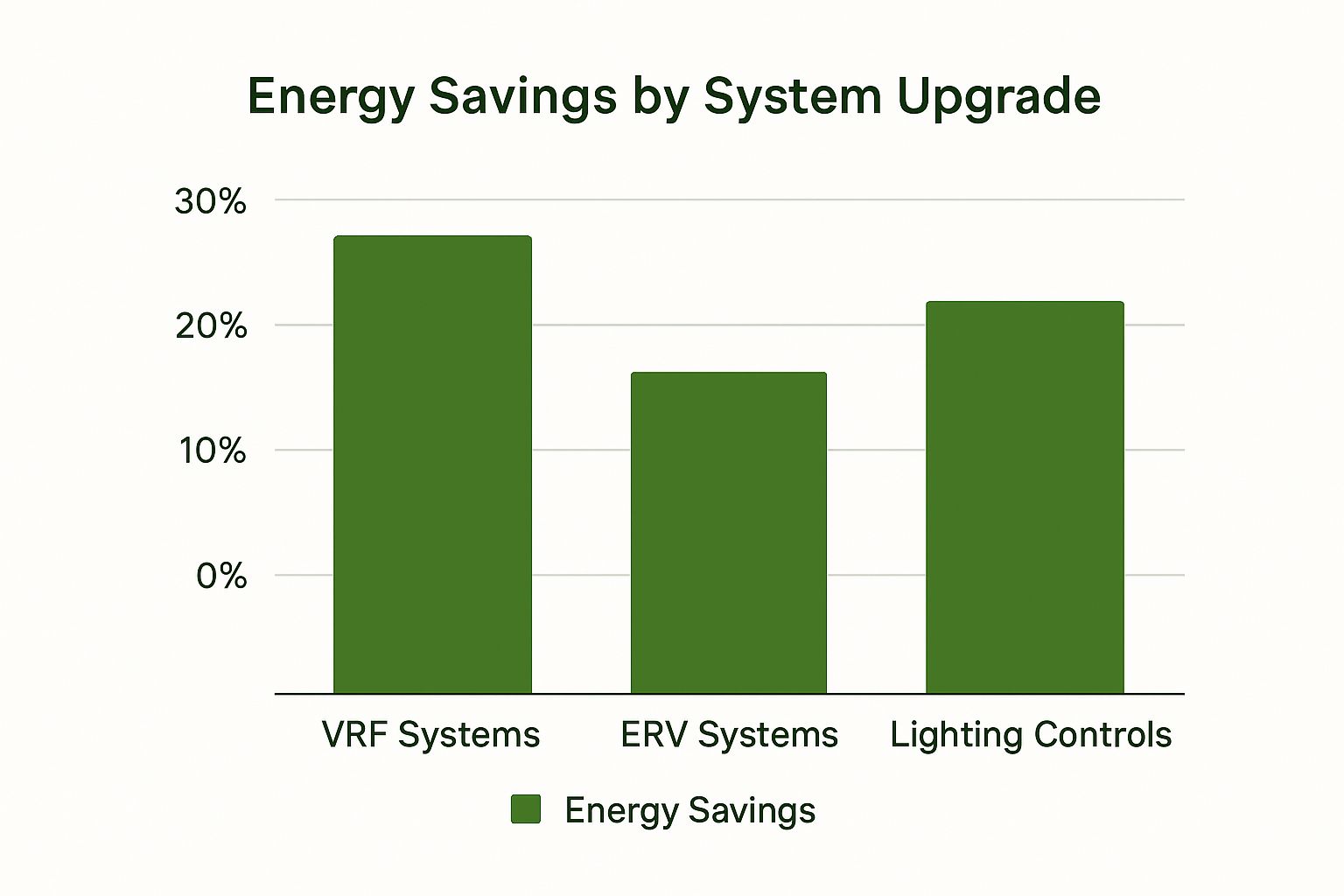
As you can see, the returns are significant across the board, with VRF systems often leading to the most substantial energy reductions.
Intelligent Lighting That Thinks for Itself
Lighting is the other energy hog in most commercial buildings, easily accounting for 20-25% of the total electricity consumption. Sure, swapping old fluorescent bulbs for LEDs is a great start, but the real magic happens when you make the lighting grid intelligent.
This is about creating a system that adapts in real time to its surroundings and the people within it. We've moved beyond just the lightbulb and into the world of smart controls.
An intelligent lighting system doesn't just provide light; it manages it. By responding to natural conditions and human activity, it can reduce lighting-related energy consumption by over 50%, transforming a fixed cost into a variable one.
The technologies making this happen are more accessible than you might think:
- Occupancy and Vacancy Sensors: This is the most straightforward form of lighting automation. Occupancy sensors turn lights on when you walk in and off after you leave. Vacancy sensors are even better for some spaces—you turn them on manually, but they'll automatically shut off, guaranteeing lights aren't left blazing in an empty room.
- Daylight Harvesting: Why pay for electricity when the sun is providing perfect light for free? Daylight harvesting systems use small sensors to measure the amount of natural light coming through the windows. They then automatically dim the overhead lights to maintain the perfect brightness level, saving a huge amount of energy in perimeter zones.
- Networked Lighting Controls: This is the brain of the operation. It connects every fixture and control into one programmable network. From a central dashboard, a facility manager can set schedules for entire floors, fine-tune light levels, and monitor energy data to spot even more opportunities for savings.
By tackling both your HVAC and lighting with these modern upgrades, you're targeting the two biggest energy drains in your building head-on. It's a one-two punch that not only delivers deep, immediate savings but also results in a more comfortable, responsive, and valuable property.
Putting Your Building to Work with Smart Technology
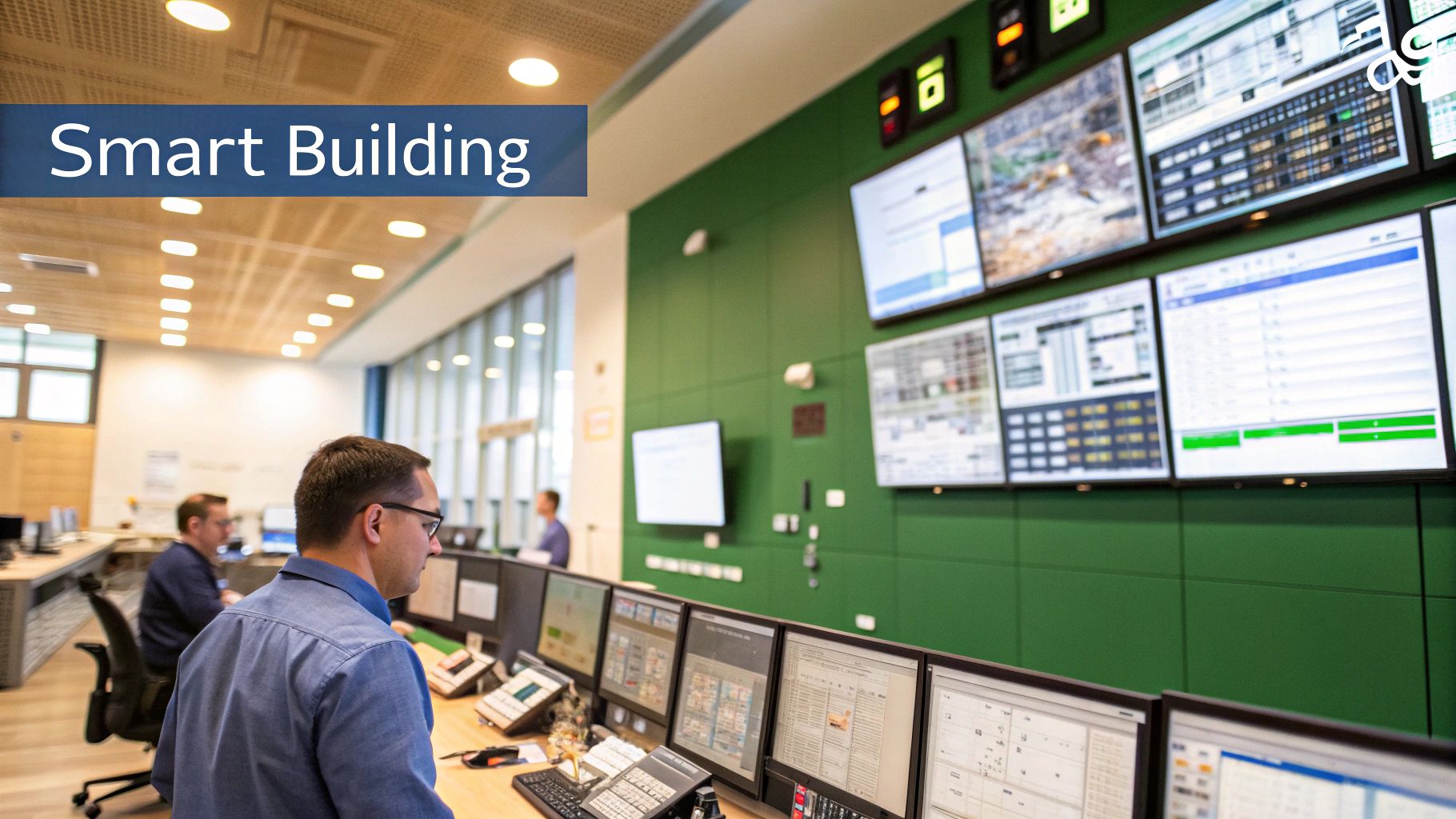
A well-designed envelope and efficient mechanical systems give a building incredible potential. But to really tap into that potential, you need a brain—a central nervous system that monitors, analyzes, and directs every component in real time. This is where an Energy Management System (EMS) comes in, transforming your property from a collection of static parts into a dynamic, intelligent asset.
Think of an EMS as your building’s digital command center. It uses a web of Internet of Things (IoT) sensors to pull in thousands of data points every second, covering everything from room temperature and occupancy to equipment performance. This constant flow of information gives you a level of insight and control that was impossible just a decade ago.
Instead of just getting a high utility bill and guessing at the cause, you can pinpoint exactly what’s happening and why. This data-first approach is the key to unlocking the next level of commercial building energy efficiency.
From Reactive Fixes to Predictive Power
For years, facility management has been a reactive game. A chiller fails on the hottest day of the year, leading to an expensive emergency repair. An EMS completely flips this model on its head by making predictive maintenance a reality.
By analyzing performance data over time, the system learns what "normal" looks like. It can then spot the subtle signs of trouble long before a catastrophic failure, like a fan motor drawing a bit too much power or a pump vibrating just outside its usual range. These are the early warnings that let you schedule maintenance on your own terms, avoiding costly downtime and getting more life out of your equipment.
This proactive strategy is at the heart of a booming industry. The global market for these technologies is set to grow at a Compound Annual Growth Rate of around 7% through 2033, and smart management systems are a huge part of that. You can discover more insights about commercial energy efficiency trends to see just how quickly this field is moving.
Automating Efficiency with Real-Time Analytics
A good EMS does more than just predict failures; it actively hunts for waste. Using automated fault detection and diagnostics (AFDD), the system constantly compares how your building is actually performing against how it should be performing. When it finds a mismatch—like an HVAC damper stuck open or lights blazing in an empty wing—it can alert your team or even correct the problem automatically.
An Energy Management System transforms building data into actionable intelligence. It's the difference between flying blind and having a full instrument panel, allowing you to make precise adjustments that maximize comfort while minimizing cost.
Here are just a few of the most powerful things this technology can do:
- Real-Time Energy Dashboards: See exactly where and when energy is being used. This makes it easy to spot underperforming buildings or systems that need attention.
- Occupancy-Based Control: Smart sensors can tell how many people are in a space and adjust lighting and temperature accordingly. No more paying to heat and cool empty rooms.
- Demand Response Automation: The EMS can talk directly to the utility grid. When electricity is most expensive during peak demand, it can automatically scale back non-essential loads, saving you a bundle or even earning you payments from the utility.
By putting smart technology to work, you're essentially giving your building the ability to think for itself. It becomes a responsive partner, always looking for new ways to cut costs, improve comfort, and boost your bottom line. This is about more than just new hardware; it's about changing your relationship with your property and turning it into an active contributor to your financial success.
Below is a quick look at some of the most effective technologies and what they can deliver.
Key Energy Efficiency Technologies and Their Impact
| Technology | Primary Function | Typical Energy Savings |
|---|---|---|
| LED Lighting & Controls | Replaces inefficient lighting and uses sensors to dim or turn off lights when not needed. | 15% – 40% |
| High-Efficiency HVAC | Modernizes heating, ventilation, and air conditioning with more efficient units and variable-speed drives. | 20% – 50% |
| Energy Management Systems (EMS) | Centralizes control and automates building systems using real-time data and analytics. | 10% – 30% |
| Building Envelope Upgrades | Improves insulation, air sealing, and windows to reduce heat loss or gain. | 10% – 25% |
| Smart Thermostats | Automates temperature settings based on occupancy, schedule, and even weather forecasts. | 5% – 15% |
These technologies often work best in tandem, creating a compounding effect that drives even deeper savings and makes your building smarter from the ground up.
How to Fund Your Efficiency Upgrades
Let's be honest: the biggest hurdle to making a commercial building more energy-efficient usually isn't the lack of good ideas. It's the sticker shock. But here’s the thing—treating these upgrades as a simple expense is the wrong way to look at it. They're actually high-return investments, and with the right financing strategy, you can make them happen without blowing your capital budget.
Think of it this way: a new high-efficiency HVAC system isn't just a cost. It's an asset that starts generating guaranteed savings from the moment it's switched on. Shifting your perspective is the first step, and luckily, you don't have to go it alone.
Smart Financing and Performance Contracts
One of the smartest ways to fund a major retrofit is with an Energy Performance Contract (EPC). This is a game-changer. You partner with an Energy Service Company (ESCO) to design and install the upgrades, and the project is paid for over time by the energy savings it creates. The best part? The ESCO guarantees those savings.
This model basically takes the financial risk off your plate. ESCOs have pioneered this approach all over the world, creating a proven path for building owners to upgrade with little to no upfront cash. You can learn more about the global ESCO market to see just how established this model is.
But EPCs aren't the only tool in the shed. You can also explore:
- Green Loans: More and more banks are offering special loans with better terms for projects that boost sustainability and efficiency.
- PACE Financing: In some areas, Property Assessed Clean Energy (PACE) financing lets you pay for upgrades through an assessment on your property tax bill, spreading the cost out over many years.
The right financing strategy turns a capital expense into a positive cash flow. When your monthly energy savings exceed the financing payment, the project pays for itself from day one.
Unlocking Government Incentives and Rebates
Don't leave free money on the table. Governments at all levels—federal, state, and local—along with your utility company, offer a ton of programs designed to get you to invest in efficiency. Tapping into these can seriously slash your initial project costs.
These incentives generally fall into a few categories:
- Tax Credits and Deductions: Federal programs, like the Section 48E and 45Y credits, offer major tax breaks for investing in renewables and energy-efficient tech. They can cover a huge chunk of your project cost.
- Utility Rebates: Check with your local electric or gas company. They almost certainly have rebates for installing specific equipment, like new chillers, LED lighting, or variable-speed drives.
- Grants: For projects that push the envelope with innovative tech or massive energy savings, competitive grants are often available.
It can feel like a lot to navigate, but the payoff is absolutely worth it. A quick call to your local utility and state energy office is the best place to start.
Calculating the True Value with LCCA
To get the green light from the decision-makers, you have to show them the full picture, not just the initial price tag. That’s where a Life Cycle Cost Analysis (LCCA) comes in. This method calculates the total cost of owning a piece of equipment over its entire life—from purchase and installation to energy, maintenance, and eventual disposal.
An LCCA might reveal that the "cheaper" rooftop unit will actually cost you a fortune over 15 years in sky-high energy bills and constant repair calls. This kind of data-driven analysis provides the hard numbers you need to justify investing in better, more efficient systems by proving their long-term value.
Seeing High-Performance Buildings in Action
All the talk about systems and specs is great, but nothing beats seeing the results in the real world. That’s where the power of commercial building energy efficiency really hits home. Let's move past the theory and look at a couple of real-world examples where buildings completely turned their performance around, offering a clear blueprint for others to follow.
These case studies aren't just about big, impressive numbers. They're stories about solving tough problems, making smart investments, and getting a real, tangible return. They prove that high-performance design isn't some far-off dream—it's a practical business strategy that works today.
Retrofit Success in an Urban Core
Picture a typical 1980s office tower in a busy downtown. The owners were getting hammered by high utility bills from its old, worn-out systems. A full demolition was out of the question, so they opted for a deep energy retrofit, focusing on upgrades that would give them the biggest bang for their buck.
They took a multi-pronged approach to the problem:
- Envelope Upgrade: The first thing to go were the original single-pane windows. They were replaced with high-performance, low-E coated glazing, which immediately cut down on solar heat gain and beefed up the insulation.
- System Overhaul: Next, they tore out the ancient, constant-volume HVAC system. In its place, they installed a modern Variable Refrigerant Flow (VRF) system that allows for precise temperature control in different zones.
- Intelligent Lighting: Finally, the entire building was switched over to LED lighting. But they didn't stop there—they integrated it with occupancy sensors and daylight harvesting controls, which slashed electricity use for lighting.
The results were stunning. The tower saw a 45% reduction in its annual energy use, saving the owners hundreds of thousands of dollars every year. Not only did the project pay for itself in less than a decade, but it also made the tenants happier and boosted the property's value on the market.
A well-executed retrofit proves that even older buildings can become models of efficiency. The key is to view the property not as a liability but as an opportunity for strategic, high-return investment.
Designing for Ultra-Low Energy Use from Scratch
Now, let's shift gears and look at a new retail building that was designed for peak efficiency right from the drawing board. The mission was simple: create a comfortable shopping space with the smallest possible energy footprint, letting smart, passive design do most of the heavy lifting.
The architects oriented the building to pull in as much natural daylight as possible while using carefully placed overhangs to block the intense summer sun. They built it with highly insulated walls and a super-tight building envelope, creating an indoor climate that was so stable it barely needed any mechanical heating or cooling.
This solid foundation meant they could get away with much smaller, more efficient HVAC systems. The project also topped it off with a rooftop solar array, which offset a big chunk of the building's already minimal energy needs. Yes, the upfront investment in a better envelope and passive design cost a bit more, but the long-term payoff was huge. The store now operates with energy costs that are 70% lower than a similar building constructed just to meet code, giving the business a permanent leg up on the competition.
Common Questions About Building Energy Efficiency
Even with the best intentions, diving into a major energy efficiency project can feel a bit overwhelming. It's natural to have questions. Over the years, I've heard similar concerns from building owners and facility managers time and again. Let's tackle some of the big ones right now.
Is an Energy Audit Really Necessary?
In a word, yes. Skipping an energy audit is like trying to navigate a new city without a map. You might eventually get where you're going, but you'll waste a lot of time and money along the way.
An audit gives you the data you need to stop guessing and start making strategic decisions. It pinpoints exactly where your building is bleeding energy, whether it's through drafty window frames, an ancient HVAC unit, or poor insulation. This information is a roadmap, showing you precisely where to invest your capital for the biggest and fastest returns. Without it, you’re just throwing money at problems and hoping something sticks.
Will Efficiency Upgrades Disrupt My Tenants?
This is probably one of the most common worries I hear, but it's one that can be managed with smart planning. The goal is always to minimize the impact on the people who work in your building.
Most of the heavy lifting can be scheduled to avoid interrupting the workday. For instance:
- Lighting upgrades are often done floor by floor or section by section, usually after hours or on weekends.
- Work on the building envelope, like sealing leaks or adding exterior insulation, happens on the outside and barely causes a ripple indoors.
- Major HVAC replacements can be timed for the milder spring or fall months when you don't have a critical need for heating or cooling.
Open communication is everything. When you keep tenants in the loop about the schedule and explain the benefits—like better air quality and more comfortable temperatures—they're usually very understanding. It helps them see the short-term inconvenience as a step toward a much better workplace.
Are the Upfront Costs Too High to Justify?
It’s easy to get sticker shock when you see the initial cost of a major upgrade. But you have to look at the full picture, not just the upfront expense. Many efficiency projects deliver a surprisingly quick payback, sometimes in just a few years, thanks to the immediate and dramatic drop in utility costs.
Plus, you rarely have to foot the entire bill yourself. There's a whole ecosystem of financial support out there, from federal tax credits and local utility rebates to specialized financing options. These incentives can significantly lower your initial cash outlay. When you add the long-term operational savings to the very real increase in your property's value, the decision becomes a financial no-brainer. An energy-efficient building isn't a cost center; it's a high-performing, profitable asset.
Ready to transform your building's performance with a design that's as smart as it is sustainable? Sherer Architects, LLC specializes in creating energy-efficient commercial spaces through thoughtful architecture and decades of expertise. Let's build a more profitable future for your property together.