Ever drive through an established neighborhood and spot a brand-new house on a lot that used to be empty or had a run-down building? That's infill development in a nutshell.
It's the practice of building on vacant or underutilized land within existing urban areas rather than pushing city boundaries further out. Think of it as filling in the missing teeth in a city's smile—revitalizing forgotten corners to create new homes, businesses, and community spaces.
Understanding What Infill Development Really Means
At its heart, infill development is just a smarter, more sustainable way for cities to grow. Instead of contributing to urban sprawl by paving over farmland on the outskirts of town, developers focus on recycling land that’s already woven into the community fabric.
This approach didn't just appear out of nowhere; it became a go-to strategy for urban planners trying to solve the problems that unchecked expansion created. With more people wanting to live closer to city centers, the demand for housing in established neighborhoods has shot through the roof, making infill a really practical solution.
The beauty of it is that it's not just about erecting new buildings. It's about strengthening communities from the inside out. Since these projects tap into existing infrastructure—think roads, sewer lines, and public transit—they are often more cost-effective and much friendlier to the environment. When the housing market gets tight, exploring new construction options on these infill lots can be a game-changer for homebuyers.
This infographic does a great job of showing how these underused pockets of land can be completely transformed.
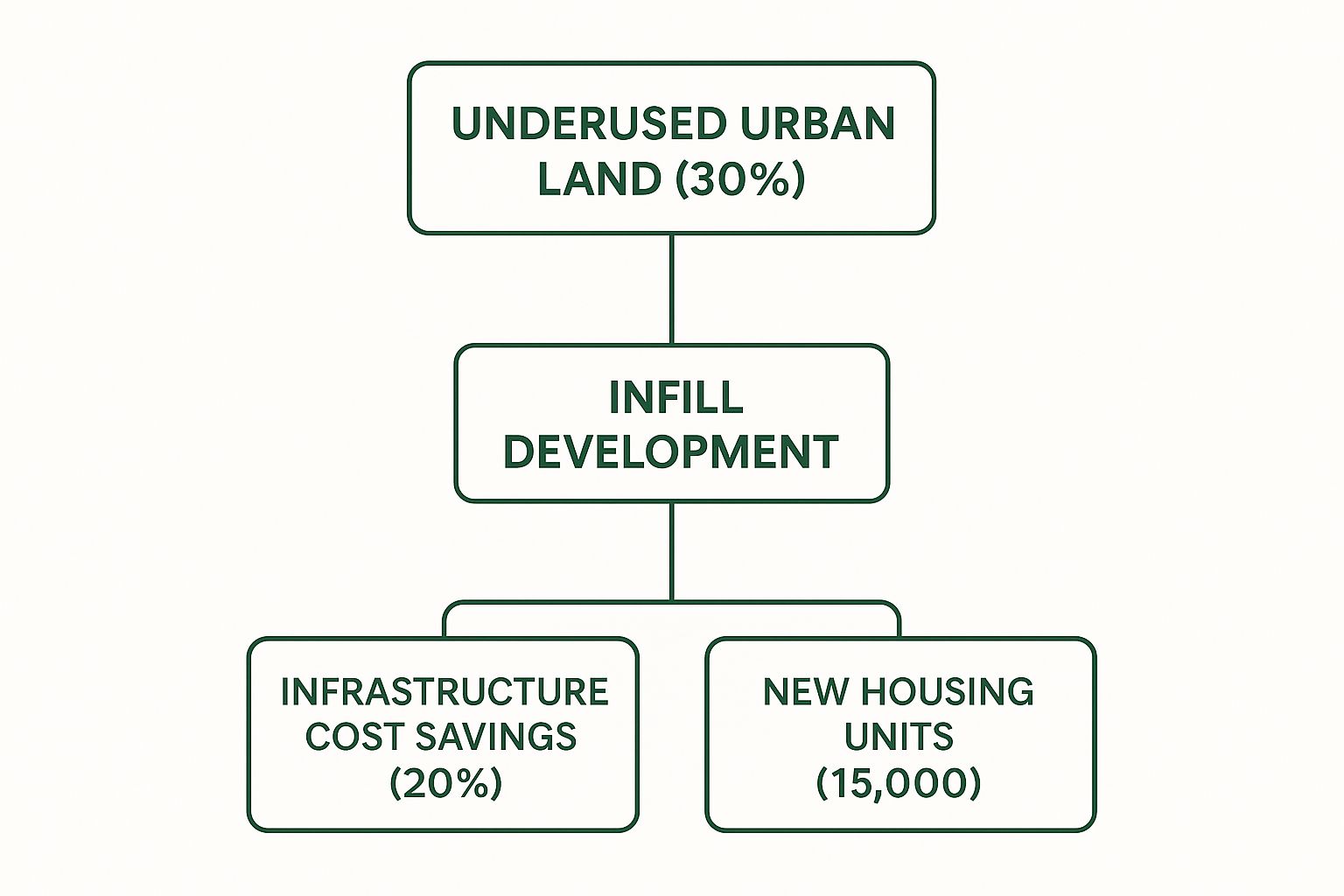
As you can see, the impact is huge. It’s not just about creating new homes; it’s also about saving a massive amount on infrastructure costs that would otherwise be spent on new developments.
Infill Development vs Urban Sprawl At a Glance
To really get a feel for why infill is so different, it helps to see it side-by-side with the more traditional model of suburban growth, often called "urban sprawl" or "greenfield development."
| Characteristic | Infill Development | Urban Sprawl (Greenfield) |
|---|---|---|
| Location | Within existing developed areas | On undeveloped land at the urban fringe |
| Land Use | Reuses vacant or underused parcels | Converts natural or agricultural land |
| Infrastructure | Leverages existing roads, utilities, and services | Requires brand new infrastructure installation |
| Density | Generally higher density (e.g., townhomes, apartments) | Typically lower density (e.g., single-family homes on large lots) |
| Transportation | Promotes walking, biking, and public transit | Car-dependent with longer commute times |
| Community Impact | Revitalizes neighborhoods, supports local businesses | Creates new communities, often disconnected from the urban core |
This table highlights the fundamental divide: infill works with the existing city, while sprawl creates something entirely new, often at a significant environmental and financial cost.
The Three Pillars of Infill Strategy
To really get a feel for infill development, you have to look at the core strategies that drive it. These aren't just high-level planning theories; they're the practical foundations for building smarter, more resilient cities. When you boil it down, the entire approach is about building inward instead of sprawling outward.
Everything rests on three key ideas that work in tandem to breathe new life into communities from the inside out.
Make the Most of the Land We Already Have
The first pillar is all about efficiency: maximize the use of existing land. Instead of bulldozing another field or forest on the outskirts of town, infill looks for the gaps inside the city limits. We’re talking about those overlooked parcels—an empty lot, a shuttered storefront, or an old industrial site that’s been sitting unused for years.
This is essentially a form of urban recycling. By building on these forgotten spaces, cities can grow their population without expanding their physical footprint, which helps protect our natural landscapes and greenbelts. It's a pragmatic way to add value right where people already live.
Plug Into Existing Infrastructure
Next, infill development smartly taps into the infrastructure that's already there. Just think for a moment about the massive cost of laying down new roads, sewer lines, water mains, and power grids for a brand-new subdivision on the edge of town. It’s a huge public expense.
Infill projects sidestep a lot of that cost by connecting to the existing grid. This makes new development more affordable for everyone—developers and taxpayers alike. New homes and businesses can be woven directly into the fabric of a neighborhood, gaining immediate access to the schools, fire stations, and bus routes that are already up and running.
This strategic approach dramatically cuts the public cost of new development. In fact, studies have shown it’s significantly cheaper to provide infrastructure for infill projects than for sprawling developments on previously untouched land.
Create Denser, More Walkable Communities
The final piece of the puzzle is about fostering connected neighborhoods where people can live, work, and play. When you build homes, shops, and offices closer together, you fundamentally change how people move around and interact with their city.
Suddenly, you can walk to grab a coffee, bike to the park, or hop on a quick bus to get to work. This naturally reduces our reliance on cars, which means less traffic, cleaner air, and lower carbon emissions. But more than that, it creates vibrant, active streets where small businesses can flourish and neighbors actually get to know each other. This is the human side of infill—it’s all about building for people, not just for cars.
Why Building Inward Is a Win for Everyone
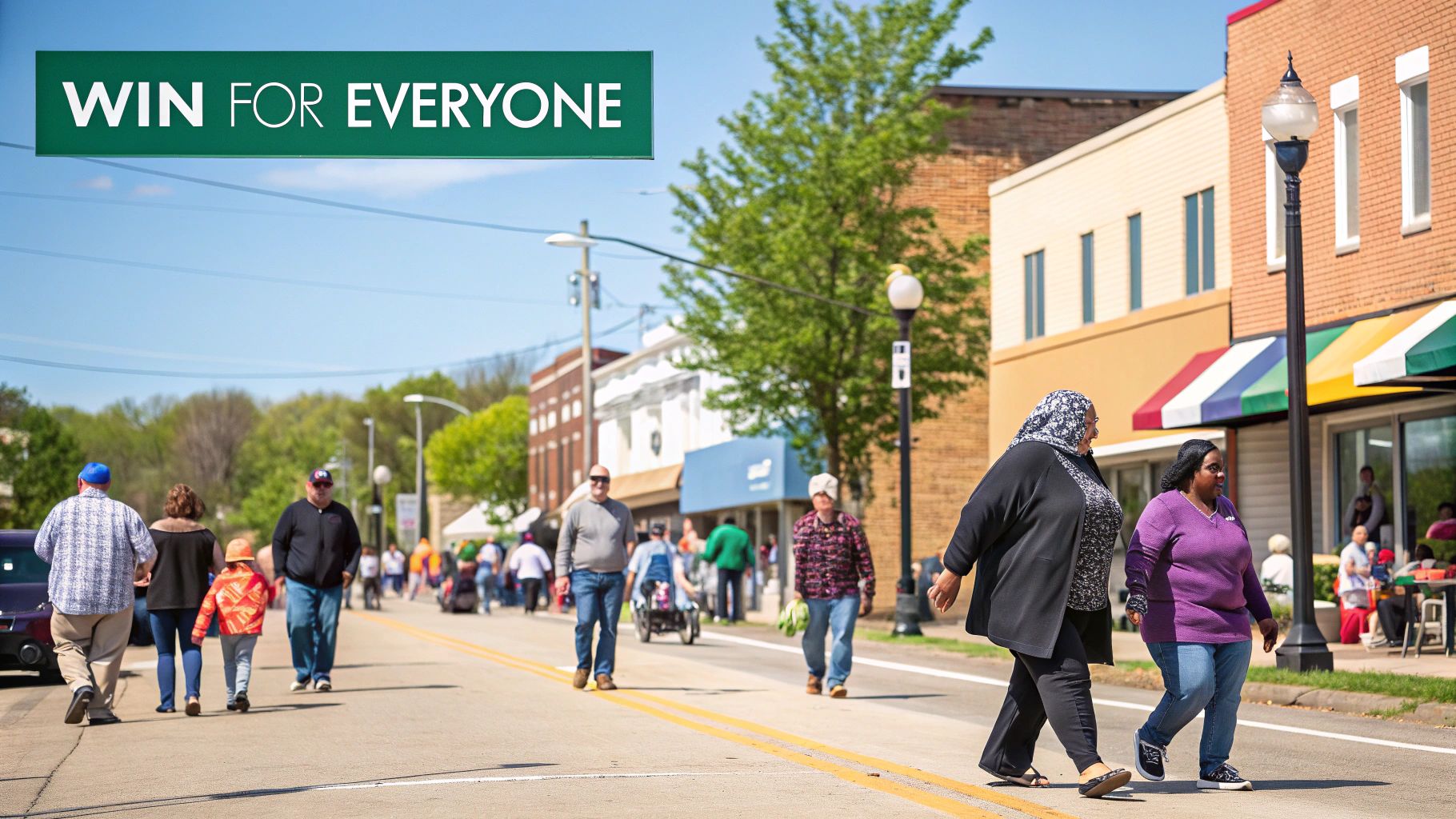
When we shift our focus from sprawling outward to building inward, the benefits echo through the entire community. This isn't just about slotting new buildings into empty spaces; it’s a practical, forward-thinking solution to some of the biggest hurdles modern cities face, from environmental pressures to economic health.
Thinking about development this way creates a kind of positive feedback loop. It's a strategy that makes our cities not just bigger, but fundamentally better places to live, work, and connect.
Economic Advantages for Communities
The most immediate impact you'll see is a jolt to the local economy. Imagine a vacant lot being replaced by a new mixed-use project. Suddenly, you have new residents and businesses that shop at the corner store, eat at the local cafe, and use nearby services. This fresh activity creates a more resilient local economy and, of course, more jobs.
It's also a much smarter way to use our tax dollars. Infill projects tap into the infrastructure we already have—the roads, sewers, and power lines. This avoids the staggering cost of building new systems from the ground up, freeing up public money for other priorities like parks or schools.
Environmental and Social Gains
From an environmental standpoint, the benefits are crystal clear. By building within our existing footprint, we protect the green spaces, farmland, and natural habitats that would otherwise be bulldozed for another subdivision. It also naturally encourages a more sustainable way of life.
By creating denser, more walkable neighborhoods, infill development inherently reduces car dependency. This leads to less traffic congestion, lower carbon emissions, and cleaner air for everyone.
On a social level, this approach helps knit together stronger, more vibrant communities. It often introduces a wider variety of housing options, from townhomes to smaller apartment buildings, which can welcome people from different backgrounds and at different life stages. That diversity is what gives a neighborhood its unique character and energy.
This isn't just a local trend; it's a global strategy for sensible urban growth. With 54% of the world’s population already living in cities—a figure expected to reach 66% by 2050—we have to be smarter about how we expand. Since cities consume the vast majority of our resources, growing efficiently is no longer an option, but a necessity. To dig deeper, check out the United Nations' findings on urban growth and its worldwide impact.
Seeing Infill Development in the Real World
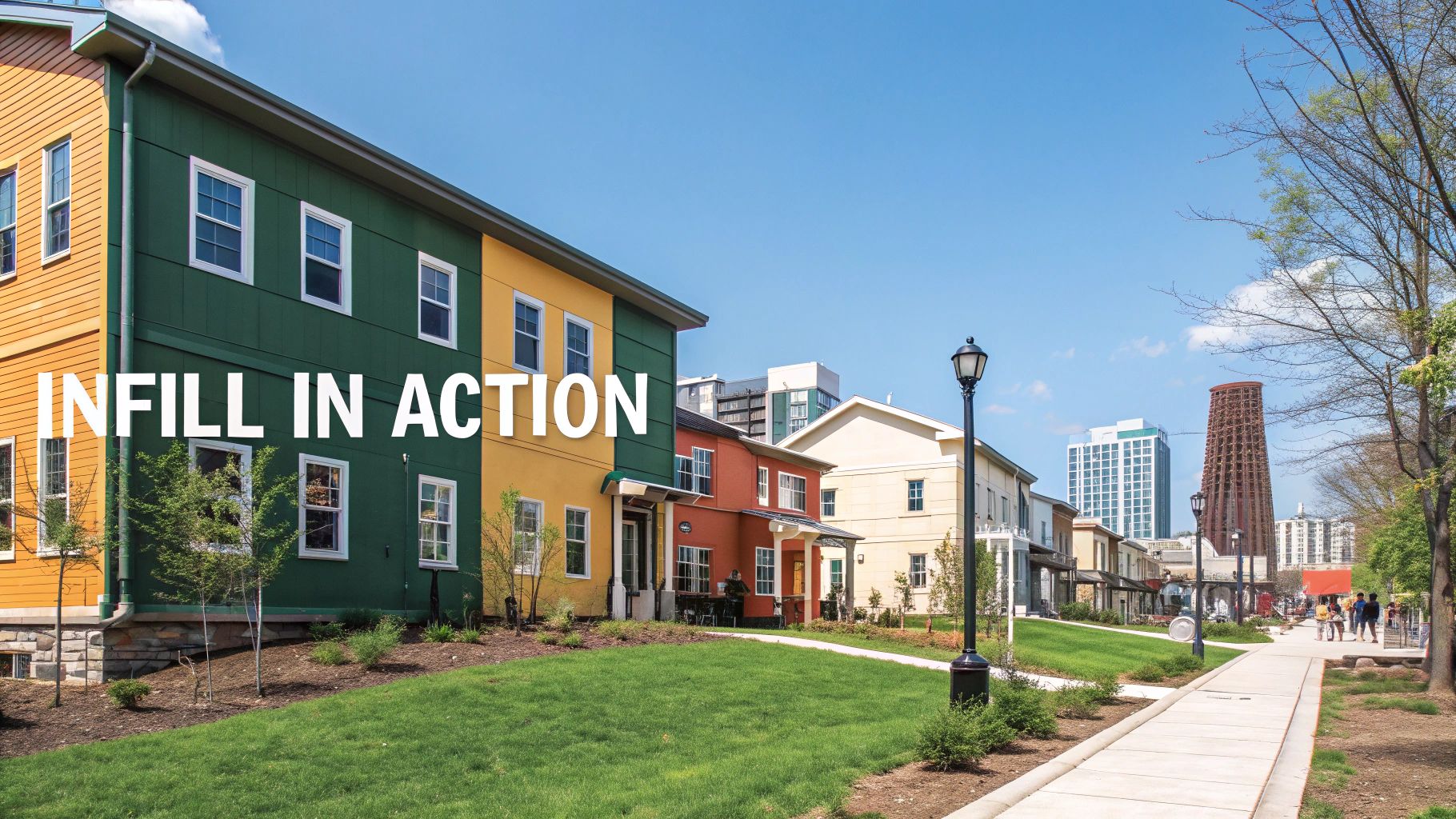
The idea of "building inward" really clicks when you see it up close. Infill development isn’t some one-size-fits-all strategy; it shows up in countless forms, each perfectly suited to the unique gaps and opportunities within a neighborhood. You’ve probably walked or driven past these projects every day without even realizing it.
The classic example is a new house popping up on a vacant lot squeezed between two older homes. But that's just scratching the surface. The real creativity comes from a much wider range of approaches.
Common Types of Infill Projects
At their core, these projects are all about maximizing the potential of what a community already has, whether that's an empty patch of dirt or a building that’s seen better days. Each type of project looks different, but they all share the same goal: smart, strategic growth.
Here are a few of the most common forms you'll see:
-
Brownfield Redevelopment: This is where we take former industrial or commercial sites—think old factories or abandoned gas stations—clean them up, and give them a new purpose. That rusty old warehouse on the edge of town could become modern loft apartments or a bustling retail center.
-
Adaptive Reuse: This is all about giving historic buildings a second act. It’s a beautiful way to preserve character while meeting modern needs, like converting a beautiful old school into senior housing or turning a decommissioned church into a community arts hub.
-
Accessory Dwelling Units (ADUs): You might know them as granny flats, casitas, or in-law suites. These are small, secondary homes built on the same lot as an existing house, gently adding more housing options to single-family neighborhoods without drastically changing their look and feel.
By their very nature, infill projects capitalize on existing public infrastructure like roads and utilities. This saves significant public money and directs investment back into established urban areas that may need it most.
For a powerful real-world example, look at The Fitzgerald, a $77 million project in Baltimore. This public-private partnership didn't just add top-notch academic space; it acted as a catalyst, sparking a wave of new investment in a neighborhood that desperately needed it. You can dig deeper into how these projects come together in this report on developer-led infill strategies.
Navigating the Hurdles of Building Inward
While infill development sounds like a great idea on paper, the path to building inward is rarely a straight line. Turning a vacant lot or an underused property into a vibrant part of the community comes with a unique set of obstacles that can easily slow down projects and stir up local friction.
One of the biggest headaches is dealing with complicated and often antiquated zoning laws. Many city codes were written decades ago and are designed to protect the status quo—which usually means single-family homes. This can make it incredibly difficult to get approval for something as simple as a duplex or a small apartment building, even in a neighborhood that desperately needs more housing options. The permitting process alone can feel like wading through a maze of red tape.
Then there's the sticker shock. Land in established, desirable neighborhoods is almost always more expensive than a patch of dirt on the outskirts of town. These high land costs can make it tough for developers to build anything that regular people can actually afford.
Community and Social Challenges
Beyond the purely logistical and financial hurdles, the social dynamics can be the trickiest part to navigate. It’s common for developers to face pushback from long-time residents who worry that new construction will clog their streets with traffic, strain local schools and parks, or change the familiar character of their neighborhood. You'll often hear this referred to as NIMBYism—an acronym for "Not In My Back Yard."
But the most significant social issue we have to confront is gentrification. If new projects only bring in high-end condos and luxury apartments, it can send property values and rents soaring, pushing out the very residents who have called the neighborhood home for years. This risk directly undermines the goal of building more inclusive and equitable communities.
The good news is that these challenges aren't insurmountable. Cities are getting smarter about this, using tools like inclusionary zoning, which mandates that a certain percentage of new units must be affordable. Others use community benefit agreements to ensure that development projects give back to the neighborhood in meaningful ways.
By thoughtfully balancing growth with preservation and equity, communities can work through these hurdles and build a better, more sustainable future from the inside out.
How Infill Is Shaping the Future of Our Cities
When we talk about infill development, we're talking about a fundamental shift in how we envision the future of our communities. It's more than just a building trend. Instead of constantly pushing city limits outward into undeveloped land, this strategy looks inward, finding clever ways to grow within the footprint we already have.
The ripple effect of this approach is powerful. Economically, it breathes new life into established neighborhoods and makes better use of taxpayer dollars by tapping into existing roads, sewers, and power grids.
From an environmental standpoint, it’s a huge win. Building "in" instead of "out" protects precious green spaces and farmland from being paved over. It also helps shrink our collective carbon footprint by creating denser, walkable communities where driving isn't always a necessity. Socially, it helps cultivate the kind of diverse, connected, and equitable neighborhoods where people want to live.
This is a vital tool for tackling some of our biggest challenges, from the housing crisis to climate change.
Infill development is about unlocking the hidden potential within our cities. It proves that the greatest opportunities for creating more resilient, engaging, and sustainable communities are often already right in front of us, waiting to be rediscovered.
To see how these projects come to life from concept to completion, it's worth understanding the full commercial real estate development process. By focusing on smart, sustainable growth, we're not just building structures; we're ensuring our cities can thrive for generations to come.
Common Questions About Infill Development
Even when you've got the basics down, a few practical questions always seem to pop up. Let's dig into some of the most common ones I hear from clients and community members to clear up any lingering confusion.
Does Infill Always Mean Big, Towering Buildings?
Absolutely not. That’s one of the biggest misconceptions out there. While some infill projects are indeed larger multi-family buildings, many are on a much smaller, more personal scale.
Think about it this way: infill can be as simple as building a single new home on a vacant lot tucked away in a city neighborhood. It could also mean converting a large, underused house into a duplex.
One of the most popular forms we're seeing right now is the accessory dwelling unit (ADU)—often called a granny flat or carriage house. These are small, standalone homes added to an existing property. The whole point is to gently increase housing density in a way that respects the neighborhood's existing look and feel.
What Will an Infill Project Do to My Property Value?
This is a question I get all the time. Generally speaking, a well-designed and thoughtfully executed infill project is great news for nearby property values. When you replace a vacant, overgrown lot or a run-down building with an attractive new home or a vibrant local shop, you're lifting the entire neighborhood.
This kind of renewal tends to create a positive ripple effect, drawing in new residents and businesses that further strengthen the local market. Of course, the devil is in the details—the project's quality and how well it fits into the community are key to seeing that positive impact.
It's important to distinguish between two often-confused terms. Infill development is a building strategy. Gentrification is a complex socioeconomic shift that can sometimes displace long-time, lower-income residents.
Is Infill Just Another Word for Gentrification?
This is a critical and completely valid concern. Let's be direct: infill can contribute to gentrification, especially if the only thing being built is high-end, luxury housing that prices out existing residents.
However, it doesn't have to be that way. When city planners and developers use smart policies like inclusionary zoning or set aside a percentage of new units for affordable housing, infill becomes a powerful tool for creating healthy, mixed-income communities. The key is managing that growth proactively to make sure it benefits everyone, not just the wealthiest newcomers.
At Sherer Architects, LLC, we've spent years untangling the complexities of infill and adaptive reuse projects to bring new life to communities. If you're thinking about starting an infill project, let our decades of hands-on experience guide you toward a beautiful and sustainable outcome. See how we approach our work at https://shererarch.com.