
Design for Lean isn't just another buzzword for cutting costs. It’s a completely different way of thinking about a project, one that’s laser-focused on maximizing value by systematically hunting down and eliminating waste. It all starts by defining what the client truly values and then engineering the entire workflow—from the first sketch to the final punch list—to deliver exactly that.
The Foundation of Lean Design in Modern Architecture

When developers and property owners hear the word "lean," they often picture a car factory or a fast-moving tech startup. But its core ideas are incredibly powerful when applied to architecture and construction. At its heart, a design for lean approach is a promise: deliver precisely what the client needs with the absolute minimum of wasted resources.
This isn't about using cheaper materials or cutting corners. It's about designing a smarter process that sidesteps the usual pitfalls of budget overruns, infuriating schedule delays, and costly rework.
The entire dynamic of a project shifts when you move from asking "what can we build?" to "what creates the most value for the end-user?" This mindset forces you to systematically target and eliminate the "eight wastes" that plague nearly every construction site, from crews waiting on materials to correcting defects and unnecessary movement of people and equipment.
Core Concepts You Need to Know
To really make lean design work, you have to get comfortable with a few key concepts that will pop up again and again. These aren't just jargon; they represent a fundamental change in how project teams need to think, act, and collaborate.
- Integrated Project Delivery (IPD): This is a game-changer. IPD is a collaborative framework that contractually binds the owner, architect, and contractor, forcing them to share both the risks and the rewards. It replaces the traditional, often adversarial, relationships with genuine teamwork because everyone's goals are finally aligned.
- Design for Manufacture and Assembly (DfMA): Think of this as building with precision-engineered components rather than just raw materials. DfMA means designing elements like modular bathroom pods or prefabricated facade panels that can be built efficiently off-site in a controlled environment and then quickly assembled on-site. The boost to quality control and construction speed is immense.
If there's one thing for developers to take away, it's this: embracing lean means doing the heavy thinking upfront. More time invested in collaborative planning and design directly translates to less time, money, and frustration wasted during construction.
The table below breaks down how these foundational lean ideas from manufacturing translate directly into the world of architecture and construction.
Core Lean Principles and Their Architectural Application
| Lean Principle | Definition in Manufacturing | Application in Architecture & Construction |
|---|---|---|
| Value | Defined solely from the customer's perspective. | Understanding the owner's and end-user's core needs (e.g., specific tenant requirements, energy efficiency goals, long-term operational costs). |
| Value Stream | All the steps required to bring a product from concept to customer. | Mapping the entire project lifecycle—from initial feasibility studies and design phases to permitting, construction, and handover—to identify and eliminate non-value-adding activities. |
| Flow | Creating a smooth, uninterrupted production process. | Ensuring a continuous workflow on-site by removing bottlenecks. This includes just-in-time material delivery, coordinated trade sequencing, and pull planning. |
| Pull | Producing only what is needed, when it is needed by the next step. | Using pull planning sessions where downstream trades (like electricians) "pull" work from upstream trades (like framers) only when they are ready, preventing overproduction and waiting. |
| Perfection | The relentless pursuit of continuous improvement. | Implementing feedback loops, post-project reviews, and performance metrics to learn from every project and refine processes for the next one. |
This isn’t just theory; it’s a practical roadmap to a more efficient and predictable project.
This fusion of lean principles with modern technology is also pushing the industry forward. We're now seeing the rise of Lean 4.0, where digital tools amplify these strategies. By 2025, an estimated 70% of manufacturers will be using Internet of Things (IoT) devices for real-time monitoring. This trend is already shaping how building components are designed and fabricated for minimal waste. You can discover more about these trends and their growing impact on our industry.
Ultimately, a lean approach is about creating a predictable, continuous workflow. It replaces the chaos of constant firefighting with a structured, proactive system that gets ahead of problems before they start. For any developer aiming for profitable and predictable outcomes, it’s no longer just an option—it’s a critical strategy.
Defining Value and Mapping the Workflow
Every truly successful lean project starts by flipping the script. Instead of architects and builders immediately jumping into what they can design, the entire team has to first rally around a much more important question: What does the client truly value?
This isn't about the basic project scope. It’s about digging deep into the business drivers, the day-to-day operational headaches, and the long-term vision that the owner and end-users have for the space.
The only way to do this right is to get everyone in the same room from the get-go. I'm talking about early-stage workshops that include the owner, key stakeholders, architects, engineers, and if you can swing it, even the people who will eventually work in the building. The whole point is to turn vague ideas into solid design criteria.
Think about a common goal like creating "a more collaborative workspace." That sounds nice, but it's not something you can draw on a blueprint. The workshop is where you break that down into something real.
- Does "collaborative" mean more casual, unbookable huddle rooms?
- Does it mean designing specific sightlines between departments that need to interact?
- Are we talking about an acoustic strategy that lets people have lively conversations without disrupting those who need to focus?
Answering these kinds of granular questions creates concrete, measurable objectives. This initial alignment is the absolute foundation of a design for lean approach. It’s how you prevent the expensive, soul-crushing rework that happens when different teams are working off their own assumptions.
The most expensive mistake on any project is perfectly executing a design that fails to deliver what the client actually needed. Defining value isn't a "soft" step; it's the single most important risk mitigation activity you can perform.
From Value to Workflow: The Power of Mapping
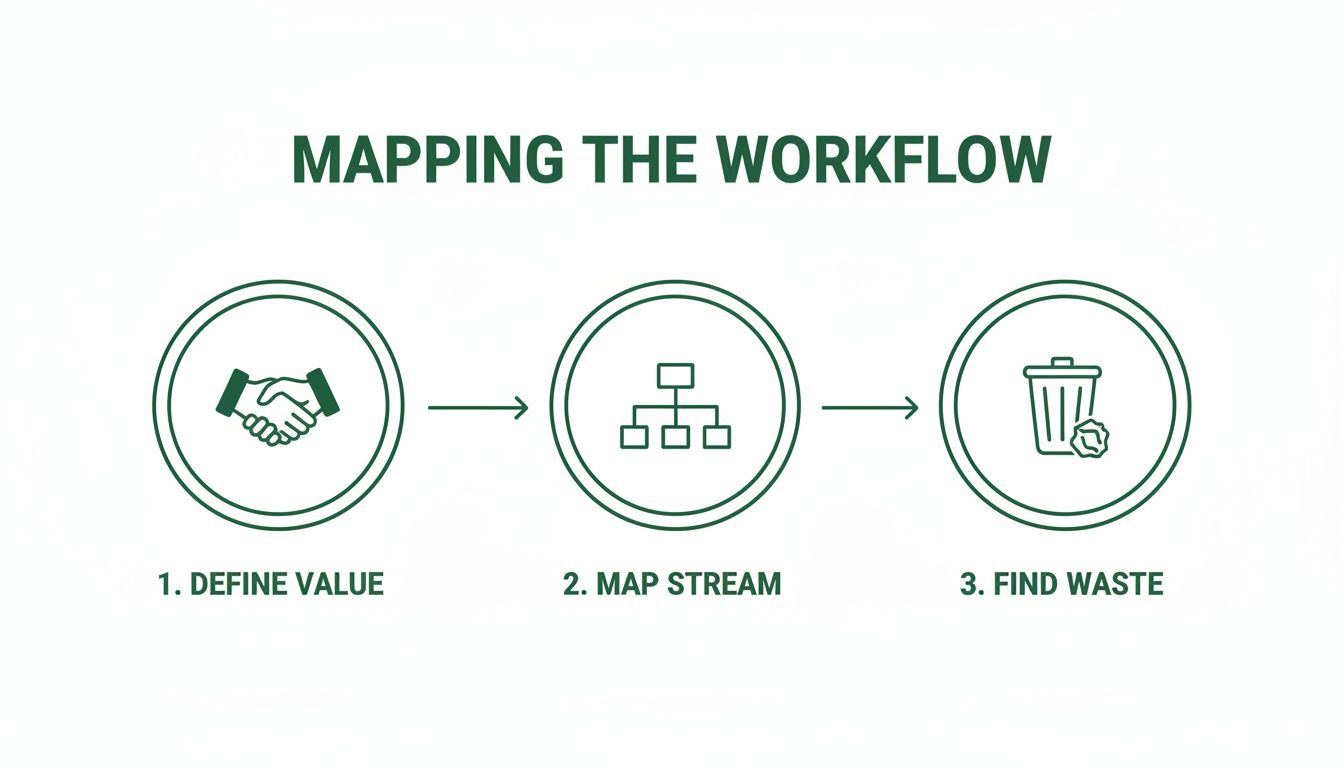
Once you’ve got a crystal-clear definition of value, the next move is to map out how you’ll deliver it. We do this with Value Stream Mapping (VSM), a ridiculously powerful tool that creates a visual of the entire project lifecycle, from that first napkin sketch to the final handover.
A VSM is so much more than a simple flowchart. Its real job is to make waste visible. By mapping every single process—including design reviews, permit approvals, information handoffs, and all the time spent just waiting—the team can finally see the non-value-adding activities that cause delays and bloat the budget.
You kick things off by mapping the "current state." Honestly, this is often a rude awakening. You might find that a critical structural review consistently sits in someone's inbox for a week, or that RFIs (Requests for Information) take days to bounce between all the necessary people. These are the classic examples of waste hiding in plain sight.
The magic happens when the team gets together to design the "future state" map. This is where you get to slash and burn, eliminating or simplifying the wasteful steps you just uncovered. Maybe you decide to co-locate key decision-makers during schematic design to kill approval delays. To really tighten up these workflows, you could even explore advanced workflow automation solutions to handle the repetitive, administrative tasks.
This mapping exercise forces a brutally honest conversation about how work actually gets done, not just how the project schedule says it's supposed to. By tackling these bottlenecks before a single shovel hits the ground, you're building a project on a foundation of smooth, predictable flow instead of constant firefighting.
Weaving Collaboration into the Project DNA
Lean projects don’t just happen; they’re built on a bedrock of genuine collaboration. The old way of doing things—architects tossing drawings over the wall to engineers, who then pass them to contractors—is fundamentally broken. That siloed approach is a recipe for rework, delays, and wasted money.
To truly design for Lean, we need a complete operational shift. It’s about moving away from an adversarial mindset and embracing a genuine partnership from day one.
This cultural change often starts with a contractual one, like Integrated Project Delivery (IPD). IPD is more than just a handshake agreement to get along. It's a formal, multi-party contract that legally binds the owner, architect, and contractor into a single, unified team.
Suddenly, everyone shares in the risk and the reward. If the project comes in under budget and ahead of schedule, everybody wins. If problems arise, everyone shares the pain. This structure completely changes the dynamic, erasing the "us vs. them" mentality and forcing every decision to serve the project's best interests, not just one company's bottom line.
Putting Pull Planning into Practice
One of the most powerful tools for making this collaboration real is the Pull Planning session. It’s a world away from traditional, top-down scheduling where a project manager builds a Gantt chart in a vacuum. Instead, Pull Planning starts with the final goal and works backward.
This process is about getting hands-on. In a Pull Planning workshop, the people who actually do the work—the electricians, plumbers, drywallers, and painters—are the ones who create the schedule. They get in a room and physically map out their tasks on a wall with sticky notes, starting from key milestones and pulling work forward.
It’s a simple but profound shift. Instead of being told when to show up, trade partners are asked, "What do you need from the team before you can start?" This simple question fosters ownership and creates a schedule built on reliable commitments, not hopeful guesses.
Imagine a commercial tenant fit-out. Here’s how it unfolds:
- Set the Finish Line: The team agrees on the major milestones. Let’s say the most important one is "Ready for Furniture Installation."
- Work Backward from the Goal: The flooring installer puts up a sticky note for their work. Then, they state what they need before they can begin—like "final coat of paint is dry." This "pulls" the painter's work into the timeline.
- Uncover the Chain Reaction: The painter, in turn, needs the drywall to be finished and sanded. That pulls in the drywall contractor, who needs the MEP (mechanical, electrical, plumbing) rough-ins to be complete.
This highly visual, interactive process immediately highlights dependencies and potential logjams that a standard schedule would completely miss. It’s no longer just a timeline; it's a network of promises made between the people on the ground.
Designing for Manufacture and Modularity
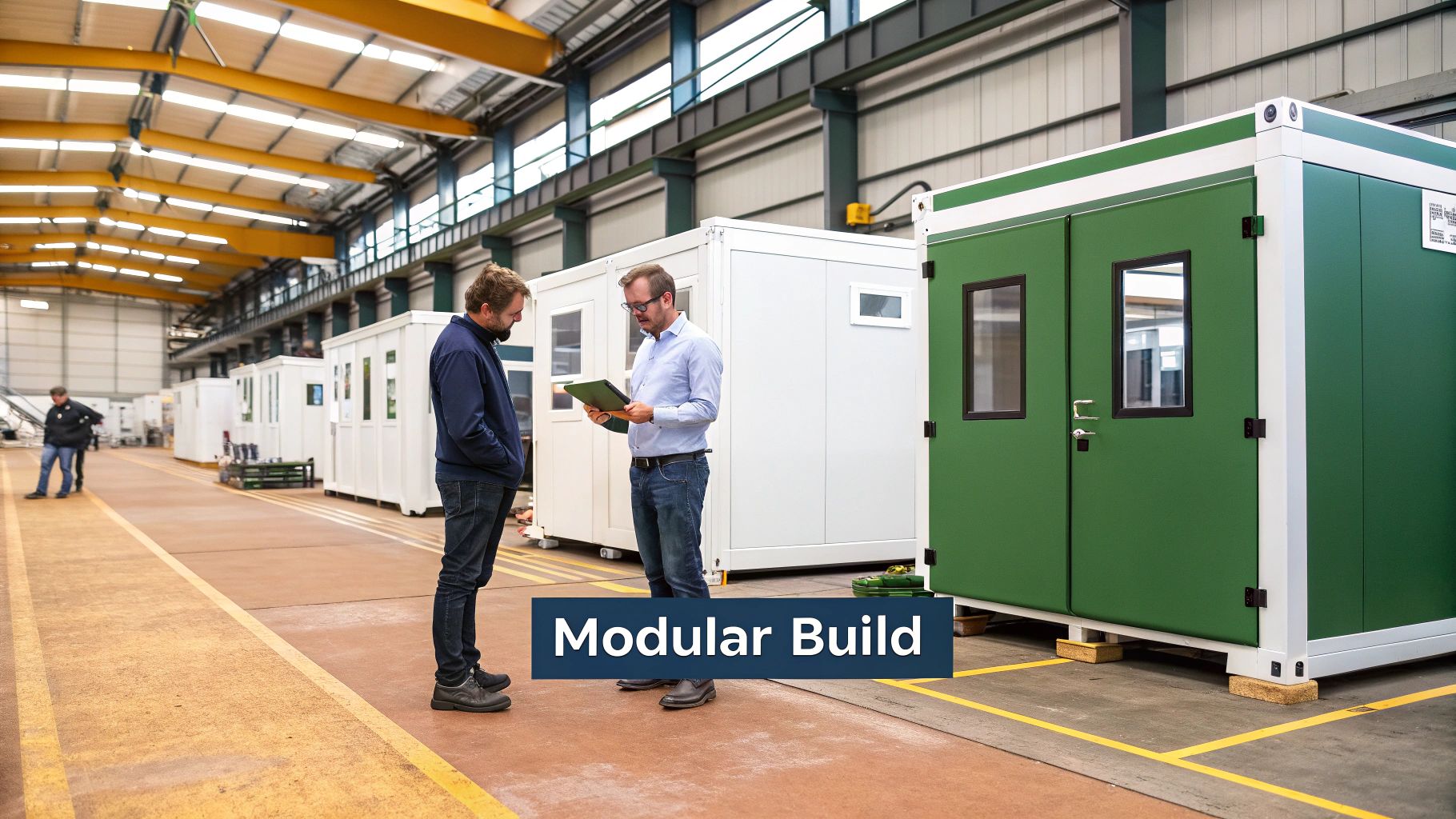
This is where the rubber meets the road. All the high-level strategy sessions and workflow mapping lead to this point: making design decisions that directly shape how the building is physically constructed. We do this through a game-changing approach called Design for Manufacture and Assembly (DfMA).
Instead of designing a building to be stick-built piece-by-piece on a potentially chaotic job site, DfMA shifts the mindset entirely. You start thinking about the building as a kit of parts. You design components—from entire bathroom pods to intricate facade panels—that can be built with precision in a controlled factory setting. These pieces then arrive on-site ready for a clean, fast, and accurate installation.
This method is a direct attack on some of the biggest culprits of waste in construction. Think about it: on-site work is messy. It's at the mercy of weather delays, material damage, and the classic coordination failures between trades. Off-site manufacturing, on the other hand, gives you incredible quality control, slashes material waste, and creates a much safer work environment. The payoff is a faster, more predictable timeline.
Bridging the Gap Between Design and Fabrication
Here’s the biggest mistake I see teams make: designing in a silo. What looks brilliant in a BIM model might be a nightmare to actually build. This is why a non-negotiable principle of design for lean is getting manufacturers and fabricators in the room from day one.
Their input is pure gold. They’ll give you instant, real-world feedback on everything from material choices and connection details to transportation logistics. Their early involvement ensures the design is actually optimized for efficient production, not just aesthetically pleasing.
A design isn't truly "lean" until it has been vetted by the people who will actually build it. Early collaboration with manufacturers isn't a nice-to-have; it's a critical step that prevents costly redesigns and fabrication headaches down the line.
DfMA in Action Real-World Examples
So, what does this look like on an actual project? The applications are incredibly versatile, and you can scale the approach to fit the needs of almost any commercial or adaptive reuse project.
- Modular MEP Racks: For a multi-story office building, designing mechanical, electrical, and plumbing systems on prefabricated racks is a massive win. These racks get assembled and pressure-tested in a factory, then hoisted into place on-site. This all but eliminates the slow, error-prone overhead work that bogs down so many jobs.
- Standardized Apartment Layouts: In a new residential tower or hotel, standardizing the layouts allows for the prefabrication of entire units, especially the complex parts like bathrooms and kitchens. You get consistent quality across hundreds of units, and the on-site crews can focus on core construction and final hookups.
- Prefabricated Facade Systems: Designing the building’s exterior as a system of panels is another great example. These are manufactured off-site and craned into place, making the building watertight in a fraction of the time. That means interior work can start much, much sooner.
This isn't a niche concept anymore; it's rapidly becoming a cornerstone of modern construction. Industry data shows that in major global markets, 90% of contract manufacturers now offer Design for Manufacturing (DFM) services to help teams get it right from the start. You can explore more manufacturing statistics to see just how deep this industry shift runs.
By fully embracing DfMA, you're directly minimizing waste from transportation, waiting, and defects. The end result is a faster, more valuable, and less risky project.
Strategies for Eliminating Waste on Your Project
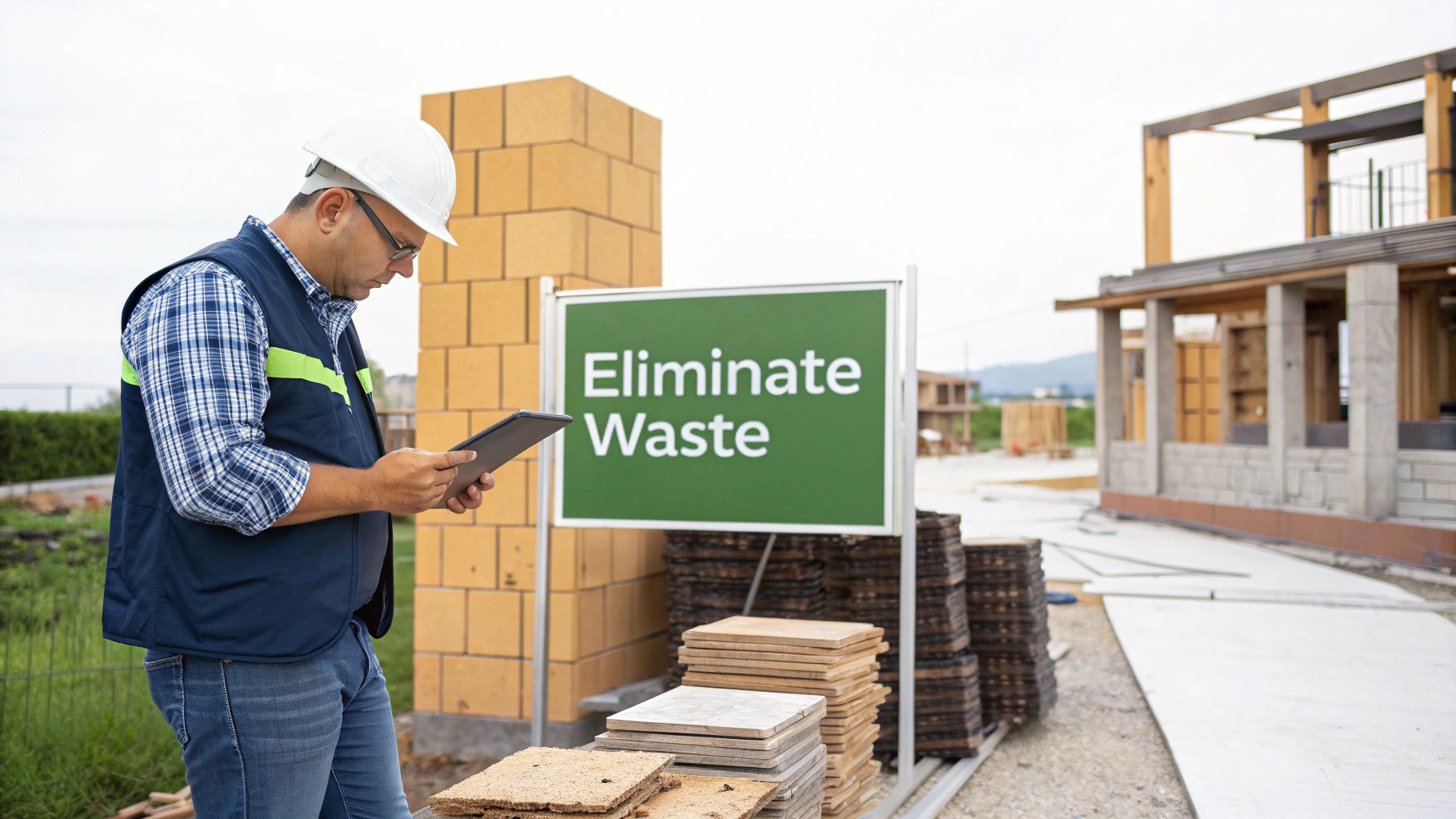
When we talk about "waste" in construction, most people picture a overflowing dumpster. That’s part of it, but it’s just the tip of the iceberg. The real project-killers are the invisible wastes: wasted time, wasted movement, and the colossal waste of not using your team's full brainpower.
Adopting a design for lean approach means training your eyes to spot these inefficiencies—all "eight wastes"—and then systematically designing them out of your workflow. This isn't just theory; it's a practical way to sharpen project performance and protect your budget.
Tackling the Eight Wastes on Your Job Site
Let's get practical. Here’s what these wastes actually look like in the wild and how you can start fighting back.
-
Defects: This is the easy one to spot. It’s any work that has to be torn out and redone. Picture a crew ripping out freshly installed ductwork because it clashes with plumbing lines that were never coordinated in the design phase. A costly, frustrating, and entirely preventable mess.
- The Fix: Use digital clash detection in your BIM models before a single component is fabricated. For tricky assemblies, build physical mock-ups. It’s far cheaper to solve a problem with plywood and 2x4s than with finished materials on-site.
-
Overproduction: This is the waste of doing work before it’s actually needed. A classic example is the design team issuing a 500-page drawing set when the site crew only needs the foundation plan for the next 90 days.
- The Fix: Ditch the massive document dumps. Instead, align design releases with the construction schedule and issue drawing packages in smaller, targeted batches. This ensures everyone is working from the latest information and prevents crews from accidentally building off outdated plans.
-
Waiting: Idle time is a project killer. It's a framing crew standing around because their lumber delivery is late, or a project manager losing two days waiting for an answer to a critical RFI.
- The Fix: This is where pull planning is a game-changer, as it forces trade partners to coordinate handoffs. Pair that with just-in-time material deliveries to keep the site clear and crews productive. The core idea is eliminating bottlenecks, a principle also seen in tools like real estate marketing automation software that focus on streamlining workflows.
Uncovering the Less Obvious Wastes
The next few wastes are more subtle but can be just as damaging to your schedule and budget.
- Non-Utilized Talent: This is the massive opportunity cost of ignoring the expertise of the people actually doing the work. It’s the architect who specifies a connection detail that’s impossible to build, or the PM who dictates a schedule without talking to the foremen who know how long things really take.
- The Fix: Get your key subcontractors and fabricators in the room during design. Ask them simple questions: "How would you build this? How can we make it safer and faster for your crew?" Their insights are pure gold.
The greatest untapped resource on any project is the collective intelligence of the entire team. Failing to ask for input from trade experts isn't just a missed opportunity; it's a guaranteed way to bake inefficiency into your plan.
-
Transportation: This is the unnecessary movement of materials. Think about a shipment of steel studs dropped in a central yard, only to be moved again to the third floor, and then moved a third time to the actual installation point. Every move adds cost and risk, but zero value.
- The Fix: Plan your site logistics with military precision. Coordinate deliveries to land materials as close as possible to their final destination, minimizing double-handling.
-
Inventory: Excess material sitting on-site is a liability. It gets damaged, stolen, or simply gets in the way. Pallets of drywall stacked in a hallway for weeks are a prime example of inventory waste.
- The Fix: Shift from large bulk orders to smaller, more frequent material drops that align with the construction pace. This requires tight coordination but keeps the site clean and capital free.
-
Motion: This is the wasted energy of people moving unnecessarily. An electrician walking 200 feet back and forth to a gang box for parts is burning time and their own energy, which adds up fast over a full day with a full crew.
- The Fix: Set up the job site for efficiency. Use mobile tool carts, pre-stocked material kits, and strategically placed supply caches to keep everything workers need within arm's reach.
-
Extra-Processing: This is work that adds no value for the client. The classic example is specifying a Level 5 paint finish for the walls inside a mechanical closet no one will ever see. It’s gold-plating that the owner didn't ask for and won't benefit from.
- The Fix: Stay laser-focused on the definition of value established with the client. Before adding a step or a feature, ask the team, "Does the owner care about this?" If the answer is no, it's a prime candidate for elimination.
The shift from a traditional mindset to a Lean one requires looking at the entire project through a different lens. Below is a quick comparison of how these two approaches handle common sources of waste.
Waste Reduction Traditional vs Lean Approach
| Type of Waste | Common Example in Traditional Projects | Lean Design Mitigation Strategy |
|---|---|---|
| Defects | Reworking clashing MEP systems found during installation. | Using BIM for digital clash detection before fabrication. |
| Overproduction | Releasing 100% of drawings at once, causing confusion. | Releasing design packages aligned with the pull plan sequence. |
| Waiting | Crews idle while waiting for material deliveries or RFI answers. | Just-in-time deliveries and co-locating the project team. |
| Non-Utilized Talent | Designers create details without input from the installers. | Involving trade partners in early design charrettes. |
| Transportation | Materials moved multiple times from laydown yard to install point. | Planning deliveries to the point-of-use to avoid handling. |
| Inventory | Bulk ordering materials that get damaged or lost on site. | Ordering smaller material quantities based on immediate need. |
| Motion | Workers walking long distances to retrieve tools or parts. | Creating mobile tool kits and strategically placed material caches. |
| Extra-Processing | Applying high-end finishes in non-public, utility spaces. | Constantly validating design choices against client-defined value. |
By learning to see these eight wastes, you empower your entire team to become active problem-solvers. They move from simply completing tasks to continuously improving the process, which is where real, sustainable gains are made.
How to Tell if It's Working (And What to Do When It Isn't)
Adopting Lean principles isn't a "set it and forget it" kind of deal. It's a real commitment. After you've got the team on board and started using practices like pull planning, you need to ask the crucial question: Is this actually making a difference?
Success in a Lean framework isn't just about hitting the final deadline or budget—that's table stakes. We need to look deeper. The real signs of progress are found in the health of your day-to-day workflow and the reliability of your plans.
Measuring What Matters on a Lean Project
Forget vanity metrics. To get a real pulse on how your team is doing, you need to track a few key indicators that show how effective your Lean implementation truly is.
- Plan Percent Complete (PPC): This is the bread and butter of the Last Planner System. Simply put, it's the percentage of tasks planned for the week that actually got done. If you're consistently hitting 80% or higher, it’s a strong sign that your workflow is predictable and your team is making reliable commitments.
- First-Pass Quality Yield: How much work is being done right the first time, with no need for fixes or rework? That's what this metric tracks. A high yield tells you that your early collaboration, clash detection, and quality checks are working exactly as they should be.
- Cycle Time: This is all about speed and predictability. It measures how long it takes to get something done from start to finish—whether that's an RFI, a submittal approval, or the fabrication of a modular bathroom pod. When you see cycle times getting shorter and more consistent, you know you're successfully squeezing waste out of the process.
Tracking these numbers changes the entire conversation. Instead of just staring at a finish date on a calendar, you start focusing on the daily and weekly reliability that actually leads to a great outcome.
Navigating the Inevitable Hurdles
Let’s be honest: shifting to a Lean approach can be tough. It’s as much a cultural change as it is a process change, and that means you're going to hit some friction. Knowing where the common roadblocks are is the first step to getting around them.
The number one reason Lean initiatives fail is when people treat it like a checklist. Lean is a mindset—a commitment to getting better every single day—not just a box to tick. Without real leadership and a team that’s willing to learn from mistakes, the whole effort will eventually fizzle out.
Here are a few of the classic challenges I see time and again, and how to get ahead of them:
- Resistance to Change: Most people are comfortable with the way they've always done things. When you introduce a new way of working, like a pull planning session, some folks might see it as just more work or a challenge to their expertise. The trick is to show them what’s in it for them: fewer frantic emergencies, less rework, and a workday that’s a lot more predictable.
- Superficial Buy-In: It’s easy for leadership to say they support Lean. It’s another thing entirely for them to provide the time, resources, and authority the team needs to actually make it work. Real buy-in means leaders show up, help clear roadblocks, and protect the team from the constant "firefighting" that kills any chance for process improvement.
- Inconsistent Application: Lean is an all-or-nothing game. If only half the team shows up for the daily huddle or if waste-reduction walks are sporadic, you'll just create new problems and erode trust in the whole system. Consistency from everyone, every day, is what makes it stick.
Getting Lean right takes patience and a willingness to stick with it. By keeping an eye on the right metrics and being prepared for these cultural hurdles, you can make sure these powerful ideas deliver real, lasting value to your projects.
At Sherer Architects, LLC, we believe that a well-designed process is the foundation of a successful project. Our expertise in commercial architecture and adaptive reuse is built on decades of experience in creating efficient, valuable, and enduring spaces. If you're ready to bring structure to your vision and maximize your investment, let's start the conversation. Learn more about our collaborative approach at https://shererarch.com.