
Before you even think about Googling “commercial architect near me,” there's some critical homework to do. The first, most important step is to get crystal clear on what you actually need. This isn't just about a wish list—it's about creating a detailed project brief that will act as your roadmap.
Taking the time to do this up front will save you a world of headaches, time, and money later on. It’s what allows you to find the right firm, fast.
Laying the Groundwork for Your Search
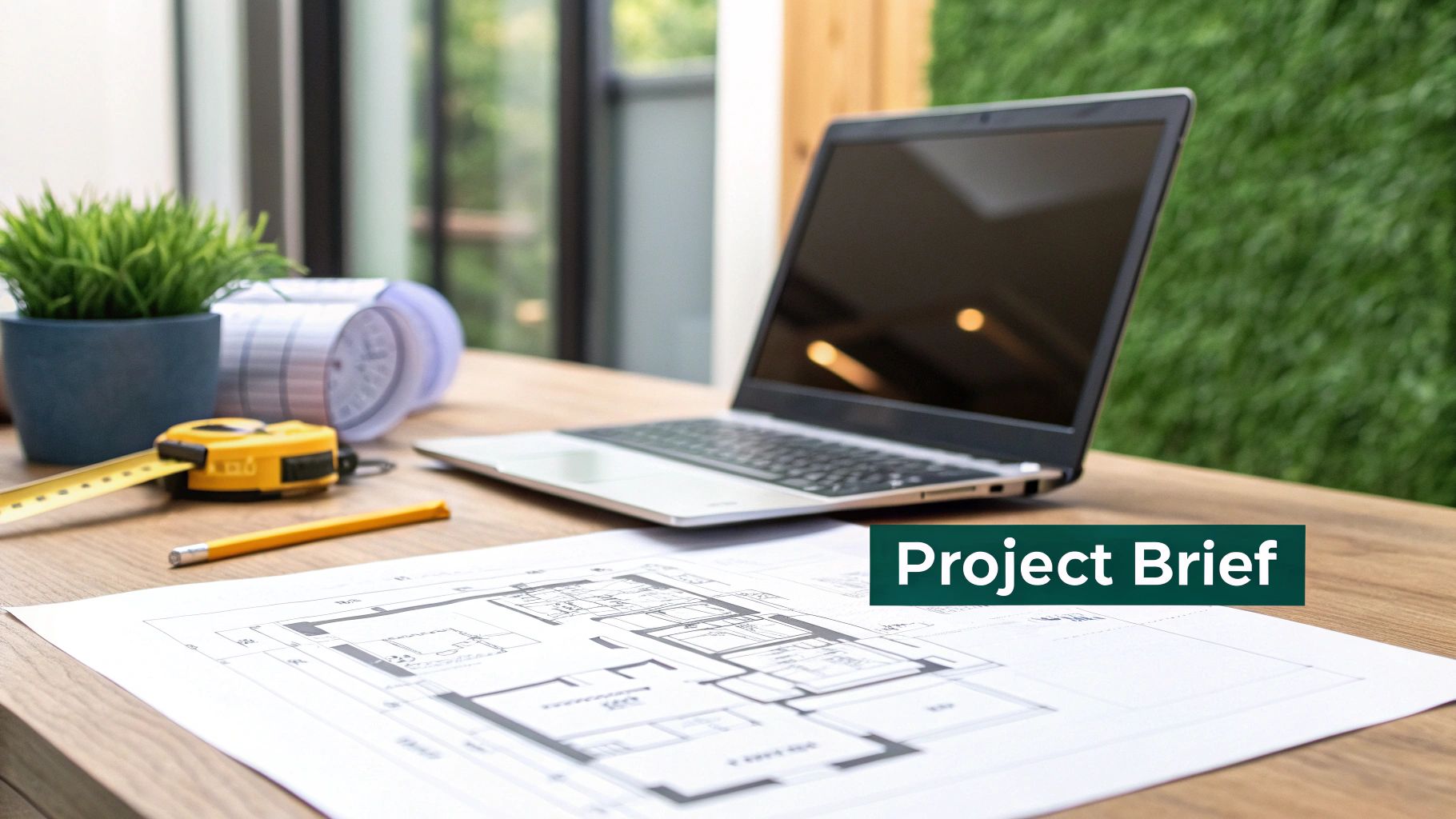
Starting a commercial project without a solid plan is a recipe for disaster. Before you start contacting architects, you need to sit down and document your vision, your budget realities, and exactly how the space needs to function. This groundwork is what enables an architect to give you a realistic proposal and decide if they’re even the right fit for the job.
Define Your Core Project Needs
To build a useful brief, start by answering a few fundamental questions. This initial thinking frames the entire conversation and gets everyone on the same page from the get-go.
Try to outline the following:
- Primary Function: What is this space for? Be specific. Is it a bustling retail store, a quiet medical office, a high-traffic restaurant, or a purely functional industrial warehouse? Each has vastly different needs.
- Essential Features: What are the absolute non-negotiables? Think about things like a mandatory loading dock, a specific number of private offices versus open-plan space, or a customer-facing reception area that needs to make a great first impression.
- Square Footage: What’s your best estimate for the size you’ll need? Make sure you account for your current operations, your team, and any plans for future growth.
As you're getting started, digging into resources on planning for office expansion can be a huge help in sharpening your project's scope.
A well-prepared project brief is the single most important tool for ensuring a successful outcome. It aligns expectations, clarifies goals, and helps architects provide meaningful, accurate feedback from the very first conversation.
The architectural industry itself is seeing healthy growth. In the United States, industry revenue is expected to grow by 1.7% in 2025, hitting an estimated $65.7 billion. This growth is being driven by a whole range of projects, from private businesses to large-scale government work.
How to Find the Right Local Architects

Okay, you've got a solid project brief. Now for the fun part: finding the right firm to bring it to life.
While typing "commercial architect near me" into a search bar is a start, it’s not how you find the best talent. The most sought-after architects are often discovered through industry connections and a bit of old-fashioned legwork. A multi-pronged approach is your best bet for uncovering the local experts you might otherwise overlook.
The real goal here is to find firms that don't just design buildings, but specialize in your type of building—be it a bustling retail space, a sterile healthcare facility, an industrial warehouse, or a delicate historic renovation.
Tap Into Professional Networks and Industry Directories
Your search should start with professional organizations. Think of these as curated lists where every member has already been vetted for credentials and licensing, giving you a baseline of quality from the get-go.
- The American Institute of Architects (AIA): The AIA's firm directory is an essential tool. You can filter by location and, more importantly, by specialty. This is how you find professionals who are committed to a high standard of practice.
- Local Business Groups: Don’t forget your own backyard. Your local Chamber of Commerce or other business associations are fantastic sources for word-of-mouth referrals. Ask other business owners in your circle who they hired and what the experience was really like.
A personal referral from a trusted colleague is often the most reliable way to find a great partner. They can provide candid insights into an architect's communication style, problem-solving skills, and ability to stay on budget.
Look Around Your Own Community
Sometimes, the best leads are right in front of you. Get out and pay attention to the commercial projects popping up around town, especially the ones that catch your eye.
Take a look at the sign on the construction site fence—it’s a simple trick, but it lists the architect, general contractor, and other key players. This gives you an immediate list of firms trusted with projects similar in scope and scale to yours.
Commercial real estate brokers are another excellent resource. They live and breathe the local market and can almost always recommend architects they’ve seen deliver great results on past deals. Their firsthand experience is incredibly valuable.
Digging into Architect Portfolios and Experience

You’ve got your shortlist. Now comes the crucial part: a deep dive into each architect's portfolio. A slick website can make anyone look good, but it’s the portfolio that reveals the real story of their experience and capability. You’re not just window shopping for pretty buildings; you’re looking for hard evidence that they can handle your specific type of project and get it done right.
Think of it as forensic accounting for architects. Critically evaluating their past work is the single most effective way to separate the true contenders from the rest.
Look for More Than Just a Pretty Façade
An architect's portfolio is more than a gallery of finished projects. It’s a testament to their problem-solving abilities. As you click through their work, you need to be asking the right questions to see past the glossy photos.
- Does the Scale Match? If you're planning a 50,000-square-foot office complex, you need to see more than just small retail renovations in their portfolio. Look for projects that mirror the size and complexity of what you have in mind.
- Do They Know Your Turf? Can you spot projects in your city or county? This isn't just about local pride; it’s a huge clue that they understand the local zoning codes, permitting headaches, and review boards you’ll inevitably face.
- What's Their Special Sauce? Are you aiming for a green building? Look for LEED certifications. Are you renovating a historic property? You need to see successful adaptive reuse projects. Find proof of the specialized skills your project demands.
The best portfolios don’t just show the ribbon-cutting ceremony. They show the "before and after" photos or detailed case studies. That’s where you see a firm's real talent for transforming a difficult space and working through real-world challenges.
The architectural services market is booming, hitting a global size of around $376.08 billion in 2023. All that growth means you have plenty of options, but it also makes it even more important to find a firm with a proven, relevant track record. You can get a better sense of industry trends by reading the architectural services market analysis from Grand View Research.
To keep your evaluation process organized, it helps to use a simple checklist. This ensures you're comparing each firm using the same standards, making your final decision much clearer.
Architect Evaluation Checklist
| Evaluation Criteria | Architect A | Architect B | Architect C |
|---|---|---|---|
| Relevant Project Type | |||
| Similar Project Scale | |||
| Local Project Experience | |||
| Specific Expertise (e.g., LEED) | |||
| Positive Client References | |||
| Clear Communication Style | |||
| Overall Portfolio Quality |
By the time you're done, your review should give you confidence that the commercial architect you choose not only gets your vision but has the on-the-ground experience to make it a reality.
How to Run a Productive Interview with an Architect
A strong portfolio gets an architect in the door, but the interview is where you decide if they're the right fit for your project. This conversation is your chance to look past the glossy photos and assess the things that truly make a project successful: communication style, problem-solving skills, and simple chemistry.
Think of it less as an interrogation and more as the start of a potential partnership. A great architect will interview you just as much as you interview them. They should be genuinely curious about your business, your goals, and your vision. The questions they ask are often more telling than the answers they give.
Questions That Get to the Heart of a Partnership
Sure, you need to talk about timelines and fees, but don't stop there. The real goal is to understand how they work.
Here’s what you should be digging into:
- Communication: How will we stay in touch? Who is my main point of contact? Will I get weekly updates, or do I have to chase them down for information?
- Problem-Solving: This is a big one. Ask them to tell you a story about a project that went off the rails. What was the challenge, and how did they work with the client and contractor to fix it?
- Budget & Cost Control: How do you keep projects from going over budget? What's your process for handling change orders when we decide to add or alter something mid-stream?
- The Team: Who will actually be drawing up my plans and managing my project day-to-day? It's crucial to know if you'll be working with the senior partner you're meeting today or a junior designer.
An architect’s ability to talk you through how they handle conflict is way more valuable than a perfect portfolio. Every single construction project hits a snag. You need a partner who can stay calm and find a solution, not just point fingers.
After the initial interview, many firms offer preliminary consultation services to hash out the project's feasibility and scope. This is a fantastic, low-commitment way to see how they think and if you genuinely work well together before signing a major contract.
Ultimately, you should walk away from the interview feeling confident not just in their technical skills, but in their ability to be a trusted guide. This isn't just about hiring a drafter; it's about finding the right long-term partner for your vision.
Making Sense of Architect Fees and Contracts
Let's talk about the money side of things. Getting a handle on how an architect gets paid is crucial for a smooth project. The fee structure isn't just an arbitrary number; it’s a direct reflection of your project's scope and complexity. Nailing this down early on prevents those awkward conversations and financial surprises later.
When you start talking numbers, you'll likely encounter a few standard ways architects bill for their work. There’s no single "best" way—the right model really depends on the specifics of your project.
Common Architect Fee Structures
Think of these as different tools for different jobs. Each one makes sense in certain situations.
- Percentage of Construction Cost: This is the go-to for most large-scale, ground-up construction. The architect’s fee is simply a percentage of the final construction cost, usually somewhere in the 5-15% range.
- Fixed Fee: If your project is straightforward with a crystal-clear scope—like a small interior renovation or a standard tenant fit-out—a fixed fee is perfect. It gives both you and the architect cost certainty from day one.
- Hourly Rate: This is ideal for the early stages of a project, like initial consultations or feasibility studies when you're not quite sure what the full scope will be. You pay for the architect's time as you use it.
Choosing the right fee structure is just as important as finding an architect whose design vision clicks with yours.
This decision tree gives you a good visual for the key checkpoints when you're trying to figure out if a local commercial architect is the right fit.
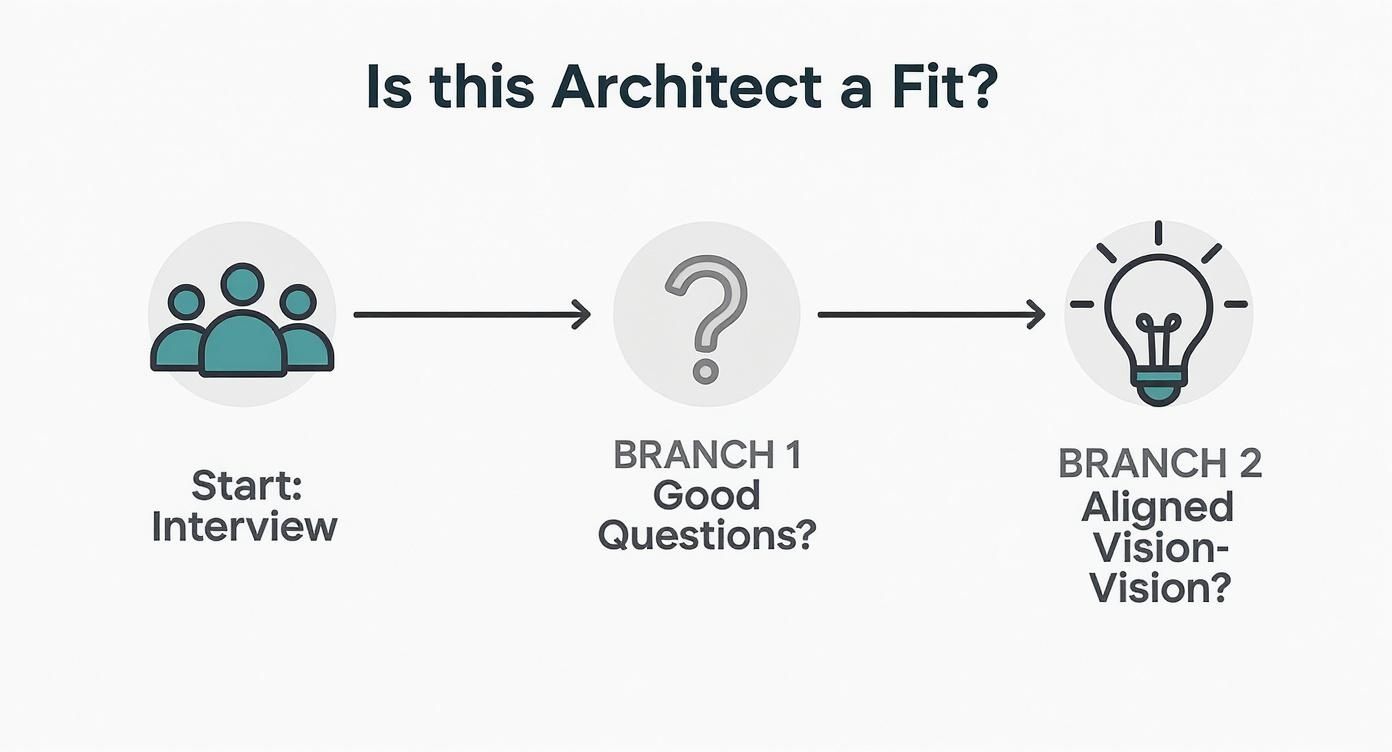
As you can see, a great partnership really boils down to asking the right questions and making sure your vision and theirs are in sync.
Beyond the fee, the contract is your project’s constitution. It must clearly outline the full scope of services, key milestones, payment schedules, and how any changes or additional work will be handled. A vague contract is an invitation for future conflict.
The demand for skilled architectural services is on the rise. In fact, the global market is projected to hit $215.13 billion in 2025. This growth is driven by the increasing complexity of modern commercial projects, which demand deep expertise from start to finish. You can dig into more details about the architectural services market from The Business Research Company. A solid, detailed contract is your best tool to ensure you get every bit of the expert service you’re paying for.
Questions You're Probably Asking About Hiring a Commercial Architect
If you're thinking about hiring a commercial architect, you've probably got a few big questions swirling around. That’s completely normal. Most business owners I talk to want to get a handle on the major pieces of the puzzle—namely cost and timeline—before they dive in. Let's clear those up so you know what to expect.
How Much Is This Going to Cost?
This is usually the first question, and the honest answer is: it depends. Architect fees aren't a flat rate because every project is unique. However, they generally fall into one of three buckets:
- Percentage of Construction Cost: This is the most common model. Fees typically run between 5% and 15% of the total construction budget. A straightforward warehouse will be on the lower end, while a complex medical facility will be on the higher end.
- Fixed Fee: If the project scope is crystal clear from day one, a fixed fee can be a great option. It gives you a predictable number for your budget.
- Hourly Rate: This is often used for the very early stages, like feasibility studies or initial consultations, before the full scope of the project is defined.
How Long Will My Project Take?
The second major question is always about the timeline. A good architect will tell you that the schedule is driven by three distinct phases, and only one of them involves actual construction.
- The Design Phase: This is where we go from ideas to detailed blueprints. How quickly this moves along often depends on you—your decisiveness and feedback are key.
- The Approval Phase: This can be the real wild card. Getting plans through city planning departments, zoning boards, and permit offices can sometimes take months. Having a local architect who knows the system and the people involved is a huge advantage here.
- The Construction Phase: This is when the contractor takes over and starts building.
An architect does so much more than just draw plans. Think of them as your project's primary advocate. They’re the one who wrangles the engineers, deciphers complicated building codes, and keeps an eye on construction to make sure the final building matches the vision and meets quality standards.
They are the central point of contact, turning your business goals into a physical space while managing all the details that make a project successful.
At Sherer Architects, LLC, we're here to walk you through every step, from answering these initial questions to seeing your project through to completion. Learn more about our commercial architecture services and how we bring clarity and expertise to the table.