SHERER ARCHITECTS

Categories
Uncategorized

Design for hospital: Essential principles for functional, welcoming care spaces

A truly successful hospital project is a masterful blend of clinical precision and human-centric design. It's about creating a space that not only heals patients but also empowers staff and delivers a solid return on investment. This isn't just about architecture; it's about understanding how every wall, window, and workflow directly impacts everything from infection rates to the bottom line.

The Strategic Blueprint for Successful Hospital Design

Think of a hospital less as a building and more as a complex, living ecosystem. For any developer or owner, the smartest move is to treat it as a high-performance asset right from the drawing board. Every single design choice, whether it's the overall campus layout or the exact placement of a hand sanitizer dispenser, has long-term consequences. These decisions echo for decades, influencing patient recovery, staff burnout rates, and the facility's financial health.

This mindset shifts architecture from a simple cost center to a core value driver. When a hospital is designed with intention, it just runs better. Nurses walk fewer miles per shift, and patient flow through high-traffic areas like the emergency department becomes smoother. A key goal is to embed strategies to boost hospital operational efficiency right into the physical DNA of the building.

Pillars of High-Performance Hospital Design

From my experience, every great healthcare facility is built on three pillars. They are completely intertwined—if one is shaky, the whole structure suffers. The real art is designing a building where architectural choices produce measurable, positive results in all three areas.

  • Improved Patient Outcomes: This is all about creating a healing environment. It’s amazing what simple design choices can do. Things like maximizing natural light, designing for quieter corridors, and ensuring a patient can easily find their way around have been proven to lower stress, reduce the need for pain medication, and actually shorten hospital stays.

  • Enhanced Operational Efficiency: A smart layout is a game-changer for staff. By cutting down on how far they have to walk for supplies or to get to a patient, you eliminate workflow bottlenecks. This means clinicians can spend less time running around and more time on what matters: patient care. The impact on operational costs is immediate and significant.

  • Strong Financial ROI: When you improve patient outcomes and boost efficiency, the hospital naturally becomes a more profitable, sustainable asset. It becomes a place that attracts and retains the best medical talent, earns higher patient satisfaction scores, and cements its reputation as a leader in the community.

This diagram really brings home how these core pillars support any successful hospital project.
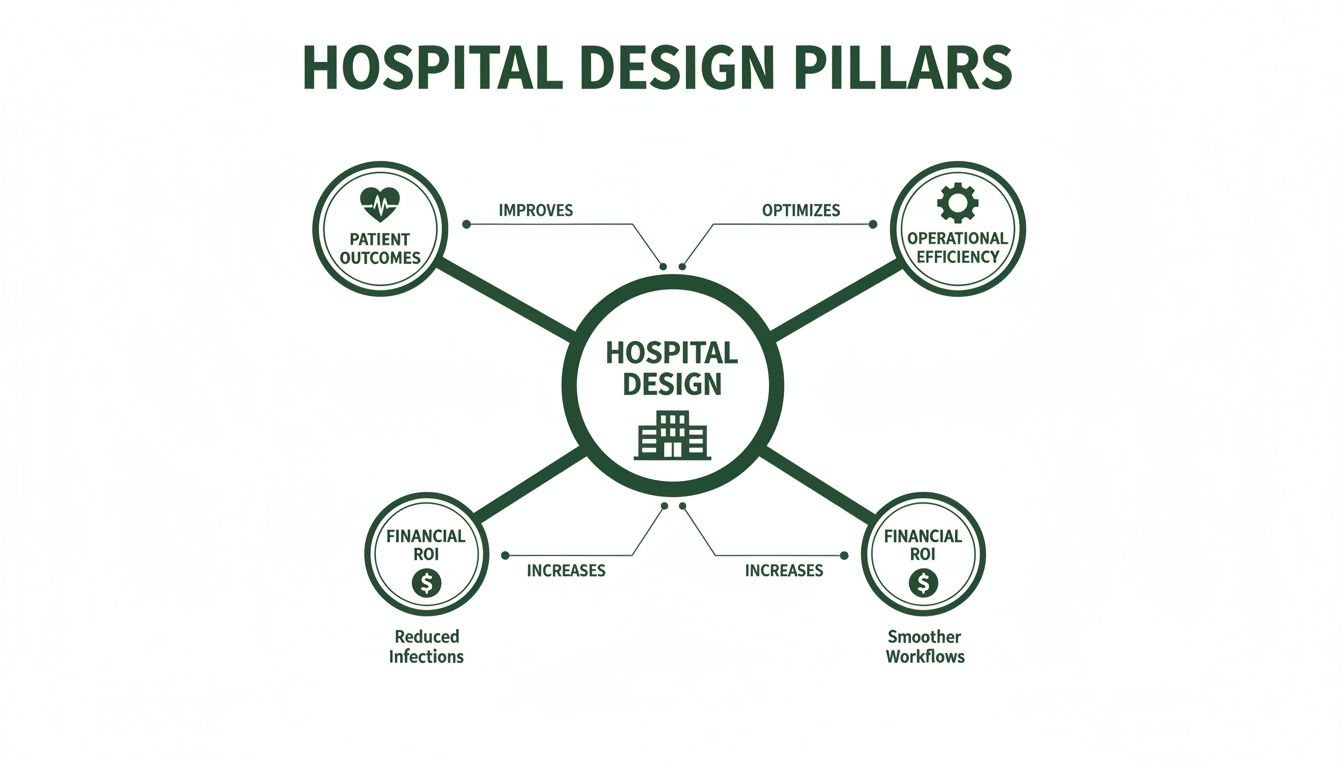
Diagram illustrating hospital design pillars improving patient outcomes, optimizing efficiency, and increasing financial ROI.

As you can see, patient outcomes, operational efficiency, and financial return are not separate goals. They're all connected, with thoughtful design acting as the foundation that holds everything together.

Mastering Site Planning for Future-Proof Hospitals

The success of a new hospital is often decided long before the first shovel hits the dirt. Strategic site planning isn't just a preliminary step; it's the very foundation of the entire project, shaping everything from patient access and emergency vehicle routes to the hospital's ability to expand down the road. It’s the single most important part of the design for hospital process.

Think of a hospital campus less like a single building and more like a small, highly specialized city. Its success depends entirely on a well-designed road grid. When the Emergency Department has a straight shot to Radiology and the Surgical Suites, you shave off precious minutes, boost efficiency, and directly improve patient outcomes. On the flip side, poor planning creates permanent operational headaches that will cost time, money, and potentially lives for decades.

This is the phase where we, as developers and architects, really dig into a potential site's DNA. The mission is to ensure the property can handle not just the hospital we need today, but also the inevitable growth and technological shifts of the next 20 or 30 years.

Core Factors in Hospital Site Evaluation

Choosing the right spot is a balancing act, weighing community needs against the hard realities of logistics and regulations. Simply finding enough available acreage isn't nearly enough.

A thorough analysis always looks at a few key factors:

  • Community and Demographic Analysis: Is the site actually where patients need it? We have to look at population density, growth projections, and accessibility via major roads and public transit for patients and staff alike.
  • Zoning and Land Use: You can't fight city hall. Navigating local ordinances is non-negotiable, so an ideal site is either already zoned for medical use or has a clear path to getting rezoned. This helps avoid long, expensive approval battles.
  • Topography and Environmental Conditions: A relatively flat site is a gift, saving a fortune in excavation costs. We also have to vet things like soil stability and flood risk to head off major structural problems later on.

Getting this foundational data right from the start helps us make an informed decision. Skipping over any one of these can inject massive risk and unforeseen costs into the project.

A hospital's physical location is its first promise to the community it serves. A well-chosen site says, 'We are here for you, easy to reach in a crisis, and ready to grow with your needs.'

Planning for Today and Tomorrow

Once a solid site is in our sights, the focus shifts to the master plan. This is where we need to balance immediate operational needs with long-term flexibility. A little strategic foresight here can save millions in renovation costs later.

A smart master plan has to nail several critical flows:

  1. Emergency Access: First and foremost, you need clear, unimpeded routes for ambulances. This entrance has to be completely separate from the main public entrance to prevent bottlenecks during a crisis.
  2. Public and Patient Flow: The main entrance should feel welcoming and be simple to navigate. We need intuitive wayfinding to key departments and plenty of accessible parking.
  3. Service and Supply Logistics: Behind the scenes, a dedicated service entrance is essential for deliveries, waste removal, and maintenance. This keeps the backstage operations from ever interfering with patient care.
  4. Future Expansion Zones: The layout must intentionally set aside land for future wings, new service lines, or extra parking structures. Crucially, this has to be planned so that future construction won't disrupt the existing hospital.

This level of detailed planning shows just how much is at stake. The global healthcare architecture market was valued at USD 8.89 billion and is expected to hit USD 13.21 billion by 2032. For developers in the U.S., where design-build is projected to account for 47% of construction spending by 2028, getting the site plan right is the most effective way to secure a return on this massive investment. You can see more on these trends in the latest industry report from Fortune Business Insights.

Designing for Patient Safety and Infection Control

When you're designing a hospital, the architectural decisions you make aren't just about aesthetics or efficiency—they're a matter of life and death. The physical layout of a building can either be your strongest ally in fighting infection or a hidden liability that puts patients at risk. Getting this right is non-negotiable; it's the foundation of any successful healthcare project and directly impacts patient outcomes and the hospital's reputation.

The first step is to think about workflows like a one-way street system designed to prevent collisions. We apply that same logic by creating completely separate “clean” and “dirty” pathways. This isn't just a suggestion; it's a critical strategy to keep sterile supplies from ever crossing paths with used materials or waste, preventing the spread of dangerous pathogens from a soiled utility room to, say, a sterile operating theater.

Building Defenses Against Infection

Stopping hospital-acquired infections (HAIs) requires weaving a multi-layered defense system right into the building's DNA. This goes so much deeper than just good cleaning routines. It’s about creating an environment that is fundamentally hostile to germs.

Here are a few of the most critical design strategies we use:

  • Ventilation and Airflow: You absolutely cannot skimp on specialized HVAC systems, especially in high-risk areas. For instance, negative-pressure isolation rooms are engineered so air flows into the room from the corridor but can’t escape back out. This traps airborne contaminants inside, protecting everyone else in the hospital.
  • Material Selection: Surfaces are the front lines in the war on germs. We have to specify materials for floors, walls, and counters that are non-porous, incredibly durable, and easy to sanitize. Even tiny details matter, like minimizing seams and joints where microbes love to hide.
  • Spatial Separation: Sometimes the simplest solution is the best. Just providing enough space between patient beds makes a huge difference. In fact, single-patient rooms are now the gold standard because they dramatically reduce infection transmission and, as a bonus, let patients rest better.

Beyond powerful ventilation, it’s our job to embed proven principles for preventing cross-contamination into every aspect of the layout. Every single choice, from the type of door handle to the finish on the walls, is an opportunity to make the building safer.

The Healing Power of Evidence-Based Design

But patient safety is more than just fighting infections. The physical environment itself has a real, measurable effect on a patient's mental state, which in turn speeds up—or slows down—their physical recovery. This is the whole idea behind evidence-based design (EBD), a practice that uses solid research to create spaces that actively help people heal.

A healing environment isn't a luxury; it's a clinical tool. Thoughtful design can reduce patient anxiety, lower the need for pain medication, and even shorten the length of a hospital stay, delivering clear returns for both the patient and the provider.

For developers and owners, thinking about EBD isn't an expense; it’s a strategic investment in better outcomes. The key elements are surprisingly straightforward:

  • Maximizing Natural Light: Sunlight isn't just pleasant; it helps regulate a patient's circadian rhythms, leading to better sleep and less depression. Time and again, studies have shown that rooms with large windows and views of nature lead to faster recovery times.
  • Clear Wayfinding: Nothing raises stress levels faster than getting lost in a sprawling, confusing hospital. Intuitive signage, logical floor plans, and memorable landmarks are essential to help anxious patients and visitors navigate with confidence.
  • Acoustic Control: Hospitals are notoriously noisy, and all that racket is a major stressor. Using sound-absorbing materials and designing quieter nurse stations and corridors creates a much more restful, therapeutic atmosphere for everyone.

By weaving these principles into the design from day one, a hospital becomes more than just a place to get treated. It transforms into an active partner in the healing process—a facility that not only safeguards patients but also protects its own operational integrity for years to come.

Integrating Complex MEP and Technology Systems
Well-lit hospital hallway featuring green doors, a large window, and a 'PATIENT SAFETY' message on a green mat.

If a hospital's structure is its skeleton, then the Mechanical, Electrical, and Plumbing (MEP) systems are its vital organs and central nervous system. These intricate networks are the facility's lifeblood, humming away behind the walls to make sure patient care happens without a hitch. For developers and owners, getting a handle on this complexity is non-negotiable for a successful design for hospital project.

Think of the hospital as a living, breathing thing. Its electrical grid is the nervous system, powering everything from life-support machines to the surgeon's overhead light. The plumbing and medical gas lines act as the circulatory system, pushing clean water, oxygen, and vacuum pressure exactly where they need to go. And the HVAC system? That's the lungs, constantly circulating clean, filtered air while whisking away contaminants.

This isn't just a clever analogy—it's the reality of the stakes. A failure in any one of these systems can have immediate, life-threatening consequences. That’s why intelligent, coordinated MEP planning isn't just a technical box to check; it’s a core part of risk management and building a truly resilient facility.

Coordinating Mission-Critical Infrastructure

Seamless integration is the name of the game. In a hospital, the MEP and technology systems are light-years more complex than in your typical office building. They have to work together in a tightly choreographed dance, and it’s the architect’s job to act as the conductor for a massive team of engineers and specialists.

Several areas require absolute precision:

  • Redundant Power Systems: A hospital simply cannot lose power. Period. The design has to include multiple layers of backup, from uninterruptible power supplies (UPS) for instant, momentary support to massive generators capable of running the entire facility for days.
  • Specialized HVAC Requirements: An operating room has drastically different air filtration and pressure needs than a public waiting area. The HVAC system must be meticulously zoned to serve the specific clinical demands of each space, preventing cross-contamination and maintaining sterile fields.
  • Medical Gas Distribution: A dedicated, and highly regulated, network of pipes is needed to safely deliver oxygen, medical air, and vacuum suction. The layout has to be perfect—planned for safety, efficiency, and easy access for future maintenance.
  • Robust Data Infrastructure: Modern medicine runs on data. The building must support a huge network of cabling for electronic health records (EHR), diagnostic imaging, patient monitoring systems, and secure Wi-Fi for both staff and visitors.

The biggest headache is preventing system clashes. Without one person leading the charge, you'll inevitably find a plumbing line routed through the exact same space an HVAC duct needs to occupy. An experienced architect spots these conflicts before they happen, saving immense time and money while ensuring all systems fit together and can be easily maintained later on.

A well-designed MEP system is invisible when it works perfectly but catastrophic when it fails. The architect's role is to ensure its invisibility by orchestrating a flawless integration from day one.

The Architect as System Integrator

Ultimately, the architect is the one responsible for turning a dozen independent systems into a single, high-performing whole. This leadership is what keeps a project on track and on budget, all while making sure the finished building meets every operational and regulatory standard.

The architect’s role in MEP coordination is multifaceted. They become the central hub of communication between mechanical, electrical, plumbing, and structural engineers, ensuring the needs of one system don't compromise another.

They also have to think about the future. This means designing systems with enough spare capacity for the medical technologies of tomorrow. It also means planning for interstitial spaces—the valuable real estate between floors—to allow for easier maintenance and upgrades down the line without shutting down critical hospital operations. A smart design for hospital MEP strategy is truly the cornerstone of an efficient, resilient, and safe healthcare environment.

The following table breaks down the core MEP systems and the specific challenges they present in a hospital setting.

Key MEP System Considerations in Hospital Design

MEP System Primary Function in Hospital Key Design Challenge
HVAC Controls air temperature, humidity, filtration, and pressure to prevent infection spread and maintain sterile environments. Meeting diverse and strict air change rates (ACH) and pressure relationships for different clinical zones (e.g., ORs vs. patient rooms).
Electrical Power Provides reliable normal and emergency power to all equipment, from lighting to critical life-support machines. Designing robust and redundant power sources (generators, UPS) with seamless, automatic transfer to avoid any interruption in care.
Plumbing Delivers potable water, hot water, and manages sanitary and storm drainage. Includes specialized systems for medical waste. Ensuring proper backflow prevention, managing high water demand, and designing specialized drainage for labs and treatment areas.
Medical Gas Systems A dedicated piping network that delivers life-sustaining gases like oxygen, medical air, nitrous oxide, and vacuum suction. Ensuring 100% system integrity and safety through meticulous planning, installation, and rigorous testing to prevent leaks or cross-contamination.
Data & Technology Supports electronic health records (EHR), nurse call systems, patient monitoring, imaging (PACS), and building automation. Planning for massive cable pathways, secure network closets, and sufficient bandwidth while future-proofing for next-gen technologies.

Each of these systems is a project in itself, but in a hospital, they must function as one cohesive, reliable unit.

Navigating Healthcare Codes and Regulations
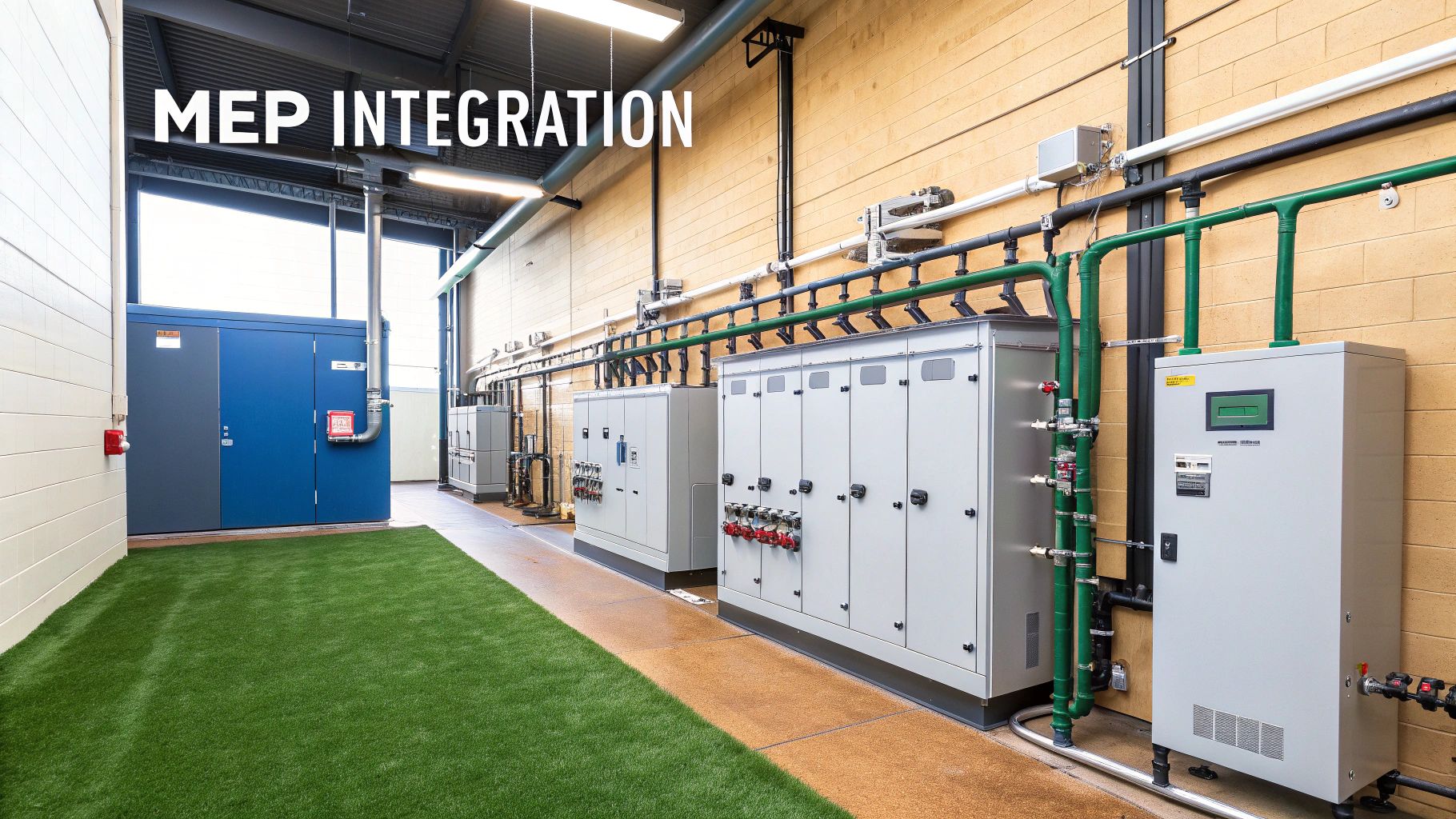
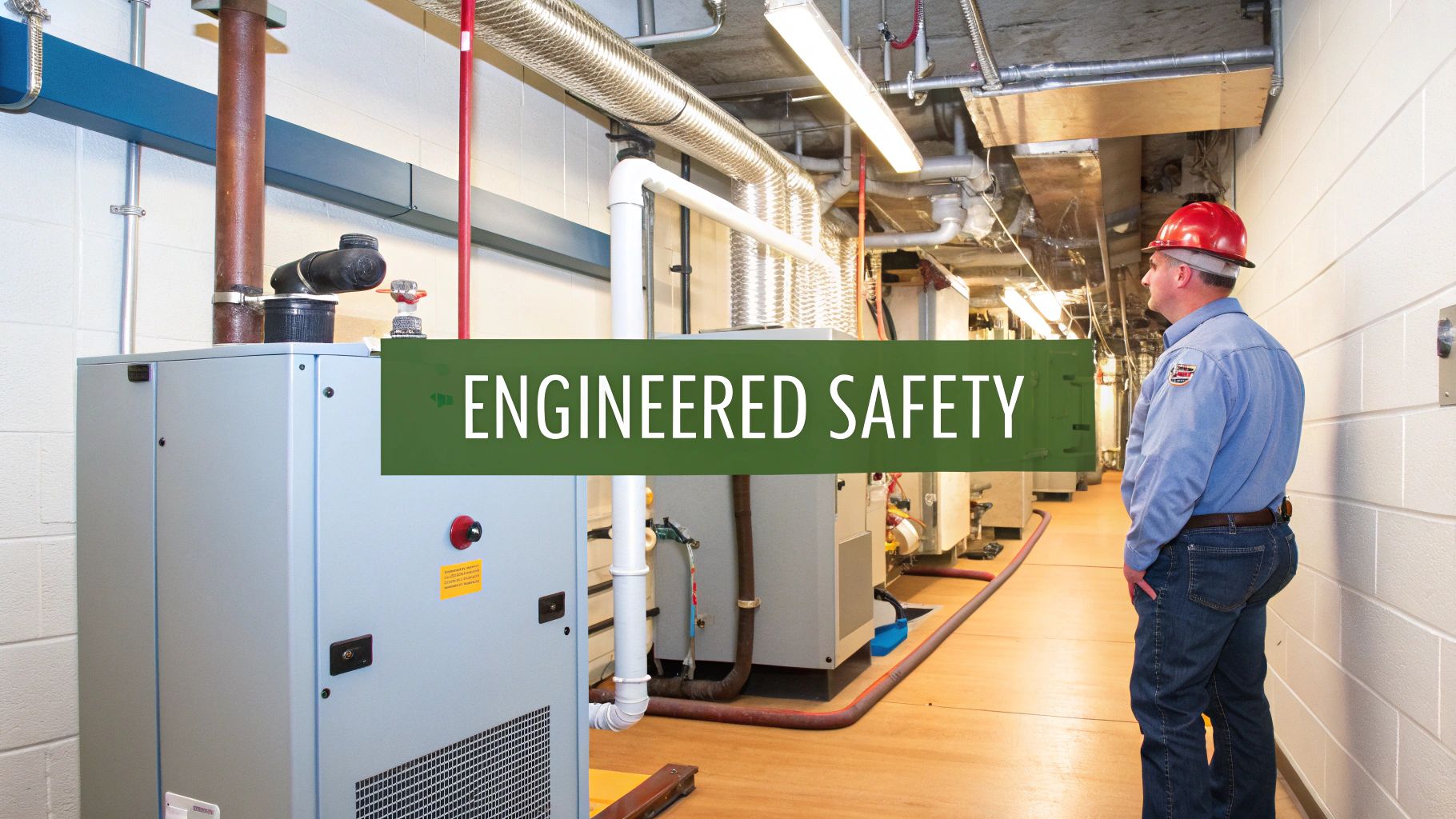
Interior of a modern facility showcasing integrated MEP systems with various industrial equipment.

For any developer or owner new to the healthcare space, the sheer volume of codes and regulations can be intimidating. It often feels like the biggest roadblock in a design for hospital project—a confusing mix of acronyms and rules that seem built to cause delays.

The best way to approach this isn't to see these codes as obstacles, but as a roadmap. Every rule, from a local building code to a federal accessibility standard, is there for a critical reason: to keep patients and staff safe and ensure the facility operates as it should. Tackling compliance head-on from the very first design meeting isn't just a good idea; it's the only way to manage risk and keep a project on track.

This is where having an experienced architectural partner becomes invaluable. They’ve been down this road before. They know how to spot regulatory pitfalls early, translate dense code requirements into practical design decisions, and ultimately, guide the project through the approvals process without costly surprises.

Understanding the Key Governing Bodies

While you’ll deal with plenty of local and state authorities, a handful of major players establish the standards that influence nearly every healthcare project in the U.S. Knowing who they are and what they do is the first step.

You’ll run into these primary groups constantly:

  • Facility Guidelines Institute (FGI): Think of the FGI Guidelines as the foundational rulebook. They set the minimum standards for almost everything, from the square footage of an operating room to the types of materials you can use on the walls in patient areas. Most states adopt these guidelines as their baseline.
  • Americans with Disabilities Act (ADA): The ADA is about ensuring everyone has equal access. In a hospital, this means much more than just ramps and parking spots. It dictates corridor widths for gurney turning radiuses, clearances needed for patient lifts, and even how easy it is for someone in a wheelchair to use a sink or call button.
  • State Health Departments: Every state has its own health department that licenses and approves hospital construction. They typically start with the FGI Guidelines but almost always add their own unique—and often stricter—requirements.

This is why it's so important to work with a design team that has a strong track record in your specific state. Their local knowledge can save you from having to do expensive redesigns after the first round of plan reviews.

Think of healthcare codes as the "rules of the road" for hospital construction. You wouldn't build a highway without them, and you can't build a safe, licensable hospital without a deep understanding of the regulatory framework.

The Role of Proactive Planning and Documentation

The secret to a smooth regulatory journey is getting ahead of it. Don't wait for a plan reviewer to send back a list of corrections. A smart project anticipates what reviewers are looking for and builds a solid compliance strategy right into the earliest design sketches.

This means documentation can't be an afterthought; it has to be a core part of the process. Every drawing and specification is proof that your design meets all the non-negotiable requirements for life safety, infection control, and patient access.

An architectural team that specializes in healthcare will assemble this evidence meticulously, making the trip through the approvals pipeline far less painful. By taking this proactive stance, you can move forward with confidence, knowing you're building a facility that will be fully licensable from day one. It transforms a potential bottleneck into a predictable, manageable part of the project.

Giving Old Buildings New Life: The Rise of Adaptive Reuse in Healthcare

The old playbook for expanding healthcare services—finding an empty plot of land and building a massive new hospital from the ground up—isn't the only option anymore. In fact, a smarter, more nimble strategy is taking hold: adaptive reuse. This is the art of transforming existing, often overlooked buildings into state-of-the-art medical facilities.

Think of it this way: instead of starting from scratch, your raw material might be an old, shuttered big-box store or a half-empty office building. It’s a story of transformation, one that shows savvy developers and healthcare owners how to unlock the incredible potential hiding in plain sight. By giving an existing structure a new and vital purpose, you're not just building a clinic; you're breathing new life into a community asset.

This isn't just a passing trend; it's a fundamental shift in how the industry thinks about growth. Within the broader design for hospital sector, renovation and adaptive reuse now go toe-to-toe with new greenfield campuses for investment dollars. The healthcare architecture market in the U.S. alone is on track to hit USD 2.79 billion by 2030.

Look at the numbers from a recent survey: while 34% of facilities were planning new or expanded hospitals, a nearly equal number were focused on infrastructure upgrades (18%) and central plant projects (17%). Medical office buildings (MOBs), which are often perfect for reuse projects, continue to be a hotbed of activity. You can dig deeper into the numbers and see the durable opportunity in healthcare conversions for yourself.

Spotting the Right Candidates for Conversion

Not every empty building has what it takes to become a healthcare facility. The best candidates have "good bones"—a solid foundation that can support the intense demands of a clinical setting. Getting this right from the start makes the entire conversion process smoother and more financially sound.

Here are the types of buildings that often make for successful projects:

  • Former Big-Box Retail Stores: These are goldmines for outpatient clinics or ambulatory surgery centers. Their massive, open floor plans, high ceilings, and acres of parking are huge assets. You can easily carve out space for clinical pods, waiting areas, and procedure rooms.
  • Vacant Office Buildings: A multi-story office building can be a great fit for specialty clinics or a multi-tenant medical office building (MOB). While the existing electrical and plumbing will need a serious overhaul, they provide a solid framework to build upon.
  • Underutilized Warehouses: Much like retail stores, warehouses offer vast, flexible spaces. They're especially well-suited for services that need room for bulky equipment, such as imaging centers or large-scale physical therapy facilities.

The Unique Hurdles of a Healthcare Conversion

While the benefits are clear, turning an old building into a modern medical center comes with its own set of challenges. This isn't a blank-slate project; it’s more like skillfully retrofitting a high-performance engine into the chassis of a classic car. You absolutely need an experienced architectural partner to navigate the inevitable twists and turns.

The art of adaptive reuse in healthcare is seeing past what a building was and envisioning what it can become. It's a puzzle of integrating advanced medical systems within an existing frame while honoring the building's original character.

You have to be ready to tackle a few key challenges head-on:

  1. Beefing Up the Structure and Infrastructure: Medical equipment—think MRI and CT scanners—is incredibly heavy. Floors often need to be structurally reinforced to handle the load. Then there's the complex web of MEP (Mechanical, Electrical, Plumbing) systems for medical gases, backup power, and specialized HVAC, all of which must be threaded through a structure that was never designed for them.
  2. Meeting Today's Strict Healthcare Codes: The entire building has to be brought up to modern healthcare codes, including the FGI Guidelines and ADA requirements. This can mean widening corridors, installing new fire suppression systems, and ensuring every finish meets exacting infection control standards—all within the constraints of an existing frame.
  3. Dealing with Hidden Hazards: Older buildings often come with baggage like asbestos or lead-based paint. These hazardous materials have to be completely and safely removed before any real renovation work can start, which adds a critical, and often costly, first step to the project.

By getting ahead of these issues, developers can turn a forgotten building into a vital community healthcare asset, delivering immense value in the process.

Common Questions on Hospital Design Answered

Diving into a hospital design project can feel overwhelming. For developers and owners, the path is filled with questions. Here, we tackle some of the most common ones with straightforward, experience-based answers to help you navigate your next healthcare project.

What Are the Biggest Cost Drivers in a Hospital Design Project?

The most significant costs in a hospital build are rarely the things you see. They're hidden within the walls and ceilings—the complex systems and intense regulatory requirements that keep a modern medical facility running safely.

MEP systems (mechanical, electrical, plumbing) are a huge chunk of the budget. We're not talking about your standard office HVAC. Hospital systems demand sophisticated air filtration, fully redundant power grids with massive backup generators, and specialized medical gas lines. Each of these comes with a serious price tag.

Then there's the medical equipment, which dictates major architectural choices. An MRI machine, for example, is incredibly heavy and requires not just significant structural support but also specialized radio frequency (RF) shielding built directly into the room. This isn't just an equipment purchase; it's a construction project in itself.

Finally, every surface and finish must meet strict infection control standards. This means specifying materials that are non-porous, highly durable, and easy to clean—all of which are more expensive than typical commercial-grade products. A skilled architect will find savings through smart planning and value engineering, but these core requirements are non-negotiable.

How Long Does a Typical Hospital Project Take?

While every project is different, a good rule of thumb for a moderately sized hospital is 3 to 5 years from the first conversation to opening day. It's a marathon, with each leg of the race just as important as the last.

Here's how that timeline usually breaks down:

  • Programming & Schematic Design: This is the foundational stage where we define goals and sketch out the big ideas. It usually takes 6 to 9 months.
  • Design Development & Construction Documents: We spend 12 to 18 months turning those initial concepts into a highly detailed set of blueprints.
  • Permitting & Regulatory Review: Getting the green light from all the necessary agencies can take anywhere from 3 to 6 months, and sometimes longer in certain cities.
  • Construction: The actual build-out is typically the longest phase, requiring 18 to 24 months or more, depending on the project's complexity.

Adaptive reuse projects can sometimes shave time off this schedule, but they come with their own risks—like discovering a surprise in the existing structure that needs to be fixed.

Evidence-Based Design isn't about chasing trends; it's about using solid research to create environments that are clinically proven to improve healing, reduce staff stress, and increase patient safety. It's a strategic investment in better outcomes.

What Is Evidence-Based Design and Why Does It Matter?

Evidence-Based Design (EBD) is about taking the guesswork out of architecture. It’s a disciplined approach where we use credible, data-backed research to make design decisions that have a direct, positive impact on patients and staff. It’s where the science of medicine meets the art of architecture.

This isn't just about creating a pleasant atmosphere. It's about using the physical environment as a tool for healing. For instance, countless studies have shown that patient rooms with large windows and views of nature can actually reduce the need for pain medication and shorten hospital stays. Another great example is using lighting systems that support the body's natural circadian rhythms, helping patients rest better and recover more quickly.

For a hospital owner, EBD is simply good business. It leads to better patient satisfaction scores, helps attract and retain top medical talent, and can even reduce the rate of medical errors. Ultimately, it’s a powerful investment in the facility's bottom line and its reputation for providing world-class care.


At Sherer Architects, LLC, we specialize in guiding developers and owners through every stage of complex commercial projects, including new construction and adaptive reuse for healthcare. We transform challenges into opportunities, delivering beautiful, enduring, and sustainable results. Learn how our expertise can maximize the value of your next project.
Categories
Uncategorized

A Guide to Modern Design for Hospitals

Designing a hospital today is about so much more than just bricks and mortar. It’s about creating a living, breathing environment that promotes healing, drives efficiency, and ensures long-term financial viability. Think of it less as a building and more as a strategic asset, one where patient-focused layouts and smart infection control are just as critical as the foundation itself. This approach builds resilient, future-proof, and profitable facilities from the very start.

The New Blueprint for Hospital Design

An architect points at a modern hospital building model and blueprints on a wooden table.

For commercial developers and investors, healthcare is a massive opportunity, fueled by an aging population and changing medical needs. The old view of a hospital as simply a place to treat the sick is long gone. Today, a successful facility is a complex system where every square foot is meticulously planned to improve patient outcomes, streamline operations, and deliver a solid return on investment.

This means that design choices have real financial weight. A thoughtfully designed hospital can lead to lower staff turnover, fewer hospital-acquired infections, and better patient satisfaction scores—all factors that directly impact the bottom line. You're not just building a structure; you're investing in a high-performance asset built to last and adapt.

Why Strategic Design Matters Now More Than Ever

The need for new and updated healthcare facilities is picking up speed. With the global population aged 60 and older expected to hit 2 billion by 2025, the demand for hospitals, clinics, and senior care centers is soaring. You can learn more about these healthcare construction industry trends and how they're shaping what’s next.

To really make the most of this boom, developers need to get a handle on the core principles of modern hospital architecture. These aren't just nice-to-haves anymore; they're the pillars of a successful project.

A modern hospital is a puzzle where every piece—from the emergency room's location to the choice of flooring material—must fit perfectly. The goal is to create an environment that actively supports healing for patients and provides an efficient, safe workplace for staff.

This guide is your roadmap. We’ll walk through how to create facilities that are not only compliant and functional but also resilient and financially sound. We'll dig into key areas like:

  • Patient-Centered Layouts: Designing intuitive spaces that lower stress and make the patient’s journey smoother.
  • Robust Infection Control: Building in features that stop pathogens in their tracks.
  • Sustainable Infrastructure: Creating efficient systems that cut operating costs and improve durability.
  • Adaptive Reuse Strategies: Finding hidden value by converting existing buildings for healthcare purposes.

At the end of the day, working with an experienced architecture firm is non-negotiable. They are the ones who can untangle the web of building codes, get the most out of your site, and deliver a facility that’s ready for whatever the future holds.

Strategic Site Planning: The Blueprint for a High-Performing Hospital

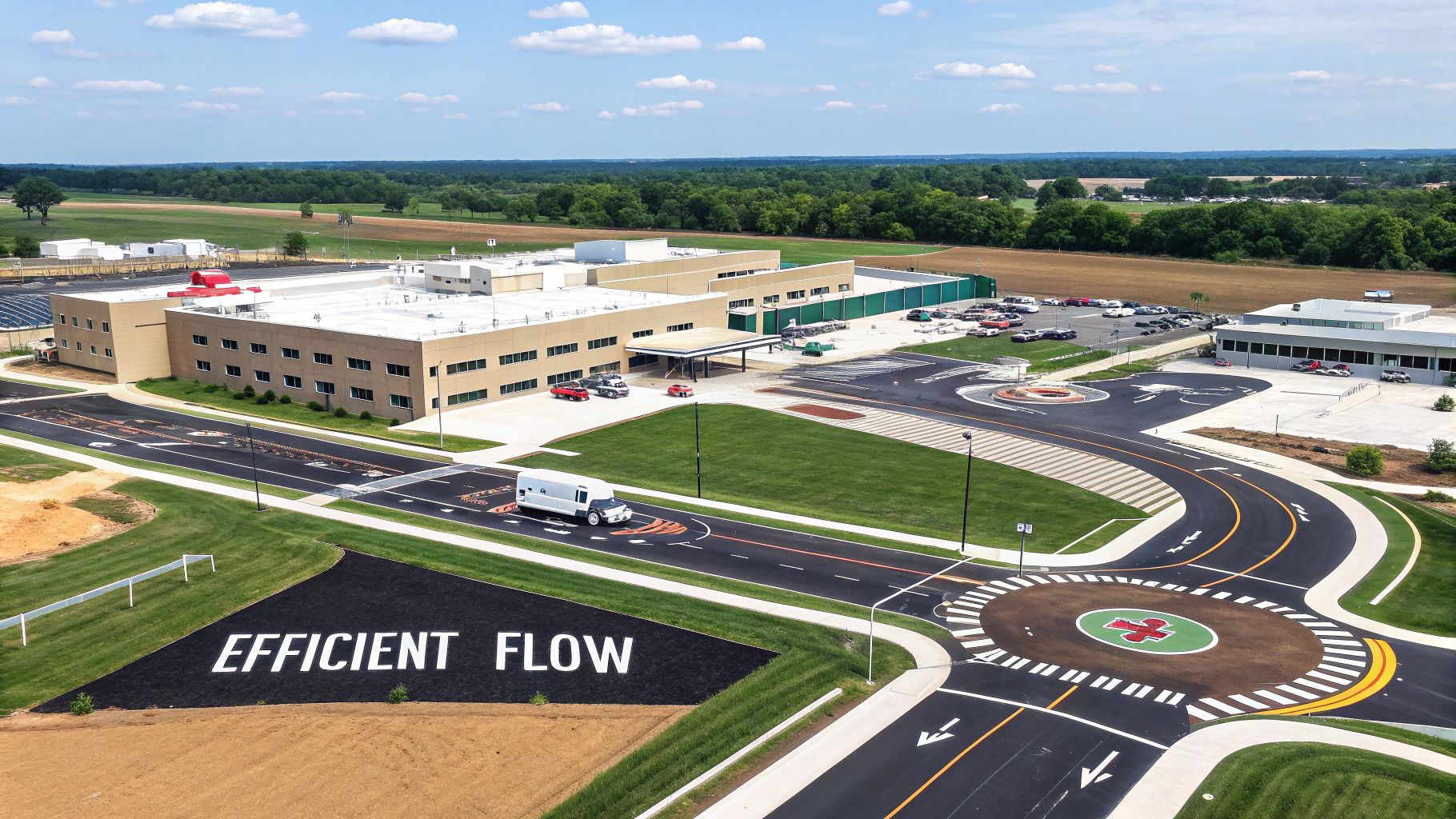
Aerial view of a modern hospital campus with an efficient road system, featuring a roundabout and 'EFFICIENT FLOW' text.

Long before the first shovel hits the ground, the ultimate success of a hospital is already taking shape in its master plan. Getting the site planning right is the absolute bedrock of a well-run healthcare facility. Think of it as choreographing a complex ballet: you have patients, staff, ambulances, and supply trucks, and they all need to move across the stage without ever colliding.

This initial phase sets the tone for everything. A site plan that’s an afterthought will create daily headaches, from gridlocked parking lots to inefficient patient transfers. On the other hand, a strategic layout is a direct investment in staff efficiency, a better patient experience, and the long-term value of the property itself.

Establishing Clear Zones of Access

A hospital campus is a convergence point for many different groups, each with their own unique path and purpose. The first order of business is carving out dedicated, intuitive routes to prevent a logistical nightmare. This isn't just about being organized; it’s about safety and speed when seconds truly matter.

You have to separate and optimize key access points:

  • Public and Patient Access: The main entrance needs to be obvious, welcoming, and easy to find from the road. It requires convenient drop-off zones and plenty of parking. This is the hospital's first impression—your chance to reduce stress before patients even walk through the door.
  • Emergency Vehicle Access: Ambulances need their own straight shot from the main road to the emergency department. This route has to be completely isolated from public traffic to guarantee a clear path for life-or-death situations.
  • Staff and Service Access: A dedicated staff entrance helps manage the flow of people during shift changes. A separate service corridor for deliveries, waste removal, and maintenance keeps all the crucial "backstage" operations out of the public eye.

This careful separation means a delivery truck will never block an ambulance, and a visitor looking for the cafeteria won't accidentally end up in a restricted staff hallway. For a developer, this translates directly into a safer, more professional, and highly functional asset.

The Logic of Departmental Adjacency

Once you’ve nailed the external flow, the internal layout demands just as much attention. Departmental adjacency is the art of placing related functions next to each other to slash travel time for both patients and staff. Picture a trauma patient arriving in the ER. The trip to get an X-ray or CT scan has to be measured in feet, not hallways.

The goal is to build an efficient "clinical core." By clustering the emergency department, surgical suites, intensive care units (ICUs), and diagnostic imaging together, you create a powerful hub for acute care. This saves precious minutes and reduces the immense physical strain on staff, who can easily walk several miles during a single shift.

This logic applies everywhere. Outpatient services, for instance, should be clustered near the main entrance with their own reception areas. This keeps outpatients from having to navigate the maze of inpatient wings, which streamlines their visit and cuts down on foot traffic in critical care zones.

Planning for Future Growth and Adaptability

A hospital is never really "finished." Medical technology marches on, community demographics shift, and new service lines are always being added. One of the biggest mistakes in site planning is failing to look ahead. A smart master plan bakes in modular design and earmarks land for future vertical or horizontal expansion.

Think about incorporating these forward-thinking strategies from day one:

  • Phased Construction: Design the initial building so that new wings can be seamlessly added later without shutting down existing operations.
  • "Soft Space": Place departments that are relatively easy to move—like administrative offices—next to clinical areas that are prime candidates for expansion, such as radiology or the surgical department.
  • Infrastructure Scalability: Make sure the central energy plant, data closets, and MEP (mechanical, electrical, plumbing) systems are built to handle a larger load down the road.

By planning for expansion from the very beginning, developers can sidestep the massive costs and disruptions of a major retrofit later on. This foresight doesn't just future-proof the facility; it dramatically increases its value as a long-term investment.

Designing For Patient Healing And Staff Well-Being

Once you get past the technical blueprints for MEP systems and the logistics of site planning, you arrive at the real heart of hospital design: creating spaces that actively help people heal. This isn't just about building a functional box to house medical equipment. A truly well-designed hospital treats the environment itself as a powerful tool in a patient's recovery.

At the same time, we have to remember the people providing the care—the nurses, doctors, and support staff. Their work is incredibly demanding, and the physical space can either be a source of constant friction or a genuine support system. Focusing on these human factors isn't a fluffy extra; it's a strategic move with a clear return on investment.

When patients feel safe and comfortable, their stress levels plummet, which is clinically proven to speed up recovery. For staff, a supportive workspace boosts efficiency, reduces medical errors, and improves retention. In short, every hospital design has to serve two clients at once: the patient and the provider.

Creating Environments That Promote Healing

This is where evidence-based design comes into play. It’s all about using solid research to connect specific design choices to real-world health benefits. For example, one of the single most impactful decisions a hospital can make is moving away from old-school multi-bed wards to private patient rooms. It’s not just about privacy; studies show that single rooms can slash the risk of healthcare-associated infections (HAIs) by more than 50% and lead to much better sleep.

Another game-changer is biophilic design—the simple idea of bringing the outdoors in. It’s amazing what a view of nature from a window can do. Research has shown it can actually reduce a patient's need for pain medication and shorten their hospital stay.

By incorporating natural light, views of greenery, indoor plants, and materials like wood and stone, we tap into our innate connection to nature. This simple strategy has a profound impact on reducing patient anxiety and creating a sense of calm in what is often a highly stressful setting.

We also have to think about the psychological stress of just getting around. A massive, unfamiliar building is intimidating. Clear and intuitive wayfinding systems that use color-coding, logical layouts, and simple signage empower patients and visitors. When people aren't worried about getting lost, they arrive at their appointments much calmer and more prepared.

Designing For Staff Efficiency And Morale

The well-being of hospital staff is just as critical as patient care. A burned-out, exhausted team is more likely to make mistakes, and high turnover is incredibly expensive. Smart hospital design tackles these problems head-on by creating workflows and support spaces that make a tough job more manageable.

A great example is the shift toward decentralized nursing stations. Instead of one massive, noisy hub, smaller stations are tucked closer to patient rooms. This one change dramatically cuts down on the miles nurses have to walk each day, keeps them more visible to patients, and gives them quieter spots for focused work.

And let's not forget the staff-only spaces. Thoughtfully designed break rooms with natural light, comfortable furniture, and quiet zones give staff a place where they can actually recharge. When you’re creating spaces for recovery and comfort, strategies for preventing sick building syndrome are essential to protect everyone’s health.

Weaving Technology Into The Human Experience

Looking ahead, technology is being woven into the very fabric of the hospital. We're seeing a major shift away from rigid, sterile buildings toward adaptive healing environments. In fact, the smart hospital market is growing at a staggering 21.9% annually worldwide. This means integrating IoT sensors, AI, telemedicine capabilities, and modular zones that can be easily reconfigured. You can find out more about how these hospital design trends are shaping the future.

The key is that all this tech has to serve the human experience, not complicate it. For a patient, this might be a smart bed that tracks vitals and adjusts for comfort, or a tablet to control the room's lighting and video chat with family. For staff, it could be a real-time location system that finds the nearest available IV pump, saving precious minutes. The goal is always to use technology to free up caregivers to do what only they can do: care for people.

The connection between patient-centered features and tangible returns is undeniable. The table below breaks down how specific design choices translate into operational and financial wins.

Patient-Centered Design Features And Their ROI

Design Feature Patient Benefit Operational/Financial ROI
Private Patient Rooms Reduced stress, improved sleep, better confidentiality, lower infection risk. Lower rates of costly HAIs, higher patient satisfaction scores (HCAHPS), shorter lengths of stay.
Biophilic Design (Views of Nature, Natural Light) Lowered anxiety, reduced need for pain medication, faster recovery. Decreased pharmacy costs, shorter patient stays, improved patient and staff morale.
Clear Wayfinding & Signage Reduced confusion and anxiety, on-time arrivals for appointments. Fewer missed appointments, less staff time spent giving directions, improved patient flow.
Family-Friendly Spaces (In-Room Sleepers, Lounges) Increased family support and involvement in care, improved comfort. Higher patient satisfaction, better care coordination with family caregivers.

Investing in these elements isn't just about creating a more pleasant space; it's a core business strategy for a modern healthcare facility. These features directly contribute to better patient outcomes, a more efficient staff, and a stronger financial bottom line.

Architectural Strategies for Infection Control

When you think about fighting infections in a hospital, you probably picture hand sanitizer and sterilization. But the truth is, a hospital’s first line of defense is its own architecture. The building itself—its layout, its airflow, the very materials used in its construction—can either help spread dangerous pathogens or actively work to contain them.

Good design builds safety right into the walls. It’s about creating an environment that inherently protects everyone inside, from the most vulnerable patients to the clinical staff on the front lines. For developers, this isn't just an added expense; it's a fundamental investment in patient safety, risk reduction, and the long-term viability of the facility.

Mastering Air Quality and Ventilation

A hospital's HVAC system is so much more than a climate control unit. Think of it as the building’s respiratory system, engineered to manage airflow with surgical precision. The entire goal is to trap and remove airborne contaminants before they can travel from a high-risk area into a clean one.

It’s a surprisingly sophisticated process, relying on a few key engineering principles:

  • Pressure Differentials: This is where the magic happens. We design isolation rooms for patients with infectious diseases to have negative air pressure. This means air is constantly pulled into the room from the hallway and then exhausted directly outside through special filters. Contaminated air can't escape. On the flip side, rooms for highly vulnerable patients, like operating theaters or transplant units, use positive air pressure. Filtered air is pushed out of the room, creating a protective bubble that keeps germs from getting in.
  • Advanced Filtration: All that air is run through high-efficiency particulate air (HEPA) filters. These aren't your standard home air filters; they are designed to capture microscopic particles like viruses and bacteria with 99.97% efficiency, constantly scrubbing the air clean as it circulates.
  • Dedicated Exhaust Systems: You can't have the air from a pathology lab mixing with the air from the maternity ward. Critical areas like labs and isolation zones have their own dedicated exhaust systems to ensure contaminated air is removed from the building entirely, never entering the main circulation.

Material Selection and Surface Integrity

Every single surface in a hospital is a potential breeding ground for pathogens. Floors, countertops, door handles, bedrails—you name it. This makes material selection a critical part of a passive infection control strategy.

The best materials are smooth, non-porous, and tough enough to withstand constant, harsh cleaning without breaking down.

The core principle is to create a seamless environment with nowhere for germs to hide. This means choosing materials like solid-surface countertops, resilient sheet flooring with heat-welded seams, and even antimicrobial coatings for high-touch surfaces like elevator buttons and light switches.

Following effective strategies for preventing hospital-acquired infections is essential, and that includes specifying furniture and fixtures that are easy to wipe down, without lots of nooks and crannies where dust and microbes can settle.

Layout Strategies and Workflow Separation

Finally, the floor plan itself is a powerful tool for preventing cross-contamination. Smart design creates a clear separation between "clean" and "dirty" workflows. A great example is a sterile processing department, which should be designed as a one-way street. Dirty instruments come in one door, go through the sterilization process, and exit, clean and packaged, through another door on the other side. The two paths should never cross.

But perhaps the single biggest layout change in modern hospital design has been the shift to single-patient rooms. Eliminating shared rooms dramatically cuts down on the risk of infections spreading from one patient to another. It’s a simple change with a massive impact on safety.

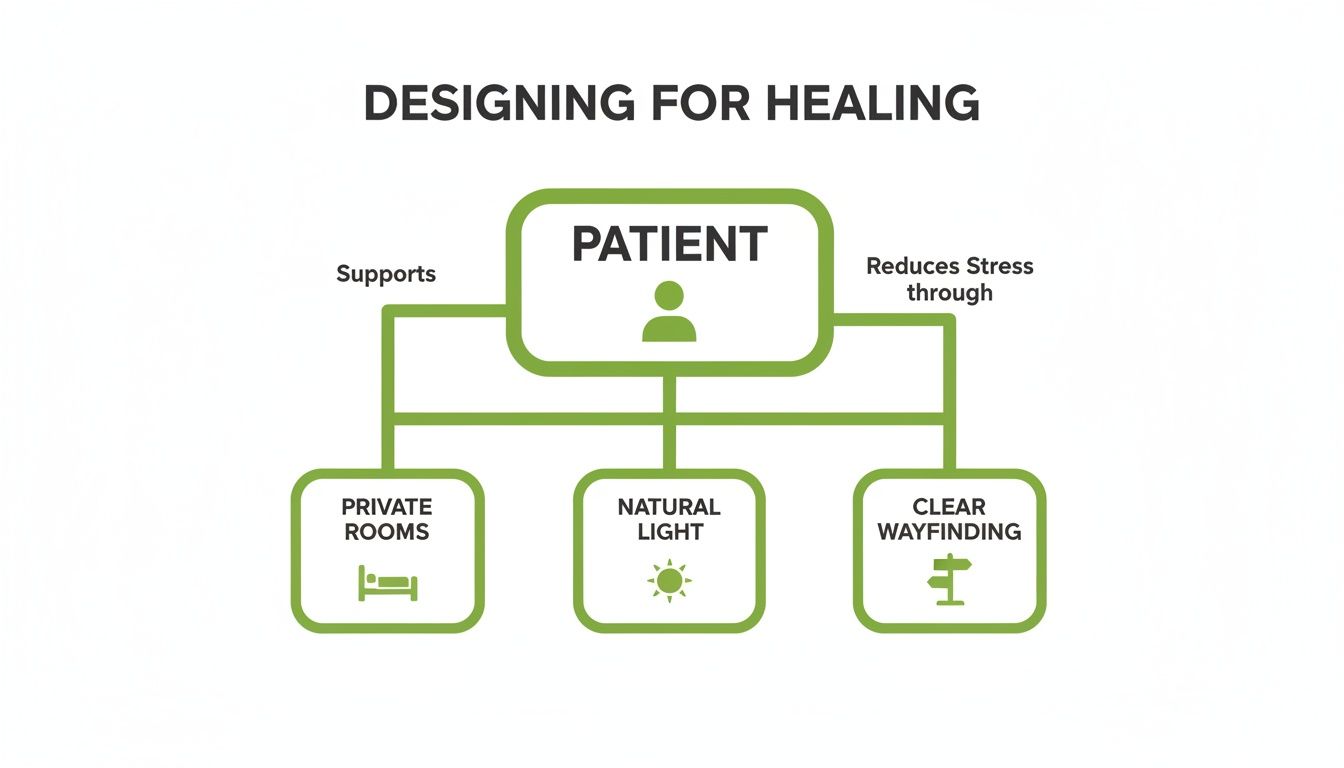
This shift is part of a larger movement toward patient-centered design, where every architectural choice supports healing.

Flowchart showing how design supports patient healing through private rooms, natural light, and clear wayfinding.

As you can see, things like private rooms, access to natural light, and easy-to-navigate hallways all work together. These aren't just features; they are carefully considered decisions that create a safer, calmer environment that actively helps people get well.

Building Resilient and Sustainable Hospitals

In the world of hospital design, "sustainability" has officially graduated from a buzzword to a core business strategy. Going green is no longer just about environmental stewardship; it's one of the smartest ways to create facilities that are both financially robust and operationally resilient. For developers, this approach isn't an expense—it's how you future-proof the investment by slashing long-term operating costs and boosting the property's market value.

Think of a sustainable hospital as its own self-sufficient ecosystem. Instead of being a massive drain on the local power grid and water supply, it's engineered to conserve resources at every turn. This creates a building that's not only cheaper to run day-to-day but is also far better equipped to handle disruptions, from a city-wide blackout to a hurricane.

The Financial Case for Green MEP Systems

If you want to find the real money-saver in a hospital's budget, look no further than its mechanical, electrical, and plumbing (MEP) systems. These networks are the building's heart and lungs, running 24/7. They're also where you can find the most dramatic cost savings through intelligent, sustainable design.

Putting capital into high-efficiency systems isn't just a one-time upgrade; it pays dividends for the entire life of the building.

  • Energy-Efficient HVAC: Modern heating, ventilation, and air conditioning systems can cut a hospital's energy consumption by a staggering 40%. We're talking about technologies like geothermal heating and cooling, variable refrigerant flow (VRF) systems, and heat recovery ventilators that recycle energy from exhaust air.
  • Smart Lighting and Controls: The switch to LED lighting is a no-brainer, but the real magic happens when you pair it with motion sensors and daylight harvesting systems. This ensures electricity is only used exactly when and where it's needed, often cutting lighting-related energy costs by half or more.
  • Water Conservation Strategies: Simple things like low-flow fixtures make a big difference at scale. But you can go further with rainwater harvesting for landscaping and systems that recycle "greywater" from sinks and showers, drastically reducing a hospital's water bill.

A sustainable hospital design isn’t about compromise; it’s about optimization. By engineering efficiency into the building’s DNA, developers create an asset that’s less exposed to volatile energy prices and contributes directly to a healthier bottom line.

Building for Resilience and Continuity of Care

Beyond the daily savings, sustainability is inextricably linked to a hospital's ability to keep its doors open during a crisis. A truly resilient hospital is designed to function as an island, capable of providing uninterrupted care even when the surrounding infrastructure goes down. This is absolutely critical for community safety and a massive value proposition for any healthcare facility.

Key resilience strategies start with on-site power generation. Think solar panels on the roof paired with battery storage systems and robust backup generators. This ensures that life-support equipment, surgical suites, and critical IT systems stay online through any outage.

But resilience goes deeper than just power. The building's physical structure needs to withstand whatever Mother Nature throws at it. This could mean reinforcing the building envelope to handle high winds, elevating critical equipment above potential flood lines, or using durable, locally sourced materials that are proven to hold up in the regional climate. These steps don't just protect the physical asset—they ensure the hospital can stand as a beacon for the community when it's needed most.

Integrating Sustainable Practices into Construction

The push for more resilient and adaptable facilities is also changing how we build them. In the hospital design space, we're seeing a major shift toward design-build methodologies, and for good reason. This approach brings designers and contractors together as a single, unified team from day one.

It’s a far more collaborative and efficient way to work, which is why studies project design-build will account for over 47% of all U.S. construction spending by 2028—a figure representing $2.6 trillion. This integrated model is perfect for ensuring sustainability and resilience goals are woven into the project's fabric from the very beginning, not just tacked on as an afterthought.

The Value of Adaptive Reuse in Healthcare

Not every new hospital needs to start with a shovel in the ground. A powerful, practical approach is taking hold in healthcare development: adaptive reuse. This is simply the art of turning old, underused buildings—think empty big-box stores, quiet office parks, or even warehouses—into modern, efficient medical centers. For developers, this can be a much smarter play than building from scratch.

Instead of starting with a blank slate, you're unlocking the potential that's already there. It's often faster, more budget-friendly, and a whole lot greener. By working with the "bones" of an existing structure, you can slash project timelines and get the doors open far sooner than with a traditional build.

Navigating the Unique Challenges

Of course, it’s not as simple as just moving in some exam tables. A former Best Buy wasn't built to handle the complex needs of an outpatient surgery center. Success hinges on tackling a few key challenges that are specific to healthcare design.

This is where a good architectural partner earns their keep—they can spot the potential deal-breakers and turn them into solvable puzzles. The big things to watch for are:

  • Upgrading Core Infrastructure: Medical facilities are power hogs. They have massive demands for electricity, data, specialized plumbing, and complex HVAC systems. The skeleton infrastructure in an old retail or office building just won't cut it.
  • Meeting Modern Building Codes: Healthcare is one of the most heavily regulated industries for a reason. You'll be dealing with incredibly strict codes for everything from fire safety and accessibility (ADA) to very specific requirements for clinical spaces.
  • Reconfiguring Inefficient Layouts: Good healthcare is all about flow—for patients, staff, and supplies. The wide-open floor plan of a department store or the choppy, cubicle-filled layout of an office building has to be completely rethought to create logical connections between departments.

Adaptive reuse is like solving a puzzle. You have to fit the demanding standards of modern medicine into a frame that was built for something else entirely. The goal isn't just to make it fit, but to make it feel like it was designed for patient care from day one.

The Strategic Advantages for Developers

Even with the technical hurdles, the payoff for adaptive reuse can be huge. For smart investors and developers, it offers a clear strategic edge.

The biggest win is often speed to market. You get to skip a lot of the time-consuming early steps, like lengthy site acquisition, zoning battles, and pouring a new foundation. This can easily shave months—sometimes even years—off a project, which means you start generating revenue that much faster.

Then there's the cost. Yes, you'll spend money on system upgrades, but reusing the main structure (the foundation, walls, and roof) can lead to major savings on materials and labor compared to a ground-up build. It’s also an inherently sustainable choice, which is more than just a feel-good story. Less landfill waste and a smaller carbon footprint can open the door to green building incentives and grants. For property owners, it’s a brilliant way to breathe new life into a struggling asset and turn it into a vital community resource.

Common Questions from Developers on Hospital Projects

If you're coming from a commercial development background, stepping into the world of hospital projects can feel like learning a new language. The stakes are higher, the regulations are tighter, and the entire process is just… different.

Let's tackle some of the most frequent questions we hear from developers and investors to help demystify the process.

How Long Is This Going to Take, Really?

There's no sugarcoating it: building a new hospital is a marathon, not a sprint. From the first sketch to the day the doors open, you're typically looking at a three- to five-year timeline. That window covers everything—initial strategy, finding and securing the right site, architectural design, navigating the maze of permits, and finally, construction.

Can you speed things up with an adaptive reuse project? Sometimes. Converting an existing building gives you a structural head start. But don't underestimate the challenge of retrofitting highly complex mechanical systems and bringing everything up to today's exacting healthcare codes. It’s still a massive undertaking.

Where Does All the Money Go? What Are the Biggest Cost Drivers?

While every project has its unique quirks, the big-ticket items in a hospital budget are remarkably consistent. The costs that often surprise developers new to healthcare are:

  • Specialized MEP Systems: The mechanical, electrical, and plumbing systems are the hospital's circulatory and nervous systems. They are exponentially more complex and expensive than what you'd find in an office building or retail center, easily consuming a huge chunk of the budget.
  • Medical Equipment: This is a major capital investment. Think MRI machines, CT scanners, and robotic surgical suites. The price tags for this kind of technology are astronomical.
  • Interior Finishes: You can't just use standard commercial-grade materials. Everything from the flooring to the paint has to meet stringent requirements for infection control and durability, and that performance comes at a premium.

One of the easiest traps to fall into is underestimating the "soft costs." The fees for specialized design, engineering, consultants, and navigating the complex permitting process can be substantial. Getting an experienced healthcare architect involved from day one is the best way to build a realistic budget that won't give you sticker shock later on.

Why Can't I Just Use My Usual Commercial Architect?

Simply put, a hospital is not just another commercial building. It's one of the most complex and highly regulated environments you can build. An architect with deep healthcare experience isn't just drawing plans; they're your strategic guide through a minefield of regulations and operational complexities.

They understand how a surgeon moves in an OR, how a nurse's workflow can be made more efficient, and how to design spaces that prevent the spread of infection. This isn't just about meeting code—it's about creating a facility that is safe, efficient for staff, and healing for patients. That expertise directly protects your investment and ensures the final building actually works for the people inside it.


Ready to turn your vision for a healthcare facility into a successful, enduring asset? The team at Sherer Architects, LLC brings decades of expertise in commercial design, adaptive reuse, and strategic planning to guide you through every stage of your project. Contact us today to start the conversation.

Categories
Uncategorized

Designing a Hospital A Practical Guide for Developers

Building a hospital is a monumental task, and the most critical work happens long before the first shovel hits the dirt. This initial strategic planning phase, which includes a deep-dive feasibility study, thorough market analysis, and meticulous space programming, is where the project's success is truly decided.

Get this part right, and you set the stage for a facility that meets clinical demands and financial targets. Skimp on it, and you're paving the way for costly rework and operational headaches down the line.

Building the Foundation Before Breaking Ground

The fate of a hospital project is sealed in its early planning. A rushed pre-design phase is a classic recipe for budget blowouts, inefficient workflows, and a building that just doesn't serve the community it was meant for. I like to think of this stage as mapping the hospital's strategic DNA—every decision made here will ripple through the entire design and construction process.

This foundational work ensures the building is a direct response to hard data, not just gut feelings or assumptions. For any developer or owner, this is your single most powerful tool for mitigating risk.

Getting the Market Analysis Right

Before a single blueprint is sketched, you have to know your market inside and out. A proper market analysis digs into the specific healthcare needs of the community you plan to serve. It's about finding out which service lines are desperately needed and which are already well-covered. This goes way beyond simple demographics; we’re talking about a forensic look at competitor services, local health trends, and even the dominant insurance providers in the area.

For example, your analysis might uncover an aging population with a high rate of heart disease but no dedicated cardiac center for miles. That’s a clear signal to prioritize a top-notch cardiology department, complete with cath labs and a cardiac ICU. On the flip side, it might show the area is saturated with maternity wards, steering you away from that investment.

You need to be evaluating data points like:

  • Demographic Trends: Look at age, income, and population growth projections. This helps you see where the demand will be in 5, 10, or 20 years.
  • Competitor Analysis: Literally map out who is doing what. Where are the gaps in care that you can strategically fill?
  • Community Health Needs Assessment (CHNA): Public health data is a goldmine. It tells you the most prevalent diseases and health issues your future patients are facing.

This data-first approach shifts the project from a speculative venture to a strategic one. It ensures you’re not just building a hospital correctly, but that you’re building the correct hospital for that specific market.

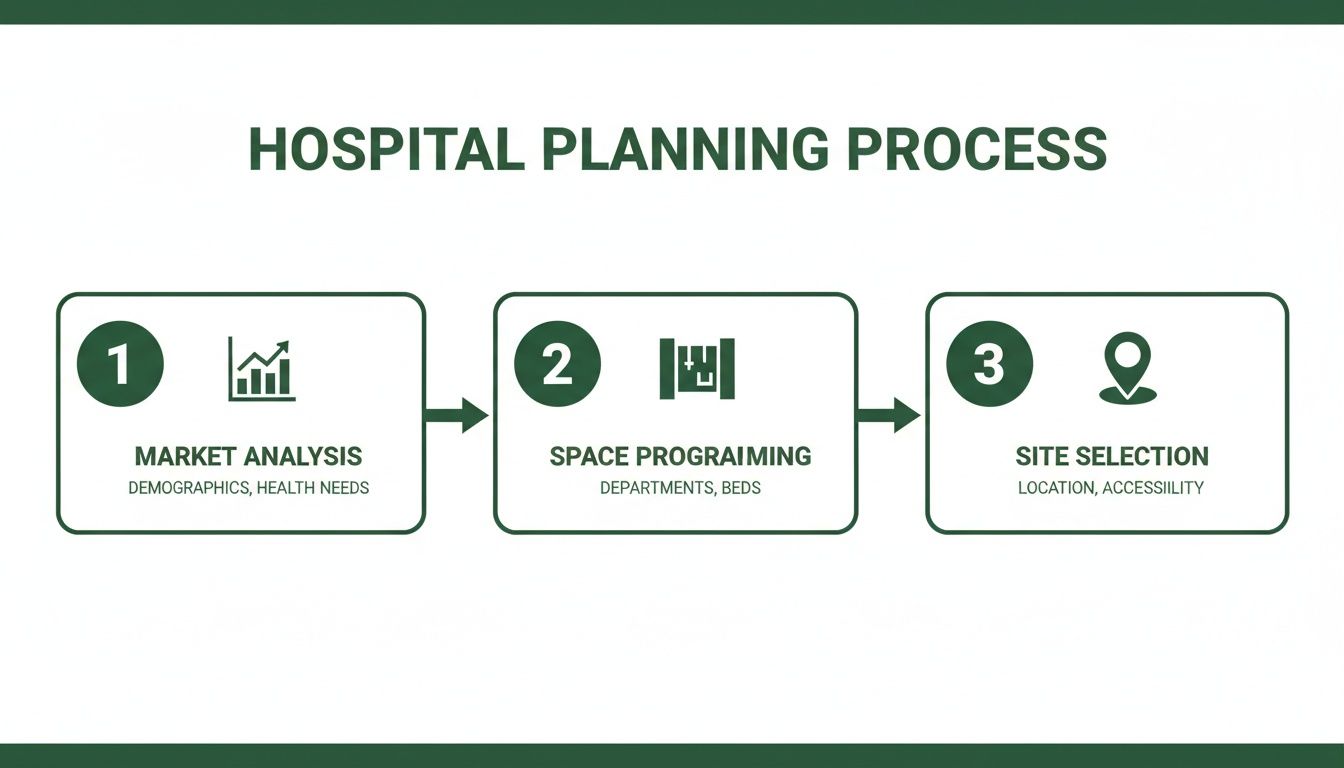
The process flows logically from understanding the market to defining the space, and finally, to picking the right spot.

Infographic showing a three-step hospital planning process: market analysis, space programming, and site selection.

As you can see, each step builds on the last, creating a rock-solid plan for the entire project.

From Services to Square Feet: The Art of Space Programming

Once you know which clinical services you'll offer, the next job is space programming. This is where we translate those services into a highly detailed list of every single room, its required size, and how it needs to relate to adjacent spaces. Think of it as the project's architectural brief—a document that quantifies the entire facility, foot by foot. You simply can't build a functional hospital without it.

A detailed space program is the bridge between your strategic vision and the physical design. It puts numbers to the hospital's operational needs, giving the architect a precise roadmap and preventing the kind of scope creep that kills budgets and timelines.

Let’s take an emergency department. A program won’t just have a line item for "ED." It will break it down into the exact number of trauma bays, triage rooms, and standard exam rooms. It will specify support spaces like nurse stations, medication rooms, and decontamination showers. This painstaking detail is what creates a department that can handle a crisis smoothly, rather than descending into chaos. It's the difference between a building that fights your staff and one that works for them.

Navigating the Labyrinth of Healthcare Codes

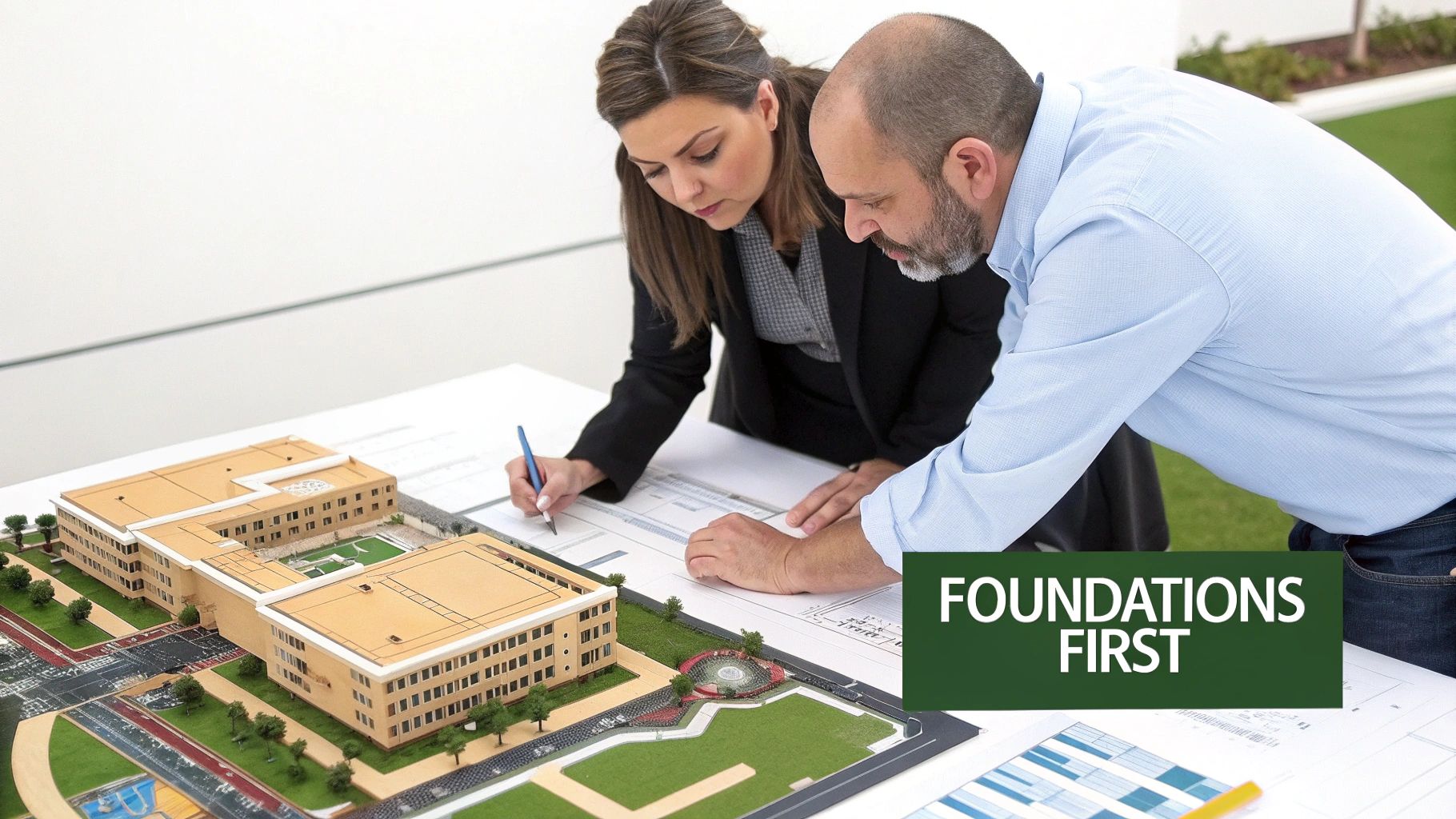
Two architects review blueprints and a large building model, collaborating on a design project.

Designing a hospital isn't just about architecture; it's about navigating a thicket of regulations. One wrong turn can lead to brutal delays and redesigns that blow up your budget. This isn't a simple box-ticking exercise. Getting it right means truly understanding the web of codes governing everything from how wide a corridor needs to be to the specifics of air filtration in an operating room.

Think of it as a layered puzzle. You have national standards, state-specific health department rules, and local zoning ordinances all piled on top of each other. They don't always play nicely together, and the real skill is in figuring out how to satisfy all of them from the very start.

The Key Players in Regulation

You’ll be answering to several different governing bodies, and each has its own rulebook and enforcement style. The Facility Guidelines Institute (FGI) is the big one, providing the foundational standards for most healthcare facilities across the U.S. Their guidelines are your starting point for patient room sizes, surgical suite layouts, and more.

But FGI is just the beginning of the story. Your state’s Department of Health will have its own licensing requirements that often add to or tweak the FGI standards. Then, local municipalities layer on their own building, fire, and zoning codes. It's a classic multi-jurisdictional headache.

The single biggest mistake a development team can make is assuming one codebook covers it all. You have to meticulously cross-reference state health mandates, FGI guidelines, and local ordinances to build a single, bulletproof compliance strategy.

For example, FGI might set a minimum for air changes per hour in an OR. Your state could demand a higher standard or specific filtration levels. Then, the local fire marshal will dictate the sprinkler systems and escape routes for that same room. You have to hit all three targets.

Common Hurdles and How to Clear Them

Some areas of hospital design are just magnets for compliance issues. Fire and life safety regulations are notoriously complex because the rules shift based on how a space is used. The requirements for an inpatient wing, an outpatient clinic, and a business office in the same building are all wildly different.

Ventilation is another minefield. Operating rooms, isolation rooms, and labs have incredibly strict rules for air pressure, filtration, and circulation to stop infections from spreading. These systems can't be an afterthought; they have to be baked into the architectural and structural plans from day one.

It’s also critical to get the electrical safety regulations right. For instance, knowing the ins and outs of the NEC tap rule for safe electrical wiring is essential for ensuring your power distribution systems are safe, compliant, and reliable.

Keep a close eye on these common trouble spots:

  • Hazardous Materials: The rules for storing and handling medical gases, chemicals, and radioactive materials are unforgivingly precise.
  • Accessibility: Meeting basic ADA standards is the floor, not the ceiling. Genuinely accessible design anticipates the needs of patients with a wide range of mobility challenges.
  • Medical Equipment: Heavy-duty imaging equipment like MRIs and CT scanners needs serious structural, electrical, and plumbing support that must be planned for well in advance.

Working with the Authorities Having Jurisdiction

The best way to manage all this complexity is to stop thinking of regulators as adversaries. The Authorities Having Jurisdiction (AHJs)—the state and local officials who sign off on your plans—should be your partners.

Get them involved early. Schedule preliminary review meetings during the schematic design phase. Walk them through your approach and ask for their interpretation of any gray areas in the code. This kind of open communication can spot a problem months before it becomes a change order during construction. A good relationship built on transparency is your most valuable asset for a smooth approvals process.

2. Designing Clinical Spaces for Peak Performance

Let's get to the heart of the matter: the clinical core. This is where the life-and-death decisions happen, and the physical design of these spaces has a direct, measurable impact on patient outcomes and staff efficiency. It's not just about aesthetics. A poorly planned clinical area creates constant friction, leading to medical errors and burnout. A thoughtfully designed space, on the other hand, becomes a silent partner in delivering exceptional care.

We're going to walk through four critical zones: the Emergency Department (ED), Operating Rooms (ORs), Imaging Suites, and Inpatient Units. Each has its own rhythm and unique demands, but they all share a fundamental need for clear circulation, smart adjacencies, and layouts that actually support the complex work happening within them.

The Modern Emergency Department

Most people think of the ED as the hospital's "front door," but from a design perspective, it's more like a high-stakes sorting facility running 24/7 under immense pressure. One of the most effective strategies I’ve seen is creating completely separate entrances for walk-in patients and ambulance arrivals. It's a simple move, but it immediately de-escalates chaos, allowing staff to triage less urgent cases without being swamped by critical emergencies rolling in.

Inside, the best EDs are broken down into distinct zones or "pods" based on patient acuity. You'll have dedicated areas for trauma, acute care, and a "fast-track" for minor issues. This model creates parallel workflows, allowing for more focused staffing and preventing a patient with a sprained ankle from tying up a bed needed for someone having a heart attack. It’s all about managing the inherent unpredictability of emergency medicine.

Optimizing the Surgical Suite

When you step into the world of operating rooms, sterility is king. The design absolutely must create an uncompromising barrier between clean and dirty pathways. A time-tested and highly effective layout is the sterile corridor system. It's a one-way street: sterile supplies and surgical teams enter the OR from a clean side, while all soiled materials and post-op patients exit through a separate, non-sterile corridor on the other.

This one-way flow is the bedrock of infection control. It also forces careful planning of all support spaces. For example, the Sterile Processing Department (SPD)—where every instrument is meticulously cleaned and sterilized—needs a direct, secure connection to that sterile core to maintain the integrity of the whole system.

The physical layout of a surgical suite is a direct expression of its infection control philosophy. Designing for a clear separation between sterile and non-sterile zones isn't a recommendation; it's a fundamental requirement for patient safety.

The Rise of Outpatient Services

One of the biggest shifts shaping hospital design right now is the massive migration from inpatient to outpatient care. So many procedures that once required an overnight stay are now done on a same-day basis, and this has profound implications for how we plan and allocate space.

This shift is a dominant force in healthcare architecture. In fact, for many health systems, outpatient revenue now equals or even exceeds inpatient revenue. This reality is forcing a total reconfiguration of facilities to better support same-day surgery, infusion centers, and advanced imaging. We're seeing new hospital projects reduce dedicated inpatient beds by 10–30% compared to older facilities, while dramatically increasing the number of procedure bays and observation areas. For a deeper look into this industry-wide trend, check out SmithGroup's detailed health forecast.

What does this mean for design? Flexibility is everything. A pre-op bay might need to function as a post-anesthesia care unit (PACU) during peak hours. Rooms have to be adaptable, capable of handling different procedures without a major overhaul. That requires building in robust infrastructure from day one—more medical gas outlets, more data ports, and flexible power options are non-negotiable.

Designing Patient-Centered Inpatient Units

After a procedure, the inpatient unit is where recovery begins. Modern design has thankfully moved away from those long, sterile institutional corridors. The focus now is on more manageable, human-scaled layouts. A popular and effective model is the decentralized nurse station, which places smaller work areas directly between small groups of rooms.

This simple change brings nurses physically closer to their patients, cutting down on wasted steps and improving direct observation. It also fosters a much quieter, calmer environment by breaking up the constant hustle of a large, central station.

Other key features we always build into our inpatient unit designs include:

  • Family Zones: Carving out dedicated space in the patient room for family members to sit, work, or rest comfortably. They are part of the care team.
  • Same-Handed Rooms: This is a big one. We design all rooms with the exact same layout—bed on the left, bathroom on the right, for example. This standardization dramatically reduces the risk of medical errors because staff instinctively know where to find everything, especially in a code-blue emergency.
  • Views and Natural Light: It's not a "nice-to-have." Ample windows with views of nature have been clinically shown to speed recovery times and lower stress. Orienting rooms to maximize daylight is a simple but powerful tool in the healing process.

Ultimately, designing a hospital’s clinical core is like solving a massive, three-dimensional puzzle of adjacencies, workflows, and future-proofing. When you get it right, you create an environment where caregivers can perform at their best and patients can heal in safety and comfort.


A critical piece of that puzzle is getting the departmental adjacencies right from the start. Placing departments that work together frequently next to each other saves precious time in transporting patients and equipment, which can be life-saving in an emergency.

Here's a look at some of the most critical adjacency pairings we prioritize in our planning.

Clinical Adjacency Planning Priorities

Primary Department High-Priority Adjacency Rationale for Proximity
Emergency Department (ED) Imaging (CT, X-ray), Lab Services Immediate access to diagnostic tools is crucial for rapid triage and treatment of trauma and acute cases.
Operating Rooms (OR) Sterile Processing (SPD), PACU Ensures a sterile instrument supply chain and facilitates smooth, safe patient transfer before and after surgery.
Intensive Care Unit (ICU) Surgical Suite, ED Allows for quick transfer of critically ill patients from surgery or emergency intake to intensive monitoring and care.
Labor & Delivery Neonatal ICU (NICU), OR Co-locating these services provides immediate access to specialized care for high-risk newborns and emergency C-sections.
Cardiology Catheterization Lab, Imaging (MRI/CT) Streamlines the diagnostic-to-treatment pathway for cardiac patients, reducing transport time during critical events.
Oncology/Infusion Pharmacy, Laboratory Close proximity to the pharmacy is essential for the timely and safe preparation of chemotherapy drugs.

Thinking through these connections early in the schematic design phase prevents major workflow headaches and operational inefficiencies down the road. It’s about designing for movement and logic, not just for static rooms on a floor plan.

Engineering for Safety and Long-Term Value

A brightly lit hospital hallway featuring a green 'Clinical Efficiency' sign and a person walking.

Great architecture and smart clinical layouts get a lot of attention, but a hospital’s real guts—its resilience and safety—are engineered deep within the walls. The mechanical, electrical, and plumbing (MEP) systems are the facility's lifeblood. This complex network is what truly dictates everything from patient recovery rates to the long-term operational budget.

For any developer or owner, making the right engineering calls upfront is one of the smartest ways to bake long-term value into the asset. We're not just talking about keeping the lights on. These systems are an active, critical part of the healing environment.

Mastering Air Quality for Infection Control

In a hospital, the air itself is a medical instrument. This is where Indoor Air Quality (IAQ) moves from a "nice-to-have" to a core design principle. Your HVAC system is the first line of defense against healthcare-associated infections (HAIs), which have devastating consequences for patients and providers alike.

The entire game is about precise control over air pressure, filtration, and circulation. For example, sensitive areas like operating rooms or protective units for immunocompromised patients must maintain positive air pressure. This means the pressure inside is slightly higher than outside, so when a door opens, clean, filtered air pushes out, keeping contaminants from drifting in.

On the other hand, airborne infection isolation rooms demand the opposite: negative air pressure. Here, the pressure is lower inside the room. This ensures that when the door is opened, any contaminated air is pulled into the room and safely exhausted, protecting the rest of the hospital. Pulling this off requires a meticulously balanced and sophisticated HVAC system.

The Role of Filtration and Air Changes

Filtration is another non-negotiable. And we’re not talking about the filters you buy at the hardware store. Healthcare facilities depend on High-Efficiency Particulate Air (HEPA) filters, which are engineered to capture 99.97% of airborne particles as small as 0.3 microns. They're absolutely essential in sterile environments for pulling bacteria, viruses, and other pathogens right out of the air.

Just as critical is the concept of Air Changes per Hour (ACH). This metric tells you how many times the entire volume of air in a room is swapped out with fresh, filtered air every hour. The demands vary dramatically by space:

  • Standard Patient Rooms: Typically require a minimum of 6 ACH.
  • Operating Rooms: Need a much higher rate, often 20 ACH or more, to quickly clear any contaminants.
  • Isolation Rooms: Require at least 12 ACH to ensure effective containment and safety.

Thinking about MEP systems solely in terms of upfront cost is a critical mistake. These systems represent a massive portion of a hospital's long-term operational budget. Investing in high-efficiency equipment and smart design from day one is one of the most effective ways to reduce lifecycle costs and boost the asset's overall financial performance.

Building Resilient Infrastructure

Beyond air quality, a hospital's core infrastructure must be designed for absolute, bulletproof reliability. Failure is simply not an option. That means engineering for redundancy in every key system.

Take the medical gas system, for instance—the network that delivers oxygen, medical air, and vacuum to patient bedsides. It must have multiple backups and alarms that instantly alert staff to any pressure drops.

The same goes for emergency power. Hospitals are required to have backup generators powerful enough to run life-support systems, surgical suites, and critical monitoring equipment for an extended time during an outage.

Water is another weak point if not planned for. The design must include a strategy for maintaining a supply of potable water during a municipal service interruption, often through large on-site storage tanks. This is the kind of resilient infrastructure that allows a hospital to keep saving lives when external utilities go down.

Hospitals are notorious energy hogs, but that consumption also creates a huge opportunity. A 300,000-square-foot hospital that manages to cut its energy use by 40% could save anywhere from hundreds of thousands to over a million dollars a year. This makes investing in high-efficiency systems a powerful financial move, not just an environmental one.

Adaptive reuse strategies, like those we champion at Sherer Architects, can push sustainability even further by extending a building's life and cutting embodied carbon by up to 20-40% versus new construction. You can dig deeper into these trends in the 2025 Hospital Construction Survey.

Getting the Project Built: Delivery Models and Financial Planning

An engineer in a hard hat inspects machinery in a facility with 'ENGINEERED SAFETY' text.

This is where the rubber meets the road. All the meticulous planning and brilliant design in the world won't matter if the project stumbles on a shaky financial foundation or gets bogged down by the wrong delivery method. For developers and owners, turning that vision into a physical, functioning hospital boils down to mastering the numbers and the team structure.

An elegant design is just a pretty picture if the budget is a fantasy or the delivery model creates conflict instead of collaboration. This phase is all about managing risk and making smart decisions that safeguard your investment for decades to come.

Building a Bulletproof Hospital Budget

A hospital budget is a different beast entirely from other commercial projects. The complexity is immense, and it’s easy to get fixated on the obvious hard costs—the concrete, steel, and labor—and completely underestimate everything else.

The real budget-busters are often hiding in the soft costs. From my experience, these can easily swell to 25-35% of your total project cost. If you don't account for them accurately from the very beginning, you’re setting yourself up for a world of financial pain down the line.

A truly comprehensive budget has to cover a lot of ground:

  • Professional Fees: This isn't just the architect and primary engineers. Think about the army of specialty consultants you'll need: medical equipment planners, acousticians, IT infrastructure experts, and more.
  • Permitting and Approvals: The fees and time required to navigate state health departments and local jurisdictions are significant. Don't treat this as an afterthought.
  • Medical Equipment (FF&E): Furniture, fixtures, and especially the high-tech medical equipment are a massive capital line item. We're talking about everything from hundreds of patient beds to multi-million-dollar MRI and CT scanners.
  • Contingency Funds: This is non-negotiable. A healthy contingency, typically in the range of 5-10% of total construction costs, is your safety net for the inevitable surprises and changes that pop up during construction.

Choosing the Right Project Delivery Model

How you structure the relationship between the owner, designer, and contractor will fundamentally shape your project's outcome. The old-school Design-Bid-Build approach, where you finish the design completely before hiring a contractor, is often slow and can create an adversarial "us vs. them" dynamic.

In the world of complex healthcare projects, more collaborative models are quickly becoming the standard. They just make more sense. Bringing everyone to the table early aligns goals and fosters a problem-solving mindset from day one.

The delivery model you choose is a strategic decision that shapes the entire project dynamic. For a complex build like a hospital, collaborative models that bring the contractor on board early are almost always superior for managing costs, schedule, and risk.

Let's look at two of the most effective alternatives:

  • Design-Build: Here, you sign a single contract with one entity that handles both design and construction. This single point of responsibility is a game-changer. It streamlines communication, slashes change orders, and can seriously compress the project timeline.
  • Integrated Project Delivery (IPD): This is the ultimate team sport. The owner, architect, and contractor all sign a multi-party agreement, sharing both the risks and the rewards. IPD drives incredible transparency and teamwork, making it perfect for the most complex or fast-tracked hospital projects.

The trend is undeniable. The U.S. hospital construction market, which hit an estimated $34.6 billion in 2025, is heavily shifting toward these collaborative methods. In fact, industry analysis suggests that design-build will account for about 47% of construction spending by 2028, largely because it can accelerate project delivery by 10–25%. If you want to dig deeper into these trends, you can find additional hospital construction insights on ibisworld.com.

The Financial Case for Resilience

A smart financial plan doesn't just stop on opening day. It has to look decades into the future and account for the hospital's long-term resilience. A facility that can’t keep its doors open during a hurricane, power grid failure, or the next pandemic is a fragile and deeply flawed asset.

Investing in resilience means hardening your facility against predictable threats. This could mean elevating critical MEP equipment above the flood plain, engineering the structure for higher wind loads, or building robust on-site power generation and water reserves.

Yes, these measures can add 5–15% to the initial construction cost. But the ROI is crystal clear. You're buying an insurance policy against catastrophic operational downtime and the staggering financial losses that follow. It’s an investment that protects revenue, staff, and the community when disaster strikes, ensuring your hospital can fulfill its core mission no matter what.

Common Questions About Designing a Hospital

Diving into a hospital project for the first time? It's natural to have questions. In my experience, a few key queries always seem to pop up early on. Let's tackle them head-on, so you can move forward with a clearer picture.

How Long Does The Hospital Design Process Typically Take?

You're looking at a design phase of roughly 12 to 24 months from the very first programming meeting until you have a set of construction-ready documents in hand. Of course, that's a wide range, and the final timeline really depends on the hospital's size, complexity, and how many specialty services you plan to include.

This period breaks down into the usual stages: schematic design, design development, and finally, the nitty-gritty construction documents. But it's the external factors that often stretch the schedule. Things like state regulatory reviews or navigating a tricky Certificate of Need (CON) process can easily tack on several extra months.

One way to potentially tighten this up is with a more integrated project delivery method. A design-build approach, for instance, can let design and early construction phases overlap, shaving valuable time off the total project duration.

What Is The Biggest Design Mistake To Avoid?

Hands down, the costliest and most frequent error I see is rushing the pre-design planning.

When a team jumps into schematic design without a solid, rigorously vetted space program and a real understanding of clinical workflows, it's a recipe for disaster. Why? Because every single change order made during construction is exponentially more expensive than a change made on paper.

Another common blind spot is failing to grasp the sheer volume required for all the MEP (mechanical, electrical, plumbing) systems. These aren't just pipes and wires; they are the hospital's lifeblood and can easily eat up 25-30% of the building's total volume. If you don't account for that massive footprint from day one, you’ll find yourself in a constant battle for space, forcing costly architectural compromises down the line.

Insufficient pre-design planning is the single most reliable predictor of budget overruns and operational headaches. The time and resources invested in meticulous upfront programming will pay for themselves many times over throughout the project's life.

How Can We Future-Proof A New Hospital Design?

Future-proofing isn't about predicting the future; it's about designing for flexibility. Healthcare delivery is always evolving, technology gets upgraded, and patient demographics shift. A smart building needs to adapt without requiring a complete teardown and rebuild.

Here are a few strategies we always build into our projects:

  • Embrace Modular and Universal Designs: By creating standardized room layouts, you build in agility. An exam room can be converted into a consultation space, or an office can become a small treatment room with minimal fuss.
  • Plan with "Soft Space": This is a simple but powerful concept. We deliberately place areas with simpler infrastructure—like administrative offices—right next to high-revenue clinical zones. When it's time to expand your OR suite or imaging department, you're knocking down drywall, not relocating major plumbing stacks.
  • Oversize Your Core Infrastructure: It’s far cheaper to build in extra capacity now than to add it later. Designing your MEP, IT, and structural systems to handle future technologies and higher patient loads gives you room to grow without a massive capital expense.

What Role Does Adaptive Reuse Play In Healthcare Development?

Adaptive reuse has become an incredibly important tool for health systems. It's a smart way to expand services quickly and manage costs. We're seeing more and more clients convert existing structures, like old office buildings or even big-box retail centers, into outpatient clinics, ambulatory surgery centers, or specialty care facilities.

The big win here is speed. It's almost always faster than ground-up construction.

But the benefits don't stop there. This approach is also inherently more sustainable. You reduce embodied carbon by keeping the original structure, you minimize demolition waste, and you can significantly lower the initial capital investment. For a healthcare provider, it's a powerful way to establish a footprint in a new community while breathing new life into an existing building.


The journey from an idea to a fully functioning hospital is incredibly complex. But with the right architectural partner, it can be a smooth and profitable one. At Sherer Architects, LLC, we specialize in guiding owners through every stage of commercial design, adaptive reuse, and historic preservation. We're here to help you solve the puzzle, aligning every piece to deliver a beautiful, enduring, and successful project. Learn how we can bring structure to your vision at https://shererarch.com.