

When you’re a commercial developer, a parking structure isn't just a box to check on a permit application. It's a strategic asset, a machine for generating revenue that can make or break your project's financial success. A smart design turns what could be a logistical headache into a powerful tool for maximizing vehicle capacity, elevating the user experience, and ultimately, boosting the value of your property.
Unlocking Property Value with Smart Parking Deck Layouts
Think of a well-designed parking deck as the silent workhorse of your commercial property. It’s the very first and last impression you make on every tenant, customer, and visitor. Its efficiency quietly dictates the daily rhythm and profitability of the building it serves.
Getting this right means moving beyond just meeting minimum requirements. A truly thoughtful layout understands the intricate dance between how cars move, the realities of structural engineering, and simple human behavior. It means looking at every single detail—from the angle of a parking stall to the slope of a ramp—through the lens of financial return. The goal isn't just to cram in more cars; it's to create a system that runs so smoothly it lowers your operational costs, improves safety, and can even be adapted for different uses down the road.
The Foundation of a Profitable Design
At its heart, a successful parking layout is all about getting a few key things to work together in harmony. Get these fundamentals right, and you're building a high-performing asset.
- Efficient Circulation: You need clear, intuitive paths for both cars and people. This isn't just about avoiding traffic jams; it's about safety and ease of use. Well-planned entries and exits are critical for managing the ebb and flow of traffic without causing backups.
- Maximized Capacity: Every square foot of a parking deck costs money to build, so it has to earn its keep. The objective is always to achieve the highest possible density of parking stalls without making the space feel cramped, unusable, or violating building codes.
- Structural and MEP Integration: This is a big one. The parking layout has to be planned in lockstep with the structural grid (where the columns go) and the mechanical, electrical, and plumbing systems. Failing to do this early on leads to costly rework and frustrating inefficiencies.
- Enhanced User Experience: A garage that's easy to navigate, well-lit, and feels safe encourages people to come back. Clear wayfinding is non-negotiable. And for modern properties, integrating systems that follow essential access control best practices can significantly elevate both security and functionality.
The sheer dominance of off-street structures is hard to ignore—they command a staggering 69.2% market share in global parking management. This is no surprise, really. They're the go-to solution for maximizing vertical space where land is at a premium. Architects are constantly refining designs to optimize traffic flow and integrate modern must-haves like EV charging stations.
The Three Core Parking Layout Patterns
Every parking garage, no matter how complex, starts with one of three basic layout patterns. It’s a bit like arranging books on a shelf—you can place them spine-out, at an angle, or stacked flat. Each method changes how many books fit and how easy it is to pull one out. The same fundamental trade-offs apply to parking.
For developers, getting a handle on these patterns is the first real step in designing a garage that works. The choice between perpendicular, angled, or parallel parking is a foundational decision that dictates everything else, from stall count and traffic flow to the overall feel of the structure.
This choice isn't just about geometry; it's about balancing capacity with the user experience, which ultimately drives revenue.
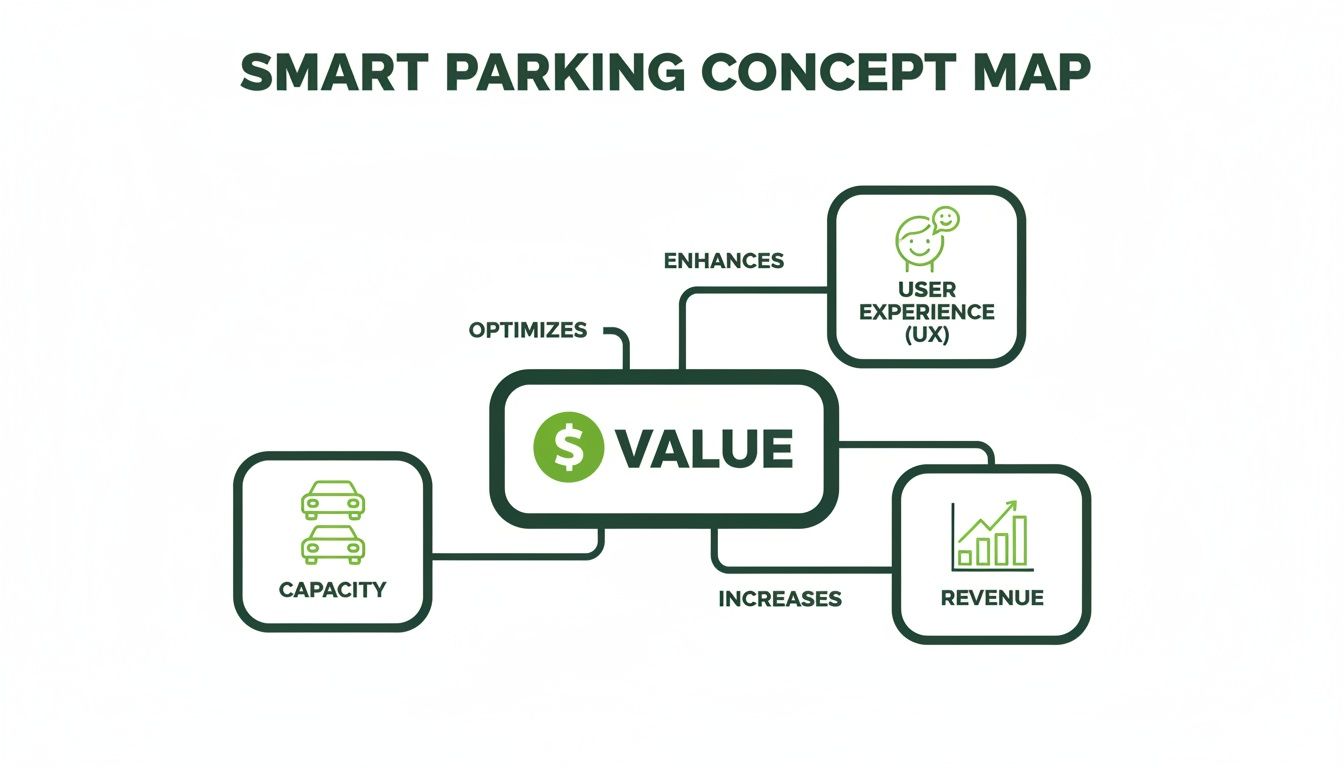
As you can see, a well-thought-out layout isn't an isolated design feature. It's directly tied to the financial performance of the asset.
Perpendicular or 90-Degree Parking
The workhorse of the industry is 90-degree parking. It’s the most common layout you’ll see because it's the most spatially efficient. This pattern arranges stalls straight-on, perpendicular to the drive aisle, packing the maximum number of cars into a given footprint.
But that density comes with a trade-off. Perpendicular layouts demand the widest drive aisles, typically 24 feet or more, to give drivers enough room for two-way traffic and the sharp turn needed to get into a spot. While you get the most stalls, those wide aisles eat up a lot of square footage.
Angled Parking
For a more driver-friendly approach, we turn to angled parking, usually set at 45 or 60 degrees. By slanting the stalls, the entry maneuver becomes much gentler, which makes parking faster and less stressful for most people.
This layout is a huge win for circulation. It naturally guides traffic in one direction, which cuts down on the risk of head-on encounters and keeps cars moving smoothly. A 60-degree layout strikes a nice balance, but you can expect to fit about 10-15% fewer stalls compared to a 90-degree design in the same space. It's a classic case of capacity versus user experience.
The core principle is simple: angled parking sacrifices some density for superior circulation and ease of use. This often makes it the preferred choice for high-turnover environments like retail centers or airports, where getting drivers in and out quickly is a top priority.
Parallel Parking
While you won’t see it as the primary layout, parallel parking is a fantastic problem-solver for those awkward, narrow spaces where nothing else fits. We often use it to line the perimeter walls of a deck or to squeeze value out of tight corners that would otherwise be dead space.
It’s the least efficient layout from a pure density standpoint, but it’s invaluable for optimization. A smart designer can use a few parallel spots along a structural wall or a ramp to turn unusable real estate into revenue-generating stalls.
Parking Stall Layout Comparison
Choosing the right layout depends entirely on the project's goals. The table below breaks down the key differences to help guide that decision.
| Layout Type | Space Efficiency (Stalls per SF) | Ease of Parking | Traffic Flow | Best Use Case |
|---|---|---|---|---|
| 90-Degree | Highest | More difficult | Two-way | Maximizing capacity in long-term or employee parking |
| Angled | Moderate | Easiest | One-way | High-turnover retail, airports, visitor garages |
| Parallel | Lowest | Moderate | One or two-way | Filling in narrow, leftover spaces along walls |
Ultimately, the best designs often blend these layouts, using 90-degree for the bulk of the space and angled or parallel parking to solve specific circulation or efficiency challenges.
This kind of strategic thinking is pushing the industry forward. The global parking garage design market is booming, with projections hitting $15.6 billion by 2027. This growth is fueled by innovative designs, where 60% of new projects now integrate automated systems that can park cars in 60% less space. For more traditional structures, even small tweaks can make a big impact. You can find more parking statistics on how these designs are changing the industry landscape.
Mastering Vertical Flow with Efficient Ramp Systems
Once you've nailed down the floor layout, the next big challenge is moving cars between levels. That's the job of the ramp system—it's the circulatory system of your garage. Picking the right ramp is like choosing between a scenic country road and a six-lane expressway; they’ll both get you there, but they serve completely different needs when it comes to speed, space, and cost.
A clumsy ramp system is a recipe for disaster. It creates frustrating bottlenecks, slows down turnover, and ultimately limits how many people can actually use your facility. The real goal here is to design a seamless vertical flow that gets drivers to an open spot and back onto the street with as little friction as possible. This decision is huge—it directly shapes the user experience and the bottom-line performance of the whole structure.
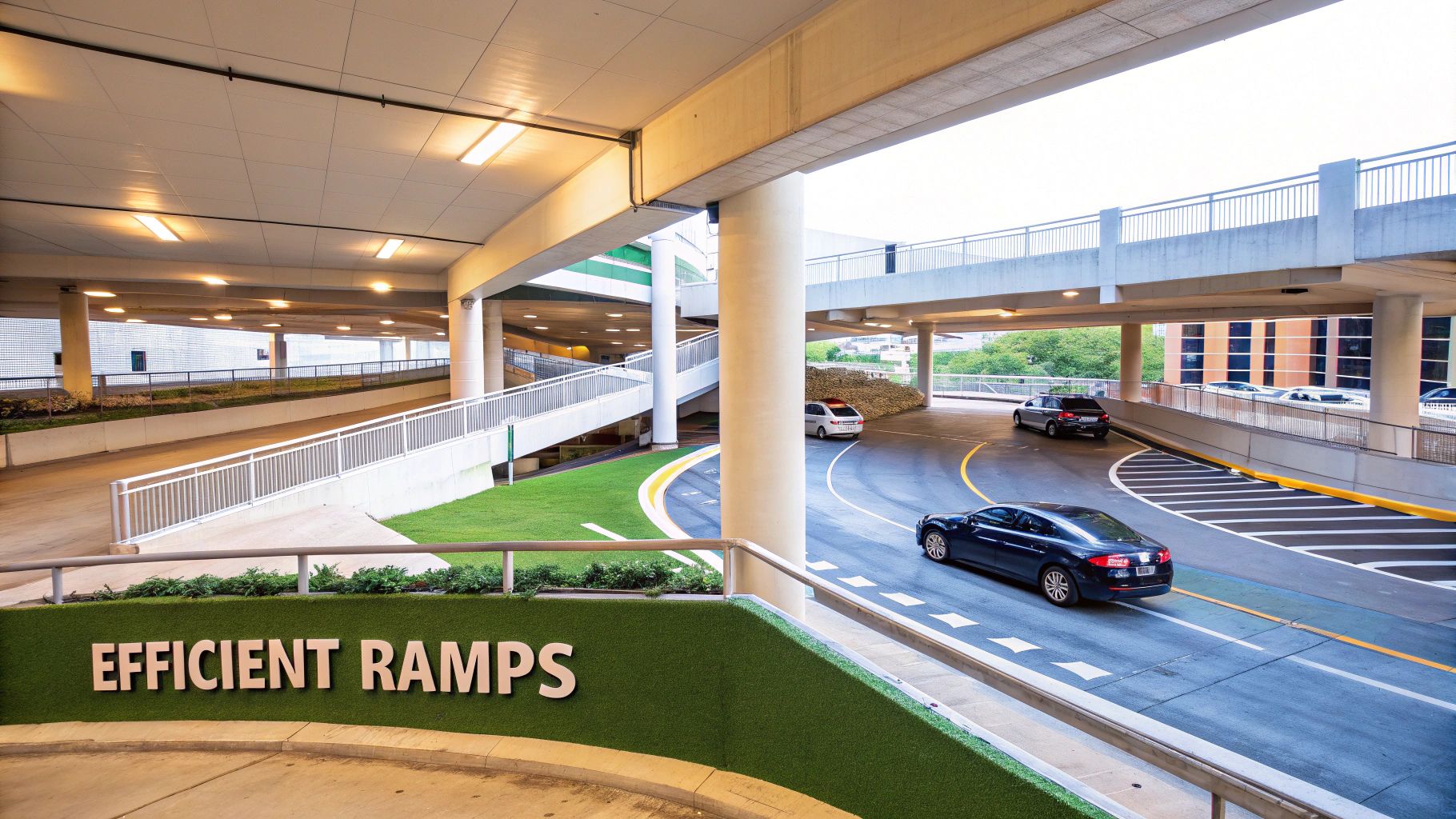
Comparing Common Ramp Designs
Most parking structures you see will use one of a few tried-and-true ramp configurations. Each one is a different mix of space-saving and traffic-handling, making them a better or worse fit depending on the project.
- Single Helix Ramps: Think of a simple corkscrew. A single helix offers one continuous, circular path for cars going either up or down. It's a very straightforward and relatively inexpensive solution, which is why you see it a lot in smaller garages where the traffic flow isn't overwhelming.
- Double Helix Ramps: Now, imagine two corkscrews twisted together. A double helix uses two completely separate ramps—one just for going up, one just for going down. This separation is a game-changer for high-volume locations. It prevents traffic conflicts and lets you move a massive number of cars quickly, making it the go-to for airports and major event venues.
- Scissor Ramps: This is a clever design that uses two straight, back-and-forth ramps that cross over each other between floors. Scissor ramps are incredibly compact and are perfect for long, skinny sites where a big circular helix just won't fit. You'll often find them in tight urban infill projects.
The big-picture decision often comes down to this: do you separate travel from parking? Express ramps, like a double helix, are basically elevators for cars—their only job is vertical movement. On the other hand, speed ramps have parking stalls built right onto the sloped ramp, combining parking and circulation into one to maximize space.
Ramp Slopes and Clearances
The steepness of your ramps—their slope—is one of those details you absolutely can't get wrong. It's dictated by building codes and the simple physics of cars. Make a ramp too steep, and drivers will feel uneasy. Worse, they’ll scrape their bumpers, which is a surefire way to get a bad reputation.
Most building codes will cap the main ramp slope somewhere between 15% and 20%. But the real art is in the transitions. At the top and bottom of the ramp, you have to flatten the slope out—usually to half the grade of the main ramp. This gentle transition prevents cars from "bottoming out" as they move from a flat floor onto the incline.
Getting the slope right is critical for a few reasons:
- Driver Comfort: A steep ramp is intimidating, especially in the rain or snow. A more moderate, well-designed slope creates a much safer and more pleasant experience.
- Construction Costs: Sure, steeper ramps are shorter and can technically save on materials. But that's a foolish trade-off if it violates code or makes the garage unusable.
- Vertical Clearance: The slope directly affects the usable headroom. You have to do the math carefully to ensure taller vehicles, like vans or trucks, can clear every part of the structure without a problem.
Ultimately, designing a great ramp system is about creating a path that's predictable, efficient, and comfortable. When you choose the right system and stick to proven standards for slope and clearance, you're building an asset that functions like a well-oiled machine.
Navigating Critical Codes and ADA Requirements
Before you ever put pencil to paper on a parking deck layout, you're already working within a strict set of rules. These aren't just guidelines; they're the building codes and federal laws that form the very DNA of your design. Thinking of these regulations as a final checkbox is a surefire way to get hit with expensive redesigns and legal trouble. The best developers I know treat them as foundational design parameters right from the start.
These rules dictate the basic geometry of every single parking space and the aisles connecting them. A standard stall usually starts around 8 feet 6 inches wide by 18 feet long, but don't take that as gospel. Local zoning ordinances often demand more generous dimensions, so your first move should always be to check the specific municipal code.
Drive aisle widths are just as tightly controlled. For a simple two-way aisle with 90-degree parking, you'll almost always need a minimum of 24 feet to give cars enough room to maneuver safely past each other. Vertical clearance is another big one. While 7 feet is a common minimum for most cars, this has to be increased for accessible van spaces, a detail that can easily be missed.
Designing for Universal Accessibility
Beyond the basic dimensions, the Americans with Disabilities Act (ADA) introduces requirements that are absolutely critical for ensuring everyone has equal access. This is about much more than just painting a few blue spaces near the elevator. It’s about creating a completely accessible path of travel from the moment someone parks their car to the moment they enter the building.
When it comes to ADA compliance, the numbers are precise and non-negotiable. The number of accessible spaces you need is directly tied to the total capacity of your garage.
- 1 to 25 total spaces: 1 accessible space required
- 51 to 75 total spaces: 3 accessible spaces required
- 101 to 150 total spaces: 5 accessible spaces required
- Over 500 total spaces: 2% of the total, plus one more for every 100 spaces over 1,000
This tiered system ensures that larger facilities provide a proportional level of accessibility. And for every six accessible spaces, at least one of them must be designated as van-accessible, which requires a much wider 8-foot access aisle for wheelchair lifts.
An accessible parking space is more than just a painted symbol on the ground. It is part of an integrated system that includes proper signage, an adjacent access aisle, and a curb-free, sloped route to the building’s primary entrance, guaranteeing a safe and dignified experience for individuals with mobility challenges.
The Anatomy of an ADA-Compliant Stall
The devil is truly in the details with ADA stall design. A standard accessible car space must have an adjacent access aisle that's at least 5 feet wide. Crucially, the entire area—both the stall and the aisle—has to be nearly flat, with a slope no greater than 2% in any direction to keep wheelchairs from rolling.
Van-accessible spaces are even more demanding. They not only need that wider 8-foot access aisle but also require a minimum vertical clearance of 98 inches (or 8 feet 2 inches). This clearance must be maintained along the entire vehicle route to and from the space, a requirement that can have a major impact on your ramp design and ceiling heights on specific floors.
If you don't bake these requirements into your initial parking layouts, the consequences can ripple through the entire project. You could be forced into major structural changes or have to completely rework your circulation patterns late in the game. By mastering these codes and ADA standards upfront, you turn a compliance headache into a strategic advantage, ensuring your facility is safe, legal, and welcoming to every single person who uses it.
How Structural Choices Make or Break Your Layout and ROI
Every line on a parking garage blueprint has a price tag attached. The structure you choose isn't just about holding the building up; it's the very foundation of your project's financial performance. The column grid and beam spans directly dictate how many cars you can park, how much it costs to build, and even what you might be able to do with the building decades from now.
Getting this right is where smart design translates directly into a healthier bottom line. We're moving past the theoretical and into the real-world numbers that define a successful parking asset.
The One Metric That Matters Most
When architects and developers talk about parking efficiency, one number comes up again and again: Net Parking Area per Stall. This isn't just the size of the painted space; it's the total square footage each car occupies, including its slice of the drive aisles, ramps, and circulation paths.
Think of it as the true real estate footprint of a single parking spot. For a typical above-ground garage, the gold standard is somewhere between 300 to 325 square feet per stall. If your number is climbing higher than that, it's a red flag that your layout or structural system is eating into your potential revenue.
The name of the game is to get this number as low as you can without making the garage feel cramped or breaking building codes. Shaving just a few square feet off this metric might seem small, but multiply that by 500 stalls, and you're looking at massive construction savings and a higher-capacity garage.
How Columns and Beams Dictate Your Floor Plan
The structural system you pick will have the single biggest impact on your layout's efficiency. It all comes down to the structural bay—the space between a set of four columns. The dimensions of that bay determine if you get clean, open rows of parking or an awkward mess of obstructed stalls.
- Precast Concrete: This is the go-to for a reason. Precast systems are built off-site and assembled quickly, and they excel at creating long, clear spans of 55 to 65 feet. This is the perfect width to accommodate two rows of parking with a drive aisle down the middle, completely free of interior columns. It's the blueprint for an incredibly efficient layout.
- Cast-in-Place Concrete: Pouring concrete on-site gives you more flexibility in shape and form, but you often pay a price with shorter spans. More columns mean more potential for them to land right where you want to put a car, which complicates the layout, reduces your stall count, and frustrates drivers.
- Steel Frames: You don't see as many standalone steel garages because the fireproofing adds significant cost. However, steel is fantastic for achieving very long spans, making it a great choice when parking is tucked under another building (like an office or apartment complex) and you need to align with a specific column grid from above.
Ultimately, the most efficient parking garages almost always use a long-span structural system. Getting rid of those interior columns doesn't just let you park more cars; it creates a wide-open, flexible floor plate that could be more easily repurposed for another use in the future.
Weaving in the MEP Systems
It’s not just about columns and concrete. You also have to thread the building’s mechanical, electrical, and plumbing (MEP) systems through your structure. These are the guts of the garage—the ventilation, lighting, and fire suppression—and they need to be planned from day one, not shoehorned in later.
Ignoring this integration is a recipe for headaches and budget overruns.
- Ventilation: Any enclosed or below-grade levels need massive ducts to move air. If you don't account for them early, they’ll hang down and eat into your vertical clearance. Suddenly, that space is no longer accessible for taller vehicles, and you might even fail to meet crucial ADA van-accessibility requirements.
- Lighting and Fire Protection: Sprinkler pipes, drains, and electrical conduits all have to run somewhere. A smart structural plan creates logical pathways for these systems, keeping them tucked up between beams so they don't lower the effective ceiling height.
When the structural grid and MEP systems are designed in harmony with the parking layout, everything just works. You avoid costly rework on-site, use materials more efficiently, and end up with a garage that’s safe, functional, and built for long-term value.
Future-Proofing Your Parking Asset
A truly smart parking deck isn’t just built for the cars we drive today; it’s designed with an eye toward what’s coming down the road. Thinking about the future isn't a luxury anymore—it's a core strategy for keeping a major commercial asset valuable for the long haul. This means building a structure that’s both tough and adaptable.
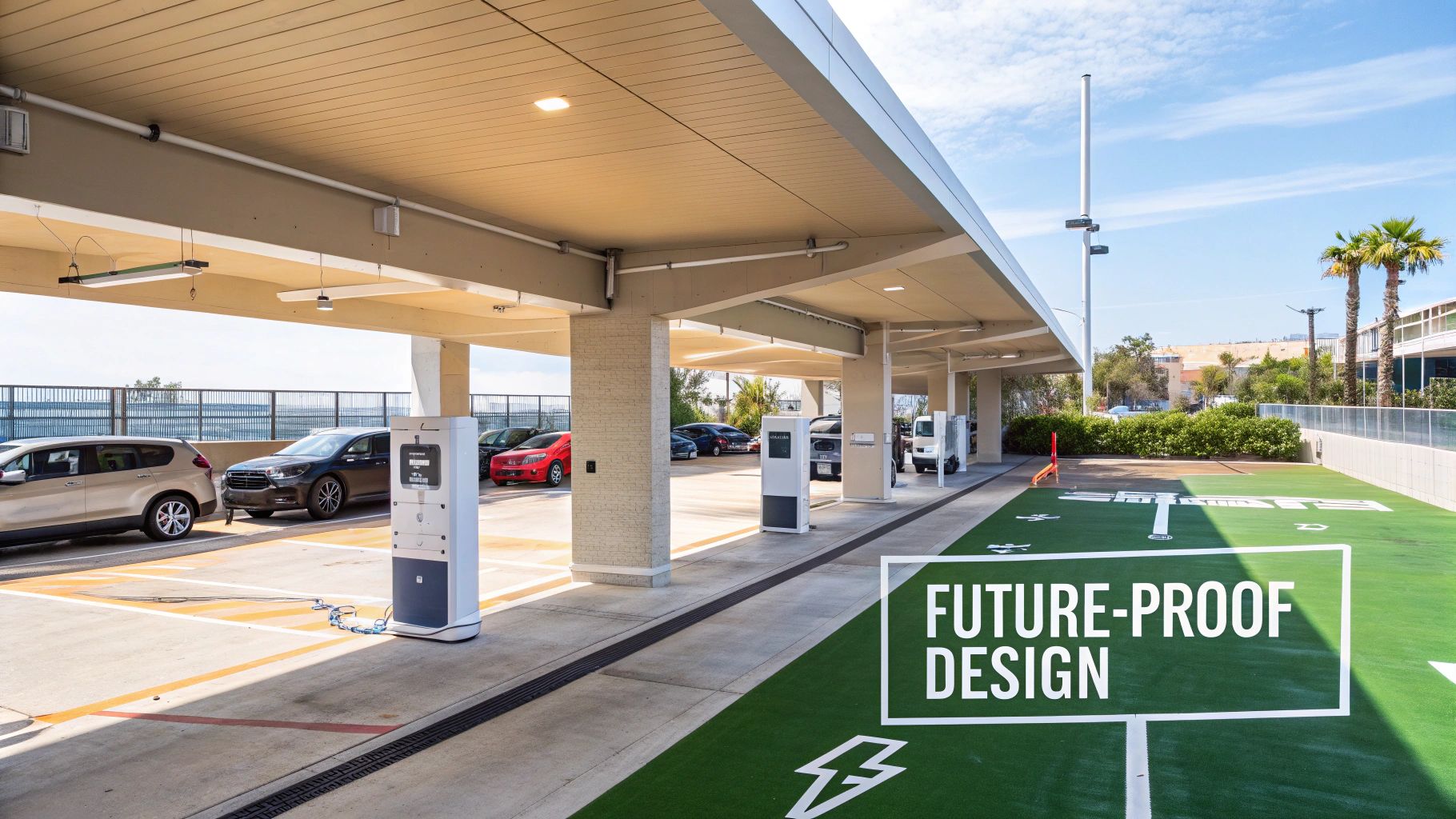
This kind of forward thinking turns a simple place to park cars into a versatile piece of real estate that can change with the times, protecting your investment for decades.
Designing for Adaptive Reuse
Think about it: what happens in a future where self-driving cars slash the need for personal vehicle storage? Or when city growth makes apartments more valuable than parking spots? A garage designed for adaptive reuse is ready for that shift. The whole game is about making structural decisions now that keep your options open later.
This strategy really boils down to a few key design moves:
- Flat Floor Plates: This is the big one. Opting for flat or nearly flat floors instead of the typical sloped ones is crucial. Sloped floors are a nightmare to convert into anything else.
- Higher Ceilings: Most parking decks have tight, low ceilings. If you want to convert the space later, you need to plan for floor-to-floor heights of 12 to 15 feet. That leaves enough room for apartments or offices once you factor in all the necessary mechanical, electrical, and plumbing systems.
- Robust Structural Capacity: You also have to design for heavier loads from the get-go. Residential or commercial spaces weigh a lot more than a floor full of cars, so the structure needs to be able to handle it without major reinforcement down the line.
By prioritizing flat floors and more generous vertical clearance from day one, you’re basically building a blank canvas. This approach lets you convert a parking garage into apartments or shops with minimal demolition, turning what could become a liability into a prime asset.
Integrating Modern Amenities and Technologies
Future-proofing also means weaving in the tech that adds value today and will be expected tomorrow. These aren’t just bells and whistles; they improve the user experience, open up new revenue streams, and give your property a competitive edge.
It all starts with smart infrastructure planning.
- EV Charging Infrastructure: Don't just stick a few chargers in a corner. You need to plan the electrical capacity and run conduit to a significant chunk of your stalls. Creating "EV-ready" spaces—where the wiring is all set for a future charger—is a savvy, cost-effective way to prepare for the inevitable surge in demand.
- Smart Parking Guidance: We’ve all been there, circling endlessly for a spot. Systems that use sensors and digital signs to point drivers directly to an open space are a game-changer. They cut down on frustration, reduce emissions, and keep traffic flowing smoothly.
- Enhanced Security: A safe garage is non-negotiable. It's not an afterthought. For a truly durable asset, it’s worth consulting a complete guide to car park security and building things like well-placed cameras and bright, efficient LED lighting into the design from the start.
By building these features into your parking deck layouts from the beginning, you’re not just building a garage. You’re creating a flexible, high-performing asset that's ready for whatever the future throws at it.
Your Parking Deck Questions, Answered
Even the most well-thought-out project plans run into real-world questions. When it comes to designing a parking structure, a few common ones always seem to pop up. Here are some straightforward, practical answers to the questions developers ask most often.
What’s the Most Space-Efficient Parking Layout?
When it comes to pure density, the 90-degree (perpendicular) layout almost always wins. It lets you pack the most stalls into a given footprint. The trade-off? You need wider drive aisles—think 24 feet or more—to make two-way traffic flow smoothly without constant three-point turns.
But pure efficiency isn't always the best solution. On a site with awkward dimensions or where driver experience is paramount, a 60-degree angled layout is often the smarter choice. You might lose a few stalls, but you gain narrower, one-way aisles that are far easier for drivers to navigate, which can seriously speed up how quickly cars get in and out.
How Do I Figure Out How Many ADA Spaces I Need?
This isn’t a flat number. The required number of ADA spaces is based on a sliding scale that’s tied directly to the total number of stalls in your garage, as laid out by the Americans with Disabilities Act. The logic is simple: the bigger the facility, the more accessible it needs to be.
Here's a quick cheat sheet for the requirements:
- 1 to 25 total stalls: 1 accessible space
- 51 to 75 total stalls: 3 accessible spaces
- 101 to 150 total stalls: 5 accessible spaces
This is one area where you absolutely cannot afford to guess. Always bring in an architect who knows the local and federal codes inside and out. They'll make sure you have the right mix of standard and van-accessible stalls in the right locations, saving you from expensive compliance headaches later on.
Can We Rework an Existing Parking Deck to Make It More Efficient?
Absolutely. Modifying an existing garage is often a much savvier move—both financially and sustainably—than building new. A thorough architectural assessment can uncover hidden opportunities, like re-striping for a tighter layout, adding a level or two, or even carving out underused areas for other income streams like self-storage or a last-mile delivery hub.
The big limitation is always the original structure. The building’s column spacing and floor-to-floor heights are the hard constraints that will dictate what’s actually possible.
What’s the Ballpark Cost Per Space to Build a Parking Deck?
The cost per space swings wildly depending on where you're building, the materials you choose, and the complexity of the design. That said, a reliable working range for a standard above-ground parking structure is usually somewhere between $25,000 and $40,000 per space.
A few things can drive that number up. Digging down for below-grade levels, incorporating ground-floor retail, or adding a complex, high-design facade will all add significant cost to the project. Your architect can dial in a much more accurate estimate once they understand your specific site and goals.
At Sherer Architects, LLC, our focus is on designing commercial structures that don't just look good, but are strategically engineered for maximum value and long-term performance. If you're planning a project and need an expert to connect the dots—from navigating tricky codes to delivering a design that’s both efficient and built to last—we can help. See our approach to commercial architecture and adaptive reuse.