The landscape of commercial construction, adaptive reuse, and historic preservation presents more complex challenges than ever. From volatile material costs to intricate code compliance and demanding timelines, successful projects require more than just a solid blueprint; they demand an absolute mastery of process. To navigate these obstacles and deliver enduring, profitable, and sustainable results, project managers must implement a suite of proven strategies that drive efficiency and mitigate risk. This guide is built to deliver precisely that.
We are detailing 10 crucial construction project management best practices that transform complex challenges into predictable, successful outcomes. This is not a theoretical overview. We will move beyond the basics, offering actionable insights, specific implementation details, and real-world examples to help you optimize every project phase, from initial preconstruction planning to the final handover. You will learn how to integrate modern methodologies like Building Information Modeling (BIM) and Lean Construction, and refine foundational skills in risk management, cost control, and stakeholder communication.
Whether you are renovating a historic landmark, upfitting an existing commercial space, or developing a new multi-use hub, these principles are the foundation of modern project success. The goal is to provide a clear, comprehensive roadmap that empowers commercial developers, property owners, and contractors to build smarter, eliminate waste, and achieve superior project results. Each practice outlined below is designed for immediate application, providing the tools needed to control costs, maintain schedules, and ensure the highest standards of quality and safety.
1. Building Information Modeling (BIM)
Building Information Modeling (BIM) is a revolutionary approach to construction project management that moves beyond traditional 2D blueprints. It involves creating and managing a digital 3D model of a project's physical and functional characteristics. This intelligent model serves as a shared knowledge resource, integrating data from architects, engineers, contractors, and other stakeholders into a single, cohesive environment.
This digital twin allows teams to visualize the entire project in three dimensions, simulate construction sequencing, and identify potential issues long before breaking ground. By embedding layers of information into the model, from structural specifications to MEP (mechanical, electrical, and plumbing) systems, BIM facilitates unprecedented collaboration and data-driven decision-making. This practice is crucial for complex commercial projects and especially valuable in adaptive reuse, where integrating new systems into an existing structure presents unique challenges.
Why BIM is a Top Best Practice
BIM has become an indispensable tool in modern construction for several key reasons. Its primary benefit is proactive clash detection. By layering different discipline models (e.g., structural, HVAC, plumbing) on top of one another, teams can instantly identify where pipes might run through beams or where ductwork conflicts with electrical conduits. Resolving these clashes digitally during the design phase is exponentially cheaper and faster than discovering them on-site, preventing costly rework and schedule delays.
Furthermore, BIM enhances cost estimation accuracy, streamlines prefabrication processes, and improves long-term facility management. The detailed model provides a clear basis for material takeoffs and informs maintenance schedules for the building's entire lifecycle.
Key Insight: The true power of BIM lies in its role as a "single source of truth." When all stakeholders work from the same integrated model, communication breakdowns are minimized, and alignment is maximized from preconstruction through to operations.
How to Implement BIM Effectively
- Establish a BIM Execution Plan (BEP): Before the project begins, create a formal BEP that outlines goals, roles, responsibilities, and the level of detail required for the model at each project stage.
- Invest in Training: Ensure all team members, from designers to on-site supervisors, are properly trained on the chosen BIM software (like Autodesk Revit or Trimble Connect) and understand the project's specific protocols.
- Start Small: If your organization is new to BIM, pilot the process on a smaller, less complex project to build internal expertise and refine your workflows before applying it to a large-scale development.
- Utilize a Centralized Platform: Implement a cloud-based common data environment (CDE) where all stakeholders can access, update, and collaborate on the latest version of the model in real time.
For a visual overview of how BIM transforms construction, watch this short video:
2. Integrated Project Delivery (IPD)
Integrated Project Delivery (IPD) is a project delivery approach that contractually unites the owner, designer, and contractor as a single collaborative entity. This model fundamentally shifts the project dynamic from siloed responsibilities to shared risk and reward, aligning all key stakeholders around a common set of project goals from the earliest stages of conception.
Unlike traditional design-bid-build methods where parties operate independently, IPD fosters a team-oriented environment built on trust, transparency, and mutual respect. This structure is particularly effective for complex commercial and adaptive reuse projects, where early input from construction experts can inform design decisions, leading to significant cost savings and schedule efficiencies. Successful examples, like projects for Stanford University and Intermountain Healthcare, have demonstrated IPD's power to deliver projects under budget and ahead of schedule.
Why IPD is a Top Best Practice
The primary advantage of IPD is its ability to optimize project outcomes by leveraging collective expertise. By involving the contractor during the design phase, constructability issues are identified and resolved on paper, not in the field. This early collaboration prevents the costly change orders and disputes that often plague traditional projects, fostering an environment of proactive problem-solving rather than reactive blame.
Furthermore, IPD’s shared risk/reward model incentivizes innovation and efficiency. When all parties have a financial stake in the project's success, they are motivated to find creative solutions, reduce waste, and improve overall value. This alignment is a cornerstone of modern construction project management best practices, ensuring decisions are made for the good of the project, not just for an individual entity.
Key Insight: IPD transforms the contractual relationship from a potential source of conflict into a framework for collaboration. By tying financial success directly to project outcomes, it ensures every key stakeholder is pulling in the same direction.
How to Implement IPD Effectively
- Utilize a Multi-Party Agreement: Use specialized contracts, such as those from the American Institute of Architects (AIA) or ConsensusDocs, that clearly define the shared risk/reward structure, decision-making processes, and liability limitations for the core team.
- Establish a Co-location "Big Room": Whenever possible, create a shared physical or virtual space where the owner, designers, and builders can work together daily. This proximity accelerates communication, decision-making, and problem resolution.
- Implement Lean Construction Principles: IPD works best when paired with Lean methodologies like the Last Planner® System. These tools help manage workflow, reduce waste, and improve the reliability of project schedules through collaborative planning.
- Foster a Culture of Transparency: Adopt an open-book accounting policy where all project costs are visible to the core team. This transparency builds trust and enables more informed, data-driven decisions about the budget.
To learn more about the principles and contracts, explore the resources from the Lean Construction Institute.
3. Lean Construction Methodology
Lean Construction applies principles from lean manufacturing to the construction industry, creating a new paradigm focused on maximizing value and systematically eliminating waste. This methodology goes beyond simply managing tasks; it refines the entire project delivery process to improve workflow, enhance productivity, and ensure predictable outcomes. It's a holistic approach that fosters collaboration and continuous improvement among all project stakeholders.
Instead of a traditional top-down, "push" system, Lean Construction utilizes "pull" planning, where work is scheduled based on downstream demand. This philosophy is particularly effective in complex commercial builds and adaptive reuse projects where coordinating multiple trades and navigating unforeseen site conditions requires exceptional efficiency and communication. Major firms like Turner Construction have successfully integrated lean initiatives to streamline their operations and deliver superior results.
Why Lean Construction is a Top Best Practice
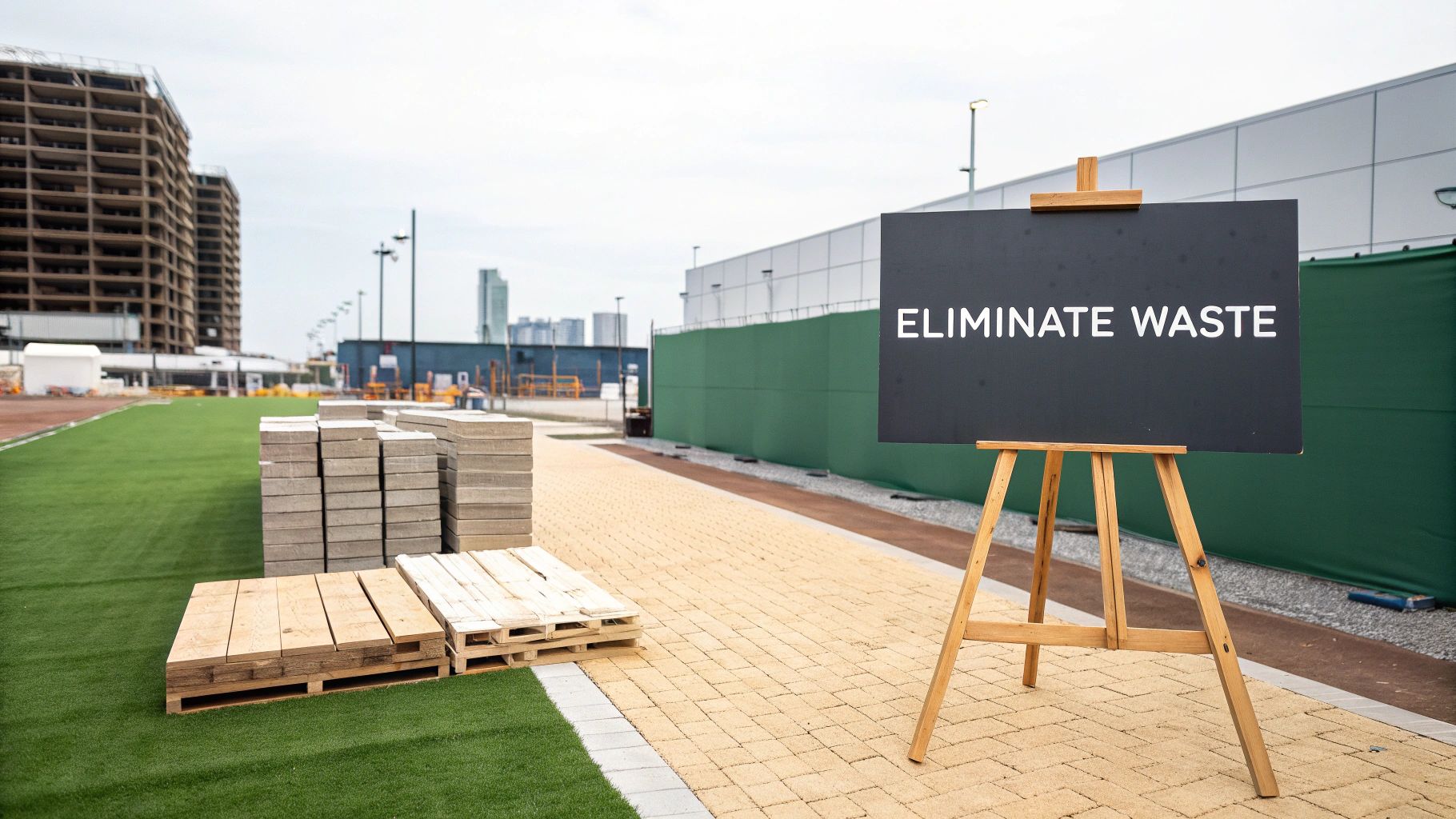
The core advantage of Lean Construction is its relentless focus on waste reduction, which extends beyond just materials. It targets eight key areas of waste: defects, overproduction, waiting, non-utilized talent, transportation, inventory, motion, and extra-processing. By minimizing these inefficiencies, projects see significant improvements in both schedule and budget performance.
A cornerstone of this practice is the Last Planner System® (LPS), a collaborative scheduling technique that dramatically improves workflow reliability. By empowering the "last planners" (foremen and team leads) to make commitments about upcoming work, the LPS ensures that schedules are realistic and achievable. This proactive approach prevents the cascading delays that plague many conventional construction projects.
Key Insight: Lean Construction transforms project management from a command-and-control system into a collaborative, commitment-based culture. This shift empowers on-site teams, improves morale, and aligns everyone toward the common goal of delivering value to the client.
How to Implement Lean Construction Effectively
- Implement the Last Planner System®: Start by creating a master schedule, then break it down into phase schedules and weekly work plans. Involve trade foremen in look-ahead planning to identify and remove constraints before they impact work.
- Conduct Daily Huddles: Hold brief, 10-15 minute stand-up meetings each morning on-site. These huddles allow teams to coordinate daily tasks, discuss progress, and quickly address any impediments to maintain workflow.
- Use Visual Management: Set up visual boards on-site to display schedules, progress updates, and key performance indicators. This makes information accessible to everyone and promotes transparency and accountability.
- Map Your Processes: Before making changes, map out your current workflows to identify specific points of waste and inefficiency. This provides a clear baseline for measuring the impact of your lean initiatives.
4. Effective Risk Management Planning
Effective risk management is a systematic process of identifying, analyzing, and responding to potential threats that could impact a construction project's objectives. This practice moves beyond reactive problem-solving by creating a structured framework to anticipate issues related to budget, schedule, safety, and quality. It involves developing a comprehensive plan before work begins, detailing potential risks and the strategies to mitigate them.
This forward-thinking approach is essential for any construction endeavor, but it is particularly critical in adaptive reuse projects where unforeseen conditions, like hidden structural defects or hazardous materials, are common. By establishing a clear process for risk assessment, teams can quantify potential impacts and develop proactive response strategies, turning uncertainty into a manageable variable. This is a core component of successful construction project management best practices.
Why Effective Risk Management is a Top Best Practice
Proactive risk management is a cornerstone of project success because it prevents minor issues from escalating into major crises. Its primary advantage is enhanced project predictability and control. By systematically identifying potential threats, from geotechnical risks in a high-rise foundation to permit delays in a highway project, project managers can allocate resources more effectively and set realistic stakeholder expectations.
This process directly protects the project's financial health by establishing contingency reserves based on quantified risk exposure rather than guesswork. It also improves safety outcomes by identifying and mitigating job site hazards before they can cause accidents. For a deeper understanding of proactive strategies, refer to this guide on "Managing Risk in Project Management".
Key Insight: The goal of risk management isn't to eliminate all risk, which is impossible. Instead, it's about shifting from a reactive "firefighting" mode to a proactive state where the team is prepared to handle disruptions efficiently and with minimal impact.
How to Implement Risk Management Effectively
- Create a Comprehensive Risk Register: Early in the planning phase, conduct a workshop with all key stakeholders to brainstorm potential risks. Document each one in a risk register, assigning an owner, a probability score, an impact score, and a preliminary response plan.
- Allocate Appropriate Contingency: Based on the risk analysis, set aside a contingency budget (typically 5-20% of the total project cost) specifically to cover the costs of managing identified risks should they occur.
- Establish Risk Triggers: For high-priority risks, define specific early warning signs or "triggers." These triggers will signal that a risk is about to materialize, allowing the team to implement its response plan before the full impact is felt.
- Conduct Regular Risk Reviews: Risk is not static. Hold monthly or bi-weekly meetings to review the risk register, update the status of existing risks, identify new ones, and remove those that have passed.
5. Comprehensive Project Scheduling and Planning
Comprehensive project scheduling and planning is the practice of creating a detailed, realistic, and dynamic roadmap for a construction project. It goes beyond a simple timeline, employing sophisticated techniques like the Critical Path Method (CPM) to identify the sequence of tasks that directly impact the project's completion date. This best practice involves breaking down the entire project into manageable components, assigning resources, and establishing clear dependencies and milestones.
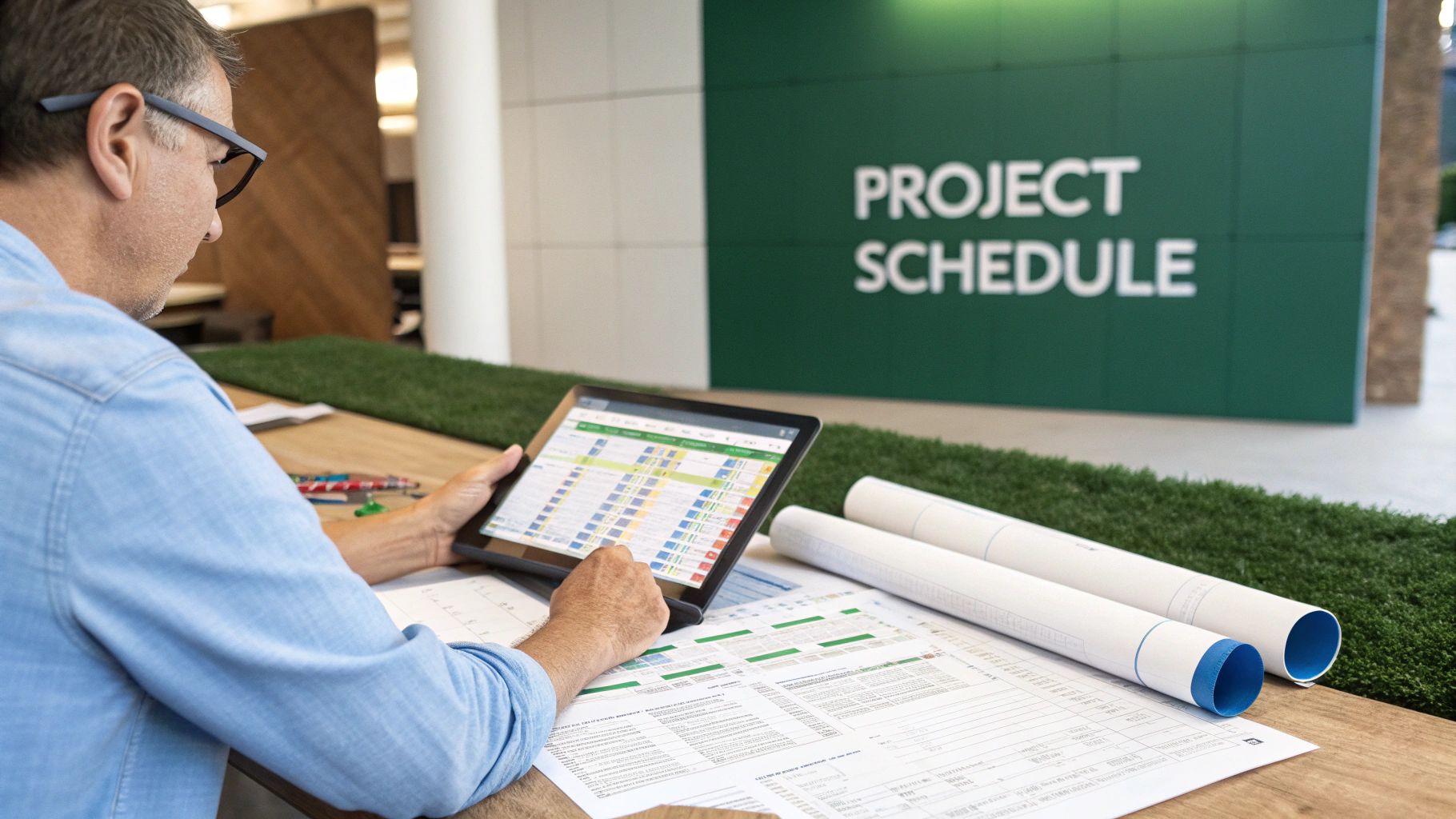
This detailed planning establishes a clear sequence for all activities, from permitting and site prep to final inspections. It serves as the primary tool for guiding project execution, tracking performance against benchmarks, and managing resource allocation. For complex undertakings like fast-track commercial builds or the intricate sequencing required in adaptive reuse projects, a robust schedule is not just a guide; it's the project's central nervous system.
Why Comprehensive Scheduling is a Top Best Practice
Effective scheduling is a cornerstone of construction project management best practices because it provides visibility and control. By using techniques like CPM, project managers can identify which activities have zero "float" or slack, meaning any delay in these tasks will directly delay the entire project. This allows for proactive management, enabling teams to focus resources and mitigation efforts where they are most needed to prevent costly overruns.
Furthermore, a well-developed schedule facilitates resource leveling, ensuring that labor and equipment are used efficiently without being over-allocated or left idle. It provides a clear, data-driven basis for communicating progress to stakeholders and justifying any necessary adjustments to the project plan, making it an indispensable tool for maintaining budget and timeline discipline.
Key Insight: A project schedule is more than a calendar; it's a dynamic management tool. The most successful projects treat the schedule as a living document, constantly updated to reflect real-world progress and used to forecast outcomes and make informed decisions.
How to Implement Comprehensive Scheduling Effectively
- Develop a Work Breakdown Structure (WBS): Start by breaking the entire project scope down into smaller, more manageable work packages. This hierarchical decomposition forms the foundation for accurate task and duration estimates.
- Involve the Entire Team: Engage subcontractors, superintendents, and lead tradespeople in the scheduling process. Their hands-on experience is invaluable for creating realistic duration estimates and identifying potential sequencing challenges.
- Build in Realistic Contingencies: No project goes exactly as planned. Incorporate schedule buffers or contingency time for high-risk activities or phases known for potential delays, such as permitting or material procurement.
- Maintain and Update Regularly: The schedule is only useful if it's accurate. Implement a strict routine for updating progress (e.g., weekly) and re-forecasting completion dates. Use software like Procore, Microsoft Project, or Oracle Primavera P6 to manage these updates efficiently.
6. Rigorous Quality Management and Control
Rigorous quality management and control is the systematic process of ensuring all aspects of a construction project meet or exceed established standards and client expectations. This practice moves beyond simple end-of-phase inspections to embed quality into every step of the process. It involves a proactive framework of quality planning, quality assurance (process-oriented), and quality control (product-oriented) to prevent defects before they occur.
This comprehensive approach ensures that materials, workmanship, and final deliverables adhere to design specifications, building codes, and safety regulations. In complex projects like hospital construction, rigorous quality control is non-negotiable for patient safety and regulatory compliance. Similarly, in adaptive reuse projects, it is vital for ensuring that new systems integrate seamlessly and safely with the historical structure, preserving integrity while meeting modern performance standards.
Why Rigorous Quality Management is a Top Best Practice
Effective quality management is fundamental to a project's long-term success and reputation. Its core benefit is the prevention of defects and costly rework. By identifying and correcting non-conformance issues early through systematic inspections and process controls, teams can avoid the significant schedule delays and budget overruns associated with fixing problems after work is completed. This is a cornerstone of effective construction project management best practices.
Furthermore, a strong quality program enhances safety, increases the building's lifespan, and improves stakeholder satisfaction. Documenting quality processes provides a clear record of compliance and performance, which is invaluable for commissioning, facility management, and mitigating potential liability claims down the line.
Key Insight: Quality is not just a final inspection; it's a culture built on proactive planning and continuous verification. Shifting focus from finding defects to preventing them transforms quality control from an expense into a value-generating investment.
How to Implement Quality Management Effectively
- Define Clear Acceptance Criteria: Before construction begins, work with stakeholders to develop and document specific, measurable, and objective quality standards for all major project components.
- Implement a "First Work in Place" Protocol: Inspect the very first installation of any repeatable task (e.g., the first window, the first section of ductwork) to ensure it meets standards. Once approved, this serves as the benchmark for all subsequent work.
- Use a Digital Quality Management System: Leverage mobile apps and software to create standardized inspection checklists, document issues with photos and notes in real-time, and track corrective actions through to completion.
- Conduct Regular Quality Training: Ensure all team members and subcontractors understand the project's specific quality standards, expectations, and their individual responsibilities for achieving them.
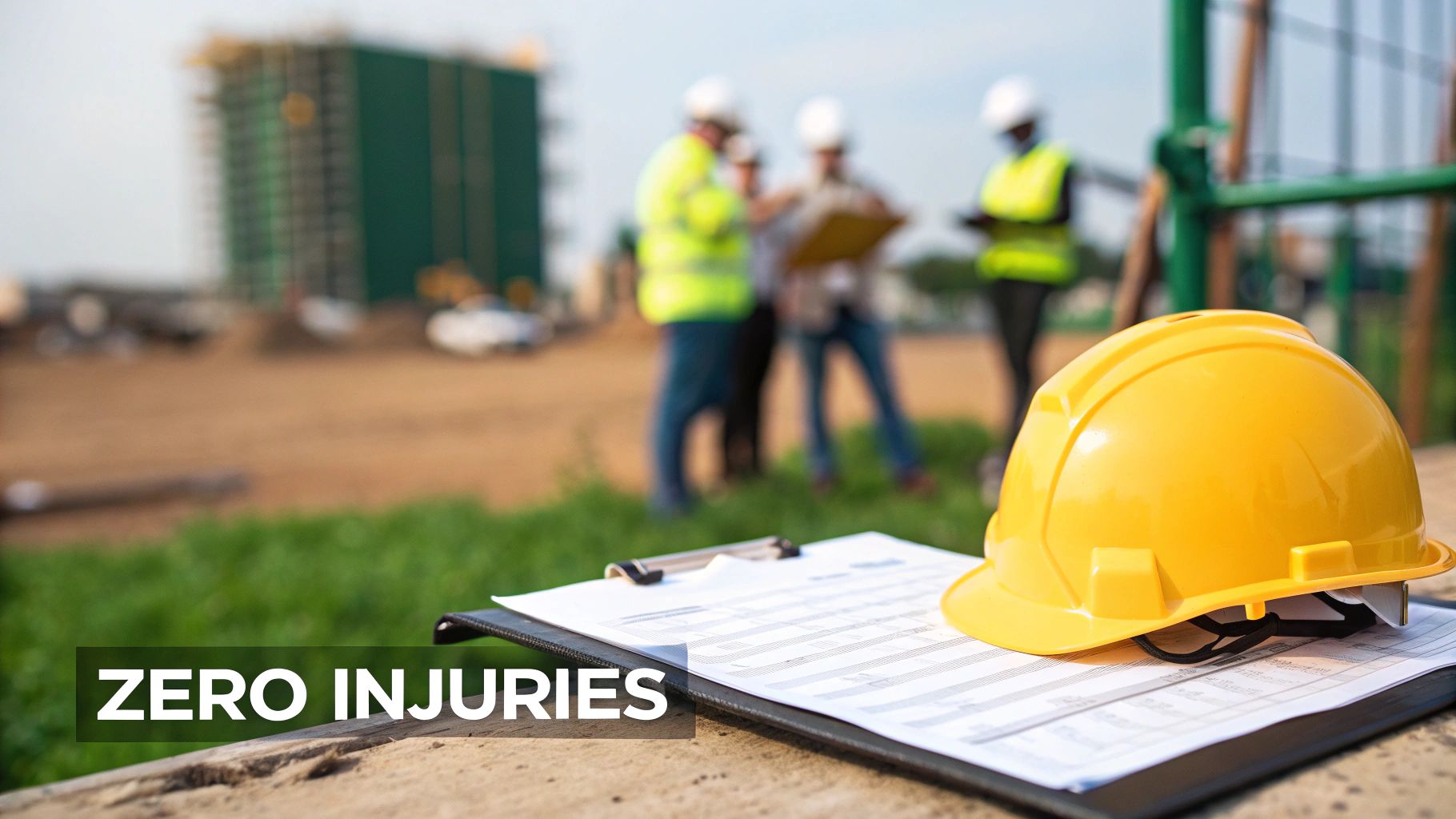
7. Proactive Safety and Health Management
Proactive Safety and Health Management is a foundational best practice that moves beyond mere compliance to foster a deeply ingrained culture of safety. This approach involves systematically identifying potential hazards, assessing risks, and implementing preventative control measures long before an incident can occur. It prioritizes leading indicators like safety training and regular inspections over lagging indicators like injury rates.
This comprehensive system includes detailed safety planning during preconstruction, daily on-site safety meetings, thorough incident investigations, and empowering every team member to take ownership of site safety. For complex adaptive reuse projects, where workers encounter unknown conditions within existing structures, a proactive safety program is not just beneficial, it is essential for mitigating unique and unforeseen risks.
Why Proactive Safety is a Top Best Practice
A robust safety program is the cornerstone of successful construction project management. Its most significant benefit is the prevention of workplace injuries and fatalities, which protects a project's most valuable asset: its people. This focus cultivates a positive work environment, improves morale, and enhances worker productivity and retention.
Furthermore, a strong safety record directly impacts the bottom line by reducing insurance premiums, minimizing the risk of costly OSHA fines, and preventing schedule disruptions caused by accidents. Companies like Turner Construction have demonstrated through their "Building L.I.F.E. (Living Injury Free Every day)" program that a zero-injury culture is an attainable goal that also yields significant financial and reputational rewards.
Key Insight: The most effective safety programs shift the mindset from reaction to prevention. By implementing a near-miss reporting system, teams can identify and correct systemic issues before they escalate into serious incidents, creating a cycle of continuous improvement.
How to Implement Proactive Safety Effectively
- Develop a Site-Specific Safety Plan (SSSP): Before mobilization, create a detailed SSSP that identifies project-specific hazards, outlines emergency procedures, and assigns clear safety responsibilities to all personnel.
- Conduct Daily Toolbox Talks: Start each day with a brief safety meeting to discuss the day's tasks, associated hazards, and relevant control measures. This keeps safety top-of-mind for every worker on site.
- Empower All Personnel: Establish a clear "Stop Work Authority" policy that empowers any individual on site, regardless of their role, to halt an operation if they perceive an immediate danger.
- Track Leading Indicators: Focus on metrics that predict future performance, such as the number of safety observations conducted, training hours completed, and hazards corrected, rather than only reacting to accidents after they happen.
8. Stakeholder Communication and Engagement
Effective stakeholder communication and engagement is the practice of systematically identifying, analyzing, and managing the expectations of every individual and group invested in a project's outcome. This goes far beyond simple project updates; it involves creating a structured framework for transparent dialogue with everyone from investors and tenants to regulatory bodies, community groups, and the project team itself.
This strategic approach ensures all participants are aligned on goals, timelines, and budgets. In complex commercial and adaptive reuse projects, where stakeholders often have competing interests, a proactive communication strategy is the glue that holds the project together. It transforms potential adversaries into partners by managing expectations, resolving conflicts before they escalate, and fostering a collaborative environment.
Why Stakeholder Communication is a Top Best Practice
Mastering stakeholder engagement is one of the most critical construction project management best practices because it directly mitigates non-technical risks. A primary benefit is proactive conflict resolution. By establishing clear channels for feedback and addressing concerns head-on, project managers can prevent minor disagreements from escalating into major disputes that cause delays and legal challenges, a common issue in public infrastructure projects with extensive community oversight.
Furthermore, strong communication builds trust and secures buy-in, which is essential for smooth decision-making and navigating the permitting process. It ensures that everyone understands the "why" behind project decisions, leading to greater support and fewer roadblocks from start to finish.
Key Insight: Project success is often defined not just by being on time and on budget, but by satisfying stakeholder expectations. A formal communication plan is the tool that ensures these expectations are clearly defined, understood, and managed from day one.
How to Implement Stakeholder Communication Effectively
- Develop a Formal Communication Plan: At the project's outset, create a detailed plan that identifies all stakeholders, their interests, and the preferred frequency and format for communication (e.g., weekly emails, bi-weekly meetings).
- Establish a Single Point of Contact: Designate a specific person to manage communications with each key stakeholder group to avoid mixed messages and ensure consistency.
- Maintain Meticulous Documentation: Document all major decisions, meeting minutes, and change orders in writing and distribute them through a centralized platform to ensure everyone has access to the same information.
- Be Transparent and Prompt: Address concerns and conflicts as soon as they arise. Provide honest, regular updates on schedule and budget performance, even when the news isn't positive, to maintain credibility and trust.
9. Cost Management and Budget Control
Cost Management and Budget Control is the disciplined process of planning, estimating, tracking, and controlling project costs from inception to completion. This practice ensures a project is completed within its approved budget, safeguarding profitability and financial viability. It involves establishing a detailed cost baseline, continuously monitoring actual expenditures against planned spending, and implementing formal processes to manage any changes or variances.
This financial oversight is more than just accounting; it’s a proactive management function. For large-scale commercial builds or complex adaptive reuse projects, where unforeseen conditions can quickly escalate expenses, rigorous cost control is the bedrock of project success. By integrating cost data with project schedules and scope, managers gain a holistic view of financial health, enabling them to make informed decisions that prevent budget overruns.
Why Cost Management is a Top Best Practice
Effective cost management is fundamental to delivering value and achieving a positive return on investment. Its primary benefit is preventing scope creep and budget overruns. A structured change order process ensures that any proposed modification to the project scope is thoroughly evaluated for its cost impact before approval. This prevents small, unmanaged changes from accumulating and eroding the project’s contingency and profit margins.
Furthermore, disciplined cost tracking provides early warning signs of financial distress. By comparing actual costs to the budget on a weekly or bi-weekly basis, project managers can identify negative trends long before they become critical. This foresight allows for timely corrective actions, such as value engineering or re-sequencing work, to bring the project back on track.
Key Insight: Proactive cost management is not about cutting corners; it's about making strategic financial decisions. A well-managed budget provides the stability needed to focus on quality, safety, and delivering the project as promised without constant financial crises.
How to Implement Cost Management Effectively
- Develop a Detailed Cost Baseline: Create a granular, line-item budget during preconstruction, using historical data and multiple estimates for validation. This baseline becomes the benchmark against which all future costs are measured.
- Implement a Strict Change Order Process: Establish a formal, multi-step approval workflow for all change orders. No work should proceed on a change until its cost impact is fully approved in writing by the client and relevant stakeholders.
- Utilize Earned Value Management (EVM): For complex projects, use EVM to integrate cost, schedule, and scope performance. This powerful technique, championed by the Project Management Institute (PMI), provides objective metrics to forecast final project costs and completion dates.
- Track Costs and Variances Religiously: Use construction-specific accounting software to track every dollar spent. Hold weekly meetings to review budget-versus-actual reports and analyze any variances to understand their root cause.
10. Effective Subcontractor and Supply Chain Management
Effective Subcontractor and Supply Chain Management is the strategic process of selecting, contracting, coordinating, and managing all third-party vendors, from specialty subcontractors to material suppliers. This practice goes beyond simple procurement; it is about building a high-performing, reliable network that functions as a seamless extension of the project team. A well-managed supply chain is critical for controlling costs, maintaining the project schedule, and ensuring quality workmanship.
This comprehensive approach involves rigorous prequalification of partners, developing clear and fair contracts, and establishing robust communication channels to monitor progress and resolve issues. In complex commercial and adaptive reuse projects, where specialized skills and materials are often required, managing these relationships effectively can be the difference between a profitable, on-time project and one plagued by delays, cost overruns, and disputes.
Why Subcontractor and Supply Chain Management is a Top Best Practice
This discipline is one of the most vital construction project management best practices because projects are rarely completed by a single entity. The primary benefit is risk mitigation. A thoroughly vetted subcontractor is less likely to default or produce substandard work, and a resilient supply chain with backup suppliers protects the project from material shortages or sudden price spikes. This proactive management prevents bottlenecks that can halt progress across the entire job site.
Furthermore, strong partnerships foster collaboration and innovation. When subcontractors are treated as valued partners, they are more likely to offer cost-saving suggestions and go the extra mile to meet project goals. This leads to better quality, more efficient workflows, and a positive on-site culture, which ultimately translates to a superior final product for the client.
Key Insight: Your project is only as strong as its weakest link. Treating your subcontractors and suppliers as integral partners, rather than just vendors, builds a foundation of trust and reliability that is essential for navigating the complexities of modern construction.
How to Implement Effective Vendor Management
- Establish Rigorous Prequalification Criteria: Before inviting bids, develop a formal process to vet potential partners on their financial stability, safety record (e.g., EMR score), past project experience, and references.
- Use Clear and Comprehensive Contracts: Utilize detailed contracts that explicitly define the scope of work, payment schedules, quality standards, and communication protocols to prevent misunderstandings down the line.
- Implement Performance Monitoring: Regularly track subcontractor and supplier performance using key metrics like schedule adherence, quality of work, and safety compliance. Monthly scorecards can help identify issues early.
- Maintain Open and Consistent Communication: Hold regular coordination meetings and maintain a central, written log of all communications, change orders, and decisions to ensure everyone is aligned. Prompt payment of invoices is also crucial for maintaining good faith.
Construction Project Management: 10 Best Practices Comparison
| Approach / Practice | Implementation Complexity 🔄 | Resource Requirements ⚡ | Expected Outcomes 📊 | Ideal Use Cases 💡 | Key Advantages ⭐ |
|---|---|---|---|---|---|
| Building Information Modeling (BIM) | High — steep learning curve, interoperability challenges 🔄 | High — software, hardware, training, data infrastructure ⚡ | Very high — better coordination, 20–30% less rework 📊⭐ | Complex, multi-discipline projects; lifecycle/facility management 💡 | Clash detection, accurate estimates, centralized data ⭐ |
| Integrated Project Delivery (IPD) | High — complex contracts and cultural change 🔄 | Medium–High — facilitation, legal support, collaborative systems ⚡ | High — cost reduction (5–15%), improved schedule/quality 📊⭐ | Projects needing early stakeholder alignment and innovation 💡 | Shared risk/reward, fewer disputes, aligned incentives ⭐ |
| Lean Construction Methodology | Medium — requires continuous cultural change 🔄 | Medium — training, supply-chain coordination, implementation tools ⚡ | High — waste down 20–30%, productivity up 10–25% 📊⭐ | Repetitive workflows, contractors focused on waste reduction 💡 | Eliminates non-value work, improves flow and productivity ⭐ |
| Effective Risk Management Planning | Medium — ongoing analysis and expertise required 🔄 | Medium — risk workshops, analysts, contingency reserves ⚡ | High — fewer surprises, protected profitability and schedule 📊 | High-risk projects (infrastructure, international, geotechnical) 💡 | Early mitigation, contingency planning, improved confidence ⭐ |
| Comprehensive Project Scheduling & Planning | Medium — time-intensive, detailed dependencies 🔄 | Medium — schedulers, tools (CPM), historical data ⚡ | High — accurate durations, early delay warnings 📊 | Complex sequences, fast-track, mega-project scheduling 💡 | Critical path visibility, resource optimization, milestones ⭐ |
| Rigorous Quality Management & Control | Medium — inspection regimes and documentation load 🔄 | Medium — inspectors, testing, QA systems and training ⚡ | High — reduced rework, regulatory compliance, customer satisfaction 📊⭐ | Healthcare, data centers, safety-critical builds 💡 | Defect reduction, consistent standards, warranty risk down ⭐ |
| Proactive Safety & Health Management | Medium — program setup and cultural adoption 🔄 | Medium — training, PPE, audits, safety staff ⚡ | Very high — prevents injuries, lowers incident-related costs 📊⭐ | High-hazard sites, large crews, regulatory scrutiny 💡 | Injury prevention, lower insurance costs, compliance ⭐ |
| Stakeholder Communication & Engagement | Low–Medium — process and cadence management 🔄 | Low–Medium — communication platforms, reporting effort ⚡ | High — fewer misunderstandings and disputes, better alignment 📊 | Public projects, multi-stakeholder programs, complex owners 💡 | Builds trust, speeds decision-making, reduces change orders ⭐ |
| Cost Management & Budget Control | Medium — detailed tracking and change control 🔄 | Medium–High — cost systems, EVM, estimators, accountants ⚡ | High — early overrun detection, maintained profitability 📊 | Fixed-price projects, portfolios, mega-project financial control 💡 | Budget discipline, forecasting, variance management ⭐ |
| Subcontractor & Supply Chain Management | Medium — vetting, contracting and performance monitoring 🔄 | Medium — prequalification, backup suppliers, KPIs ⚡ | High — timely deliveries, consistent workmanship, fewer delays 📊 | Projects dependent on many vendors or JIT delivery 💡 | Reduced supply risk, stronger vendor relationships, quality control ⭐ |
Integrating Best Practices for Enduring Success
Navigating the intricate landscape of modern construction, especially within the demanding realms of commercial projects and adaptive reuse, requires more than just a competent team and a set of blueprints. The difference between a project that merely meets specifications and one that delivers enduring value lies in the deliberate, systematic integration of proven methodologies. The ten construction project management best practices we've explored are not isolated tactics to be deployed ad-hoc; they are interconnected pillars that form a resilient framework for project delivery.
From the digital-first approach of Building Information Modeling (BIM) that creates a single source of truth, to the collaborative ethos of Integrated Project Delivery (IPD) that aligns all stakeholder incentives, these principles work in concert. A comprehensive project schedule is not just a timeline; it's a dynamic tool that informs your cost management strategy and highlights potential risks before they materialize. Similarly, a Lean Construction mindset, focused on eliminating waste, directly enhances both your quality control and safety management programs by fostering a culture of continuous improvement and meticulous attention to detail.
From Knowledge to Action: Your Next Steps
Merely understanding these concepts is the first step. The true challenge and reward come from weaving them into the operational fabric of your organization. It's about moving from a reactive to a proactive stance, transforming potential liabilities into predictable outcomes and profitable assets.
Actionable Takeaways to Implement Now:
- Audit Your Current Process: Select one recently completed project and evaluate it against these ten best practices. Where were the gaps? Did a lack of proactive risk planning lead to budget overruns? Could better stakeholder communication have streamlined the permitting phase?
- Prioritize a Pilot Program: You don't need to implement everything at once. Choose one or two high-impact practices to pilot on your next project. For example, introduce a more rigorous preconstruction planning phase using BIM or implement daily huddle meetings to improve subcontractor communication and flow, a core tenet of Lean.
- Invest in Technology and Training: The right tools are force multipliers. Whether it’s adopting project management software that facilitates transparent communication or investing in training for Lean methodologies, empowering your team with the right resources is critical for successful implementation.
The Holistic Advantage in Modern Construction
Ultimately, mastering these construction project management best practices is about building a cohesive, predictable system. It’s a commitment to a philosophy where proactive planning mitigates unforeseen challenges, where transparent communication builds trust, and where rigorous quality control ensures the final product is not just built to code, but built to last.
This integrated approach is the key to unlocking true project potential, especially in complex adaptive reuse or historic preservation scenarios where every decision carries significant weight. By shifting from a collection of disparate tasks to a unified strategy, you cultivate a project environment defined by efficiency, accountability, and excellence. This commitment doesn't just get projects done; it builds a reputation for delivering exceptional results on time and on budget, turning every build into a cornerstone of enduring success.
Ready to see how an integrated, architect-led approach can transform your next commercial or adaptive reuse project? The team at Sherer Architects, LLC builds these best practices into every design and management decision, ensuring your vision is realized with precision and expertise. Contact us today to discuss how we can bring your project to life.