SHERER ARCHITECTS

Categories
Uncategorized

A Practical Guide to Modern Fire Station Design

A modern fire station is a finely tuned machine, a complex blend of operational grit, firefighter well-being, and community trust—all wrapped up in a single, resilient structure. We've moved far beyond just building a garage for fire trucks. Today, it's about creating a facility that enables lightning-fast response times, actively protects responders from long-term health risks, and stands as a durable public asset for generations.

The Evolution of Fire Station Architecture
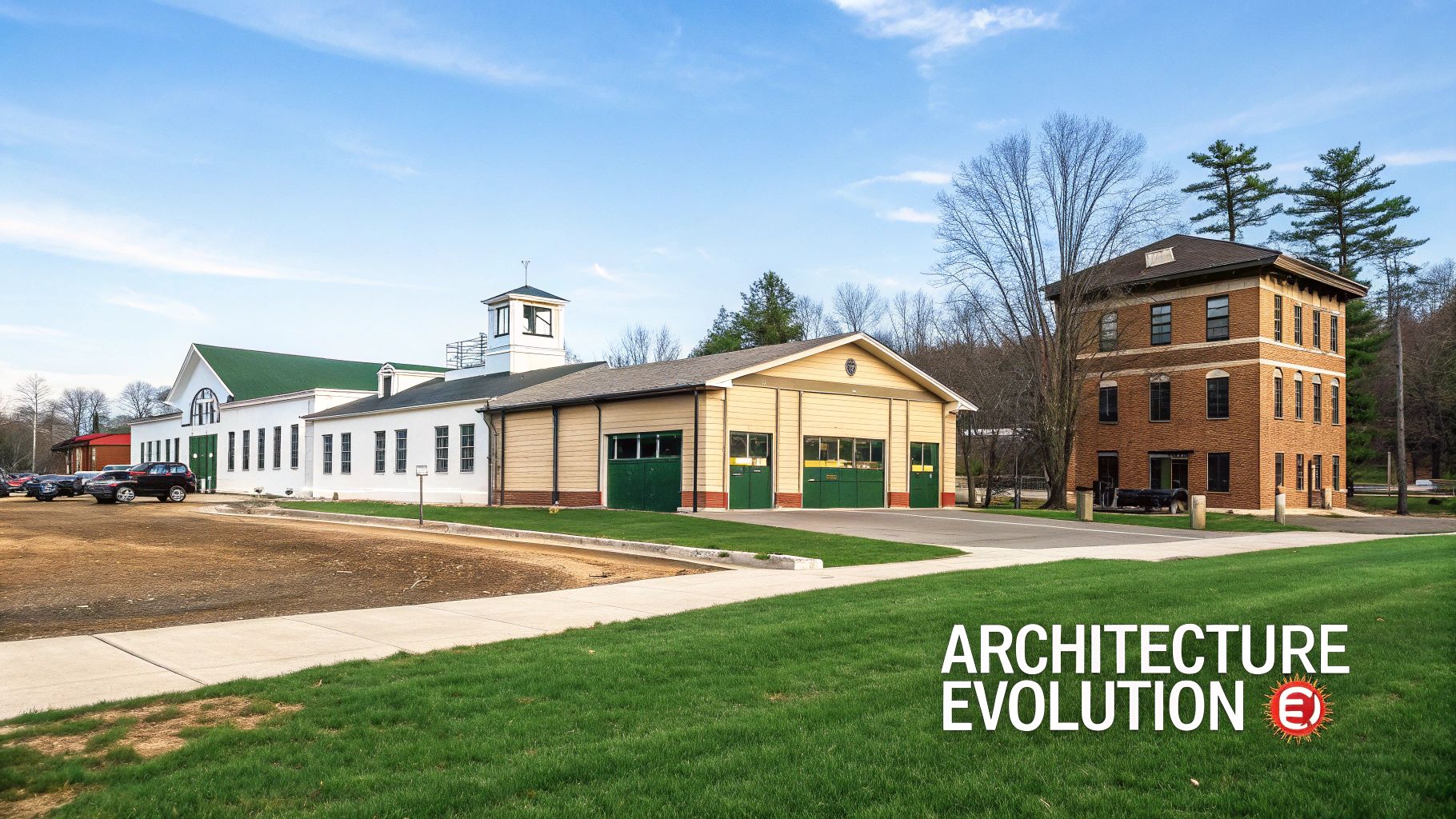
A complex of historic buildings, including a white fire station with a tower and a tall brick building, on a sunny day.

Before we get into the nuts and bolts of today’s designs, it helps to look back. Fire stations have always been a direct reflection of the technology of their time, the needs of their communities, and our ever-growing understanding of what it takes to keep firefighters safe and healthy.

The first "firehouses" were really just sheds or repurposed carriage houses. They held the basics—buckets, ladders, maybe a hand-pumper—and were staffed by volunteers. The only real design consideration was finding a central spot to get to the fire quickly. For centuries, that was about it.

From Horse-Drawn to High-Tech

The first major shake-up came when horse-drawn steam pumpers gave way to motorized engines in the late 19th and early 20th centuries. This wasn't just a simple equipment swap; it completely rewired the DNA of the fire station.

Suddenly, fire station design had to account for vehicles that were bigger, heavier, and needed much wider, taller bay doors. Out went the haylofts and stables; in came maintenance shops and fuel tanks. This is also when we saw the birth of iconic features like the fire pole, a simple but brilliant solution for getting firefighters from the living quarters to the apparatus floor in a heartbeat.

That leap forward set the stage for everything that followed. As fire apparatus continued to grow, the bays had to keep pace with reinforced concrete floors, soaring ceilings, and complex support systems.

Adapting to Modern Demands

But the evolution didn't stop at the garage doors. The firefighter's job description has expanded dramatically, and the station had to expand right along with it. What started as a simple garage has become a dynamic, multi-purpose hub.

Today's fire stations are complex environments that must function as a high-performance workplace, a temporary home, a training facility, and a community safe haven, often all at once.

This shift has totally changed the architectural blueprint. It's now standard to see modern stations include:

  • Dedicated Training Spaces: Think training towers for practicing high-rise rescues or classrooms for EMT certification.
  • Health and Wellness Areas: Fitness rooms are a given, but we're also seeing dedicated quiet zones for mental decompression—a critical tool for fighting the cumulative stress of the job.
  • Community-Facing Elements: Many new stations feature public meeting rooms or designated safe-haven lobbies, strengthening the bond between the department and the people they protect.

The journey from a simple shed to these multi-functional centers is pretty incredible. With nearly 30,000 fire stations across the U.S. serving over a million firefighters, the design process is constantly evolving to incorporate new strategies for health, sustainability, and operational readiness. You can discover more insights about the history of firefighting and its architectural impact. This historical backdrop is exactly why a forward-thinking, holistic approach to fire station design is more critical than ever.

Choosing the Right Site and Layout

So much of a fire station's success is decided long before a single shovel hits the dirt. Picking the right location isn't a guessing game; it's a science, driven by hard data. Think of it as placing a vital organ in the body of a community—its placement determines the health and safety of the whole system. The goal is simple: ensure the fastest possible response when every second counts.

It all starts with a deep dive into community data. We rely heavily on tools like Geographic Information System (GIS) mapping, which lets us layer critical information onto a single, dynamic map. This helps us see the patterns and pressures that tell us exactly where a new station will do the most good.

Pinpointing the Perfect Location with Data

To find that ideal spot, we work with municipal leaders to model how a new station will perform. We're looking for the sweet spot, the location that provides maximum coverage and the quickest response times for the largest number of people and properties.

We zero in on a few key datasets:

  • Historical 911 Call Data: By mapping where calls come from, we can identify "hot spots." The new station needs to be placed strategically to relieve pressure on other stations and cover those high-demand zones.
  • Traffic Patterns and Road Networks: A site might look great on paper, but if it’s on a road that's constantly gridlocked or doesn't have a straight shot to a major artery, response times are dead on arrival. We analyze traffic flow to make sure fire trucks can get out and get moving, fast.
  • Population Density and Future Growth: We're not just planning for today. We have to look at projections for future development to make sure this station will still be in the right place 50 to 75 years from now.

A fire station is a long-term community investment. Siting it based on future growth projections, not just current needs, prevents it from becoming obsolete as the community expands.

When you layer all this information together, a clear picture emerges, pointing to the most strategic zones for the new facility. This data-first approach takes the guesswork out of the equation and ensures public funds are invested in a location that truly enhances safety.

To break it down, here’s a look at the essential criteria we evaluate when vetting potential sites.

Key Factors in Fire Station Site Selection

Factor Description Data Sources
Response Time Coverage The ability of the station to meet established response time goals (e.g., 4-6 minutes) for its designated service area. GIS analysis, 911 call volume maps, population density studies.
Access to Major Roads Direct, unimpeded access to arterial roads and highways is critical for rapid deployment. We avoid sites with traffic congestion or complex intersections. Traffic flow data, municipal road network maps, peak-hour congestion studies.
Site Topography & Size The land must be large and stable enough to accommodate the building, apparatus aprons, parking, and training areas without extensive grading. Topographical surveys, geotechnical reports, zoning regulations.
Future Community Growth The site should be positioned to serve not only the current population but also anticipated future residential and commercial developments. Municipal master plans, economic development forecasts, demographic projections.
Zoning & Land Use The property must be properly zoned for a public safety facility, or the potential for rezoning must be high. Local zoning ordinances, community development plans.

Ultimately, a thorough analysis of these factors ensures the final site selection is based on objective, life-saving criteria, not just availability or cost.

From Site Selection to Building Orientation

Once we've got the land, the focus shifts to how the station will actually sit on the property. This is just as critical as its location on the city map. The building’s orientation and layout will dictate everything from daily workflow and firefighter safety to its long-term energy costs.

Getting the orientation right is crucial. For instance, we always want the apparatus bay doors facing the primary direction of travel. This simple move eliminates awkward turns and shaves precious seconds off every call. It’s a foundational principle in fire station design.

It's not just about speed, either. Smart orientation can make a building much more sustainable. By positioning living quarters and offices with southern exposure, we can capture passive solar heat in the winter and use architectural overhangs to provide shade in the summer. These aren't just feel-good features; they translate into real, long-term savings on utility bills and create a healthier environment for the crew.

Even the landscaping has a job to do. We have to account for zoning setbacks, manage stormwater runoff, and create secure, separate access points for the public and for staff. Every detail, from the turning radius of the driveway to the placement of a security fence, is part of a unified design that makes the station fast, safe, and a good neighbor to the surrounding community.

Designing for Firefighter Health and Well-Being

A fire station is so much more than a garage for big red trucks. For first responders, it’s a second home—the place they eat, sleep, and try to decompress between incredibly stressful calls. The best modern fire station design puts this reality front and center, making the physical and mental health of firefighters a non-negotiable part of the architectural plan. Creating a truly safe and supportive environment isn't an afterthought anymore; it’s the entire point.

One of the biggest leaps forward in this area has been the focus on contamination control. Think of it like a hospital's cleanroom protocol. The mission is simple but critical: stop dangerous carcinogens and other toxic gunk from being tracked from a fire scene into the station's living quarters. The way we do this is by creating very clear, distinct zones inside the building.

Implementing Hot, Warm, and Cold Zones

This zoning strategy is all about creating a deliberate, one-way path for firefighters and their gear when they get back from a call. It’s a workflow designed to systematically strip away contaminants at each stage, protecting their long-term health.

  • Hot Zone: This is the first stop. It's usually the apparatus bay and a dedicated decontamination room. Here, firefighters get the worst of the grime off themselves and their equipment. All turnout gear, helmets, and tools stay in this zone. Period.
  • Warm Zone: This is the transition area. It’s where you’ll find locker rooms—often with separate lockers for dirty gear and personal items—as well as showers and special laundry facilities built to extract contaminants. Firefighters move through this zone after the Hot Zone but before they can enter the clean living spaces.
  • Cold Zone: This is the "clean" side of the station. It includes the kitchen, dayroom, bunk rooms, and offices. Absolutely no contaminated gear or clothing is allowed to cross this threshold. This is what keeps the space safe for rest and recovery.

This whole process—from figuring out where a station should even be built to how its internal zones are laid out—is driven by careful planning and data.
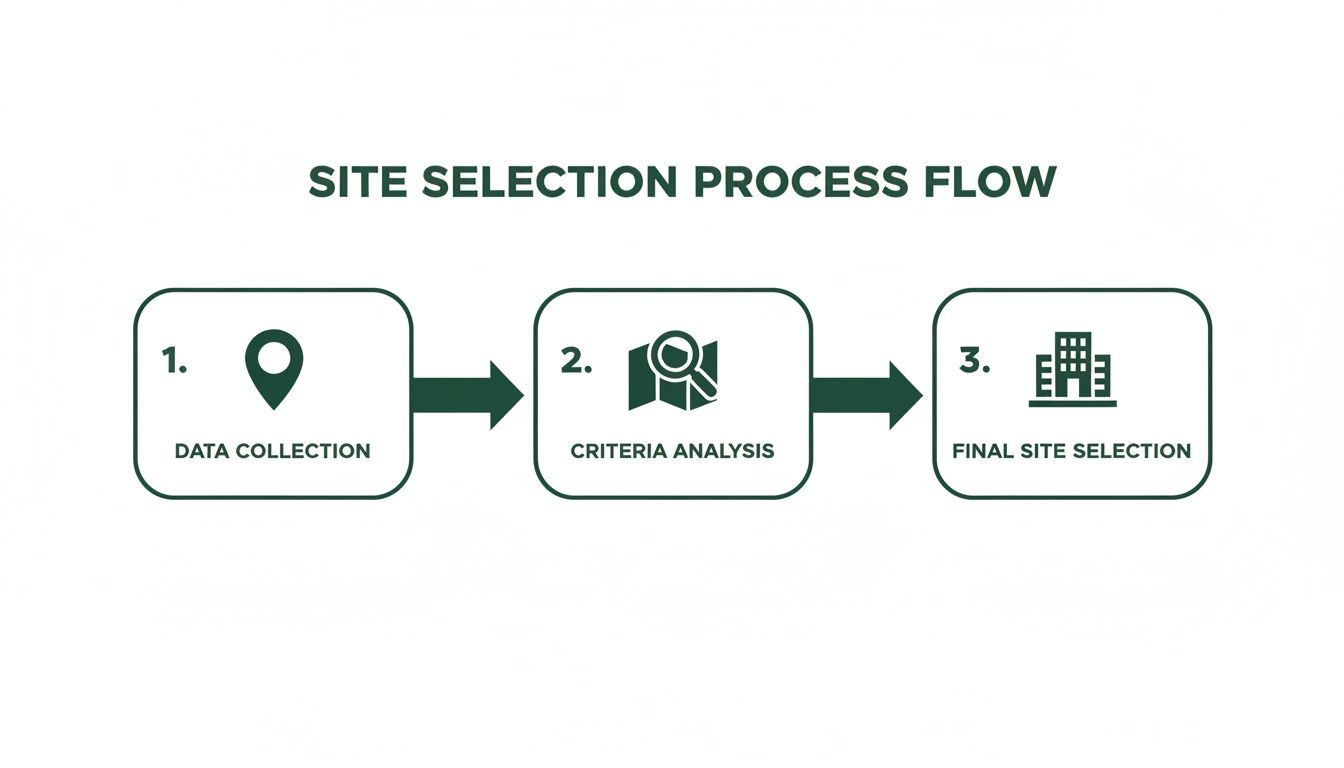
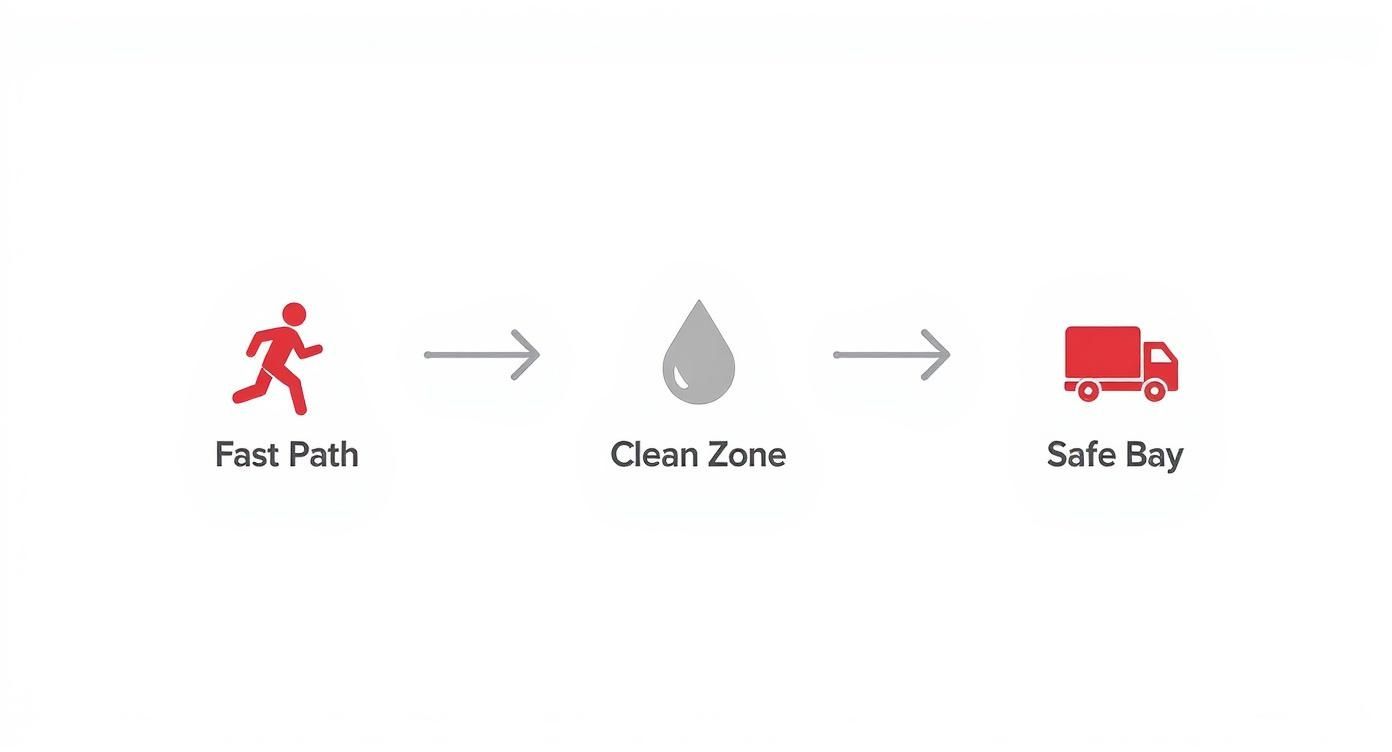
A three-step process flow diagram illustrating site selection from data collection to final choice.

As you can see, good design starts with solid analysis. That data doesn't just influence the station's location; it directly shapes the internal layout needed to keep firefighters healthy.

Beyond Decontamination: Fostering Well-Being

While cancer prevention is a huge priority, a truly holistic approach to firefighter well-being has to tackle both physical and mental health. The design of the living spaces themselves plays an enormous part in lowering stress and building camaraderie.

Layouts that use "hot, warm, and cold zones" are becoming the standard for combating carcinogen exposure, a leading cause of cancer among the 1.1 million U.S. firefighters. With more than 40% of America's 30,000 fire stations being over 40 years old, the need to update these facilities with modern air quality systems and decontamination areas is more urgent than ever.

A well-designed living space is an active tool for mental health support. It provides opportunities for both social connection and private reflection, helping firefighters manage the cumulative stress of their profession.

Here are a few design elements that really move the needle:

  • Acoustic Separation: Getting quality sleep is essential. Using sound-dampening materials and smart layouts to keep quiet bunk rooms isolated from noisy areas like the apparatus bay or kitchen makes all the difference.
  • Natural Light and Views: It's amazing what a little sunlight can do. Maximizing daylight and providing views of nature in dayrooms and offices has been proven to lower stress and lift moods.
  • Ergonomic Kitchen and Dining Areas: The firehouse kitchen is the heart of the station. Designing a space that allows multiple people to cook and eat together helps build that "family" dynamic, which is vital for a cohesive team.
  • Dedicated Fitness Spaces: Staying in shape is not optional in this line of work. A well-equipped and easily accessible fitness area is crucial for maintaining physical readiness and serves as a fantastic outlet for stress. The principles are similar whether you build a home gym or an industrial-grade station facility; the space needs to be functional and inviting.

When we focus on these human-centric design principles, we create fire stations that do more than just enable peak performance. We build facilities that actively protect and support the long-term health of the people who dedicate their lives to serving our communities.

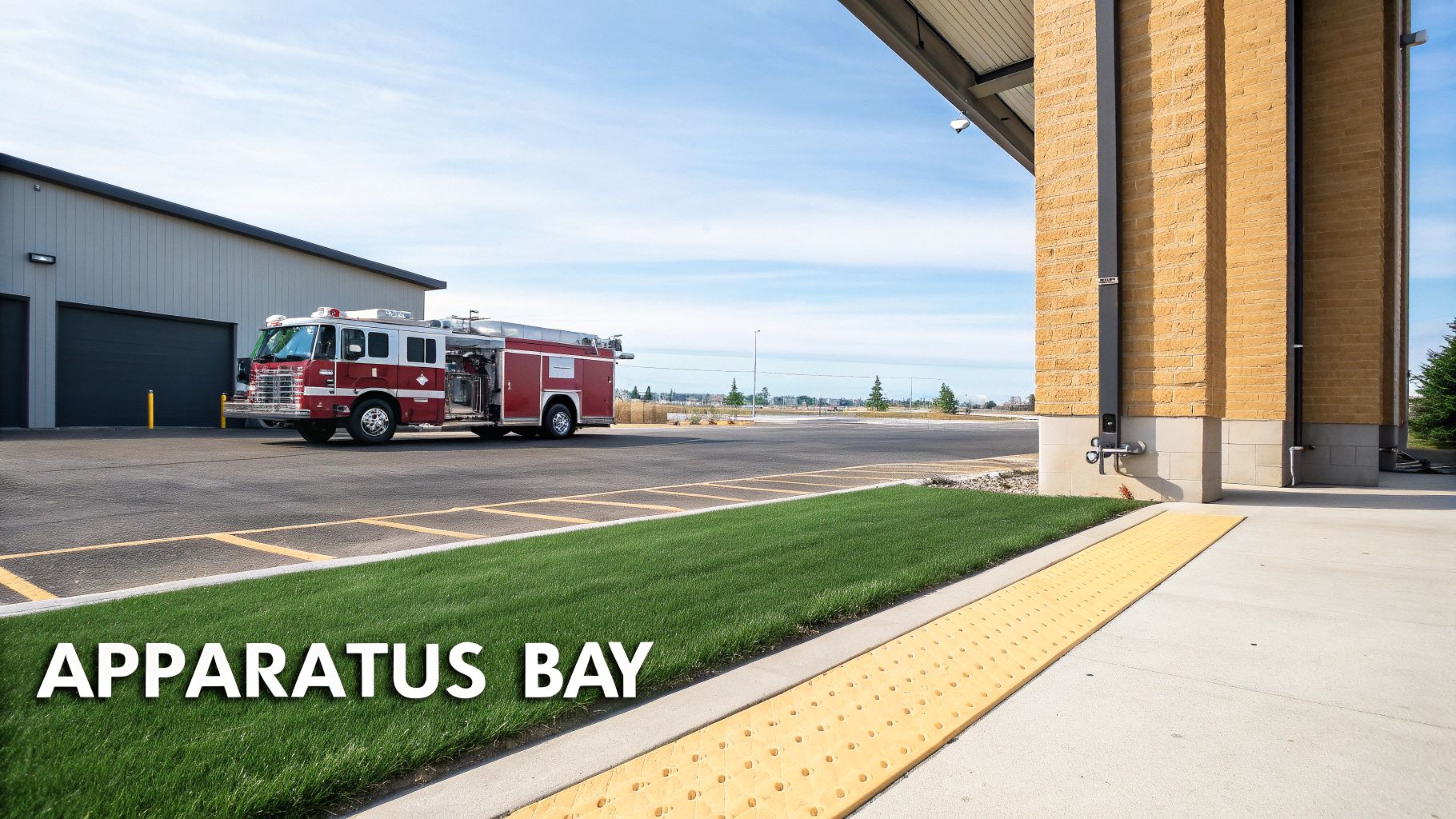
If you think of a fire station as a living entity, the apparatus bay is its powerful, beating heart. It's not just a big garage; it's the launchpad for every single emergency response. This is where the action begins and ends, making its design a masterclass in efficiency, durability, and most importantly, safety.

Every single decision here, from the type of floor drain to the speed of the bay doors, has a direct impact on response times and the well-being of the firefighters. Getting this space right isn't just important—it's everything. And that process starts with a fundamental question: how do the trucks get in and out?
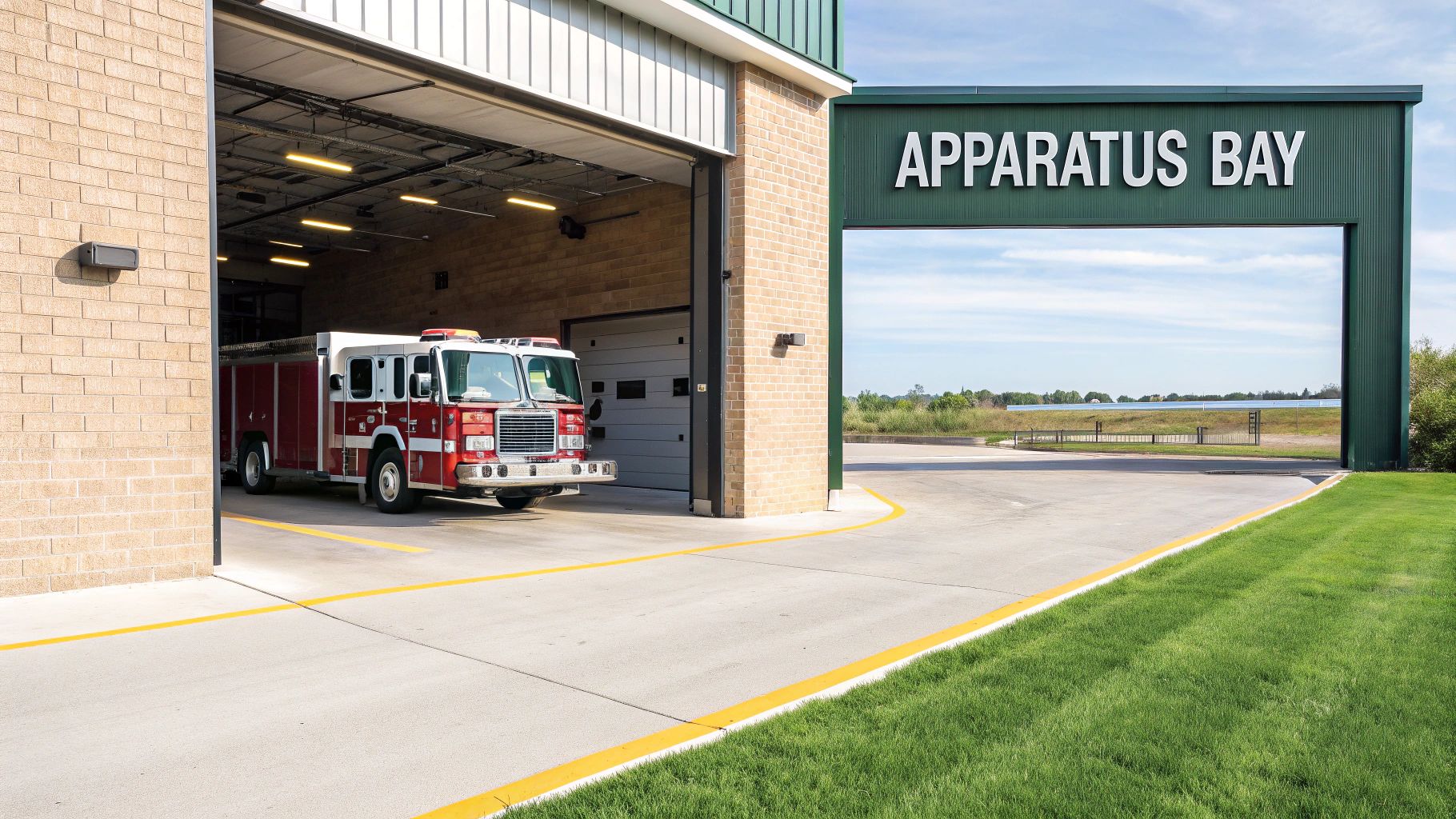
Modern fire station with a red fire truck parked inside the apparatus bay.

Drive-Through vs. Back-In Configurations

The entire flow of the apparatus bay comes down to one big choice: a drive-through layout or a traditional back-in setup. There's no single right answer; the best solution is dictated by the site itself—its size, its shape, and how it connects to the surrounding streets.

  • Drive-Through Bays: This is the gold standard for a reason. It's faster and safer. By allowing fire trucks to simply pull straight in one side and out the other, you eliminate the tricky, time-consuming process of backing a massive vehicle into a tight space. If a site has enough depth or fronts two different streets, this is the way to go.

  • Back-In Bays: Sometimes, you just don't have the space for a drive-through design. Narrow lots or sites with single-street access make a back-in configuration a necessity. While this is common in older stations, modern fire station design makes it much safer with advanced backup cameras, warning sensors, and carefully painted visual guides on the floor.

A drive-through apparatus bay can shave critical seconds off response times by removing the need to back in vehicles. This seemingly small detail is a significant operational advantage that enhances both speed and on-site safety.

Ultimately, whether it's a drive-through or a back-in, the objective is the same: create the straightest, most direct path for an apparatus to leave the station and hit the road.

Building a Foundation for Performance

The floor of an apparatus bay is an unsung hero of structural engineering. It has to be tough enough to handle immense stress day in and day out. We're talking about vehicles that can weigh over 40 tons. This isn't your standard concrete slab. It’s a heavily reinforced foundation, often built thicker and with a higher psi rating to withstand the constant weight and movement.

Drainage is just as critical. The floors are meticulously sloped—usually between 1-2%—to channel water toward robust trench drains. This ensures that water from washing the trucks, snowmelt, or equipment runoff is whisked away quickly. A dry floor is a safe floor, preventing the slips and falls that are a constant risk in this environment.

Essential Systems for a Safe Environment

Beyond the heavy-duty structure, a series of integrated systems turns the bay from a simple storage area into a safe and highly functional workspace.

A non-negotiable feature in any modern station is the vehicle exhaust capture system. These systems hook directly to the apparatus exhaust pipes, pulling toxic diesel fumes out of the building before they can contaminate the air. This isn't a luxury; it’s a critical health and safety measure to protect firefighters from long-term exposure to carcinogens.

Several other design details are just as important:

  • Ceiling Heights and Clearances: You need a lot of vertical space. Ceilings are often 16 to 18 feet high, sometimes more, to accommodate the newest ladder trucks. Just as crucial is leaving plenty of clearance on all sides of the parked vehicles for maintenance access, gear storage, and safe movement.
  • Apparatus Bay Doors: Every second counts, and that includes the time it takes for doors to open. Fast-acting bifold or four-fold doors are a huge upgrade over traditional overhead rolling doors. They open significantly faster and are built to withstand high winds and heavy use without failing.
  • Strategic Storage: An organized bay is an efficient bay. Well-designed, durable cabinetry and clearly marked storage zones for tools, rescue equipment, and medical gear are essential. Keeping everything in its place means it can be grabbed in an instant when the tones drop.

When you meticulously plan every detail—from the slope of the floor to the speed of the doors—the apparatus bay becomes more than just a place to park trucks. It becomes a high-performance machine, engineered to make every response as fast and safe as possible.

Building for Sustainability and Resilience

A modern fire station has to be more than just a garage for fire trucks. It needs to be a rock-solid pillar of the community, the one place that’s guaranteed to be running when everything else fails. This is where resilience becomes a non-negotiable part of the design conversation.

When a hurricane, flood, or massive power outage hits, the fire station can't go down with it. It has to become the command center, a beacon of stability when all other infrastructure is compromised.

This kind of toughness starts with the building envelope itself. We're talking about choosing materials and construction methods that laugh in the face of extreme weather—from high-wind-rated roofing and impact-resistant windows to a reinforced structural frame. Using advanced materials like charred accoya cladding, for example, not only gives the station a distinctive look but also provides an incredibly durable exterior that resists rot, pests, and punishing conditions for the long haul.

Fortifying for Uninterrupted Operation

A tough shell is just the beginning. True resilience comes from having redundant, independent systems that ensure the lights stay on and the water keeps flowing, no matter what’s happening outside. These are the station's lifelines during a crisis.

Some key strategies we always build into the plan include:

  • Backup Power Generation: An on-site generator is absolutely essential, typically running on natural gas or diesel. It needs to be beefy enough to power the entire station—apparatus bay doors, comms, HVAC, everything—for days, not hours.
  • Redundant Utilities: We look for ways to eliminate single points of failure. This might mean installing large on-site water storage tanks or even tapping into two different water mains if possible.
  • Storm-Hardened Infrastructure: Every piece of equipment on the outside of the building, from HVAC units to radio antennas, has to be secured and shielded from high winds and flying debris.

Resilience isn't just about surviving a storm; it's about maintaining full operational capability throughout the event and its aftermath. The fire station must be the one building everyone can count on when disaster strikes.

Thinking this way about robust, self-sufficient infrastructure dovetails perfectly with the larger movement toward sustainability. After all, a resilient station is an efficient one, designed from the ground up to do more with less.

The Financial Case for Green Design

Sustainable design isn't just a feel-good add-on anymore; it's a core component of smart financial planning for any public facility. While green features like a geothermal system or a roof full of solar panels might have a higher price tag initially, they pay for themselves over and over again in long-term operational savings.

That's real money freed up for a municipality to use on other vital services.

High-performance insulation, energy-efficient windows, and smart LED lighting all work together to slash daily energy use. Technologies that once seemed exotic are now proving their worth in demanding 24/7 environments. Geothermal HVAC, for instance, uses the earth’s constant underground temperature to heat and cool the building with incredible efficiency and lower maintenance needs. Solar panels can knock out a huge chunk of a station’s electricity bill and, in some areas, even generate revenue by selling power back to the grid.

A fantastic real-world example is the 25,000-square-foot Kaukauna Fire Station, which opened in 2017. By integrating geothermal, solar panels, and LEDs, they cut their annual energy costs by more than $37,000. That’s a powerful return on investment.

When we design for both resilience and sustainability, we're not just building a fire station. We're creating a public safety asset that is stronger, more reliable, and fiscally responsible for decades to come.

Balancing Budgets with Adaptive Reuse

Let's be honest: building a new fire station is a massive public investment. With costs for a modern facility easily hitting anywhere from $9 million to $14 million, municipal budgets are often pushed to their limits. This financial reality puts a huge premium on smart, cost-conscious planning from day one.

To get a new build across the finish line, project leaders often lean on strategies like value engineering—a formal process for getting the most function for the lowest cost without cutting corners on quality. Another go-to tactic is project phasing, which maps out the construction over several years. This lets a community build what's most critical now, like the apparatus bay, and add things like a new training tower later when more funds are available.

But building from the ground up isn't the only path forward. For communities with older, architecturally significant stations, adaptive reuse offers a compelling alternative that can be both budget-friendly and sustainable.

Breathing New Life into Historic Stations

Instead of tearing down a community landmark, adaptive reuse is all about modernizing it from the inside out. This approach keeps the historic soul of the building and its place in the town’s heart, while completely updating it to handle the intense demands of modern firefighting. It’s a brilliant way to honor the past while equipping heroes for the future.

This process is like solving a complex puzzle—fitting modern systems into a historic shell. It almost always involves:

  • Structural Reinforcements: Old floors weren't designed to hold the immense weight of today's fire engines and ladder trucks.
  • Complete MEP Overhauls: This means ripping out and replacing ancient electrical, mechanical, and plumbing systems with efficient, code-compliant modern ones.
  • Interior Reconfigurations: The challenge is to carve out logical spaces for decontamination zones, contemporary living quarters, and administrative offices within the original footprint.

Turning Heritage into a Financial Asset

One of the biggest wins for this approach is the bottom line. For developers and owners, this trend favors adaptive reuse over demolition. Specialized architecture firms can upgrade systems cost-effectively, preserving historic character while securing tax credits and grants—extending a building’s useful life by 50 to 75 years sustainably. This flips a potential liability into a celebrated community asset. You can discover more insights into modern fire station trends that highlight these financial and community benefits.

By leveraging historic tax credits and preservation grants, municipalities can significantly offset renovation costs. Suddenly, modernizing a legacy station becomes a much more palatable financial choice than starting from scratch.

This strategy doesn't just save taxpayer money and divert materials from the landfill; it preserves the deep sense of civic pride tied to a historic public building. It's proof that with creative design, a station built for horse-drawn steam engines can be reimagined to serve its community for another hundred years.

Frequently Asked Questions About Fire Station Design

When you're tasked with building a new fire station, you're juggling a lot: the crew's safety, the community's expectations, and the city's bottom line. It's a huge responsibility, and naturally, a lot of practical questions come up right away. Let's tackle some of the most common ones I hear from project leaders.

How Long Does a Fire Station Project Take?

Let's be realistic: a new fire station is a long-term commitment. From the first conversations to the day the firefighters move in, you're looking at a multi-year timeline. While every project has its own quirks, they all follow a similar path.

Here’s a general breakdown of what to expect:

  • Design Phase (12-18 months): This is where the vision takes shape. It’s a busy period filled with site evaluations, community meetings, and hammering out the detailed architectural plans and construction documents.
  • Bidding and Permitting (2-3 months): With the blueprints finalized, the project is put out to bid to find the right construction partner. At the same time, the team works to get all the necessary permits lined up with local authorities.
  • Construction Phase (18-24 months): The longest stretch. This covers everything from the groundbreaking ceremony and pouring the foundation to raising the steel, finishing the interiors, and installing all the complex systems a modern station needs.

All told, you can realistically expect the entire process to take three to four years from start to finish. For a real-world example, the planned relocation of Raleigh Fire Station 15 is scheduled to start design in summer 2024 and wrap up construction in spring 2028.

What Is a Realistic Budget for a New Station?

There's no single price tag for a new fire station—the final cost is tied to everything from land prices and local labor to the station's size and special features like a training tower or public meeting space. That said, we can look at recent projects to get a solid baseline.

Right now, construction costs for a new, full-service fire station are generally landing somewhere between $9 million and $14 million. For instance, a proposed station in Huntington, Indiana, saw construction estimates that ranged from $9.54 million to $13.79 million. Keep in mind, these figures are for the building itself. Things like buying the land, architectural fees, and all the equipment are separate costs.

A critical mistake is confusing construction costs with the total project budget. You have to account for "soft costs"—design fees, permits, furniture, fixtures, and specialized equipment—which can easily add another 20-30% to the construction total.

How Can the Community Get Involved?

Bringing the community into the process isn't just a box to check; it’s fundamental to a successful project. When you build an inclusive process, you foster public trust and end up with a building that truly serves its neighborhood.

Here are a few proven ways to make community engagement meaningful:

  • Public Meetings and Workshops: Host open forums early in the design process. This gives residents a chance to see the initial concepts, ask questions directly, and weigh in on how the station will look and function.
  • Advisory Committees: Create a small, dedicated group of community leaders, direct neighbors, and local business owners. They can serve as a sounding board and a direct line of communication throughout the entire project.
  • Surveys and Online Feedback: Digital tools are great for reaching a wider audience. An online survey allows people who can't make a meeting to share their priorities and concerns on their own schedule.

By actively listening to feedback, your team can get ahead of potential issues like traffic flow, noise, or building aesthetics, turning the new station into a point of pride for everyone.


At Sherer Architects, LLC, we specialize in guiding clients through every stage of complex design and construction projects, from new commercial builds to historic preservation. We transform puzzles into beautiful, enduring, and sustainable results. Learn how our expertise can bring your next project to life.

Categories
Uncategorized

Firehouse Floor Plan: firehouse floor plan for fast response

A firehouse floor plan is so much more than a set of drawings. It’s the operational heartbeat of the station and a silent partner on every single call. A well-designed layout can shave precious seconds off response times, protect the long-term health of firefighters, and create a building that serves the community for decades.

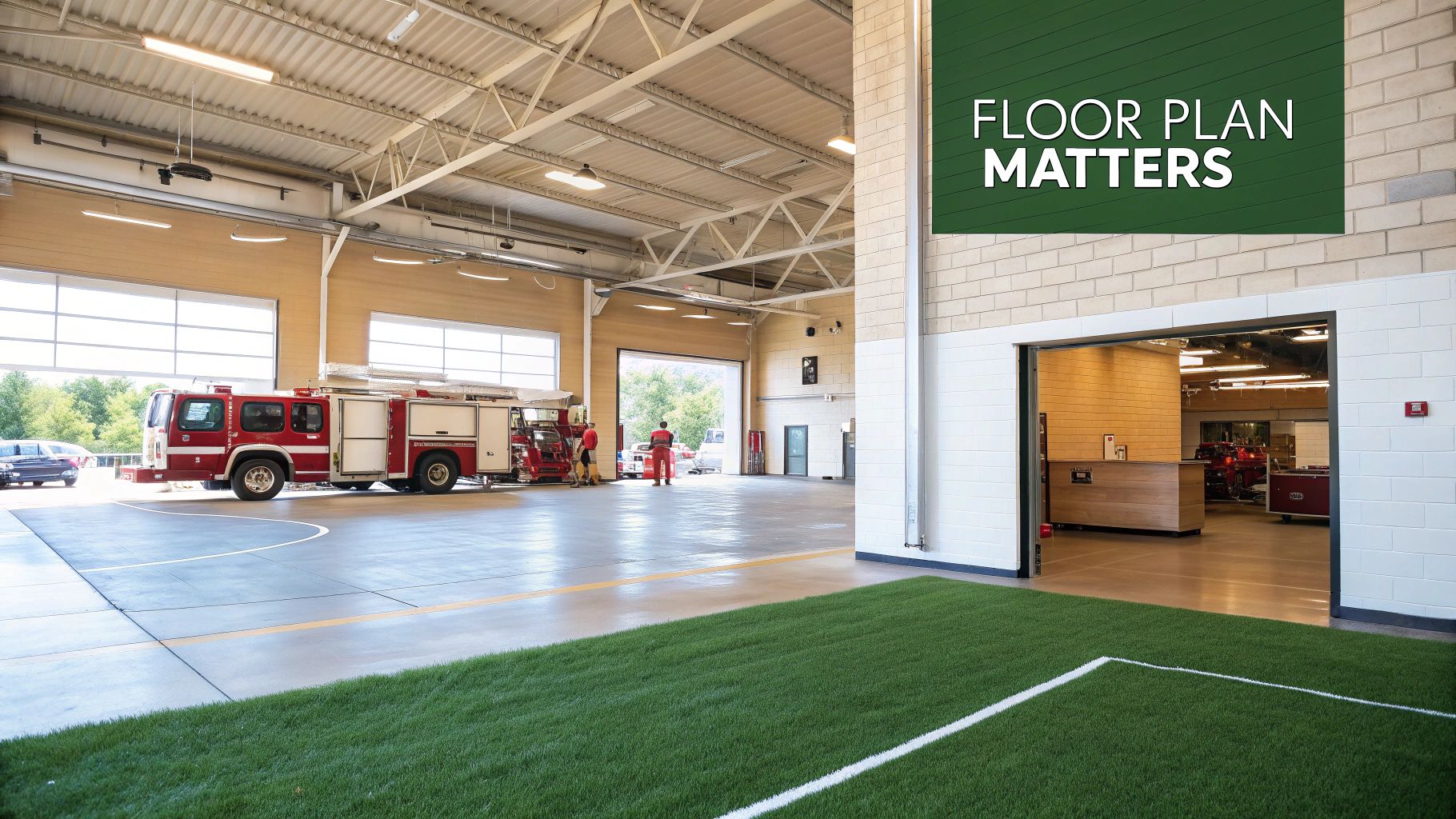
Beyond the Blueprint: Why Your Firehouse Floor Plan Matters

Looking at a blueprint, you're essentially seeing a puzzle where every single piece has a critical job to do. The ultimate goal is to design a building that runs like a well-oiled machine for emergencies but also functions as a safe, healthy second home for the crew.

A strategic firehouse floor plan isn't just about fitting rooms into a box; it's a careful balancing act between the urgent demands of emergency response and the day-to-day human needs of 24/7 living.

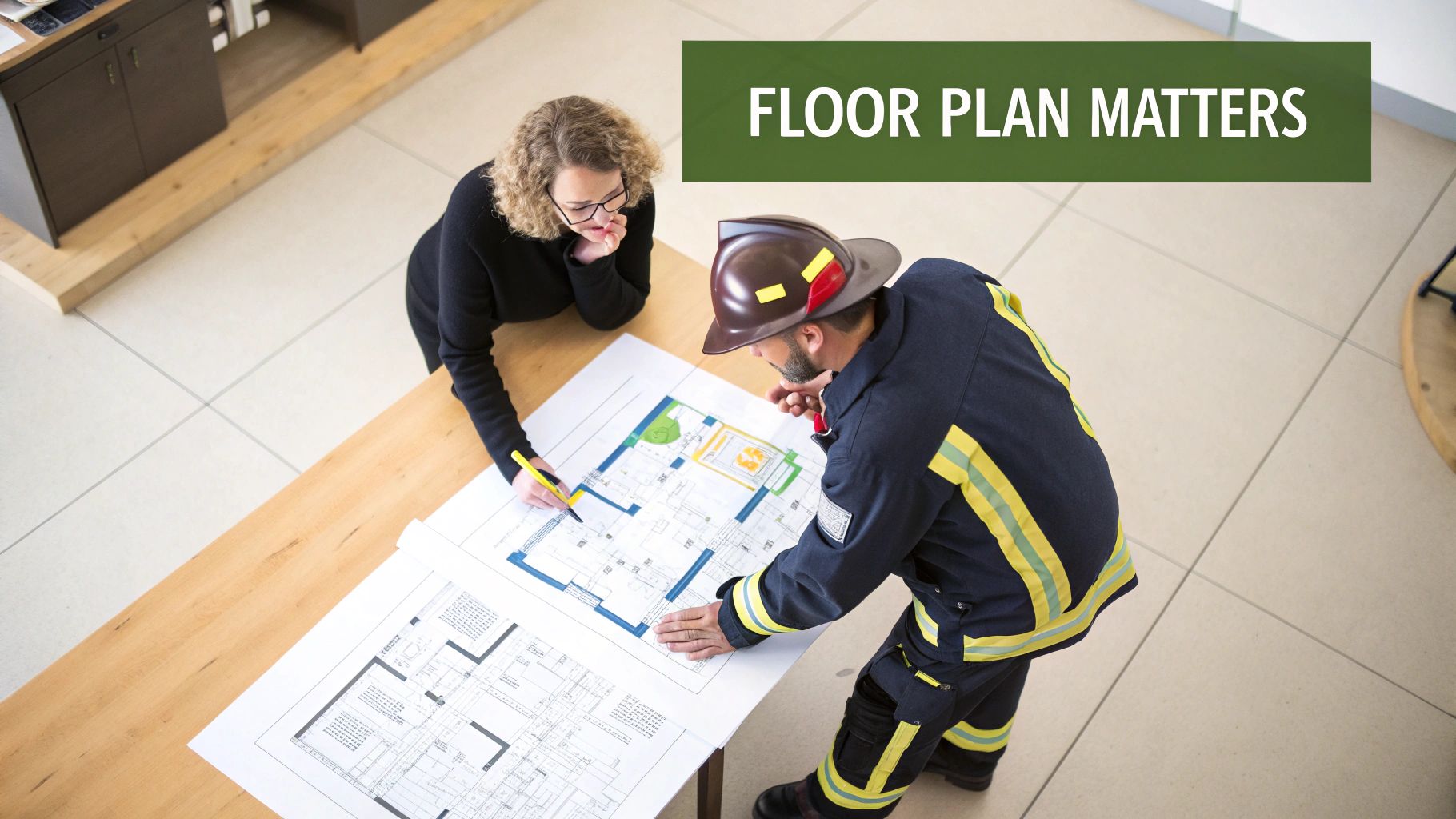
A firefighter and a woman collaborate, reviewing a building floor plan blueprint on a wooden table.

Core Components of a Modern Station

Today's fire stations are incredibly complex buildings. They have to serve multiple, distinct functions all at once, and each zone needs to be positioned just right for maximum efficiency and safety. To get this right, it pays to dig into optimal space planning strategies that can guide the layout.

Every effective plan is built around a few primary components:

  • Apparatus Bay: Think of this as the launchpad. It’s built for getting vehicles out the door fast and maintaining them safely when they return.
  • Decontamination Zone: This is a non-negotiable transition area. It’s the buffer that stops carcinogens and other contaminants from being tracked into the clean living spaces.
  • Living Quarters: Often called the "cold zone," this is where firefighters eat, sleep, and recharge. It includes bunk rooms, a kitchen, a dayroom, and other personal spaces.
  • Support & Administrative Areas: This bucket includes everything else needed to run the station—training rooms, fitness areas, gear storage, and offices.

Balancing Efficiency with Well-Being

The best floor plans manage to accomplish two things that seem completely at odds. First, they create the shortest, most direct path from the living quarters to the apparatus bay to ensure the fastest possible turnout.

But at the same time, they must create a deliberate, multi-step "dirty" path from the bay back into the living quarters to ensure firefighters can properly decontaminate.

A successful firehouse floor plan acts as a critical health and safety tool. It's designed to minimize exposure to hazards and support the long-term physical and mental well-being of the personnel who live and work within its walls.

This dual focus—operational speed on one hand, crew health on the other—is what truly defines modern fire station design. You can see it in projects like the new Bernalillo County Fire Station #36, which integrates 12 bunks and four apparatus bays into a layout that prioritizes both. A thoughtfully designed floor plan isn't an expense; it's a powerful investment in the safety of your crew and your community.

The Apparatus Bay: The Engine of Your Fire Station

You can think of the apparatus bay as the heart of the entire fire station. It's far more than a glorified garage; it's the launchpad for every single emergency response. The design of this space—from the type of doors you choose to the slope of the floor drains—directly impacts how fast and safely your crew can get on the road.

The whole layout is about one thing: rapid deployment. It’s not just about finding a spot to park the trucks. It’s about creating a dead-simple, unobstructed path for firefighters to get from the living quarters into the rigs. Every second shaved off that process is a second that can save a life or a home out in the community.

Red and white fire truck parked in front of a modern fire station's apparatus bay on a sunny day.

Drive-Through or Back-In Bays

One of the first big forks in the road when designing the bay is deciding on its basic flow. The two main options each have their own pros and cons, usually dictated by the size of your lot and your department's standard operating procedures.

  • Back-In Bays: This is the traditional setup you see most often. Vehicles leave through the front doors and have to back in when they get back to the station. This layout is a real space-saver, making it a good fit for smaller or narrower properties. The downside is that it demands a lot of skill from the driver and requires spotters, and the whole process of backing in a massive ladder truck can bring other station activities to a halt.

  • Drive-Through Bays: With this design, the apparatus comes in through doors at the back of the bay and pulls straight through, parking nose-out and ready for the next call. This is by far the safer option because it eliminates almost all the risks that come with backing. Of course, it requires a bigger piece of land to allow access to both the front and rear, but it makes on-site circulation a breeze and dramatically cuts the time it takes to get rigs back in service.

Ultimately, choosing between these two is a classic balancing act between ideal operations and the practical constraints of land and budget. When the site allows for it, though, a drive-through design is almost always the preferred choice for safety and speed.

Calculating Critical Clearances

The geometry of the apparatus bay is a game of inches. Fire trucks, especially the newer ladder trucks and aerials, are bigger and heavier than ever. Your firehouse floor plan can't just account for the vehicle's footprint; it has to include the space people need to hustle around it without tripping over each other.

A rookie mistake is designing for the fleet you have today, not the one you'll have in the future. Apparatus only gets bigger, and the bay needs to be sized to handle vehicles the department might not even buy for another 15-20 years.

This kind of forward-thinking means adding generous clearances that act as a buffer for whatever comes next.

Essential Spatial Math

  • Vertical Clearance: Bay doors need a minimum clear opening of 14 feet high and 14 feet wide. But honestly, 16 feet is becoming the new standard to be safe with modern aerials. The ceiling inside the bay needs to be even higher to give mechanics room to tilt the cab for engine work.
  • Horizontal Clearance: You absolutely need at least four to five feet of clear walking space around every side of a parked rig. This "walk-around" room is non-negotiable for daily truck checks, opening compartments, and letting firefighters throw on their gear without being pinned against a wall.
  • Bay Depth: The bay has to be long enough for your longest vehicle, plus a buffer of at least five feet at the front and the back. This simple cushion prevents expensive mishaps with the overhead doors and equipment.

Integrating Support Functions

A well-designed apparatus bay doesn't work in isolation. Its real power comes from the smart placement of all the support spaces that feed into it. The whole idea is to create a seamless workflow for everything from decontamination to maintenance and storing gear.

Key adjacent zones to plan for:

  • Decontamination Area: This needs to be the first stop for crews coming back from a call. Placing it for immediate access is a critical step in protecting firefighter health.
  • Workshop/Maintenance Bay: A dedicated spot for routine checks and small repairs keeps the fleet ready to roll at a moment's notice.
  • Gear & SCBA Storage: Locating this right off the bay floor shaves critical seconds off turnout times.
  • Hose Storage/Drying Tower: Taking proper care of hoses makes them last longer and perform reliably when it counts.

When you start treating the apparatus bay and its support areas as one integrated system, the firehouse floor plan evolves from a simple parking structure into a finely tuned operational hub.

Designing for the Crew: Crafting Effective Living Quarters

While the apparatus bay is the operational heart of a fire station, the living quarters are its soul. A fire station isn't just a place of work; it's a second home where crews live, eat, and sleep through 24-hour shifts. The environment has to support rest, recovery, and readiness, so a human-centric firehouse floor plan goes far beyond just providing shelter—it has to address the very real needs of modern first responders.

We've come to understand that a firefighter's performance is tied directly to their physical and mental well-being. The days of cramped, noisy communal dorms are fading fast. They're being replaced by thoughtfully designed spaces built to reduce stress, improve sleep, and forge strong team bonds. Every decision made in this "cold zone" is an investment in a healthier, more resilient, and more effective crew.

From Open Dorms to Private Bunk Rooms

One of the biggest shifts in fire station design is the move from large, open-bay dormitories to individual bunk rooms. Sure, the old-school dorms built a certain kind of shared experience, but they completely failed to provide the privacy and quiet needed for quality rest between calls. All it took was one person's snoring or a late-night stir to disrupt the entire shift's sleep.

Individual bunk rooms solve that problem head-on. They give each firefighter a personal space to decompress and get the deep, restorative sleep that's so critical for high-stakes decision-making. This isn't just a creature comfort; it's a powerful tool for recruitment and retention, helping create a more professional and inclusive environment for a diverse workforce.

A well-rested firefighter is a safer, more effective firefighter. Prioritizing individual sleeping quarters isn't an expense—it's an investment in operational readiness and long-term career sustainability.

These rooms don't need to be huge. A typical bunk room is an exercise in efficiency, usually just big enough for a bed, a small desk, and a personal locker or closet. The most important feature is the door that closes, giving each crew member a small slice of control over their own environment.

Where the Crew Becomes a Team: Communal Spaces

While private bunks are essential for individual rest, it's the communal areas where a group of firefighters truly becomes a team. These spaces are intentionally designed to spark interaction, collaboration, and the kind of informal bonding that proves critical in a high-stress profession. More often than not, the kitchen and dining area becomes the social hub of the entire station.

Here’s how these shared spaces bring a crew together:

  • Kitchen & Dining: This is where stories are told and meals are shared. An open layout with a big, sturdy dining table encourages everyone to sit down together, strengthening relationships. The space has to be tough, with commercial-grade appliances and plenty of storage to handle the demands of multiple shifts.
  • Dayroom: Think of this as the station's living room. It’s a place to unwind, watch TV, or hit the books. The key is comfortable, durable seating and a layout that can host a group watching a game or offer a quiet corner for someone to read.
  • Outdoor Patio: Never underestimate the power of fresh air. A simple patio or outdoor seating area provides a much-needed escape, giving crews a place to decompress away from the constant state of readiness inside.

These zones are more than just amenities; they are foundational to building the trust and cohesion that a team relies on during an emergency. The design for Bernalillo County Fire Station #36, for instance, made the spacious kitchen and dayroom central components of its 12-bunk facility for exactly this reason.

Integrating Training and Support Zones

Beyond sleeping and eating, a modern fire station has to support continuous training and physical fitness. Weaving these support zones directly into the firehouse floor plan makes them accessible and encourages their use, which pays dividends in firefighter performance and safety.

Key support areas to include are:

  • Fitness Center: Physical conditioning isn't a hobby; it's a core requirement of the job. An on-site fitness room with a good mix of cardio and strength-training equipment is non-negotiable. Critical design details include excellent ventilation and tough, resilient flooring.
  • Training Classroom: This room is the hub for formal instruction, shift briefings, and studying for certifications. It needs to be a flexible space, outfitted with modern audiovisual tech to support different learning styles.
  • Administrative Offices: The station captain and other officers need a dedicated space to handle reports, scheduling, and other administrative work without constant interruptions from the day-to-day station buzz.

By strategically placing these functions within the station, the design moves beyond a simple garage for fire trucks. It becomes a comprehensive facility where personnel can rest, train, and thrive throughout their careers.

Hot, Warm, and Cold Zones: A Modern Health-First Approach

One of the biggest shifts in fire station design over the past couple of decades has been a laser focus on protecting the long-term health of firefighters. The core principle is straightforward but vital: stop the invisible threats—carcinogens, soot, and chemical residues from a fire scene—from ever migrating into the station's living quarters. A well-designed firehouse floor plan accomplishes this by creating a clear, one-way path through distinct "hot," "warm," and "cold" zones.

Think of it like a cleanroom in a manufacturing plant or a sterile corridor in a hospital. You'd never see a surgeon walk straight from the parking lot into an operating theater. There's a mandatory, multi-step process of scrubbing, gowning, and transitioning. We now apply that same uncompromising logic to fire stations to contain hazardous materials and protect the crew.

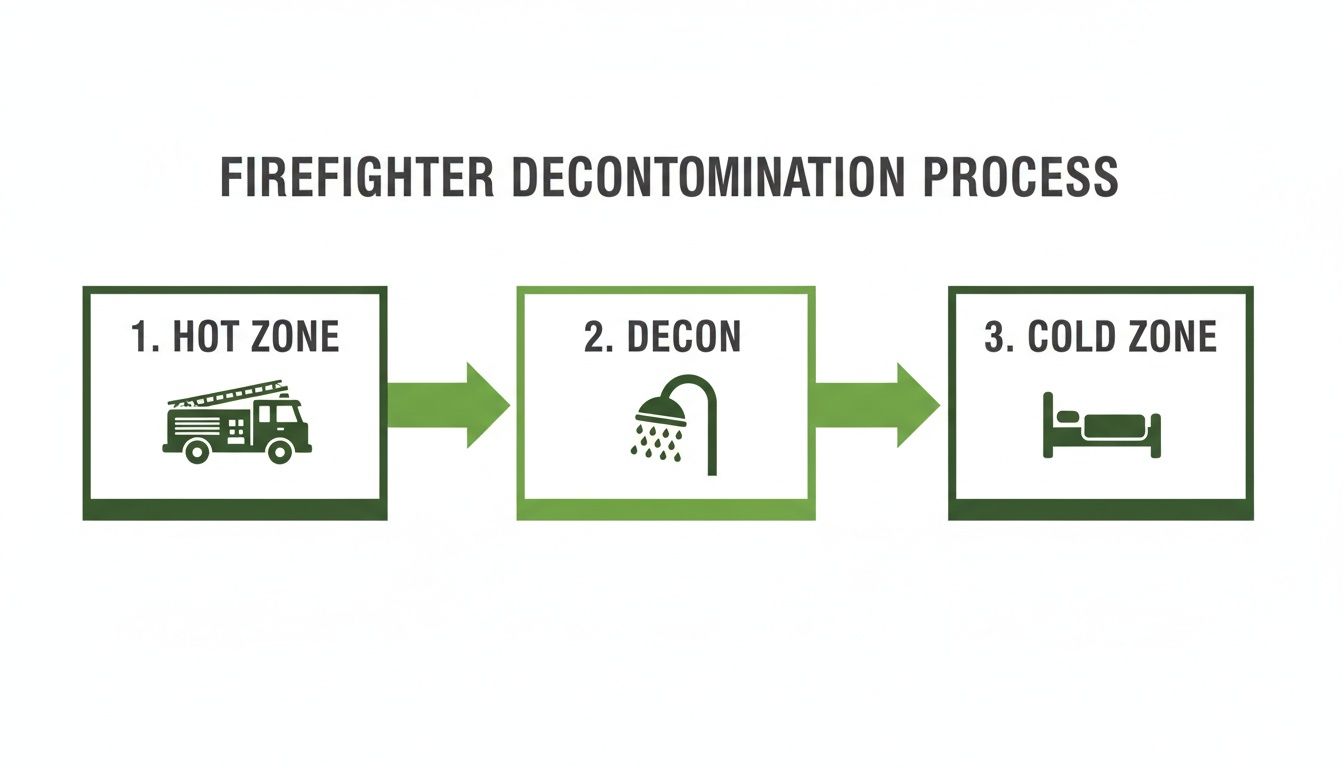
This diagram lays out the decontamination workflow that is physically built into a modern firehouse floor plan, showing how a firefighter moves from a contaminated state to a clean one.

Diagram showing the firefighter decontamination process flow from a hot zone to a cold zone.

As you can see, the path from the apparatus bay to the living quarters isn't a straight line. It’s a deliberate, mandatory detour through a decontamination sequence.

Following the Decontamination Path

This entire process kicks off the second a truck pulls back into the station. The apparatus bay is the designated Hot Zone, the most contaminated space in the entire building. Before going any further, firefighters perform a "gross decon" right there, hosing down themselves and their gear to remove the worst of the grime.

Next, they step into the Warm Zone, which acts as a sophisticated airlock between the dirty bay and the clean living spaces. The workflow here is linear and non-negotiable, typically flowing through a few key areas:

  • Turnout Gear Room: First, they enter a "dirty" room to shed all their contaminated bunker gear. That gear goes straight into specialized, heavy-duty extractors (washing machines) designed to handle hazardous materials.
  • Decon Shower: After stripping off their gear, the firefighter moves directly into an adjacent pass-through shower. This isn't just for comfort; it's a critical health step to wash off any lingering particulates from their skin.
  • Clean Room/Locker Area: Once showered, they emerge into a "clean" room on the other side. Here, they can finally access clean uniforms, towels, and personal items from lockers that have never been exposed to contaminants.

This sequence is not just a suggestion; it's a fundamental health and safety protocol that is physically enforced by the building's layout. The floor plan itself becomes an active partner in preventing job-related cancers and illnesses.

Only after running this entire gauntlet can a firefighter enter the Cold Zone—the kitchen, dayroom, bunk rooms, and offices—with full confidence that they aren't dragging carcinogens in with them.

The table below breaks down this essential workflow, showing how each action corresponds to a specific, purpose-built zone within the fire station floor plan.

Fire Station Decontamination Zone Workflow

This table outlines the sequential steps and corresponding floor plan zones for proper firefighter decontamination, preventing cross-contamination into living areas.

Step Action Designated Zone Key Design Feature
1 Truck returns to station, crew performs gross decon on apparatus and gear. Hot Zone (Apparatus Bay) Floor drains, exhaust extraction system, designated decon area.
2 Firefighter enters the station via a dedicated decon entrance. Warm Zone (Transition) Direct, isolated access from the bay, preventing entry to other areas.
3 Contaminated turnout gear, boots, and helmet are removed. Warm Zone (Dirty Utility) Durable, non-porous surfaces; direct access to gear extractor/washer.
4 Firefighter proceeds through a pass-through shower to remove contaminants. Warm Zone (Decon Shower) Pass-through layout connecting the "dirty" and "clean" sides.
5 Firefighter enters a clean space to access fresh clothes and personal items. Warm Zone (Clean Utility) Separate lockers for clean items, physically isolated from dirty gear.
6 Fully decontaminated firefighter enters administrative or living quarters. Cold Zone (Living Quarters) A secure door that can only be accessed after completing the full decon path.

By embedding this process into the architecture, the station actively guides firefighters to follow best practices for their own health and safety every single time they return from a call.

Defending the Cold Zone's Air Quality

Physical separation is the first and most important line of defense, but a truly health-conscious design has to account for airborne threats, too. Contaminated air can easily migrate from one area to another if you're not careful. To combat this, hot zones are often designed with negative pressure ventilation, ensuring air is always being pulled out of the building and never flows into the clean zones.

Even with these precautions, achieving superior indoor air quality throughout the station is the final piece of the puzzle. This is especially true in the Cold Zone, where firefighters need to rest and recover. Exploring advanced solutions for improving indoor air quality like whole-building filtration adds another powerful layer of protection against any particles that may have slipped through. This commitment to clean air creates a genuine safe haven where the crew can breathe easy and recuperate before the next alarm sounds.

Building for Longevity: Site Planning and Sustainability

A great fire station isn't born on the drafting table; it begins with the piece of land it sits on. Before we even think about walls and windows, the big-picture decisions about site planning and orientation set the stage for a station that will serve its community well for decades. This is where you either bake in long-term value or miss the opportunity entirely.

Thinking about the site is a bit like a game of chess—you have to see several moves ahead. We're analyzing traffic patterns to make sure trucks can roll without a hitch, looking at community growth projections to place the station where it'll be needed most in ten or twenty years, and ensuring the site works for both emergency apparatus and public visitors.

Get these initial steps wrong, and it doesn't matter how perfect the interior layout is. A station on a perpetually congested road or in a neighborhood that's emptying out will see its effectiveness slowly bleed away over time.

Smart Orientation for Efficiency and Savings

Once we've got the right spot, the next question is how to place the building on it. The way a station is oriented on its lot directly impacts everything from how quickly crews can respond to how much the department pays in utility bills. A smart firehouse floor plan always works with the site's natural features, not against them.

For example, just aiming the apparatus bay doors toward the most common call direction can shave precious seconds off a response. At the same time, positioning the living quarters and administrative areas to capture natural daylight slashes the need for artificial lighting, which adds up to huge energy savings over the life of the building.

  • Sunlight as an Ally: Placing dayrooms and offices with south-facing windows maximizes natural light and provides passive solar heat in the winter.
  • Blocking the Wind: In colder climates, we can reduce heat loss simply by minimizing openings on the side of the building that gets hit hardest by the wind.
  • Working with the Land: Using the natural slope for drainage can cut down on site prep costs and help manage stormwater more effectively.

The most resilient and cost-effective fire stations are the ones that are in tune with their environment. Thoughtful orientation is a zero-cost strategy that pays dividends for the entire life of the building.

This holistic view, treating the building and its site as one integrated system, is how you create a truly high-performing, sustainable facility. It’s about building a finely-tuned tool for community safety, not just a structure.

Adaptive Reuse: A Sustainable Alternative

While brand-new construction gets all the glory, one of the most powerful moves a community can make is adaptive reuse—taking an existing building and giving it a new life as a fire station. This approach is not only a big win for the environment but can often be a smarter financial decision than building from the ground up.

When you renovate an older building, whether it's a historic firehouse or even a solid commercial structure, you sidestep the massive carbon footprint that comes with demolition and new construction. It’s a way to preserve a piece of the community's story while updating it for modern firefighting. This kind of work is a specialty, requiring a deep understanding of how to weave the old and new together seamlessly.

This isn't a new idea. Back in the post-WWII boom from 1947 to 1963, Los Angeles moved away from ornate city firehouses to more practical, single-story designs to serve its sprawling suburbs. For firms with experience in this area, this history underscores the incredible potential of adaptive reuse. Upgrading these well-built, mid-century stations can extend their service life by another 50-75 years—often at a lower cost than a new build—all while keeping their unique character intact. You can dive deeper into this history by reviewing the City of Los Angeles's survey of post-WWII fire stations.

Benefits of Repurposing Existing Buildings

Opting to adapt an existing building brings a host of advantages that are perfect for communities trying to be both fiscally responsible and environmentally conscious.

  1. Cost Savings: Renovation is often less expensive than new construction, particularly when you factor in land acquisition and major site work.
  2. Faster Timelines: With the main structure already standing, project timelines are often shorter, which means getting the station up and running sooner.
  3. Sustainability: Reusing a building is the ultimate form of recycling. It keeps tons of material out of the landfill and reduces the demand for new resources.
  4. Community Character: Saving a familiar landmark or a well-built structure helps maintain the unique fabric of a neighborhood and fosters a sense of local pride.
  5. Financial Incentives: Many adaptive reuse projects, especially those involving historic buildings, can qualify for historic tax credits and other grants that can seriously lower the final price tag.

In the end, whether you build new or adapt an old structure, the goal is identical: to create a durable, efficient, and healthy firehouse floor plan that will stand the test of time. By starting with smart site planning and seriously considering sustainable options like adaptive reuse, a community can make a wise investment that protects both its first responders and its bottom line for years to come.

Future-Proofing Your Investment in Community Safety

Let's be honest: building a new fire station is a massive financial undertaking for any community. A great firehouse floor plan isn't just a blueprint for a building; it's a long-term investment in public safety, and it demands some serious fiscal stewardship. The days of putting up a simple, four-wall station on a shoestring budget are long behind us.

The sheer complexity and cost of these facilities have skyrocketed. Back in the 1980s, you might have paid $50-60 per square foot. Today, you’re looking at $190-250 per square foot, and often much more. That jump isn't just inflation—it’s because modern stations have to do so much more. They're part training academy, part decontamination facility, and part emergency command center, all wrapped into one, and built to incredibly tough codes.

This is a real challenge, especially when you consider that 43% of the 27,000+ fire departments in the U.S. are working out of stations that are over 40 years old. Smart, forward-thinking financial planning isn't just a good idea; it's essential. You can dig deeper into how modern fire station design is being shaped by these trends to see the full picture.

Smart Strategies for a Fiscally Responsible Build

So, how do you manage these costs without cutting corners on safety and function? The answer isn't just building the biggest station you can afford. It's about being strategic and designing a facility that maximizes value and can evolve over time.

Here are a few proven approaches we've seen work time and again:

  • Phased Construction: Don't try to build for the next 50 years all at once. Design the station with a clear plan for future expansion. This lets you build what you absolutely need today while making it easy and cost-effective to add another apparatus bay or more bunk rooms when the community—and the budget—grows.
  • Multi-Use Spaces: Every square foot should earn its keep. A training room doesn’t have to sit empty most of the week. With a little smart design, it can also serve as a public meeting space or a backup emergency operations center, which makes the building a far greater asset to the entire community.
  • Data-Driven Site Selection: Where you build is just as important as what you build. Use real data—call volume, population growth projections, and response-time modeling—to pick a site that provides the best coverage not just on day one, but 20 years down the road. This simple step helps you avoid the incredibly expensive mistake of building a station that’s in the wrong place a decade from now.

Partnering for Long-Term Value

When you start viewing a fire station as a generational asset, the conversation shifts. It’s no longer just about minimizing upfront costs; it becomes about maximizing long-term value for the community.

An experienced architecture firm can guide you through this process. They help ensure the final design is a home run for your crews operationally while also being a sound and defensible investment of public funds.

By framing the firehouse plan as a strategic investment in safety, operational readiness, and firefighter retention, you build a facility that truly lasts. The right partner helps you navigate the financial realities and delivers a station that will serve your community with distinction for decades.

Common Questions About Firehouse Floor Plan Design

Whenever a community starts talking about a new fire station, a lot of questions pop up. It's natural. Fire chiefs, city managers, and community leaders all want to get it right, and getting on the same page early is key to a successful project. Let's tackle some of the most common questions we hear, breaking them down with straightforward, practical answers.

These aren't just minor details; they get to the heart of the station's purpose, its budget, and its ability to serve for decades to come. And it all comes back to the firehouse floor plan.

What Is the Most Important Factor in a Modern Firehouse Floor Plan?

If I had to pick just one thing, it's the strict separation of "hot" and "cold" zones. Hands down. This isn't just a design trend; it's a critical health and safety strategy.

Think of it as creating a one-way street for decontamination. When firefighters return from a call, they're covered in carcinogens and other nasty stuff. A well-designed floor plan forces them through a deliberate path—from the apparatus bay into a gear washing area, then to showers—before they can ever step foot in the "clean" living quarters. This focus on contaminant control is the single biggest thing we can do to protect the long-term health of the crew.

How Much Space Does a New Fire Station Need?

There’s no magic number here. The station's size is driven entirely by its mission. A small, rural volunteer station housing a single engine might only need 8,000 square feet. On the other hand, a bustling urban headquarters with multiple specialized trucks, administrative wings, and in-house training facilities could easily top 20,000 square feet.

The main factors that determine the final footprint are:

  • The number and type of vehicles you need to house.
  • How many firefighters are on shift, which dictates the size of the living quarters.
  • Whether the building needs to serve other purposes, like a public meeting room or an emergency operations center.

The only way to get a real answer is to start with a thorough needs assessment. That's the first and most important step.

The goal isn't just to build for today's needs, but to anticipate future growth. The floor plan should be flexible enough to accommodate the apparatus and crew of tomorrow.

Should We Renovate Our Old Station or Build New?

This is the classic "renovate or rebuild" debate, and the answer comes down to a hard look at the existing building, the budget, and what you need the station to do. Sometimes, adapting an older station is a fantastic option. It can be more cost-effective, it's a sustainable choice, and it keeps a piece of community history alive.

But there are deal-breakers. If the old bay doors can't fit a modern ladder truck, if the building has major structural problems, or if its location is hamstringing your response times, then a new build on a better site is almost always the smarter long-term investment. An architect with public safety experience can help you weigh the pros and cons to see if the old station is a diamond in the rough or a money pit.


Navigating these decisions requires expertise in balancing modern operational needs with long-term value. At Sherer Architects, LLC, we specialize in designing commercial and public safety facilities that are efficient, sustainable, and built to last. Learn how we can guide you through every stage of your fire station project by visiting us at https://shererarch.com.

Categories
Uncategorized

Optimizing Fire Station Floor Plans for Peak Performance

When you start sketching out a fire station floor plan, you’re not just designing a building—you’re creating a strategic tool for emergency response. Every hallway, doorway, and room placement is planned to shave precious seconds off the time it takes to get from alarm to on the road, what firefighters call "chute time."

A successful layout is all about maximizing speed, safety, and operational flow.

The Modern Fire Station: A Machine for Rapid Response

Gone are the days of thinking of a fire station as just a big garage for fire trucks. Today's stations are complex, highly specialized facilities where every square foot is engineered for peak performance and, just as importantly, the long-term well-being of the crew. It's less like a house and more like a finely tuned machine built for one critical purpose: saving lives.

At the very core of this modern design philosophy is the ‘Hot-Warm-Cold’ zoning concept. This isn't just a suggestion; it's a non-negotiable strategy for protecting firefighters from the hazards they face on the job.

  • Hot Zone: This is the apparatus bay. It's where the trucks return after a call, often covered in soot, chemicals, and other carcinogens.
  • Warm Zone: Think of this as a crucial airlock. It's home to decontamination showers and turnout gear storage, creating a buffer between the dirty work area and the clean living space.
  • Cold Zone: This is the safe haven—the bunk rooms, kitchen, dayroom, and offices. It's completely sealed off from the Hot Zone's contaminants.

This strict separation is a game-changer. It stops dangerous particles from migrating from the trucks and gear into the areas where firefighters eat and sleep, a major focus in health-conscious station design today.

Layouts Evolving with Shifting Call Demands

The very mission of the fire service has also forced a major rethink of station layouts. Over the past few decades, the types of emergencies have shifted dramatically. For many departments across the U.S., a staggering 60% to 80% of all calls are now for Emergency Medical Services (EMS), a huge jump from the 1970s.

This means modern floor plans must now dedicate significant space to things like medical supply storage, climate-controlled rooms for paramedics to restock, and specialized decontamination zones just for EMS equipment.

This operational reality is backed by hard data and national standards that set benchmarks for response times. Architects use these targets to map out the most efficient travel paths inside the station, ensuring the living quarters are no more than a 60 to 90-second journey to the apparatus bay. This data-driven approach means today's fire station plans are less about grand civic architecture and more about quantifiable results.

Every room-to-room connection is optimized for speed and safety. You can dive deeper into these performance-driven design principles in this in-depth federal report on fire station location and response times.

Planning Key Spaces for Operational Flow

When you look at a fire station floor plan, you're not just looking at rooms and hallways. You're looking at a machine built for speed, where every second counts. The real genius of a great design is how it arranges spaces to create a seamless workflow, a concept we call adjacency planning.

Think of it this way: a poorly designed station creates friction. It forces firefighters to run down long hallways or double back to grab gear, wasting precious time. A smart layout, on the other hand, guides them logically from the moment an alarm sounds all the way through post-incident decontamination. It’s all about creating the straightest, fastest line from point A to point B.

The Heart of the Station: The Apparatus Bay

The apparatus bay is far more than just a big garage. It’s the station's operational command center—the starting line for every call and the place for daily vehicle checks and maintenance. How this space is designed has a ripple effect on the entire station's efficiency.

You'll generally see two main types of bays:

  • Back-In Bays: This is the traditional setup. Trucks return from a call and have to be carefully backed into their spot. It requires a lot of skill from the driver and a good bit of space on the apron (the concrete pad out front), but it can work for sites that aren't very deep.
  • Drive-Thru Bays: This is the gold standard in modern design. The apparatus comes in through a rear door and drives straight out the front for the next call. It's faster, significantly safer, and dramatically cuts down on the risk of accidents. Whenever the property allows for it, this is the way to go for fire station floor plans.

But no matter which style you choose, the bay’s real power comes from its direct connections to the rest of the station.

Creating a Decontamination Corridor

Right next to the apparatus bay, you absolutely must have the decontamination area. This isn't just a room; it's the critical "airlock" that separates the contaminated "Hot Zone" from the clean living areas of the station. A properly designed decon corridor is a one-way street that prevents dangerous cross-contamination.

After a fire, crews step directly from the bay into this zone to scrub their gear and themselves before they go anywhere else. You'll find specialized washing machines for turnout gear, dedicated showers, and storage for clean uniforms here. It's an essential barrier that keeps carcinogens and other toxins out of the living quarters.

A study of one modern station design revealed that a dedicated decontamination corridor can reduce the transfer of harmful particulates into living areas by over 90%. This shows how a floor plan isn't just about logistics—it's a fundamental tool for protecting firefighter health.

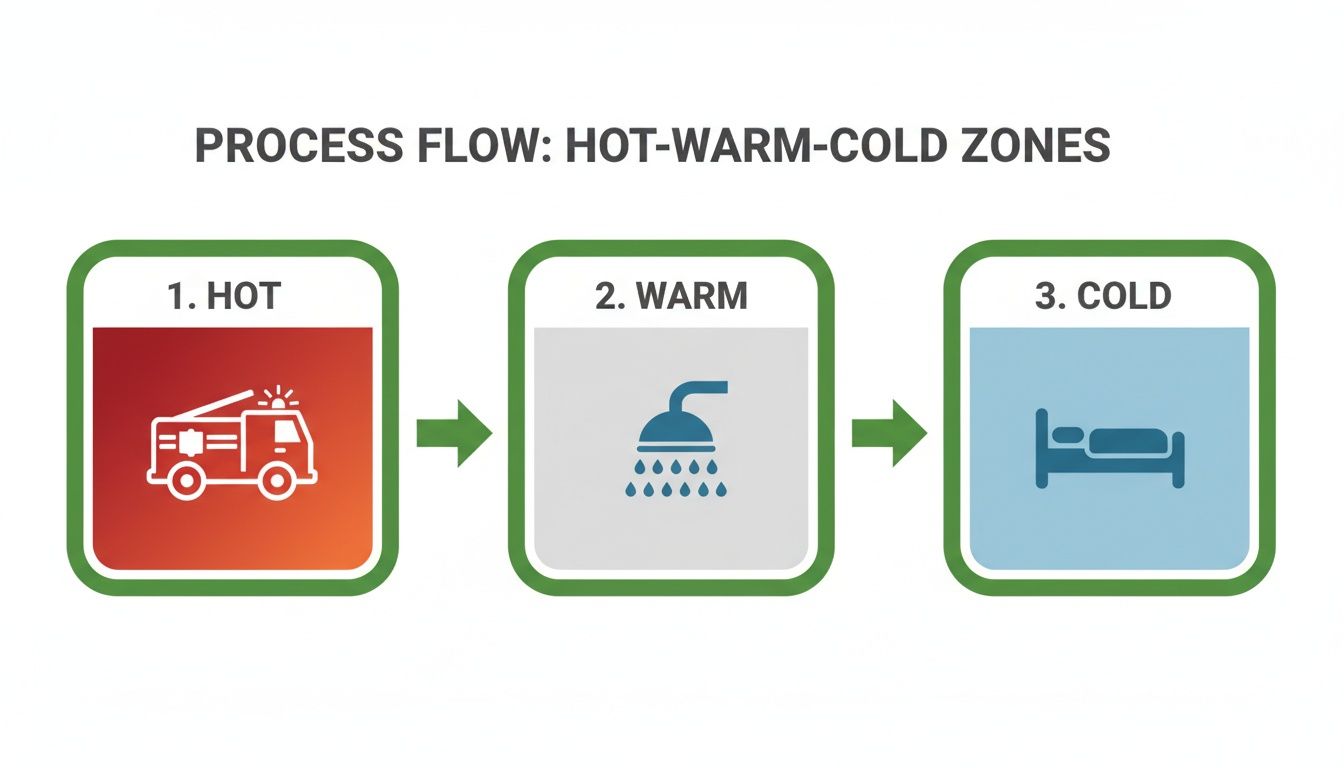
This simple diagram shows the ideal flow from a high-risk to a low-risk environment, which is the core principle of modern fire station design.

A process flow diagram shows three zones: hot (fire truck), warm (shower), and cold (bed).

This process flow illustrates the mandatory separation of Hot, Warm, and Cold zones. It ensures that contaminants from an incident (Hot) are systematically removed (Warm) before personnel ever enter the safe living quarters (Cold).

Living Quarters Designed for Readiness

The "Cold Zone" is where you'll find the living quarters—the dayroom, kitchen, and bunk rooms. While this is the area for rest and recovery, its layout is still driven by the absolute need for a rapid response. The name of the game is minimizing travel distance from these spaces to the turnout gear and, ultimately, the apparatus bay.

Bunk rooms are usually clustered in a quieter part of the station, but they're always connected by a direct, clear hallway to the turnout gear corridor. Dayrooms and kitchens are often positioned to have a straight shot or at least a clear line of sight to the bay.

For example, a new station in Bernalillo County was designed with 12 bunks and four apparatus bays, and the layout was obsessed with one goal: ensuring a firefighter could get from deep sleep to the truck in under 90 seconds. Every single wall and doorway was placed to make that journey as short and straight as humanly possible.

Getting the Dimensions Right: Sizing and Circulation

Moving from a floor plan sketch to a real, working fire station is all about the details. Every single inch counts, especially when you’re dealing with response times measured in seconds. Getting the sizing and circulation right isn't just about comfort; it's about designing a facility that performs flawlessly when the pressure is on.

The heart of the station is the apparatus bay, and its dimensions are absolutely non-negotiable. Fire trucks today are bigger than ever, and designing a bay for yesterday’s equipment will hamstring a department from day one. You have to plan for the biggest truck in the current fleet—and ideally, the biggest one you might possibly acquire in the next 20 years.

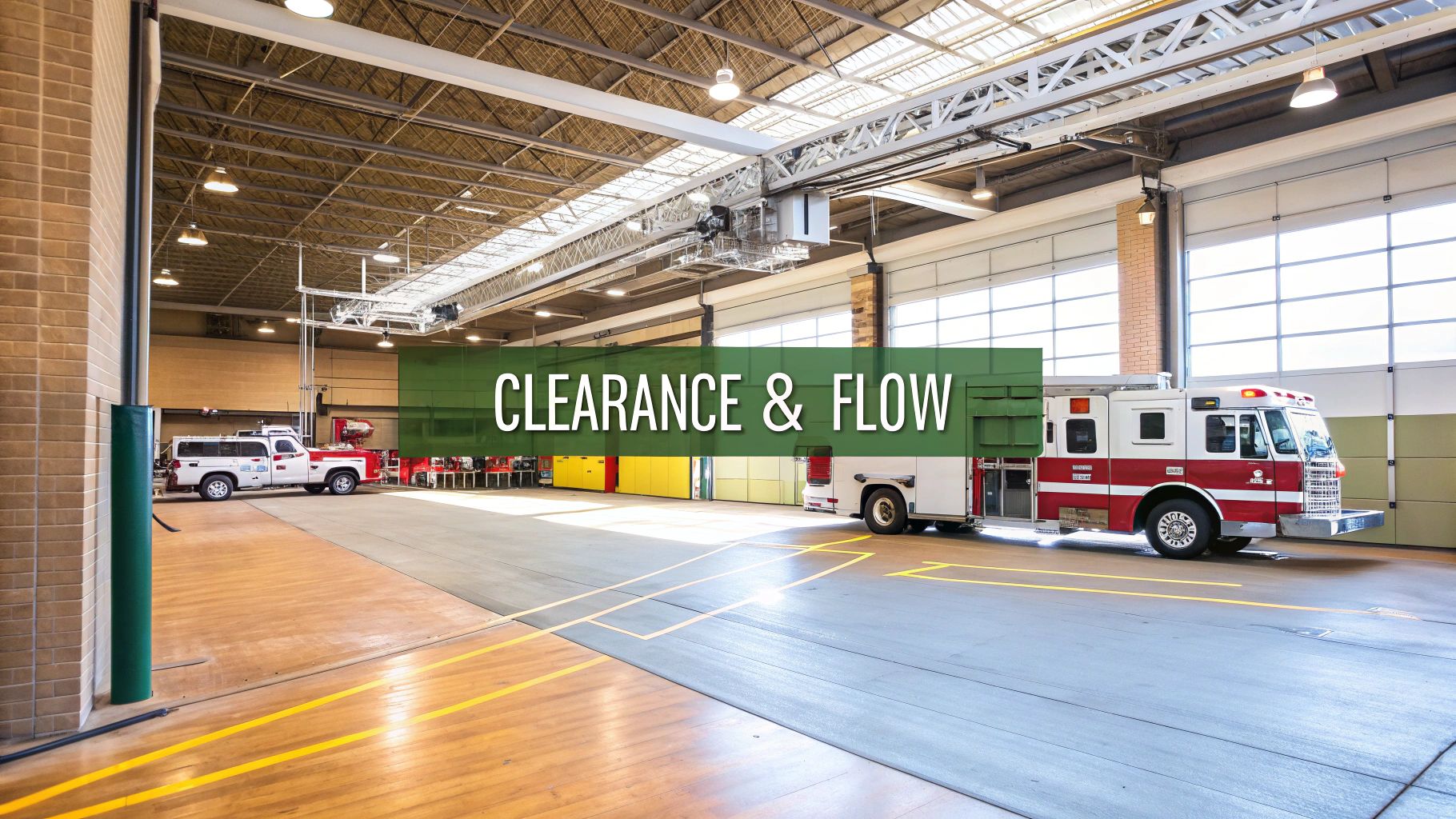
Interior of a modern fire station with a fire truck and pickup, showing clear floor markings.

Sizing the Apparatus Bay for Safety and Function

The apparatus bay is much more than a parking garage. It's a dynamic workspace where firefighters perform daily checks, stage gear, and handle maintenance. Because of this, generous clearances aren't a luxury—they're a core safety requirement. A cramped, crowded bay is a hazard zone, raising the risk of everything from trips and falls to costly vehicle damage.

Here are a few industry-standard guidelines to keep in mind:

  • Bay Width: Each bay should be at least 18 to 20 feet wide. This gives firefighters enough room to swing open massive cab and compartment doors without banging into walls or adjacent trucks.
  • Bay Depth: For a drive-thru design, you’ll need a minimum of 80 feet. For back-in bays, that number can stretch closer to 100 feet to give drivers the space they need to maneuver safely.
  • Clearances: Always plan for at least five feet of clear walking space around the front, back, and working side of every parked apparatus. This "safe zone" is essential for daily tasks and rapid deployment during a call.
  • Door Dimensions: The doors themselves need to be a bare minimum of 14 feet wide and 14 feet high. Many new stations are opting for 16-foot heights to future-proof the building for taller aerial trucks.

Think of the circulation space around an apparatus like the clear zone around heavy machinery in a factory. It’s not wasted space; it’s an active safety feature that prevents accidents and ensures smooth, predictable operations when every second counts.

These dimensions are the absolute baseline for any functional fire station floor plans. Cutting corners on bay size creates immediate operational headaches and severely limits a department's ability to adapt to new vehicles and technology down the road.

To help you visualize how these areas fit together, here’s a quick breakdown of typical space allocations for a standard two-bay station.

Typical Space Allocation in a Fire Station Floor Plan

This table provides estimated square footage guidelines for key areas within a standard two-bay fire station, helping developers plan for overall building size.

Functional Area Typical Size (Square Feet) Key Design Considerations
Apparatus Bay (Two Bays) 3,000 – 4,000 Must accommodate largest planned vehicle with 5 ft. clearances.
Decontamination Zone 200 – 300 Direct access from bay; includes showers, extractors, gear storage.
Living Quarters (Dorms) 800 – 1,200 Individual bunk rooms for privacy and rest are now standard.
Kitchen/Dayroom 600 – 900 Open concept to foster camaraderie; durable, commercial-grade finishes.
Training/Meeting Room 400 – 600 Flexible space with A/V hookups for training and community use.
Fitness Room 300 – 500 Needs space for cardio and strength equipment; good ventilation.
Administrative Offices 250 – 400 Captain's office, report writing stations, and secure storage.
Restrooms/Showers 350 – 500 Separate facilities for men and women, accessible from living areas.

These figures are a starting point, of course. A department’s specific operational needs, staffing levels, and community roles will ultimately shape the final design.

The Math Behind Movement and Response Time

Beyond the bay, the entire building's layout is governed by one thing: the relentless pursuit of speed. Pathways from the living quarters to the apparatus bay must be direct, wide, and completely free of obstacles. A winding hallway or a poorly placed door can easily add precious seconds to turnout time.

This isn't just a local issue; it's a global standard. In China, for instance, national guidance suggests a typical urban fire station should have a total floor area around 3,300–4,800 m² to properly serve its jurisdiction. Research confirms there's a direct correlation between a station's floor area, its capacity, and its effectiveness. As detailed in this study on station planning and risk coverage, you can actually quantify how new stations or added bays improve a city's overall protection.

The underlying principle is universal: create a "path of travel" that is as straight and simple as humanly possible. Corridors should be a minimum of five feet wide, allowing multiple firefighters to rush past one another without colliding, especially when they're throwing on heavy gear.

Finally, you have to think about the site itself. The apron—that big concrete pad in front of the bay doors—needs to be deep enough for trucks to exit and turn onto the street without executing a complicated three-point turn. A turning radius of at least 50 feet is a common benchmark to ensure apparatus can leave the station quickly and merge safely into traffic.

Making Sense of Critical Building Codes and Standards

When you're laying out a fire station floor plan, you're doing a lot more than just arranging rooms. You're navigating a dense web of building codes and safety standards that are non-negotiable. These aren't just suggestions—they are strict requirements that guarantee the station is safe, accessible, and strong enough to serve as a lynchpin for the community. A fire station isn't treated like a typical commercial building; it's officially classified as an Essential Facility, which bumps it into a much higher category for structural and safety performance.

This special status means the building has to be tough. Really tough. It must be engineered to withstand major disasters like earthquakes or hurricanes and stay standing when everything else might not. The International Building Code (IBC) lays out the specific seismic design criteria and structural standards for these facilities, ensuring they can function as a command post right after a major event hits.

Health and Safety Codes Driven by the NFPA

Beyond just keeping the building upright, the health and well-being of the firefighters are absolutely critical. This is where the National Fire Protection Association (NFPA) comes in. They publish a whole suite of standards that have a massive impact on the floor plan, going far beyond just sprinklers. These rules are designed to protect the long-term health of the people who call the station home 24/7.

A few of the biggest NFPA-driven requirements you'll see are:

  • Vehicle Exhaust Systems: NFPA 1500 requires direct-source capture systems for vehicle exhaust in the apparatus bay. This is a must-have to keep toxic diesel fumes from seeping into the station's air supply.
  • Contaminant Control: The layout must follow a strict "Hot-Warm-Cold" zone system. This prevents firefighters from unknowingly tracking cancer-causing agents from their gear into the living quarters.
  • Electrical Safety: Planning a fire station means following numerous safety regulations, and that includes the electrical systems that power everything. To ensure comprehensive electrical safety, understanding standards like the NFPA 70E electrical safety standards is crucial for designing power systems that are both safe and easy to maintain.

These health-based rules have become increasingly important as the fire service grapples with the high rates of job-related illnesses, especially cancer.

Designing for Accessibility and Inclusion

Like any modern public building, a fire station has to comply with the Americans with Disabilities Act (ADA). This has a huge effect on the floor plan, as it mandates that every part of the facility must be accessible. This isn't just for public-facing areas like a lobby or meeting room; it applies to the crew's work and living areas, too.

Designing for ADA compliance isn't just about ticking a legal box; it's about future-proofing the station. It ensures the facility can accommodate any member of the fire service and the community, creating a more inclusive and effective organization.

This means thinking through details like zero-threshold doorways, fully accessible restrooms and showers, and wide, clear pathways everywhere—from the offices to the kitchen. These considerations can't be an afterthought. They need to be baked into the design from day one, because trying to retrofit a non-compliant building later is a costly and disruptive nightmare. By embracing these codes from the very start, you build a station that isn't just compliant, but fundamentally safer, healthier, and ready to serve for decades.

New Construction Versus Adaptive Reuse Strategies

When a community decides it needs a new fire station, one of the first and most critical decisions is where that station will live. Do you start from scratch with a brand-new building, or can you breathe new life into an existing structure? This is the core question behind new construction versus adaptive reuse.

Both paths have their own unique set of pros and cons, and the right choice directly shapes the final fire station floor plans. It's a major decision that weighs budget, timing, location, and the specific operational needs of the fire department. A new build is a blank canvas, while an adaptive reuse project is more like solving a complex, three-dimensional puzzle.

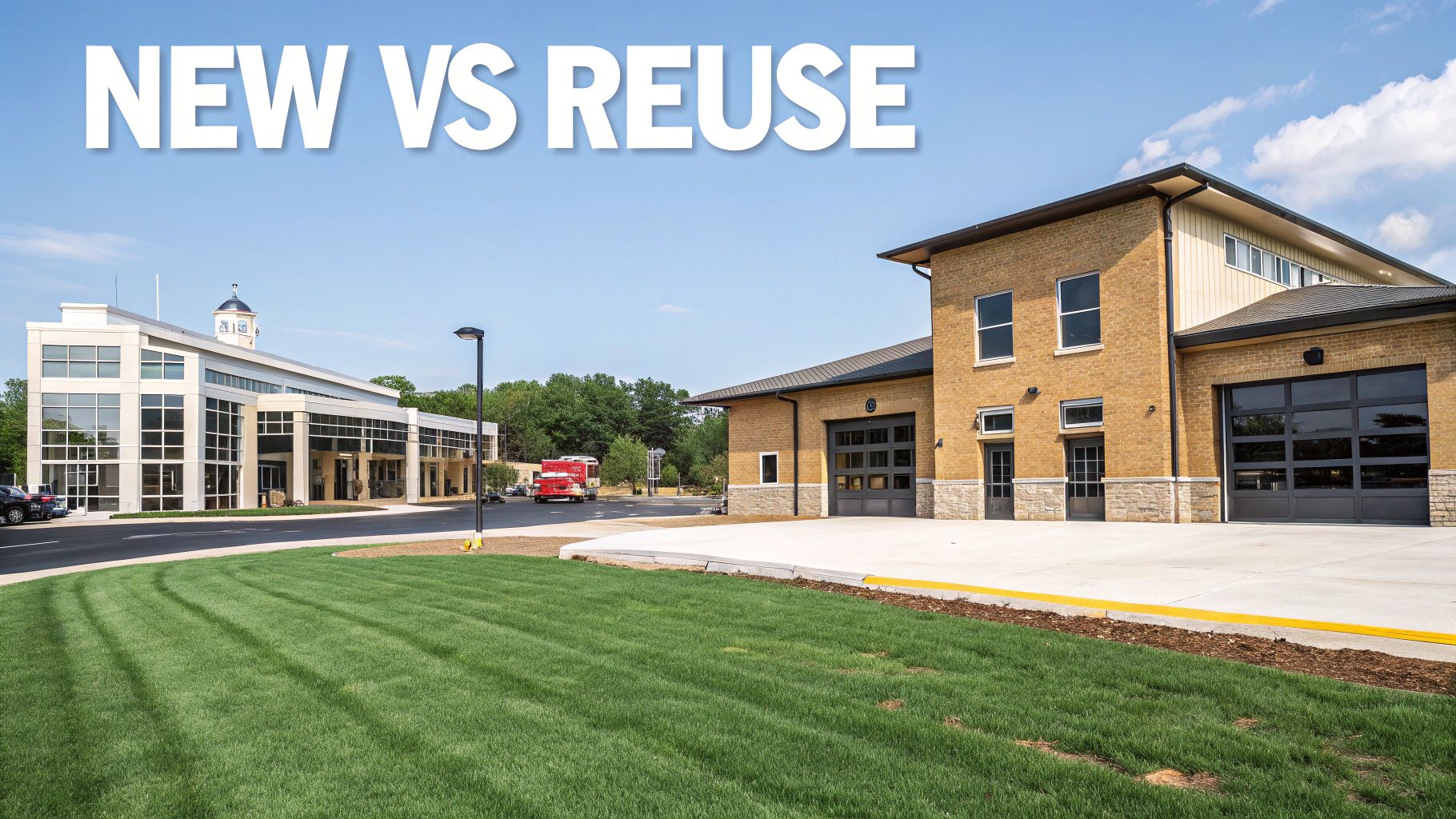
Two contrasting buildings, a modern structure and a brick fire station, illustrating new vs reuse.

The Blank Canvas of New Construction

There's no denying the appeal of starting with a clean slate. New construction offers complete freedom to design a fire station that is perfectly matched to the department's workflow and future ambitions. Every detail, from the width of apparatus bay doors to the exact layout of the decontamination zone, can be optimized for safety and efficiency without compromise.

Take the new Fire Station #36 in Bernalillo County, for instance. Designing from the ground up allowed for 12 bunks, four apparatus bays, and even an on-site solar energy system. More importantly, it meant they could incorporate New Mexico's first electric fire truck—a feature that would have been incredibly difficult, if not impossible, to shoehorn into a retrofitted building. When you're building new, integrated project delivery methods like Design Build services can really help streamline the entire process, from the first sketch to the final ribbon-cutting.

Ultimately, this approach ensures the floor plan is a true reflection of modern firefighting, free from the constraints of a building designed for another era.

The Intricate Puzzle of Adaptive Reuse

Adaptive reuse is all about transformation—taking an existing building like an old warehouse, a vacant school, or even a historic storefront and giving it a new purpose as a fire station. This route can be a more sustainable and sometimes more affordable option, especially in dense urban areas where open land is either nonexistent or prohibitively expensive.

But this path comes with its own set of significant engineering and design challenges. You’re not just moving in; you’re performing major surgery on the building.

Here are the main hurdles you'll almost always face:

  • Structural Integrity: A fully loaded fire engine can weigh over 80,000 pounds. The existing floor slab in a typical commercial building was never designed for that kind of load and will need massive reinforcement.
  • Sufficient Clearances: Modern fire trucks need tall bay doors, often requiring 14- to 16-foot vertical clearance. Cutting those openings into an existing wall without compromising the entire structure is a major undertaking.
  • Operational Flow: The biggest puzzle is often figuring out how to create a logical circulation path within a fixed footprint. You still have to establish those critical Hot, Warm, and Cold zones, which can be tough when you can't move walls wherever you want.
  • System Upgrades: The building's electrical, plumbing, and HVAC systems will almost certainly need a complete overhaul to handle the 24/7 demands of an essential facility.

While adaptive reuse can seem like a shortcut, it often requires just as much—if not more—creative problem-solving than new construction. The goal is to make the old building perform like a new one, which demands a deep understanding of both modern fire service needs and existing building constraints.

Making the Right Choice

So, how do you decide? The choice to build new or adapt an old building boils down to a careful analysis of your community's specific priorities.

The table below breaks down the key considerations for each approach, giving you a clearer picture of the trade-offs involved.

New Build vs. Adaptive Reuse for Fire Stations

Consideration New Construction Adaptive Reuse
Design Flexibility Total freedom to design a perfect, future-proof floor plan. Constrained by the existing building's footprint and structure.
Initial Cost Typically higher due to land acquisition and ground-up building. Potentially lower, especially if the building is acquired at a good price.
Project Timeline Predictable but can be lengthy, often 18-24 months from design to completion. Can be faster, but unexpected structural issues can cause delays.
Location Limited by the availability of suitable and affordable vacant land. Opens up more possibilities in established, built-out neighborhoods.
Community Impact Can be a symbol of civic investment and progress. Preserves local character and promotes sustainable development.

Whether you're starting fresh on an empty lot or reimagining a piece of your town's history, the fundamental goal is the same: to create a fire station floor plan that helps firefighters respond faster, work safer, and stay healthier for decades to come.

Your Essential Fire Station Planning Checklist

Getting a new fire station from a concept on paper to a fully operational reality is a monumental task. There are dozens of critical decision points along the way, and a successful project really boils down to asking the right questions at the right time.

This checklist is designed to be your guide. Whether you're a fire chief, a city leader, or a developer, it will help you make sure no crucial detail gets missed in your fire station floor plans. Think of it less as a rigid set of rules and more as a strategic roadmap to spark discussion, challenge old assumptions, and keep everyone on the same page.

Phase 1: Foundational and Site Analysis

Before anyone even thinks about drawing a floor plan, you have to do your homework on the ground. The decisions you make here will ripple through every other phase of the project, affecting everything from response times to the station's long-term value.

  • Map Your Response Coverage: Have you run a detailed GIS analysis to prove this site gives you the best possible coverage? It’s critical to confirm you can meet the NFPA 1710 travel time standards.
  • Assess Site Circulation: Is there actually enough room for trucks to get in and out easily, without a 10-point turn? You need to plan for a minimum 50-foot turning radius for the apron, no exceptions.
  • Evaluate Zoning and Utilities: Double-check that the site is zoned for an essential facility. Have you confirmed that the water, sewer, and power lines can handle a 24/7 operation?
  • Conduct Geotechnical and Environmental Surveys: Are there any nasty surprises lurking underground? Hidden soil problems, drainage issues, or environmental contaminants can derail a budget faster than anything else.

A proactive site analysis can prevent 80% of future design and construction headaches. Rushing this initial phase is the single most common mistake that leads to budget overruns and compromised operational flow.

Phase 2: Programming and Operational Planning

This is where your department's day-to-day reality gets translated into an architectural program. You're defining the specific spaces you need and, just as importantly, how they all need to connect to support the mission.

  • Define Your Apparatus Fleet: What’s the biggest rig you have now, or plan on buying in the next 20 years? The entire plan has to be built around that future vehicle, not just what’s sitting in the bay today.
  • Confirm Staffing Levels: How many firefighters will be on-duty per shift, both now and down the road? This number drives everything from the number of bunks and lockers to the size of the dayroom and kitchen.
  • Map the Decontamination Workflow: This is a big one. Have you clearly mapped out the one-way path from the apparatus bay (Hot Zone), through the decon area (Warm Zone), and into the living quarters (Cold Zone)? For the health of your crew, this flow is non-negotiable.
  • Identify Community and Training Needs: Will the station have a community room for public meetings? A dedicated training tower? A real fitness area? These spaces need to be worked into the layout without ever getting in the way of an emergency response.

Phase 3: Future-Proofing and Long-Term Viability

A new fire station is a 50-year investment. Designing just for today's needs is shortsighted. You have to think about what's coming next to make sure this facility serves the community for decades.

  • Plan for Expansion: Does the site plan and building design leave room to grow? Think about adding an extra apparatus bay or more administrative offices later on.
  • Accommodate New Technology: Are you wiring and planning for things that aren't even standard yet? This means infrastructure for electric vehicle charging, better data systems, and even designated areas for drone deployment.
  • Design for Flexibility: Are you building in adaptability? Using things like movable partitions or flexible furniture in training rooms and offices means the space can evolve as your operational needs change.

By working through these questions step-by-step, your team can build a plan that goes beyond just looking good on paper. You’ll create a station that’s effective on day one and remains a resilient, valuable asset for generations to come.

Answering Your Key Questions on Fire Station Design

When you're knee-deep in planning a fire station, the questions come thick and fast. It's a complex project, and everyone from the fire chief to the town council needs to be on the same page. Let's walk through some of the most common questions we hear and get you some clear, straightforward answers.

These aren't just academic points; they get to the heart of what makes a station design work in the real world—efficiency, firefighter safety, and a building that will serve its community for decades.

What’s the One Thing We Absolutely Have to Get Right in the Floor Plan?

If you get one thing right, make it the operational flow. The entire design should be obsessed with minimizing "chute time"—the clock starts the second the alarm sounds and stops when the truck's wheels are rolling out the door.

A great plan accomplishes this with a dead-simple, wide, and totally clear path from the living quarters, through the turnout gear room, and straight to the apparatus. No zig-zags, no narrow hallways, no obstacles. Every second shaved off that response time by good design is a second gained at the scene of an emergency. It's truly the most critical element.

How Much Does Decontamination Really Change the Design?

It changes everything. The growing understanding of cancer risks has completely overhauled how we lay out a modern fire station. A strict ‘Hot-Warm-Cold’ zone system isn't just a trend; it's the new non-negotiable standard for protecting firefighters.

Here’s how it works in practice:

  1. Hot Zone: The crew and their gear come off the truck and enter a dedicated decontamination area directly from the apparatus bay.
  2. Warm Zone: Next, they move through a transition space with special showers and gear washers to remove contaminants.
  3. Cold Zone: Only after they are completely clean do they re-enter the "clean" living side of the station—the kitchen, bunks, and offices.

This isn't an optional add-on anymore. It's a fundamental part of the building's design, crucial for protecting the long-term health of the crew.

A well-designed decontamination workflow is one of the biggest leaps forward in fire station architecture. Think of it as a direct investment in your firefighters' futures, shielding them from the cumulative effects of toxic exposure.

Can We Actually Convert an Old Building into a Fire Station?

Absolutely, and it can be a great, sustainable option. But it's not as simple as just parking a truck inside. An adaptive reuse project demands a very careful and realistic feasibility study right from the start.

You run into some serious engineering puzzles. First, can the existing structure handle the massive weight of a modern fire engine, which can top 80,000 pounds? Second, do you have enough ceiling height for the apparatus bays? And finally, can you carve out a logical and safe circulation path within the constraints of the old building? It takes a creative design team, but with the right building, the results can be fantastic.

What's a Realistic Budget for a New Fire Station?

This is the big question, and the answer varies a lot by location and the specifics of the project. As a starting point, you can expect new construction to fall somewhere between $400 and $700+ per square foot. So, for a pretty standard 12,000–15,000 sq ft station, you're likely looking at a total project cost of $5 million to over $10 million.

That number might seem high, but it reflects the fact that this is a 24/7 essential facility built to last for 50+ years. It requires heavy-duty structural, mechanical, and electrical systems that you just don't see in a typical office building. For a real-world example, a recent project for a new four-bay station in Bernalillo County was budgeted around $15.8 million, which shows the level of investment needed for a resilient, modern public safety facility.


At Sherer Architects, LLC, we specialize in solving complex design puzzles for commercial, adaptive reuse, and historic preservation projects. If you are planning a facility that demands precision, durability, and a deep understanding of operational needs, let our decades of experience guide your project to a successful outcome. Learn more about our approach at https://shererarch.com.

Categories
Uncategorized

A Practical Guide to Fire Station Floor Plan Design

A fire station floor plan is far more than just a blueprint for a building. It's the operational DNA of the entire facility, a strategic map that directly impacts response times, firefighter safety, and the crew's well-being. Think of it this way: every hallway, every doorway, every designated zone is meticulously planned to shave precious seconds off a call when it matters most.

Why a Modern Fire Station Floor Plan Matters

Spacious fire station interior with a red fire truck, firefighters, and a sign stating 'FLOOR PLAN MATTERS'.

Imagine a high-performance engine. For it to run at peak capacity, every single component must work in perfect harmony. The same is true for a fire station, and the floor plan is the engineering schematic that ensures this synergy. It dictates the flow of people, equipment, and information, all under the immense pressure of an emergency.

A poorly designed station introduces friction. It adds seconds to turnout times and creates unnecessary risks for the crew. On the other hand, a thoughtfully designed fire station floor plan creates a facility that’s both a rapid-response launchpad and a safe, restorative home for its firefighters.

The Core Concept of Zoning

The absolute cornerstone of modern fire station design is zoning. This isn't just about labeling rooms; it's a philosophy that divides the station into distinct areas based on their function. This strategic separation is crucial for preventing cross-contamination and streamlining movement.

Every layout decision comes back to how these three primary zones interact:

  • Operational Zone: This is the "hot" zone. It's where the action happens, containing the apparatus bay for vehicle storage and the critical decontamination areas. Durability, safety, and direct, unimpeded access to the exterior are the top priorities here.
  • Living Zone: This is the "clean" zone—a sanctuary. It includes bunk rooms, the kitchen, the dayroom, and fitness areas. The entire focus is on creating a healthy and restful environment, completely isolated from the toxins and carcinogens of the operational side.
  • Administrative and Public Zone: This area serves as the station's front office, housing command staff, reporting rooms, and public-facing spaces like a lobby. It acts as a necessary buffer between the public and the private living quarters of the firefighters.

A fire station is one of the few building types that must function as a high-stakes industrial facility, a residential dwelling, and a public administrative building all at once. The floor plan is the key to making these competing needs coexist effectively.

From Blueprint to Lifeline

The way these zones connect is non-negotiable. For example, the path leading from the apparatus bay back into the station must pass directly through a decontamination corridor. This isn't optional; it’s a critical health and safety measure that prevents dangerous particulates from being tracked into the kitchen or sleeping areas.

Likewise, the route from the bunk rooms to the apparatus bay needs to be as short and straight as humanly possible. An efficient plan gets rid of sharp turns, extra doors, and cluttered hallways. This isn't just about convenience; it’s about shaving critical seconds off the response when the alarm sounds. Every single choice, from the width of a corridor to the placement of a door, directly impacts the station's ability to protect its community and keep its own people safe.

Exploring the Core Zones of a Fire Station

Interior view of a fire station with a "CORE STATION ZONES" sign, green turf, and equipment area.

A fire station is much more than just a building; it’s a high-performance machine fine-tuned for rapid response and a sanctuary for the crew who calls it home. Every space has a very specific job, from the adrenaline-fueled operational areas to the quiet, restorative living quarters.

Getting the fire station floor plan right means understanding how these distinct zones work together. The goal is to create a seamless flow that enhances safety, efficiency, and the well-being of the firefighters. Let's break down the essential components.

The Apparatus Bay: The Heart of Operations

The apparatus bay is the undeniable nerve center of the station. This isn't just a fancy garage—it's the launchpad where every single emergency response begins. The design here is all about durability, space, and, most importantly, speed.

Floors have to be heavily reinforced to support the massive weight of modern fire trucks, and ceiling heights must be generous enough to clear the tallest aerial ladders. Even the doors are a critical decision; fast-acting bifold or four-fold models are often chosen over traditional overhead doors because they can shave precious seconds off a crew's departure time.

Of course, proper ventilation is non-negotiable. Sophisticated systems are designed to capture and vent harmful diesel exhaust fumes immediately, preventing them from creeping into the station’s other zones.

The Decontamination Zone: A Critical Buffer

Tucked right next to the apparatus bay is arguably one of the most vital areas in any modern fire station: the decontamination (decon) zone. This space functions as a one-way corridor, designed to trap carcinogens and other contaminants before they can find their way into the living quarters.

The decon zone is the single most important design element for long-term firefighter health. It creates an essential airlock between the "hot" operational side and the "clean" living side of the station.

Firefighters returning from a call must follow a strict protocol that moves them through this area. The zone is typically broken down into a few key spaces:

  • Gross Decon: Where firefighters get an initial rinsing of their turnout gear.
  • Gear Storage: Dedicated, separately ventilated rooms to store contaminated gear away from everything else.
  • Transition Showers: A required stop for firefighters to shower before they're allowed to enter the clean living areas.

Living Quarters: The Sanctuary

Once through the decon zone, firefighters step into the "clean" side of the station. This is their home away from home for grueling 24 or 48-hour shifts, so the floor plan must be designed to support genuine rest and recovery.

  • Bunk Rooms: We've seen a major shift away from large, open-bay dormitories toward individual or semi-private bunk rooms. This one change can drastically improve sleep quality—a vital component for maintaining mental and physical health in such a high-stress profession.
  • Kitchen and Dayroom: This is the communal hub, the heart of the station's social life. An open-concept kitchen flowing into a comfortable dayroom helps build camaraderie and teamwork. The design should feel less institutional and more residential, giving crews a real space to decompress.
  • Fitness Center: Staying in peak physical condition is part of the job. A well-equipped, dedicated fitness area—often with easy access to an outdoor space—is now a standard feature in any new fire station floor plan.

Administrative and Specialized Support Areas

Beyond the main operational and living zones, today's stations require a handful of other key spaces. A watch room or communications center often acts as the station's brain, requiring specific layouts for dispatch equipment and monitoring systems. When designing these high-tech hubs, it’s wise to account for advanced emergency management system features to ensure the physical space can support the technology.

You'll also find training rooms, administrative offices for the captain or chief, and even public-facing community rooms becoming standard. Each zone, from the rugged apparatus bay to the quiet bunk room, has a distinct and crucial role to play. A successful design orchestrates their functions into a seamless whole, creating a facility that is safe, efficient, and truly supportive of its crew.

To give you a clearer picture, here's a quick summary of how these zones are organized:

Core Zones in a Fire Station Floor Plan

Zone Key Spaces Included Primary Design Goal
Apparatus Bay Vehicle Bays, Tool Storage, Workshop Maximize speed, durability, and operational readiness.
Decontamination Gross Decon, Gear Storage, Showers Isolate contaminants and protect firefighter health.
Living Quarters Bunk Rooms, Kitchen, Dayroom, Fitness Promote rest, recovery, and crew camaraderie.
Support & Admin Offices, Watch Room, Training, Public Areas Manage station operations and community engagement.

Ultimately, a thoughtfully zoned floor plan ensures that every part of the station works in harmony, supporting the health and readiness of the firefighters who depend on it.

Designing for Safety and Rapid Response

A fire station floor plan isn't just about arranging rooms logically—it's a life-saving tool where every single design choice shaves seconds off a response time. This is where the rubber meets the road, turning architectural theory into a facility that has to perform flawlessly under extreme pressure. When an alarm blares, seconds count, and the building's layout is the crew's first and best advantage.

The goal is to create a sense of controlled urgency. This means circulation paths need to be dead simple, direct, and completely free of obstacles. When a call comes in, firefighters have less than a minute to go from zero to one hundred. A great floor plan makes that transition feel like second nature.

It all boils down to two key principles: creating the fastest possible path to the trucks and protecting the crew's long-term health by keeping the "dirty" part of the job separate from the "clean" living spaces. These aren't just nice ideas; they're critical goals we achieve with smart, deliberate design.

Optimizing the Response Path

The path from the bunk room to the apparatus bay is the single most important route in the station. The mission is simple: keep it as short and as straight as humanly possible. No zig-zagging hallways, no unnecessary doors, no clutter to trip over in the dark.

Put yourself in the boots of a firefighter jolted awake at 3 AM. The path needs to be so ingrained that they can navigate it on muscle memory alone. This is why you'll often see living quarters placed right next to the apparatus bay, sometimes with several direct-access doors to prevent a traffic jam when everyone is scrambling at once.

A fantastic real-world example of this principle comes from a large-scale project in Australia. By building new stations and relocating older, poorly-sited ones across Greater Sydney, they saw a measurable drop in average fire engine arrival times. The data proved that better layouts and locations didn't just improve response times—they led to better fire containment and less property damage. It’s a powerful testament to how a building's design directly impacts community safety. You can read more about these findings on the U.S. Fire Administration website.

The Critical Separation of Hot and Clean Zones

Just as critical as getting out the door quickly is protecting the crew's health when they get back. We now know far more about the long-term dangers of carcinogens and other toxins that cling to gear and equipment after a fire. A modern fire station floor plan has to tackle this head-on with an uncompromising approach to zoning.

We think about it in terms of "hot," "warm," and "clean" zones.

  • Hot Zone: This is the apparatus bay itself, where contaminated trucks and gear first return.
  • Warm Zone: Think of this as an airlock. It’s a dedicated decontamination corridor where firefighters can do a gross decon of their gear, store it in specially ventilated rooms, and shower before going any further.
  • Clean Zone: This includes the living quarters, kitchen, administrative offices, and any public-facing areas. Contaminated gear or personnel are never allowed to cross into this space.

By forcing a one-way flow from the hot zone, through the warm zone, and into the clean zone, the floor plan itself becomes an active defense mechanism. It protects firefighters from chronic exposure to hazardous materials long after the fire is out.

This isn't just a "best practice"—it's a non-negotiable standard for protecting the health and careers of first responders. Following strict building codes, like those from the National Fire Protection Association (NFPA), is mandatory. For a look at how technology is helping manage these complex requirements, it's worth exploring the role of AI in navigating building codes and regulations.

Smart Apparatus Bay Design

The design of the apparatus bay is where speed and safety converge. There are two primary models, and the right choice often comes down to the site's limitations and the department's operational needs.

Drive-Through Bays:
This layout is the gold standard for safety, period. It allows apparatus to pull in from one side of the station and drive straight out the other, completely eliminating the need for slow, dangerous backing maneuvers. This forward-only flow is much safer on-site and can shave precious seconds off a departure. The only real downside is that it requires a larger lot with access on two sides, which can be tough to find in dense urban areas.

Back-In Bays:
This is the more traditional and space-efficient approach, but it requires drivers to reverse massive vehicles into tight spots. While it’s incredibly common, it inherently brings a higher risk of accidents. To make it work safely, the design must include a generous concrete "apron" in front of the station for maneuvering, clear sightlines, and is often supplemented with sophisticated vehicle cameras and sensor systems to give drivers an extra set of eyes.

No matter which model you choose, every bay must have a robust vehicle exhaust capture system. These are typically hose-based systems that connect directly to a vehicle's tailpipe to vent toxic diesel fumes outside. It’s an absolutely critical health and safety feature that prevents those fumes from building up inside the station where people live and work.

Common Fire Station Layouts and When to Use Them

Not every fire station is built from the same blueprint. What works for a quiet, rural volunteer department will be completely wrong for a high-call-volume urban crew. Choosing a layout isn’t about picking what looks best—it’s a critical decision that has to balance the reality of your site, your budget, and the daily operational needs of your firefighters.

Think of it like choosing a tool for a job. You wouldn't use a screwdriver to hammer a nail. In the same way, the right floor plan is the one that’s perfectly suited to the unique demands of the community it serves. The first step is getting familiar with the most common designs.

Before we dive into specific layouts, this graphic illustrates the three core principles that guide every modern fire station design: speed, safety, and readiness.

An infographic showing a three-step process: Fast Path (running person), Clean Zone (water drop), and Safe Bay (delivery truck).

This flow—from a rapid response path to controlling contaminants and maintaining a secure apparatus bay—is the foundation of an efficient and safe station.

The Single-Story Layout

When you have the land to work with, the single-story layout is king. It’s the most common design for a reason: it’s simple, efficient, and fast. By placing all the essential zones—apparatus bays, living quarters, and administrative offices—on the same level, you create the shortest, most direct path from the bunk room to the truck.

This design naturally eliminates stairs and fire poles. While poles are an iconic part of fire station lore, they also represent a significant fall risk. Keeping everything on one floor creates a safer, more intuitive environment that shaves precious seconds off turnout times and makes meeting ADA requirements much simpler.

Of course, the big catch is its footprint. A single-story station needs a lot of real estate, which can be a deal-breaker in dense urban areas where land is either unavailable or prohibitively expensive.

The Two-Story Configuration

What do you do when your site is tight? You build up. The two-story fire station floor plan is the classic solution for compact urban lots. Typically, the apparatus bay and support spaces occupy the ground floor, while the living quarters—bunks, kitchen, dayroom—are stacked directly above.

This vertical design dramatically shrinks the building’s footprint, allowing a full-service station to fit on a much smaller piece of land. It’s also the reason the fire pole was invented, offering a gravity-powered shortcut to get crews from the living area down to the trucks. Modern designs also rely on well-placed, wide staircases as a safer alternative.

The decision to go multi-story is almost always driven by site constraints. It’s a brilliant way to save space, but it adds complexity. You have to carefully engineer the flow to ensure crews can still get from the second floor to the bay safely and without delay.

Back-In Versus Drive-Through Designs

This is one of the most fundamental decisions you'll make, and it shapes the entire site plan. The traditional back-in model is a space-saver, but it forces firefighters to perform tricky, high-risk backing maneuvers every time they return to the station. This layout can be made much safer with a large concrete apron for maneuvering and the help of modern vehicle cameras and sensors.

The drive-through design, on the other hand, is the gold standard for on-site vehicle safety. It allows apparatus to enter through one set of bay doors and exit through another, completely eliminating the need to back in. This simple forward flow dramatically cuts the risk of accidents. For instance, a new station proposed in Huntington, Indiana, made this a core safety feature of its design.

The trade-off is obvious: land. A drive-through station needs a "through lot" with access from two streets or a very deep parcel to accommodate the flow. That’s a luxury many municipalities just don't have.

Ultimately, the best fire station floor plan is the one that gives its crew the safest and most efficient path to response, all while respecting the real-world constraints of the budget and the building site. Whether it’s a sprawling single-story campus or a compact two-story urban station, the goal is always the same: a fast, safe, and effective response.

How Fire Station Design Has Evolved

To get a real handle on the modern fire station floor plan, it helps to look at where it came from. The fire stations we build today didn't just appear overnight; they're the result of centuries of trial, error, and adaptation, with each era leaving its own distinct mark on the blueprint.

Imagine the earliest firehouses. They were little more than basic sheds or barns, built for one simple purpose: to keep horse-drawn pumpers and handcarts out of the rain and snow.

Their job was straightforward—store the gear. The designs were purely practical, usually just a big central door and maybe a small stable off to the side. You wouldn't find living quarters, decontamination zones, or fitness rooms. The mission was purely logistical.

The Shift to Motorized Apparatus

The invention of the motorized fire engine in the late 19th and early 20th centuries changed everything. This one piece of technology forced a ground-up rethink of fire station design. The story of how fire station layouts evolved is really the story of these technological and social shifts.

As engines replaced horses, stations had to get bigger and stronger to accommodate larger, heavier vehicles that needed to get out the door fast. This meant designing larger apparatus bays with wider doors and reinforced floors. You can take a deeper dive into this architectural shift and how it still influences us today by exploring the history of fire station design.

But this wasn't just about making space for bigger trucks. Motorized apparatus gave fire departments incredible speed and range, turning firefighting from a small-scale neighborhood effort into a professional, city-wide service. This new level of professionalism demanded full-time firefighters on duty around the clock.

From Garage to Home

The introduction of 24-hour shifts created a whole new list of design needs. A fire station could no longer just be a garage for a truck; it had to function as a second home for the crew. This is when the idea of separate "living zones" really started to emerge.

  • Bunk Rooms: What started as large, open dormitories slowly evolved into more private sleeping quarters.
  • Kitchens: A shared kitchen became the heart of the station, a necessity for crews living and eating together.
  • Dayrooms: Spaces for training, unwinding, and building camaraderie became standard.

This dual purpose added new layers of complexity to the floor plan. The building was now serving two very different masters: the urgent, industrial demands of the apparatus bay and the everyday residential needs of the firefighters.

The modern fire station floor plan is a direct response to an expanded mission. It has evolved from a simple equipment shed into a multi-functional facility that must support not only emergency response but also the long-term health, wellness, and operational readiness of its firefighters.

And that evolution is still happening. Today, we're focused on firefighter health and safety like never before. New designs include sophisticated decontamination corridors to keep carcinogens out of the living areas and create more restorative environments for the crew. Every new challenge continues to shape the blueprint for the fire station of tomorrow.

Answering the Big Questions About Fire Station Design

When you're planning a project as vital as a fire station, a lot of questions come up. It's only natural. From city officials to the design team, everyone needs solid answers to make the right calls. Let's tackle some of the most common questions we hear when developing a modern fire station floor plan.

Getting these fundamentals right is the first step toward building a station that's a smart investment in the safety of both the community and its firefighters.

What Is the Most Critical Factor in a Fire Station Floor Plan?

Hands down, the single most critical factor is the speed and clarity of the response path. When the alarm sounds, there needs to be a straight, unobstructed shot from the living quarters to the apparatus bay. Every single second shaved off that time can make a life-or-death difference out in the field.

This means thinking carefully about where you put every room, doorway, and hall to cut down travel time and remove any bottlenecks. Running a very close second is the non-negotiable separation of "hot zones"—areas contaminated by carcinogens and soot from a fire—from the "clean zones" where the crew eats and sleeps. That division is absolutely essential for protecting their long-term health.

How Much Does a New Fire Station Typically Cost?

The final price tag can swing pretty wildly depending on the region, the station's size, and the features you include. That said, you can generally expect construction costs to fall somewhere between $190 and over $250 per square foot in today's market.

For a smaller station of around 15,000 square feet, you're looking at a construction budget in the neighborhood of $2.8 million to $3.75 million. And that's just for the building itself. Don't forget that this number doesn't cover land costs, architectural fees, site work, or the specialized equipment, all of which will add a significant amount to the total project cost.

What Are the Benefits of a Drive-Through Apparatus Bay?

The biggest win here is safety. A drive-through bay means firefighters don't have to back those massive, heavy engines into a tight space—a tricky maneuver that’s a recipe for accidents, injuries, and expensive vehicle damage.

A drive-through apparatus bay simplifies vehicle movement into a continuous forward motion, improving both on-site safety and operational speed during departures and returns.

This design naturally makes things run smoother, since trucks can get in and out faster. The main trade-off? You need a bigger piece of land with access from two sides. Securing a site like that, especially in a built-up urban area, can be a major challenge and a big-ticket item.

How Do Modern Floor Plans Support Firefighter Wellness?

Today’s fire station designs are worlds away from the old models, with a much bigger focus on both physical and mental well-being. It all starts with those distinct contamination control zones we mentioned, which are designed to keep toxic exposures from fires from following firefighters into their living spaces.

The living quarters themselves are also designed to be places of rest and recovery. We're seeing a major shift toward private or semi-private bunk rooms because good sleep is no longer a luxury—it's a necessity. Other features that are now becoming standard include:

  • Dedicated Fitness Rooms: To help the crew stay in peak physical condition.
  • Quiet Rooms or Decompression Areas: Giving firefighters a space to mentally recharge after a tough call.
  • Natural Lighting: Flooding dayrooms and common areas with daylight has a proven positive effect on mood.
  • Access to Outdoor Spaces: A simple patio or green space offers a welcome place to unwind.

These aren't just amenities; they are crucial components that help firefighters manage the incredible stress that comes with the job.


At Sherer Architects, LLC, we see every fire station as a unique puzzle where every piece—from operational flow to firefighter wellness—must fit together perfectly. We walk owners and developers through each phase of the design and construction process, making sure the final building is not only beautiful and built to last but is perfectly tuned for its critical mission. See how our attentive listening and decades of experience can bring structure to your vision at https://shererarch.com.