SHERER ARCHITECTS

Categories
Uncategorized

Mastering the Financial Feasibility Study in Real Estate

At its core, a financial feasibility study answers the most important question you can ask before breaking ground: Will this project actually make money? It's a hard-nosed, data-driven look at a proposed venture's viability, weighing everything from the initial cash outlay and projected income to potential risks and the ultimate return on investment.

This analysis is the critical go/no-go signal for any serious developer or investor.

Your Blueprint for a Profitable Real Estate Venture

Long before we sketch the first line or a single shovel hits the dirt, a financial feasibility study acts as the project's strategic roadmap. It's about moving past a gut feeling and transforming a promising idea into a bankable business case supported by cold, hard numbers.

For complex undertakings like commercial real estate development and especially adaptive reuse, this analysis isn't just a preliminary step—it's the bedrock for every decision that follows. It forces you to pressure-test your assumptions against market realities, ensuring the architectural vision is firmly tethered to financial practicality.

Think of it as the business plan for the building itself. A well-executed study becomes your most powerful tool for securing financing, as it proves to lenders and investors that you’ve done your homework and have a clear-eyed view of the path to profitability.

What We Aim to Achieve

The main objective is to determine if a project makes economic sense before anyone commits serious capital. This means digging deep into several key areas:

  • Validating the Concept: Does the market demand and projected revenue justify the development costs? Simple as that.
  • Spotting Financial Risks: The study is designed to uncover hidden vulnerabilities—things like potential construction overruns, a slower-than-expected lease-up, or a sudden shift in interest rates.
  • Fine-Tuning the Project Plan: Often, the findings reveal opportunities to tweak the project's scope, scale, or even the design to get a better financial result.
  • Building Investor Confidence: Nothing speaks louder to capital partners and lenders than a transparent report filled with data-backed evidence.

The whole process is about simplifying complex financial decisions by breaking them down into a clear, logical workflow.
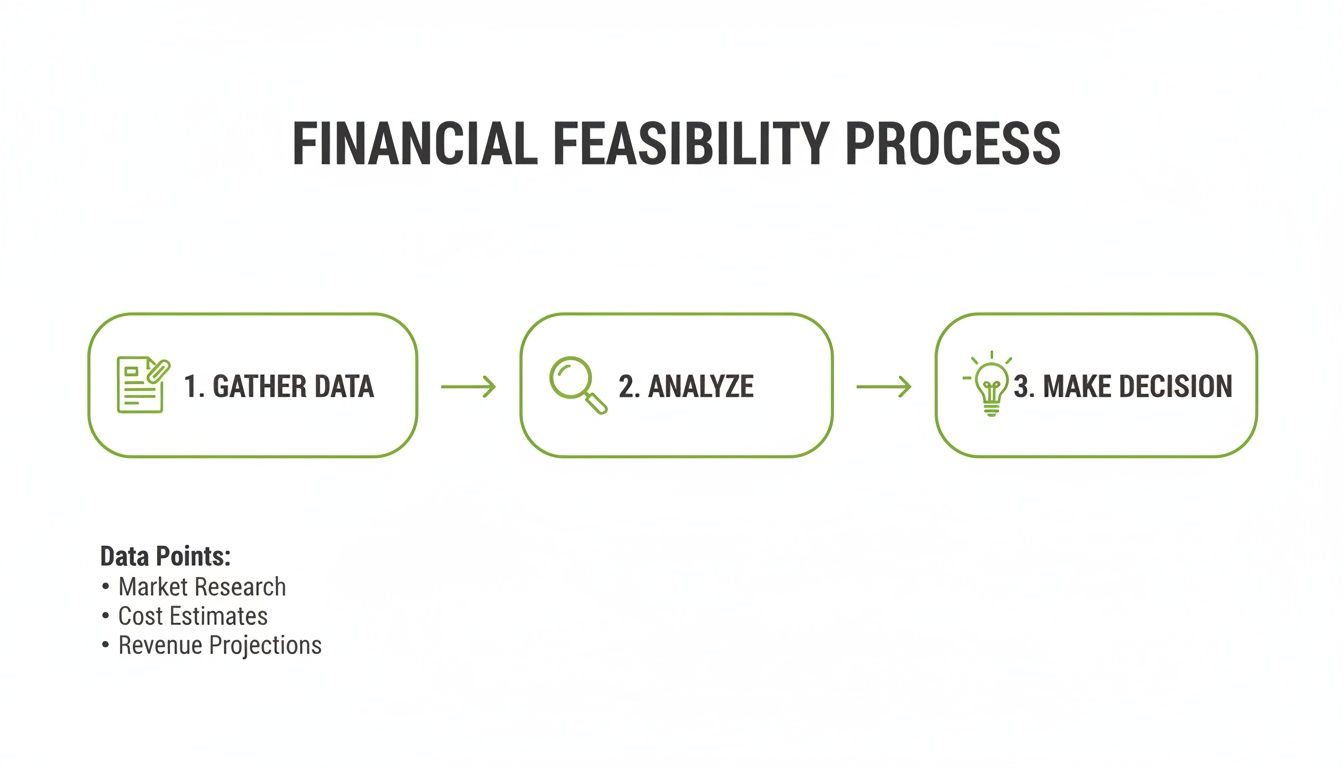
A diagram outlining the three-step Financial Feasibility Process: Gather Data, Analyze, and Make Decision.

As you can see, every solid study follows this progression. We gather the right data, run the numbers, and empower you to make a smart, informed decision.

A well-structured study pulls together several critical pieces of analysis. This table gives a snapshot of the core components we always include to build a complete financial picture.

Key Components of a Financial Feasibility Study

Component Objective Key Metric Examples
Market Analysis Assess demand, competition, and rental/sale price potential. Vacancy Rates, Absorption Rates, Comparable Rents/Sales
Cost Estimation Project all hard and soft costs from acquisition to stabilization. Cost per Square Foot, Contingency Budgets (e.g., 10-15%)
Revenue Forecasting Model potential income streams over the project's lifecycle. Gross Potential Rent, Vacancy Loss, Effective Gross Income
Financing Structure Determine sources and uses of funds, including debt and equity. Loan-to-Value (LTV) Ratio, Debt Service Coverage Ratio (DSCR)
Profitability Analysis Calculate the expected return on investment. Cash-on-Cash Return, Internal Rate of Return (IRR), ROI
Sensitivity Analysis Stress-test the pro forma against potential market shifts. Best/Worst/Base Case Scenarios for Rent, Costs, and Vacancy

Each of these components informs the others, creating a dynamic financial model that accurately reflects the project's potential.

Why It's Non-Negotiable for Adaptive Reuse

For adaptive reuse projects, particularly those involving historic buildings, the financial feasibility study becomes even more crucial. These ventures come with a unique set of challenges and opportunities that you just don't see in new construction.

A study for an adaptive reuse project has to meticulously account for variables like historic tax credits, the cost of unforeseen structural repairs, and the potential for premium rents that come with a building's unique character. Getting this wrong leads to flawed projections and serious financial exposure.

For example, turning an old warehouse into loft apartments involves far more than standard construction estimates. We have to factor in the real costs of things like hazardous material abatement, navigating the demands of preservation boards, and sourcing specialized labor.

But on the flip side, we can model the enormous financial upside of state and federal historic tax credits, which can completely change a project’s capital stack and supercharge its ROI.

In the end, this study isn't just another box to check. It’s a powerful risk-mitigation tool that protects your investment, gets all your stakeholders on the same page, and sets the stage for a project that isn't just an architectural landmark, but a genuine financial success.

Building an Accurate Project Cost Estimate
Two male architects discussing house plans and a model with "WILL IT PROFIT" sign in office.

A financial feasibility study lives and dies by the quality of its cost projections. If you lowball the budget, you're setting yourself up for a cash flow crisis down the road. But if you pad the numbers too much, you might walk away from a project that could have been a real winner.

The key to a realistic budget is a meticulous breakdown of every single expense, separating the physical construction from all the other essential costs. It all starts with two fundamental categories: hard costs and soft costs. Nail these, and you’ll have a pro forma that can withstand scrutiny from lenders, investors, and even your own team.

Decoding Hard Costs

Hard costs are the most tangible part of your budget—they’re what most people think of when they imagine construction. We're talking about the bricks, mortar, steel, and labor that bring architectural plans to life. If you can physically touch it or watch it being installed on-site, it’s a hard cost.

To get your arms around these numbers, you need to be grounded in current market data. Keeping an eye on regional benchmarks, like the latest UK building costs per square metre, can give you a solid starting point for back-of-the-envelope calculations, no matter where your project is located.

A typical hard cost breakdown will always include:

  • Site Work: All the prep work before you can go vertical, including demolition, excavation, grading, and running utilities.
  • Foundation and Structure: The building's skeleton—concrete, steel beams, framing, and the roof.
  • Exterior Finishes: Everything that makes up the building's skin, like siding, masonry, windows, and doors.
  • Interior Finishes: Drywall, flooring, paint, cabinetry, light fixtures, and all the details that make a space usable.
  • MEP Systems: A huge line item covering all mechanical, electrical, and plumbing work.
  • Landscaping and Paving: The final touches, from sidewalks and parking lots to green spaces.

While these are often estimated on a per-square-foot basis initially, a truly reliable estimate only comes from getting detailed quotes from general contractors and subs who know the local labor and materials market inside and out.

In our experience, the biggest budget surprises often come from what’s hidden. For adaptive reuse projects, this could be anything from asbestos that needs abatement to a foundation that requires unexpected reinforcement. A thorough pre-construction assessment is non-negotiable.

Accounting for Soft Costs

While hard costs are about the physical build, soft costs cover all the essential—yet less tangible—expenses needed to design, permit, and manage the project. It's a common mistake to overlook these in early estimates, but they can easily swallow 25-30% of your total project budget. Ignoring them is a recipe for disaster.

Think of soft costs as the professional services and administrative fees that make the whole thing possible. They are just as vital to your financial study as the price of concrete.

Make sure you've budgeted for these key soft costs:

  • Architectural and Engineering Fees: The price for the design, blueprints, and structural engineering expertise.
  • Permits and Inspection Fees: The non-negotiable municipal charges for building permits, zoning applications, and site inspections.
  • Legal and Accounting Fees: Costs tied to property acquisition, reviewing contracts, and financial oversight.
  • Financing Costs: Fees from your lender, like loan origination, appraisals, and the interest you'll pay during construction.
  • Insurance: Builder’s risk, liability, and other policies needed to protect the project during construction.
  • Real Estate Commissions: Broker fees for acquiring the land or property.

Budgeting for the Unpredictable

No project ever goes exactly as planned. This is especially true for adaptive reuse and historic preservation. That’s why a contingency fund isn't a "nice to have"—it's a critical line item in any credible budget. This isn’t a slush fund; it's a calculated reserve set aside for unforeseen problems, scope changes, or sudden material price spikes.

For brand-new construction, a contingency of 5-10% of hard costs is a safe bet. But for complex adaptive reuse projects where you’re almost guaranteed to uncover surprises, we strongly recommend a contingency of 15-20%, sometimes even more.

This buffer is what protects your project from delays and financial strain, giving you the capital to handle surprises without derailing the entire venture. A healthy contingency is what turns a hopeful guess into a resilient financial plan.

Forecasting Revenue to Project Long-Term Profitability
A close-up of a desk with a 'Project Costs' document, pen, calculator, material samples, and a model house.

Once you've nailed down your project costs, you have to pivot to the other side of the ledger: income. A building's success isn't just about controlling what you spend; it's about what it can earn. This is where we shift from construction budgets to the art and science of revenue forecasting, which truly forms the heart of your pro forma.

A believable revenue model isn't just wishful thinking. It's a detailed, multi-year projection built on hard market data, a clear-eyed look at the competition, and a solid grasp of what makes your property special. This process is how you turn an architectural vision into a financial story that makes lenders and investors feel secure.

Grounding Your Projections in Market Reality

Any credible forecast starts with a deep dive into the local market. You have to anchor every assumption in what's happening on the ground, right now. This means getting granular—forget city-wide trends and focus on your specific neighborhood and property type.

The first number to establish is your Gross Potential Rent (GPR). Think of this as the absolute best-case scenario: the total income you’d collect if every square foot was leased 100% of the time at full market rates. To get this number right, you need to run a thorough competitive analysis, or "comp study."

Here’s what that looks like in practice:

  • Find Your Rivals: Pinpoint at least 3-5 similar properties right in your area. You’re looking for buildings of a similar age, class (A, B, or C), and size, with amenities that match what you're offering.
  • Analyze Real Rents: What are they actually charging per square foot? Don't get distracted by the asking price on a website; find out what tenants are truly paying.
  • Check Vacancy Rates: If the building next door is half-empty, that’s a huge red flag. It points to weak demand or too much supply. On the flip side, if everything is leased up, you're in a healthy market.

This legwork gives you the hard data you need to set a realistic market rent for your own units, creating the baseline for your entire income model.

When it comes to adaptive reuse, a standard comp study might not capture the full picture. The unique character of a historic building—think exposed brick, soaring ceilings, or original hardwood—can often demand a premium. We’ve seen tenants gladly pay 10-15% more for a space with authentic soul compared to a new, cookie-cutter box.

From Gross Potential to Realistic Income

Let's be honest: no building is ever 100% full all the time. To get from a theoretical maximum to a real-world projection, you have to factor in vacancies and potential credit loss. This calculation gives you the Effective Gross Income (EGI), a much truer picture of the cash you'll actually collect.

Your EGI is simply your GPR minus a vacancy allowance. In a strong market with a stabilized property, assuming a 5-7% vacancy rate is a safe bet. But if you’re launching a new development, you have to be more realistic. For the initial lease-up period, you might model a much higher vacancy that slowly shrinks over the first 12-24 months.

And don't overlook other income streams, often called ancillary income. This is money that comes from sources other than rent checks.

This could include things like:

  • Parking fees
  • Renting out storage units
  • Coin-operated laundry
  • Vending machines
  • Common Area Maintenance (CAM) charges passed through to tenants

These might seem small, but together they can make a real difference to your bottom line.

Calculating Key Profitability Metrics

With your income and expenses mapped out, you can finally calculate the core metrics every investor is waiting for. These numbers are the bottom line; they distill your entire pro forma into a few powerful figures that signal whether the project is a winner.

These are the three most critical metrics you'll need:

  1. Net Operating Income (NOI): This is the pure profit your property generates before you pay the mortgage or taxes. It's the cleanest measure of performance, calculated as: EGI – Operating Expenses = NOI. This is the single most important number in real estate investment.

  2. Capitalization Rate (Cap Rate): This metric connects the NOI to the property's value, giving you a snapshot of its potential return. The formula is: NOI / Property Value = Cap Rate. A higher cap rate often signals a higher return (but can also mean higher risk).

  3. Cash-on-Cash Return: This gets personal. It answers the investor's main question: "For every dollar I put in, what do I get back each year?" It's calculated as: (NOI – Debt Service) / Total Cash Invested = Cash-on-Cash Return.

By carefully building your revenue forecast from the ground up and translating it into these essential metrics, your financial feasibility study moves beyond theory. It becomes a clear, defensible roadmap to profitability that makes your project an irresistible opportunity.

Structuring Your Capital Stack and Securing Financing

Man viewing a revenue forecast on a tablet with charts, outdoors near city buildings.

You’ve done the hard work. Costs are tallied, revenues are projected, and your financial feasibility study has laid out a clear business case for the project. Now comes the moment of truth: turning all that data into actual capital.

This is where the rubber meets the road. Your study is no longer just a planning document; it’s the single most important tool you have for building confidence with lenders and investors. A well-built capital stack isn't just about getting a loan. It's about strategically blending different funding sources to fit your project’s specific goals, especially for something as complex as adaptive reuse.

The "capital stack" is simply how a project is paid for, layer by layer. Picture it like a pyramid. The most secure, lowest-cost debt sits at the bottom, and the riskiest, highest-return equity lives at the top. Finding the right mix is a balancing act between managing risk and maximizing your potential return. When a lender asks to "see the numbers," your feasibility study is the only answer that matters.

Understanding the Layers of Capital

The foundation for most deals is senior debt, which is usually a commercial mortgage from a bank. It’s the biggest and cheapest piece of the financing puzzle because it’s the safest for the lender—if things go south, they get paid back first. The quality of your feasibility study has a direct impact on the terms you get here. Strong NOI projections and reasonable cost estimates can help you land a higher loan-to-value (LTV) ratio and a more favorable interest rate.

What if senior debt doesn't cover everything? That’s where you might see mezzanine debt or preferred equity. These are more expensive, higher-risk options that bridge the gap between your primary loan and your own cash. Let’s say the bank will only finance 70% of your project. Mezzanine financing could potentially cover another 10-15%. These lenders take on more risk, so they expect a higher return, but they are often the key to getting a deal across the finish line.

At the very top of the pyramid is common equity. This is your skin in the game—the cash you and your partners invest. It’s the riskiest position, but it also gets the biggest rewards when a project succeeds.

Your financial feasibility study is not just an internal document; it's a marketing tool for capital. It proves you've thought through the risks, validated your assumptions, and have a clear, data-driven plan to repay debt and deliver returns.

Specialized Financing for Adaptive Reuse and Preservation

When you’re working on adaptive reuse or historic preservation projects, the capital stack can get far more creative—and much more profitable. These projects often qualify for powerful incentives that can completely change the financial equation. Walking away from these opportunities is like leaving money on the table.

Here are a few programs we see making a huge impact:

  • Federal Historic Tax Credits: This is a true game-changer. The federal program offers a tax credit for 20% of qualified rehabilitation costs. For a $10 million renovation, that's a $2 million direct, dollar-for-dollar reduction in your tax bill. Better yet, these credits can often be sold to investors to generate upfront equity.
  • State Historic Tax Credits: Many states, including South Carolina, have their own historic tax credit programs. These can be "stacked" on top of the federal credit, shrinking the amount of cash you need to bring to the table even further.
  • Preservation Grants and Easements: Don’t overlook grants from local and national organizations dedicated to preserving historic properties. You can also explore placing a facade easement on a building, which can generate a significant tax deduction.

Navigating the complex application process for these programs takes real expertise. An experienced architect can guide you through the compliance maze, making sure your design qualifies while maximizing the financial benefit. What looks like an administrative headache can actually become a cornerstone of your financing strategy.

The entire industry is moving in this direction. Recent AIA data shows that reconstruction projects now make up 62% of revenue from commercial and industrial facilities. That’s a massive jump from just 38% fifteen years ago, highlighting the clear economic momentum behind adaptive reuse.

In the end, assembling your capital stack is all about telling a convincing story. Your financial feasibility study is the script, filled with credible data that shows capital partners your vision isn't just a beautiful design, but a sound, profitable investment.

How to Stress-Test Your Financial Model

So, you’ve built your pro forma. Every cost is itemized and every revenue stream is meticulously projected. But what happens when the real world throws a curveball at your perfect spreadsheet? A truly solid financial feasibility study doesn't just paint a pretty picture; it prepares for a storm.

This is where stress-testing your numbers comes into play. By running a sensitivity and scenario analysis, you can see just how much pressure your project can handle before it breaks. It's how you shift from a static prediction to a dynamic tool that reveals your deal’s true resilience and shows lenders you’ve done your homework.

Identifying Your Project’s Key Variables

First things first, you need to pinpoint the handful of assumptions that really move the needle on your bottom line. These are the variables where a tiny shift can create a massive ripple effect across your returns. For any real estate deal, a few usual suspects always make the list.

The goal is to isolate the numbers that truly drive the financial outcome. To do this right, you first need a solid foundation in building winning real estate financial models that can accurately reflect different outcomes and risks.

Look for variables like these:

  • Construction Costs: What happens if material prices jump 10% because of a supply chain snag?
  • Interest Rates: How does a 1% or 2% hike in your construction loan rate eat into your profits and impact debt service?
  • Lease-Up Period: What if it takes 18 months to hit stabilization instead of your planned 12?
  • Market Rents: How would a 5% dip in achievable rents hit your Net Operating Income (NOI)?
  • Exit Cap Rate: What if the market cools off and your exit cap rate ticks up by 50 basis points, knocking down your final sale price?

You don't need to test every single line item. Just focus on the big ones—the levers with enough power to fundamentally change your project's financial story.

Running a Sensitivity Analysis

Once you’ve identified your key variables, it's time for a sensitivity analysis. This is where you tweak one variable at a time, keeping everything else the same, to see how it affects your most important metrics, like your Cash-on-Cash Return or Internal Rate of Return (IRR).

You can set this up easily in a spreadsheet with a data table. For instance, put a range of potential construction costs on one axis (e.g., -10%, -5%, Base Case, +5%, +10%) and your IRR on the other. The table will instantly show you just how sensitive your returns are to budget overruns.

This simple exercise is incredibly powerful. You might discover your project can absorb a 10% cost increase without much trouble, but that a slight delay in leasing is absolutely devastating. That kind of insight tells you exactly where to focus your energy on mitigating risk.

It helps you find the true "load-bearing walls" in your financial structure.

Building Out Scenarios

While sensitivity analysis looks at risks one-by-one, scenario analysis bundles them together to tell a more complete story about what the future might look like. Instead of just changing single numbers, you create entire narratives for different potential outcomes.

The common practice is to build out three distinct scenarios to really understand the full spectrum of possibilities.

  1. Best-Case Scenario: This is your blue-sky, everything-goes-right outlook. Construction finishes early, you lease up faster than planned, rents are higher than you projected, and financing stays cheap. This is your project’s maximum potential upside.
  2. Most-Likely Scenario: This is your base case—the realistic, grounded projection you’ve already built. It's what you actually expect to happen based on today's market data and reasonable assumptions.
  3. Worst-Case Scenario: Here's where you model a perfect storm. Costs balloon, the economy dips, leasing grinds to a halt, and interest rates spike. The point isn't to be a pessimist; it's to find out if your project can actually survive a serious downturn. Can it still make its debt payments even under intense pressure?

By modeling these different futures, you get a much deeper understanding of your project’s risk profile. Your financial feasibility study transforms from a simple forecast into a strategic roadmap, letting you make decisions with your eyes wide open to what could be coming.

Answering Your Key Questions About Financial Feasibility Studies

Even with a roadmap in hand, it’s natural to have questions when you’re getting started. Over the years, we’ve found that most developers, investors, and property owners circle back to the same core concerns. Let's tackle some of the most common questions we hear, clearing up the practical details so you can move forward with confidence.

How Much Does a Feasibility Study Cost?

This is usually the first thing people ask, and the honest answer is, it really depends. The price tag is directly tied to how complex and large your project is. A quick look at a small commercial upfit will be a modest expense, but a deep-dive analysis for a massive adaptive reuse project with historic tax credits is a much bigger undertaking.

But here’s how we encourage our clients to think about it: this isn't a cost, it's an investment in de-risking your entire project. A solid, upfront study can save you from sinking millions into a deal that was flawed from the start.

The cost of a good feasibility study is a tiny fraction of the potential loss from a bad investment. It's the cheapest insurance policy you can buy for a multi-million dollar venture.

Ultimately, the fee for a detailed study will be a reflection of the overall project budget. It’s a specialized service that pulls together market research, complex financial modeling, and architectural expertise, and the price reflects that high-level insight.

When Is the Right Time to Perform a Study?

As early as humanly possible. The best time to dig in is often before you even have a property under contract. What you learn can be a powerful tool for negotiating the purchase price and shaping the terms of the deal. The sweet spot is when you have a solid concept but before you’ve committed any serious, non-refundable money.

Here are the key moments in a project's life when a study makes the most sense:

  • Before Buying the Property: A preliminary study can validate your offer, making sure the numbers work from day one.
  • During Your Due Diligence Period: This is the perfect window for a more detailed analysis. You can uncover any red flags before the deal is final.
  • Before You Go Out for Financing: A complete, professional study isn't just a document—it's the foundation of your pitch to lenders and investors.

If you wait until after you’ve hired the full design team or closed on the property, you're too late. The study is meant to guide these big decisions, not just rubber-stamp them after the fact.

How Does It Differ for New Builds vs. Adaptive Reuse?

The basic formula—costs versus revenue—is the same, but that's where the similarities end. The focus and complexity of a study shift dramatically when you're comparing a new build to an adaptive reuse project. Frankly, a new construction study is often more straightforward. The costs are more predictable, and you’re dealing with fewer unknowns.

With adaptive reuse, especially when you’re talking about historic buildings, the analysis gets a lot more interesting.

Factor New Construction Adaptive Reuse
Cost Estimation Based on current material/labor rates; fewer surprises. Must account for unforeseen conditions, abatement, and specialized labor.
Revenue Projections Based on market comps for new, modern spaces. Can often command premium rents due to unique character and history.
Financing Sources Primarily traditional debt and equity. Can tap into powerful tools like historic tax credits and preservation grants.
Risk Profile Risks are typically market-driven (e.g., lease-up pace). Risks include both market factors and hidden construction challenges.

A feasibility study for an adaptive reuse project requires a much deeper bench of experience. You have to be able to accurately model not just the unique construction risks but also the significant financial incentives that can make these projects so rewarding. It’s a trickier puzzle, but the payoff is often much greater.


Navigating the complexities of a financial feasibility study, especially for adaptive reuse and historic preservation, is our specialty. At Sherer Architects, LLC, we combine rigorous financial analysis with decades of design experience to ensure your vision is both beautiful and profitable. Contact us today to discuss your next project.

Categories
Uncategorized

A Developer’s Guide to the Heyward House Historic Center

For today's real estate developers, the Heyward House Historic Center is more than just a charming relic; it's a powerful case study in turning historic properties into profitable, community-building assets. Its evolution from a private home into a public institution offers a masterclass in adaptive reuse and generating long-term ROI.

The Heyward House: A Blueprint For Modern Developers

Two men review blueprints for adaptive reuse in front of the Heyward House Historic Center.

Too often, developers see historic buildings as liabilities—riddled with constraints, hidden costs, and regulatory nightmares. But that mindset misses the bigger picture. An old structure isn't just a pile of aging materials; it’s a vessel of stories, character, and deep-seated community value just waiting to be tapped. The Heyward House proves that heritage can be a serious competitive advantage.

Its story is one of incredible resilience. Nestled in the heart of Bluffton's historic district, the Heyward House is a remarkable survivor. On June 4, 1863, Union troops shelled the town, starting fires that wiped out an astonishing 75% of Bluffton. Only eight homes and two churches from the antebellum era were left standing. The Heyward House is one of those precious few. You can learn more about its story as one of the few Civil War survivors directly from the Heyward House Historic Center.

This dramatic history of survival is the bedrock of its modern success. By leaning into its past, the property was reborn not as a stuffy, static museum, but as Bluffton’s official welcome center—a living, breathing part of the local economy.

The table below offers a quick snapshot of the building's key details.

Heyward House Historic Center At-a-Glance

Attribute Details
Built Circa 1841
Architecture Carolina Farmhouse (Carpenter Gothic)
Location 70 Boundary Street, Bluffton, SC
Historical Note One of only eight homes to survive the 1863 Burning of Bluffton.
Current Use Official Welcome Center for the Town of Bluffton.

This blend of history and modern function is what makes the property so compelling today.

From Private Home To Public Institution

The journey of the Heyward House provides a clear, practical roadmap for any developer considering an adaptive reuse project. The secret wasn't to erase its history but to build on it. This strategy delivers tangible benefits for modern developments:

  • Built-in Marketability: A property with a one-of-a-kind story and unique architecture already has a marketing narrative that new construction could never hope to match.
  • Community Buy-In: When you restore a beloved local landmark, you often get a groundswell of public goodwill and support. This can smooth the path for approvals and help build a loyal base of customers or tenants from day one.
  • Sustainable Development: Reusing an existing structure is simply a smarter, more environmentally responsible choice that dramatically reduces waste and conserves resources.

The journey of the Heyward House demonstrates a core principle we champion at Sherer Architects: thoughtful preservation isn't about freezing a building in time. It's about adapting it for the future to create lasting financial and cultural value.

Why the Carolina Farmhouse Design Endures

The Heyward House is far more than just an old building; it's a living lesson in architectural intelligence, perfectly adapted to its surroundings. Its design, what we know as the Carolina Farmhouse style, wasn't created to follow a trend. It was a deeply practical and brilliant solution to the unique challenges of living in the South Carolina Lowcountry.

For anyone looking at a historic property, understanding this connection between form and function is absolutely crucial. The building's original design isn't some dusty relic—it’s a roadmap to its inherent value. I often compare it to a classic car; the original engineering is what makes it a timeless, high-performance machine. If you start swapping out parts without understanding why they were chosen in the first place, you risk destroying the very thing that makes it special.

When you look at the Heyward House Historic Center, every architectural detail tells a story of survival and clever design. These features weren't just for looks; they were essential tools for living comfortably in a place that’s hot, humid, and prone to flooding.

Built for the Lowcountry Climate

The real genius of the Carolina Farmhouse is how it works with nature, not against it. Long before we had modern air conditioning, several key features allowed these homes to breathe and keep their inhabitants comfortable. It’s a masterclass in understanding local materials and the environment.

  • Expansive Porches: These weren't just for sipping sweet tea. They were the building's first line of defense against the relentless sun, creating a wide shade buffer that kept the interior walls cool and drastically reduced the heat beating down on the house.
  • Raised Foundations: Lifting the main living area off the ground on brick piers served two critical purposes. First, it protected the wooden structure from damp ground and potential floodwaters. Second, it created a pocket for air to circulate underneath the house, acting as a natural cooling system.
  • Timber Framing: The home’s skeleton was built with a robust timber frame, often using dense, resilient heart pine that could stand up to hurricane-force winds. The simple, open floor plans weren't just a style choice; they were designed to encourage cross-ventilation, letting breezes flow freely from room to room.

These elements prove that the original builders were master problem-solvers. This is precisely why our first step in any preservation project at Sherer Architects is deep architectural research.

By studying the original materials and building methods, we uncover the "architectural DNA" of a structure. This knowledge allows us to make informed decisions that honor the building's history while adapting it for a profitable, modern future.

Jumping into a project without this foundational knowledge is a recipe for expensive mistakes. A developer who doesn't grasp why the foundation was raised might accidentally introduce moisture problems. Someone who removes a porch for a more modern look could see their future energy costs skyrocket. The original design holds the keys not just to the building’s past, but to unlocking its future potential in a way that is both authentic and economically sound.

How the Heyward House Found Its New Purpose

For most of its life, the Heyward House was simply a private home. Its architectural importance and deep connection to the community were treasures known mainly to the people of Bluffton. But by the late 20th century, the house, like so many historic buildings, was facing a very uncertain future. A building’s story can easily end with a wrecking ball if no one steps in with a vision to carry it forward.

That critical moment came in 1998. The Bluffton Historical Preservation Society saw the building for what it was—irreplaceable—and acquired the property. This wasn't just a real estate transaction; it was a deliberate investment in the town's future. The plan wasn't just to save an old house, but to give it a new mission as Bluffton's official welcome center and a public museum.

From Private Residence to Public Asset

This journey from a quiet family home to a bustling public landmark is a perfect case study in adaptive reuse. Making it happen took a lot more than a fresh coat of paint. It required a meticulous restoration that honored the building's history while outfitting it for a new, public-facing role. The Preservation Society’s work guaranteed the structure would once again be at the heart of Bluffton's daily life.

The careful work became a masterclass in breathing new purpose into an old frame. Understanding the potential locked inside a distressed property is the first step in giving historic sites a second chance, just as the Heyward House found its calling.

This timeline illustrates how some of the key design elements of the Carolina Farmhouse style have evolved over the years.

You can see how enduring features like timber frames, wide porches, and raised foundations were fundamental to the building’s original, climate-smart design.

By turning the Heyward House into a welcome center, the community created a powerful hub for tourism and local pride. It became the first stop for visitors, instantly connecting them to the town's story. This strategy gets to the heart of what we believe at Sherer Architects.

Extending a building's useful life by 50-75 years through thoughtful adaptation is almost always a smarter, more sustainable, and more profitable investment than demolition and new construction. The Heyward House is proof that preservation pays dividends.

The project’s success isn't just measured in the historic materials saved, but in the real economic and cultural value it brings to the Town of Bluffton every single day. It shows how one building, repurposed with foresight, can energize a community and generate a return on investment that far outweighs the initial costs. It stands today as a living monument to strategic preservation.

Unlocking the Financial Value of Historic Properties

Preserving a landmark like the Heyward House Historic Center obviously pays off in cultural and historical rewards. But for savvy developers and investors, the real question is: does it make financial sense?

Too often, historic properties are seen as risky ventures, tangled in red tape and hidden costs. But here's the thing—with the right expert guidance, these buildings represent a fantastic opportunity to generate serious returns.

This is where a seasoned preservation architect becomes the most valuable player on your team. It's not just about restoring old features. It's a strategic puzzle that involves digging into materials research, navigating complex approval bodies like Design Review Boards, and, most importantly, unlocking a deep well of financial incentives. Your architect is your guide, turning potential headaches into profitable assets.

Think of it like restoring a classic car. Anyone can give it a new coat of paint, but a master mechanic—or in our case, a specialized architect—knows how to rebuild the engine for peak performance, ensuring every detail is authentic and adds to its long-term value.

Tapping into Powerful Financial Incentives

The financial landscape for historic preservation is surprisingly rich with opportunity, but you have to know where to look. Getting your hands on these benefits takes deep institutional knowledge and a proven process for documentation and applications. This is precisely where a firm like Sherer Architects can create immense value for clients.

Here are a few of the key financial tools available:

  • Federal Historic Tax Credits: This is the big one. It offers a 20% income tax credit for the qualified rehabilitation of historic, income-producing buildings. This isn't just a deduction; it's a direct, dollar-for-dollar reduction in what you owe in taxes, which can dramatically improve a project's bottom line.
  • State Historic Tax Credits: Many states, including South Carolina, have their own tax credit programs. The best part? They can often be stacked on top of federal incentives, making the financial picture even more attractive for developers.
  • Preservation Grants and Specialized Loans: Beyond tax credits, numerous foundations and government programs offer grants specifically for historic preservation. There are also specialized loan programs out there that can provide more favorable terms for projects that save historic structures.

For anyone looking at South Carolina's Lowcountry market, the Heyward House is a perfect example of this strategy in action. Honoring the building's historic character through detailed research—while securing tax credits and grants—delivers lasting value. It also builds community goodwill, which is a huge advantage in a major tourism-driven market. You can learn more about how the Heyward House serves its community.

De-Risking the Investment with Expert Guidance

Trying to navigate this complex world on your own is a huge risk. An architect specializing in historic preservation does more than just design; they build a financial and regulatory strategy from the ground up.

They do the legwork to prove a building's historical significance, prepare the mountains of documentation required for tax credit applications, and represent your project with credibility in front of review boards.

By partnering with an expert who knows how to unlock these financial tools, a developer can transform a historic property from a high-risk gamble into a predictable, high-return investment. The incentives are designed to make preservation the smart financial choice.

This kind of partnership effectively de-risks the entire project. It ensures that your renovation not only meets all historical standards but is also set up for maximum financial success right from the start, turning a community treasure into a profitable, legacy-building asset.

What Today's Developers Can Learn From This Project

Two men, a construction worker and a client, shake hands with a house in the background.

The story of the Heyward House Historic Center isn't just a fascinating piece of local history; it’s a practical playbook for developers aiming to build projects with both profit and legacy in mind. It teaches a powerful lesson: a building’s past isn't a liability to be managed, but its single greatest asset.

At the end of the day, successful development is about creating places people genuinely want to be. The Heyward House nails this by embracing its incredible story of survival and resilience. That narrative is more than just a historical footnote—it’s a powerful marketing tool that a brand-new building simply can't buy. Developers can learn from this by digging into the history of their own properties and using that story to build a real, authentic connection with the community.

Turning Character into Commerce

The Heyward House is living proof that preserving a building’s character pays real dividends, both financially and in terms of reputation. Its role as Bluffton's official welcome center shows how weaving a project into the fabric of the community drives foot traffic and creates lasting value.

The numbers back this up. Today, the Heyward House Historic Center is a major draw, earning a stellar 4.5/5 rating from 111 TripAdvisor reviews, with 71 of those visitors rating their experience as 'excellent.' This kind of public enthusiasm isn't an accident. It’s the direct result of a smart decision to make the building an essential part of the town’s modern identity, as highlighted in its heritage site overview.

The lesson for developers is crystal clear: adaptive reuse isn't just a sustainable choice; it's a smart business move. When you give a historic building a new life that serves the surrounding community, you create an asset with deep roots and a built-in audience.

Strategies for Your Next Project

Putting these ideas into practice means shifting your mindset. Stop seeing old buildings as problems to be solved and start seeing them as puzzles with incredible potential waiting to be unlocked.

Here are a few core strategies to take from the Heyward House model:

  • Lead with the Story: Don’t hide the building’s history in a dusty plaque. Make it the star of your design and marketing. This is what gives your property an identity that no one else can copy.
  • Find a Community Fit: The building’s new purpose should fill a real need, whether that’s retail, housing, or a public gathering place. A project that serves the community is a project that will last.
  • Bring in the Experts Early: Working with architects who live and breathe historic preservation, like Sherer Architects, isn't just another line item on the budget. It's an investment in getting the details right and maximizing the property's financial and cultural worth.

We Help Developers Build a Lasting Legacy

Historic properties are so much more than just old buildings; they're opportunities waiting to be rediscovered. Think of a place like the Heyward House Historic Center—each one is a unique puzzle. Cracking the code requires a deep dive into its history, meticulous research, and a clear vision for how to marry its heritage with the demands of today. It’s about seeing a vibrant future waiting within a structure's storied past.

Turning a potential headache into a profitable, legacy-building asset is no accident. It’s a deliberate process that hinges on a partnership built on genuine experience and a shared passion for preservation. For developers looking to make a real mark in South Carolina, the first step is always choosing the right guide.

Turning History into Opportunity

At Sherer Architects, we specialize in bringing these complex projects to life in a way that’s beautiful, sustainable, and built to last. We have a knack for looking past the immediate hurdles—the peeling paint, the outdated systems—to see the immense financial and cultural value locked within those historic walls.

Our approach is straightforward but thorough:

  • We start with a deep dive. Our team investigates every detail, from the original building materials to the construction techniques used, ensuring any restoration feels authentic.
  • We design for the future. Our plans don't just restore; they adapt. We thoughtfully extend a building's life, making sure it meets modern needs and building codes without sacrificing its character.
  • We navigate the financial side. We guide our clients through the process of securing historic tax credits and other incentives, helping them make the project financially successful.

For any developer serious about creating lasting value, the single most important decision you'll make is choosing an architect who lives and breathes preservation. It's the move that turns a piece of history into your next great opportunity. Let's build your legacy together.

Common Questions About Historic Preservation

For developers and property owners, taking on a historic preservation project can feel like stepping into a whole new world. It’s only natural to have questions about costs, regulations, and whether it’s a sound investment. Let’s tackle some of the most common concerns to clear things up.

Isn't Historic Preservation Just More Expensive Than Building New?

This is probably the number one question we get, and the answer might surprise you. While every project is different, adapting an existing historic building is often more cost-effective in the long run.

Think about it: the building’s core structure—its "good bones"—is already in place. That represents a massive amount of material and labor that's already been paid for. When you add powerful financial tools like federal and state historic tax credits into the mix, the final investment can be significantly lower. It's often the smarter financial move.

The goal isn't just about saving an old building; it's about creating a financially successful asset. A great preservation project strikes a perfect balance between historical character and modern needs, resulting in a one-of-a-kind property that new construction simply can't match.

How Can You Possibly Meet Modern Building Codes in a Centuries-Old Structure?

This is where the real expertise comes in. Bringing a historic building up to today's standards for safety, accessibility, and energy efficiency is a central part of any preservation project. The trick isn't to force modern systems into an old frame but to integrate them with skill and creativity.

This could mean:

  • Cleverly routing new electrical and plumbing to keep them out of sight.
  • Restoring and upgrading original windows for modern thermal performance instead of tearing them out.
  • Designing innovative accessibility features that feel like they belong, rather than being tacked on as an afterthought.

A seasoned preservation architect knows how to work with building officials to find solutions that satisfy the spirit of the code without sacrificing the building's historic soul. Beyond a landmark like the Heyward House, countless properties need this kind of thoughtful care. For anyone tasked with this responsibility, understanding what is property preservation is fundamental to protecting the investment for the long haul. It’s all about respecting the past while building a safe, functional, and valuable asset for the future.


At Sherer Architects, LLC, we live for these kinds of complex challenges. We help developers navigate every single step of a historic preservation project, turning what seem like obstacles into unique, profitable opportunities. Contact us today to see how we can help bring your vision to life.

Categories
Uncategorized

Senior Living Design: A Practical Guide to Profitable, Resident-Focused Living

Senior living design is much more than just architecture; it’s about crafting entire communities that support the health, safety, and social lives of older adults. It's a move away from the sterile, institutional models of the past and a full embrace of vibrant, hospitality-driven environments where residents can thrive. The best new communities feel more like a high-end resort than a traditional care facility, focusing on wellness, connection, and an active lifestyle.

Why Thoughtful Design Is the New Market Reality

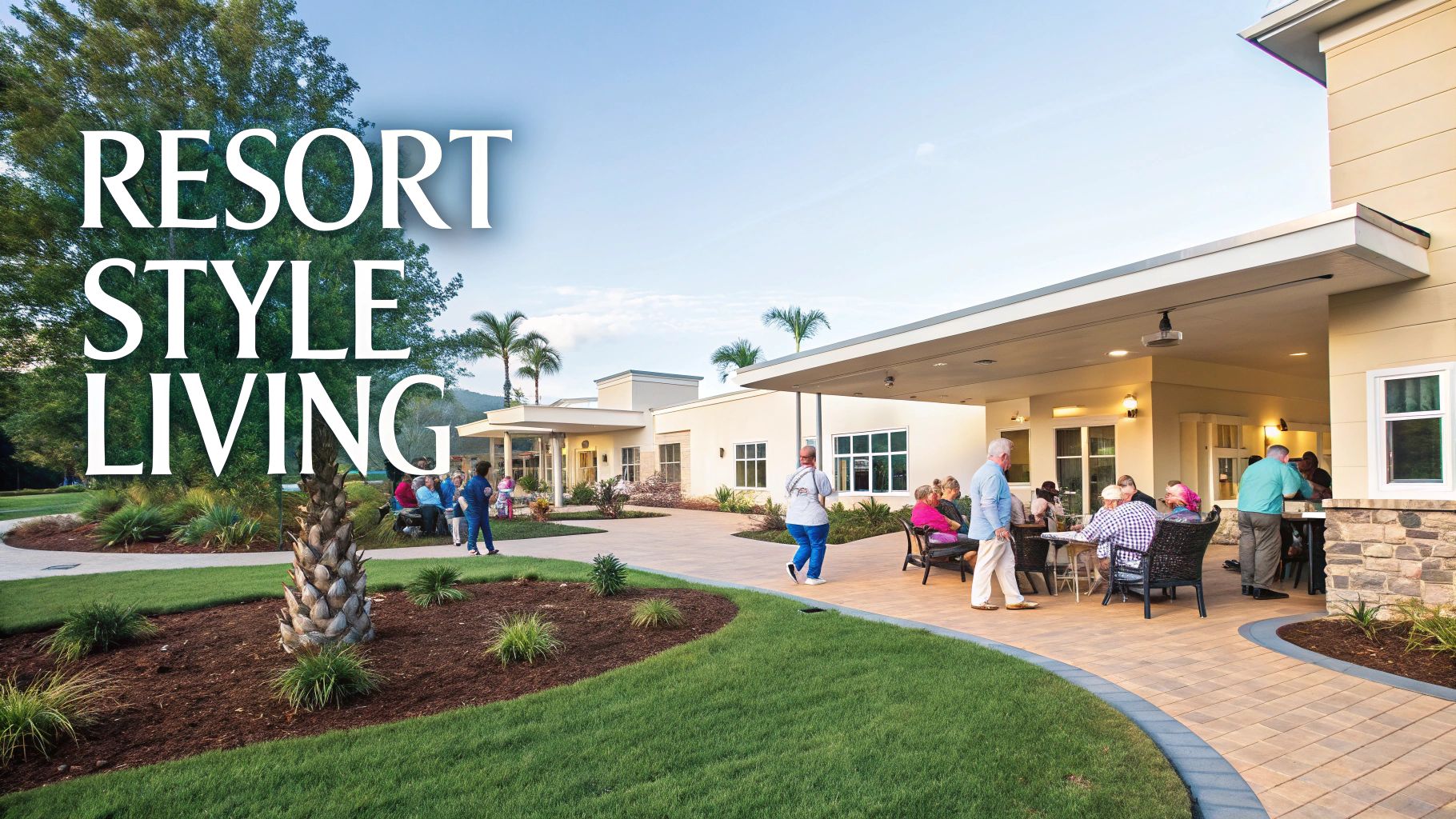
Seniors socialize on a sunny resort-style patio with modern buildings and lush landscaping.

The world of senior housing has completely changed. We've left behind the era of cookie-cutter facilities. Today’s market is all about creating dynamic, engaging communities for a generation of older adults who are more active and have higher expectations than ever before. This isn't just a fleeting trend—it's a massive shift driven by powerful demographic and economic realities.

The global senior living market is booming. Valued at USD 260.12 billion in a recent year, it's on track to hit USD 388.55 billion by 2032. This incredible growth is a direct result of an aging global population seeking specialized living options that expertly blend independence with just the right amount of support. You can learn more about the senior living market's impressive growth and see firsthand what it means for developers and owners.

Connecting Architecture to Profitability

In such a competitive field, architecture has become the primary engine for profitability and what makes a community stand out. It’s no longer just about providing shelter. A well-designed community is a powerful strategic investment that directly impacts your bottom line.

Think about it like this: a generic, uninspired building is just a commodity, forced to compete almost entirely on price. A thoughtfully designed community, on the other hand, becomes a destination—a place people genuinely want to live. This kind of desirability creates tangible business advantages:

  • Higher Occupancy Rates: Premium, beautifully designed spaces attract residents faster and keep them happier, reducing turnover.
  • Increased Revenue Streams: Hospitality-style amenities like bistros, wellness centers, and theaters add value and create new income opportunities.
  • Stronger Brand Identity: Unique architecture tells a compelling story, making your property memorable and much easier to market.
  • Enhanced Resident Satisfaction: When you focus on wellness and social connection, you get happier residents and powerful, positive word-of-mouth.

The core concept is simple: great senior living design creates a product so compelling that it sells itself. It transforms a real estate asset into a thriving community, delivering a strong return on investment by meeting the sophisticated demands of today’s seniors.

Understanding the Spectrum of Care

To create a successful senior living community, you first have to understand the different needs of residents across the continuum of care. Each model, or typology, serves a distinct purpose and demands its own unique architectural strategy. Many of the most successful projects cleverly blend these models on a single campus, giving residents the peace of mind that they can age in place as their needs evolve.

This table breaks down the main senior living typologies to give you a clearer picture of how they differ.

Key Senior Living Typologies at a Glance

Typology Target Resident Profile Level of Care Primary Design Focus
Independent Living (IL) Active, self-sufficient older adults (55+) seeking a maintenance-free lifestyle. None to minimal. Primarily hospitality and social services. High-end amenities, social spaces, upscale apartment/condo-style units, walkability.
Assisted Living (AL) Seniors needing help with Activities of Daily Living (ADLs) like bathing, dressing, and medication. Daily support. Non-medical assistance from on-site staff. Balance of private residential units with easily accessible common areas, dining, and caregiver support stations.
Memory Care (MC) Residents with Alzheimer's, dementia, or other forms of cognitive impairment. 24/7 specialized care. Staff trained in dementia care. Secure environment, circular pathways to prevent confusion, clear sightlines, sensory gardens, and familiar visual cues.
Skilled Nursing (SNF) Individuals requiring 24/7 medical supervision and post-acute rehabilitative care. Intensive medical care. Licensed nurses and therapists on staff. Clinical efficiency, therapy spaces, accessible rooms designed for medical equipment, comfortable but functional environment.

By really digging into these typologies, developers and architects can design purpose-built environments that do more than just meet code. They can create places that foster dignity, independence, and a genuinely high quality of life. This is the strategic thinking that separates a struggling facility from a community that leads the market.

Designing for Resident Wellbeing and Dignity

Great design in senior living isn't about how a space looks; it’s about how it feels and how it works for the people who call it home. We're crafting environments that champion dignity, foster independence, and provide genuine comfort. It's a move away from simply providing shelter and toward creating a premium living experience that supports every aspect of a resident's health—physical, cognitive, and emotional.

To get this right, you have to layer several key design philosophies. It’s a lot like a master chef building a complex flavor profile; each ingredient is distinct but essential to the final result. Principles like universal design, biophilic design, and evidence-based strategies all come together to create a community that feels safe, empowering, and truly desirable to residents and their families.

Blending Autonomy with Safety Through Universal Design

At its core, universal design is about making spaces usable for everyone, no matter their age, mobility, or ability. The real magic of it is when you don’t even notice it’s there. Instead of tacking on accessibility features as an afterthought, we integrate them seamlessly so the environment is just naturally intuitive and easy to navigate. This is absolutely fundamental to preserving a resident’s sense of independence.

A perfect example is the bathroom grab bar. Instead of a sterile, clinical-looking bar, a universal design approach might specify a beautifully crafted towel rack that is also structurally rated for support. It’s a simple switch, but it maintains the high-end residential feel of the space while delivering the safety that’s needed.

Other practical applications we see every day include:

  • Zero-Threshold Showers: These not only look sleek and modern, but they completely eliminate a major tripping hazard and allow for easy roll-in access.
  • Lever-Style Door Handles: A small detail that makes a world of difference for someone with arthritis or limited grip strength compared to a traditional knob.
  • Wider Corridors and Doorways: This isn’t just about accommodating wheelchairs. It makes the entire community feel more open, gracious, and less institutional.

Bringing Nature Indoors with Biophilic Principles

There's a reason we feel better when we're connected to nature—it’s baked into our DNA. Biophilic design taps into this innate human need. By weaving natural elements into the built environment, we can see real, measurable health benefits, like reduced stress, better cognitive function, and an improved mood. In a senior living context, this isn’t a luxury; it’s a necessity.

This is a much bigger idea than just putting a few potted plants in the lobby. It’s a holistic strategy for blurring the lines between the indoors and the outdoors.

A well-executed biophilic design strategy can transform a building from a simple structure into a restorative sanctuary. Studies have shown that even views of nature can speed up recovery times and lower blood pressure, making this a powerful tool for promoting resident wellness.

Here are some key biophilic elements to consider:

  • Maximizing Natural Light: Think huge windows, skylights, and spaces designed to catch the sun as it moves through the day.
  • Natural Materials and Textures: Using real wood, stone, and other natural finishes creates a tactile, calming environment that feels authentic.
  • Views of Nature: Every room should have a purpose. We strategically orient spaces to look out onto gardens, courtyards, or whatever natural landscape is available.
  • Indoor Gardens and Living Walls: Bringing vibrant, living plants directly into the building creates focal points and improves air quality.

Using Evidence-Based Design for Cognitive Health

Evidence-based design (EBD) is about taking the guesswork out of the equation. It means using credible research and hard data to make decisions about the physical environment to get the best possible outcomes for residents. In senior living, and especially in memory care, EBD is our most powerful tool for supporting cognitive health and physical safety.

Take lighting, for instance. Research has proven that the right lighting strategy can dramatically reduce fall risks. Beyond that, tunable LED systems that mimic the natural cycle of daylight can help regulate residents' circadian rhythms, which leads to better sleep and can even reduce "sundowning" behaviors in those with dementia.

Acoustics are another critical piece of the puzzle. The constant hum of an HVAC system or chatter from a busy hallway can be incredibly stressful and agitating. EBD guides us to use sound-absorbing materials and design layouts that create a peaceful, serene atmosphere. We also use color and texture with intention, providing subtle visual cues that help residents find their way, which fosters a sense of control and reduces confusion.

Mastering Community Flow and Amenity Planning

Beyond the four walls of an apartment, the real heart of a senior living community beats in its master plan. This is where we get into programming—the art and science of placing spaces to generate social energy, pull residents into activities, and make life easier for staff. Think of it like designing a great little town; you want the streets and public squares to have a clear purpose, guiding people and creating natural opportunities for them to connect.

Smart adjacencies are the secret sauce here. Imagine placing a lively bistro right near the main entrance. Suddenly, the lobby isn't just a pass-through space; it's a dynamic social hub, filled with the hum of conversation. Or picture connecting therapy rooms directly to an outdoor rehab garden. This creates a seamless wellness journey, making it feel natural for a resident to move from an indoor session to gentle activity in the fresh air.

The Evolution of Senior Living Amenities

Today’s seniors aren't just looking for a place to live; they're shopping for a lifestyle. The amenities on offer have become a massive differentiator in a crowded market. The days of the lonely, stuffy multipurpose room are long gone. The modern approach to senior living design is all about creating dedicated, high-quality venues that support a huge range of interests and wellness goals.

The best new communities feature amenities that feel more like a boutique hotel or a high-end club:

  • Dedicated Fitness and Wellness Centers with everything from low-impact cardio machines to group classes like chair yoga and tai chi.
  • Creative Art Studios fully equipped for painting, pottery, or other crafts, giving residents a real sense of purpose and a chance to learn new skills.
  • Modern Cinemas with truly comfortable seating and top-notch A/V for movie nights and special events.
  • Tech Lounges where residents can get help with their devices, learn new digital skills, or video chat with family.

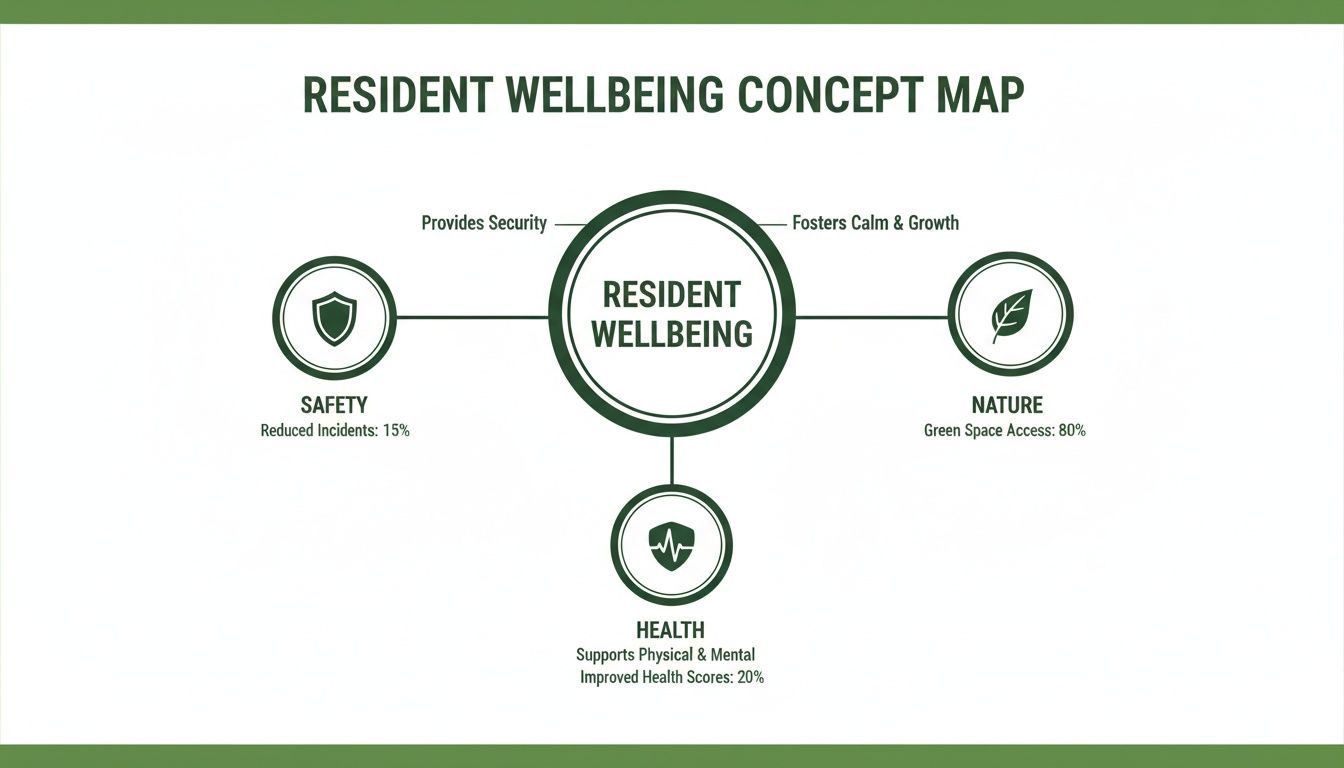
This all comes down to a central focus on resident wellbeing, where every design choice is interconnected.

A concept map showing Resident Wellbeing connected to Safety, Nature, and Health with key benefits and metrics.

As you can see, a holistic design marries safety, nature, and health to build an environment where people don't just live—they thrive.

The market data backs this up completely. Senior housing occupancy in primary U.S. markets recently hit 87.4%, with demand outpacing new construction. It's telling that independent living led the pack with 89.0% occupancy, sending a clear signal that today's residents want an active, wellness-driven lifestyle that high-quality amenities make possible. You can discover more insights about the latest senior housing trends to see where the industry is heading.

Designing for Flexibility and Maximum ROI

A wide variety of amenities is critical, but smart developers know every square foot has to earn its keep. The key is designing flexible, multi-use spaces that can pivot to meet different needs and maximize their use throughout the day. A room with only one purpose is an operational liability. A room that can serve three is a powerful asset.

Think of a well-designed common area not as a fixed room, but as a flexible stage. In the morning, it's a bustling coffee social. In the afternoon, it can be reconfigured for a bridge tournament or a guest lecture. At night, it could be the setting for a resident wine-tasting event.

This chameleon-like approach delivers a much higher return on investment than building separate, single-purpose rooms that sit empty for hours. It also gives the community the agility to evolve its programming over time to match the unique interests of whoever is living there.

In the end, mastering community flow is about creating a layout that is functional, beautiful, and profitable. It’s an exercise in choreography, where the architecture itself guides movement, encourages interaction, and organically builds a sense of community. When you get the harmony right between social spaces, wellness amenities, and operational pathways, you create a senior living design that not only attracts new residents but also works seamlessly for your staff, ensuring success for the long haul.

Navigating Building Codes and Accessibility

For developers and owners, this is where the ambitious vision for a senior living community meets the hard reality of regulation. It's tempting to see building codes as just another frustrating checklist—a series of hoops to jump through that add cost and complexity.

But the most successful projects flip that script. They don't treat codes as a burden. They see compliance as a strategic advantage, the essential foundation for creating environments that are safer, more comfortable, and ultimately, far more marketable.

The web of regulations governing senior living design is dense, weaving together federal mandates, state laws, and local ordinances. Getting this right from day one isn't just about passing inspections; it's about smart risk management. A single misstep can trigger costly rework, frustrating delays, and even legal challenges down the road.

This is exactly why bringing an architect with deep sector experience on board early is non-negotiable. They are your guide, translating the dense language of codes into practical, elegant design solutions that actually boost your property's value.

Key Regulations in Senior Living Design

While codes vary by location, a few core regulations form the bedrock of compliant senior living design across the country. Think of them as overlapping layers of safety and accessibility, each with a different focus.

  • Americans with Disabilities Act (ADA): This is the federal civil rights law that sets the baseline for accessibility. In senior living, it primarily dictates the design of common areas—think lobbies, dining rooms, and amenity spaces that are open to the public.
  • Fair Housing Act (FHA): The FHA hones in on the residential units themselves. It requires specific accessibility features within multifamily housing, directly shaping the layout and function of resident apartments.
  • NFPA 101 Life Safety Code®: You could argue this is the most critical code of all for senior living. It's laser-focused on fire safety and emergency egress, dictating everything from smoke detection and sprinkler systems to the fire-resistance ratings of walls and doors.

The real goal isn't just to meet the letter of the law, but to embrace its spirit. A truly exceptional design goes beyond the bare minimum, creating spaces that feel generous and intuitive, not just compliant. This approach turns a regulatory hurdle into a powerful marketing tool.

From Compliance to Competitive Advantage

The true artistry is in weaving these requirements into the design so seamlessly that residents never even notice them. The space should feel intentional and upscale, not like a place that was grudgingly retrofitted for accessibility. This is where clever, thoughtful solutions make all the difference.

For example, a code might mandate a minimum corridor width for wheelchair access. An average design meets that number exactly. A superior design, however, makes the corridor a bit wider, transforming a simple hallway into a gracious gallery with curated lighting and finishes.

When it comes to the details, accessible bathroom remodeling for the elderly offers a great real-world example of this principle in action. It’s about installing zero-threshold showers that look sleek and modern while completely eliminating a major trip hazard. It’s about integrating grab bars that double as stylish towel racks, blending safety with sophisticated decor.

Ultimately, mastering building codes is about more than just avoiding fines. It’s a fundamental commitment to the safety and dignity of your residents. When you approach regulations with a design-forward mindset, you create a community that isn’t just safe and accessible—it's beautiful and desirable, giving you a powerful edge in a competitive market.

The Power of Adaptive Reuse in Senior Living

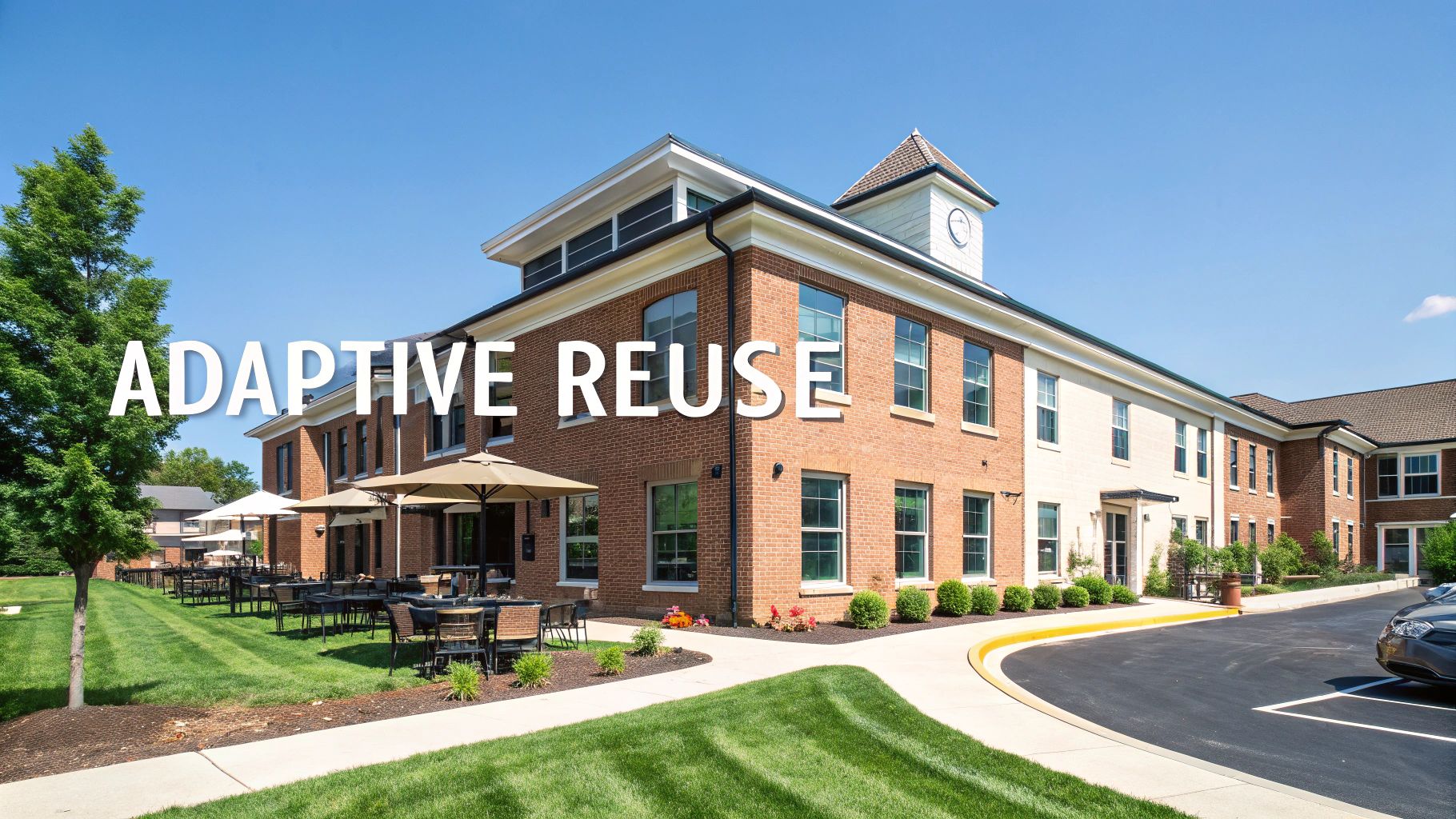
Modern building, a successful adaptive reuse project, features a clock tower and inviting outdoor patio.

With construction costs on the rise and prime land becoming harder to find, the best site for your next senior living project might just be the one that’s already built. Instead of starting from a patch of dirt, adaptive reuse—the art of renovating and repurposing existing buildings—is proving to be a smarter, more sustainable, and often more profitable path than new construction.

This is all about seeing the potential in structures others have overlooked. It’s about breathing new life into a historic school, a vacant hotel, or an old industrial mill and transforming it into a vibrant, modern senior living community. This strategy does more than just save a piece of local history; it delivers some serious business advantages that go straight to the bottom line.

Why Adaptive Reuse Makes Financial Sense

It’s no surprise that more and more developers are looking at adaptive reuse for its compelling financial upside. A new build is a long, expensive journey filled with uncertainties, from land acquisition and zoning fights to unpredictable supply chains. Retrofitting an existing building helps you sidestep many of those headaches, creating a much cleaner, and often faster, path to opening your doors.

Think about the project timeline. An adaptive reuse project can get to market significantly faster because the building’s skeleton—the foundation, walls, and roof—is already standing. That accelerated schedule means you start generating revenue sooner, which can make a huge difference to your project's internal rate of return (IRR).

On top of that, the cost savings can be massive. While every project has its own quirks, renovating an existing shell is almost always more cost-effective than building the same square footage from the ground up.

Adaptive reuse isn't just a sustainable choice; it's a strategic business decision. By leveraging the bones of an existing building, developers can reduce construction timelines, mitigate financial risks, and create a final product with unmatched character and market appeal.

The current market makes this strategy even more compelling. The U.S. senior living market is on track to grow from USD 97.85 billion to a staggering USD 154.55 billion by 2033. But with new construction slowing down and inventory tightening in key markets, smart renovations are becoming one of the most effective ways to meet this skyrocketing demand. You can discover more insights about the expanding U.S. senior living market to see how adaptive reuse fits into the big picture.

The Uniqueness of Repurposed Spaces

One of the biggest wins for adaptive reuse is something a new build can never manufacture: genuine character. A converted 1920s hotel or a repurposed textile mill comes with a built-in story and architectural soul that really connects with prospective residents and their families.

This built-in uniqueness is a powerful marketing tool. You aren't just selling another new apartment; you’re offering a home with history. These one-of-a-kind features often include:

  • Soaring Ceilings: Old industrial or institutional buildings frequently boast high ceilings, creating a sense of light and airiness that’s hard to justify in a new build budget.
  • Large, Historic Windows: The kind of oversized, character-filled windows from a bygone era can drench units in natural light and offer incredible views.
  • Exposed Brick and Original Wood Beams: These elements bring a warmth, texture, and tangible link to the building's past that residents love.
  • Unique Floor Plans: Working within the constraints of an existing structure forces creativity, often leading to far more interesting and varied unit layouts than the cookie-cutter plans of many new developments.

This distinct character forges a strong sense of place, turning the property into a local landmark and a truly desirable community to call home.

Unlocking Value with Historic Tax Credits

If the building you’re eyeing has historical significance, adaptive reuse opens up an incredibly powerful financial tool: historic tax credits. These federal and state programs are designed to encourage the preservation of historic properties by giving developers a dollar-for-dollar reduction in their tax liability.

Now, securing these credits is a detailed process that demands careful documentation and following strict preservation standards. But the reward is well worth the effort. The Federal Historic Preservation Tax Incentives program, for example, offers a 20% tax credit for the certified rehabilitation of historic buildings. Many states have their own programs that can be "stacked" on top, which can dramatically lower your total project cost.

This is where working with an architectural firm that specializes in historic preservation is absolutely essential. They know how to navigate the complex approval process with State Historic Preservation Offices (SHPOs) and the National Park Service. Their expertise ensures your design both honors the building's past and meets all the needs of a modern senior living community. This transforms a building’s history from a nice story into a real financial asset, maximizing your return and setting the project up for long-term success.

Straight Talk on Senior Living Design: Answering the Big Questions

When you're developing a senior living community, the questions come thick and fast. Developers and owners need clear, practical answers to make smart decisions about planning, budgeting, and ultimately, creating a place that will thrive. Let's tackle some of the most common questions we hear from our clients.

What Is the Biggest Design Mistake We Can Make?

Hands down, the single most expensive mistake is designing for an outdated idea of what it means to be old. This thinking leads to sterile, institutional-feeling buildings with a cookie-cutter approach, boring amenities, and no real sense of energy. You end up with a property that feels more like a clinic than a home.

That model is dead. Today’s seniors are savvy consumers who expect a hospitality experience, not just a place to receive care. They're looking for a vibrant community where they can truly live, not just a place to move into when they have to. A design that misses this point will struggle from day one to attract residents and keep occupancy high.

The goal should always be to prioritize choice, community, and well-being. That means creating multiple dining options, offering top-notch fitness and social programs, and weaving in technology that actually helps. It's about designing a place people genuinely want to live.

How Can Good Design Help with Operations and Staffing?

Smart design is one of the most effective, yet often overlooked, tools for making daily operations run smoothly and keeping your staff happy. It’s all about creating a physical space where workflows just make sense, which saves time, reduces frustration, and lessens the physical toll on your team. This has a massive ripple effect on everything from the quality of care to your bottom line.

Think about it this way: strategically placing laundry rooms, supply closets, and nurse's stations can shave miles off the distance your staff walks every day. Designing logical service corridors that keep back-of-house hustle and bustle away from resident areas creates a more peaceful, pleasant environment for everyone.

Well-designed staff spaces aren't a frill; they are a critical investment in your most valuable asset. A nice break room with natural light and comfortable chairs sends a powerful message: "we value you." In an industry plagued by high turnover, that simple act can do wonders for morale and retention.

A supported, efficient staff provides better care. Better care leads to happier residents and glowing reviews from families. Good design creates a positive cycle that benefits the entire community.

Is It Really Cheaper to Repurpose an Old Building?

While every project is different, adapting an existing building can often be more cost-effective and get you to profitability faster than starting from scratch. When you renovate, you typically save a huge chunk of capital on big-ticket items like site work, foundations, and the basic building shell.

The timeline is another huge advantage. With the main structure already standing, the journey from purchase to opening day is often much shorter. That accelerated schedule means you start bringing in revenue sooner, which is a game-changer for your financial projections.

And it’s not just about the upfront costs. If you’re working with a historic building, you may be able to tap into valuable federal and state historic tax credits. These credits can cover a significant portion of your renovation costs, turning the building's past into a real financial advantage. Plus, these projects have a built-in character and story that new construction just can't match, giving you a powerful marketing edge.

What Future Trends Should We Be Paying Attention To?

The world of senior living is changing fast, and design is evolving with it. Looking ahead, three things are really shaping the future: technology, a broader definition of wellness, and a much bigger emphasis on flexibility. Developers who get ahead of these trends will be setting themselves up for success for years to come.

Technology is moving beyond being a simple convenience and becoming deeply woven into the fabric of daily life.

  • Smart-Home Features: Things like voice-activated lights and thermostats will become standard, making life much easier for residents with mobility issues.
  • Safety and Health Monitoring: We'll see more passive sensors for things like fall detection and wearable tech that tracks vitals, giving residents and their families incredible peace of mind.
  • Seamless Connectivity: Rock-solid Wi-Fi and easy-to-access tech support are already non-negotiable.

The concept of wellness is also getting a major upgrade. It's no longer just about a small gym in the basement. The new focus is on a holistic approach that nurtures mental, social, and spiritual health. That means designing dedicated spaces for yoga, meditation gardens, art studios, and classrooms for lifelong learning.

Finally, flexibility is everything. Tomorrow's successful communities will be designed to adapt. Think multi-purpose spaces that can host a fitness class in the morning, a lecture in the afternoon, and a concert at night. This adaptability extends to the units themselves, with layouts that can be modified as a resident's care needs change, allowing them to age in place gracefully.


At Sherer Architects, LLC, we specialize in turning complex challenges into enduring, profitable results. Whether you're looking to unlock the value of an old building with historic tax credits or planning a new commercial development from the ground up, our team knows how to navigate the process. Let's talk about how our expertise in historic preservation and thoughtful design can make your next project a success. Visit us at shererarch.com to start the conversation.

Categories
Uncategorized

How to Hire Commercial Architecture Firms That Deliver

Before you even think about shortlisting commercial architecture firms, the most important work you'll do is internal. It all starts with building a rock-solid project brief. This document is your roadmap, turning a back-of-the-napkin idea into a detailed, actionable plan. Get this right, and you'll get accurate proposals from firms that truly understand what you're trying to achieve.

First, Define Your Vision—Then Hire an Architect

A wooden desk with a tablet showing 'DEFINE VISION', an open architectural book, and a planning notebook.

Walking into meetings with architects without a clear, documented vision is a classic mistake. It leads to miscommunication, wasted hours, and proposals that miss the mark. The best commercial architecture firms don't just want your business; they want to solve your problem. A thorough brief gives them the details they need to offer realistic feedback, accurate fee structures, and creative solutions.

Think of it this way: your brief is the first filter. It immediately weeds out firms that aren't a good match, saving everyone a lot of headaches. This early planning phase is all about translating your abstract goals into concrete parameters—setting the rules of the game before you invite anyone to play.

From Vague Ideas to Concrete Plans

It’s time to get specific. Vague descriptions won't cut it. "A modern office space" is a start, but it's not a plan.

A better approach is to quantify everything: "An open-plan office for 75 employees, three private executive offices, two conference rooms, and a 500-square-foot collaborative lounge." That’s a description an architect can actually work with.

Your project brief should dig into the details on several fronts:

  • Functional Needs: How does the space need to work? Map out the critical workflows. For a restaurant, that means tracking the path from kitchen to table. For a warehouse, it's all about loading dock access and inventory movement.
  • Spatial Program: Get down to the numbers. Define the square footage for every single area, and don’t forget the less glamorous spaces like restrooms, storage closets, and mechanical rooms. They all count.
  • Aesthetic & Brand: What should the building feel like? Are you going for industrial grit, sleek minimalism, or something more traditional? More importantly, how does the design reinforce your company’s brand and culture?

A well-defined brief is your best defense against scope creep and budget overruns. It aligns everyone from day one and ensures the final design is a perfect match for your financial and operational goals.

Establishing Your All-In Budget

Your budget isn’t just a number; it’s a critical design constraint. A realistic, detailed financial plan gives commercial architecture firms the clear boundaries they need to design a project that’s both beautiful and buildable. Your "all-in" budget has to cover much more than just construction.

Be sure to break it all down:

  • Hard Costs: The bricks and mortar—physical construction, materials, and labor.
  • Soft Costs: All the professional services, like architectural and engineering fees, permits, legal reviews, and insurance.
  • FF&E: The costs for all furniture, fixtures, and equipment.
  • Contingency: This is non-negotiable. Set aside a buffer of 10-15% of your total project cost for the inevitable surprises.

Just as important is knowing the difference between your absolute must-haves and your nice-to-haves. This simple act of prioritization is a lifesaver. It empowers an architect to make smart trade-offs if the budget gets tight, protecting the core goals of the project without derailing the whole thing.

How to Find and Vet the Right Architectural Partner

Woman compares commercial architecture firms, viewing building designs on a laptop and a checklist.

Once you have a solid project brief in hand, the real work begins: finding the right team to execute your vision. Choosing between commercial architecture firms isn't just about a quick online search. It’s more like an investigation, a strategic hunt for a partner whose expertise aligns perfectly with what your project demands.

The global architectural services market is massive—it's projected to hit $249.2 billion by 2025. This isn't just a big number; it signifies a highly competitive field where specialization is everything. It's why firms like Sherer Architects can carve out a niche, developing deep, practical expertise in areas like sustainable commercial design and tricky adaptive reuse projects. You can get a clearer picture of the industry landscape by checking out the latest market data on IBISWorld.

Building Your Initial Longlist

Your first step is to cast a wide, but smart, net. A "commercial architects near me" search will get you started, but the real gems are often found a layer or two deeper. You want to look in places where quality and relevance have already been filtered.

Here are a few proven methods for uncovering top-tier candidates:

  • Industry Awards & Publications: Keep an eye on recent award winners from groups like the American Institute of Architects (AIA). If a firm is getting recognized for a project that mirrors your own in scale, function, or market, they should absolutely be on your list.
  • Local Business Journals: These publications are a goldmine. They're constantly covering new developments, groundbreakings, and project profiles. Make a note of the architects and design teams behind the projects that catch your eye.
  • Drive the Market: This is old-school, but it works. Take a drive around your city and look at the commercial buildings you genuinely admire. A quick property search online or even a call to the building manager can usually tell you which firm designed it.

Building a strong shortlist is about finding proof, not just promises. Look for firms that have already solved the types of challenges your project presents, from navigating local design review boards to executing a flawless historic preservation.

From Longlist to Shortlist

Now it’s time to get critical. The goal is to whittle your list down to three to five top contenders. This is where you move past the polished portfolio photos and start analyzing the substance and strategy behind their work.

When you're digging into their portfolios, ask these tough questions:

  • Does the complexity match? Look for evidence that they’ve handled projects with similar moving parts—tricky zoning negotiations, mixed-use components, or challenging site constraints.
  • Is their specialty relevant? If you’re planning an adaptive reuse project, how many have they actually completed? A firm that’s done one simple renovation isn’t the same as an expert in historic tax credits and complex structural retrofitting.
  • Do they have local wins? A firm’s track record with local planning departments, historic commissions, and review boards is invaluable. Proof that they’ve successfully navigated the very same regulatory hurdles you’ll be facing is a huge advantage.

Selecting the right architect requires a methodical approach. The following table provides a checklist to help you systematically evaluate and compare potential partners, ensuring you cover all the critical bases.

Key Criteria for Vetting Commercial Architecture Firms

Evaluation Criterion What to Look For Red Flags to Watch For
Relevant Portfolio Projects of similar scale, budget, and type (e.g., adaptive reuse, new build). A portfolio filled with residential projects or commercial work in a completely different sector.
Local Regulatory Experience A proven track record of successful approvals with your city's planning, zoning, and historic commissions. Vague answers about their experience with local codes or unfamiliarity with key city officials.
Team Expertise & Chemistry A dedicated principal, clear project manager, and a team that communicates well and understands your vision. High team turnover or difficulty getting a straight answer on who will actually be working on your project.
Client References Glowing reviews from past clients with similar projects who praise communication, budget adherence, and problem-solving. Reluctance to provide references or providing contacts for projects completed many years ago.
Design Philosophy An approach that aligns with your goals—whether it’s sustainability, historic integrity, or cutting-edge modernism. A rigid, "one-size-fits-all" design style that they try to apply to every project.
Technical Proficiency Expertise in relevant software (BIM, CAD) and an understanding of modern building materials and systems. Outdated software or a lack of experience with the specific construction methods your project requires.

Using a structured checklist like this helps you move beyond a gut feeling and make a data-driven decision, setting your project up for success from the very beginning.

The Power of Reputation and Real-World Feedback

Finally, you need to look beyond the firm’s own marketing materials. What do their past clients and industry colleagues really think? Candid feedback is one of the most powerful indicators of how they’ll perform.

Ask for a list of recent clients and actually make the calls. Get specific: How was their communication? Did they stick to the budget? What happened when an unexpected problem came up?

Don't stop there. A firm's reputation among general contractors and engineers is incredibly telling. These are the people in the trenches who know which commercial architecture firms deliver clear, buildable plans and which ones create chaos on the job site. This behind-the-scenes insight is often the most reliable predictor of a smooth and successful partnership.

Mastering the Interview and Proposal Review

You've got your shortlist of firms, and their portfolios look solid. Now for the real test: the interview. This is far more than just a formality. It’s your opportunity to get a feel for how these commercial architecture firms truly operate—how they think on their feet, communicate under pressure, and solve the kinds of messy, real-world problems that never show up in a glossy brochure.

Think of it this way: you’re not just hiring a vendor. You're bringing on a strategic partner for a complex, high-stakes, and often long-term journey. You need to find the team you can trust to have your back when things don't go according to plan, because at some point, they won't.

Questions That Go Beyond the Portfolio

Any firm can walk you through their greatest hits. Your job is to peel back the curtain and understand the process, not just the polished final product. Generic questions will get you generic, rehearsed answers. You have to dig deeper.

Here are a few questions I've found that really reveal how a team works:

  • "Tell me about a time a project went sideways because of an unforeseen issue. What was the problem, how did you break the news to the client, and what did you do to fix it?"
  • "What does your ideal client relationship look like? How much involvement and what kind of communication do you expect from our team from schematic design through construction?"
  • "How do you handle value engineering? Give me a specific example of how you cut costs for a client without gutting the design or sacrificing quality."
  • "What's your track record with the local design review board and zoning department? Walk me through your typical process for getting a project through those approvals."

Pay attention to how they answer. Are they speaking in vague hypotheticals or do they have specific stories? A team with real experience will have concrete examples ready to go. That’s the sign of a firm that has been in the trenches and knows how to communicate.

Decoding the Proposal and Fee Structure

After the interviews, the proposals will start rolling in. This is where you put on your analyst hat. A proposal is much more than a price tag; it's a detailed roadmap of what the firm will deliver, and when. If you see vague language or ill-defined scopes, that's a major red flag.

You’ll likely see a few different ways that commercial architecture firms structure their fees. It's important to understand the pros and cons of each.

The most common models are:

  1. Fixed Fee: A single, all-in price for a very specific scope of work. This gives you budget certainty, which is great, but it can get complicated if the scope needs to change mid-project.
  2. Percentage of Construction Cost: The fee is tied to a percentage of the final build cost, often in the 5-15% range. This model scales with the project's size, but some owners worry it creates an incentive for the project to cost more.
  3. Hourly Rates: You're billed for the actual time the architectural team spends on your project. This is perfect for initial feasibility studies, consulting, or smaller projects where the full scope isn't yet known.

When you're comparing proposals, look carefully for what's not included. Are things like 3D renderings, structural engineering fees, or a certain number of design revisions considered "additional services" with a separate price tag? A good, transparent proposal will spell all of this out clearly.

In the end, this decision shouldn't come down to just the lowest number. A slightly higher fee from a firm with a comprehensive scope and a proven ability to solve problems is almost always the smarter long-term investment. This is your chance to find a partner who fits your goals, your budget, and your communication style.

Untangling Contracts and Cutting Through Red Tape

You’ve found your firm. It feels like the hard part is over, but in many ways, the real work is just getting started. Now it's time to formalize the relationship and get ready to navigate the maze of local bureaucracy. This is where your architectural services agreement becomes the single most important document for the project.

Think of it as the blueprint for your professional relationship. It’s not just about the money; it’s about setting crystal-clear expectations to protect everyone involved. A good contract meticulously defines the scope of work, breaking down every phase from initial concepts to overseeing construction. It should also spell out exactly what you’re getting—like drawing sets, 3D renderings, or material specifications—and link those deliverables to a payment schedule. And whatever you do, don't just gloss over the liability clauses. Have your attorney review them with you so you understand exactly what the insurance requirements are.

Reading Between the Lines of the Agreement

When that contract lands on your desk, it’s time to put on your detail-oriented hat. Any ambiguity in the scope is a direct invitation for scope creep, surprise bills, and headaches down the road. You need absolute clarity on what's included in the base fee versus what counts as an "additional service."

Here are a few key areas I always tell clients to scrutinize:

  • Reimbursable Expenses: Get a clear list of what costs will be passed on to you. This could be anything from printing large-format drawings to travel or city permit application fees.
  • Ownership of Documents: This one surprises people. The architect almost always retains the copyright to their designs. The contract gives you a license to use them for this specific project, but you don't own the drawings themselves.
  • Termination Clause: Life happens. Make sure you understand the process and financial penalties if, for whatever reason, you or the firm need to part ways before the project is complete.

A thoughtfully negotiated contract is your best defense against future disputes. It aligns expectations on deliverables, timelines, and payment, setting the stage for a partnership built on trust, not misunderstandings.

From Your Signature to a Building Permit

With the contract signed, a truly experienced firm starts to show its real value by navigating the often-frustrating world of municipal approvals. This process can easily derail a project timeline, and a firm with deep local roots and relationships is worth its weight in gold. They become your advocate, your guide, and your translator in front of zoning boards, planning commissions, and historic review committees.

It’s one thing to design a beautiful building; it’s another to get it approved. A sharp architect knows precisely how to frame a request for a zoning variance, using solid design principles to build a compelling case. They can anticipate the kind of pushback a design review board might have and will prepare a presentation that proactively addresses those concerns. This is particularly crucial when you're working with the best in the business. In the US, the field is led by giants like Gensler, Perkins&Will, and HKS, who are consistently ranked among the top 300 architecture firms. You can see more about the leading US architecture firms of 2025 on Architectural Record. Their teams have the regulatory savvy to not only get projects approved but also to secure things like preservation grants or tax credits.

That kind of on-the-ground expertise is what prevents months of costly delays and keeps your project on track.

Ensuring a Successful Project From Design to Completion

Signing the contract isn't the finish line—it’s the starting gun for a deep, collaborative partnership. A successful project truly hinges on how well your team and your chosen commercial architecture firms work together, from the initial napkin sketches all the way to the final punch list.

This journey is built on a foundation of clear communication and a shared understanding of the process.

It all starts with schematic design, where your architect translates your vision into broad-stroke concepts, site plans, and initial floor layouts. From there, we move into design development, where those big ideas are refined with specific materials, building systems, and structural details. Finally, this all evolves into a comprehensive set of construction documents—the detailed blueprints and specifications your contractor will use to bring everything to life. Each phase needs your input and decisive action to keep the momentum going.

Fostering a Productive Partnership

To keep things running smoothly, you need to establish clear rules of engagement right from day one. Set up a predictable communication rhythm, whether it’s a standing weekly call or a shared project management portal. Transparent decision-making is just as important. Figure out who has the final say on changes and, crucially, how those decisions will be documented to prevent costly missteps down the road.

Your architect’s role during the construction phase is to be your advocate on-site. They conduct regular site visits to ensure the work conforms to the design documents, answer contractor questions, and help solve the inevitable field issues that arise, protecting the integrity of your original vision.

This workflow gives you a clear picture of the key stages leading up to construction, from getting the contract signed to final approval.

Infographic showing the three-step architectural approval process: contract, review, and final approval.

This streamlined process really highlights how a structured approach keeps everyone aligned before you even break ground.

Avoiding Common Project Derailers

Even the best-laid plans can go sideways without proactive management. Here’s a quick guide to identifying common challenges in commercial architectural projects and implementing strategies to prevent them from becoming major headaches.

Common Pitfall Potential Impact Preventative Strategy
Scope Creep Uncontrolled additions lead to budget overruns and timeline delays. Document the original scope meticulously. Evaluate every change request against the initial budget and goals before approval.
Budget Overruns Financial strain, project stalls, or compromises on quality. Establish a detailed budget with a contingency fund. Your architect should provide regular cost updates and suggest value-engineered alternatives.
Communication Gaps Misunderstandings cause rework, missed deadlines, and friction between teams. Set up a regular meeting schedule and use a central platform for all project communications. Always confirm key decisions in writing.

By anticipating these issues, your team can stay ahead of problems instead of just reacting to them. A good firm will help you navigate these challenges from the very beginning.

As your project nears completion, don’t forget the details that make a building truly functional and appealing. For instance, a comprehensive guide to signage for commercial buildings can be an invaluable resource for an element that is often an afterthought. A detail-oriented commercial architecture firm will integrate this into the design from the start.

This kind of comprehensive planning is why the industry continues to expand. The architectural services market is projected to grow from $214.19 billion in 2025 to $275.16 billion by 2029, a trend fueled by urbanization and infrastructure investment. By understanding the architect's role throughout construction, you can ensure the final building is a faithful execution of your investment.

Common Questions About Hiring Commercial Architecture Firms

Even for seasoned developers, bringing an architectural partner on board can kick up a lot of questions. Getting clear, honest answers from the get-go is the best way to move forward with confidence and sidestep the kind of misunderstandings that can derail a project timeline.

Here are a few of the most common questions we get from business owners and investors just starting the process.

Architect vs. Design-Build Firm: What’s the Difference?

This is one of the first hurdles. It's easy to get the two confused, but their roles are fundamentally different.

When you hire an architect, you're hiring an independent, licensed professional whose sole job is to design your project and represent your best interests. They are your advocate. A design-build company, on the other hand, is a single business that handles both the design and the construction. It's a one-stop-shop.

With a dedicated architect, you get an expert who is loyal only to you and the quality of the final product. A design-build firm can simplify communication by giving you one point of contact, but be aware that since the designer and builder are on the same team, it can create a potential conflict of interest if problems pop up during construction.

How Fees and Involvement Work

Money is always a big question. How do architecture firms actually charge for their work? It almost always comes down to one of three common models:

  • Percentage of Construction Cost: This is a classic model, where the fee is a percentage of the final build cost, typically ranging from 5-15%.
  • Fixed Stipulated Sum: A flat fee. This works best when the scope of the project is crystal clear from the beginning.
  • Hourly Rate: You'll see this most often for smaller consultations or for projects where the full scope is still a bit fuzzy.

No matter the model, your contract needs to spell out the fee structure in black and white, detailing exactly what services are included. As you research firms, you’ll find many are structured as Limited Liability Companies (LLCs). If you're unfamiliar with what that means for their operations, it’s worth a quick read on understanding the meaning of an LLC.

Your involvement is absolutely crucial in the early stages—what we call programming and schematic design. This is where we're downloading your vision, your budget, and how you need the space to function. A great firm won't just disappear; they'll establish a clear communication plan to pull you in at key milestones without burying you in daily details.

What About Historic Tax Credits?

For clients with older buildings, this question is a big one. An architect with deep experience in historic preservation is non-negotiable for these projects.

They are the experts who know how to navigate the notoriously strict approval processes with State Historic Preservation Offices (SHPOs) and the National Park Service. It's their specific knowledge of documentation, material science, and design standards that successfully secures the tax credits that can make or break the financial viability of your project.


Navigating a commercial build, adaptive reuse, or historic preservation project demands a partner who has been there before and operates with total transparency. At Sherer Architects, LLC, we make it our business to align every piece of the puzzle to deliver results that are not just beautiful, but also enduring and sustainable. Learn how our dedicated approach can bring structure to your vision and maximize your investment.

Categories
Uncategorized

Your Guide to Build To Suit Real Estate Projects

A build-to-suit (BTS) development is a bit like getting a custom-tailored suit instead of buying one off the rack. It’s a commercial real estate deal where a developer agrees to finance and construct a brand-new building to a tenant's exact specifications.

The company gets a facility designed purely for its needs, and in return, it commits to a long-term lease. This setup is a game-changer for businesses that require specialized spaces but don't want to sink a massive amount of capital into buying land and managing construction themselves.

Understanding The Core Build To Suit Concept

An architectural blueprint of a commercial building being reviewed on a wooden desk.

At its heart, a build-to-suit is a partnership. It connects a company with very specific operational needs to a real estate developer who has the funding and know-how to bring that vision to life. The tenant walks away with a perfectly suited building, while the developer secures a steady, long-term income stream from the lease.

This approach is becoming increasingly vital in sectors like industrial real estate. We're seeing a decline in the construction of generic, "speculative" buildings built without a tenant already lined up. For instance, speculative industrial deliveries hit a high of 481 million square feet in 2023 but are forecasted to fall sharply to just 150.2 million square feet in 2025.

As the supply of cookie-cutter space tightens, the build-to-suit model becomes a far more appealing option for companies whose operations are anything but standard.

Key Players in a Build To Suit Project

A successful build-to-suit project isn't a one-person show; it's a carefully coordinated effort between several key players. Each party has a distinct role and objective, and clear communication among them is what keeps the project on track from blueprint to ribbon-cutting.

Here’s a quick rundown of who’s involved and what they’re trying to achieve.

Player Primary Role Key Objective
The Tenant The future occupant of the building. To secure a custom facility that maximizes operational efficiency without tying up capital in real estate.
The Developer The project manager and financier. To construct a high-quality asset that meets tenant needs and generates a stable return on investment through a long-term lease.
The Investor The long-term owner (often the developer). To acquire a property with a creditworthy tenant and predictable cash flow, minimizing vacancy risk.

Understanding these roles is the first step in seeing why this model has become so popular for complex projects.

Why This Model Works

The build-to-suit model truly shines when standard, one-size-fits-all buildings just won't cut it. It’s the go-to solution for industries with highly specific operational demands.

Think about sectors like:

  • Logistics and Distribution: These companies often need precise ceiling heights for vertical storage, complex conveyor systems, and a particular layout of dock doors to keep goods moving.
  • Manufacturing: A factory might require specialized high-voltage power, reinforced flooring to support heavy machinery, or a custom layout for its production lines.
  • Life Sciences and Healthcare: Cleanrooms, labs, and medical centers depend on exacting climate control, specialized ventilation, and other highly technical features that you can't find in a generic building.
  • Retail Chains: Even well-known brands like Wendy's use build-to-suit programs to roll out new locations with their standardized, hyper-efficient restaurant designs.

Ultimately, the process requires deep collaboration and meticulous planning. You can see this in action in substantial commercial development projects, where every detail, from the structural engineering down to the specific type of commercial doors, has to be perfectly aligned with the tenant's operational goals.

The Strategic Payoff of Building to Suit

Choosing to go the build-to-suit route is a serious undertaking. We're often talking about a 12 to 36-month journey from the first sketch to moving day. So, why would anyone commit to this long game instead of just signing a lease on an existing building?

The answer is simple: control. A build-to-suit project lets a company create a facility that's more than just real estate—it becomes a high-performance business tool, perfectly molded to its operations.

A Space Engineered for Your Workflow

Think about it. An existing building is always a compromise. You end up bending your processes to fit the space you have, not the space you need. Build-to-suit flips that script completely.

It’s about designing a facility around your unique workflow. You get to create an environment that's built for maximum efficiency and productivity right from the start.

Designing for Peak Performance

Imagine a distribution company getting to decide the exact number and placement of its loading docks to shave minutes off every truck's turnaround time. Or a biotech firm designing a lab with the specific ventilation and power grids it needs for sensitive research. This is the kind of granular control that defines the build-to-suit model.

And this isn't just about solving today's problems. A custom build is your chance to future-proof your operations. You can lay the groundwork for tomorrow's technology, design modular walls that can be reconfigured as teams grow, or even plot out a seamless future expansion on the property.

Key areas where this customization really shines include:

  • Workflow Optimization: Laying out a floor plan that creates a natural, efficient flow for people, inventory, and equipment.
  • Specialized Infrastructure: Building in the non-negotiables, like reinforced flooring for heavy machinery, clean rooms, or complex climate control systems.
  • Technological Integration: Pre-wiring the facility for robotics, automation, and the data infrastructure you'll need in the years ahead.

A custom-built facility is more than just a building; it's a strategic tool engineered to enhance a company's core operations. It turns real estate from a fixed cost into a competitive advantage by directly supporting efficiency and growth.

Ultimately, this level of control ensures the building is an asset that actively works for the business, rather than a liability the business has to work around.

A Savvy Financial and Branding Move

Beyond the day-to-day operations, the build-to-suit model presents some pretty compelling financial and branding upsides.

One of the biggest wins is capital preservation. Instead of sinking millions into buying land and funding construction, a company can keep that cash free for what it does best—investing in R&D, marketing, or hiring top talent.

The developer handles the heavy financial lifting of the real estate project. The tenant’s main obligation is the long-term lease, which translates into predictable operating expenses instead of a massive, upfront capital hit. This structure makes a custom-built facility surprisingly accessible.

A build-to-suit facility also becomes a powerful, three-dimensional representation of a company's brand. The architecture, the materials, the location—all of it can be curated to reflect your corporate identity and values. A sleek, glass-and-steel headquarters can scream innovation, while a building using sustainable materials and green space can broadcast a commitment to corporate responsibility.

This is more than just looks. It’s about making a tangible statement to your employees, your customers, and the community. You get a landmark building in a prime location, all without the risks of ownership, turning your real estate into a powerful symbol of your brand.

A Step-by-Step Guide to the Build-to-Suit Process

Kicking off a build-to-suit project can feel massive, but like any complex endeavor, it becomes much more approachable when you break it down into a clear, step-by-step process. Think of it as a detailed roadmap where each stage builds on the one before it. Following these steps helps ensure every decision is aligned with your ultimate goal: creating a facility that’s a true operational asset.

The entire journey, from the first conversation to opening the doors, typically takes anywhere from 12 to 36 months. The exact timeline will hinge on things like the project's complexity, how ready the site is, and the local permitting landscape. Successfully navigating this requires a solid plan and a strong, collaborative team from day one.

This simple visualization shows how the core advantages of a build-to-suit—customization, capital, and brand—are all intertwined.

Infographic showing the three-step advantages of build-to-suit Customization, Capital, and Brand.

The flow from a custom design to smart capital use and a strong brand presence really highlights how each phase contributes to the project's strategic value.

Phase 1: Assembling Your Team and Defining Your Vision

Long before a single shovel hits the dirt, the most important work happens. This is the foundational stage where you define what you truly need and assemble your expert team. You absolutely cannot over-invest in getting this part right.

Your first job is to translate your business operations into a detailed list of building specifications. This goes way beyond just square footage.

  • Operational Must-Haves: What are the non-negotiables? Think specific ceiling heights, floor load capacities, power requirements, or the number and type of docking bays.
  • Workflow Essentials: How do people and materials need to move through the space? The layout should make your workflow seamless, not fight against it.
  • Future Growth: Where might you need to expand in five or ten years? It’s far cheaper to plan for that possibility now than to try and add it on later.

Once you have your needs outlined, you’ll bring together a team of specialists. This is usually led by a commercial real estate broker with deep experience in build-to-suit deals. Your team will also include architects, engineers, and legal counsel who can protect your interests through what can be a very complex negotiation process.

Phase 2: Site Selection and Due Diligence

With a clear vision and your team in place, the hunt for the perfect location begins. Finding a site for a build-to-suit project is about much more than just finding an empty plot of land. It’s a strategic decision that will impact your logistics, access to labor, and long-term costs for years to come.

Your broker and developer will scout potential sites that check all your boxes for accessibility, zoning, and proximity to suppliers or customers. After you have a shortlist, the due diligence phase kicks in. This is a meticulous investigation designed to uncover any potential red flags.

Due diligence is the project's insurance policy. It involves a thorough review of zoning regulations, environmental assessments, soil testing, and utility access to ensure the site is viable and free of costly surprises.

This stage confirms that the land you’ve chosen can legally and physically support your custom facility, preventing the kind of unforeseen issues that can derail a project's timeline and budget.

Phase 3: Design Finalization and Lease Negotiation

With a viable site locked in, your architect gets to work turning your operational needs into detailed construction blueprints. This is a deeply collaborative phase where your feedback is crucial to ensure the final design is a perfect match for your vision. Every last detail, from the HVAC systems down to the location of data ports, is finalized here.

At the same time, your legal team will be hammering out the details of the build-to-suit lease agreement with the developer. This is a complex document that’s worlds away from a standard rental contract. It clearly outlines who is responsible for what—construction costs, timelines, change orders, and potential delays.

Key negotiation points will include:

  • Rent Structure: How the lease rate is calculated based on the total project costs.
  • Construction Milestones: Defining key deadlines the developer is contractually obligated to meet.
  • Contingency Plans: Agreeing on how cost overruns or schedule delays will be handled.
  • Tenant Improvement Allowances: Clarifying what the developer pays for in the base build versus what you’ll cover.

Phase 4: Construction and Final Handover

Once the lease is signed and the developer has secured financing, construction can finally begin. During this phase, your role shifts to monitoring and communication. You’ll be a regular at project meetings to stay updated on progress and help address any issues that pop up.

Demand for build-to-suit facilities, especially in the industrial sector, has exploded. The trend went into overdrive with the e-commerce boom and supply chain disruptions, which pushed companies to hold more inventory and demand more sophisticated warehouses. Just look at Amazon—the company leaned heavily on this strategy, spending an estimated $5.8 billion in 2021 on build-to-suit fulfillment centers. You can learn more about the market drivers behind the build-to-suit surge at Matthews.com.

As construction wraps up, you’ll conduct a final walkthrough of the facility with the developer. This is where you create a "punch list" of any remaining items that need to be fixed or finished. Once those are resolved and the building gets its certificate of occupancy, the developer officially hands over the keys, and your lease term begins. Your custom-built facility is now ready for business.

How Build To Suit Projects Are Financed

Figuring out how a build-to-suit project gets funded is the key to understanding why it's such a game-changer for so many companies. The financing structure is what dictates who holds the risk, who ultimately owns the property, and where all the money comes from. While the fine print can get complicated, nearly all deals boil down to one of two main approaches.

Each path offers a different blend of control, financial obligation, and long-term ownership. Let’s pull back the curtain on these two common financing models to see how an idea on a blueprint becomes a fully operational facility.

https://www.youtube.com/embed/opu6nzPBjbg

The Traditional Developer-Led Model

By far, the most common route is developer-led financing. In this scenario, you can think of the developer as both the project captain and its banker. The developer shoulders the full responsibility—and the risk—of buying the land, securing the hefty construction loans, and managing the entire build-out from day one.

The tenant’s job is to provide the detailed specs for their dream building and, crucially, to sign a long-term lease before any dirt is moved. That lease agreement is the financial linchpin for the entire deal.

The tenant's signed lease is what gives the developer's lenders the confidence to fund the project. It proves there’s a guaranteed, long-term revenue stream ready to flow the moment the doors open.

Basically, the developer puts up all the initial cash and uses the tenant’s strong credit and lease commitment to secure the financing needed to build. Once construction is finished, the developer owns the building and collects rent, while the tenant gets a brand-new, custom facility without tying up a dime of their own capital in real estate.

The Sale-Leaseback Structure

Another popular method is the sale-leaseback, which is sometimes called a reverse build-to-suit. This approach flips the script on who takes the initial lead. Here, the company that will become the tenant manages its own development. They might already own a piece of land or go out and buy the perfect site, then oversee the design and construction of their own facility.

So, why is it called a "sale-leaseback"? Because as soon as the building is complete, the company sells the property to an investor, often a real estate investment trust (REIT). At the very same time, they sign a long-term lease to become the tenant in the building they just built and sold.

This move allows the company to immediately get back 100% of the capital it spent on the project. That cash is now free to be pumped back into the core business—hiring more people, buying new equipment, or funding R&D—instead of being stuck on the balance sheet as a real estate asset.

Comparing Build To Suit Financing Models

So, which one is better? It really depends on a company's financial situation, its appetite for risk, and how much control it wants over the development process. Each model comes with its own set of pros and cons.

To make the differences crystal clear, here’s a simple side-by-side comparison.

Feature Developer-Led Financing Sale-Leaseback Structure
Initial Capital Outlay None for the tenant. The developer covers all upfront costs. Significant for the tenant. They fund the entire construction.
Development Risk Held by the developer. They manage construction risks and costs. Held by the tenant. They are responsible for project execution.
Process Control Shared. Tenant controls design, but the developer manages the build. Full control for the tenant. They manage the entire process.
Final Ownership The developer/investor owns the property. The investor owns the property after the sale is complete.
Key Benefit Preserves tenant capital and outsources development complexity. Maximizes tenant control and unlocks capital post-construction.

At the end of the day, both paths lead to the same great outcome: a tenant moving into a facility built exactly for their needs. The real difference is who’s in the driver's seat during construction and how the capital and risk are handled along the way.

Understanding the Risks and How to Mitigate Them

Let's be realistic: while getting a custom-built facility sounds perfect, a build-to-suit project is a massive undertaking. It comes with its own unique set of challenges, and ignoring them is a recipe for disaster. Knowing the potential pitfalls from the very beginning is the best way to steer clear of them and keep your project on track.

The first thing you’ll notice is the significant time commitment. We're not talking about a few months here. A typical build-to-suit project can take anywhere from 12 to 36 months from the first sketch to the day you move in. That timeline demands serious patience and a solid long-term vision, because a lot can change—in the market and in your own business—over two or three years.

Managing Costs and Long-Term Commitments

Every tenant's biggest fear? Cost overruns. It's a classic construction problem. Maybe the crew discovers unexpected issues with the land, material prices suddenly spike, or you decide on a last-minute design change. Any of these can blow up the budget. And since your lease rate is tied directly to the final project cost, a bigger price tag means a higher rent payment for the next decade or two.

This is where a rock-solid lease agreement becomes your best friend.

  • Guaranteed Maximum Price (GMP): This is non-negotiable. A GMP clause puts a cap on the total project cost that the developer can use to calculate your rent. It shifts the financial risk of most overruns from your shoulders to theirs.
  • Clear Change Order Process: Things change, but how you handle them matters. Your agreement needs a formal process for any deviation from the original plan. This forces everyone to agree in writing on the cost and schedule implications before any new work starts.

The sheer inflexibility of a long-term lease—often 15 to 20 years or more—is another major risk. Committing to a space for that long means you need to be incredibly confident in your company's future growth and operational plans.

Before you put ink on paper, really stress-test your financial forecasts. What if your business pivots in year seven and you need a completely different kind of space? A savvy negotiator will push for clauses that offer an exit ramp, like rights to sublet, options for future expansion, or even early termination penalties under specific circumstances. A little flexibility now can save you a world of hurt later.

The Importance of Your Development Partner

When it comes down to it, the single best way to sidestep almost every potential problem is to choose the right development partner. This isn't just a contractor you're hiring. They are your guide, your financier, and your project manager all rolled into one. Their experience, financial health, and track record are the bedrock of your project's success.

A developer who has been around the block has seen it all—zoning battles, supply chain nightmares, and permitting delays. That hard-won expertise means they can see problems coming a mile away and solve them before they derail the timeline or the budget.

When you're vetting potential partners, dig deep and look for:

  • A Strong Track Record: Don't just take their word for it. Ask to see a portfolio of similar build-to-suit projects they’ve completed.
  • Financial Stability: Make sure they have the capital and banking relationships to finish a project of this scale, even when things get bumpy.
  • Transparent Communication: The best partners are an open book. They should provide regular, honest updates and keep the lines of communication open from day one to the ribbon-cutting.

A great partnership doesn't eliminate risks, but it turns them into manageable challenges. It transforms a complex, high-stakes construction project into a predictable and successful investment in your company's future.

The Future of Custom Commercial Real Estate

A modern, sustainable commercial building with large windows and green landscaping under a clear blue sky.

The days of one-size-fits-all commercial real estate are numbered. We're seeing a clear shift in the market, where the build-to-suit model is moving from a niche alternative to a core strategy for ambitious, forward-looking companies. This isn't just a trend; it's a response to powerful forces in technology, sustainability, and specialized industries that need facilities as unique as their operations.

Simply put, a generic warehouse or a standard office park just can't keep up with the complex demands of today's most dynamic businesses. The result? A surge in demand for highly specialized properties that have to be designed and built from scratch.

The Rise of Specialized Facilities

The future of build-to-suit is really being written by industries with very specific, often technical, needs. You just can't retrofit a standard building to become a cutting-edge facility for sectors like these:

  • Data Centers: These digital fortresses require massive power loads, advanced cooling systems, and layouts designed for security and airflow—features you'll never find on the open market.
  • Life Science Labs: For R&D, non-negotiable elements like clean rooms, specialized HVAC, and precisely controlled environments are the price of entry.
  • Advanced Manufacturing: As robotics and automation become the norm, facilities need custom floor plans, heavily reinforced foundations, and specific power grids to support them.

For businesses in these fields, build-to-suit isn't just an option; it's the only practical way to get the job done. It allows them to engineer an environment built for pure innovation and peak performance.

As businesses become more specialized, their real estate must follow suit. The build-to-suit model is evolving from a real estate transaction into a core strategic decision that directly enables a company’s long-term growth and resilience.

Sustainability and Technology as Standard

Not too long ago, Environmental, Social, and Governance (ESG) criteria were a nice-to-have. Now, they are a fundamental driver of real estate decisions. A build-to-suit project is the perfect opportunity to weave sustainability into a building's DNA right from the initial blueprints.

This means creating green-certified, highly energy-efficient buildings that not only slash operational costs but also bolster a company's reputation. Looking ahead, integrating the principles of sustainable real estate development isn't just good practice—it's essential for creating assets that will hold their value.

The global market is already reacting. Data centers, for instance, are in such high demand that 100% of new constructions across nine major markets were pre-leased before they were even finished. With the commercial real estate market projected to hit an incredible $120 trillion by 2025, it’s clear that properties designed for customization and sustainability are becoming the most valuable assets out there.

Got Questions? Let's Talk Build-to-Suit Realities

Even with a solid grasp of the build-to-suit process, a few practical questions almost always come up. It's one thing to understand the theory, but it's another to know how it all plays out in the real world. Let's tackle some of the most common "what ifs" that pop up.

How Long Does This Actually Take?

There’s no one-size-fits-all answer here, as the timeline really depends on what you’re building. For a relatively straightforward industrial warehouse, you could be looking at 12-18 months from start to finish. But for a highly specialized facility, like a life science lab with complex systems, that timeline can easily stretch to 24-36 months or even longer.

Several big variables will shape your project’s schedule:

  • Permitting and Zoning: Honestly, navigating the local government approval process can be the most unpredictable and time-consuming part of the whole deal.
  • Site Conditions: Starting with a raw piece of land that needs significant groundwork will add months compared to a site that’s already prepped and ready for construction.
  • Design Complexity: The more unique your architectural plans and the more specialized your internal infrastructure, the more time you'll need to build it right.

Who's on the Hook If Construction Goes Over Budget?

This is the million-dollar question, isn't it? The answer should be clearly spelled out in your lease agreement. In a properly structured deal where the developer is leading the charge, the tenant is typically protected by a Guaranteed Maximum Price (GMP).

This clause is your safety net. It means the developer takes on the financial risk for most cost overruns. The key exception is when the tenant makes changes after the plans are locked and construction is underway. These "change orders" will almost always add costs, which are then passed back to the tenant, usually by adjusting the final lease rate.

What Happens When the Lease Is Up?

A build-to-suit lease is a marathon, not a sprint. We're talking long-term commitments, often 15 to 20 years. When that initial term finally comes to an end, the tenant typically has a few paths forward, all of which should have been negotiated right at the start.

You have to plan for the end at the very beginning. Getting renewal terms, purchase options, or fair market value adjustments locked in upfront is crucial. It gives you long-term flexibility and saves you from major headaches down the road.

Here are the most common scenarios when the lease ends:

  1. Renew the Lease: You can choose to extend your stay for another set period. The new rate is often based on the property's current fair market value.
  2. Buy the Building: Many agreements include a purchase option, allowing you to buy the property at a price that was either predetermined or is based on its market value at the time.
  3. Move On: You can simply pack up and move out. The developer then takes back the property and finds a new tenant.

At Sherer Architects, LLC, we live and breathe this stuff. We're experts at steering clients through every stage of commercial design and construction, transforming even the most complex ideas into buildings that are efficient, lasting, and beautiful. If a custom facility is on your radar, let our decades of experience help shape your vision. See how we can make it happen by visiting https://shererarch.com.