
SHERER ARCHITECTS

Categories
Uncategorized

Your Guide to the Commercial Property ROI Calculator

When you're staring at a potential commercial real estate deal, how do you separate a genuine opportunity from a money pit? You run the numbers. A commercial property ROI calculator is the tool that lets you do just that, translating a spreadsheet full of figures into a clear, concise story about profitability.

It's designed to take all the key variables—purchase price, renovation costs, projected rent, and operating expenses—and distill them into the metrics that actually matter. This isn't just about number-crunching; it's about gaining a precise understanding of an asset's financial health before you ever sign a contract.

What a Commercial Property ROI Calculator Really Tells You
Desk setup with a laptop showing financial data, a calculator, notebooks, and coffee, with 'COMMERCIAL ROI OVERVIEW' text overlay.

Think of an ROI calculator less like a simple machine and more like your financial co-pilot for an investment. It’s built to cut through the noise and ambiguity that often surrounds real estate deals. Gut feelings have their place, but this tool ensures your final decision is anchored in solid, verifiable data.

Ultimately, its job is to paint a clear picture of an investment’s viability before you commit a single dollar. It creates a standardized framework, allowing you to compare vastly different properties on an even playing field. Whether it’s a modern office building or a historic warehouse you plan to convert, a good calculation provides the clarity you need to move forward with confidence.

The Inputs Your Analysis Depends On

There's an old saying in data analysis: garbage in, garbage out. It couldn't be more true here. The accuracy of your ROI forecast is only as good as the numbers you put into it.

To get a realistic projection, you'll need to gather some key data points:

  • Purchase Price: This is the all-in acquisition cost of the property.
  • Renovation & Upfit Costs: Your budget for any construction, major repairs, or tenant improvements.
  • Projected Rental Income: Be realistic here. What can you genuinely expect for gross annual rent?
  • Operating Expenses: Think property taxes, insurance, maintenance, and property management fees.
  • Financing Details: If you're using debt, you'll need the loan amount, interest rate, and term.

Pulling this together takes some real legwork. You'll be researching comparable market rents, getting firm quotes from contractors, and digging into local tax assessments. This initial diligence is the foundation of a trustworthy ROI calculation. While we're focused on commercial deals here, a general real estate ROI calculator can provide a broader context for how these tools work across different property types.

The Outputs That Drive Your Decisions

With your inputs loaded, the calculator gets to work and delivers the metrics that professional investors live and breathe by. These outputs are the language of commercial real estate and will form the core of your investment strategy.

Here’s a quick look at the kind of data you can expect to see.

Before we dive into the details of each metric, here's a quick cheat sheet to keep the key players straight. This table summarizes the core ROI metrics we'll be exploring, what they measure, and why they are so critical for making smart investment choices.

Key ROI Metrics at a Glance

Metric What It Measures Why It Matters for Your Decision
NOI A property's income after operating expenses but before debt service or taxes. It shows the raw profitability of the asset itself, independent of financing.
Cap Rate The rate of return based on the income a property is expected to generate. It's a quick way to compare the relative value of similar properties in the same market.
Cash-on-Cash The annual pre-tax cash flow relative to the total cash invested. This tells you the direct return on your out-of-pocket capital, which is crucial when using leverage.
IRR (Internal Rate of Return) The annualized rate of return on an investment over its entire holding period. It accounts for the time value of money, making it a sophisticated metric for long-term projects.
NPV (Net Present Value) The difference between the present value of cash inflows and outflows. It helps determine if an investment will be profitable by translating future returns into today's dollars.

These metrics aren't just static numbers; they're tools for dynamic analysis. They let you stress-test your assumptions and model different outcomes. What happens to your returns if vacancy hits 10% instead of the projected 5%? How much does an unexpected $50,000 in renovation costs eat into your cash-on-cash return? A good calculator helps you answer these "what-if" questions in seconds.

For example, say you buy a tired commercial building for $1 million. You put $300,000 into a full renovation, and five years later, it appraises for $2 million. Using a simple cost-based calculation, your ROI would be a very attractive 53.8%—a figure that helps justify the upfront risk and effort.

A great investment is born from great analysis. A commercial property ROI calculator doesn't make the decision for you, but it provides the critical intelligence needed to make the right decision. It illuminates risks, highlights opportunities, and grounds your strategy in financial reality.

Getting to Grips with the Core ROI Metrics

To really get a feel for an investment's potential, you need to speak its language. The numbers a good commercial property ROI calculator spits out aren't just figures; they're the vocabulary of professional real estate. They take you way beyond a simple "profit vs. loss" view and reveal the true financial pulse of a property.

Let's walk through the essential formulas that drive any serious investment analysis. To keep things grounded, we'll use a single, consistent example: a hypothetical $2,000,000 office building you're thinking about buying.

The Foundation: Net Operating Income (NOI)

Before you even start thinking about your mortgage or taxes, you have to answer one critical question: does this property actually make money on its own? That's exactly what Net Operating Income (NOI) tells you. Think of it as the purest measure of a property's cash-generating power, completely separate from how you choose to finance it.

The formula itself is pretty straightforward:

NOI = Gross Operating Income (GOI) – Operating Expenses

Gross Operating Income is all the rent you could possibly collect, minus what you realistically lose to empty units or tenants who don't pay. Your operating expenses are everything it takes to keep the lights on and the building running—property taxes, insurance, maintenance, management fees, you name it.

What’s crucial here is what’s not included: your loan payments (debt service), depreciation, and income taxes. Those are about your financial situation, not the building's intrinsic performance.

Let's plug in the numbers for our $2,000,000 office building:

  • Gross Potential Rent: $220,000/year
  • Vacancy Allowance (a realistic 5%): -$11,000
  • Gross Operating Income (GOI): $209,000
  • Total Operating Expenses: -$75,000
  • Net Operating Income (NOI): $134,000

This $134,000 is the engine of your investment. It's the raw cash the property generates all by itself.

The Market Benchmark: Capitalization Rate (Cap Rate)

Once you've got your NOI, you can quickly figure out the Capitalization Rate, or Cap Rate. In the world of commercial real estate, this is one of the most common metrics for a quick side-by-side comparison of similar properties in the same market.

It essentially shows you the rate of return you'd get if you bought the property with all cash.

Here's the calculation:

Cap Rate = Net Operating Income (NOI) / Current Market Value (or Purchase Price)

Using our example:

$134,000 (NOI) / $2,000,000 (Purchase Price) = 0.067 or 6.7%

Our building has a Cap Rate of 6.7%. Now, that number means nothing on its own. Its real power is in comparison. If similar office buildings down the street are selling at a 5.5% cap rate, this deal might be a bargain. But if they're trading at an 8% cap rate, it could be a red flag that you're about to overpay.

Pro Tip: Think of the Cap Rate as your market barometer. A lower cap rate often points to a lower-risk, higher-value asset in a prime location. A higher cap rate might signal more risk, more required management, or a less desirable property.

Your Actual Return: Cash-on-Cash

Let's be real—most investors aren't buying a $2,000,000 building with a briefcase full of cash. They're using a loan, or leverage. That's why the Cash-on-Cash Return is so vital. It hones in on the return you're getting on the actual money you've pulled out of your own pocket. It's the ultimate gauge of how well your financing is working for you.

Here’s how you figure it out:

Cash-on-Cash Return = Annual Pre-Tax Cash Flow / Total Cash Invested

First, we need that Annual Pre-Tax Cash Flow. It's simply your NOI minus your total mortgage payments for the year (your debt service).

Sticking with our example, let's say you put down $500,000 (your total cash invested) and your annual mortgage payments come to $90,000:

  • Net Operating Income (NOI): $134,000
  • Annual Debt Service: -$90,000
  • Annual Pre-Tax Cash Flow: $44,000

Now we can calculate your Cash-on-Cash Return:

$44,000 / $500,000 = 0.088 or 8.8%

Your Cash-on-Cash Return is 8.8%. This tells you that for every single dollar you personally invested in this deal, you're getting almost nine cents back each year before taxes. It’s a direct reflection of how your money is performing, not just how the building is performing.

The Big Picture: Internal Rate of Return (IRR)

The metrics we've covered so far are great snapshots of a single year. But what about the entire life of the investment, from the day you buy it to the day you sell it? That’s where the Internal Rate of Return (IRR) steps in.

IRR is a more sophisticated metric that calculates your total annualized return over the entire holding period. Its secret weapon is that it accounts for the time value of money—the fundamental idea that a dollar in your hand today is worth more than a dollar you expect to get next year.

You won't find a simple pen-and-paper formula for IRR; it's the kind of thing you solve for using a financial calculator or a spreadsheet program like Excel. It essentially works backward to find the discount rate that would make the net present value (NPV) of all your cash flows—your initial investment, the annual cash flows, and the final payout from the sale—add up to zero.

While the math gets a little heavy, the concept is simple. IRR boils down your entire investment journey into a single percentage. This makes it an incredibly powerful tool for comparing totally different projects, especially those with unique timelines and irregular cash flow.

Putting the ROI Calculator to Work on Real Projects

Theory is one thing, but the real power of these metrics comes to life when you start plugging in numbers from actual deals. This is where an ROI calculator stops being a textbook exercise and becomes your guide for navigating risk, spotting opportunities, and mapping out your potential profit.

But before you can model anything, you have to get your hands dirty and gather the foundational data. This isn't about pulling rough estimates from a quick online search. We're talking about sourcing accurate, defensible figures for every key variable, because the quality of what you put in absolutely dictates the reliability of what you get out. Think of this initial due diligence as non-negotiable.

Your starting data checklist should always include:

  • Total Acquisition Cost: This is the purchase price, of course, but don't forget to add all the associated closing costs—things like legal fees, title insurance, and appraisal fees add up.
  • Renovation and Upfit Budget: Get detailed, quote-based estimates for all the work you have planned. This covers everything from major structural changes to the cosmetic touches needed for a specific tenant.
  • Projected Operating Expenses: Be realistic. Your annual costs for property taxes, insurance, maintenance, utilities, and management need to be grounded in reality. The best way to do this is to pull data from comparable properties in the area.

This whole process is about building a clear financial picture, piece by piece.
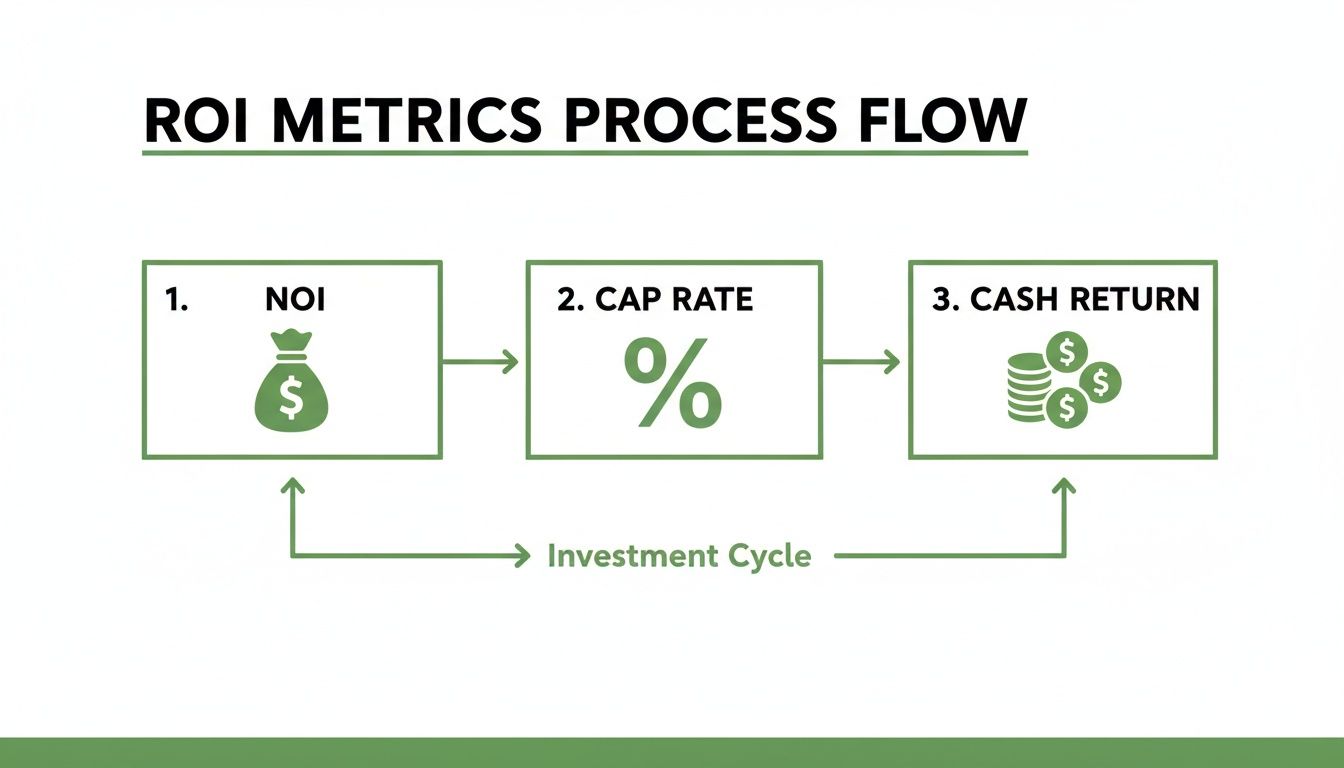
Flowchart illustrating the ROI metrics process, showing NOI, Cap Rate, and Cash Return in an investment cycle.

As you can see, each metric really just builds on the one before it. You start with income, factor in costs, and end up with a progressively sharper view of an asset's true financial performance.

Comparing Investment Scenarios

To really see how a commercial property ROI calculator flexes its muscles, let's compare two completely different strategies for the same urban site: building a brand-new property from the ground up versus an adaptive reuse of a historic building that's already there. Each path comes with its own unique set of costs, timelines, and potential returns that a good calculator can lay bare.

By modeling different scenarios, you turn your ROI calculator from a simple number-cruncher into a powerful strategic tool. It lets you pressure-test your own assumptions and find the most profitable path forward before a single dollar is committed.

Financing, for example, can dramatically change the outcome. Take a real-world case of a Toronto rental property bought with a $109,000 down payment. It generated $12,792 in gross annual rent. After accounting for $4,000 in expenses, the NOI landed at $8,792, giving the investor a first-year ROI of 8.07%. But the story doesn't end there. As the mortgage gets paid down, the ROI is projected to hit 10-12% within just five years. It's a perfect illustration of how leverage can amplify your returns over time. You can see how different financing structures play out by using a good rental property calculator.

Scenario Comparison: New Build vs. Adaptive Reuse

Let's dig into the financials for our two hypothetical projects. For this exercise, we'll assume both are targeting a 20,000 square foot mixed-use commercial space. They're on the exact same piece of land, which was purchased for $1,000,000.

Financial Factor New Construction Scenario Adaptive Reuse Scenario
Initial Investment Land: $1,000,000
Hard Costs: $4,000,000
Soft Costs: $600,000
Total: $5,600,000
Land/Building: $1,000,000
Hard Costs: $2,500,000
Soft Costs: $375,000
Total: $3,875,000
Financing (25% Down) Down Payment: $1,400,000 Down Payment: $968,750
Project Timeline 18-24 months 12-16 months
Gross Potential Rent $500,000 / year $450,000 / year (lower due to layout constraints)
Operating Expenses $150,000 / year (lower due to new systems) $165,000 / year (higher due to older infrastructure)
Special Incentives None 20% Federal Historic Tax Credit on qualified expenses ($500,000)

The table lays out the raw numbers, but the story is in how they interact to produce a final return. The new build looks clean and predictable, while the adaptive reuse has some compelling financial quirks.

Analyzing the New Construction ROI

For the new build, the math is pretty straightforward. You're building a modern property with brand-new systems, which means you can command higher rents and expect lower maintenance costs. That all adds up to a strong NOI.

  • Net Operating Income (NOI): $500,000 (Rent) – $150,000 (Expenses) = $350,000
  • Cap Rate: $350,000 / $5,600,000 = 6.25%
  • Annual Debt Service (est.): $252,000
  • Annual Cash Flow: $350,000 – $252,000 = $98,000
  • Cash-on-Cash Return: $98,000 / $1,400,000 (Down Payment) = 7.0%

A 7.0% cash-on-cash return is solid and dependable for a new Class A asset. The trade-off for that stability is a much higher initial investment and a longer timeline where your capital is tied up before it starts earning.

Unpacking the Adaptive Reuse ROI

Now, let's look at the adaptive reuse project. The numbers here tell a more complex, but potentially far more rewarding, story. The upfront investment is significantly lower, and you'll get to cash flow much faster. While the gross rent is a little lower and operating costs are a bit higher, there’s a massive financial incentive that changes the entire game.

  • Net Operating Income (NOI): $450,000 (Rent) – $165,000 (Expenses) = $285,000
  • Cap Rate: $285,000 / $3,875,000 = 7.35%

Right off the bat, that higher cap rate suggests you're getting a better value relative to the cost. But the real magic happens when you factor in the Historic Tax Credit.

That $500,000 tax credit isn't just a paper deduction; it directly reduces the amount of cash you need to bring to the table. Instead of a $968,750 down payment, your effective out-of-pocket investment drops to just $468,750. This has a colossal impact on your return.

  • Annual Debt Service (est.): $174,375
  • Annual Cash Flow: $285,000 – $174,375 = $110,625
  • Cash-on-Cash Return: $110,625 / $468,750 (Effective Equity) = 23.6%

The difference is staggering. Even though it generates less cash flow in absolute dollars, the adaptive reuse project delivers a cash-on-cash return more than three times higher than the new build. This is the kind of insight that a detailed, side-by-side analysis gives you. It proves that the most obvious path isn't always the most profitable one and shows how creative strategies and incentives can produce truly outstanding returns.

How Smart Design Choices Can Supercharge Your Returns

An open book of blueprints on a wooden desk in a modern office with large windows.

The numbers that pop out of a commercial property roi calculator aren't just theoretical. They’re a direct reflection of real-world decisions about a building's design, its materials, and the systems that make it run. An investment’s profitability isn’t set in stone; you can actively shape it with strategic architectural choices that boost value and slash long-term costs.

This is where the spreadsheet meets the stud wall. Smart design is far more than just making a place look good—it's one of the most powerful financial levers you can pull. By focusing on elements that improve efficiency and unlock incentives, you can directly tweak the inputs of your ROI calculation for a much more attractive outcome.

Driving Down Expenses with Energy Efficiency

One of the most direct ways to fatten up your Net Operating Income (NOI) is to relentlessly attack your operating expenses. Utility bills are a constant, significant drain on any commercial property, but they’re also one of the most manageable if you get the design right from the start.

Investing in energy efficiency pays you back for the entire life of the property. And I’m not just talking about swapping out a few light bulbs. This is about a whole-building approach to performance.

  • High-Performance HVAC Systems: Modern, efficient heating and cooling systems can make a massive dent in your monthly utility spend.
  • A Tighter Building Envelope: Think of superior insulation and sealing as wrapping your investment in a warm blanket. It stops energy from leaking out, so your HVAC system doesn't have to work nearly as hard.
  • Strategic Daylighting: Designing spaces to pull in as much natural light as possible cuts down on the need for artificial lighting, which is a constant drain on electricity.
  • Solar Integration: The upfront cost is real, but commercial solar can wipe out a huge chunk of your energy expenses. A typical system costs between $1.00 and $2.50 per watt before you even factor in incentives.

Remember, every single dollar you save on utilities is a dollar added straight to your NOI. That not only improves your annual cash flow but also directly increases the building’s market value.

A building designed for peak energy performance is fundamentally a more profitable asset. It commands higher tenant satisfaction, boasts lower operating costs, and holds its value better over time, making it a clear winner in any ROI analysis.

The Financial Power of Historic Preservation

If you're looking at older properties, historic preservation offers one of the most powerful financial tools in the entire game: historic tax credits. These aren't just minor deductions. They are game-changing incentives that can completely reshape the economics of an adaptive reuse project, turning a borderline deal into a home run.

Take the Federal Historic Preservation Tax Incentives program. It gives you a 20% income tax credit for the qualified rehabilitation costs of a certified historic building. That credit is a dollar-for-dollar reduction of your tax bill, which dramatically cuts the amount of your own capital tied up in the project.

The ripple effect on your ROI is huge. For a project with $1 million in qualified rehab expenses, you’d get a $200,000 tax credit. That cash infusion effectively lowers your equity contribution and can juice your final cash-on-cash return by as much as 25%.

We're seeing a similar trend in Europe, where new energy mandates are pushing investors to retrofit historic assets. Those updated properties are showing returns of 11% compared to just 7% for their unoptimized counterparts. Expertly navigating complex building codes is also key—doing it right can save 5-10% of potential yield that would otherwise get eaten up by delays. You can dig deeper into how these financial strategies work with expert guidance in this analysis of commercial property ROI.

By using these credits, you turn a building's history from a potential headache into a massive financial asset. It’s a perfect example of how knowing the rules and incentives can turn the dials on your ROI calculator firmly in your favor.

Avoiding Common Mistakes in Your ROI Analysis

Even the most sophisticated commercial property roi calculator is only as good as the numbers you plug into it. Let's be blunt: an overly optimistic projection isn't just a simple miscalculation—it's a direct route to a disastrous investment. I’ve seen it happen. The most critical part of any analysis is stress-testing every single assumption you make.

This is where you have to separate wishful thinking from verifiable reality. The single biggest mistake I see investors make is taking a rosy view of future income and expenses. It leads to a beautifully inflated ROI on paper that will never, ever show up in your bank account.

Overly Optimistic Projections

It's surprisingly easy to fall into the trap of assuming a 100% occupancy rate. Or maybe you underestimate how long it will take to find tenants for a vacant space. Markets shift, tenants move on, and securing the right replacement always takes time. A realistic vacancy allowance, usually somewhere between 5% and 10%, isn't just a suggestion; it’s an absolute necessity for an accurate forecast.

Likewise, it's tempting to project aggressive rent growth right out of the gate. While we all hope for strong appreciation, your initial analysis must be firmly planted in current, verifiable market rates.

Don't confuse your investment goals with your market analysis. Your projections should reflect what the market is, not what you hope it will become. Ground your numbers in comparable property data, not aspirations.

Another danger zone is the renovation budget. Assuming timelines and costs will go exactly as planned is a rookie move. Delays are inevitable, and unexpected problems always surface once you start opening up walls. Building a contingency fund of 10-15% into your renovation budget isn't pessimism; it's professionalism.

Ignoring Hidden and Future Costs

A truly professional ROI analysis peers beyond the immediate, obvious expenses. It meticulously accounts for the big-ticket, infrequent costs—often called capital expenditures, or CapEx—that can ambush an unprepared owner years down the road.

If you forget to budget for these future costs, your cash flow will look deceptively healthy.

  • Roof Replacement: Every commercial roof has a finite lifespan. You have to set aside funds annually for the day it needs to be replaced.
  • HVAC Systems: These are complex, costly systems. Eventually, they will demand major repairs or a full replacement.
  • Parking Lot Repaving: Over time, asphalt breaks down. Resurfacing it requires a significant capital outlay.
  • Major System Upgrades: Think about the big stuff in an older building—elevators, plumbing, or electrical systems that will eventually need a complete overhaul.

Failing to account for these items means you're effectively overstating your property's profitability every single year. A proper analysis always includes a "replacement reserve" in the operating expenses, which ensures you’re building that financial cushion for these certainties. While the specifics differ, learning about the common pitfalls of online short-term rental calculators can offer valuable lessons. The core principle is universal: you have to scrutinize your inputs and understand the limitations of any tool you use.

Your Top Commercial Property ROI Questions, Answered

Even with the best tools, you're going to have questions when you're deep in the numbers on a potential deal. It's just part of the process. Below, I’ve tackled some of the most common questions investors ask when they’re trying to make sense of a property's real potential.

Think of this as a quick reference to clear up those nagging uncertainties that pop up right when you're trying to decide whether to move forward.

What Is a Good ROI for a Commercial Property?

This is the million-dollar question, isn't it? The honest answer is, "it depends." There’s no single number that works everywhere, for every building. It all comes down to the market, the property type, and how much risk you're willing to take on.

That said, a good rule of thumb for a stable, low-risk commercial property is a cash-on-cash return in the 8-12% range. But if you’re looking at something riskier—say, a major value-add project or building from the ground up—you need to aim much higher. For those deals, you should be targeting an ROI of 15-20% or even more to make the extra risk and headache worthwhile. The key is to compare apples to apples with similar local investments.

How Does Financing Affect My ROI Calculation?

Financing completely changes the game. It’s the lever that can turn a decent deal into a fantastic one. By using a loan, you reduce your upfront cash investment, which can send your cash-on-cash return through the roof.

Of course, there's no free lunch. A loan means a mortgage payment, which eats into your monthly cash flow. This is exactly why a good commercial property ROI calculator is non-negotiable. It lets you play with different loan scenarios—adjusting interest rates, loan amounts, and payment schedules—to see precisely how financing impacts your bottom line before you sign on the dotted line.

Your financing structure is one of the most powerful levers you can pull to optimize an investment. Using a calculator to compare different debt options isn't just good practice; it's a critical step in maximizing your financial outcome.

How Often Should I Recalculate My Property ROI?

Your initial analysis is just the starting line. You should be re-running the numbers on your property at least once a year. This keeps you honest about its actual performance and shows you how changes in rent, expenses, or market conditions are affecting your investment.

It's also crucial to recalculate ROI after any major event. Did you just put on a new roof? Sign a big, long-term lease? Refinance your loan? Each of these events changes the financial picture. Staying on top of your numbers means you’re always making decisions based on what’s happening now, not what you hoped would happen a year ago.

Can I Use a Simple ROI Calculator for an Adaptive Reuse Project?

A simple calculator is fine for a quick, back-of-the-napkin look, but for something as complex as an adaptive reuse project, it just won’t cut it. These deals are a different beast entirely. They come with unpredictable renovation costs, long construction timelines, and unique financial incentives that a basic tool simply isn't built to handle.

For example, incentives like the 20% Federal Historic Tax Credit can fundamentally change the economics of a project, making a seemingly impossible deal incredibly profitable. To get a real sense of an adaptive reuse project's potential, you need a more sophisticated calculator or a custom spreadsheet that can account for these high-impact variables.


At Sherer Architects, LLC, we specialize in turning complex commercial, adaptive reuse, and historic preservation projects into profitable realities. Our expertise in design, navigating tax credits, and optimizing building performance ensures your investment is sound from blueprint to bottom line. Let's build something enduring together. https://shererarch.com
Categories
news

Remodel vs New Construction The Definitive Guide

At its core, the choice is pretty straightforward: a remodel is often faster and lets you keep your location's history, while new construction gives you total design freedom and modern efficiency. The right path for you really depends on what you value more—adapting what's already there or creating a custom space from the ground up.

Making the Foundational Choice

Deciding between a remodel and new construction is one of the biggest calls a commercial property owner can make. It isn't about which one is "better." It's about which approach truly lines up with your business goals, the condition of your site, and your long-term vision. This decision shapes everything that comes next—your budget, your timeline, and the final result.

This isn't just a theoretical debate; it's happening all around us. The remodeling market in the United States is booming, largely because we're dealing with an aging building stock. Think about it: with nearly 48% of owner-occupied homes built before 1980 and a median age of 41 years, updating existing structures is no longer a niche—it's a massive part of the construction industry. You can learn more about the growth of the home remodeling market and see just how significant this trend is.

Image

Key Decision Factors at a Glance

To start, it helps to see the main trade-offs. A remodel takes advantage of an existing foundation and character, but you can also run into unexpected problems lurking behind the walls. On the flip side, new construction offers a clean, predictable slate but demands a much bigger upfront investment in land and site development.

A remodel forces you to solve a puzzle with existing pieces, often leading to creative solutions. New construction lets you design the puzzle from scratch, giving you total control over the final picture.

To help frame your thinking, let’s quickly break down the core differences.

Quick Look: Remodel vs. New Construction Key Differences

This table offers a high-level summary of the most critical factors that differentiate a remodel from a new build.

Factor Remodeling (Renovation) New Construction
Project Timeline Generally shorter, but can be derailed by unforeseen issues hidden in the old structure. Longer upfront planning and site prep, but the build schedule is usually more predictable.
Initial Cost Typically lower upfront costs because the main structure and site already exist. Higher initial investment due to land purchase, extensive site work, and new utility hookups.
Design Flexibility Limited by the existing building footprint, structural walls, and core systems. Complete freedom to design the layout, look, and functionality from the ground up.
Location You get to stay in an established location, which could be historic or in a prime, developed area. Limited to whatever land is available, which might be in less developed or outlying areas.
Sustainability Great potential for adaptive reuse, which preserves the embodied carbon of the existing structure. Opportunity to build with the latest green technologies and high-efficiency systems from the start.

In the end, the right choice always comes down to a careful look at your project's specific needs. By digging into each of these factors, you can make a smart, informed decision that boosts your return on investment and gets you closer to your strategic goals.

Analyzing the Financial Realities of Each Path

A modern, glass-walled commercial building under construction with a crane in the background

When you're weighing a remodel against new construction, the financial analysis has to go much deeper than the initial quote. Each path comes with its own unique set of costs, risks, and potential returns that demand a close look. A quick, surface-level comparison can be incredibly misleading because the hidden expenses and long-term value are worlds apart.

At first glance, remodeling often looks like the more budget-friendly option. It’s a massive market for a reason. Americans spent around $603 billion on property improvements in a single year, and 57% of contracting pros say projects are only getting bigger. For a detailed breakdown, you can check out the full report on these remodeling market findings. The catch? This path is notorious for unforeseen expenses that can blow up a budget in a hurry.

The Hidden Costs of Remodeling

When you decide to renovate, you’re not just buying new materials; you're inheriting the building's entire history, warts and all. Those "hidden" costs aren't just hypothetical possibilities—they’re common hurdles we see on projects all the time and must be baked into any realistic financial plan.

Here are a few of the usual suspects:

  • Structural Deficiencies: Finding a compromised foundation, termite damage, or walls that can't handle the new load is a project-stopper. These discoveries trigger extensive, and very expensive, repairs.
  • Hazardous Material Abatement: It's almost a given that older buildings contain asbestos, lead paint, or mold. Getting rid of them safely requires specialized (and costly) remediation crews.
  • Code Compliance Upgrades: A renovation often forces you to bring the entire building, or at least major systems, up to current building, electrical, and plumbing codes. This can be a huge, un-budgeted expense.

Beyond the upfront work, you have to think about long-term operational costs, especially utilities. For example, simply understanding SEER ratings and their impact on energy bills can highlight massive long-term savings. Swapping out an old HVAC system for a high-efficiency one is practically a must in any major remodel today.

Remodeling budgets are often derailed not by the planned work, but by the mandatory fixes discovered along the way. A robust contingency fund—typically 15-20% of the total project cost—is non-negotiable.

The Upfront Investment of New Construction

New construction, on the other hand, is a much heavier lift financially from day one. You'll face fewer surprises once you break ground, but getting to that point requires serious capital before a single wall goes up.

The primary costs you’re looking at include:

  • Land Acquisition: Finding and buying a suitable piece of land in a good location is often the single biggest line item.
  • Site Preparation: This is a huge undertaking. It involves clearing the land, grading it, excavation, and soil testing to make sure the ground can support your structure.
  • Utility Infrastructure: Tying into water, sewer, electrical, and gas lines can be a complex and expensive process, particularly if the site is undeveloped.
  • Permits and Impact Fees: Don't underestimate what local municipalities charge. The fees for permits and to offset the new development's impact on public services can be staggering.

How Each Path Builds Long-Term Value

So, where does the real financial value come from? It all depends on the project's context.

Think about a historic warehouse conversion in a revitalized downtown area. Here, the value is tied to the building’s authentic character—exposed brick, high ceilings, a story to tell. That's something you simply can't replicate with new construction, and it can command premium rents for commercial lofts or apartments. You're also preserving embodied carbon, which is a big plus.

Now, contrast that with a modern commercial building on a suburban plot. Its value comes from pure efficiency and customization. The facility can be designed from the ground up to support a specific company’s workflow, fitted with the latest energy-saving systems, and tailored to a tenant's exact needs. This approach creates value by slashing long-term operating costs and maximizing functionality—a huge draw for businesses looking for a predictable, purpose-built space.

Ultimately, the choice between remodel vs. new construction comes down to which financial model best serves your long-term strategy for the asset.

Comparing Project Timelines and Management Hurdles

In commercial real estate, time is money—it's that simple. Your choice between remodeling an existing space or building from the ground up will have a massive impact on your project's schedule and the management headaches you'll face along the way. Each path forces a trade-off between speed and predictability, a decision that ripples through everything from your financing to when your tenants can finally move in.

A remodel almost always looks faster on paper. You have a structure, so you can skip the long slog of land acquisition and major site work. Design and demolition can often kick off in short order. But that early speed can be deceptive, hiding the very real risk of unexpected, and often costly, delays.

The Predictability of New Construction Timelines

Building new is a marathon, not a sprint, especially in the beginning. The pre-construction phase is a beast, involving a long checklist of permits, environmental studies, site prep, and getting utilities in place. It can feel agonizingly slow, but there's a huge upside: you're dealing with all the big unknowns upfront.

Once you actually break ground, the schedule becomes remarkably linear and predictable. The process follows a logical sequence:

  1. Foundation and Site Work: The slab gets poured and the building's skeleton goes up.
  2. Exterior and Roofing: The structure is "dried in," protecting it from the weather.
  3. Interior Systems: All the guts get installed—HVAC, plumbing, and electrical.
  4. Finishes and Landscaping: The final details come together inside, and the site work is completed.

This step-by-step progression leaves very little room for surprises. A good general contractor can map this out with incredible accuracy. Unless you're hit with a major weather disaster or a significant supply chain breakdown, the completion date they give you is usually one you can take to the bank.

The Unpredictability of Remodeling Timelines

Remodeling timelines, on the other hand, are infamous for being a moving target. The biggest wildcard is what you’ll find once you start opening up walls. A straightforward interior refresh can spiral into a full-blown crisis when your crew discovers ancient wiring that isn't up to code, asbestos hiding in the walls, a crumbling foundation, or years of hidden water damage.

Here's the core timeline dilemma in the remodel vs. new construction debate: New construction is a predictable but longer journey. Remodeling offers a faster start but with the constant threat of unpredictable detours that can derail your schedule and budget.

Every one of these discoveries brings work to a screeching halt. Progress stops while you figure out a solution, which almost always costs more time and money. This creates a domino effect, pushing back every subsequent phase of the project and making it nearly impossible to guarantee a firm deadline. It’s not uncommon for a simple three-month renovation to drag on for six months or more, wreaking havoc on business operations and leasing agreements.

External Factors and Management Hurdles

Of course, both project types are at the mercy of outside forces. Economic shifts, labor shortages, and wild swings in material costs can throw a wrench into the most carefully crafted plans. For instance, while new construction is key to supply, its pace can be volatile. In August 2025, building permits were issued for about 1,312,000 housing units on an annual basis—a drop of 11.1% from the previous year, partly driven by these economic headwinds. You can dig into the specifics in the official new residential construction report.

With all the moving parts and potential chaos, adopting effective project scheduling isn't just a good idea; it's essential. Solid project management is what helps you navigate the hurdles, whether you’re coordinating a dozen trades in a tight renovation or wrangling the massive logistics of a new build.

Ultimately, your decision comes down to your tolerance for risk. If a rock-solid move-in date is non-negotiable for your business, the longer but far more stable timeline of new construction is probably your best bet. If getting operational quickly is the top priority and you have a healthy contingency fund for whatever surprises pop up, a remodel could get you across the finish line faster.

Evaluating Design Flexibility and Structural Limits

Architectural blueprints and a hard hat on a wooden table, symbolizing design and construction.

Beyond the numbers and schedules, the choice between remodeling and new construction really comes down to your architectural freedom. One approach gives you a completely blank canvas, while the other is more like solving a puzzle—challenging your team to innovate within an existing framework. This decision will shape not just how your space looks, but how it functions for years to come.

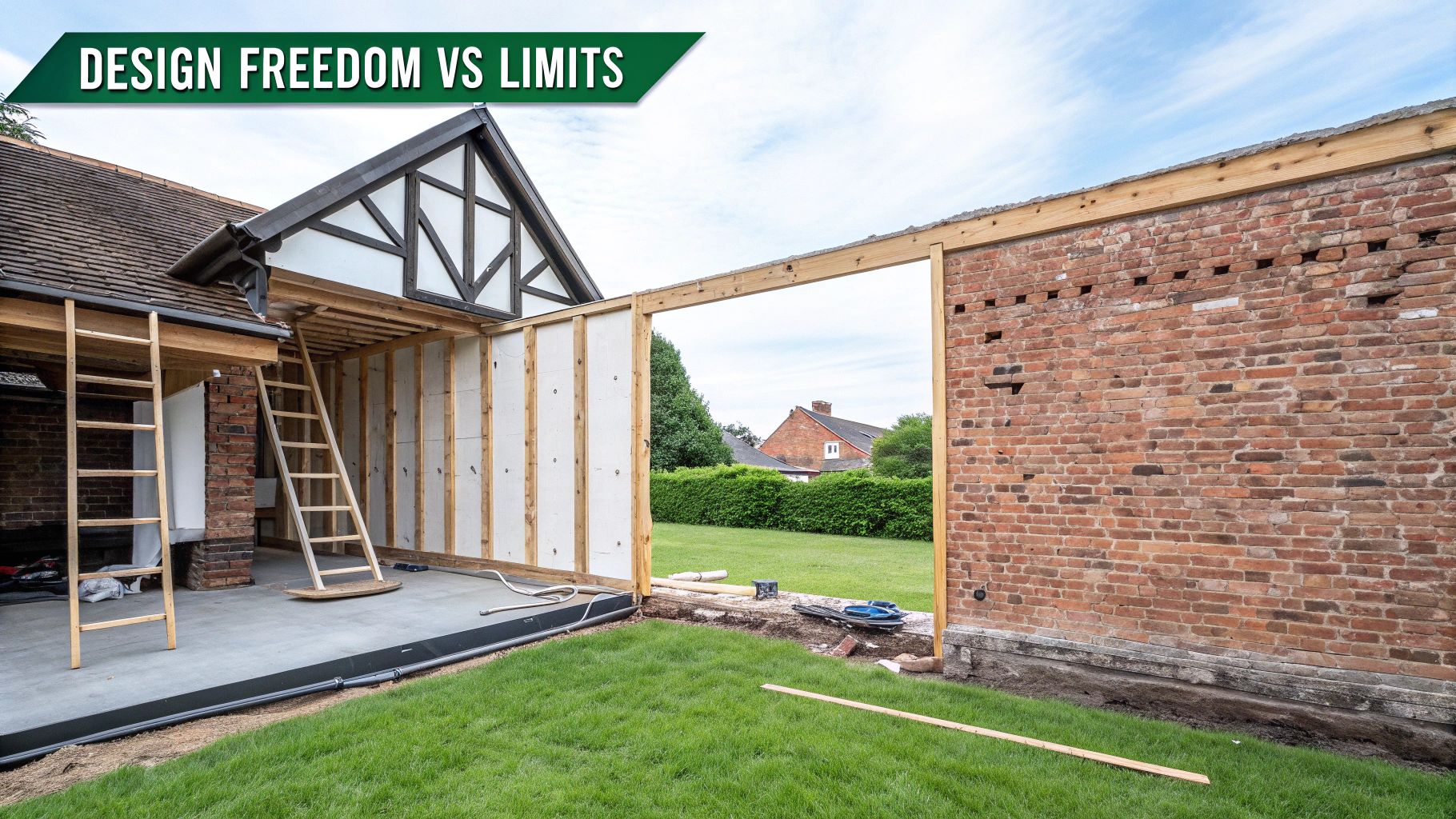
New construction is all about total design control. From the way the building is oriented on the lot to the precise layout of every last room, you’re in the driver’s seat. This "blank slate" is perfect for businesses with very specific operational needs that an existing building simply can't meet.

The Creative Freedom of New Construction

Picture designing a custom corporate headquarters from scratch. With a new build, you can engineer every detail for optimal workflow, bring in abundant natural light, and maximize energy efficiency right from the start. You're not just building walls; you're creating an environment that embodies your company culture.

The upsides are pretty clear:

  • Unlimited Layout Options: There are no load-bearing walls or odd footprints from a previous life to work around. You can design for perfect traffic flow and logical adjacencies.
  • Modern Systems Integration: New projects allow you to seamlessly weave in the latest HVAC, IT infrastructure, and security systems from day one.
  • No Compromising on Your Vision: The finished building is a direct reflection of your goals, with no concessions made to a past design.

This is exactly why companies needing specific, non-negotiable features—like a high-tech manufacturing plant or a specialized medical clinic—almost always choose to build new. It avoids costly workarounds and guarantees the building actively supports its purpose.

New construction offers the ultimate design authority, allowing you to create a purpose-built asset from the ground up. Remodeling, in contrast, is an exercise in creative adaptation, blending new vision with existing character.

Working Within Remodeling Constraints

Remodeling is a whole different ball game. You’re working with the building's "bones"—its foundation, structural grid, and overall footprint. While that might sound restrictive, these limitations often force the kind of creative thinking that leads to truly innovative, character-rich spaces.

Take the classic example of converting an old warehouse into modern office lofts. The original brick walls, massive industrial windows, and soaring ceilings aren't constraints; they're the very features that give the space its unique appeal. The real art is in adding modern functionality without stripping the building of its history.

Of course, those constraints are real. Load-bearing walls will dictate where you can create open areas, sometimes limiting your layout options. If the building is in a historic district, preservation rules can add another layer of complexity, putting strict limits on what you can change, especially on the exterior.

A renovation project might run into these common hurdles:

  • Load-Bearing Walls: Taking these out or moving them requires serious engineering and can drive up costs significantly, making some layout changes impractical.
  • Low Ceilings or Awkward Columns: An existing building may have features that are incredibly difficult or expensive to change, forcing designers to get creative with their plans.
  • Historic Preservation Overlays: In designated areas, any modification visible from the street could require approval from a design review board, adding time and potential restrictions to the project.

In the end, it all comes down to your priorities. If your project demands a very specific layout and fully integrated modern systems, the freedom of new construction is the obvious choice. But if your goal is to create a one-of-a-kind space with a story to tell, tackling the design puzzle of a remodel can result in a truly remarkable building.

Comparing Sustainability and Environmental Impact

The environmental footprint of a project is no longer just a box to check—it's a massive factor in the remodel vs. new build debate. Each path has a totally different sustainability story, forcing you to weigh the benefits of preserving what's already there against building for peak future efficiency. The right call comes down to looking at the entire lifecycle, from the carbon spent on day one to the energy used for the next 50 years.

When you remodel, you’re essentially practicing the ultimate form of recycling. By going the adaptive reuse route, you’re preserving the embodied carbon that’s already locked into the building’s bones—the concrete, steel, and wood. Think of it as all the energy that was spent years ago to create and assemble those materials in the first place.

This immediately keeps tons of demolition waste out of our landfills, which is a huge environmental win. Since construction and demolition debris makes up a startling amount of total waste, simply keeping a building standing is a major victory for sustainability right out of the gate.

The Value of Adaptive Reuse

There's a saying in the industry: the greenest building is the one that's already built. Adaptive reuse embodies this idea, using the past to build a more sustainable future. But it’s not always a simple path. While you save big on embodied carbon, getting an older structure to meet today's tough energy codes can be a real headache.

The core environmental trade-off is clear: Remodeling saves embodied carbon and reduces landfill waste upfront, while new construction offers a clean slate to maximize long-term operational energy efficiency.

Achieving high-end insulation, airtightness, and modern system performance in a building designed decades ago demands clever engineering and investment. Still, the environmental payoff from avoiding a total teardown is immense.

Building for Future Efficiency

New construction offers a different flavor of green. It gives you a blank canvas to design a hyper-efficient building from the ground up, perfectly optimized to sip energy for its entire lifespan. You can integrate the latest green tech without having to work around the constraints of an old structure.

Here's where new builds really shine:

  • Advanced Building Envelope: You can engineer walls, roofs, and foundations for maximum insulation and air-sealing—something that’s often impossible to achieve in a retrofit.
  • Passive Design Integration: New construction allows you to orient the building perfectly on its site to capture natural light and take advantage of passive solar heating, cutting down on lighting and HVAC costs.
  • Modern Systems and Materials: Everything from geothermal HVAC systems and sustainably harvested wood to high-performance windows can be chosen for peak efficiency and minimal impact.

The result is a building with a much lower operational carbon footprint—that's the energy it consumes every day just to run. Over the 50+ year lifespan of a typical commercial building, those operational savings can become massive, sometimes even offsetting the higher initial carbon cost of construction.

Let's break down how these two approaches stack up on key environmental metrics.

Environmental Impact Comparison

Environmental Factor Remodeling (Adaptive Reuse) New Construction
Embodied Carbon Low. Preserves the carbon already "spent" on the original structure and materials. The biggest green advantage. High. Requires a massive upfront carbon investment for manufacturing and transporting all new materials.
Construction Waste Minimal. Significantly reduces demolition debris sent to landfills, a major source of waste. High. Demolition of any existing structure and new construction generate substantial waste.
Operational Efficiency Variable. Can be challenging and costly to bring an old building up to modern energy performance standards. Excellent. A blank slate to design for maximum long-term energy efficiency with the latest tech and materials.

Ultimately, there’s no single right answer. It all comes back to your project’s goals. If preserving resources and minimizing your upfront environmental impact is the top priority, remodeling is a powerful choice. But if you’re aiming to build a facility that will perform at peak efficiency for the next half-century, new construction gives you the tools to do it right. A full lifecycle analysis is really the only way to know for sure which path delivers the best long-term environmental return on your investment.

Making the Right Choice for Your Project

After weighing the financial, scheduling, design, and sustainability angles, the choice between remodeling and new construction really comes down to your project's core mission. There’s no single right answer here—just the path that best aligns with your goals, budget, and vision.

The decision often pivots on a handful of non-negotiables. For some clients, preserving the soul and history of an existing building is everything. For others, the only acceptable outcome is a facility built for maximum efficiency and future growth.

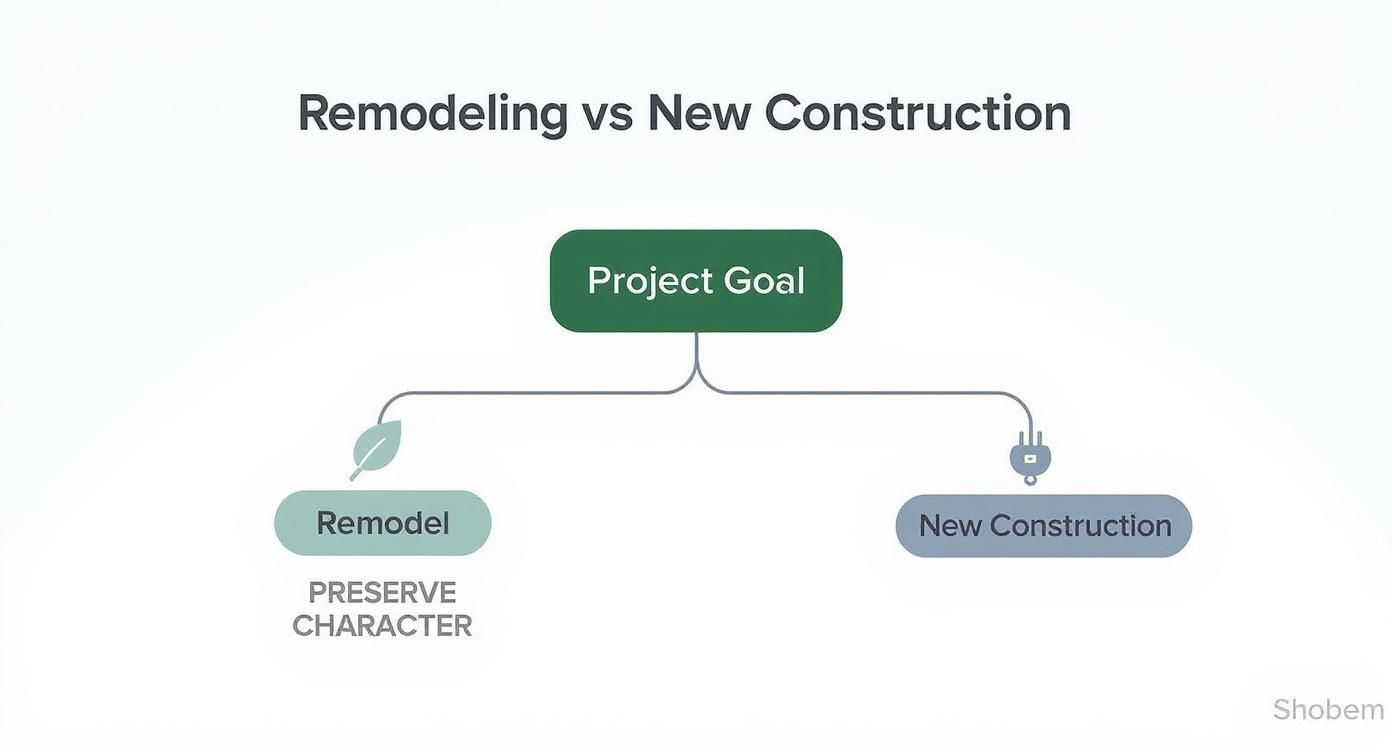
This decision tree gives you a visual shortcut, showing how your primary goal can point you in the right direction.

Infographic decision tree for choosing between a remodel vs new construction project

As you can see, when priorities like historic preservation or a tight timeline lead the way, remodeling is the natural fit. But if custom functionality and peak performance are what you’re after, new construction is probably your answer.

When Remodeling Is the Undisputed Winner

In certain situations, a remodel or adaptive reuse project isn't just a good idea—it's the smartest move. If your project ticks any of these boxes, renovation should be your first consideration.

  • Historic Significance: Is the property a landmark or located in a historic district? Preservation is the name of the game. Remodeling lets you respect the building's architectural heritage while upgrading its function. It can also unlock some very valuable historic tax credits.
  • Prime, Developed Location: When your building sits on an irreplaceable piece of real estate in a dense urban core, demolition is almost never the best option. A renovation helps you cash in on that premium location without losing your footprint.
  • Speed is Critical: If you need a commercial space up and running fast, a well-planned remodel can often get you there quicker than a new build. Even with a few surprises, you can frequently beat the lengthy permitting and site prep timelines that come with starting from scratch.
  • Budget Constraints: When upfront capital is the biggest hurdle, remodeling typically demands a lower initial investment. It’s often a more financially accessible route than buying land and building from the ground up.

For projects where the story and location of a building are its greatest assets, remodeling isn't just a choice—it's the strategy that unlocks its highest value.

When New Construction Is the Only Logical Choice

On the flip side, some project goals simply can’t be met within the confines of an existing structure. Trying to force a remodel in these cases leads to frustrating compromises and a finished product that doesn't quite hit the mark.

Here are a few scenarios where building new is the clear winner:

  • Highly Specific Operational Needs: Think about a specialized manufacturing plant, a state-of-the-art medical clinic, or a high-tech data center. These facilities demand a specific layout and infrastructure that’s nearly impossible to retrofit into an old building without major sacrifices.
  • Long-Term Efficiency is Paramount: If your objective is to create a building with the lowest possible running costs for years to come, new construction is the way to go. You can design everything from the ground up for peak performance, from passive solar design to geothermal HVAC.
  • The Existing Structure is Unsalvageable: Let’s be honest—sometimes a building has too many issues. Between deep structural deficiencies, hazardous materials, and widespread code violations, there's a tipping point where the cost of fixing it all exceeds the cost of a fresh start.
  • Maximizing Site Potential: If you have an old, undersized building sitting on a large, valuable piece of land, a teardown is often the best financial move. It allows you to construct a larger, more profitable building that makes much better use of the property.

Ultimately, the best decision is an informed one. By getting crystal clear on your project's main objectives and taking an honest look at the existing conditions, you can confidently choose the path that will deliver a successful and enduring result.

Frequently Asked Questions

When you're weighing a remodel against new construction, the big picture is important, but it's the specific, practical questions that often make or break the decision. Let's tackle a few of the most common ones we hear from our commercial clients.

What Are the Most Common Hidden Costs in a Remodel?

It's almost always what's lurking behind the walls. Once demolition starts, we often find things like outdated (and unsafe) electrical wiring, plumbing that's nowhere near current code, or even structural damage from long-term water leaks or pests.

Another major budget-buster is abatement. Discovering hazardous materials like asbestos or lead paint is common in older buildings, and removing them safely is a non-negotiable expense that can quickly inflate your costs.

We always tell clients that a healthy contingency fund is their best defense. For a commercial remodel, you should plan on setting aside 15-20% of your total project budget just for these kinds of surprises. It's not a matter of if you'll find something, but what.

How Do Property Taxes and Insurance Differ?

Building from the ground up will almost certainly result in a higher property tax assessment—you’re creating a brand-new asset with a high market value. The flip side is that insurance premiums are often lower. New buildings are constructed to the latest safety codes for fire, wind, and flood resistance, which insurers love to see.

A major remodel will also trigger a property value reassessment, which means a higher tax bill. While your insurance rates might dip a bit thanks to upgraded systems, they could just as easily go up if the building's overall value increases significantly or if it's in an area with changing risks, like an updated flood map.

Is One Option Always Better in a Flood Zone?

If your property is in a designated flood zone, the decision might already be made for you. Regulations like FEMA's 50% rule are a major factor. In short, if your planned improvements cost more than 50% of the building's market value, the entire structure has to be brought up to modern flood-resilience standards. That can mean incredibly expensive work, like physically elevating the whole building.

When faced with that scenario, the cost of compliance can make a new build the only practical choice. It allows you to design and construct a fully resilient building from the start, which often proves to be a smarter long-term investment that saves on future repairs and insurance.


Choosing between preserving a piece of the past and building for the future is a complex puzzle. Sherer Architects, LLC has spent decades helping clients put the pieces together, ensuring the final result is beautiful, sustainable, and profitable. You can see how we've navigated this for others in our portfolio of commercial, adaptive reuse, and historic preservation projects.