

People often use the words “renovation” and “remodeling” interchangeably, but in the world of architecture and construction, they mean very different things. The core distinction is actually quite simple: a renovation restores a space, while a remodeling project changes its form or structure.
Think of a renovation as giving a room a serious facelift. You might be painting the walls, installing new flooring, or swapping out old light fixtures. A remodel, on the other hand, is more like reconstructive surgery—you could be moving a wall, completely reconfiguring a kitchen layout, or changing a building's entire purpose.
Defining Renovation vs Remodeling
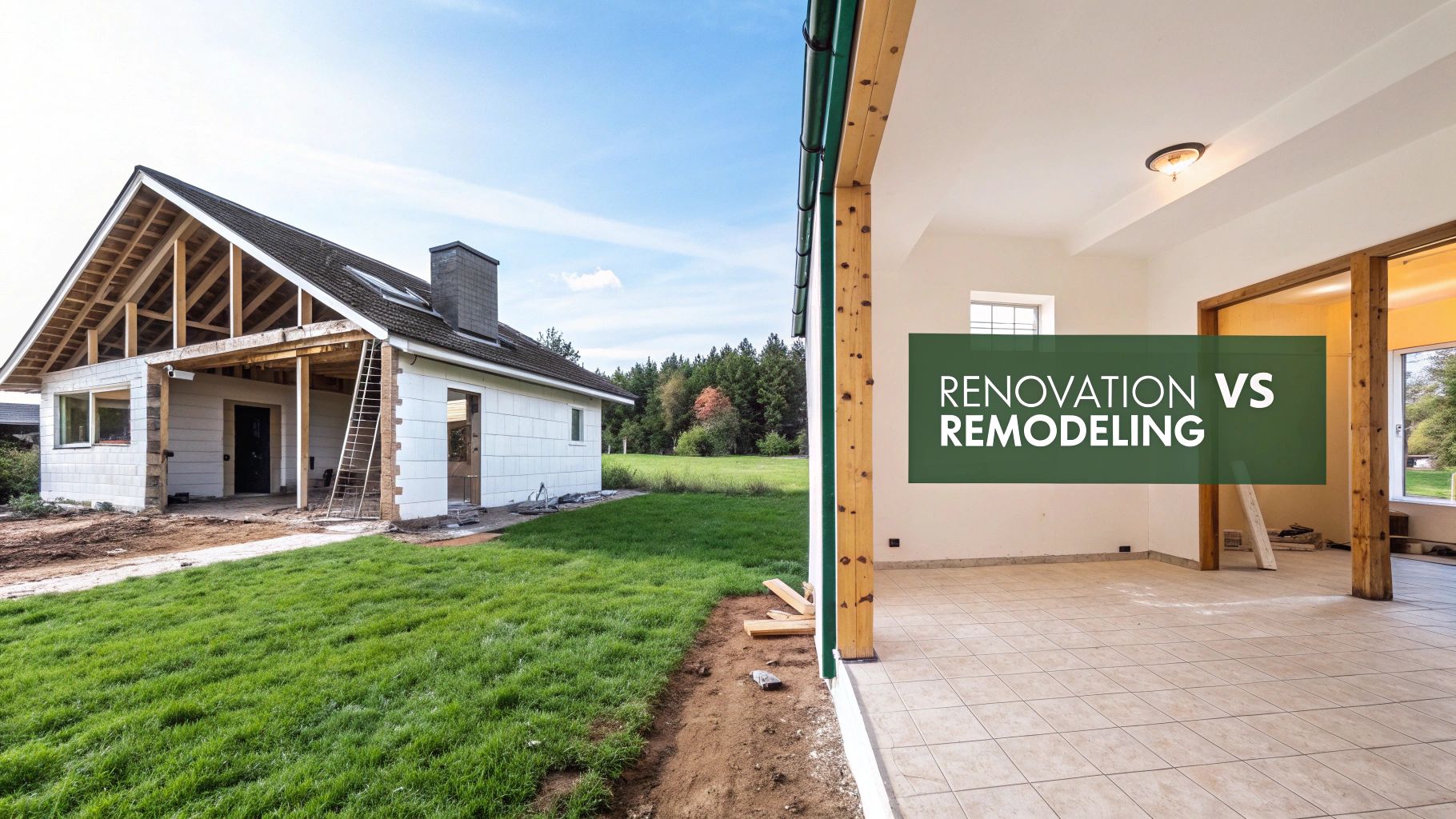
Getting this distinction right from the start is critical. It shapes your project’s scope, budget, and timeline. The choice between renovating and remodeling determines the professionals you'll need to hire, the permits you'll have to secure, and the ultimate impact on your property's value and function.
A renovation is all about bringing a space back to life. It focuses on updating surfaces, fixtures, and finishes to make the area feel fresh and new without altering its fundamental purpose. It’s about restoring and refreshing what's already there.
Remodeling is a much deeper endeavor. This is where you transform a space’s character, function, or layout to create something entirely new. This process is inherently more complex and almost always involves structural changes and a much broader team of experts.
Key Conceptual Differences
Let's break down the core ideas behind each term to make it even clearer:
- Renovation (Restore): The main objective is to bring something back to a good state of repair. Think "making it new again." A common commercial renovation would be updating an office lobby with a fresh coat of paint, new carpeting, and modern lighting, all while keeping the original layout perfectly intact.
- Remodeling (Change): Here, the goal is to fundamentally change the character or structure of a room or building. An adaptive reuse project that converts an old, forgotten warehouse into modern loft apartments is a perfect, large-scale example of remodeling.
The easiest way to tell them apart is to ask yourself: "Am I changing the design or just updating the finishes?" If you're just updating, it's a renovation. If you're changing the layout or use, it's a remodel.
This single distinction ripples through every part of a project, from the initial cost estimates to the final timeline. To give you a quick visual summary, here’s a table that lays out the key differences.
Renovation vs Remodeling At a Glance
| Aspect | Renovation (To Restore) | Remodeling (To Change) |
|---|---|---|
| Primary Goal | Update, refresh, or repair an existing space. | Alter the structure, layout, or function of a space. |
| Typical Scope | Painting, new flooring, refacing cabinets, replacing fixtures. | Moving walls, changing plumbing locations, reconfiguring a floor plan. |
| Permits Required | Rarely needed for cosmetic changes. | Almost always required, especially for structural or systems work. |
| Project Cost | Generally lower cost and completed faster. | Significantly higher cost with a much longer timeline. |
As you can see, while both improve a property, they are fundamentally different paths. One is about polishing a diamond, and the other is about cutting a new one.
How to Plan a Successful Renovation

Pulling off a great renovation comes down to understanding its scope and, just as importantly, its limits. Unlike a remodel, you’re not tearing down walls or changing the fundamental purpose of a space. Instead, a renovation is all about refreshing what’s already there—breathing new life into a room with cosmetic updates.
The real beauty of renovating is its efficiency. You're working with the "good bones" of the building, which means less disruption and a tighter budget. This is the core difference in the renovation vs. remodeling conversation and a key factor that shapes your costs, schedule, and the experts you'll need on your team.
Defining the Scope of Your Renovation
First things first: you need a clear vision. A renovation is all about surface-level changes that can completely transform the look and feel of a room without major structural work.
Think of it in terms of these high-impact tasks:
- Painting interior or exterior walls: Nothing beats a fresh coat of paint for a fast, affordable update.
- Refacing or repainting cabinets: This can give a kitchen a whole new personality without the expense of a full replacement.
- Installing new flooring: Getting rid of dated carpet or tile can modernize an entire space overnight.
- Replacing light fixtures and hardware: Small details like new faucets, handles, and lights add that polished, finished feel.
A big part of planning is knowing how to create a project timeline that makes sense. Since renovations don't involve a lot of structural surprises, the timeline is usually much shorter and more reliable than a complex remodel.
Assembling the Right Team
For a renovation, you won't need an architect or structural engineer. Your team will be made up of skilled tradespeople who specialize in specific finishes.
Depending on what you're doing, you might hire:
- Painters
- Flooring installers
- Electricians (for swapping out fixtures)
- Plumbers (for new faucets or toilets)
This focused approach keeps your labor costs in check and makes managing the project a lot simpler. It's no surprise that the global home renovation market is booming, with a projected value of $2049.25 billion that's expected to hit $2659.60 billion by 2032. People want to improve the spaces they already have, making smart, efficient renovation planning more valuable than ever.
Key Takeaway: A renovation is the perfect move when your property’s layout works just fine, but the style is stuck in the past. It delivers the biggest visual bang for your buck with the least amount of structural mess and expense.
Take a bathroom, for example. A renovation might mean keeping the plumbing exactly where it is but bringing in a new vanity, laying down modern floor tiles, and installing a sleek, water-efficient toilet. The room's footprint doesn't change, but its look is completely transformed. That’s the heart of a well-done renovation—a fresh start without the headache.
Navigating the Remodeling Process
While a renovation restores, a remodel truly transforms. This is where the renovation vs. remodeling discussion gets serious, as remodeling involves fundamental changes to a property's structure, layout, or even its entire purpose. You're not just giving a space a facelift; you're changing how it functions from the ground up.
Think of it this way: instead of just painting kitchen cabinets, a remodel might involve moving the entire kitchen to a different part of the house. This level of change is far more complex and requires a much deeper level of planning, bringing in a whole team of skilled professionals.
The Scope of a True Remodel
Remodeling is all about reconfiguring a space. The goal isn't just to update the look but to create something entirely new within the existing shell.
Here are a few classic examples of what a remodel looks like in practice:
- Creating an open-concept layout by knocking down a load-bearing wall between the kitchen and living room.
- Reconfiguring a bathroom to add a walk-in shower where a closet used to be, which means moving plumbing and drains.
- Converting an unused attic into a functional master suite, a project that requires new walls, electrical wiring, and HVAC systems.
- Adding a new room or expanding the building's footprint, which fundamentally alters the exterior structure.
These projects are leagues beyond simple renovations. They demand meticulous, expert-level planning to ensure the building's structural integrity is maintained or even improved, which is exactly why timelines are longer and budgets are significantly bigger.
Remodeling is the answer when your current layout no longer serves its purpose. If you need to change how you live, work, or move within a space, you are planning a remodel, not a renovation.
Assembling Your Expert Team
A successful remodel is a team sport. It calls for a group of specialized professionals who can tackle the structural, mechanical, and design challenges that will inevitably pop up. Unlike a simple renovation where you might hire a few tradespeople, a remodel is almost always led by an architect or a dedicated design-build firm.
Your team will likely include:
- Architects to draft the detailed blueprints and make sure the new design is safe, functional, and up to code.
- Structural Engineers to assess load-bearing walls and design the necessary supports for any major changes.
- General Contractors to manage the entire project, from scheduling subcontractors to overseeing the day-to-day construction.
The global remodeling market, which is driven by these intensive projects, was valued at a massive $3.5 trillion and is on track to hit $5.2 trillion by 2034. This growth shows a clear trend toward adapting existing buildings for modern needs. You can explore more about this market's drivers through industry analysis by gminsights.com.
And remember, this commitment to large-scale change almost always means navigating a complex permitting process with your local authorities—a step that is rarely required for a simple renovation.
Comparing Costs and Return on Investment
When you get down to the brass tacks of budgeting, the financial line between renovating and remodeling becomes incredibly sharp. Generally speaking, renovations are significantly less expensive. They sidestep the big-ticket items like structural changes, complex permits, and the fees for architects or engineers that remodels almost always require.
A remodel, on the other hand, can see its budget swell in a hurry. The moment you start moving walls, re-routing plumbing, or overhauling electrical systems, your investment in both labor and materials climbs steeply. It’s also common for these bigger projects to unearth surprises—like old wiring that isn’t up to code or a hidden foundation issue—that can blow the budget wide open.
Understanding Return on Investment
While a remodel costs more upfront, you can’t have a real discussion about renovation vs. remodeling without talking about Return on Investment (ROI). ROI is the percentage of your project’s cost you can expect to get back when you sell. Here's where it gets interesting: the most expensive projects don't always deliver the biggest returns.
Time and again, industry data shows that smaller, high-impact renovations often provide a much better ROI than massive remodels.
- Minor Kitchen Renovation: Think cabinet refacing, new countertops, and modern flooring. These projects often recoup 70-80% or more of their cost.
- Major Kitchen Remodel: A gut-and-replace, high-end kitchen overhaul might only see a 50-60% return on its much larger investment.
This isn't just a kitchen phenomenon. Simple cosmetic fixes like a new garage door or a fresh coat of exterior paint consistently rank high for ROI because they pack a huge visual punch for a relatively small outlay.
Analyzing the Numbers
The logic here is pretty simple. Homebuyers will pay a premium for a home that feels updated and move-in ready, but they aren’t always willing to pay top dollar for your specific, high-end custom tastes. This is why it’s so important to distinguish between the highest impact investments for your forever home and projects designed for a quick resale.
Homeowner spending habits reflect this reality. In the United States alone, spending on home improvements is projected to exceed $1.2 trillion. Kitchen projects are the most popular, making up 38% of all renovations, with bathroom updates coming in at a close second with 26%.
Key Financial Insight: If maximizing resale value is your main goal, renovation is usually the smarter financial play. A remodel is better seen as a long-term investment in your own quality of life, where getting every dollar back is less of a priority than creating a space you truly love.
When to Renovate vs. When to Remodel
The choice between renovating and remodeling really boils down to one simple question: does your current layout work for you? If the answer is yes, but everything just feels a bit tired or dated, a renovation is probably what you need. It’s the perfect way to breathe new life into a space that has good bones but needs a serious style update.
On the other hand, if your daily life is constantly hampered by a clumsy floor plan or your family has simply outgrown the space, it’s time to start thinking about a remodel. This is the path for anyone who needs to fundamentally change how their home functions—like knocking down a wall for an open-concept kitchen or adding a much-needed bathroom.
Factors That Shape Your Decision
Your decision isn't just about the layout. It's a careful balancing act between your goals, your budget, and how much disruption you're willing to live with. A renovation is almost always faster, cheaper, and creates a lot less chaos in your life.
A remodel, however, is a major commitment of both time and money. It often means you'll have to find somewhere else to live for a while.
Before you make a final call, think through these key factors:
- Long-Term Goals: Are you fixing the place up to sell, or is this your forever home? Renovations tend to give you a quicker, higher return on investment, while remodels are more of a long-term investment in your quality of life.
- Budgetary Reality: Be brutally honest about what you can afford. Remodels are notorious for uncovering hidden problems that drive up the cost, so you absolutely need a contingency fund of 15-20% set aside.
- Structural Integrity: Does the building have a solid foundation and frame? If the property needs major work just to meet modern building codes, those expenses could easily turn what you thought was a simple renovation into a full-blown remodel.
Ultimately, the renovation vs. remodeling debate comes down to aligning your immediate needs with your long-term vision. Don't sink a fortune into a massive remodel if a few smart renovations will do the trick. But don't just put a cosmetic bandage on a problem when what you really need is more—or better—space.
The decision tree below maps out this thought process, helping you see which path makes the most sense for your project's goals.
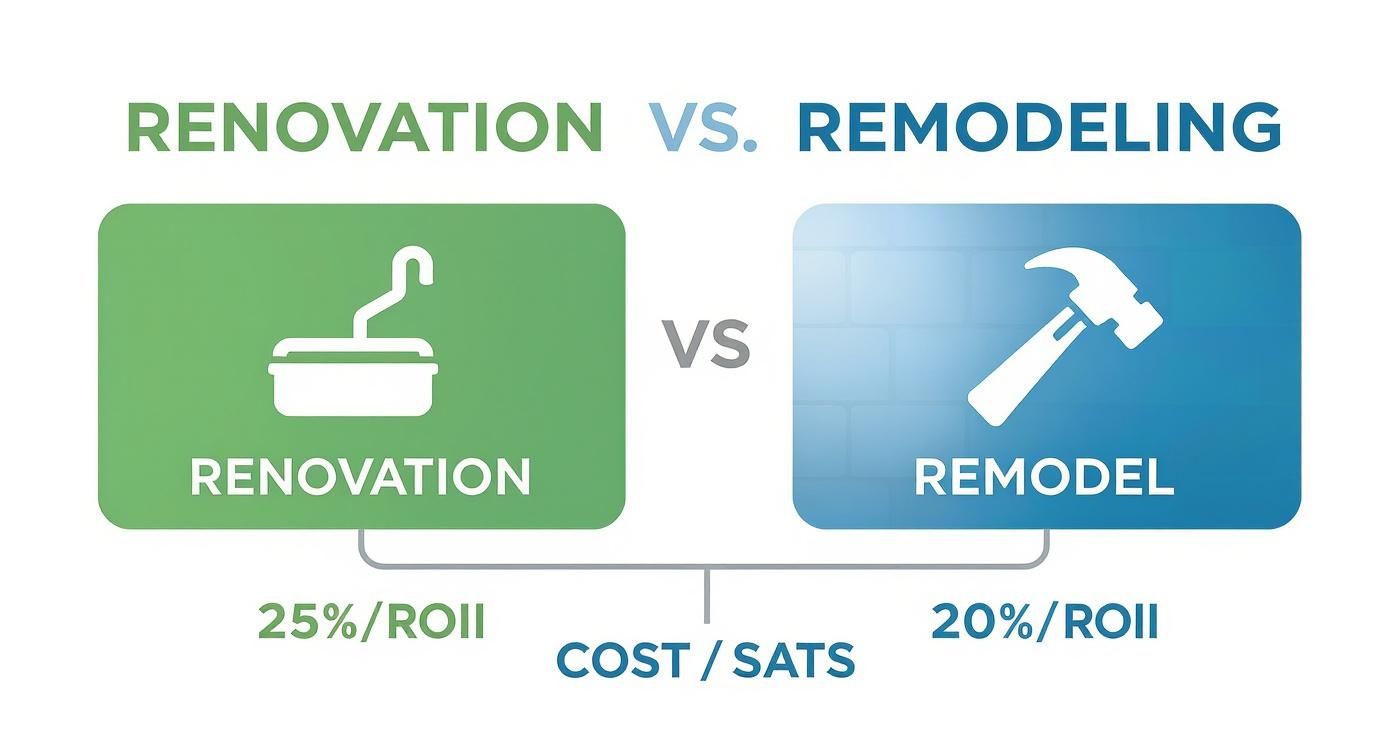
This visual guide really drives the point home: the right choice depends entirely on whether you need to restore what you already have or completely change its function and form.
Answering Your Top Renovation and Remodeling Questions
Even when you know the difference between renovating and remodeling, a lot of practical questions pop up. Getting these details right is crucial for planning a project that doesn't spiral out of control, budget-wise or timeline-wise.
Let's dig into some of the most common questions we hear. Answering them will help you see how these concepts play out in the real world, so you can classify your own project and know what you're getting into.
Can a Project Involve Both?
Absolutely, and it happens all the time. Many large-scale commercial projects are actually hybrids of the two.
Imagine a developer taking an old, compartmentalized office building and remodeling it by knocking down interior walls to create a modern, open-concept workspace. After that major structural change, they’ll renovate the new layout with fresh paint, contemporary flooring, and updated light fixtures. The project is ultimately defined by whether the building's core structure or purpose was changed at any point.
Which One Adds More Value to a Property?
This is the million-dollar question, isn't it? Both can significantly bump up a property's value, but they do it in different ways.
A simple cosmetic renovation—think a new coat of paint or refacing kitchen cabinets—often gives you a fantastic return on investment (ROI) because the upfront cost is low. It's a quick, effective way to boost a property's appeal without a massive financial commitment.
On the other hand, a major remodel, like adding a new wing or completely reconfiguring a floor plan, can add more absolute dollar value. But because the initial cost is so much higher, the percentage ROI might actually be lower than a smaller, smarter renovation.
The most profitable path forward really comes down to what the market wants. You have to align your project's scope with what buyers or tenants in your specific area are actually looking for and willing to pay for.
Are Permits Always Required?
Permit rules depend entirely on your local building authority, and they can vary dramatically from one town to the next. As a general rule, simple cosmetic renovations that don't touch the structure or systems usually don't need a permit.
However, almost any remodeling work that involves altering structural walls, moving plumbing, or rerouting electrical systems will require one. This isn't just red tape; it's a critical step to ensure the work is safe and up to code. Always check with your local building department before starting anything. It's the best way to avoid expensive fines and frustrating delays down the road.
Navigating the complexities of a commercial remodel or adaptive reuse project requires expert guidance. At Sherer Architects, LLC, we specialize in transforming properties to meet modern demands while honoring their unique character. Let's discuss how to bring structure to your vision.