SHERER ARCHITECTS

Categories
Uncategorized

how to apply for historic preservation grants: quick guide

Before you ever type a single word of a grant application, there’s some critical homework to do. Think of this as the foundation work. A winning application isn’t just well-written; it’s built on a rock-solid understanding of your project’s story, its official standing, and the funding sources that actually make sense for it.

Laying the Groundwork for Your Grant Application

Too many grant applications get rejected right out of the gate, not because the project is bad, but because the prep work was flimsy. It’s easy to get excited about the restoration itself, but you have to move from a vague idea like "fix up this old place" to a specific, compelling, and—most importantly—fundable project.

The first thing you need to nail down is the "so what?" Why does this specific building matter? Grant reviewers see hundreds of applications. Yours needs to stand out by showing a real, tangible connection to your community's heritage. Was it designed by a well-known local architect? Does it represent the last vestige of a certain building style in your town? Maybe a significant historical event happened right on the front steps. Answering these questions is how you start building your case.

What’s Your Property’s Story? Defining its Historical Significance

Every single grant application you write will live or die by its Statement of Significance. This isn't a dry history report; it's the heart and soul of your pitch. You're telling the story of your property and explaining why it deserves to be saved.

For instance, saying a building was "built in 1890" is a fact, but it's not a story. A much stronger angle would be to frame it as "one of only three remaining examples of commercial Romanesque Revival architecture in the original downtown, built during the city’s post-railroad boom." See the difference? That context gives the project an undeniable sense of urgency and importance.

Check Your Property's Official Status

Next up, you need to figure out your property's official designation. This is a big one. For many state and federal grants, having a specific listing is non-negotiable.

  • National Register of Historic Places: This is the gold standard. Being on the official federal list opens up the most funding doors.
  • State or Local Register: Don't overlook these! Many states and even cities have their own historic registers that qualify you for specific local grant programs.
  • No Designation? If your property isn't listed anywhere, don't panic. Your first step might be to get it nominated. In fact, some smaller planning grants exist specifically to help fund that nomination process.

Knowing where you stand on these lists is key because it dictates which grants you can even consider applying for.
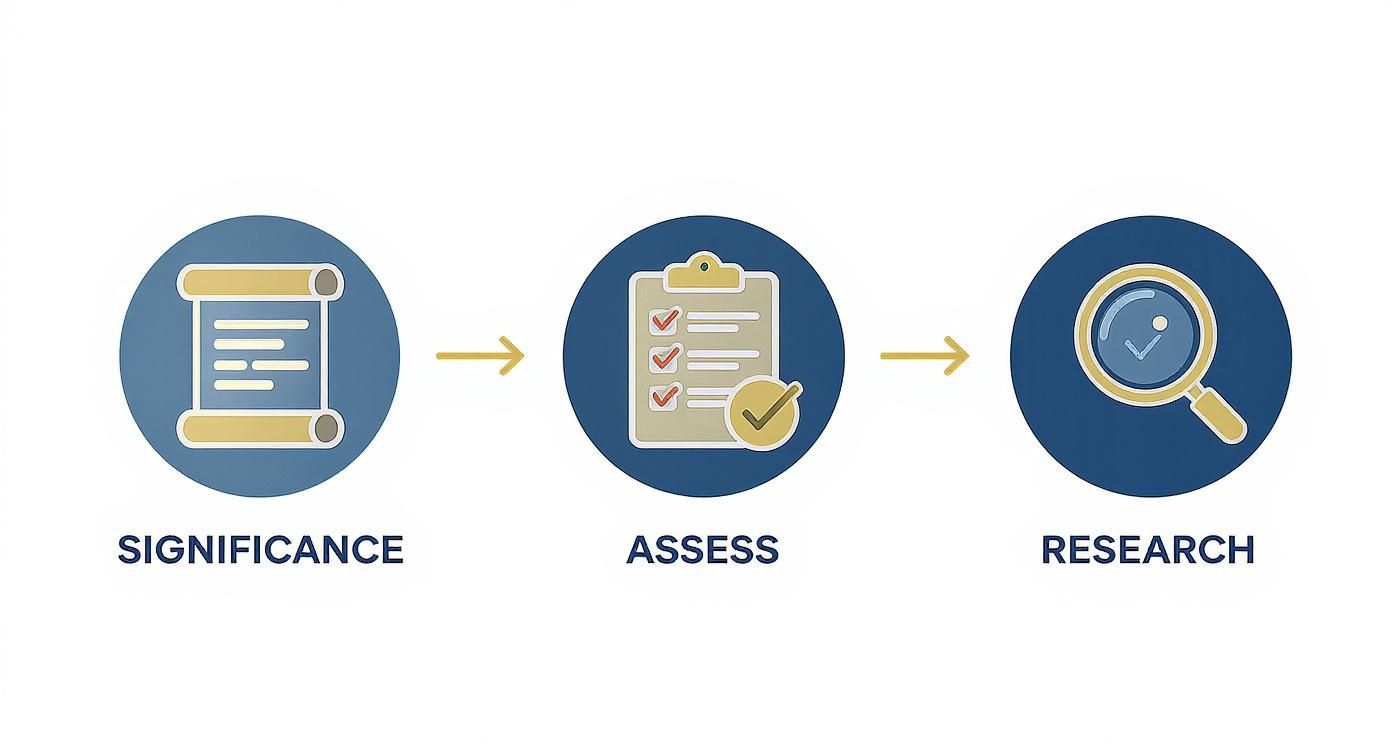
Three-step process workflow showing significance, assess, and research stages with scroll, checklist, and magnifying glass icons

This simple workflow—Significance, Assess, Research—is a tried-and-true method. Each step builds on the last, so by the time you're ready to write, you have a clear, defensible project.

Start Surveying the Grant Landscape

Finally, it’s time to start looking at what's out there. The world of preservation funding is incredibly varied, from massive federal programs to tiny foundations focused on a single county. It’s a competitive field. Just look at the U.S. Historic Preservation Fund (HPF), which recently had appropriations of nearly $189 million for a single fiscal year. Those funds, managed by the National Park Service, get distributed across all kinds of state, tribal, and local grant categories. You can dig into the specifics by checking out the HPF statistical reports and funding data on the NPS website.

One of the biggest mistakes I see people make is taking a shotgun approach—applying for every grant they can find. You’ll burn yourself out. Be a sniper. Focus your energy only on the opportunities that are a perfect match for your project’s scope, budget, and story. A targeted approach will always win.

Finding the Right Grant for Your Preservation Project

So you have a preservation project. The first question is always: where does the money come from? The world of grants can feel overwhelming, but the secret isn't applying for everything you see—it's about smart, targeted research.

A nonprofit saving an old downtown theater and a county trying to restore its historic courthouse are playing in different sandboxes. Your project's ownership, scale, and specific needs will point you toward the right funding streams. Don't waste time casting a wide net; a focused strategy is what wins grants.

Person researching historic preservation grants on laptop while reviewing archival documents and taking notes

Start with State and Federal Programs

For most people, the grant journey begins with public money. These are typically the largest grants available, but they also come with the most paperwork and the strictest rules. You have to play by their game.

Your first call should always be to your State Historic Preservation Office (SHPO). Every state has one, and they are the primary gatekeepers for federal dollars flowing from the Historic Preservation Fund (HPF). Think of them as your guide. They don't just administer grants; they offer invaluable technical advice that can make or break your application.

Beyond the SHPO, a number of federal agencies offer direct grants. In the U.S., more than 10 federal agencies, from the National Park Service to the National Endowment for the Arts, have preservation-related programs. Another well-known source is the Daughters of the American Revolution (DAR), which funds a wide range of projects. Just remember, these big players have rigid deadlines, so you need to plan months, sometimes even a year, in advance.

Here are the heavy hitters in government funding:

  • Historic Preservation Fund (HPF) Grants: This is the bedrock of public funding. The National Park Service funnels this money to the SHPOs, who then grant it out for state and local projects.
  • Certified Local Government (CLG) Grants: Is your town or county a designated CLG? If so, you've got access to a dedicated pot of money. Since 2001, just in Maryland, the CLG program has invested over $2.4 million in local projects.
  • Save America's Treasures Grants: These are the big leagues. We're talking highly competitive, high-dollar grants for nationally significant properties.

Exploring Private Foundations and Niche Grants

Don't overlook private money. Foundations often offer smaller grants, but they come with far more flexibility and can fill crucial funding gaps. These are the specialists.

You'll find foundations that only fund the restoration of rural churches, others that focus on historic theaters, and some dedicated to preserving sites related to a specific community's heritage. Digging into databases like Candid’s Foundation Directory Online is how you uncover these hidden gems that most people miss.

A targeted search is everything. I once worked on a project to restore a historic firehouse. We were struggling with a funding gap until we discovered a small, family foundation dedicated to honoring first responders. Our project fit their mission perfectly, and they became a key funder.

As you look for historic preservation grants, it’s a good idea to also explore various funding options. Sometimes a combination of grants, loans, and other financing is the most effective approach.

Matching Grant Sources to Your Project Needs

To build a smart search strategy, you have to know who funds what. The table below is a practical comparison to help you identify the best funding source for your specific preservation goals.

Matching Grant Sources to Your Project Needs

Grant Source Typical Recipient Project Focus Average Grant Size
Federal (NPS/HPF) SHPOs, CLGs, Nonprofits Large-scale restoration, surveys, planning $50,000 – $500,000+
State (SHPO) Nonprofits, Municipalities, Private Owners Brick-and-mortar repair, architectural plans $10,000 – $100,000
Local (CLG) Property Owners in CLG communities Facade improvements, roof repair, planning $5,000 – $25,000
Private Foundations Mostly Nonprofits Varies widely by foundation's mission $2,500 – $50,000

This table shows you the general landscape. A museum planning a multi-million dollar restoration should be looking at a Save America's Treasures grant. A homeowner needing to restore original wood windows in a historic district should start with their local CLG program.

By identifying the right category from the get-go, you instantly improve your chances of finding a funder who is genuinely excited about your project.

Pulling Together a Winning Grant Application

Think of your grant application as the ultimate sales pitch for your project. Reviewers are buried under a mountain of proposals, so yours has to do more than just check the boxes. It needs to be sharp, persuasive, and perfectly organized to tell a story that makes them want to fund you.

A rookie mistake is treating the application like a homework assignment. You're not just filling in blanks. You're building a case, piece by piece, that your project is vital, urgent, and—most importantly—achievable. Every single document, from the historical narrative to the budget spreadsheet, has to hammer home that same message.

Crafting a Powerful Statement of Significance

This is where you bring your building to life. The Statement of Significance is your chance to connect the bricks and mortar to a bigger, more meaningful story. Grantors aren't just paying for repairs; they're investing in the tangible history and identity of a community.

A weak statement just says, "This building is old." A strong one shows the reviewer why its age matters. Don't just say it was a general store. Explain how it served as the social and economic heart of a rural town for a century, using details from original ledgers or stories from locals to prove it.

Your statement absolutely must answer these questions:

  • What’s the historical context? Link the property to local, state, or even national events and trends.
  • What makes it architecturally special? Is it a rare example of a specific style? Was it designed by a well-known architect?
  • Who are the people connected to it? Did important figures or groups live, work, or meet here?
  • Why does it matter culturally? Does it hold a special meaning for a particular community or group?

Your Statement of Significance should be a story backed by hard evidence. It’s not just about what happened inside the walls, but how those events shaped the world outside. Make the reviewer feel the loss if that story were to disappear.

Laying Out a Professional Treatment Plan

Okay, you’ve convinced them the place is important. Now you have to show them you know how to fix it. A fuzzy or unprofessional treatment plan is a massive red flag for funders. They need to see a clear, well-defined scope of work that’s rooted in sound preservation practices.

The gold standard here is a Historic Structures Report (HSR). This is a deep-dive document that analyzes a building's history, details its current condition, and lays out a professional plan for its restoration. While a full HSR can be pricey, many grantors will accept a more focused "conditions assessment and treatment plan" from a qualified preservation architect or contractor.

Make your plan easy for a layperson to grasp. Use clear headings, annotated photos, and architectural drawings to show what you're planning. For example, don’t just write "repair roof." Get specific: "Replace 300 square feet of deteriorated slate shingles in-kind on the south-facing slope, using salvaged slate where possible, and install new copper flashing…" See the difference?

Getting the Project Budget Right

This is where so many good applications go to die. A sloppy budget screams "bad planning" and can sink your proposal before it even gets a serious read. Your numbers need to be detailed, realistic, and completely justified.

Get rid of round numbers. A line item for "$10,000 for masonry repair" looks like you pulled it out of thin air. But an entry for "$9,750 for repointing 650 square feet of the north facade using Type N mortar, based on a quote from Acme Preservation" proves you've done the legwork.

Break your budget down into logical chunks:

  1. Pre-Development Costs: This is for the planning work—architectural drawings, engineering studies, permit fees.
  2. Hard Costs (Construction): The actual hands-on work. List specific tasks like foundation repair, window restoration, or HVAC updates.
  3. Soft Costs (Administration): The overhead. Think project management, insurance, and legal fees.
  4. Contingency: This is non-negotiable. Always budget a contingency of 10-15% of your hard costs. Trust me, you’ll need it for the surprises that always pop up.

Finally, back everything up with strong supporting documents. You'll need high-quality photos (before, during, and after shots are fantastic if you have them), architectural plans, and, critically, letters of support. Getting letters from community leaders, elected officials, and partner organizations shows the grant committee that this isn't just your pet project—it's a valued community asset.

The Review Process and the All-Important Matching Funds

Once you’ve hit 'submit,' your grant application begins its journey. This isn’t the end; it's the start of a formal review process where your proposal will be judged by people who have seen it all before. Knowing what happens behind the scenes can help you manage expectations and prepare for what's next.
Grant package folder with pen and application documents on outdoor table for historic preservation funding

First, your application usually lands with the staff at the granting organization, like your State Historic Preservation Office (SHPO). They'll do an initial once-over to make sure it's complete and meets the basic eligibility rules. Think of it as a gatekeeper check.

From there, it goes to a review committee. This group is typically made up of seasoned architects, historians, and community leaders who will score your application against a very specific set of criteria.

Why Your Match is More Than Just Money

One of the most heavily weighted criteria? Your ability to come up with matching funds. It's rare for a preservation grant to cover 100% of your project cost. Funders want to see that you have skin in the game. A 1:1 match is standard, meaning you need to secure a dollar from another source for every dollar they give you.

Frankly, this is where many promising applications stumble. The competition is fierce. The National Trust for Historic Preservation, for instance, often gives grants around $25,000 (capping out at $50,000) for planning and educational projects. With so many applicants vying for limited funds, a solid plan for your match shows you're financially serious and gives your proposal a major boost. If you want a real sense of the competition, you should understand how to make your preservation funding application stand out.

Grant reviewers look at a strong matching funds plan as a sign of community buy-in and overall project health. If you can’t rally local support, they'll question if the project is as vital as you say it is. It's less about the cash itself and more about the momentum it proves you have.

Getting Creative with Your Match

Don't let the match requirement intimidate you—you don't necessarily need a pile of cash sitting in the bank. Grantors know that resources can be tight, which is why they usually allow a combination of cash and "in-kind" contributions. This opens up some really effective ways to build your match.

Here are a few strategies I've seen work time and again:

  • A "Buy-a-Brick" Campaign: Small, grassroots fundraising efforts are perfect. They not only bring in cash but also create a dedicated group of locals who are emotionally and financially invested in your success.
  • "Stacking" Smaller Grants: This is a smart move. Use a confirmed grant from one foundation as the matching funds to apply for another. It shows other funders that your project has already been vetted and approved elsewhere.
  • Documenting In-Kind Contributions: This is a powerful, yet often overlooked, tool. In-kind matches are simply non-cash contributions like professional services, volunteer labor, or donated materials.

Valuing and Documenting In-Kind Support

The trick with in-kind support is to value and document it properly. If a preservation architect donates 20 hours of their time to draft drawings, that's a legitimate contribution. You document it by calculating the value of their services at their standard hourly rate.

Here’s what that looks like in the real world:

  • Professional Services: An architect donates their time, a lawyer reviews contracts pro-bono, or a marketing expert helps with your fundraising campaign.
  • Volunteer Labor: If community members show up for a clean-up day or help with non-specialized painting, you can value their hours at the state's official volunteer labor rate.
  • Donated Materials: A local lumberyard gives you historically accurate wood, or a paint store provides the right kind of primer. These are counted at their fair market retail value.

By mixing cash fundraising with meticulously documented in-kind support, you can build a powerful matching funds package. It not only meets the grant requirements but also proves your project has the broad community backing it needs to truly succeed.

Avoiding Common Grant Application Mistakes

You've spent months pulling everything together. The research, the plans, the budget—it's all there. But after all that work, a simple, avoidable mistake can be the thing that lands your application in the "no" pile. It’s rarely the obvious stuff like missing a deadline; the most damaging errors are often far more subtle.
Two people exchanging cash at outdoor table with donation jar for matching funds program

Trust me, experienced grant reviewers can spot a half-baked application from a mile away. They’re looking for well-conceived projects with a clear path to success. Little inconsistencies or vague language can suggest a project isn’t fully thought out, making it seem like a risky investment for them. Let's walk through some of the classic trip-ups I've seen over the years so you can catch them before you hit "submit."

The Unfocused Project Scope

One of the fastest ways to lose a reviewer is with a project scope that’s either too vague or wildly ambitious. This usually comes from a place of passion—you want to fix everything!—but to a funder, it just looks like poor planning. It screams, "I haven't really thought through the nuts and bolts of this."

For example, don't just say your goal is to "restore the historic community hall." That's an idea, not a plan.

Get laser-focused instead. A much stronger proposal would define the scope as: "Phase 1 restoration of the community hall, focused on structural stabilization of the west wall, replacement of the cedar shake roof in-kind, and restoration of 12 original double-hung wood windows." Now that sounds like a concrete, actionable plan that can realistically be done on time and on budget.

I see this all the time: applicants try to do everything at once. Funders would much rather back a successful, well-defined Phase 1 than pour money into a sprawling, multi-year effort that might never see the finish line. Bite-sized, achievable phases are always more fundable.

Understanding common pitfalls and traps to avoid is crucial whether you're seeking grants or crowdfunding. The core principles of clear communication and realistic goals are universal.

A Budget That Raises Red Flags

Your budget isn’t just a spreadsheet; it’s the financial story of your project, and it absolutely must match your narrative. An unrealistic budget—whether it’s inflated or suspiciously low—is an immediate warning sign for any seasoned reviewer. It tells them you haven't done your homework.

Here are a few budget blunders that can sink an otherwise good application:

  • Using Round Numbers: A budget full of clean estimates like $20,000 for plumbing or $50,000 for masonry looks like guesswork. It signals you haven’t gotten actual quotes from qualified contractors.
  • Forgetting the Contingency: Old buildings are notorious for surprises. If you don't include a contingency line item of at least 10-15% of your construction costs, it shows a lack of real-world experience.
  • No Justification for Costs: Your numbers need a narrative. Why did you pick that contractor? How did you calculate the material costs? Explain the "why" behind the numbers.

Weak Arguments and Missing Support

Finally, a lot of applications fail because they don’t make a powerful case for why the project matters and who is behind it. Your passion for the building is essential, but you have to translate that feeling into a compelling argument backed by solid evidence.

A weak Statement of Significance is a killer. You have to connect your property to broader historical themes and clearly spell out its architectural or cultural value. Just saying it's old isn't nearly enough.

Just as damaging is a lack of community buy-in. An application that arrives without strong letters of support from local officials, community organizations, and neighborhood leaders feels like it exists in a vacuum. Grantmakers want to invest in projects the whole community values, not just one person. That collective backing proves your project is a shared priority with a much better shot at long-term success.

Your Questions About Preservation Grants Answered

Navigating the grant application process can feel like you're trying to solve a puzzle with a few pieces missing. It’s completely normal to have questions swirling around—about how long this will all take, what the money can really be used for, and what happens if you get a "no."

Let's clear the air on some of the most common questions I hear from property owners. Getting these answers straight from the start will save you a lot of headaches down the road.

How Long Does the Historic Preservation Grant Process Take?

The honest answer? Longer than you think. In the world of preservation funding, speed is not part of the equation. From the day you start your research to the moment funds actually hit your bank account, you should realistically budget for a 6 to 18-month timeline, and sometimes even up to two years.

Federal and state grant cycles have a predictable, albeit slow, rhythm:

  • The Application Window: You'll typically have a two- to three-month period to submit your proposal.
  • The Review Period: This is the long wait. After the deadline, it can take anywhere from four to six months for committees to review, score, and rank all the applications.
  • The Announcement: Finally, notifications go out, and grant agreements are drawn up.

The big takeaway here is that you have to plan way ahead. Grants are a strategic tool for a future project, not a quick fix for an immediate cash-flow problem.

Can I Use Grant Money to Buy a Historic Property?

This question comes up all the time, and the answer is almost always a firm no.

The vast majority of preservation grants are earmarked for the physical work of saving a building you already own or have legal control over. Think of it as funding for restoration, rehabilitation, or stabilization—the "doing" part of preservation.

Funders want to see their money go directly into the bricks and mortar: fixing a leaking roof, restoring original wood windows, or shoring up a failing foundation. The funds to actually purchase a historic property come from entirely different pots of money, like:

  • Specialized loan programs from preservation nonprofits
  • Land trusts or conservancies
  • Traditional bank financing or private investment

Grants are for implementing the preservation plan, not for acquiring the property itself.

Rejection is not a dead end; it's a detour with a map. The feedback from a rejected application is often the very thing you need to succeed the next time around. If reviewer comments are available, treat them like gold—they are your roadmap to a stronger proposal.

What Should I Do If My Grant Application Is Rejected?

First, take a deep breath and don't take it personally. The grant world is incredibly competitive. There are always more fantastic projects than there is money to go around, and sometimes a rejection is simply a matter of a slight mismatch with that year's specific priorities.

The most critical thing you can do is turn it into a learning experience.

If the funding agency offers feedback, ask for the reviewer's comments immediately. This is, without a doubt, the most valuable tool you have. Those notes will pinpoint exactly where your application fell short. Was the budget unclear? Was the scope of work too ambitious? Was the statement of significance not compelling enough? Use that direct, honest feedback to rework your proposal and come back stronger in the next cycle.

Is Hiring a Professional Grant Writer Worth It?

For large, complex federal grants like Save America's Treasures, it can absolutely be a game-changer. An experienced grant writer understands the nuances and speaks the specific language that reviewers are looking for. They know how to frame a project to align perfectly with a funder's mission and can help you avoid common but critical mistakes.

That said, you don't always need a pro. For many smaller state or local grants, a well-organized person with strong writing skills and a passion for the project can definitely pull off a winning application. The secret is meticulous attention to detail. Follow every single instruction, answer every question completely, and let your genuine enthusiasm for saving your building shine through.


At Sherer Architects, LLC, we've spent decades helping property owners navigate the intricate world of historic preservation, from the initial building assessment all the way through the grant and tax credit process. We know how to build a compelling case for your project to give you the best possible shot at securing funding. Learn more about how we can help you reach your preservation goals at https://shererarch.com.
Categories
Uncategorized

how to apply for historic preservation grants: Quick guide

Finding the money to bring a historic property back to life is often the biggest hurdle. It’s a process that demands a smart strategy, rock-solid documentation proving your building's worth, and an application that tells a compelling story. It all starts with knowing where to look—and making sure your project is exactly what a funder wants to support.

Navigating the World of Preservation Funding

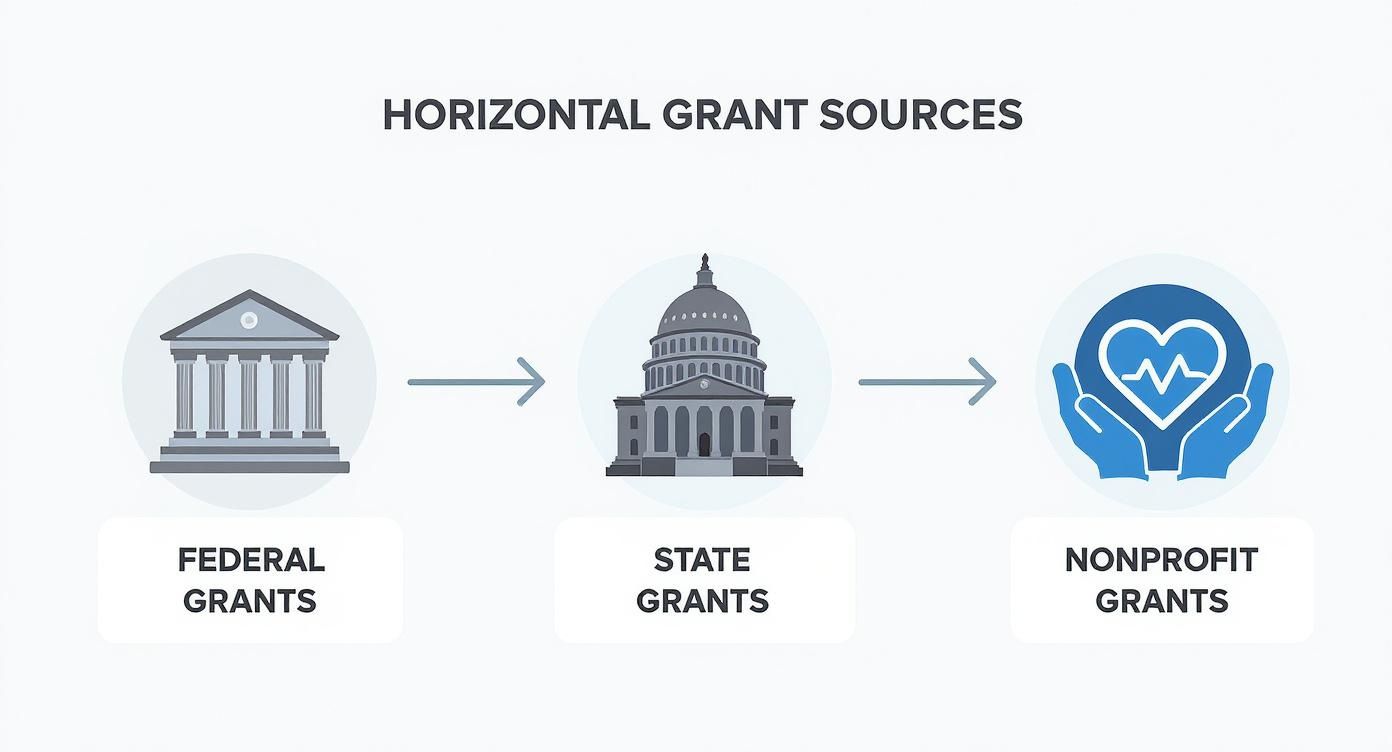
Before you even think about filling out an application, you need to get a lay of the land. The world of preservation grants can feel like a maze, but most funding flows from three main sources: federal agencies, state programs, and private nonprofits. Each operates differently, with its own mission, funding cycles, and pet projects. Not understanding this is probably the single biggest mistake applicants make, leading to a lot of time spent on applications that were doomed from the start.

Federal grants, often coming from big players like the National Park Service (NPS), can offer the largest awards. But they're also the most competitive. State-level funding, which you'll typically find through your State Historic Preservation Office (SHPO), is usually a bit easier to get and is focused on what matters locally. Then you have influential nonprofits, like the National Trust for Historic Preservation, which often fund very specific things like project planning, educational programs, or advocacy work.

Finding the Right Funder for Your Project

The secret is simple: match what you need with what a funder wants to accomplish. A grant program dedicated to architectural surveys isn't going to pay for your new roof, no matter how badly you need one.

  • Federal Grants: These are the heavy hitters, often fueled by the Historic Preservation Fund (HPF). Think big—projects with national significance or major rehabilitation efforts.
  • State Grants: Your SHPO is your best friend here. They manage funds that help with everything from restoring a Main Street storefront to documenting a local historic district. They're your go-to for most hands-on projects.
  • Nonprofit and Local Grants: Don't overlook these. They're often the perfect fit for smaller, community-centered work. A local foundation could be the ideal partner for restoring the windows on a neighborhood landmark or creating new interpretive signs.

This flowchart breaks down how these different funding streams typically operate and interact.

Horizontal grant sources flowchart showing federal grants, state grants, and nonprofit grants with directional arrows

As you can see, the pathways often connect. Federal money frequently trickles down to state agencies, which then fund the on-the-ground work in your community.

Understanding the Financial Landscape

The grant process in the U.S. is well-established but fiercely competitive. Annually, more than $1 billion in grant funding is directed toward historic preservation efforts across the country. To put that in perspective, the Historic Preservation Fund (HPF), administered by the NPS, allocated nearly $189 million in fiscal year 2024 alone to support everything from documentation and planning to the actual "bricks and mortar" restoration work.

Key Takeaway: Success isn't just about having a worthy project; it's about presenting that project to the right audience. Researching a funder's past awards is one of the best ways to gauge if your proposal is a good fit.

To give you a clearer picture, here’s a quick rundown of the major players and what they typically look for.

Key Grant Sources and Their Primary Focus

Funding Source Type Primary Administrator(s) Typical Project Focus Common Applicant Type
Federal National Park Service (NPS) Large-scale restoration, surveys, disaster relief, major national landmarks SHPOs, Tribal Historic Preservation Offices (THPOs), Certified Local Governments (CLGs)
State State Historic Preservation Office (SHPO) Building rehabilitation, historic structure reports, local district nominations, community planning Nonprofits, municipalities, private property owners, CLGs
Nonprofit/Private National Trust for Historic Preservation, local foundations, community trusts Planning grants, feasibility studies, educational programs, smaller "bricks-and-mortar" projects 501(c)(3) organizations, community groups, municipalities

This table shows why it's so crucial to target your application. A private owner restoring a historic home will have more luck with their SHPO, while a city government trying to survey a large historic district might look to federal pass-through funds.

Finally, remember that preservation grants rarely cover 100% of a project's cost. It's wise to get familiar with the broader financial world by exploring various funding options, including grants that can help you pull together the required matching funds or cover expenses that your preservation grant won't.

Laying the Groundwork for a Winning Application

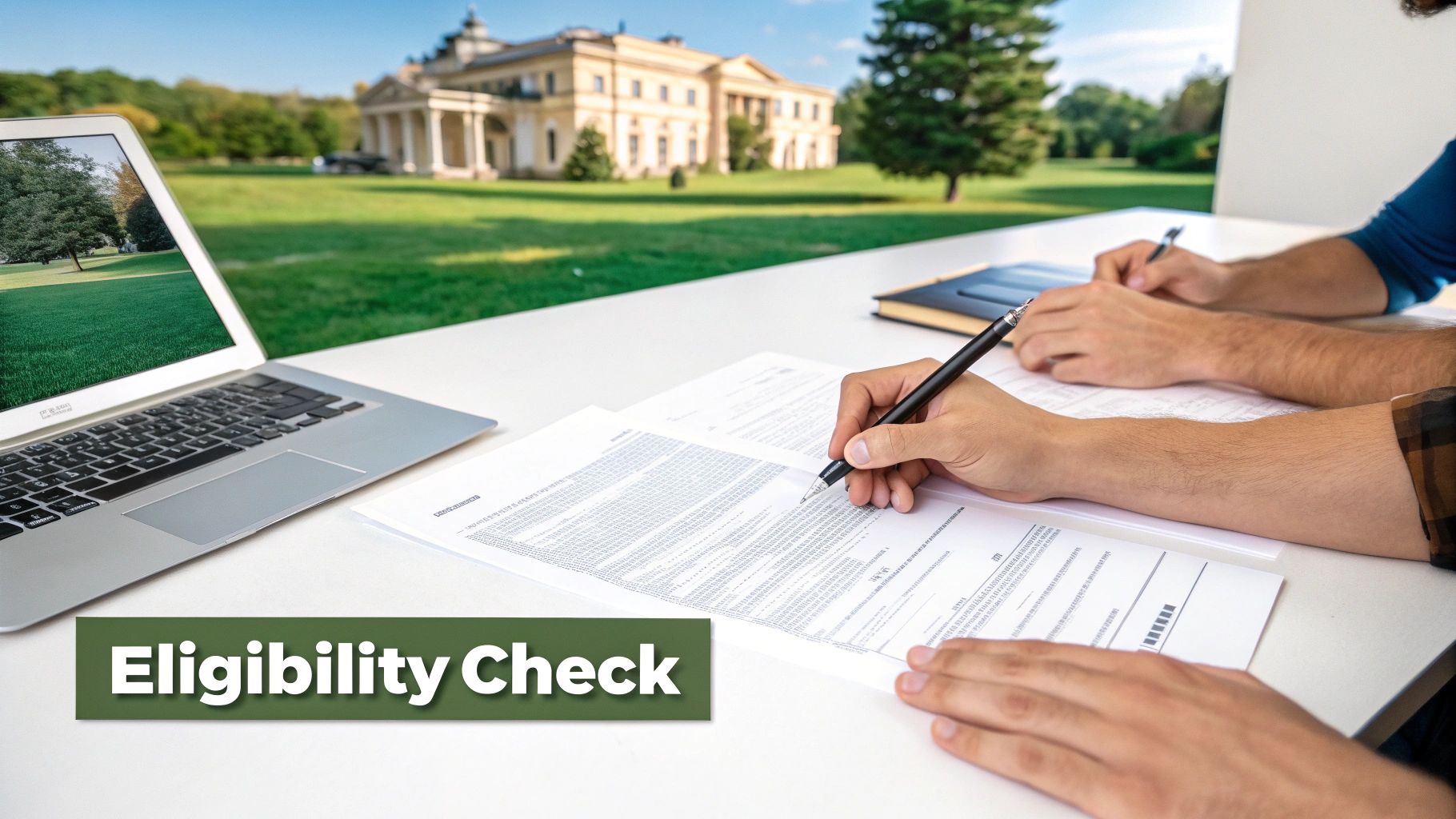
Two people reviewing historic preservation grant eligibility documents outdoors with laptop and paperwork

The secret to a successful grant application isn't just in the final submission—it’s in the meticulous preparation you do months before a deadline is even announced. This is where the real work happens, separating the projects that get funded from those that end up in the "no" pile.

Think of this as setting the stage. Getting your ducks in a row now means you're not scrambling later. It’s all about confirming your eligibility, building the right relationships, and nailing down the specifics of your project.

Step Zero: The Eligibility Check

Before you pour dozens of hours into writing, you have to be absolutely certain your project is eligible. This sounds basic, but you’d be surprised how many people trip up here. For most state and federal grants, everything hinges on one thing: official historic designation.

Typically, this means your property must be listed on the National Register of Historic Places. It can be listed individually or as a contributing building within a larger historic district. If it’s not, your first call should be to your State Historic Preservation Office (SHPO) to figure out the nomination process. Be warned: this can take a while, so don't wait.

The property is only half the equation; who you are also matters. Many grants are specifically for:

  • Nonprofit 501(c)(3) organizations
  • Government agencies like municipalities, especially those designated as a Certified Local Government (CLG)
  • Tribal Historic Preservation Offices (THPOs)

Private homeowners and developers do have options, particularly at the state level, but they are generally more limited. The takeaway? Read the funder’s guidelines with a fine-tooth comb to confirm exactly who can apply.

Make Friends with Your SHPO

Your State Historic Preservation Office (SHPO) is your single most valuable ally in this process. So many applicants treat the SHPO like a bureaucratic obstacle or a gatekeeper to get past. That’s a huge mistake. These are the experts who live and breathe preservation in your state, and they genuinely want to see good projects come to life.

Get in touch with them long before you plan to apply. Introduce yourself, your property, and what you’re hoping to accomplish. Ask for their initial take and see if they know of any programs that might be a good fit. This early conversation can steer you away from a dead end and give you priceless insight into what grant reviewers are really looking for.

One of the best pieces of advice I ever received was to treat the SHPO staff like partners. They see hundreds of applications and know what works. A ten-minute phone call with them can provide more clarity than ten hours of reading guidelines alone.

This kind of outreach does more than just give you information; it shows you're serious and professional. When your application eventually lands on their desk, a familiar name is always better than a complete unknown.

Define Your Project and Get Real Numbers

Grant reviewers don't fund vague ideas. "Fix the old theater" is a wish, not a project. You need to present a concrete, well-defined plan that has a clear beginning, middle, and end.

Start by getting professional cost estimates. This isn't the time for a back-of-the-napkin guess. You'll need to bring in architects, engineers, or preservation consultants who know their way around historic buildings. Their detailed estimates become the backbone of your budget and prove to funders that you’ve done your homework.

A solid project scope needs to be broken down into specific, actionable pieces:

  1. Condition Assessment: A thorough report on what’s wrong and why it failed.
  2. Proposed Treatment: A detailed plan for the repairs that follows established preservation standards.
  3. Project Timeline: A realistic schedule, from mobilization to final inspection.
  4. Detailed Budget: An itemized list of every single cost, from labor and materials to scaffolding and permit fees.

Putting in this level of detail up front demonstrates that you’re a capable manager of their money and that their investment will lead to a tangible, lasting preservation outcome.

Crafting a Compelling Grant Proposal

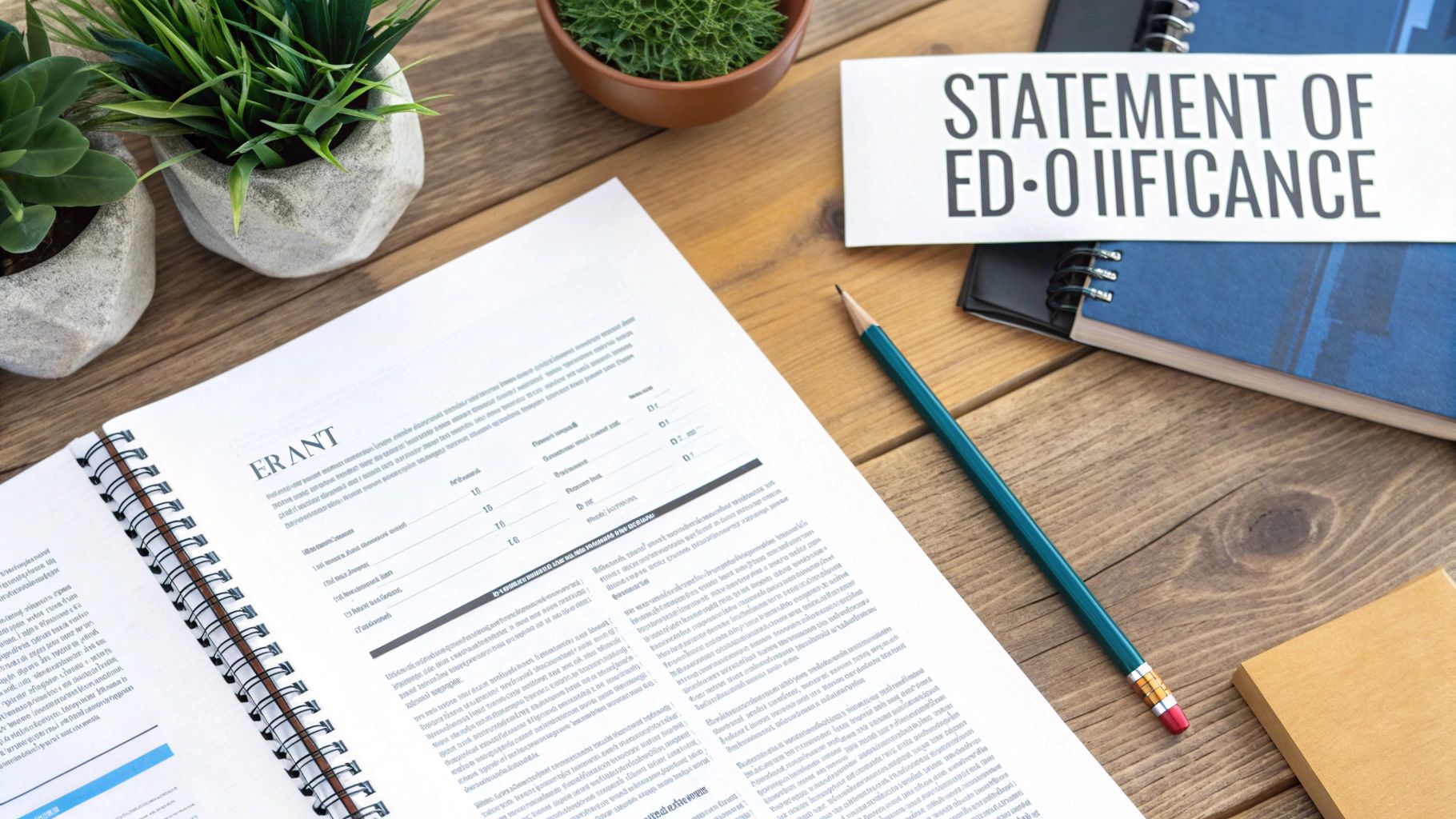
Statement of significance document for historic preservation grant application on wooden desk with plants

Alright, this is where all your legwork comes together to tell a persuasive story. Think of your grant proposal less like a stack of forms and more like a pitch. You need to convince a review committee, who sees dozens of these, that your project is not just important but a sound investment of their very limited funds.

The three main pillars—the Statement of Significance, the Preservation Plan, and the Budget—can't exist in silos. They have to weave together, each part reinforcing the others to build an undeniable case for your project.

Telling Your Story in the Statement of Significance

This is the heart and soul of your application. The Statement of Significance needs to answer one critical question: "So what? Why does this place matter?" The most common mistake I see is people just listing historical dates or architectural jargon. That's a fact sheet, not a story. It won't move anyone.

Your real job here is to connect the bricks and mortar to a living, breathing community need. How did this building anchor the neighborhood? What pivotal events took place within its walls? Who are the people whose stories are tied to this place?

To really make an impact, your statement should hit these points:

  • Architectural Value: Explain what makes the building special. Is it a rare example of a certain style? Does it feature unique construction techniques?
  • Historical Association: Draw clear lines connecting the property to important people, events, or movements in your town, state, or even national history.
  • Community Impact: This is crucial. Describe the building's role in your community's identity and, more importantly, how bringing it back to life will benefit the public today.

A great proposal tells a story that sticks with the funders. Brushing up on powerful storytelling strategies for nonprofits can make a huge difference in how your application is received.

Detailing Your Methods in the Preservation Plan

If your Statement of Significance is the "why," then the Preservation Plan is the "how." This is the technical document that proves you know what you’re doing. It’s where you show the review board you have a professional, well-reasoned approach for the hands-on work.

Your plan needs to be specific, methodical, and—this is non-negotiable—it must align with the Secretary of the Interior’s Standards for the Treatment of Historic Properties. These standards are the bible of preservation work. Referencing them signals that you're committed to doing the job correctly.

A solid plan will always include:

  • A clear description of the property's current condition, supported by high-quality, well-labeled photos.
  • A step-by-step breakdown of the proposed work for each part of the building (e.g., roof, windows, masonry).
  • A solid justification for why you chose these specific treatments.
  • An outline of the materials and methods you intend to use.

Pro Tip: Don’t try to write this in a vacuum. A preservation architect or a qualified historic contractor is your greatest asset here. Their input not only makes the plan technically sound but also gives it immediate credibility with the review committee. It shows you're taking a professional approach right from the start.

Building a Transparent and Trustworthy Budget

Your budget is where the rubber meets the road. It has to be detailed, easy to understand, and perfectly in sync with your Preservation Plan. A vague or poorly researched budget is one of the quickest tickets to the rejection pile.

Every single line item needs to make sense. Don't just put "Window Repair – $50,000." Break it down into something like, "Scrape, prime, and reglaze 25 historic wood windows at $1,800/window" and "Install historically appropriate storm windows at $200/unit." That level of detail shows you’ve done your homework and builds trust.

And don't forget to clearly document your matching funds. Almost every grant requires you to have some skin in the game. This can be:

  • Cash Match: Money from your own reserves, a loan, or even another grant.
  • In-Kind Contributions: The documented dollar value of donated professional services (like an architect's time), materials, or skilled volunteer labor.

Showcasing both types of matching funds proves your project has broad support and isn't entirely dependent on this one grant.

Knowing your funder helps, too. For instance, the National Trust for Historic Preservation often funds nonprofits and public agencies for planning and educational projects. In the 2023-2024 cycle alone, the National Trust awarded over $1 million to 196 projects, often favoring those that could show how their work would get the community involved.

When you're finished, these three documents should tell one cohesive story: The building is significant, the plan to save it is sound, and the budget proves you can pull it off responsibly.

Assembling a Flawless Submission Package

Person organizing manila folders with documents preparing submission materials for grant application on white desk

You’ve poured everything into the narrative and meticulously crunched the budget numbers. Now it’s time for the final push: pulling it all together into a professional package that makes a reviewer's job as easy as possible. This is where the little details really matter—they signal that you’re competent and respect the funder’s process.

Don't let all your hard work get derailed by a simple technicality. A sloppy or incomplete submission can get your brilliant proposal tossed before anyone even reads it. Think of this stage as the final quality check, ensuring your application gets judged on its merits.

Gathering Your Essential Supporting Documents

Beyond your core proposal, you need a solid collection of supporting documents to back up your claims. These materials aren't just filler; they add layers of credibility and paint a complete picture of your project’s importance and viability.

One of the most persuasive things you can include is a strong set of letters of support. These letters prove your project isn't just an idea floating in a vacuum—it has real backing from key people in your community.

  • Who to ask? Think strategically. Reach out to your mayor, state representatives, the president of the local historical society, or even leaders of influential neighborhood associations.
  • What should they say? A good letter is specific. It needs to move beyond generic praise and clearly state why the project matters to that person or their constituents.

These endorsements show a grant committee that their investment will be valued by the entire community.

The Power of Visual Storytelling

Words can only do so much. High-quality photographs and clear architectural drawings are essential storytelling tools, not just optional attachments. They provide undeniable visual proof of your property’s condition, its historic significance, and why the work is so urgent.

Your visual documentation should be:

  • High-resolution: Grainy, poorly lit photos look unprofessional and can obscure important details.
  • Well-labeled: Every file needs a descriptive name (e.g., "North_Facade_Water_Damage.jpg") and should be referenced directly in your narrative.
  • Comprehensive: Include shots of the entire building in its setting, plus detailed close-ups of the specific areas you plan to work on.

This evidence helps a reviewer who has never laid eyes on your property understand exactly what you’re talking about. A sharp photo of crumbling mortar joints is infinitely more compelling than a paragraph trying to describe it.

Expert Insight: Never underestimate the power of a well-annotated "before" photo. Clearly marking areas of deterioration or specific architectural features helps the review committee quickly grasp the scope and necessity of your proposed interventions, connecting your budget directly to the visual evidence.

The Final Checklist Before You Submit

Before you hit that "submit" button or seal the envelope, one last methodical review is your best defense against common—and costly—errors. Every grant program has its own quirks and rules. For instance, many state and Certified Local Government (CLG) programs, which get their money from the federal Historic Preservation Fund (HPF), are notoriously strict on formatting. Since 2020, SHPOs have received an average of $57.7 million annually from the HPF, and they manage those funds with intense oversight.

Run through this practical checklist before you send anything:

  1. Read the Guidelines (Again): Match your final package against the funder’s instructions, item by item. Seriously.
  2. Check File Names and Formats: If you’re submitting online, stick to their exact naming conventions (e.g., "ProjectName_Budget.pdf") and required file types.
  3. Confirm All Signatures: A missing signature on a required form is an instant red flag and an easy reason for disqualification.
  4. Proofread Everything: Typos and grammar mistakes undermine your credibility. Get a fresh pair of eyes to look over the entire package.
  5. Verify Page Limits and Margins: Don’t let a simple formatting error knock you out of the running.

This final, careful pass is what separates the pros from the amateurs. It ensures your proposal is judged on its strength, not dismissed because of a preventable oversight. You’re showing the funder you are a thorough, reliable partner for their investment.

What Happens After You Click Submit

You’ve done it. Hours of research, writing, and painstaking budget calculations have all led to this moment. But hitting that "submit" button isn't the finish line—it's the starting pistol for the review phase. Let's walk through what actually happens behind the scenes so you know what to expect.

https://www.youtube.com/embed/Q_A22ukipwM

The first gate you have to pass is purely administrative. A program officer or staff member will give your application a quick once-over to make sure it’s actually complete. Did you sign everything? Are all the required attachments there? This is a simple pass/fail check, and it’s where a good checklist can save you from getting knocked out on a technicality before your project is even reviewed.

Navigating the Review Timeline

Once you've cleared the administrative check, your application moves into the real substance of the review. This is where a committee—usually a mix of preservation professionals, board members, and maybe even community stakeholders—gets to work. They'll score your proposal against the funder's specific criteria.

This part of the process can feel like a black box and requires a good dose of patience. The timeline can be anywhere from a few weeks to several months, depending entirely on the agency’s funding cycle and how many other applications they’re juggling.

The grant guidelines almost always publish a decision date. Mark it on your calendar and then try to put it out of your mind. Calling or emailing for constant updates before that date won’t do you any favors. However, if a program officer reaches out to you with a specific question, that's a great sign. It means they're digging into your proposal. Answer them promptly and clearly.

Understanding the Three Possible Outcomes

Eventually, the email or letter will arrive. It’s going to fall into one of three categories, and it helps to be mentally prepared for each one.

  • Awarded: The best news! You’ll get an official award letter spelling out the grant amount and what comes next. This isn't just free money; it's the beginning of a formal partnership.

  • Waitlisted: This is a good-but-frustrating outcome. It means your project was deemed worthy, but they ran out of funds before they got to you on the list. If another project doesn't move forward, you could get bumped up.

  • Rejected: No one likes seeing this, but don't take it personally. The competition for these grants is fierce, and fantastic projects get turned down all the time simply because there isn't enough money to go around.

Key Takeaway: A rejection is not a final judgment on your project's merit. Think of it as valuable data. The most persistent applicants I know have often applied two or three times, refining their proposal with feedback from each cycle before finally securing funding.

Your Next Steps After the Decision

How you respond matters, regardless of the news.

If you got the grant, your immediate focus shifts to the grant agreement. This is a binding contract. Read it carefully with your team before signing, as it will detail everything from the project scope and reporting deadlines to how you'll get paid. Now is also the time to get your financial tracking in order.

Grant programs, especially major federal ones, require meticulous documentation. For example, the U.S. State Department’s Ambassadors Fund for Cultural Preservation awards grants from $70,000 to over $400,000 for projects around the globe and is known for its stringent reporting. You can read the complete findings on these global preservation grant requirements to get a sense of the high standards you'll need to meet.

If you’re waitlisted, send a brief, polite note thanking the program officer and confirming that your project is still ready to go.

If you were rejected, your single most important next step is to ask for feedback. See if the program officer can share the reviewers' comments. That feedback is pure gold—it’s your roadmap for strengthening your application for the next round.

Common Questions About Historic Preservation Grants

Even with the best roadmap, the path to securing funding can feel a bit murky. As you get into the weeds of how to apply for historic preservation grants, you're bound to have questions. Let's tackle some of the most common ones we hear from property owners and developers.

Think of this as your final briefing before diving in. Getting these details straight now can save you a world of headaches down the line.

What Are the Most Common Reasons Preservation Grant Applications Are Rejected?

Getting a rejection letter is tough, but understanding why it happened is the key to improving your next shot. Most rejections, I've found, boil down to a handful of issues that are almost always preventable.

The most straightforward reason is simple ineligibility. This could mean your property isn’t officially listed on the National Register, or maybe you, as a private owner, don't qualify for a grant that’s only open to nonprofits or government agencies. Another classic mistake is an incomplete application. Missing a signature or a single required document is the quickest way to land in the "no" pile before anyone even reads about your project's merits.

Beyond those technical knockouts, a weak "Statement of Significance" is a common stumbling block. If you can't build a strong, persuasive case for why your building matters and how its restoration serves the public good, your application just won't stand out. Finally, grant reviewers are pros at spotting financial wobbles—unrealistic budgets, vague timelines, or a poorly explained plan for your matching funds all signal a project that isn't fully baked.

Can I Use a Grant to Pay for Work I Have Already Completed?

This is a big one, and it trips up a lot of enthusiastic owners. The answer is almost always a hard no. Preservation grants are meant to fund future work, not to reimburse you for projects you've already paid for or even started.

The logic here is all about oversight and compliance. Grant agreements are legal contracts. They're put in place before work begins to ensure every single step—from mortar repair to window restoration—meets strict guidelines like the Secretary of the Interior’s Standards for the Treatment of Historic Properties.

A Word of Warning: Kicking off any construction before a grant is officially awarded and you have a signed contract in hand can make those expenses completely ineligible for funding. In some situations, it could even put your entire award at risk. Always, always wait for the official green light.

How Important Are Letters of Support and Who Should I Ask for Them?

Don't mistake letters of support for a simple formality. They're powerful proof that your project has real, widespread community backing. They act as a third-party endorsement, showing funders that their investment will be valued and celebrated by the people it’s meant to serve.

You’ll want to gather support from a diverse and influential group. Think strategically.

  • Elected Officials: Your mayor, city council members, and state representatives carry a lot of weight.
  • Community Leaders: The heads of the local historical society, a neighborhood association, or a downtown business district.
  • Relevant Experts: A school principal if your project has an educational component, or a prominent local business owner if it ties into economic revitalization.

The key to a great letter is specificity. A generic template is useless. The best letters are personal and clearly explain why the project matters to that individual and the community they represent.

What Is the Difference Between In-Kind and Cash Match Funds?

Most grants require you to have some "skin in the game," which they call a match. This shows the funder you’re just as invested in the project's success as they are. This match can come in two different flavors.

A "cash match" is exactly what it sounds like—real money you're putting toward the project. This can be cash from your organization's reserves, a bank loan, or funds from another donor earmarked for this purpose.

"In-kind match," on the other hand, is the documented value of non-cash contributions. This is a fantastic way to demonstrate community buy-in and resourcefulness. Common examples include:

  • Donated professional services (like an architect or engineer waiving a portion of their fees).
  • The market value of donated construction materials from a local supplier.
  • The value of volunteer labor, which many grant programs allow you to calculate at a specific hourly rate.

In my experience, a strong application often shows a healthy mix of both cash and in-kind support. It paints a complete picture of a project that is both financially sound and passionately supported by its community.


Navigating the world of historic preservation grants takes more than just filling out forms; it requires a deep understanding of what funders are truly looking for. At Sherer Architects, LLC, we have decades of experience guiding clients through this exact process. We help craft compelling narratives, secure approvals, and get the funding needed to bring historic properties back to life. Learn how our preservation expertise can help you succeed.