
So, what exactly is a real estate development feasibility study? Think of it as a comprehensive, boots-on-the-ground investigation to see if a proposed project can actually succeed. It’s the ultimate stress test for your idea, designed to answer one crucial question before you sink a single dollar into the ground: “Is this project actually worth building?”
Why a Feasibility Study is Your Project's Bedrock
Jumping into a development project without a proper feasibility study is like trying to navigate a ship in a storm without a compass. It's a huge gamble, and every unknown factor dramatically increases the risk of making a catastrophically expensive mistake. This structured analysis is the bedrock of your project, turning a promising concept into a solid, data-backed business plan.
This isn't just about ticking boxes. It’s a strategic deep dive that methodically picks apart every critical piece of your proposed development. By weaving together market trends, financial modeling, and a hard look at regulations, it gives you a clear, unvarnished picture of both the potential rewards and the hidden risks.
The Strategic Value of Early Analysis
The whole point is to give developers, investors, and lenders the confidence to green-light a project—or the critical insight needed to walk away from a bad deal. A thorough study uncovers potential deal-breakers early on, giving you time to pivot or solve problems before they can derail the entire project.
A well-executed feasibility study equips everyone involved with the clarity to make smart decisions, sidestep potential pitfalls, and ultimately transform a real estate vision into a profitable reality.
By identifying and putting a number on risks from day one, you can develop real strategies to manage them. This proactive approach is infinitely cheaper and less stressful than trying to put out fires halfway through construction. In short, the study moves you from guesswork to strategic confidence.
Core Questions a Feasibility Study Answers
At its core, this entire process is about finding clear, defensible answers to the make-or-break questions that will determine a project's fate. For a broader look at getting started, this smart project planning guide for real estate feasibility studies offers a helpful overview.
A solid analysis will always dig into these key areas:
- Market Viability: Is there a real, sustainable demand for what we want to build, right here, right now? Who are our buyers or tenants, and what do they want?
- Financial Soundness: Will the money coming in cover all the costs of building and running this thing, and still provide a return that makes the risk worthwhile?
- Legal & Regulatory Compliance: Does the project fit within the local zoning laws, land use plans, and environmental rules? Are we going to hit a wall of red tape?
- Site Suitability: What's the deal with the land itself? Are we facing challenges with soil quality, utility access, or the site’s physical layout?
Getting straight answers to these questions provides the proof you need to secure financing, bring on partners, and steer your project from a simple idea to a successful, completed development.
Gauging Market Demand and Economic Viability
Every successful real estate project starts with one simple, gut-check question: “Does anyone actually need this?” Before a single line is drawn or a spreadsheet is built, you have to prove there’s a real, measurable demand for what you want to build. This is the first, and arguably most important, hurdle in any real estate development feasibility study. It’s where a good idea starts to look like a smart investment.
This isn’t about confirming a vague need for “more housing” or “office space.” It’s about getting specific. If you’re planning luxury condos, you need to find a growing pocket of high-income earners who want to live there. If it's a new industrial warehouse, you'd better be able to point to a boom in local logistics or e-commerce that makes that space essential.
Digging into the Data
To make your case, you have to become a bit of a data detective. You’re looking for the hard evidence—the economic and demographic signals—that a community is primed for your project. This is how you move from a hunch to a bankable business plan.
Your investigation should cover:
- Demographic Trends: Is the local population growing? What's the mix of ages and average household incomes? A surge in young professionals might scream "new rental apartments," while a graying population could signal an opportunity for a senior living community.
- Employment Growth: A healthy job market is the engine of real estate demand. Are major employers moving in? Are certain industries expanding? Low unemployment and high job growth are powerful indicators that new people—and businesses—are on their way.
- Local Economic Indicators: Look beyond the big numbers. Are retail sales climbing? Are new business permits being issued? Is the city investing in new roads, parks, or public transit? These are all tell-tale signs of a community on the rise.
This data helps you forecast a critical metric: the absorption rate. That's just a fancy term for how quickly available properties in the area are being snapped up (sold or leased). A high absorption rate tells you that demand is strong and your project likely won't be sitting empty for long.
Sizing Up the Competition
No project is an island. A huge piece of your real estate development feasibility study involves a brutally honest look at who you’re up against. You need to know exactly who else is vying for your target tenants or buyers and figure out how your project is going to be different—and better.
Get ready to ask some pointed questions:
- What similar projects are already out there, and how full are they (what are their vacancy rates)?
- Is anyone else building something that will compete with you? Are there projects in the pipeline?
- What are they offering? Look at their amenities, finishes, and, most importantly, their price points.
- Where are they falling short? This is your opportunity. Maybe they lack modern amenities, have poor layouts, or are priced too high. Your project can be designed to fill that gap.
This competitive deep-dive helps you carve out your unique space in the market. It might reveal that nobody is serving the need for smaller, more affordable commercial units, or that there's a desperate shortage of family-sized rentals. That’s not just data; that’s your strategic advantage.
A strong market analysis does more than just list facts and figures. It weaves them into a compelling story that connects the dots between population growth, a booming economy, and the undeniable need for your specific project.
Thinking big is just as important as drilling down into local stats. Globally, the real estate market was valued at roughly USD 10 trillion in 2023 and is on track to hit USD 15 trillion by 2032, driven by massive urbanization and infrastructure investment. You can explore more about these global real estate trends to see the bigger picture. Your local analysis gains power when it's clear you understand how these larger forces are playing out on your home turf. By proving the demand is there, you lay the rock-solid foundation for the entire project.
The Seven Core Components of a Feasibility Study
A proper real estate development feasibility study isn’t just one big step; it’s a series of careful, deliberate investigations. Think of it like a master chef preparing a complex dish. They don't just throw ingredients in a pot. They source, prep, and test each component—the protein, the vegetables, the spices—to ensure the final meal is a success. A misstep with one ingredient can ruin the whole thing.
In the same way, a feasibility study methodically examines seven core components. When pieced together, they give you a complete, 360-degree picture of your project's real potential, turning a hopeful idea into a plan you can bank on.
Let's walk through this essential checklist.
1. Detailed Site Analysis
Before you even think about what you’re going to build, you have to understand the canvas you’re working on: the land itself. A detailed site analysis goes way beyond just looking up the address. It’s a deep dive into the physical reality of the parcel and all its quirks.
This involves digging into:
- Topography and Soil Conditions: Is the land flat as a pancake, or are you dealing with a steep slope? Are there hidden soil contamination issues or poor drainage that will send your foundation costs through the roof? A geotechnical report isn't optional here; it's critical.
- Utility Access: How easily can you hook into essential services like water, sewer, electricity, and gas? Having to extend utility lines a long distance can become a massive, unexpected expense if they aren't already at the property line.
- Accessibility and Infrastructure: We confirm how close the site is to major roads, public transit, and other key infrastructure. This directly impacts the property's value and how attractive it will be to future tenants or buyers.
2. Zoning and Regulatory Review
Imagine designing your dream building, pouring money into the plans, only to find out it's illegal to build it there. The zoning and regulatory review is what prevents that nightmare. This is where your vision crashes into the hard reality of local laws.
You need definitive answers to a few key questions:
- What, exactly, is this piece of land zoned for? What uses are permitted?
- Are there strict limits on building height, density (how many units you can build), or setbacks from the property line?
- What does the local entitlement process look like, and more importantly, how long will it take to get the permits you need?
Here in South Carolina, this phase often means navigating local Design Review Boards or historic preservation committees, which adds another layer of complexity and time. This review spots the bureaucratic hurdles early on, so you can either plan for them or decide they’re just too high to clear.
3. Conceptual Design and Space Planning
Once you have a solid handle on the site and the rules that govern it, you can start to sketch out what’s possible. Conceptual design isn’t about drafting final blueprints. It’s about creatively testing different ideas to figure out the highest and best use of the property.
This is the stage where we translate all the market data and site constraints into a physical form. It’s the bridge between the numbers on a spreadsheet and a real building that solves a specific need in the community.
An architect might whip up several massing studies or layout options. We'd explore how many units can comfortably fit, how to configure parking efficiently, or how to orient the building to maximize views and natural light. This ensures the final design is not just beautiful, but also smart, efficient, and profitable.
4. Construction and Operating Cost Estimation
A project can look brilliant on paper, but it’s dead on arrival if the numbers don't add up. This is the part of the feasibility study where we put a price tag on your vision. It demands a realistic, detailed estimate of every single cost, from the day you break ground to the day-to-day cost of running the building.
Costs generally fall into two buckets:
- Hard Costs: These are the tangible expenses of actually building the thing—labor, concrete, steel, lumber, and site work.
- Soft Costs: This covers everything else, like architectural and engineering fees, permits, legal services, insurance, and the cost of financing.
Just as important is projecting the long-term operating expenses: things like property management fees, routine maintenance, property taxes, and insurance. Ignoring these ongoing costs is a surefire way to watch your project's profitability vanish over time.
5. Comprehensive Market Analysis
So, who is actually going to rent, buy, or use this new development? The market analysis answers that fundamental question. It’s an objective look at the supply and demand dynamics in your specific area for your specific product type.
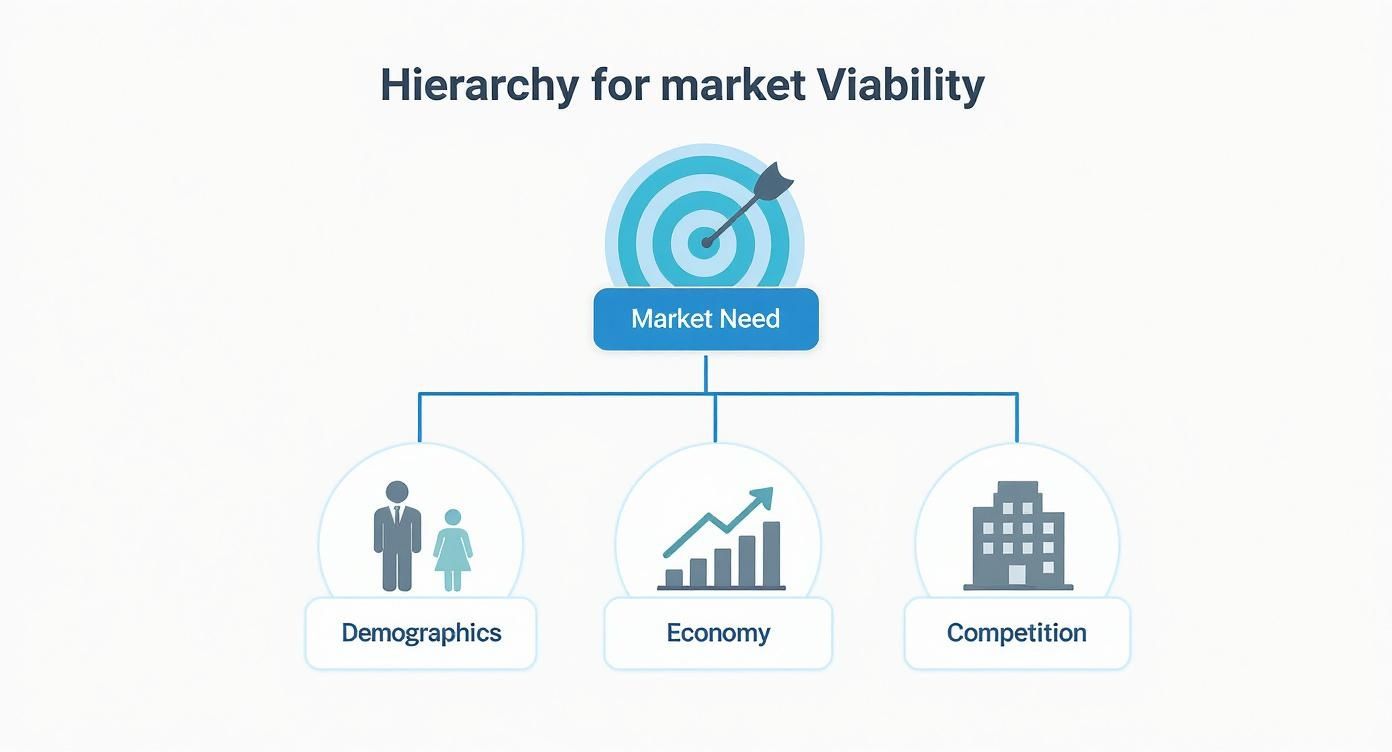
As the diagram shows, a project's viability hinges on the interplay of several factors. It's not just about one thing, but about the combined strength of real market demand, a healthy local economy, and a clear edge over the competition. We look at demographic trends, absorption rates for similar properties, and what competitors are charging to make sure your project is positioned to succeed.
6. The Financial Pro Forma
This is where it all comes together. The financial pro forma is the master spreadsheet that tells your project’s financial story. It projects all the potential revenues and expenses over a multi-year period (typically 5-10 years) to model profitability and potential returns.
The pro forma is the ultimate test of financial viability. It translates all the previous research into the language that investors and lenders speak: metrics like Net Operating Income (NOI), Cash-on-Cash Return, and Internal Rate of Return (IRR). It models everything—from rental income and vacancy rates to debt payments and the eventual sale price.
7. Risk and Return Analysis
Finally, no study is complete without an honest look at what could go wrong. The risk and return analysis identifies potential threats and evaluates their impact. What happens if construction is delayed by six months? What if interest rates shoot up? What if the market softens and it takes longer to lease up the building?
This often involves a sensitivity analysis, where we stress-test the financial model to see how the project's returns hold up if our key assumptions change. By identifying and quantifying these risks ahead of time, you can build in contingency plans and make a fully informed decision about whether the potential rewards truly justify the risks involved.
To help tie this all together, here’s a quick summary of what each component is designed to achieve.
Key Components of a Real Estate Feasibility Study
| Component | Primary Goal | Key Questions |
|---|---|---|
| 1. Site Analysis | To understand the physical constraints and opportunities of the land itself. | Is the site buildable? What are the hidden costs related to topography, soil, or utilities? |
| 2. Zoning & Regulatory | To confirm what can be legally built and navigate the approvals process. | What is the property zoned for? What are the height/density limits? How long will permitting take? |
| 3. Conceptual Design | To determine the "highest and best use" that is physically and legally possible. | What is the most efficient and profitable layout for the site? How many units can we fit? |
| 4. Cost Estimation | To develop a realistic budget for both construction and long-term operations. | What are the total hard and soft costs? What will it cost to run the building each year? |
| 5. Market Analysis | To verify that there is genuine demand for the proposed project. | Who are the target tenants/buyers? What is the competition? What rents/prices can we expect? |
| 6. Financial Pro Forma | To model the project's financial performance and calculate potential returns. | Is the project profitable? What are the key financial metrics (IRR, NOI, Cash-on-Cash)? |
| 7. Risk & Return | To identify potential threats and determine if the reward justifies the risk. | What could go wrong? How would that impact returns? Do we have a contingency plan? |
Each of these components builds upon the last, creating a progressively clearer picture of the project's viability. Skipping a step or relying on guesswork is a recipe for a very expensive mistake.
Building Your Financial Pro Forma Step by Step
If your market analysis is the foundation of your real estate development feasibility study, then the financial pro forma is the steel frame holding everything up. This is where all your research, cost estimates, and revenue projections finally come together to tell a story with numbers.
Think of it as a detailed, multi-year forecast, usually in a spreadsheet, that predicts whether your project will sink or swim financially. It’s the tool that translates your vision into the language investors and lenders care about most: the bottom line. A solid pro forma gives you the clarity to make that final, confident go/no-go decision.
Assembling Your Key Financial Inputs
The old saying "garbage in, garbage out" has never been more true. The accuracy of your pro forma lives and dies by the quality of the numbers you feed it. This isn't the time for wishful thinking or overly optimistic guesses; every figure needs to be backed by the hard research you did during your market analysis and cost estimation.
Here are the essential ingredients you'll need for your financial model:
- Projected Income: This is your top-line revenue, almost always from rent. You'll base this on current market rates for comparable properties and project modest annual increases (rent growth) based on historical data and economic forecasts.
- Vacancy Rates: No property stays 100% occupied forever. A realistic vacancy rate, often somewhere in the 5-10% range, accounts for the natural churn of tenants and the time it takes to lease up empty units.
- Operating Expenses (OpEx): These are the ongoing costs to keep the lights on and the property running smoothly. Think property management fees, routine maintenance, insurance, property taxes, and utilities.
- Debt Service: This is simply your loan payment. It’s the total amount you'll pay each year on your construction and permanent financing, covering both the principal and the interest.
Beyond just plugging in numbers, a truly professional pro forma also incorporates strategies for managing financial risk to protect the project's long-term profitability.
Interpreting the Critical Metrics
Once all your inputs are in place, the pro forma will spit out several key performance indicators (KPIs) that act as a scorecard for your project's financial health. Knowing what these metrics mean is crucial for actually evaluating the investment.
The goal isn't just to build a spreadsheet; it's to use that spreadsheet to answer the big questions. Does this project actually generate cash? Is the return worth the risk we're taking? How long until we get our initial investment back?
Let's break down the most important ones in plain English:
- Net Operating Income (NOI): This is your property's pure, unadulterated profit from operations. It’s the total income left over after you've paid all the operating expenses but before you've made your loan payment or paid income taxes. It's the cleanest measure of a building's ability to generate cash.
- Cash-on-Cash Return: This is a straightforward metric that tells you the annual pre-tax cash flow you receive compared to the total cash you initially invested. If you put $1 million of your own money into a deal and get $80,000 back in cash flow that year, your cash-on-cash return is 8%. It’s that simple.
- Internal Rate of Return (IRR): A more sophisticated metric, the IRR calculates the project's total annualized return over its entire life, factoring in the final sale price. It's the gold standard for comparing the profitability of your project against other, completely different investment opportunities.
Preparing for Uncertainty with Sensitivity Analysis
A pro forma built on a single, perfect set of assumptions is brittle. Real life is messy—interest rates spike, construction gets delayed, a recession hits. This is where sensitivity analysis proves its worth.
This process is all about stress-testing your model. You intentionally change key variables to see how much it hurts your returns. What happens to my IRR if interest rates climb by 1%? How does a 10% jump in construction costs crush my cash flow?
By running these "what-if" scenarios, you can pinpoint the project's biggest vulnerabilities and start building contingency plans. It shows investors and lenders that you’re not wearing rose-colored glasses—you understand the risks and are prepared for a few curveballs. This is what turns a simple financial forecast into a truly powerful decision-making tool.
Navigating Construction Costs and Supply Chains
A sophisticated financial model is only as good as its weakest assumption. Once you've confirmed there's a market for your project and sketched out potential revenue, the feasibility study has to get real about the tangible, often unpredictable, world of construction costs and supply chain headaches. This is where your spreadsheet meets the hard reality of lumber prices, labor shortages, and logistical nightmares.
Getting this part right is everything. It’s the bridge connecting your financial dreams to the physical act of building. If you underestimate these costs, your project’s profit can vanish before you’ve even poured the concrete. But if you're too conservative, you might kill a perfectly good project, walking away from a fantastic opportunity.
Hard Costs Versus Soft Costs
First things first, you need to split your expenses into two main buckets: hard costs and soft costs. It's a fundamental distinction, and getting it right is key to building a budget that holds up.
- Hard Costs: These are the tangible expenses—the stuff you can literally see and touch. Think bricks, steel, concrete, and all the labor needed to assemble it. Site prep, landscaping, and hooking up utilities all fall into this category.
- Soft Costs: These are the less obvious but equally critical expenses that make the project happen. They aren’t part of the physical building but support the whole process. We're talking about architect and engineering fees, permits, legal bills, the cost of financing, and insurance.
A classic rookie mistake is fixating on the hard costs and glossing over the soft costs. Be careful—those soft costs can easily chew up 25-30% of your total project budget.
The Realities of Modern Supply Chains and Labor
Today’s global supply chains are a tangled, volatile mess. A factory shutdown on the other side of the planet can halt your project in its tracks, sending material prices through the roof and causing massive delays. These are the external pressures that can blow a hole in your financial projections.
A project’s budget isn't a static document set in stone. It's a living forecast that must be actively managed to account for real-world variables like inflation, labor shortages, and unexpected material delays.
This volatility means you have to plan for the unexpected. For instance, forecasts for 2025 point to a huge drop in new commercial real estate completions, largely due to high construction costs and not enough skilled workers. U.S. office completions, in particular, are expected to plummet by around 73%. This creates a really weird supply dynamic that can mess with your project's timing and profitability. For a deeper dive, you can explore the 2025 Global Real Estate Outlook and see these trends for yourself.
To handle this, your feasibility study needs a solid contingency plan. A contingency fund—usually 5-10% of the total construction cost—isn't a sign of bad planning. On the contrary, it’s a mark of a pro. It gives you the breathing room to absorb those inevitable surprises without sinking the entire venture. When you account for these variables honestly, your financial model goes from a simple guess to a powerful, resilient tool.
How an Architect Supports Your Feasibility Study

Bringing an architect on board early in your real estate development feasibility study is one of the smartest moves you can make. It’s a decision that pays for itself long before a single shovel hits the dirt. They do far more than just sketch final designs; an experienced architect is a crucial partner who grounds your financial projections in the physical world.
Think of them as the bridge connecting your market data to what's actually possible on a piece of land. They translate the site's quirks, the jungle of zoning rules, and the demands of the market into tangible, conceptual designs. This ensures your vision is not just inspiring, but also buildable, efficient, and ultimately, profitable. This kind of collaboration is key to de-risking a project from day one.
Maximizing Value Through Conceptual Design
One of the most valuable things an architect does right away is help figure out a site's "highest and best use." This isn't just about cramming in the maximum number of units. It's about finding the sweet spot—the optimal layout that boosts profitability, grabs the market's attention, and creates long-term value.
During the feasibility phase, an architect can quickly generate practical tools to guide your decisions:
- Massing Studies: These are essentially simple 3D models. They let us test different building shapes and sizes to see how they fit within the property lines, zoning envelopes, and required setbacks.
- Test-Fit Plans: Think of these as quick-and-dirty floor plans. We use them to explore different unit mixes and layouts to confirm exactly how many rentable square feet you can realistically get, which feeds directly into your revenue projections.
- Site Planning Options: Architects are experts at analyzing how cars will move through the property, how to design efficient parking, and where to place amenities to create a site that’s both functional and appealing.
This whole process turns your abstract financial goals into a concrete, spatial strategy.
An architect’s early involvement turns the feasibility study from a purely theoretical exercise into a practical roadmap. They help answer the crucial question "What can we actually and profitably build here?" before you commit significant capital.
By exploring different design concepts from the start, an architect can spot hidden opportunities to boost your project's returns. Maybe it’s a subtle shift in the building's orientation to capture premium views, or a smarter parking layout that frees up land for a money-making amenity. This early strategic input is what makes sure the final design is perfectly aligned with the financial goals of your study.
Got Questions? Let's Talk Feasibility Studies.
Even with a solid plan, it's natural to have questions before diving into a real estate development feasibility study. Think of this section as a conversation where we tackle the practical "what ifs" and "how muches" that developers and investors ask us all the time.
How Much Does a Real Estate Feasibility Study Cost?
There's no one-size-fits-all answer here. The cost is a direct reflection of your project's size and complexity. For a relatively simple commercial infill project, you might be looking at a few thousand dollars. But for a large-scale, multi-phase mixed-use development, the cost can easily climb into the tens of thousands.
What drives that number? A few key things:
- Project Size and Scope: A bigger, more complicated project simply has more moving parts to analyze.
- Location and Data Access: Digging up reliable data in a small, out-of-the-way market is often tougher (and more expensive) than in a major city where information is readily available.
- Specialized Expertise: If we need to bring in experts like environmental engineers or traffic analysts, their fees will be part of the total cost.
It's easy to see it as just another expense, but a good feasibility study is one of the best risk-management tools you can buy. That upfront cost is a tiny fraction of what you could lose by moving forward with a project that's destined to fail.
How Long Does a Feasibility Study Take to Complete?
Just like cost, the timeline is all about complexity. A quick, high-level look might only take a few weeks. However, a truly comprehensive study—the kind that involves deep site analysis, extensive market research, and detailed financial modeling—usually takes somewhere between four to twelve weeks.
The timeline can stretch depending on how quickly we can get accurate data, how responsive the local zoning office is, and how many design options we need to explore to land on the best path forward. It's tempting to rush, but this is one area where patience pays off. Cutting corners here can lead to some very expensive mistakes later.
What Are the Biggest Red Flags in a Feasibility Study?
Think of your feasibility study as a check-up for your project's health. Some findings are minor, but others are serious warning signs you absolutely can't ignore. Pushing past these red flags is a recipe for financial trouble.
Keep a sharp eye out for these deal-breakers:
- Rose-Colored Projections: If the financial forecast assumes pie-in-the-sky rent growth and impossibly low vacancy rates with no data to back it up, the numbers aren't real.
- A Skimpy Contingency: A budget with less than a 5-10% contingency for construction costs isn't realistic. It shows a failure to plan for the unexpected delays and cost overruns that happen on almost every project.
- Major Zoning Headaches: Uncovering a need for a long, contentious rezoning process or finding out there's strong local opposition can stop a project dead in its tracks.
Answering these questions and making sense of the final report is where having an experienced partner makes all the difference. At Sherer Architects, we provide the strategic architectural insight that keeps your feasibility analysis grounded in what’s actually buildable and profitable. We help you make sure every piece of the puzzle fits.
Let's talk about making your vision viable. Visit us at https://shererarch.com.