

Think of it this way: a plot plan is a close-up, and a site plan is the wide-angle shot. A plot plan is all about a single piece of property, showing exactly where a building will sit in relation to its boundaries. A site plan, on the other hand, zooms out to show the entire project—how it connects to roads, utilities, and the surrounding environment.
Which one you need really boils down to the scale of your project. Are you putting up a single building, or are you developing an entire commercial complex?
Plot Plan vs. Site Plan: Key Distinctions
Getting these two documents straight is one of the first hurdles for any developer or property owner. It's a common mistake, but mixing them up can cause serious headaches with permitting offices, leading to delays and unexpected costs. While both are technical drawings, they answer very different questions depending on your project's size and complexity.
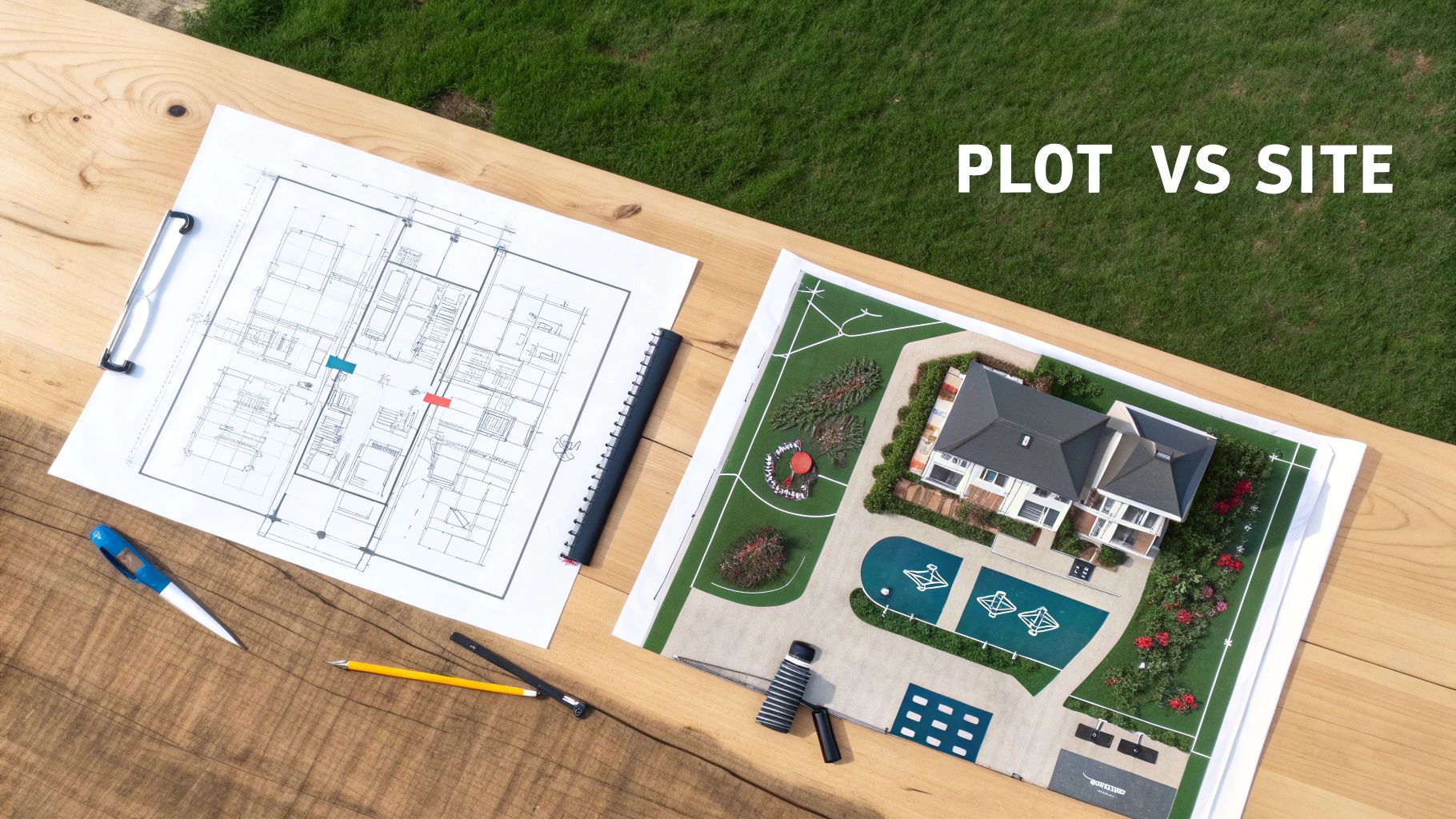
A plot plan puts a single lot under the microscope. Its main job is to prove that what you want to build—be it a small retail store, a new fence, or an expanded garage—fits within the legal lines. It’s a document that confirms you’re following the rules on setbacks, easements, and property boundaries. It's a compliance tool, pure and simple.
A site plan, conversely, is the big picture. It maps out how your entire project works as a whole and interacts with everything around it. This is the go-to document for larger developments like shopping centers, apartment complexes, or industrial parks, where things like traffic flow, drainage, and utility connections are just as important as the buildings themselves.
At-a-Glance Comparison: Site Plan vs. Plot Plan
To make the core differences crystal clear, here’s a quick breakdown of their main attributes. Keep this handy when you're figuring out what your project demands.
| Attribute | Plot Plan | Site Plan |
|---|---|---|
| Scope | A single parcel or lot of land. | The entire project area, often multiple lots. |
| Focus | Building placement, boundaries, and setbacks. | Overall project layout, including infrastructure. |
| Primary Use | Zoning permits for minor construction. | Major development approvals and site engineering. |
| Key Details | Property lines, structure footprint, easements. | Topography, utilities, drainage, parking, access. |
Ultimately, both plans are critical in land development, but they play separate parts. A plot plan is tightly focused on one piece of land and its structures, while a site plan tackles the broader infrastructure—roads, drainage, landscaping, and utilities. You can dig into more details about their distinct roles in development projects to see how they apply in different scenarios.
Key Takeaway: A plot plan proves a building fits on its lot according to local rules. A site plan demonstrates how an entire development functions within its environment and connects to public infrastructure. The first is about legal placement; the second is about functional design and integration. Getting this right from the start makes every conversation with your architect and the city planning department ten times smoother.
When to Use a Plot Plan
Think of a plot plan as the official, legally binding blueprint for a single piece of property. It’s a tightly focused, scaled drawing that lives and breathes one thing: the relationship between a specific lot's boundaries and the buildings on it, both existing and planned. In many ways, it’s a visual compliance checklist, designed to prove to local authorities that your project fits neatly within all the zoning rules before you even think about breaking ground.
This is your go-to document when your project is contained entirely within one lot and the main objective is getting a permit for smaller-scale work. For commercial property owners, this usually means projects that don't involve a major site overhaul but still need a stamp of approval from the city or county.
Securing Permits for Minor Construction
The most frequent reason you'll need a plot plan is to get a building or zoning permit for anything that changes your property's layout. It offers a clear, indisputable record of your legal boundaries and where everything sits, which is exactly what a municipal reviewer needs to see.
Here are a few common scenarios where a plot plan is non-negotiable:
- Adding an Accessory Structure: Building a detached garage, a storage shed, or another small outbuilding.
- Constructing a Fence or Retaining Wall: This proves the new structure won’t cross onto neighboring properties or interfere with public easements.
- Applying for a Mortgage or Refinancing: Lenders often want a plot plan to confirm the property's legal description and make sure there are no brewing boundary fights.
- Planning a Small Building Addition: For instance, extending an existing commercial building where the new footprint is small enough that it doesn't require new parking lots or drainage systems.
A plot plan is your key to unlocking straightforward permits. It demonstrates compliance with setbacks, easements, and property lines, answering the critical question for zoning officials: "Does this project fit legally within its designated space?"
Preventing and Resolving Property Disputes
Because it's rooted in legal precision, a plot plan is an incredibly valuable tool for heading off conflicts over property lines. It’s the authoritative map that shows exactly where your property ends and your neighbor's begins. That kind of clarity is crucial when you're putting up a fence, planting a thick row of trees near the boundary, or building anything that gets close to another lot.
The plot plan's role today actually grew out of centuries-old cadastral mapping. Back in the early 19th century, these maps were the foundation for defining property lines and figuring out how cities were laid out. Now, with powerful tools like Geographic Information Systems (GIS), these documents are more accurate than ever. This technology allows modern planners to reconstruct urban development and manage land with an incredible degree of precision, as detailed in some fascinating in-depth urban analysis research.
This history really underscores why the plot plan remains a cornerstone of property law. It’s your best defense against any potential encroachment claims.
Key Elements of a Plot Plan
To do its job for permitting and legal verification, a plot plan has to include some very specific, non-negotiable details. While a site plan gives you the bird's-eye view of an entire development, the plot plan zooms way in, focusing only on the core legal and physical facts of one lot.
Every compliant plot plan must show:
- Legal Property Boundaries: The exact dimensions and orientation of the lot lines, pulled directly from the property’s legal description.
- Location of Existing Structures: The footprint of all current buildings, driveways, and other major features.
- Proposed Structure Placement: A clear outline showing precisely where the new construction will sit on the property.
- Setbacks: The mandatory buffer zones from the property lines where no construction is permitted.
- Easements: Any parts of the property that utility companies or the public have a legal right to access.
When to Use a Site Plan
A plot plan is a simple, legal snapshot of a property. A site plan, on the other hand, is the master blueprint for any serious development. It goes way beyond basic property lines to become the central strategic tool for commercial, industrial, and large-scale residential projects. You need a site plan when the complexity of your project demands a complete picture of how it will actually function and fit into its surroundings.
Think of the site plan as the project's command center. It connects every critical piece—from the buildings and parking lots down to the underground utilities and stormwater drainage—into a single, working system. This is the document you’ll need for major building permits, zoning approvals, and any serious meeting with stakeholders.
Coordinating Complex Development Projects
At its core, a site plan is a coordination document. It’s the common language that gets civil engineers, architects, landscape designers, and city planners all on the same page. Without it, trying to juggle the intricate layers of a development would be a recipe for disaster, full of expensive conflicts and frustrating delays.
This comprehensive overview is non-negotiable for:
- Commercial Developments: Think shopping centers, office parks, and retail spaces where things like traffic flow, parking, and pedestrian safety are absolutely critical.
- Industrial Facilities: Warehouses and manufacturing plants have unique needs, such as loading docks, truck turning radii, and heavy-duty utility connections, which must be mapped out.
- Multi-Unit Residential Projects: For apartment complexes or subdivisions, the plan must carefully lay out shared amenities, green spaces, and public access points.
A site plan is the strategic roadmap for a project. It’s not just about what you’re building; it’s about how every component—from the topography of the land to the flow of traffic—works together to create a viable, sustainable, and compliant development.
Integrating Infrastructure and Environmental Systems
Unlike a plot plan, a site plan digs deep into the infrastructure and environmental details that will make or break a project. This level of detail is essential for getting a green light from municipal authorities. They need to see that your development won't strain public systems or harm the local environment, and a solid site plan gives them that proof.
Key integrated systems on a site plan include:
- Topography and Grading: It shows existing and proposed land contours, which is fundamental for managing earthwork and ensuring water drains correctly.
- Stormwater Management: This details everything from retention ponds and bioswales to the underground pipes needed to handle runoff and prevent flooding.
- Utility Infrastructure: It maps the exact location and specs for water mains, sewer lines, gas, and electrical conduits.
- Traffic Circulation: The plan designs access points, internal roads, and parking layouts to keep vehicle and pedestrian movement safe and efficient.
This integration is where a site plan really proves its worth. For instance, it connects the dots, showing how the grading plan funnels water into a stormwater system that's been specifically designed to handle the runoff from all the new asphalt and rooftops.
Securing Major Building Permits and Approvals
For any project bigger than a simple home addition, the site plan is the absolute cornerstone of the permitting process. Planning departments and review boards depend on this document to check your project's compliance with a whole host of regulations—zoning ordinances, building codes, environmental laws, and public safety standards.
A well-drafted site plan offers verifiable proof that you’ve done your homework and met all regulatory requirements. It shows you have a sound plan for everything from fire truck access to landscaping and lighting. Honestly, showing up with a thorough, professional site plan is the best way to smooth out the approval process and convince city officials that your project is a well-thought-out addition to their community. Without this master blueprint, a large-scale project is dead in the water.
Comparing Critical Project Requirements
When you move from simple definitions to real-world application, a head-to-head comparison is essential. The choice between a plot plan and a site plan isn't just about paperwork; it directly shapes your project's budget, schedule, and path to getting that all-important permit. Let's break down the comparison into the five core areas every developer needs to get right.
We'll look at the big picture (scope and scale), the nitty-gritty details, the primary purpose of each document, the impact on your wallet and timeline, and the experts you'll need to hire. This isn't just about spotting differences—it's about making a smart, cost-effective decision from day one.
Scope And Scale
The most glaring difference between a site plan and a plot plan is the sheer amount of ground they cover. A plot plan keeps its focus tight, zeroing in on a single, legally defined piece of land. Think of it as a close-up shot, concerned only with how one building fits within its specific property lines and setback requirements.
It’s the go-to document for a standalone retail building, a minor commercial addition, or even a single-family home. Its world begins and ends at the lot boundaries.
A site plan, on the other hand, is the wide-angle shot. It takes a much broader, macroscopic view of the entire project area, which could span multiple lots, include public roads, and cover huge tracts of land. This is the blueprint for a sprawling commercial campus, a new residential subdivision, or a large industrial park where the interplay between all the different pieces is absolutely critical.
Required Detail And Information
The level of detail flows directly from the scope. A plot plan is all about minimalism. It shows just enough information to prove to a building department that you're following local zoning rules. Its job is to confirm that a proposed structure fits legally within its designated box.
Key elements of a plot plan typically include:
- The exact legal boundaries of the single lot
- The footprint and precise location of all existing and proposed structures
- Distances from buildings to property lines (the setbacks)
- The location of any legal easements crossing the property
A site plan is a different beast altogether—it’s a comprehensive master document. It weaves together complex layers of engineering, architectural, and environmental data to show not just what you're building, but how it will all work together in its environment.
Crucial Differentiator: A plot plan answers the question, "Does it fit?" A site plan answers the far more complex question, "How does it work?" This fundamental shift from simple placement to integrated functionality is the core difference.
The information packed into a site plan is far more extensive. While both plans show where underground infrastructure is, a site plan details the entire system. For complex projects, this might even involve using precise utility location methods like potholing to ensure nothing is left to chance before excavation begins.
Expect a site plan to include:
- Topographical data showing the natural slope and elevation of the land
- Grading and drainage plans, including complex stormwater management systems
- Detailed layouts for all utilities: water, sewer, gas, and electrical lines
- Vehicle circulation patterns, parking lot designs, and pedestrian walkways
- Landscaping plans, exterior lighting grids, and any required environmental mitigation features
This infographic highlights the kind of large-scale projects where a site plan is non-negotiable.
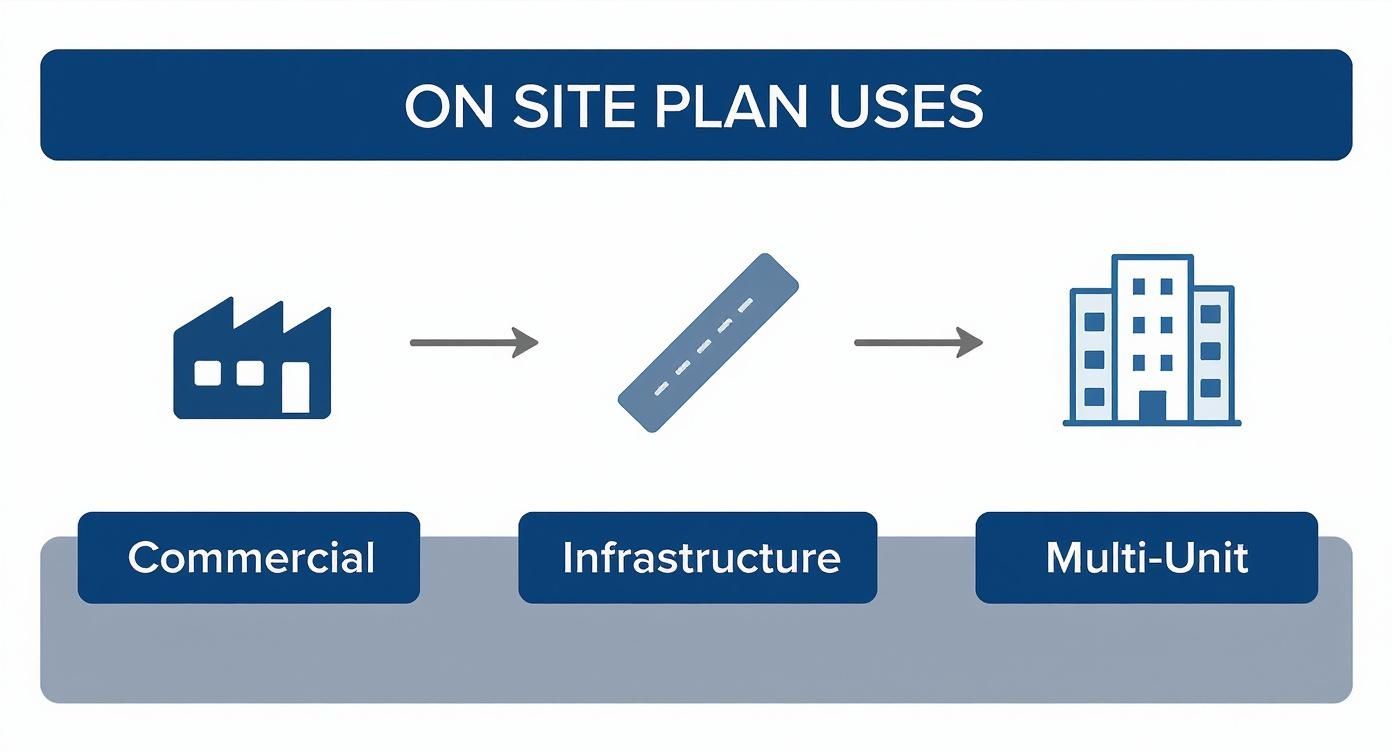
As you can see, site plans are essential for complex, multi-faceted developments that have a real impact on the surrounding community and environment.
Primary Use Case And Professional Expertise
A document's main purpose dictates who creates it and why. A plot plan is, at its core, a permitting tool for smaller-scale work. You'll submit one with your application to build a fence, put on a small addition, or construct an accessory building. A licensed land surveyor or an architect can typically knock one out, with the main goal being legal accuracy.
A site plan serves a much bigger, more strategic purpose. It's the master document you'll use to gain major development approvals from planning commissions, city councils, and other regulatory bodies. Because it's so complex, creating a site plan is a team sport. It requires a collaborative effort from licensed professionals like civil engineers, architects, and landscape architects—and sometimes environmental consultants, too.
This team approach reflects the site plan’s true role as a detailed engineering and design document, not just a simple boundary map. As you'd expect, the cost and timeline are significantly higher, often reflecting hundreds of hours of expert work.
To make these distinctions crystal clear, here’s a detailed breakdown of what to expect from each document.
Detailed Breakdown Plot Plan vs Site Plan Requirements
| Feature | Plot Plan (Single-Lot Focus) | Site Plan (Development-Wide Context) |
|---|---|---|
| Primary Goal | Verify zoning compliance for a single lot. | Gain full development approval for a project. |
| Scope | One individual, legally-defined parcel of land. | Entire project site, often spanning multiple lots. |
| Key Information | Property lines, setbacks, building footprints, easements. | Topography, grading, utilities, traffic flow, landscaping. |
| Typical Use | Minor additions, fences, sheds, single-structure permits. | Subdivisions, commercial centers, industrial parks, public works. |
| Who Prepares It? | Land Surveyor, Architect, or sometimes the property owner. | A team: Civil Engineer, Architect, Landscape Architect. |
| Regulatory Body | Local Building or Zoning Department. | Planning Commission, City Council, Environmental Agencies. |
| Cost & Timeline | Relatively low cost and quick turnaround (days to weeks). | Significant investment and long lead time (weeks to months). |
| Level of Detail | Minimalist; shows only what's needed for compliance. | Comprehensive; a detailed engineering and design document. |
This table neatly summarizes the operational differences. A plot plan is a tactical tool for a simple job, while a site plan is a strategic blueprint for a complex vision.
Navigating Permitting and Regulatory Hurdles
Getting a project from a great idea to a physical structure comes down to one thing: securing approval from the local authorities. This is where the whole site plan vs. plot plan discussion gets real. It stops being about definitions and starts being about compliance. Your local planning department and its zoning code are the final word, and they will tell you exactly what level of detail they need to see before you can break ground.
For a smaller project with a limited scope—think a simple addition or a new fence—a detailed plot plan is often all you need. It gives officials a quick and clear way to verify that what you’re planning to build respects the basic rules like property line setbacks and easements. It's a simple compliance check.
But the moment your project gains any real complexity, the paperwork demands grow right along with it. A full-blown site plan becomes non-negotiable once your development hits certain regulatory triggers. Knowing what these triggers are is absolutely critical to avoiding the kind of delays and rejections that can sink a project timeline.
Common Triggers for Site Plan Requirements
While every town has its own rulebook, some project features almost always push you from needing a plot plan to requiring a comprehensive site plan. If your project involves any of the following, you should prepare for a much more thorough review.
- Change in Land Use: If you're turning a residential lot into a commercial one, or converting a retail shop into a restaurant, you're fundamentally changing its impact. A site plan is needed to analyze everything from parking and traffic flow to infrastructure demands.
- Significant Square Footage: Most jurisdictions set a size limit. For instance, any new build or addition over 5,000 square feet will almost certainly trigger an automatic site plan review.
- Impact on Public Infrastructure: Any work that requires new tie-ins to city water and sewer mains, or that will dump significant new traffic onto public streets, needs a site plan. You have to prove your project won’t overwhelm the existing systems.
- Environmental Sensitivity: Building on or near protected zones like wetlands, steep slopes, or coastal areas means you'll have to produce a detailed site plan that shows how you'll mitigate environmental impact and develop the land responsibly.
A common pitfall is underestimating a project's impact. A seemingly minor change can trigger a full site plan review if it affects traffic patterns, drainage, or public utilities. Always consult the local planning office before finalizing your documentation strategy.
Understanding the specific commercial building permit requirements is crucial, as both site and plot plans play a vital role in the approval process.
Demystifying the Approvals Process
Wading through the permitting process can feel like a nightmare, but getting out in front of it makes a world of difference. Your goal is to figure out what the reviewers need to see and give it to them in a format that's impossible to poke holes in. In my experience, an incomplete or incorrect submission is the number one cause of project delays.
First things first: get your hands on a copy of the local zoning ordinance and the planning department’s development review checklist. These documents are your roadmap—they spell out every single requirement. Look closely at the details, like required drawing scales, whether you need a professional seal from an engineer or architect, and all the submission deadlines.
Another strategy that pays off is talking to the planning staff early. Schedule a pre-application meeting to walk them through your project. This is your chance to uncover potential red flags and get a straight answer on whether a plot plan will cut it or if a full site plan is your only option. That one conversation can save you weeks, if not months, of painful revisions later on.
Choosing the Right Plan for Your Project Scenario
Knowing the difference between a site plan and a plot plan is one thing, but applying that knowledge to a live project is where the rubber really meets the road. Getting this choice right saves you time, money, and headaches with the planning department. The wrong document can lead to frustrating delays and costly rejections.
Let's walk through a few common development scenarios. This isn't just about definitions; it's about matching the right tool to the job to keep your project on track.
Scenario 1: Building a Custom Home
If you're building a new single-family home on an established lot, a plot plan is almost always what you'll need. Your main objective here is to demonstrate to the local building department that the house, driveway, and any other structures (like a shed or garage) fit within the legal property boundaries and respect all setback rules.
The city's checklist is usually pretty straightforward:
- Does the building footprint honor the front, side, and rear setbacks?
- Will the construction obstruct any easements on the property?
- Is the house oriented correctly on the lot as proposed?
A plot plan gives them exactly what they need to see—no more, no less. It’s the most direct and cost-effective way to provide the compliance details for a standard residential building permit.
Scenario 2: Developing a Retail Center
For a large-scale project like a shopping plaza or retail strip, a comprehensive site plan is non-negotiable. This kind of development goes way beyond just placing a building on a piece of land. You're essentially designing a small-scale public ecosystem, and regulators need to understand every moving part.
A simple plot plan would be instantly rejected because it can't possibly answer the planning commission's critical questions. Your site plan must show detailed traffic flow patterns, parking calculations, pedestrian walkways and safety features, stormwater management systems, utility tie-ins, and landscaping plans. It becomes the master document that proves your development is functional, safe, and properly integrated with the surrounding public infrastructure.
Key Insight: For any multi-tenant commercial project, the site plan isn't just a compliance document—it's your core strategic blueprint. It's what proves the project's real-world viability to investors, potential tenants, and city officials.
Scenario 3: Adding a Warehouse Extension
The right plan here really hinges on the scale of the addition and its ripple effects. For a small, 5,000-square-foot bump-out on an existing warehouse that doesn't mess with parking, drainage, or site access, a plot plan might just do the trick. It would clearly show the new footprint in relation to the property lines, and that might be all the city needs.
But if you're planning a massive 50,000-square-foot expansion, you're firmly in site plan territory. An addition that large will almost certainly demand new loading docks, wider truck aprons, more employee parking, and a beefier stormwater system to manage all that new roof runoff. These aren't minor tweaks; they fundamentally change how the site operates, and that requires a full site plan review.
Scenario 4: Applying for a Zoning Variance
When you're going to the city to ask for a zoning variance—say, to build a little closer to the property line than is normally allowed—the plot plan is your go-to document. The whole point of a variance application is to argue for a specific, targeted exception on a single lot.
For this, you need a highly accurate plot plan, prepared by a licensed surveyor, that clearly shows the current state of the property and the precise change you're requesting. This drawing is the star witness in your case. It gives the zoning board a crystal-clear visual of what you're asking for and why it's necessary. Bringing a full site plan would just muddy the waters with irrelevant information.
Frequently Asked Questions
When you're deep in the weeds of a development project, a few practical questions always seem to pop up about the required documentation. Let's tackle some of the most common ones developers and property owners ask about site plans and plot plans.
Can I Prepare a Plot Plan Myself?
For your own personal brainstorming, sure. But for any official purpose, like a permit application, the answer is a firm no.
Jurisdictions are sticklers about this for a good reason. They need assurance that what's on paper is accurate and meets all legal standards. That's why they require any submitted plan to be prepared and stamped by a licensed professional—typically a land surveyor, civil engineer, or architect. Their seal is a guarantee of accuracy, and it’s non-negotiable for the folks in the permitting office.
What Is the Cost Difference Between a Plot Plan and a Site Plan?
The price gap between these two documents is huge, and it perfectly mirrors the difference in their complexity.
- Plot Plan Cost: A standard plot plan is a relatively small line item, usually running just a few hundred dollars. This fee covers a professional's time to verify property lines and show exactly where a single structure sits on its lot.
- Site Plan Cost: A full-blown site plan for a commercial project is a serious investment. The cost can easily soar into the tens of thousands of dollars, reflecting the immense amount of detailed engineering, surveying, and design work involved.
The cost difference really gets to the heart of the site plan vs. plot plan comparison. A plot plan is a simple verification, while a site plan is a comprehensive design and engineering effort that often requires a whole team of experts.
Does a Site Plan Replace a Plot Plan?
In almost every case, yes. A site plan is the more sophisticated, all-encompassing document. It naturally includes all the information you'd find on a plot plan, but then goes much, much further.
Think of the site plan as the master blueprint for the entire project area. It lays out the big picture. Within that master plan, the specific details for each individual parcel are defined with the same precision as a standalone plot plan. It essentially absorbs the plot plan's function and builds upon it.
Navigating the maze of site development, from early concepts to final permits, requires a seasoned guide. The team at Sherer Architects, LLC has spent decades helping commercial developers master the challenges of zoning, design review, and construction. We make sure every project starts on solid ground. Learn more about our commercial architecture services.