SHERER ARCHITECTS

Categories
Uncategorized

Nature and Interior Design: A Practical Guide to Boost Property Value

Integrating nature into interior design—a practice known as biophilic design—goes far beyond a simple aesthetic choice. It's a strategic business move that can significantly enhance a building's financial performance. For commercial properties, this means creating spaces that aren't just beautiful but are measurably more profitable.

The core idea is to foster a connection to the natural world, which in turn boosts employee productivity, drives tenant demand, and ultimately, strengthens your bottom line.

Why Nature in Design Is a Smart Investment

Let's get one thing straight: weaving nature into a building's design isn't just about a "nice-to-have" upgrade. For smart developers and property owners, it’s a calculated investment with a clear and measurable return. Thoughtful biophilic design creates environments where people genuinely want to be, and that has serious financial upside in the world of commercial real estate.
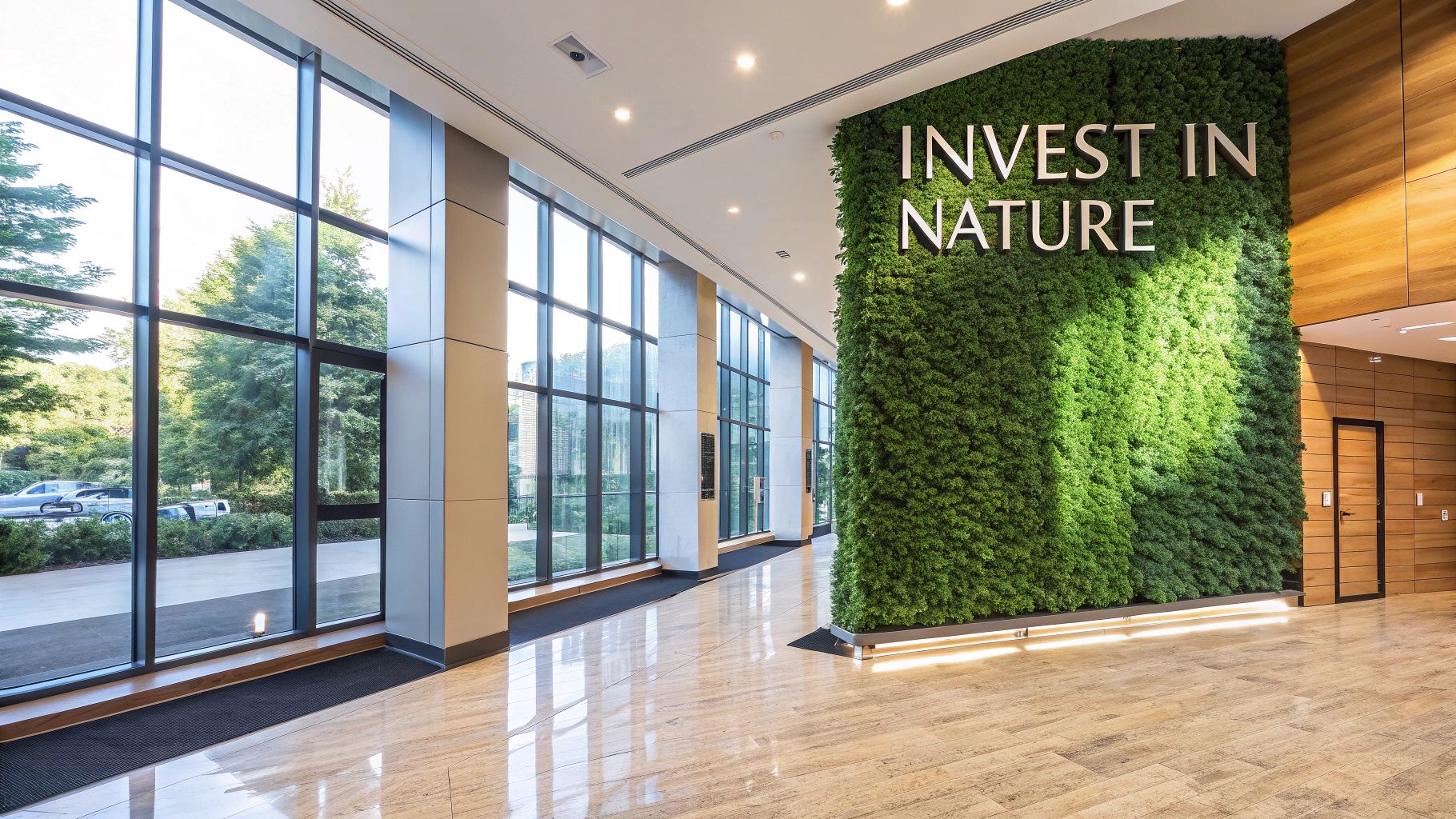
A modern building lobby featuring a large living green wall with 'INVEST IN NATURE' text, large windows, and a shiny floor.

This investment pays dividends in very real ways, turning what might seem like simple design features into powerful assets that attract and keep high-value tenants and their employees.

Boosting Tenant Demand and Lease Rates

In a crowded market, biophilic elements are a huge differentiator. Properties that offer a connection to nature—whether through a stunning living wall, abundant natural light, or accessible outdoor terraces—are immediately perceived as premium spaces. This isn't just a feeling; it translates directly into higher occupancy and better rental income.

I saw this play out on a project recently. A client was weighing a standard cosmetic refresh against a full biophilic renovation for their aging office building. They went with the biophilic route, adding a central atrium with live trees and reconfiguring layouts to maximize daylight. The result? The building was fully leased months ahead of our projections, commanding lease rates 10% above the local market average.

Improving Occupant Productivity and Wellbeing

The link between nature and human performance is undeniable. When people have access to natural light, views of greenery, and good air quality, their focus and creativity improve. This connection to the natural world is proven to reduce stress and mental fatigue, which means fewer sick days and higher overall productivity.

For any business leasing your space, that's a massive operational advantage. A productive workforce is a profitable one, making biophilic offices a hot commodity for corporate tenants. By incorporating these elements, you significantly increase property value, making it a truly smart investment for long-term growth.

One study I often point to found that offices with plants and natural light see a 15% increase in workplace productivity. That number represents a direct financial benefit to the businesses in your building, making the rent you charge an easier pill to swallow.

The table below breaks down how specific biophilic features translate into tangible financial returns.

Biophilic Features and Their Commercial ROI

Biophilic Element Example Application Direct Financial Impact
Living Green Walls Lobby or common area feature wall. Attracts premium tenants, boosts brand image, and can justify higher lease rates.
Abundant Natural Light Large windows, skylights, open floor plans. Reduces energy costs by 10-40%, improves occupant mood and productivity.
Natural Materials Wood finishes, stone accents, natural textiles. Creates a high-end feel that can increase perceived property value and appeal to luxury tenants.
Indoor Plants & Trees Planters in offices, atrium gardens. Improves air quality, reduces stress, and is linked to a 12% increase in productivity.
Views of Nature Orienting desks toward windows, creating green roof terraces. Shown to reduce employee absenteeism and increase job satisfaction, a key selling point.

Each of these elements contributes to an environment that not only looks and feels better but actively performs better as a commercial asset.

The Growing Market for Biophilic Design

The demand for nature-centric spaces isn't a fad; it's a market that's rapidly expanding. The global biophilic design market is projected to hit $12.94 billion by 2032, which tells you everything you need to know about its importance in commercial development.

We're seeing real data to back this up. Tenants in major urban markets have shown they are willing to pay a 14% rent premium for floors with access to terraces and green spaces. That's proof of a direct ROI right there.

Applying Biophilic Principles to Your Project

Moving biophilic design from a high-level concept to a buildable plan requires a clear framework. For commercial and adaptive reuse projects, we've found it’s best to break it down into three core, actionable categories. This isn't just about scattering a few potted plants around; it’s about weaving nature into the very fabric of the building to create spaces that are both functional and genuinely restorative.

Each category offers a different path to fostering that connection to the natural world. By understanding these approaches, you can pick and choose the strategies that actually make sense for your project’s goals, budget, and physical constraints—whether you're starting from scratch or breathing new life into an old structure.

Direct Experience of Nature

This is the most literal application of biophilic design, and it’s exactly what it sounds like: bringing real, living nature indoors. It’s all about creating immediate, tangible connections to the living world. While a massive living wall in a lobby is a definite showstopper, direct nature can be brought in through countless other accessible ways.

For instance, on a recent adaptive reuse project, we took a dark, forgotten corridor and turned it into a vibrant common area. By installing a series of large skylights directly above a cluster of tall, low-light indoor trees, we didn't just add life—we created a dynamic play of light and shadow that moves and changes all day long.

Common ways to achieve this include:

  • Living Green Walls: These are fantastic for making a powerful first impression in lobbies or amenity spaces, and they do double duty by helping improve indoor air quality.
  • Water Features: The sound of moving water is a proven stress-reducer. Small fountains or water walls are perfect for quiet zones, wellness rooms, or waiting areas.
  • Indoor Planters and Atriums: Strategically placed plants can do so much—they can define different zones, guide foot traffic, and soften hard architectural lines. For smaller nooks or individual offices, you can even create a terrarium to add a self-contained touch of green.

Indirect Experience of Nature

Indirect experiences are all about representation. This approach uses materials, colors, textures, and patterns that feel like nature without being literal copies. It’s an incredibly powerful tool, especially in historic preservation or on projects where a tight budget makes complex living systems impractical.

Think about specifying reclaimed timber for the exposed beams in an old warehouse conversion. The wood’s natural grain, its imperfections, and its warm tones immediately create a sense of organic comfort and history. That single material choice connects people to both a natural process and the building’s own past.

An indirect approach is really about sensory engagement. The cool, smooth feel of a natural stone countertop or the visual texture of a grasscloth wall covering can trigger the same positive psychological responses as direct contact with nature.

Other examples of this principle in action are:

  • Natural Materials: Prioritizing wood, stone, bamboo, and cork for flooring, walls, and furnishings.
  • Biomorphic Forms: Choosing furniture, light fixtures, or architectural details with the kind of curved, organic shapes you’d find in nature.
  • Natural Color Palettes: Drawing inspiration from earthy tones, deep greens, and sky blues to create an atmosphere that feels calming and grounded.

Experience of Space and Place

This third principle is more subtle but just as important. It’s less about what you put in the space and more about how you shape the space itself to mirror our experiences out in the natural world.

A perfect example comes from a new build where we oriented the entire building to maximize views of a nearby wooded area. The floor plan was specifically designed so that the most-used spaces, like collaborative work zones and break rooms, had direct lines of sight to the trees. That strategic move didn't just boost wellbeing; it also slashed the need for artificial lighting, cutting projected energy costs by over 20%.

Key strategies for this approach include:

  • Prospect and Refuge: This is about creating spaces that offer broad, open views (prospect) from a safe, enclosed position (refuge). Think of a comfortable seating nook that overlooks a bustling, open atrium.
  • Dynamic and Diffuse Light: Designing for natural light that changes throughout the day is critical. Using elements like light shelves or fritted glass can help soften and diffuse direct sunlight, preventing harsh glare.
  • Organized Complexity: Nature is full of rich, detailed patterns. We can mimic this by introducing fractal patterns—like those in leaves or snowflakes—through textiles, screens, or architectural details to create visual interest that engages the mind without being overwhelming.

Choosing Natural Materials for Lasting Appeal

This is where your design concept gets real. Selecting materials is the moment your vision for a nature-infused space becomes something tangible—something you can see, touch, and experience. For any new build or adaptive reuse project, this is a critical stage. You're constantly balancing aesthetics with commercial-grade durability, ongoing maintenance needs, and, of course, the budget.

The goal isn't just to pick materials that look good on day one. It's about choosing finishes that perform reliably in high-traffic commercial environments for years to come. Your decisions here directly impact the project's longevity and, ultimately, the property's value. Things like reclaimed wood, natural stone, cork, and bamboo all have their place, but each comes with its own set of practicalities, from sourcing and installation to meeting demanding commercial fire codes.

This decision-making process helps you figure out the best path forward for your specific project.
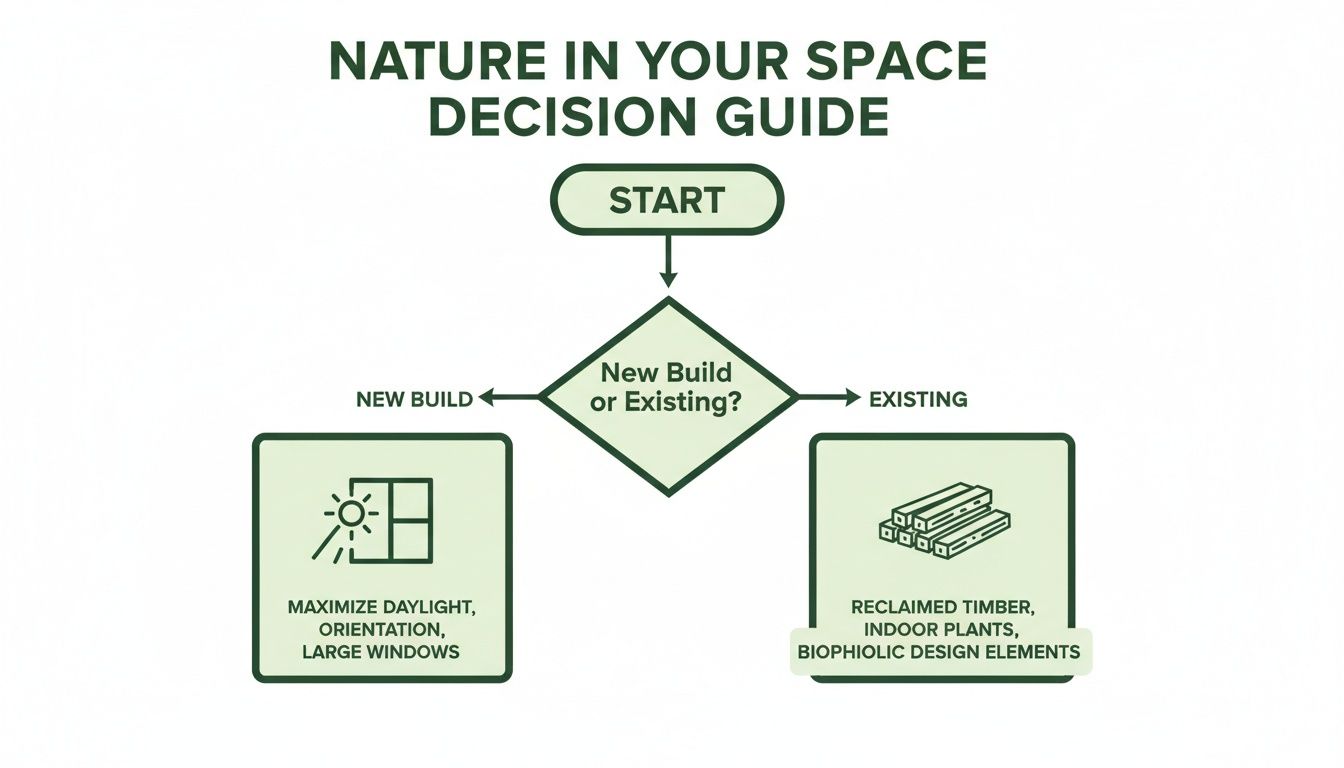
Flowchart guiding how to incorporate nature into new or existing building designs and spaces.

This decision tree shows how the project type—a fresh new build versus an existing structure—shapes your initial focus. For new construction, you might prioritize maximizing daylight, while a renovation often means celebrating the original materials already there.

Wood and Bamboo Applications

When people think of bringing warmth into a space, wood is usually the first thing that comes to mind. Reclaimed wood, salvaged from old barns or industrial buildings, is a fantastic choice for adaptive reuse projects. Its character is built-in—the saw marks, nail holes, and aged patina all tell a story, adding a layer of authenticity that new materials just can't replicate.

But let's be realistic. For a busy commercial floor, that beautiful old wood might not hold up. This is where engineered hardwood or even a high-quality luxury vinyl tile (LVT) with a photorealistic wood grain can be a more practical call for durability and maintenance. Bamboo, which is technically a grass, is another brilliant sustainable option. It's incredibly fast-growing and, in its strand-woven form, is harder than many traditional hardwoods.

A few ideas for where to use them:

  • Reclaimed Wood: Perfect for feature walls, ceiling beams, or custom furniture where it can be admired without being subjected to constant wear and tear.
  • Bamboo Flooring: A great, durable choice for common areas, offices, and retail spaces. Always opt for strand-woven bamboo for maximum hardness in commercial settings.
  • Engineered Hardwood: Gives you the classic look of solid wood but with much better stability, making it a solid pick for spaces with fluctuating humidity.

Stone, Cork, and Other Natural Surfaces

There's a reason natural stone like granite, marble, and slate has been used for centuries; it brings an unmatched sense of permanence and elegance. A polished granite floor in a corporate lobby makes a powerful first impression. For something more subtle and tactile, a honed slate reception desk provides a grounded, earthy feel.

Cork is one of my favorite unsung heroes in sustainable materials. It's harvested from the bark of cork oak trees without ever harming them, making it wonderfully renewable. It’s also naturally antimicrobial, a fantastic sound absorber, and feels great underfoot. This makes it an ideal choice for places where acoustics and employee comfort are priorities, like open-plan offices or wellness rooms.

The demand for these materials is part of a much bigger trend. The global sustainable home decor market, which absolutely includes commercial projects, is projected to hit $415.7 billion by 2028. The largest slice of that pie? Floor coverings. This just underscores how critical your flooring decisions are during tenant buildouts and renovations. For a deeper dive, you can explore more data on this expanding market and see its trajectory.

For adaptive reuse projects, we always look for opportunities to expose and celebrate original materials. Uncovering an old brick wall or a concrete floor can provide a powerful, authentic backdrop that connects the new design to the building's history.

Sourcing and Certifications

When you're specifying natural materials for a commercial project, it’s not enough for them to just look good. They have to work hard and be safe. Always get the product spec sheets and testing data from your suppliers to ensure they meet strict durability standards and local fire codes.

Beyond compliance, making thoughtful material choices can help your project earn valuable certifications, which can be a huge boost to its marketability and value.

  • LEED (Leadership in Energy and Environmental Design): Using materials with high recycled content, that are sourced regionally, or are rapidly renewable (like bamboo or cork) can all contribute points toward a LEED certification.
  • Historic Preservation Guidelines: In designated historic buildings, your choices must respect the original character. We often find ourselves researching original construction techniques to select modern materials that are compatible in both performance and appearance.

By carefully weighing all these factors, you move beyond just picking finishes. You make smart, informed decisions that result in a space that is beautiful, sustainable, durable, and compliant—an investment that will endure for decades to come.

Navigating Building Codes and Systems

So, you're ready to bring a stunning, living piece of nature into your building. That's the exciting part. Now comes the part where vision meets reality—the nitty-gritty of building systems and local regulations. Getting this right from the start is what separates a successful, thriving installation from a maintenance nightmare.

Think of a multi-story living wall not as a decoration, but as an active, biological system. It breathes, it drinks, and it fundamentally alters the interior environment. This means we have to be proactive and strategic with our engineering, ensuring the building can handle its new living component without breaking a sweat.

HVAC Integration for Interior Green Spaces

The first thing we always tackle with large-scale interior plantings is humidity. Plants release a lot of moisture into the air through transpiration. It’s fantastic for them, but it can absolutely overwhelm an HVAC system that isn't ready for it. This extra load can lead to mold, mildew, and a general feeling of dampness for occupants.

Your typical commercial HVAC system is sized for people and sunlight, not for a wall that's constantly adding moisture to the air. You can't just plug a green wall in and hope for the best. The solution is to either specify a system with enhanced dehumidification capabilities from the outset or, more commonly, install a separate, dedicated dehumidifier just for the zone with the plants. This keeps the building's overall climate perfectly balanced.

Air circulation is another big one. You need gentle, consistent airflow around living walls and large planters to prevent stagnant pockets of air where plant diseases can fester. We often work with mechanical engineers to strategically place HVAC registers and returns, creating a subtle current of air that keeps both the plants and the people in the space healthy.

Lighting That Works for Plants and People

In a biophilic space, your lighting design has two very different clients: the people who work there and the plants that live there. The real art is finding an energy-efficient sweet spot that serves both beautifully.

We almost always rely on full-spectrum LED grow lights to keep plants thriving indoors, but just sticking a few bulbs overhead won't cut it. It’s all about creating a layered lighting strategy.

  • Task Lighting: This is your focused, functional light for workstations.
  • Ambient Lighting: This sets the overall mood, often with warmer, more comfortable tones.
  • Horticultural Lighting: This is the specialized, plant-focused light that delivers the spectrum needed for photosynthesis. Crucially, it's often on a completely different schedule than the general lighting.

This approach prevents the powerful plant lighting from creating harsh glare or an unnatural, sterile feel for employees. We also love specifying fixtures that shift in color temperature throughout the day, mimicking natural circadian rhythms. It's a small touch that has a big impact on well-being.

We once worked on an adaptive reuse project where we integrated grow lights directly into architectural coves and ceiling details. The light source became an invisible, supportive element rather than an ugly, obtrusive fixture. It’s a perfect example of how nature and interior design can be seamlessly blended with the building’s core systems.

Code Compliance and Accessibility

Every single biophilic element has to play by the rules of building codes and accessibility. A gorgeous planter can turn into a serious liability if it blocks an emergency exit or creates a tripping hazard.

Here are the compliance issues we're constantly navigating on these projects:

  • ADA Requirements: Circulation paths have to remain clear. We meticulously plan the placement of planters and water features to ensure they are well outside the minimum clearance zones for wheelchair access and general foot traffic.
  • Fire Codes: This is non-negotiable. The materials used in large installations, especially the backing panels and irrigation components for living walls, must meet strict fire-resistance standards.
  • Zoning Ordinances: Some features, especially if they're visible from the outside or on a rooftop, might require a trip to the local Design Review Board. Having detailed drawings ready is key to a smooth approval process.

By tackling these technical details head-on during the initial design phase, we sidestep costly delays and ensure the final result isn't just beautiful, but completely safe, compliant, and built for the long haul.

The Value of Sustainable Furnishings

Once you’ve got the structural bones and core systems in place, the real character of a space comes from its furniture, fixtures, and equipment (FF&E). This is the stuff people interact with every single day, and it's where your design vision truly comes to life. In today's commercial market, the conversation has moved decisively toward furnishings that are sustainable, non-toxic, and thoughtfully sourced.
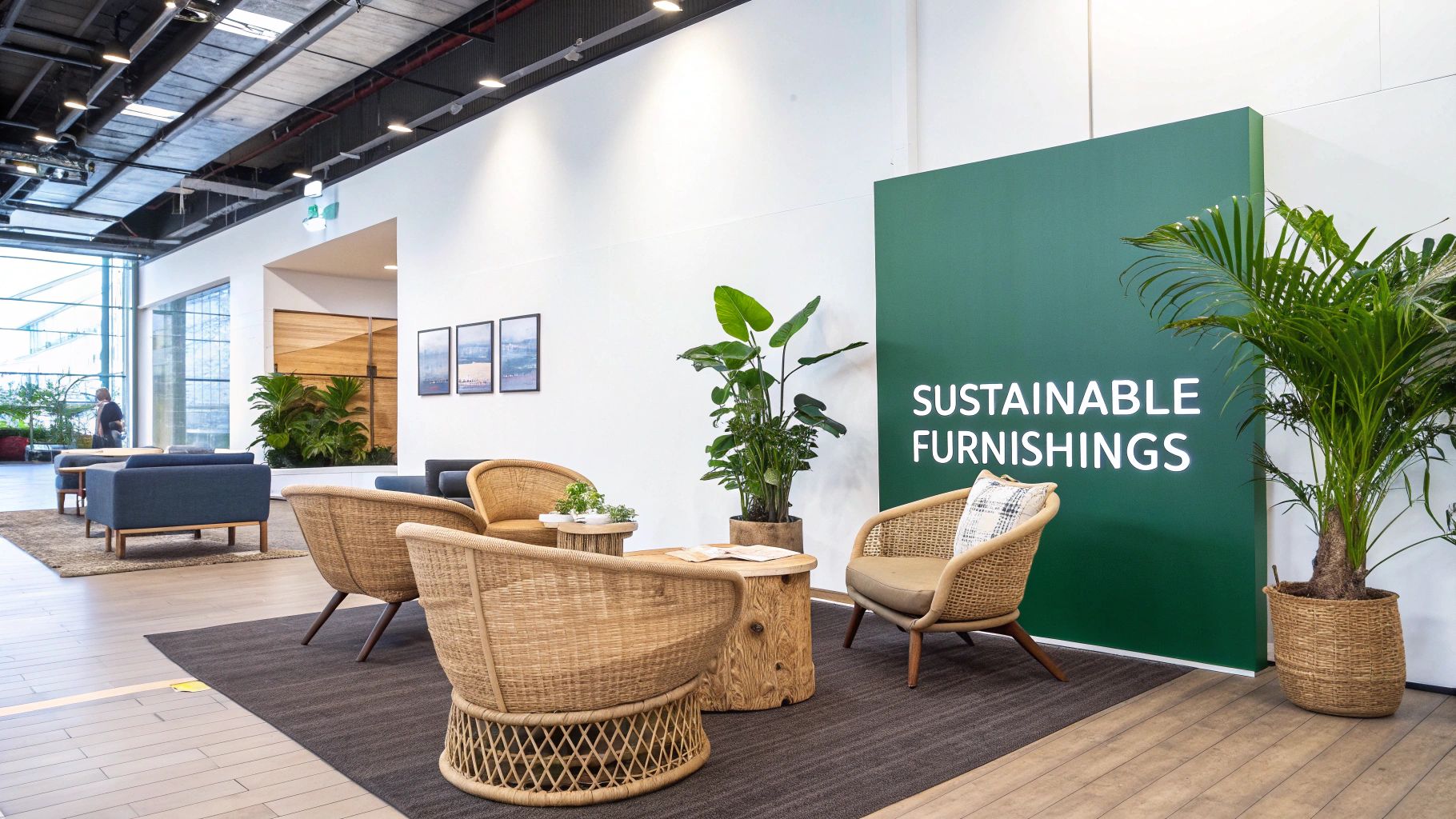
A modern lounge with sustainable rattan chairs, wooden tables, and large potted plants, featuring a 'SUSTAINABLE FURNISHINGS' sign.

This isn't just about looking good or being eco-friendly anymore. It’s a smart business move that has a real impact on tenant attraction, occupant health, and the long-term value of your property.

Prioritizing Healthier Indoor Environments

For years, commercial interiors were packed with furniture and materials quietly releasing volatile organic compounds (VOCs) from glues, plastics, and synthetic fabrics. That’s all changing. Tenants are now acutely aware of how indoor air quality affects their teams' well-being and productivity, and they’re demanding healthier spaces.

One of the most direct ways to deliver that is by selecting FF&E made from natural, non-toxic materials. We're talking about solid wood desks with low-VOC finishes, seating upholstered in natural fibers like wool or linen, and systems furniture built without formaldehyde-based adhesives.

We recently worked with a corporate client who made indoor air quality a non-negotiable in their lease. They explicitly required that all new furniture for their upfit meet stringent low-VOC standards. This isn't a niche request anymore; it's quickly becoming the baseline for premium commercial tenants.

Connecting Furnishings to Financial Outcomes

When you choose high-quality, eco-friendly FF&E, you’re sending a clear message: this is a forward-thinking, premium property. This commitment to quality and sustainability resonates with the high-value tenants you want to attract. And the market data backs this up in a big way.

The eco-friendly furniture market hit $43.26 billion in 2022 and is still climbing, signaling a permanent shift in what both consumers and businesses want. Properties that feature sustainable design and furnishings are simply more appealing, and developers are catching on that this is a reliable way to boost a property's worth. You can learn more about the growth of sustainable interior design and see the numbers for yourself.

This investment pays dividends across the board:

  • Tenant Attraction and Retention: A sustainably furnished space is a huge selling point. It proves you’ve invested in a healthy, high-quality environment, which is a powerful tool for attracting and keeping great tenants.
  • Increased Asset Value: Properties with green credentials and superior finishes are often appraised higher and command a stronger position in the market compared to conventional buildings.
  • Durability and Lower Lifecycle Costs: Let’s be practical. Sustainably sourced materials like solid wood are typically much more durable than cheap composites. They last longer and don’t need to be replaced as often, which saves you money in the long run.

Making Smart FF&E Choices

As you're selecting furnishings, the key is to find pieces that weave into your overall nature and interior design strategy. You're looking for items that not only tick the sustainability box but also enhance the biophilic experience you're trying to create.

Think about tables made from reclaimed wood that bring history and texture into a room. Or consider chairs with organic, curved forms that subtly echo shapes found in the natural world. By curating your FF&E with this level of intention, you complete the story, creating a cohesive, healthy, and high-performing commercial space that will genuinely stand out.

Finding the Right Partner to Bring Your Project to Life

We've walked through the tangible ROI of biophilic design, dug into material choices, and untangled the complexities of building systems. But taking a project from a rough concept to a thriving, profitable property is where the real work begins. Pulling all these threads together isn't just about a great idea—it's about having a clear strategy and an experienced guide to navigate the process.

This is exactly where a dedicated architectural partner proves invaluable. I often think of these projects as intricate puzzles. Our job is to see how every single piece, from maximizing natural light in an old warehouse to satisfying historic preservation boards, clicks together seamlessly. We thrive on managing those complexities so you can stay focused on your vision.

From a Napkin Sketch to a Finished Building

An architect who lives and breathes commercial and adaptive reuse projects does a lot more than just draft blueprints. We become your chief strategist and advocate, making sure every single decision aligns with your long-term financial objectives.

Here’s what that partnership looks like in practice:

  • Connecting Design to Your Bottom Line: We’re experts at translating your vision for a high-demand, profitable property into a design that's actually buildable and sails through permitting.
  • Smoothing Out the Approval Process: Having spent years in front of zoning boards and code officials, we know how to anticipate the hurdles that can derail a project, keeping you on schedule and on budget.
  • Creative Problem-Solving on the Fly: When the inevitable surprises pop up—and they always do—we’re the ones at the table with practical, creative solutions that protect your investment.

A truly successful project feels cohesive and intentional from the first conversation to the final walk-through. The right partnership ensures the end result isn’t just a beautiful building, but an enduring, profitable asset that elevates your entire portfolio.

At the end of the day, weaving nature and interior design together is one of the most powerful moves you can make to boost a property's value and market appeal. It’s a direct investment in creating healthier, more productive, and deeply desirable spaces that modern tenants are actively seeking.

If you’re ready to see how these principles could work for your next commercial, adaptive reuse, or historic preservation project, I’d love to start a conversation. Contact Sherer Architects today and let’s discuss how we can bring your vision to life.

Answering Your Questions About Nature in Commercial Design

As biophilic design moves from a buzzword to a project reality, the conversation naturally shifts. Developers, investors, and business owners want to get down to brass tacks. It's no longer just about the why; it's all about the how. Let's tackle the practical questions we hear most often when we're mapping out these projects.

Getting these details sorted out early demystifies the whole process. It’s how we turn an exciting vision into a building that not only looks incredible but also works financially.

What’s the Real Cost of Biophilic Design?

There's a common misconception that bringing nature indoors automatically inflates the budget. That’s not necessarily true. Sure, a dramatic multi-story living wall is a significant line item, but many of the most effective biophilic strategies are either cost-neutral or can actually save you money down the line.

Think about it: orienting a building to maximize natural daylight or choosing locally sourced, natural materials are decisions made early in the planning stage, often without a major budget impact. The real story is in the return on investment. When you factor in a potential 15% boost in productivity, lower energy bills, and the ability to command higher rents, the initial spend often pales in comparison. A good architect knows how to prioritize the high-impact moves that fit the budget you have.

The trick is to stop thinking of biophilic design as an add-on. When it’s baked into the design strategy from the very beginning, you can weave in these elements efficiently, making it a smart, accessible approach for almost any project.

How Much Upkeep Do Living Features Really Need?

This is a big one. No one wants a wilting, high-maintenance headache. For something like a large green wall, an automated irrigation and lighting system is a non-negotiable. It handles the daily grind, but you’ll still need to budget for periodic professional servicing to check nutrient levels and prune everything back. It’s a planned operational cost, not an unexpected problem.

For simpler designs, like strategically placed large planters, bringing in a local horticultural service is usually the easiest path for a commercial property. Part of our job during the design phase is to match the plants and systems to your team’s ability to care for them. The goal is to make sure these natural elements stay a beautiful asset for years to come, not a burden.

Can This Actually Work in an Old Building?

Absolutely. In fact, adaptive reuse and historic preservation projects are fantastic settings for biophilic design. We often get to work with incredible original materials like exposed brick, stone, and old-growth timber—these are powerful, indirect connections to nature right there in the building's bones.

Introducing modern biophilic elements, like cutting in a new skylight or adding a sleek interior garden, creates a stunning dialogue between old and new. You end up honoring the building's history while giving it new life and meeting the wellness demands of modern tenants. Of course, with any historic project, every single move is carefully planned to respect the building's original character and navigate preservation guidelines.


At Sherer Architects, LLC, we specialize in solving these kinds of puzzles. If you're ready to see how biophilic design can elevate your next commercial, adaptive reuse, or historic preservation project, let's start a conversation.
Categories
Uncategorized

architecture and sustainable design: Commercial edition

In commercial real estate, architecture and sustainable design has moved far beyond a niche interest—it’s now a core business strategy. It’s an approach that engineers buildings for peak performance, guaranteeing long-term financial health, better well-being for the people inside, and critical environmental responsibility.

Why Sustainable Design Is No Longer Optional

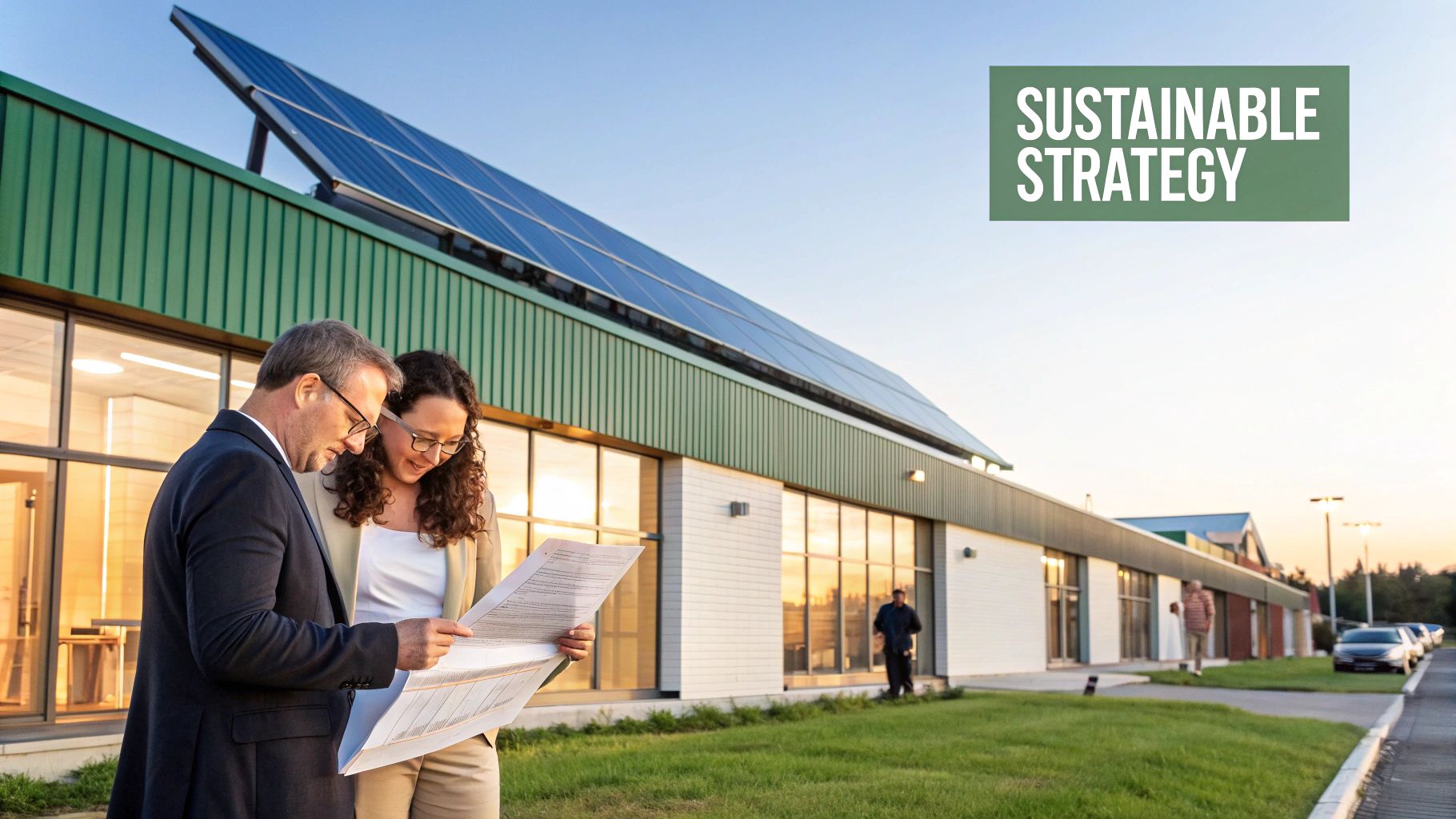
Man and woman discussing sustainable architecture plans next to a building with rooftop solar panels.

Think of a modern commercial building like a high-performance engine. Every single component, from the windows and insulation to the HVAC system and lighting, has to work together perfectly. When that "engine" is engineered with sustainability in mind, it simply runs better—it consumes less fuel (energy), produces fewer emissions, and needs less maintenance, which all adds up to a superior return on investment.

This isn’t just a nice analogy; it’s a necessary response to a pretty stark reality. The global buildings and construction sector is a massive driver of environmental damage. It’s responsible for a staggering 32 to 37 percent of both global energy demand and CO₂ emissions.

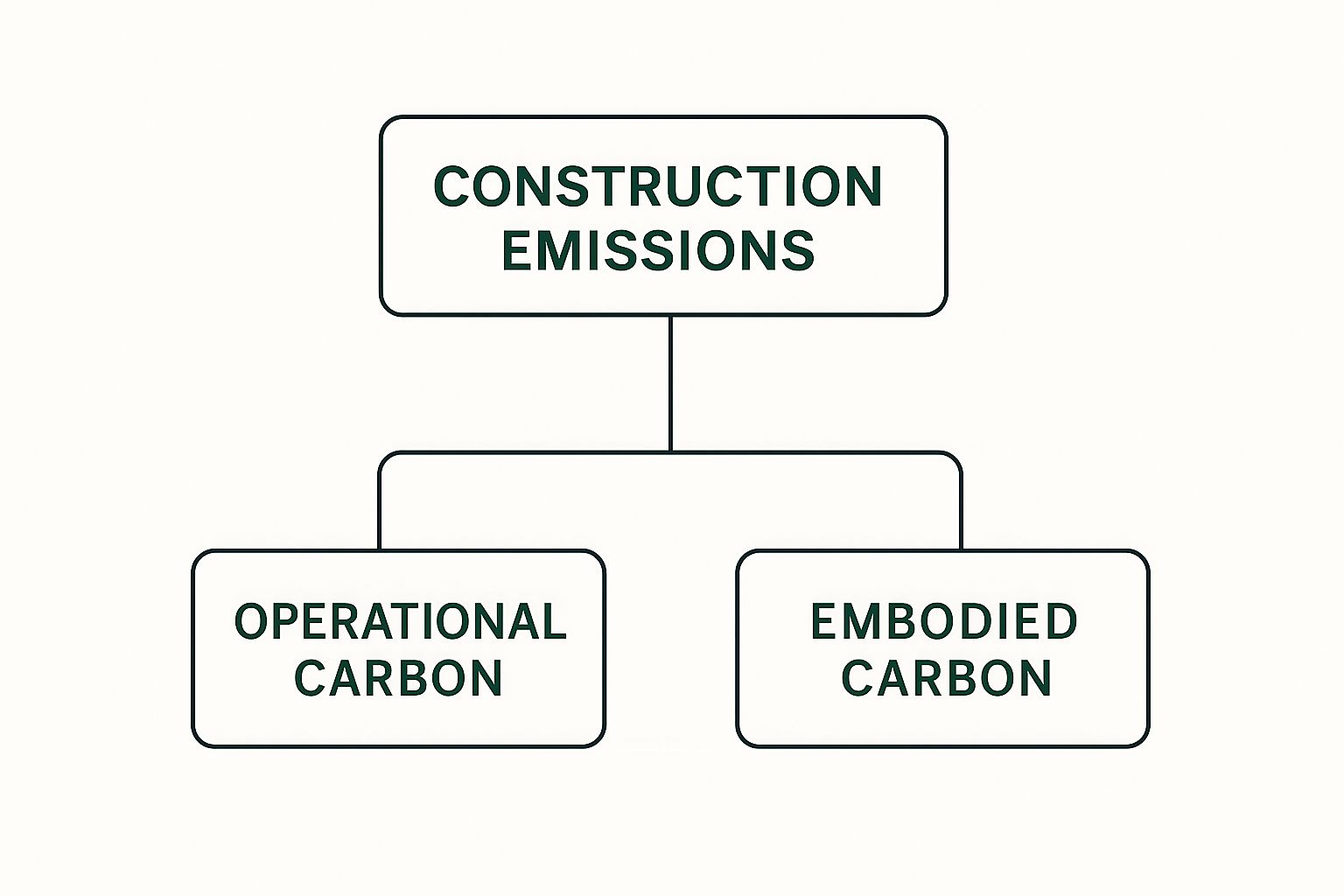
Just last year, operational emissions from buildings hit a record 9.8 gigatonnes, with another 2.9 gigatonnes coming from embodied carbon—that’s all the emissions from making and shipping the materials in the first place. This massive footprint puts a heavy weight on the shoulders of developers, owners, and architects. Ignoring it is no longer an option, not just for ethical reasons, but for smart financial ones, too.

A Fundamental Shift in Commercial Real Estate

The pressure to build sustainably is fundamentally reshaping the industry. Regulations are getting tougher, tenants are actively seeking healthy, green spaces, and investors are putting their money into assets that meet high Environmental, Social, and Governance (ESG) standards. This shift has officially moved sustainable design from the "nice-to-have" column squarely into the "must-have" category for any modern development.

A sustainably designed building isn't just an environmental statement; it's a future-proofed asset. It anticipates regulatory changes, attracts premium tenants, and lowers operational risk, making it a smarter, more resilient investment.

To get a sense of the bigger picture, it’s worth exploring strategies for decarbonizing cities and achieving net-zero goals.

The Immediate Benefits for Developers and Owners

When you bake architecture and sustainable design into a project from day one, the advantages are immediate and tangible. These principles do a lot more than just save on the power bill; they create real value across the board.

Here’s what you stand to gain:

  • Lower Operating Costs: An efficient building uses less energy and water, which directly slashes utility bills for the entire life of the asset.
  • Increased Asset Value: It’s a fact that green-certified buildings often command higher rents and sale prices, attracting top-tier corporate tenants who want the best.
  • Enhanced Occupant Well-being: Features like clean air and abundant natural light are proven to make people more productive, happier, and less likely to call in sick.

Smart Design Before You Build

The biggest wins in sustainable commercial building—and the most cost-effective ones—happen long before anyone breaks ground. Think of the choices made in the earliest design phase as a building's DNA. They set the code for its performance, efficiency, and operating costs for its entire life. This is where architecture and sustainable design delivers its greatest punch.

Trying to bolt "green" tech onto an inefficiently designed building later on is like trying to fix a gas-guzzler by upgrading the sound system. It's a costly patch that misses the point entirely. Instead, by focusing on passive design principles first, you’re baking efficiency right into the building's bones.

These aren't complicated gadgets. They are fundamental, time-tested architectural strategies that work with nature, not against it. By simply respecting the site, the sun, and the local climate from day one, you create a building that naturally needs less energy to run. That means more comfortable occupants and lower bills for owners.

Harnessing the Sun with Smart Orientation

The most powerful resource you have is completely free: the sun. A building’s orientation—the direction it faces—has a massive impact on how much energy it will need. It's the difference between a building that's constantly fighting the climate and one that uses it to its advantage.

In a place like South Carolina, the game is all about letting in useful daylight while blocking the intense solar heat, especially during our long, hot summers. This all comes down to strategic placement.

  • North-Facing Facades: These get gentle, indirect sunlight all day. It’s perfect for spaces needing consistent, glare-free light, like offices or design studios.
  • South-Facing Facades: In the Northern Hemisphere, south-facing windows catch low-angle sun in the winter, giving you free passive heating. In the summer, the sun is high overhead, so it's easily blocked with simple overhangs or awnings to prevent the building from cooking.
  • East and West Facades: These are the real challenge. They get blasted by low-angle sun in the morning (east) and late afternoon (west), causing a ton of heat gain and glare. Smart design either minimizes windows on these sides or uses tools like high-performance glazing and external shading to take the edge off.

Just by rotating a building on the site plan, you can cut its energy use by 20-30% before you’ve even picked out a single brick. It’s a zero-cost move with decades of payoff.

Daylighting for Healthier and More Productive Spaces

Letting in natural light does more than just lower the electricity bill. Daylighting is about creating spaces that feel alive, and it has a direct, measurable effect on the people inside.

Study after study shows that access to natural light boosts mood, reduces eye strain, and can make people up to 15% more productive. For a developer or landlord, that’s a powerful selling point. You're offering a premium space that tenants want because it supports their team's well-being. Good daylighting isn't just about more windows; it's about smart design—using light shelves to bounce sunlight deeper into rooms, choosing interior finishes that reflect light, and opening up floor plans so light can reach the building's core.

A well-daylit space does more than save energy; it connects people to the outdoors and the natural rhythm of the day. This creates a healthier, more engaging environment that sets a property apart from the competition.

Defining the Building Envelope

If a building is a body, its building envelope is the skin. This is the complete physical barrier between the comfortable inside and the weather outside—the roof, walls, windows, doors, and foundation. A high-performance envelope is the single most important factor in achieving top-tier energy efficiency.

A leaky, poorly insulated envelope is like wearing a mesh jacket in a blizzard. You're constantly losing heat and burning energy just to stay comfortable. A truly robust envelope, on the other hand, is like a high-tech thermal shell. It maintains a stable interior temperature with very little help from the HVAC system.

Three things are absolutely critical for a great building envelope:

  1. Continuous Insulation: This is all about eliminating "thermal bridges"—spots like uninsulated steel studs where heat can zip right through the wall. Wrapping the exterior of the structure with a continuous layer of insulation creates an unbroken thermal blanket.
  2. High-Performance Windows: You can now get windows tuned for a specific climate. For South Carolina, that means specifying glass with a low Solar Heat Gain Coefficient (SHGC) to block unwanted summer sun while still letting in plenty of visible light.
  3. Airtight Construction: Tiny, uncontrolled air leaks can add up to huge energy losses. Meticulous air sealing around every joint, seam, and opening is crucial to keep your conditioned air in and the humid outside air out.

Investing in a superior envelope isn't an optional upgrade; it's fundamental. It dramatically shrinks the heating and cooling loads, which often means you can install smaller, less expensive HVAC systems from the start and enjoy lower energy bills for decades.

Choosing Materials That Reduce Your Carbon Footprint

While smart design strategies are fantastic for cutting down a building's operational carbon emissions—the energy it uses day-to-day—there's another huge piece of the puzzle: embodied carbon.

Think of it as the carbon "price tag" already attached to every single material showing up at your job site.

This price tag covers everything from mining raw materials and manufacturing products to shipping them to your project and even their eventual disposal. It’s the carbon debt your building racks up before the lights are even turned on. In some new buildings, embodied carbon can account for up to 75% of the total carbon footprint over the first decade.

Focusing on materials with a lower carbon price tag is a game-changer. It’s about making conscious choices to shrink your project’s immediate environmental impact, looking beyond just long-term efficiency to the building's entire lifecycle.

Understanding The Lifecycle of Building Materials

To really tackle embodied carbon, you have to look at the complete story of a material, from cradle to grave. This is what a lifecycle assessment (LCA) does. An LCA is a deep dive that measures environmental impacts at every stage, giving you the hard data needed to compare different options.

This is where material choices intersect with the foundational principles of smart, sustainable design.

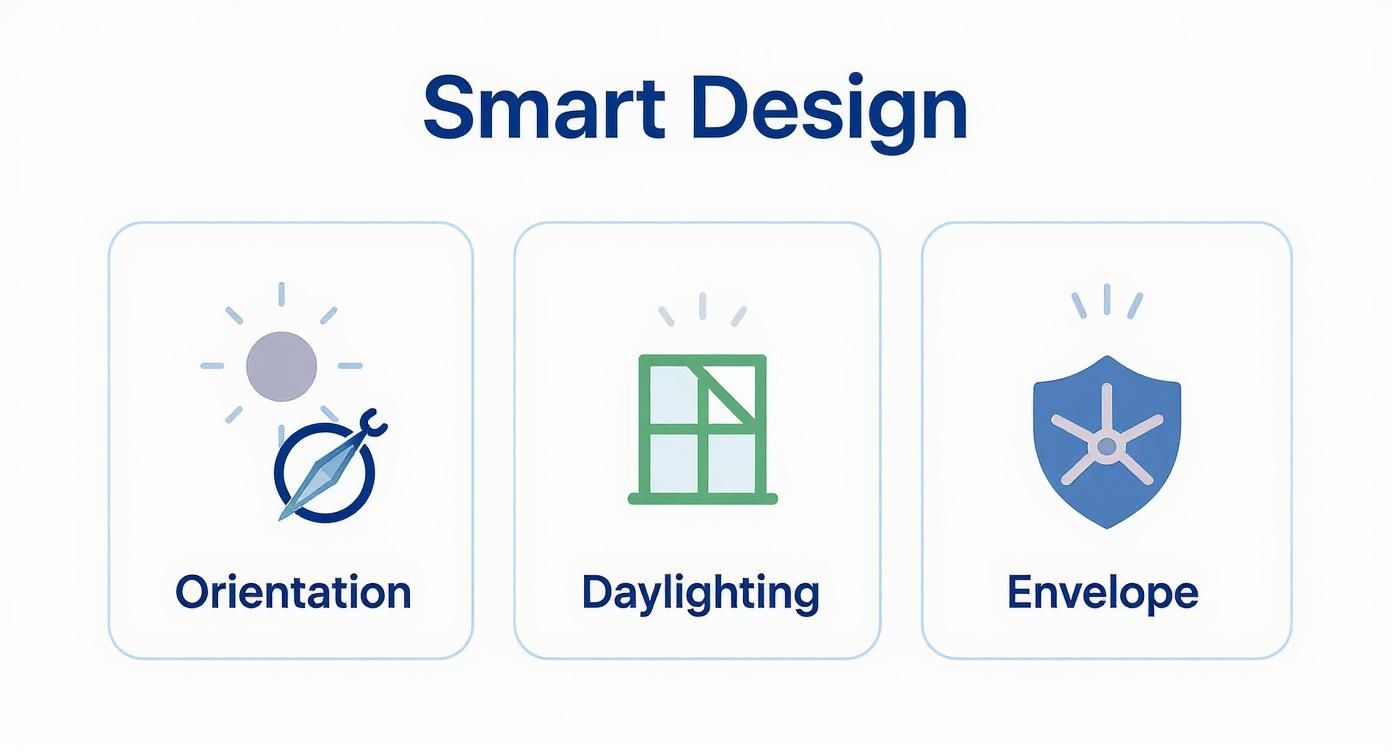
An infographic illustrating smart design principles: orientation, daylighting, and building envelope, with descriptive icons.

These core strategies—orientation, daylighting, and the building envelope—are the perfect partners for thoughtful material selection. Together, they create a truly high-performance, sustainable building.

Low-Carbon Material Alternatives

The good news? The market for low-carbon building materials is expanding fast. These alternatives often perform just as well—if not better—than conventional options while slashing your project's environmental debt.

Here's where we're seeing some of the biggest wins:

  • Mass Timber: Products like cross-laminated timber (CLT) and glulam are engineered wood marvels that can replace steel and concrete for a building's main structure. Since trees absorb and store carbon as they grow, mass timber can have a neutral or even negative carbon footprint.
  • Recycled Steel: Making new steel is incredibly energy-intensive. But using recycled steel? That requires about 75% less energy. Simply specifying a high percentage of recycled content is one of the easiest and most effective moves you can make.
  • Locally Sourced Materials: This one is just common sense. Choosing materials extracted and made nearby—like stone from a South Carolina quarry—drastically cuts the transportation emissions baked into your project. Plus, it keeps money in the local economy.

Even the smaller details add up. For instance, selecting eco-friendly and sustainable blinds can contribute to both better energy efficiency and a lower overall carbon footprint.

The most sustainable choices are often rooted in simplicity and locality. By prioritizing materials that are renewable, recycled, or sourced nearby, you are directly investing in a healthier planet and a more resilient local supply chain.

When you're evaluating your options, comparing the embodied carbon of different materials can really put things into perspective.

Comparing Common Building Materials by Embodied Carbon

This table gives a quick snapshot of how swapping out just a few key materials can make a significant difference in your project's upfront carbon emissions.

Material Conventional Option Sustainable Alternative Key Benefit of Alternative
Structure Concrete, Virgin Steel Mass Timber (CLT, Glulam) Carbon sequestering; stores carbon instead of emitting it.
Insulation Polystyrene Foam (XPS) Cellulose, Cork, Wood Fiber Made from recycled/renewable sources; lower energy to produce.
Cladding Aluminum Composite Panel Reclaimed Brick, Local Stone Drastically reduces manufacturing and transportation emissions.
Flooring Vinyl Composition Tile (VCT) Bamboo, Polished Concrete Renewable resource (bamboo) or uses the existing slab.

Looking at these comparisons makes it clear that sustainable alternatives aren't just hypotheticals—they are practical, available, and powerful tools for reducing embodied carbon.

Using EPDs for Transparent Choices

So, how do you actually compare the carbon footprint of two different products with confidence? The answer is the Environmental Product Declaration (EPD).

Think of an EPD as a nutrition label for a building material. It's a standardized, third-party verified report that clearly lays out a product's environmental impact across its entire lifecycle.

EPDs give you transparent data on factors like global warming potential (the official term for embodied carbon), allowing for a true apples-to-apples comparison. By asking manufacturers for EPDs and specifying products with lower embodied carbon, you can be sure your choices are backed by solid, verifiable data.

This commitment to material transparency is a cornerstone of modern sustainable design. It empowers developers and owners to build not just for today, but for a far more resilient and responsible future.

Unlocking the Hidden Value in Existing Buildings

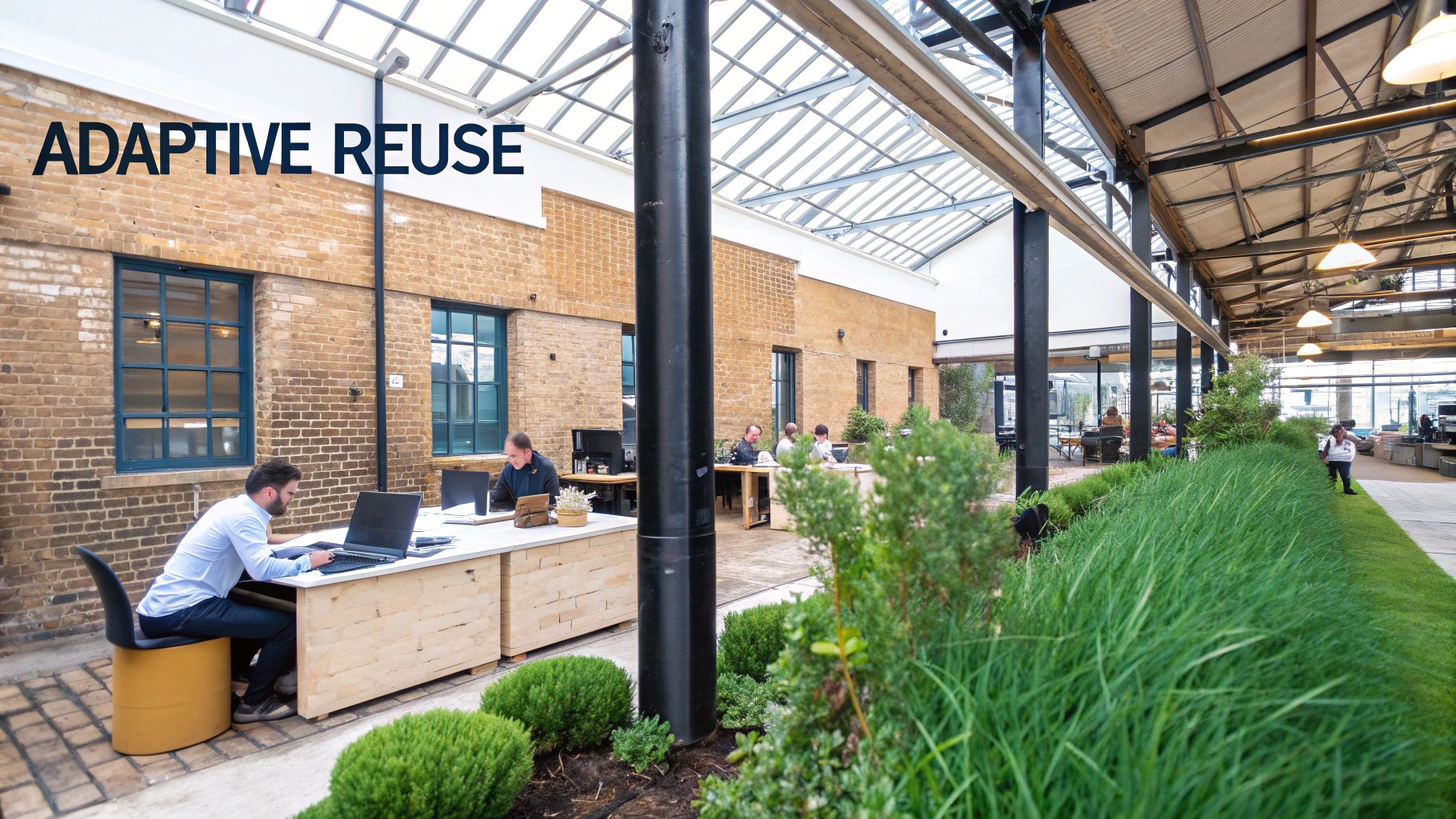
An open-plan office space with exposed brick, glass roof, greenery, and people working, highlighting adaptive reuse.

While we often focus on low-carbon materials for new projects, one of the biggest moves we can make in architecture and sustainable design is to look at the buildings we already have. There’s a well-known saying in the industry: "the greenest building is the one that’s already built." And it’s absolutely true. This idea gets to the heart of adaptive reuse—the art of breathing new life into old structures by repurposing them for today's needs.

Think of it this way: every existing building is a massive vault of embodied carbon. All the energy that went into manufacturing its steel, concrete, and bricks is locked right into the structure. When we tear a building down, we not only waste those materials but also release a huge amount of carbon in the demolition and hauling process. Adaptive reuse lets us sidestep that entire carbon hit.

But it's about more than just avoiding waste. This approach preserves the character and history woven into a community's fabric. That forgotten textile mill can become a bustling hub with apartments and shops. A century-old bank can be transformed into a sleek, modern office. You get all the benefits of a new space without sacrificing the architectural soul that gives a place its identity.

Making Adaptive Reuse Work in the Real World

Turning an old building into a modern, high-performing asset is a bit like solving a complex puzzle. It's a different game than starting from scratch on an empty lot, and it demands a thoughtful, strategic approach to get it right.

A successful adaptive reuse project usually follows a few key steps:

  1. Digging into the Details: It all starts with a deep-dive assessment. We have to understand the building's bones—its structural integrity, the state of its electrical and plumbing systems, and whether there are any hazardous materials like asbestos to deal with.
  2. Smart Upgrades, Not Just Repairs: The goal isn't to just patch things up. It’s about a strategic modernization. This means weaving in new, energy-efficient systems, beefing up the insulation to tighten the building envelope, and reimagining the interior layout to fit how people live and work now.
  3. Wrangling the Rules: Getting an older building to meet modern codes for things like accessibility, fire safety, and energy use is often the biggest hurdle. This is where a deep knowledge of both historic preservation rules and current regulations becomes critical.

Navigating these challenges is precisely where an experienced architecture firm proves its worth, finding creative ways to turn potential deal-breakers into design opportunities.

The Financial Incentives That Make Preservation Pay Off

Beyond the obvious environmental wins, adaptive reuse often makes incredible financial sense. This is largely thanks to some powerful incentives designed to make saving old buildings the smart business move. For developers, these programs can completely change the math on a project's profitability.

Adaptive reuse is where sustainability meets smart business. By leveraging historic tax credits and other incentives, developers can turn underutilized properties into highly valuable, sustainable assets with a unique market identity.

Federal and State Historic Tax Credits are the real game-changers here. Together, these programs can offer a tax credit of up to 40% of the project's qualified rehabilitation costs for income-producing historic properties. We’re talking about a direct, dollar-for-dollar reduction in what you owe in taxes, which can dramatically boost a project’s ROI.

  • Federal Historic Tax Credit: Provides a 20% income tax credit.
  • South Carolina Historic Tax Credit: Offers an additional 10-25% state income tax credit, which can be stacked on top of the federal credit.

These aren't just minor perks; they are fundamental to building a strong financial case for preservation. They make it clear that investing in our existing building stock is a winning strategy that pays dividends—environmentally, socially, and on the bottom line. For developers who know how to tap into this potential, our old buildings represent some of the smartest opportunities on the market today.

Building the Business Case for Green Construction

For years, there’s been a myth floating around that sustainable construction is a noble but costly affair, something best reserved for passion projects with deep pockets. Let’s put that idea to rest, right here and now.

In today's market, choosing architecture and sustainable design isn’t about sacrificing profit for the planet. It’s about making a smarter, more lucrative financial decision. The numbers don't just support this—they prove that green construction is a powerful engine for profitability.

The most common objection I hear is about higher upfront costs. Yes, high-performance insulation, better windows, or an advanced HVAC system might require a greater initial investment. But focusing only on that is incredibly shortsighted. It's like comparing a cheap gas-guzzler to a high-efficiency hybrid based only on the sticker price, completely ignoring what you’ll save on fuel over the car's lifetime.

A sustainably designed building is an operational powerhouse. That efficiency translates directly into substantial, long-term savings that start piling up the day you open the doors.

From Upfront Costs to Long-Term Gains

The return on investment (ROI) for sustainable design isn't some abstract concept; it's a measurable financial reality. And the biggest driver of that ROI? Drastically lower operational expenses.

An energy-efficient building slashes utility bills year after year, creating a predictable and significant boost to the property's net operating income (NOI). On top of that, high-quality, durable materials and systems mean less frequent maintenance and replacement, which cuts down even further on long-term spending. These savings compound over the life of the asset, often paying back that initial "green premium" in just a few years.

The conversation around sustainable building costs has to shift. Instead of asking "how much more will it cost?" we need to be asking, "how much more will it earn?" Lower operational expenses, higher rents, and increased asset value create a financial case that simply outperforms conventional construction.

This financial upside is becoming impossible for the market to ignore. The global green building market is projected to hit a staggering $1.37 trillion by 2034. This explosion is fueled by real, tangible benefits—including 16.9 percent reduced operational costs for green buildings compared to their conventional counterparts. With numbers like that, the financial argument is undeniable. You can find more green building statistics and insights that back this up.

Attracting Premium Tenants and Higher Market Value

Beyond just saving money on operations, sustainable buildings hold a distinct advantage in the open market. They're magnets for high-value tenants and consistently command premium prices.

Think about it from the tenant's perspective. Corporate clients are increasingly driven by their own Environmental, Social, and Governance (ESG) goals. They are actively hunting for office spaces that reflect their values and are absolutely willing to pay more for buildings that offer healthier environments and lower carbon footprints. For building owners, this demand translates directly into stronger financial metrics.

Here’s a look at how green buildings consistently outperform the competition:

  • Higher Rental Rates: Study after study shows that green-certified buildings can command rental rates that are up to 20% higher than comparable non-certified properties.
  • Lower Vacancy Rates: These highly desirable buildings attract and retain tenants more effectively, which means more stable occupancy and reliable cash flow for you.
  • Greater Resale Value: As market awareness and regulations continue to grow, energy-efficient and sustainable properties are seen as less risky, future-proofed assets. This perception results in significantly higher sale prices down the road.

At the end of the day, ESG-focused investors are actively seeking out these exact kinds of properties. A building with strong sustainability credentials isn't just a well-designed structure anymore—it's a top-tier financial asset that perfectly aligns with modern investment priorities. By embracing sustainable design, developers and owners aren't just building better buildings; they're building a more profitable and resilient portfolio.

Bringing Sustainable Design Home to South Carolina

Global principles of sustainable architecture are great on paper, but they only really come to life when you put them to work in a specific place. For anyone building in South Carolina, that means getting real about our biggest local challenge: the relentless heat and humidity. The whole point is to design buildings that work with our climate, not in a constant, energy-guzzling battle against it.

This shift in thinking has to happen right at the start of a project. Instead of just defaulting to a bigger, more powerful air conditioning system, the smarter approach is to lean on passive strategies first. We're talking about simple but powerful moves like orienting a building to avoid the brutal afternoon sun, using deep overhangs to shield windows in the summer, and designing for natural airflow to cut down on how much you have to rely on mechanical cooling.

These aren't just academic ideas. They are tried-and-true methods for making spaces that are genuinely comfortable and efficient, even when the heat index is off the charts.

What's Working Right Here in SC

You don't have to look far to see this in action. South Carolina has a growing roster of commercial projects that prove sustainable design isn't just possible here—it’s a recipe for success. Whether it's the clever adaptive reuse of historic buildings in Charleston or new LEED-certified offices in Columbia and Greenville, these projects offer a practical playbook.

They showcase a few key strategies that really move the needle:

  • Airtight Building Envelopes: This is all about top-notch insulation and sealing up every crack and crevice to keep the cool, conditioned air in and the sticky, humid air out.
  • Cool Roofs: Simply choosing light-colored, reflective roofing materials can bounce a huge amount of solar heat back into the atmosphere, dramatically lowering the building's cooling demand.
  • Smart Landscaping: Using native, drought-tolerant plants doesn't just look good; it slashes irrigation costs and helps support the local ecosystem.

Lessons from Global Innovators

While our focus is local, it never hurts to see what's happening on the world stage. Some truly incredible projects show just how far we can push the envelope. Take Stockholm Wood City in Sweden, set to be the world's largest urban district built from mass timber. Or The Edge in Amsterdam, which earned a near-perfect BREEAM sustainability score of 98.36 out of 100 and is often called the smartest, greenest building on the planet. These examples aren't just inspiring; they prove what’s possible when ambition meets innovation. You can dig into more of these pioneering sustainable buildings and their features to see what the future holds.

Tapping into Local and State Incentives

Let's talk money. Building sustainably in South Carolina isn't just an environmental win; it's a smart financial move, thanks to some valuable incentives. Developers who know where to look can find programs that seriously improve a project's bottom line.

By combining climate-savvy design with the right local and state incentives, developers can build high-performing assets that are good for the planet and great for their portfolio right here in the South Carolina market.

The opportunities are out there. Utility providers like Duke Energy and Dominion Energy offer rebates for everything from high-efficiency lighting and HVAC systems to other major building upgrades. On top of that, the South Carolina State Energy Office frequently has grants and low-interest loans available for projects that integrate renewable energy or achieve major efficiency gains. When you add it all up, these programs make the business case for going green undeniable, giving sustainable design a real competitive edge.

Frequently Asked Questions

What’s the single biggest thing I can do for sustainable design?

If you have to pick just one area to focus on, put your energy into the building envelope. Think of it as the building's skin—its roof, walls, windows, and foundation. A high-performance envelope with top-notch insulation, airtight sealing, and high-efficiency windows is the most powerful move you can make.

This isn't an active, energy-consuming system; it's a passive strategy that works silently, 24/7, for the entire life of the building. It dramatically cuts the energy needed for heating and cooling, which means you can often install smaller, less expensive HVAC systems. The payoff, both for the planet and your wallet, starts immediately.

Are green building certifications like LEED really worth the hassle and cost?

For most commercial developers and owners, the answer is a firm yes. Pursuing a certification like LEED (Leadership in Energy and Environmental Design) isn't just about getting a plaque for the lobby. It’s a rigorous, third-party stamp of approval that tells the world your building is efficient, healthy, and built to last.

This kind of verification makes your property far more attractive to top-tier tenants who increasingly demand sustainable spaces. It can also lead to higher rents and faster lease-ups. Beyond marketing, the certification process itself provides a clear, proven framework for making smart design choices and often opens doors to green financing and tax incentives that can offset the initial investment.

A green building certification is more than a plaque on the wall; it’s a trusted signal to the market that your property is a high-quality, future-focused asset.

How can I make my existing building more sustainable without a massive renovation?

You don't have to gut the building to make a real difference. The smartest first step is a professional commercial energy audit to pinpoint exactly where you're losing the most energy and money. It takes the guesswork out of the equation.

Based on the audit, you can target a few high-impact upgrades:

  • Swap out old lighting for LEDs. This is often the fastest, easiest way to slash your electricity bill.
  • Install smart thermostats and modern building controls to optimize when and where you use energy.
  • Add insulation where it’s easiest to access, like in the attic or roof assembly.
  • Replace old fixtures with low-flow toilets and faucets to cut water usage with minimal investment.

Even just one or two of these focused improvements can deliver significant savings on your utility bills and make the building a much more comfortable place for everyone inside.


Ready to unlock the value in your next commercial project through smart, sustainable design? Contact Sherer Architects, LLC to align your vision with enduring, profitable, and responsible architecture. Learn more at https://shererarch.com.

Categories
news

Adaptive Reuse Architects Reshaping Our Cities

You've probably seen them without even realizing it. An old warehouse now buzzing with co-working spaces. A forgotten church transformed into a stunning event venue. A historic bank now serving craft cocktails. These incredible transformations are the work of adaptive reuse architects.

Think of them as architectural storytellers. Instead of starting with a blank canvas, they take an existing building—with all its history, quirks, and character—and give it a brand new chapter. It's a creative field that's becoming absolutely essential for building smarter, more sustainable cities.

Why Adaptive Reuse Is Redefining Architecture

A modern interior of a revitalized historic building, showcasing exposed brick and new fixtures.

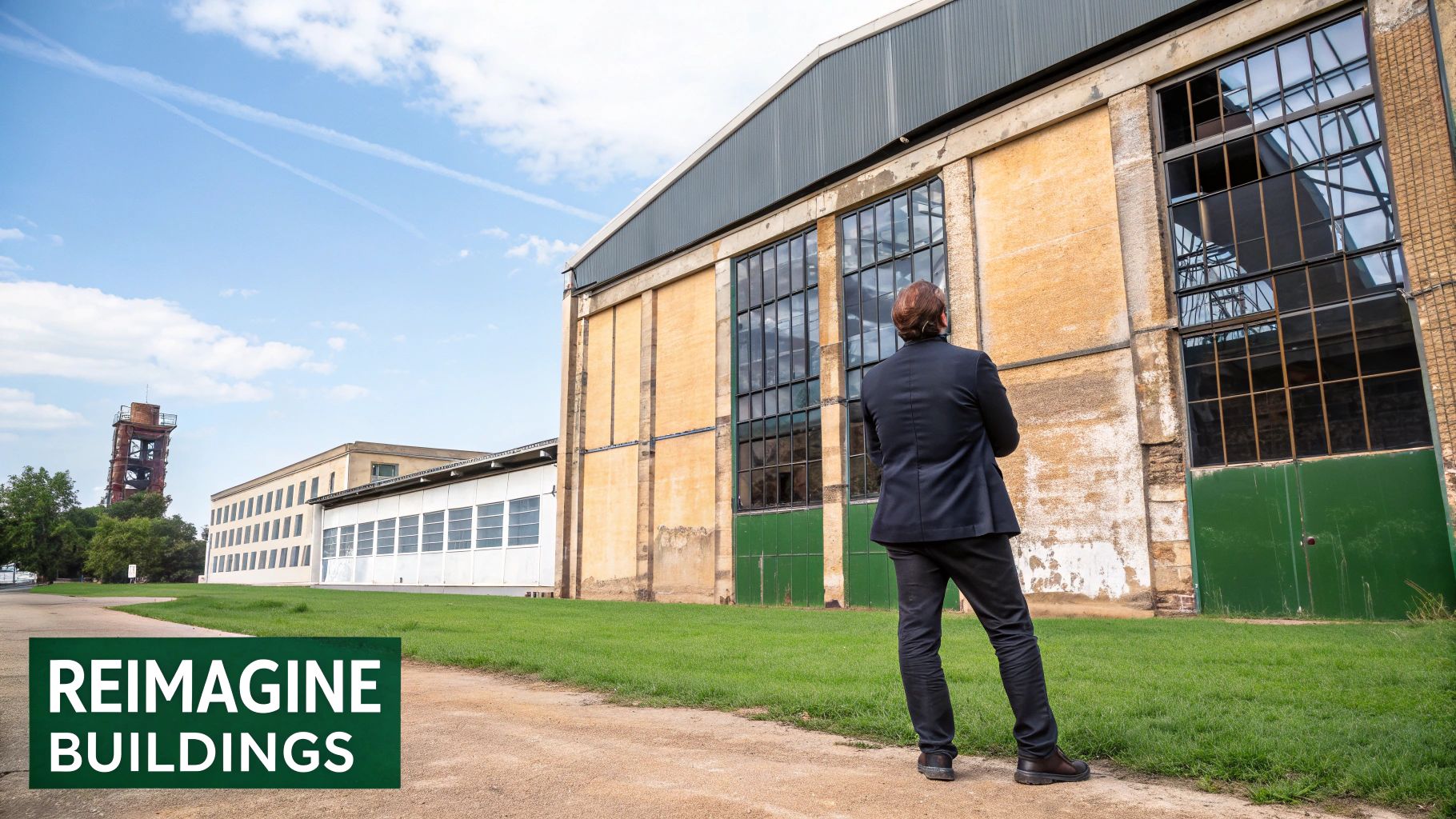
Imagine a tired, old textile mill. Instead of a wrecking ball, picture it alive again as a vibrant hub of loft apartments, studios, and shops. That’s the magic of adaptive reuse. It’s a field where architects don't just build; they see the immense potential locked inside our existing buildings and find clever ways to unlock it.

This whole approach marks a huge shift in how we view urban development. It challenges the old tear-down-and-rebuild model, arguing for a more thoughtful path. It’s about seeing value where others might see decay and preserving the unique fabric of our communities.

A New Era of Architectural Problem Solving

The job of an adaptive reuse architect is far more complex than just sketching out new floor plans. They have to wear multiple hats: part historian, part structural detective, and part creative visionary. It's a constant balancing act.

Their work requires them to:

  • Respect Historical Integrity: They dive deep into a building's past to honor its original character, preserving the details that give it a soul.
  • Introduce Modern Performance: At the same time, they have to weave in everything a modern building needs—from energy-efficient systems and accessibility ramps to up-to-date safety codes.
  • Solve Complex Puzzles: Figuring out how to fit a new, modern function inside an old, often quirky, structure is like solving a giant 3D puzzle. It demands some seriously ingenious design and engineering.

The core idea is simple but powerful: the most sustainable building is the one that already exists. Adaptive reuse architects are on the front lines, making our cities more resilient, interesting, and environmentally sound, one project at a time.

This isn't just a niche practice for historical landmarks anymore; it's a mainstream global strategy. With construction and demolition waste accounting for nearly 40% of total solid waste, the push to reduce this impact is massive. By keeping an existing structure, you're not just saving a building—you're avoiding the huge carbon footprint that comes with producing new concrete, steel, and other materials.

A perfect example is the growing trend of transforming commercial property into residential spaces. This movement highlights how architects are creating lively, sustainable communities by simply reimagining the buildings we already have.

The Guiding Principles of a Reuse Architect

An architect reviewing blueprints inside a historic building undergoing renovation.

So, what really makes an adaptive reuse architect tick? It's more than just technical skill; it's a unique mindset. They have a way of seeing immense potential where most people would only see decay or a lost cause. Think of them as translators, meticulously decoding a building’s past to write its next, vibrant chapter.

This entire process starts with a profound respect for the building itself. Before sketching a single new line, they listen to what the structure has to say. This philosophy is built on a few core principles that ensure the final space honors its history while being perfectly suited for today.

Reading the Building's Bones

The first, and arguably most important, principle is what we in the field call "reading the building's bones." This is less of a casual walkthrough and more of a forensic investigation into the structure's soul. An architect doesn’t just see bricks and beams; they see a story revealed through materials, forgotten construction methods, and the natural patina of time.

They carefully analyze the structural grid, the flow of the original layout, and any unique architectural details that give the place its personality. Are there massive timber trusses that could become a breathtaking centerpiece? Do those tall, arched windows present a golden opportunity for flooding the space with natural light? This deep dive uncovers the building's character—and its limitations—which then become the creative guardrails for the entire project.

By figuring out the why behind the original design, adaptive reuse architects can make smarter, more empathetic decisions. It helps them separate the elements that are essential to the building's identity from those that can be thoughtfully updated or removed.

An adaptive reuse architect acts as a building whisperer. They listen to the echoes of the past within the walls to understand the structure's soul, ensuring the new design feels like a natural evolution, not a forced reinvention.

Balancing Preservation with Performance

Once the building's history is fully understood, the real puzzle begins: weaving modern needs into a historic framework. This is the delicate tightrope walk of balancing preservation with performance. After all, a beautifully restored building is nothing but a museum piece if it’s drafty, unsafe, or costs a fortune to heat and cool.

This balancing act means integrating contemporary systems without stripping the building of its charm. It’s a constant negotiation between the old and the new.

  • Modern Systems Integration: This is where the real creativity comes in. The challenge is to snake new HVAC, electrical, and plumbing through a building that was never meant to hold them, all while trying to leave historic finishes untouched.
  • Energy Efficiency Upgrades: Bringing a vintage structure up to modern standards means introducing high-performance insulation, new windows that replicate historic profiles, and energy-efficient lighting. This dramatically lowers the building’s ongoing carbon footprint and operational costs.
  • Code Compliance and Safety: The building must meet today's strict codes for fire safety, accessibility (like ADA requirements), and structural stability. This often requires clever, sensitive solutions that don't scream "modern retrofit."

The ultimate goal is to create a seamless conversation between the original structure and the new interventions. A successful project feels timeless. The modern comforts are so well-integrated that they simply enhance the historic character, never competing with it. That’s the true signature of a masterfully executed adaptive reuse.

The Tangible Benefits of Revitalizing Old Buildings

Choosing to give an old building a new life instead of tearing it down is more than just a sentimental decision. It’s a smart, strategic move with powerful, real-world advantages. Adaptive reuse architects create value that ripples out far beyond the property line, benefiting the environment, the budget, and the entire community. These aren't just abstract ideas; they're measurable outcomes that build a rock-solid case for breathing new life into existing structures.

When you break it down, the advantages fall into three main buckets: environmental, economic, and cultural. Looking at them together reveals just how impactful this approach can be.

Environmental Wins

The most immediate and dramatic benefit is environmental. Think of it this way: every building has embodied carbon. That’s all the greenhouse gas emissions tied to its original construction—from making the steel to pouring the concrete. When you demolish a building, you're not just creating a pile of rubble; you're throwing away all that invested carbon, and then you start the high-emission process all over again.

By preserving a building's primary structure and foundation, adaptive reuse can slash embodied carbon emissions by 50% to 75% compared to new construction. That's a massive win for sustainability before a single new tenant even walks through the door.

This approach also tackles the huge problem of construction and demolition debris, which chokes our landfills. It's a direct way to conserve natural resources by cutting down on the demand for new steel, concrete, and timber.

Beyond the big picture, adaptive reuse projects also offer a chance to significantly upgrade a building's performance. Architects can weave in modern, sustainable systems, like weighing different energy-efficient roofing options, which helps lower operational costs for decades to come.

Economic Advantages

While every project has its complexities, adaptive reuse often makes more financial sense than starting from scratch. The most obvious savings come from skipping demolition costs and using the existing foundation and structural frame—two of the most expensive parts of any new build.

This initial advantage often leads to a cascade of other financial perks:

  • Faster Project Timelines: With the bones of the building already in place, the construction schedule can be significantly shorter. This means lower carrying costs and a faster path to getting tenants in and generating revenue.
  • Tax Incentives: Many older buildings, especially historic ones, qualify for a range of federal, state, and local preservation tax credits. These can offset a huge chunk of the rehabilitation costs.
  • Increased Marketability: Let's face it, character sells. Restored buildings with unique architectural details are magnets for tenants and buyers, often commanding premium rents and filling up faster than their generic, new-build counterparts.

Community and Cultural Gains

Perhaps the most inspiring benefit of all is the one you can feel on the street. Old buildings hold a city's stories. They give a place its identity. When an adaptive reuse architect successfully transforms a forgotten factory or an empty school, they’re doing more than just creating a new space—they’re saving a piece of local history for the next generation.

These projects often become the spark that ignites neighborhood-wide revitalization. They can act as anchors, drawing in new businesses, residents, and foot traffic, breathing life back into areas that were once overlooked. By turning a dormant liability into a vibrant community asset—whether it’s a boutique hotel, a bustling public market, or creative office space—these projects craft memorable, meaningful places that strengthen the very soul of a city.

A quick comparison really brings the differences into focus.

New Construction vs. Adaptive Reuse: A Comparative Overview

This table compares key factors between building from scratch and repurposing an existing structure, highlighting the distinct advantages of adaptive reuse.

Factor New Construction Adaptive Reuse
Environmental Impact High embodied carbon, significant waste, resource-intensive. 50-75% less embodied carbon, minimal waste, conserves resources.
Project Timeline Longer due to groundwork, foundation, and structural phases. Often shorter, as the primary structure is already in place.
Initial Costs High costs for demolition, excavation, and new structure. Avoids major demolition and structural costs; potential for tax credits.
Character & Marketability Can be generic; relies on new design for appeal. Inherent character, unique history, and authentic details create a strong market draw.
Community Integration Creates a new presence; may disrupt existing neighborhood fabric. Preserves local identity, revitalizes existing areas, and strengthens community ties.

Ultimately, while new construction certainly has its place, the compelling blend of sustainability, financial viability, and cultural preservation makes adaptive reuse a powerful and intelligent choice for the future of our cities.

An Inside Look at the Adaptive Reuse Process

Breathing new life into an old building isn’t magic; it’s a carefully choreographed process. An adaptive reuse architect guides a project through a series of distinct phases, turning what seems like a complex puzzle into a clear roadmap. Each step builds on the one before it, ensuring the final space is not only beautiful but also safe, functional, and financially sound.

This journey starts long before a single hammer swings. It begins with a deep dive into the building’s past and present, almost like a detective piecing together a case.

Discovery and Feasibility

This first phase is all about doing the homework. Before anyone commits to a massive investment, the architect has to figure out if the dream is even possible. They meticulously inspect the building's "bones" to get a read on its structural health, hunting for hidden issues that could throw a wrench in the works down the line.

This deep investigation covers a few key areas:

  • Structural Assessment: Engineers come in to test the strength of the foundation, support beams, and roof. Is it solid, or are there underlying weaknesses?
  • Hazardous Materials Survey: The team searches for old-school hazards like asbestos and lead paint that need to be handled with extreme care.
  • Historical Significance Review: The architect digs into the building's story, identifying the unique, character-defining elements worth preserving.
  • Zoning and Code Analysis: They check local regulations to make sure the new use is allowed and figure out what it will take to bring everything up to modern safety standards.

This phase wraps up with a detailed feasibility report. Think of it as a brutally honest assessment of the project's risks, potential rewards, and a rough budget, giving the owner the clarity they need to move forward.

Creative Design and Re-Engineering

Once everyone understands the building's limits and possibilities, the real creative work can begin. This is where the adaptive reuse architect truly shines, blending artistry with engineering to design a space that honors the past while looking squarely toward the future.

The trick is to fit a new purpose—like apartments, offices, or a boutique hotel—into an old structure so it feels completely natural. It's a delicate balancing act. An architect might place a minimalist, modern kitchen against a beautifully weathered, century-old brick wall, creating a stunning conversation between old and new. They’ll also find ingenious ways to thread modern HVAC, plumbing, and electrical systems through a building that was never meant for them, sometimes hiding them in plain sight or even making them part of the industrial-chic aesthetic.

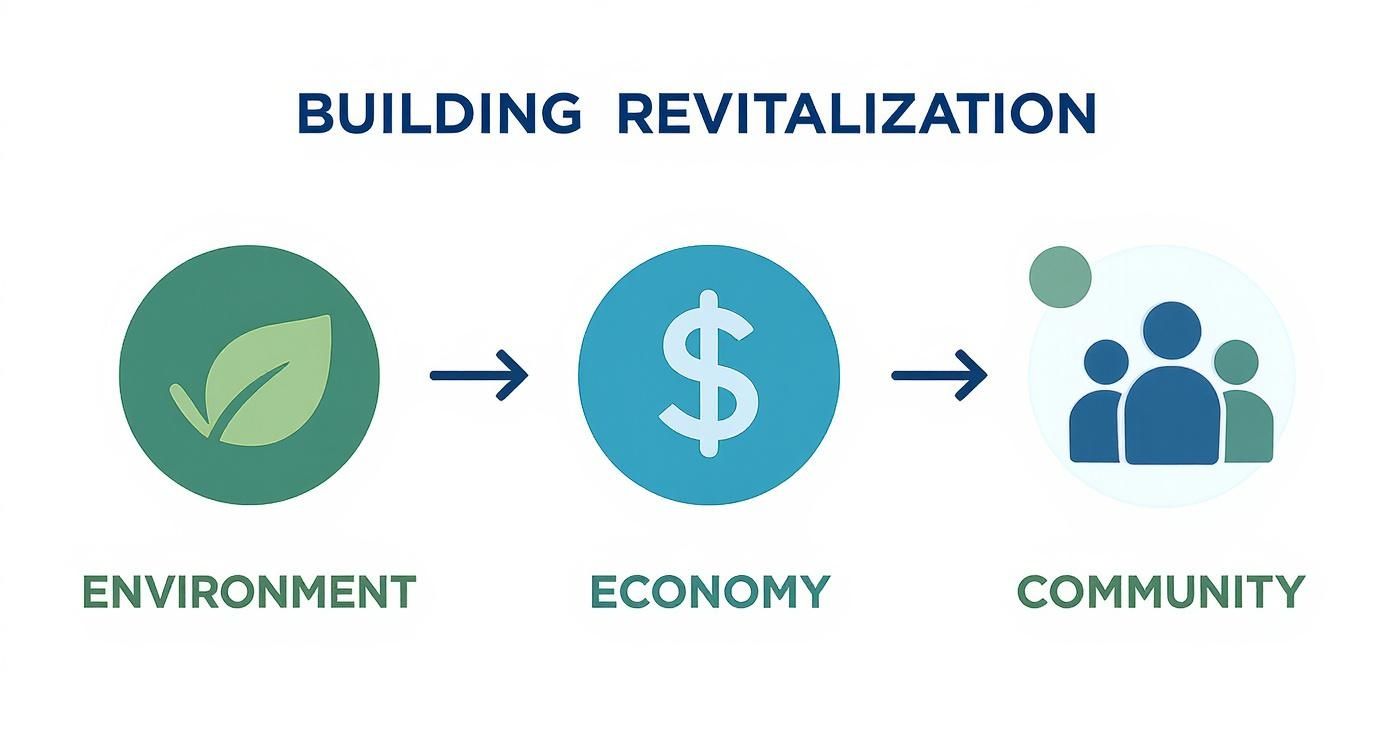
The infographic below shows how this process connects environmental, economic, and community goals.

Infographic about adaptive reuse architects

As you can see, a successful project isn't just about one thing; it's a balanced ecosystem where sustainability, profitability, and social value all support each other.

Navigating Regulations

A brilliant design is just a drawing until it’s approved. This phase is all about navigating the maze of city agencies, historic preservation boards, and sometimes, community groups. The architect becomes the project's chief advocate, presenting the plans, explaining the vision, and negotiating any changes needed to get the green light.

Getting permits for an adaptive reuse project is often far more complicated than for new construction. The architect has to prove the design not only meets today's strict life-safety codes but also respects the building’s historical soul.

Construction and Transformation

Finally, the vision starts becoming a reality. During construction, the architect's role shifts to that of a quarterback and problem-solver. They work side-by-side with the contractors, making sure the design is being followed precisely and tackling the inevitable surprises that pop up when you open up old walls.

This hands-on oversight keeps the project on schedule, on budget, and true to the original concept. The result? A revitalized landmark, ready to begin its next chapter.

The Future of Adaptive Reuse Architecture

The world of adaptive reuse is anything but static; it’s constantly evolving. Looking ahead, adaptive reuse architects are leaning into new technologies, fresh mindsets, and forward-thinking policies that redefine what’s possible. The practice is graduating from just saving old buildings to pioneering a genuinely circular and intelligent way of thinking about our built environment.

This future-focused strategy isn't just about giving a building a second life today. It's about preparing it for infinite cycles of use tomorrow. We're witnessing a massive shift away from the old linear "build, use, demolish" model and toward a circular one, where buildings are designed for disassembly from day one.

Designing for a Circular Future

The next big leap for adaptive reuse is achieving true circularity. While most projects today are about extending a single building's life, this new way of thinking is about designing materials and structures for endless reuse. The biggest headaches in current projects often come from permanently bonded materials—think flooring glued to a subfloor or coatings that can’t be removed—which just end up as waste.

The innovation lies in creating fully detachable, reconfigurable building elements that can be used again and again without losing their quality. For more on this, check out these insights on designing for true circularity.

This whole concept is known as design for disassembly. It means architects are now specifying mechanical fasteners instead of permanent glues and designing modular components that can be easily swapped out or moved. Imagine walls, facade panels, and even entire rooms that can be unbolted and reinstalled somewhere else. The building itself becomes a bank of high-quality materials ready for the next project.

"The future of sustainable architecture isn't just about reusing what we have; it's about creating new things with their next life already in mind. Every component becomes a temporary resident, not a permanent fixture."

The Role of Advanced Technology

Technology is a huge part of this evolution, giving architects tools with incredible precision. Take 3D laser scanning. It allows them to create hyper-accurate digital models of existing buildings in a tiny fraction of the time it used to take. These scans capture every little detail, from a slight shift in the foundation to the exact dimensions of historic trim.

This data feeds directly into Building Information Modeling (BIM) software, creating a detailed "digital twin" of the structure. With this model in hand, architects can:

  • Simulate Renovations: They can test out different design ideas virtually, figuring out the most efficient and least disruptive path forward before a single wall is touched.
  • Analyze Performance: It’s possible to model energy use, daylighting, and structural loads to ensure the updated building meets modern performance standards.
  • Streamline Construction: Contractors get precise, clash-free plans, which dramatically cuts down on errors and waste during the actual build.

These tools empower adaptive reuse architects to make smarter, more informed decisions. They help de-risk complex projects and uncover hidden opportunities that would have been completely invisible with old-school, two-dimensional methods. This tech-driven approach, combined with a focus on circularity and supportive city policies, is what will keep adaptive reuse at the heart of building the resilient, character-rich cities of tomorrow.

Your Top Questions About Adaptive Reuse, Answered

As more people recognize the incredible potential locked inside our older buildings, adaptive reuse is moving from a niche specialty to a go-to strategy for smart development. But for clients, developers, and even community members new to the idea, it often comes with a lot of questions.

Let's clear things up. Answering these common questions will help demystify the process and show you exactly where an experienced adaptive reuse architect makes all the difference.

Is It Really Cheaper Than Building New?

This is the big one, and the honest answer is: usually, but it's not a simple yes or no. The biggest savings, right off the bat, come from what you don't have to build. The foundation and structural frame are already there, and that alone can account for a huge chunk of a new construction budget.

Of course, the building's current condition is the real wild card. The budget can get complicated if you run into unexpected issues, such as:

  • Hazardous Material Abatement: Discovering asbestos or lead paint means bringing in specialists, which is a necessary but costly step.
  • Major Structural Surprises: If the "bones" of the building aren't as strong as they look, you'll need to invest in reinforcement.
  • Tricky Systems Integration: Fitting modern mechanical, electrical, and plumbing (MEP) systems into a structure from a different era is often more complex than a standard installation.

This is why a seasoned adaptive reuse architect insists on a thorough feasibility study upfront. That initial deep dive is what separates a reliable budget from a hopeful guess. When you factor in potential tax credits for historic preservation and often faster project timelines, reuse frequently comes out on top financially.

What Kinds of Buildings Are Best for Reuse Projects?

While just about any structurally sound building can be a candidate, some types are clear favorites for a reason. Old industrial buildings—think warehouses and factories—are the classic example. Their high ceilings, tough-as-nails construction, and massive open floor plans are a dream to work with, easily transforming into lofts, creative offices, or buzzing retail hubs.

Beyond industrial shells, look for buildings with great character and generous space. Former schools, churches, and old department stores all have solid structures and unique architectural details just waiting to become the centerpiece of a new design.

The ideal candidates for adaptive reuse are buildings that have a story to tell and a solid frame to back it up. A good architect’s first look goes past any current decay to see the building’s potential as a distinctive, functional, and truly memorable place.

How Do You Balance Historic Character with Modern Needs?

This is where the real artistry comes in. It’s less of a battle and more of a conversation between the past and the present. The first step is to identify the building's character-defining features—the original brickwork, the soaring timber trusses, the unique window patterns—and make them the heroes of the new design.

From there, modern elements are woven in to complement the old, not overpower it.

  • Contrast Creates Beauty: A sleek, minimalist kitchen against a rough, centuries-old stone wall makes both elements stand out even more.
  • Honest Interventions: New additions are often designed to be clearly different from the original structure, honoring the building's timeline instead of trying to fake it.
  • Guided by Standards: Architects rely on proven guidelines, like The Secretary of the Interior's Standards for Rehabilitation, to ensure the building's story isn't just preserved but enriched with a new chapter.

What Are the Biggest Headaches in a Reuse Project?

Without a doubt, the biggest challenges are the ones you can't see. It's the surprises lurking behind the walls that cause the most stress, delays, and budget creep. Uncovering hidden structural decay, undocumented modifications from past owners, or hazardous materials can throw a wrench in the most detailed plans.

Another common hurdle is bringing a historic structure up to modern code. Satisfying today’s requirements for accessibility, fire safety, and energy efficiency in a building from the 1920s requires some serious creativity. The same goes for integrating complex MEP systems. It takes ingenuity and smart problem-solving—skills a dedicated adaptive reuse architect has honed over many projects, turning potential roadblocks into unexpected design opportunities.


At Sherer Architects, LLC, we see the hidden potential in existing buildings. With over 30 years of experience in adaptive reuse and historic preservation, we’ve learned how to navigate every challenge and seize every opportunity, turning overlooked structures into valuable, sustainable community assets. Learn how we can bring your vision to life at shererarch.com.

Categories
news

How to Hire an Adaptive Reuse Architect

At its heart, an adaptive reuse architect is a special kind of professional who sees a vibrant future where others might only see a forgotten past. Think of them as part historian, part visionary, and part sustainability champion, all rolled into one. Their unique talent lies in transforming old, disused structures into dynamic, modern spaces that can serve communities for generations to come.

Giving Old Buildings a New Purpose

A modern, renovated industrial building with large windows and a clean facade, showcasing adaptive reuse.

Picture a cavernous old warehouse with soaring ceilings and timeworn brick walls, or maybe a decommissioned schoolhouse, its long hallways still echoing with memories. Where a wrecking ball sees an obstacle, an adaptive reuse architect sees a once-in-a-lifetime opportunity. They don't start with a blank canvas; instead, they listen to the story the building has to tell, reading its history to imagine its next chapter.

This specialized field is so much more than a simple renovation. It’s a creative and highly technical practice focused on repurposing a building for a function it was never originally intended for. This approach is absolutely critical for building sustainable cities and saving our irreplaceable cultural heritage.

The Value of a Second Life

So, why is this idea catching on everywhere? The appeal goes way beyond just looking cool. The benefits are real, touching everything from the environment to the economy and the community's spirit. By choosing to adapt an old structure instead of tearing it down, property owners and developers unlock a surprising number of advantages.

The key benefits of adaptive reuse really stack up:

  • Environmental Sustainability: Keeping the building's core structure intact dramatically cuts down on landfill waste from demolition. It also saves the massive amount of embodied carbon required for new construction. It’s one of the greenest ways to build.
  • Cultural Preservation: Old buildings are the storybooks of our communities. An adaptive reuse architect helps keep that narrative alive, preserving the unique character and soul of a neighborhood.
  • Economic Viability: These projects can often be more cost-effective and completed on a faster timeline than building from scratch. You get to skip the high costs of demolition, major excavation, and pouring a new foundation.
  • Unique Character: You just can't fake history. Repurposed buildings boast one-of-a-kind features—exposed brick, original timber beams, massive industrial windows—that new constructions can't replicate, creating spaces people are excited to be in.

Adaptive reuse is about more than just bringing lights back to empty offices. It is about creating something that supports community and drives value for developers, for families, and for the city.

More Than Just a Renovation

The work of an adaptive reuse architect is a masterful blend of artistry and intricate problem-solving. They need a deep knowledge of historic materials and construction methods, a knack for navigating modern building codes as they apply to old structures, and the ingenuity to weave in new systems—like HVAC and electrical—without destroying the building’s historic integrity.

To get a real sense of this magic, it helps to see the results. Looking at some inspiring before and after house flips can show how this transformative power works, even on a residential scale.

This guide will walk you through what it really means to take on an adaptive reuse project, from understanding the core philosophy to finding the right expert to bring your vision to life.

The Philosophy of Adaptive Reuse Architecture

Adaptive reuse is so much more than a simple facelift for an old building or a clever way to cut costs. It’s a completely different way of looking at our cities and towns. At its heart, this philosophy is about sustainability, honoring our history, and being smart about how our urban spaces grow. The core question shifts from "What can we build here?" to "What can we preserve and reimagine?"

Think about the difference between a new, flat-pack piece of furniture and a beautifully restored family heirloom. The new piece gets the job done, sure, but the heirloom tells a story. It has character, a certain patina, and a quality that simply can't be replicated because it comes from its past. An adaptive reuse architect sees buildings as those treasured heirlooms, recognizing the immense value in their structure, their materials, and their soul.

This whole approach is built on a simple but powerful idea: the most sustainable building is the one that's already standing. Tearing down a structure is incredibly wasteful. It floods landfills with debris and demands a massive amount of energy and new materials to build something from scratch. Adaptive reuse neatly sidesteps this entire cycle.

Valuing What Already Exists

The guiding principle here is appreciating the tremendous value locked away inside existing buildings. This isn't just about feeling nostalgic; it's about tangible, measurable benefits that span environmental, economic, and cultural spheres.

  • Environmental Value: Every building contains what we call embodied carbon. This is the sum of all the greenhouse gas emissions created from making the materials, shipping them to the site, and the construction process itself. When a building is demolished, all that carbon is essentially thrown away. By keeping the main structure, we keep that carbon locked in.
  • Economic Value: The "bones" of a building—its foundation, structural frame, and outer shell—are almost always the most expensive and time-consuming parts of any new construction project. When you reuse them, you're getting a huge head start, which often means faster timelines and lower upfront costs.
  • Cultural Value: Buildings are the physical storybooks of a community. An old brick factory tells a tale of industry, while a historic schoolhouse holds the memories of generations of learning. An adaptive reuse architect’s job is to be a guardian of these stories, making sure they aren't erased but are instead woven into the city’s next chapter.

This mindset has become a vital part of sustainable urban development. By saving the core structure of existing buildings, adaptive reuse projects can slash embodied carbon by up to 50% compared to starting new. In the United States alone, this approach has rescued more than 1,000 historic buildings from the wrecking ball since 2010, with project owners seeing average cost savings of 10-15% over building new. You can find more insights on the rise of adaptive reuse in urban development and why it’s become such an important strategy.

More Than a Trend—A Movement

The philosophy of adaptive reuse isn't just a passing fad; it’s a necessary answer to the challenges we face today. It champions a circular economy, where we stop seeing buildings as disposable assets and start treating them as valuable resources to be continually refreshed and repurposed.

"We’re embracing a philosophy where 'the new is old, and the old is new.' Instead of starting from scratch, we’re finding new purposes for existing materials… This approach celebrates creativity in working with what we have and reflects a broader commitment to sustainability."

Pulling this off requires a special mix of creativity and down-to-earth pragmatism. An architect in this field has to find the perfect balance between honoring the past and meeting the needs of today. They need to be just as comfortable with historic construction methods as they are with modern building science, able to integrate high-performance new systems without stripping a building of its essential character.

At the end of the day, the philosophy of adaptive reuse is about profound respect—for our history, for our resources, and for the world we’re building for the future.

Financial and Community Returns of Repurposing Buildings

While saving an old building’s soul is a beautiful idea, let's be honest—the numbers have to work. The good news is that adaptive reuse isn't just an altruistic choice; it's often a brilliant financial and community-building strategy. When you choose to repurpose a structure, you're making a savvy business decision that can deliver impressive returns while sparking a genuine neighborhood revival. A skilled adaptive reuse architect is the key to unlocking both sides of this equation.

The most obvious financial win comes from what you don't have to build. By keeping the building's "bones"—its foundation, structural frame, and exterior—you get to skip some of the most expensive and unpredictable stages of a new build. This means less money poured into demolition, excavation, and brand-new structural materials, which can translate into major upfront savings.

This head start also shaves precious time off the project schedule. With the heavy lifting of the core structure already done, you can get the property up and running—and generating revenue—much faster than if you started with a vacant lot.

Boosting the Bottom Line

The financial perks go far beyond just saving on concrete and steel. Many adaptive reuse projects, especially those involving historic buildings, are eligible for some very attractive tax credits and grants.

  • Historic Tax Credits: Federal and state governments often offer substantial tax incentives to offset the cost of rehabilitating old buildings. This can dramatically improve a project's profitability right from the start.
  • Faster ROI: A shorter construction timeline means you can start leasing or selling units sooner. That shortens the gap between spending money and making it back, which is a huge win for any investor.
  • Increased Property Value: There's just something about a repurposed building. The unique character, story, and history often allow them to command higher rents and sale prices, building long-term value in a way cookie-cutter new builds can't.

The data backs this up. A 2023 report revealed that adaptive reuse projects in major cities worldwide saw an average return on investment of 18-22%, consistently outperforming new construction. Here in the U.S., New York City completed over 1,200 of these projects between 2015 and 2022, injecting more than $12 billion into the local economy. You can dive deeper into how adaptive reuse is revitalizing cities with this great analysis.

Catalysts for Community Revitalization

The magic of a great adaptive reuse project spills out well beyond its own four walls. These projects are often the spark that ignites a whole new chapter for a neighborhood, creating a positive cycle of growth and investment.

Picture that abandoned warehouse on the edge of town. For years, it’s been a magnet for graffiti and a source of blight. But in the right hands, it can be reborn as a vibrant hub with apartments, artist lofts, a craft brewery, and cool little shops.

This single project doesn't just save a building; it creates a destination. It draws in new residents, generates local jobs during and after construction, and provides new amenities for the existing community.

Suddenly, property values in the surrounding blocks start to creep up. New cafes and businesses open to cater to the influx of people. The increased foot traffic makes the whole area feel safer and more alive. This renewal strengthens the local tax base, which means more funding for things like parks and schools, and builds a powerful sense of pride among residents.

Financial Comparison: New Construction vs. Adaptive Reuse

To put some real numbers to this, let's look at a simplified comparison for a hypothetical commercial building. Of course, every project has its own unique quirks, but this gives you a good sense of where the savings typically come from.

Financial Metric New Construction (Estimate) Adaptive Reuse (Estimate)
Demolition & Site Prep $500,000 $50,000
Foundation & Structure $3,000,000 $750,000 (Repairs/Reinforcement)
Exterior Shell $1,500,000 $400,000 (Restoration/Updates)
Interior & Systems $4,000,000 $5,000,000 (Complex Integration)
Total Project Cost $9,000,000 $6,200,000

As you can see, even though you might spend more on the interior to skillfully integrate modern systems into an old frame, the massive savings on the building's core and shell lead to a much lower total cost. An experienced adaptive reuse architect knows how to navigate this balance, turning an old building into a financially successful project that becomes a true community asset.

Navigating the Adaptive Reuse Design Process

Breathing new life into an old building isn't just a renovation; it's a careful dance between past and present. The entire process is a journey, and an adaptive reuse architect is your guide—part detective, part visionary. They have to uncover the building's secrets while meticulously planning its future, ensuring every decision respects the structure's history while serving its new modern purpose.

There’s no cookie-cutter approach here. Every building is its own unique puzzle, with a distinct history, structural quirks, and untapped potential. To make this tangible, let's walk through the key phases of a project, imagining we're converting a beautiful old, decommissioned church into a community performance venue.

Phase 1: Initial Feasibility and Discovery

Before a single line is drawn, the architect's first job is to play investigator. This discovery phase is all about figuring out if the project is even possible. Think of it like a doctor giving a new patient a full physical exam—the goal is to understand the building’s health, its history, and any pre-existing conditions.

This stage involves a few crucial assessments:

  • Structural Assessment: An engineer is brought in to examine the "bones" of the church. Are the foundational supports still solid? Can the old roof trusses handle the weight of new stage lighting and sound equipment? You have to know the building's physical limits before you can dream.
  • Hazardous Materials Survey: Older buildings often hide nasty surprises like asbestos in the insulation or lead in the paint. Identifying these hazards and planning for their safe removal is a non-negotiable first step for safety and budget.
  • Zoning and Code Review: The architect has to become an expert in local regulations. Is a performance venue even allowed in this specific zone? What are the modern rules for accessibility, fire safety, and emergency exits, and how can they be integrated into a historic structure without destroying its character?

For our church-to-venue project, the architect would confirm the grand, open nave is structurally sound for large audiences and that the local zoning board is on board with the idea of a public assembly space in that neighborhood.

"We’re moving towards sustainable, purpose-driven design where there’s often a clear ‘right’ answer beyond aesthetics. Our challenge is to work within the existing fabric, evolving and adapting structures to find new relevance for the future rather than erasing their history."

Phase 2: Conceptual Design and Visioning

Once the feasibility study gives a green light, the real creative work begins. This is where the architect translates the project's goals into an actual vision. It's a collaborative dance, figuring out how to preserve the building's soul while designing for its new life. Today's tech can be a huge help here; for instance, you can revolutionize renovation projects with Scan to BIM services to create hyper-accurate digital models of the existing building to work from.

In our church example, the architect and client would start asking the big questions:

  • How can we integrate a state-of-the-art sound system without damaging the original plasterwork or the stunning stained-glass windows?
  • Where can we tuck in new restrooms and a box office without disrupting the building's historic flow?
  • Could the old choir loft be repurposed as a cool VIP seating area or a tech booth?

This phase results in the first sketches, 3D renderings, and floor plans that show how the old and new will coexist. It's all about finding that sweet spot between honoring the past and equipping the building for a vibrant future.

This infographic lays out the core financial benefits that make adaptive reuse so compelling, from initial cost savings to long-term value.

Infographic about adaptive reuse architect

The visual flow shows how starting with an existing structure can lead to a more efficient build and a more valuable asset in the end.

Phase 3: Detailed Design and Construction Documents

With the concept approved, the architect switches gears and gets technical. This is where they create the detailed blueprints that contractors will actually use to build the project. Every single detail gets specified, from the type of mortar needed for brick repair to the exact model of the HVAC units.

This set of documents is incredibly thorough and includes:

  1. Architectural Plans: Highly detailed drawings of every floor, elevation, and cross-section.
  2. Structural Drawings: The engineer’s plans showing any necessary repairs, reinforcements, or new structural components.
  3. MEP Schematics: Complete layouts for all the new Mechanical, Electrical, and Plumbing systems.
  4. Material Specifications: A comprehensive list of every approved material, fixture, and finish.

For our performance venue, these documents would show precisely how to route new electrical conduits behind historic wood paneling or how to properly reinforce the floor to support tiered seating. These plans are the bible for the construction team, leaving nothing to chance.

Phase 4: Construction and Project Realization

During construction, the architect’s role evolves from designer to project guardian. They are on-site regularly, making sure the contractor is following the plans and helping solve the inevitable problems that pop up when you work with old buildings.

You can pretty much guarantee there will be surprises. Workers might uncover a hidden structural issue or find that a wall they thought was simple plaster is actually solid masonry. An experienced adaptive reuse architect knows how to think on their feet, work with the construction team, and devise creative solutions that keep the project on track and on budget. Their deep understanding of the vision ensures the final result is true to the original design, successfully bridging the gap between past and present.

Must-Have Skills for Your Adaptive Reuse Architect

Architectural blueprint of a historic building being adapted for modern use.

Picking the right architect for your project is more than just hiring a designer. It’s about finding a partner who is part historian, part engineer, and part visionary—all rolled into one. An adaptive reuse architect needs a unique blend of skills that go far beyond what’s required for new construction. They have to be able to read a building’s past to design a functional, beautiful, and viable future for it.

Frankly, not all architects are equipped for this specialized work. The professional you choose needs a specific toolkit to navigate the complex challenges of transforming an existing structure. These skills aren't just nice-to-haves; they are non-negotiable for ensuring your project is a success.

Deep Knowledge of Historic Materials

An old building is like a library of forgotten construction techniques. The architect you hire must be fluent in the language of historic materials, whether it’s horsehair plaster, hand-forged steel, heart pine timbers, or lime-based mortar. This knowledge is absolutely crucial for a few key reasons.

  • Authentic Restoration: Understanding the original materials ensures repairs and additions are actually compatible. Slapping modern cement on old brick, for instance, can cause irreversible damage. The right approach preserves the building's historic character and prevents long-term problems.
  • Structural Integrity: An experienced architect will know the load-bearing capacities and potential failure points of older materials, allowing them to make sound engineering decisions.
  • Cost-Effective Solutions: Someone familiar with historic methods can often find clever, less expensive ways to repair rather than replace, saving you money while keeping the building's authentic character intact.

When you're interviewing a candidate, ask them to describe a time they had to work with a challenging historic material. Their answer will tell you everything you need to know about their real-world experience.

"Future architectural leaders will balance creativity with carbon-conscious design, ensuring that every choice reflects a commitment to sustainability."

Mastery of Building Codes for Existing Structures

Navigating modern building codes is a headache on a good day. But trying to apply them to a century-old structure? That's an art form. An expert adaptive reuse architect knows how to meet today’s stringent requirements for safety, accessibility, and energy efficiency without completely gutting the building's soul.

This skill is all about creative interpretation and, often, negotiation. They need to know which parts of the code are inflexible and where there's room to propose alternative solutions that achieve the same level of safety while respecting the historic fabric.

The growing popularity of adaptive reuse reflects a major industry shift. According to a 2025 survey from the American Institute of Architects, 68% of firms in the U.S. now incorporate these principles into their work—a huge jump from just 32% in 2015. This trend highlights the demand for architects who are comfortable with both old and new techniques. You can learn more by checking out the latest architecture trends on metalcon.com.

A Portfolio of Creative Problem-Solving

Every adaptive reuse project is a puzzle, and you’re almost guaranteed to find some pieces are missing. This is why the most critical skill for your architect is the ability to solve problems that no one saw coming. In an old building, surprises are the only guarantee.

Look for a portfolio that showcases more than just pretty pictures. It should tell stories of ingenuity:

  1. Integrating Modern Systems: How did they cleverly route new HVAC ducts, plumbing, and electrical wiring through a building with solid masonry walls and no convenient empty spaces?
  2. Overcoming Structural Hurdles: Ask them to walk you through a time they discovered a major structural flaw mid-project. How did they adapt the design to fix it without derailing the budget or timeline?
  3. Balancing Vision and Practicality: Can they show you a project where they successfully balanced the client’s ambitious vision with the building’s physical limitations and a real-world budget?

An exceptional adaptive reuse architect doesn't just design buildings; they solve complex, three-dimensional problems. They thrive on the challenge of fitting a modern program into a historic shell, turning constraints into the very features that make the project unique. Their portfolio is the best evidence of their ability to deliver on that promise.

Finding and Partnering With the Right Architect

Finding a true adaptive reuse architect isn't as simple as a Google search. This is a specialized field that demands a rare mix of historical appreciation, creative vision, and serious technical chops. You’re not just looking for a designer; you’re looking for a building whisperer.

So, where do you find these experts? Start by looking at who’s winning local and national preservation awards. Organizations like the National Trust for Historic Preservation or your city’s own historical society are constantly celebrating the best in the business. The architects behind these projects are the ones you want to talk to. Another great resource is your local landmark commission—they can often recommend professionals they’ve seen do incredible work firsthand.

Vetting Potential Candidates

Once you’ve got a shortlist, it's time to dig in. An architect’s portfolio is everything, but for an adaptive reuse project, you need to look past the glossy "after" photos and understand the journey.

Look for a portfolio that showcases:

  • Experience with similar building types: If you’re converting an old factory, you want someone who knows their way around industrial structures, not just single-family homes.
  • Creative problem-solving: Look for case studies that explain how they solved a tricky problem, like weaving modern plumbing through a 150-year-old building without destroying its character.
  • Clear before-and-after photos: This is the ultimate proof. It shows they can see the hidden potential in a derelict space and have the skills to bring that vision to life.

When you sit down to talk, ask them specific questions. How do they approach assessing a building's "bones"? Are they comfortable with the paperwork for historic tax credits? Their answers will quickly separate the true specialists from the generalists.

The goal is to find a partner who sees a building's constraints not as roadblocks, but as creative opportunities that will define the project's unique character and success.

Forging a Successful Partnership

Finding the right architect is the first step, but building a solid partnership is what truly makes a project succeed. This isn’t a hand-off process; it's a deep collaboration built on a shared vision and open, honest communication.

Set yourself up for a smooth process from the get-go:

  1. Define Clear Goals: Be upfront and crystal clear about your budget, your non-negotiables for the new space, and your timeline.
  2. Establish a Communication Rhythm: Decide how you’ll stay in touch. Will you have weekly check-ins? How will changes be approved? Getting this sorted out early prevents headaches later.
  3. Trust Their Expertise: Remember why you hired a specialist. Lean on their experience, especially when navigating tricky building codes or making decisions about what historical elements to preserve.

When you work together this way, every decision pushes the project forward. It transforms a complex, often challenging renovation into an incredibly rewarding—and ultimately successful—venture.

Frequently Asked Questions

When you're thinking about breathing new life into an old building, a lot of questions pop up. It’s a unique process that blends old-world character with modern-day demands. Here are some straightforward answers to the questions we hear most often.

Is Adaptive Reuse Always Cheaper Than New Construction?

Not necessarily, but it can definitely offer significant savings. You get to sidestep huge expenses like demolition and pouring a new foundation, which is a major plus. However, old buildings can hold a few surprises. You might run into costs for removing hazardous materials like asbestos, tackling unexpected structural repairs, or the intricate work of updating the building to meet today's strict fire and safety codes.

The only way to get a clear picture is with a detailed feasibility study from an adaptive reuse architect. On average, you can expect to see cost savings in the ballpark of 10-15%, but this figure really depends on the building's current state.

What Types of Buildings Are Best for Adaptive Reuse?

The best candidates are typically buildings with solid structural integrity, wide-open floor plans, and a unique story to tell. We're talking about old warehouses, industrial lofts, retired schools, or even churches. Architects often say these buildings have "good bones," meaning their fundamental framework is strong and flexible enough for a new vision.

Of course, the building's location and local zoning rules play a huge part. A skilled architect can look at a structure and quickly gauge its potential, figuring out if the existing layout can be cleverly adapted for a new use without breaking the bank on massive alterations.

The real magic happens when a building's original form can support a new function. The most memorable projects don't hide the old structure—they celebrate it, turning its quirks and constraints into the most compelling parts of the new design.

How Long Does an Adaptive Reuse Project Typically Take?

Often, the timeline is shorter than building from scratch simply because the main structure already exists. You save a massive amount of time on things like excavation, foundation work, and framing. This can really fast-track the project toward the finish line.

On the flip side, the initial design and permitting phase can sometimes be a bit longer. This is because you're often dealing with historic preservation boards and navigating building codes that have specific rules for renovations. Working with an architect who specializes in adaptive reuse is key here; they know how to make this process much smoother. Ultimately, the total time depends on the building's condition and the scale of the renovation.


At Sherer Architects, LLC, we see the incredible potential hiding within existing buildings. Our team has the specialized expertise to guide you through every step of your adaptive reuse project—from the first feasibility study to the final nail—ensuring the result is beautiful, sustainable, and a smart investment.

Find out more about how we work at https://shererarch.com.

Categories
news

Sustainable Buildings in the Landscape

When we talk about integrating a building into its landscape, we're really talking about starting a conversation between the structure and its surroundings. This goes way beyond simple aesthetics. It’s about forging a deep, respectful connection with the environment. The real secret to success is taking it step-by-step, from first learning to read the land's unique story to finally choosing materials that echo the natural world around you.

Harmonizing Structures with Their Environment

The best architecture never feels forced. It settles into its context, looking as if it has always been there. This sense of harmony isn’t some happy accident; it’s the result of a very deliberate process that puts the relationship between the built and natural worlds first. The whole point is to design buildings that complement the landscape, not dominate it.

Getting this balance right is more critical now than ever. The global construction market was valued at roughly $15.78 trillion and is only expected to grow. That number highlights the massive footprint new structures have on our planet, making thoughtful, environmentally-aware design an absolute necessity.

The Core Phases of Integration

Successfully integrating a building into its environment starts long before anyone breaks ground. It's a sequence of careful observation, thoughtful planning, and precise execution, with each phase building on the one before it. This ensures the final structure truly feels like it belongs.

This process can be broken down into a few key stages, each with a clear purpose.

Here’s a quick overview of how these phases work together to achieve a seamless integration.

Key Phases of Landscape Integration

Phase Purpose Key Actions
Site Analysis To understand the unique character of the land. Study topography, climate, local ecology, and existing views.
Orientation & Siting To position the building for optimal performance and minimal impact. Align with sun paths, wind patterns, and natural contours.
Material Selection To choose materials that reflect the local environment. Source local stone, wood, and other regional materials.
Sustainable Design To create a structure that works with nature, not against it. Implement green roofs, rainwater harvesting, and passive heating/cooling.

Following these steps ensures that every decision, from the big picture down to the small details, contributes to the final harmony.

The chart below visualizes how these stages flow from initial analysis to the finished design, creating a building that truly belongs.

Infographic about buildings in the landscape

As you can see, a thorough site analysis is the foundation. It directly informs how you orient the building and which materials you choose, leading to a design that feels completely at home in its setting.

Beyond Aesthetics to Connection

Forging a genuine connection means doing more than just matching colors or using local stone. You have to go deeper by understanding the site's ecology, its specific climate, and even its history. Think about a mountain retreat designed to follow the natural contours of a slope. It doesn't just look good—it minimizes excavation and preserves the land's original form.

To really blend structures with their surroundings, we can get creative. Exploring stone design trends in biophilic design, for example, is a great way to bring natural elements indoors and blur the lines between inside and out.

A building should appear to grow easily from its site and be shaped to harmonize with its surroundings if Nature is manifest there.
– Frank Lloyd Wright

This philosophy is what turns a building from a static object into an active participant in the landscape. It’s how you create spaces that feel both protected and completely connected to the world outside.

Reading the Land Before You Build

Before a single shovel hits the dirt, the land itself tells a story. The best architecture listens. It doesn't just sit on a piece of property; it has a conversation with it. This first, crucial phase is all about "reading the land"—getting to know its quirks, its strengths, and the natural systems already at play.

This isn't just a nice idea; it's a critical responsibility. In just over a decade, global building floorspace ballooned from about 200 billion to over 260 billion square meters. That’s a staggering amount of construction, and it highlights just how important it is to build with intention. When we get it right, we treat the site as a partner in the design process, not just a platform.

Decoding the Topography

Every site has its own unique fingerprint, etched by its slopes, ridges, and valleys. The first step is to really understand this shape—to work with the land, not against it.

A steep hill isn't a problem to be bulldozed flat; it's an opportunity. Think of it as a natural prompt for a multi-level design that could open up incredible views while dramatically cutting down on expensive and destructive excavation.

Imagine a home on a sloped lot. Instead of carving out a massive, flat pad and building a huge retaining wall, we can study the contours. By stepping the foundation along the natural grade, we reduce our impact, prevent the kind of unnatural water runoff that causes erosion, and save a small fortune in earthmoving costs. To get a handle on what this involves, it’s worth checking out this expert guide to site preparation excavation to see how the pros approach it.

Image

Following the Sun and Wind

The sun and wind are invisible forces, but they should have a very visible impact on your design. Think of them as free, renewable sources of energy and comfort, just waiting for you to tap into them.

  • Solar Paths: Spend time on the site. Watch how the sun moves across it not just from morning to evening, but also from season to season. This knowledge dictates everything—where to place windows for passive solar heating in winter, and where to use overhangs or trees for shade in the summer.
  • Prevailing Winds: Figure out where the dominant breezes come from. This simple observation can help you orient the building for fantastic natural ventilation. Placing windows on opposite sides of a room creates a cross-breeze, providing passive cooling that can slash your reliance on air conditioning.

When you start by observing these natural patterns, you're doing more than just designing a structure. You're creating an environment that feels better, costs less to run, and is truly connected to the world around it.

Understanding Water Flow

Water is the lifeblood of a landscape, and it's also one of its most powerful sculptors. You absolutely have to understand how water moves across, through, and under your site if you want a lasting design.

Look for the subtle clues: natural drainage channels, low spots where water might collect, and signs of the broader watershed.

Even on a lot that looks perfectly flat, a slight dip or swale could be the primary path for stormwater after a heavy rain. If you build right on top of that, you're asking for a damp basement or, worse, foundation issues. A smarter approach is to see that swale not as a problem, but as an asset. You can turn it into a rain garden or a landscaped bio-swale, creating a beautiful feature that manages water sustainably. That's how you build things that last.

Orienting Your Building for Performance and Views

How you place a building on its site is one of the most powerful—and cheapest—design decisions you'll ever make. It's a choice that costs nothing extra upfront but can pay you back for decades in energy savings and pure, simple enjoyment. Getting the orientation right is all about striking a balance between performance, like thermal efficiency, and the simple pleasure of a perfectly framed view.

This isn't some niche concept for custom homes; it's fundamental to every project. The top 100 global construction firms recently pulled in revenues of around $1.978 trillion, and every single one of those projects started with a decision about where to point the building. If you're curious about the scale of the global construction market, Deloitte's detailed report offers some fantastic insights.

Balancing the Sun and the Scenery

Here’s the classic architect's dilemma: a site with a stunning westward view over the ocean or a mountain range. Your first instinct is to install a massive wall of glass to capture it all. But you know that the intense afternoon sun will turn the inside of that building into an oven, sending your cooling costs through the roof.

This is where smart orientation becomes a puzzle worth solving.

Instead of facing the view head-on, think about angling the structure just slightly. A small shift, a subtle pivot, can keep the primary view while deflecting the harshest solar heat. This simple move can make a world of difference in both comfort and energy bills.

I remember a coastal research center project that nailed this. The design team angled the main laboratory wing to frame panoramic ocean vistas and catch the prevailing sea breezes. That orientation allowed for natural ventilation, which dramatically cut down the need for air conditioning in a hot, humid climate.

Tools for Predicting Light and Shadow

Thankfully, you don't have to guess how the sun will move across your property. Modern tools give us the power to predict its path with incredible accuracy, so your design can work with nature all year long.

  • Sun-Path Simulators: Digital software is a game-changer here. We can create a 3D model of your building on its site and simulate the sun's movement for any day of the year. You see exactly where shadows will fall and where sunlight will stream in, helping you place windows, overhangs, and even patios for the best effect.

  • Simple On-Site Models: Never underestimate the power of a physical model. Seriously. A basic cardboard or foam-core model placed on the actual site can be incredibly revealing. Watching it at different times of the day gives you a real-world feel for light and shadow that no computer screen can ever fully replicate.

Smart orientation is about making the sun your ally, not your enemy. When you understand its path, you can use it to warm your home in the winter, keep it cool in the summer, and fill your rooms with beautiful, natural light.

Thinking Beyond the Building Itself

Great orientation work also considers everything around the building. Existing trees, a neighbor’s house, even small hills can all be used to your advantage.

That huge old oak on the west side of a property? It’s a natural asset. It provides a dense canopy of shade in the summer but lets warming sunlight pass through its bare branches in the winter.

By mapping these features during your initial site analysis, you can position the building to work with them. Thoughtful placement transforms the landscape from a pretty backdrop into an active part of your building’s performance system. That's how you get a truly integrated and sustainable design.

Choosing Materials That Belong To The Landscape

Materials are the skin and bones of any building, yet they do more than hold up walls. They anchor a design in its surroundings—geology, ecology and local history all come into play. When you really study the earth beneath your feet, you begin to see a palette waiting to be built into.

Selecting resources nearby does more than cut down on transport emissions. It taps you into the unique character of a place. A farmhouse built from quarried stone just a few miles away will feel like it’s always belonged there.

Connecting With Local And Sustainable Sources

Nothing beats materials pulled directly from your region. By using what’s available—be it stone, native timber or even earth—you create a building that’s of the land, not merely on it. Plus, local tradespeople gain work and transport energy falls dramatically.

Here are a few options I often recommend on site visits:

  • Local Stone: Granites, limestones or sandstones harvested close by bring unmatched durability and a timeless link to the terrain.
  • Sustainable Timber: Wood from responsibly managed forests, especially native species, adds warmth and renewability.
  • Rammed Earth: An age-old method of compacting soil, sand and clay delivers solid walls that feel sculpted from the site itself.

In one desert project, we rammed earth directly from the build site. The walls matched the dunes’ ochre tone perfectly—and their thermal mass kept the interior cool by day, warm by night.

By choosing materials on-site, the building becomes not just part of the landscape but a living extension of it.

Evaluating A Material’s Full Lifecycle

A smart material choice means thinking beyond the purchase price. Every step—from quarrying or harvesting through manufacturing, shipping, installation and eventual disposal—carries an environmental cost. That embodied carbon can add up.

Consider this lifecycle illustration:

Screenshot from https://en.wikipedia.org/wiki/Sustainable_building

It’s a reminder to weigh maintenance needs, long-term emissions and end-of-life options alongside upfront expenses. Materials like concrete and steel aren’t off-limits, but they demand efficient use and thoughtful detailing.

When you vet a material, ask:

  • Where does it come from? Prioritize nearby quarries, forests or reclaimed sources.
  • How is it manufactured? Seek low-energy processes with minimal waste.
  • What’s its lifespan? Durability in your specific climate beats trendy finishes.
  • How does it retire? Can it be reused, recycled or safely returned to the earth?

A true lifecycle approach means you’re investing in both the building’s health and the planet’s.

Comparing Sustainable Building Materials

Before you make a final call, it helps to see how different options stack up at a glance:

Here’s a quick overview to help you weigh material options:

Material Sustainability Rating Average Cost Thermal Performance
Local Stone 8/10 $$$ High
Sustainable Timber 9/10 $$ Medium
Rammed Earth 9/10 $$ Very High
Straw Bale 10/10 $ Extremely High

This snapshot highlights the trade-offs between environmental impact, budget and thermal properties. Use it as a starting point when narrowing down your material list.


By digging into local geology, scrutinizing each product’s lifecycle and comparing real performance data, you’ll choose materials that feel rooted and perform beautifully for years to come.

Sustainable Strategies for a Living Design

True integration goes beyond just looks. It’s about creating a living, breathing system where your building becomes an active participant in the landscape's ecological cycles. Instead of designing a static object dropped into nature, we can create structures that are dynamic contributors, supporting the very environment they inhabit. We're aiming for buildings in the landscape, not just on it.

Think of the building not as a sealed-off box, but as a porous, interactive membrane. When we weave living systems into our designs, we end up with buildings that are more resilient, more efficient, and deeply connected to their place. These strategies aren't just for show; they often solve multiple practical problems while adding incredible ecological value.

Green roof on a modern building in a landscape

Embracing Living Roofs and Walls

One of the most powerful ways to physically merge a structure with its environment is to quite literally cover it in plant life. Green roofs and living walls are far more than just a pretty facade; they are hardworking systems that deliver a surprising number of environmental and financial perks.

Take a green roof, for example. It acts as a thick blanket of insulation, which can slash a building's heating and cooling energy needs by up to 25%. It also acts like a giant sponge, absorbing stormwater that would otherwise overwhelm municipal drains. In dense urban areas, it even creates a brand-new habitat for pollinators and birds where green space is almost nonexistent.

Managing Water Naturally on Site

Conventional development typically treats rainwater as a nuisance—something to be piped away as fast as possible. A more thoughtful approach sees it for what it is: a valuable resource to be captured and put to work right where it falls. This is the core idea behind low-impact development (LID) techniques.

  • Permeable Paving: Forget impermeable asphalt or concrete. Using permeable surfaces for driveways, paths, and parking lots lets rainwater soak directly into the ground. This simple switch recharges groundwater, filters out pollutants, and prevents the erosive runoff that plagues so many developed areas.
  • Rainwater Harvesting: Funneling roof runoff into cisterns or rain barrels provides a free, ready-to-use water source for irrigating the landscape. Even a basic setup can make a huge dent in your reliance on treated municipal water, which saves both money and a critical natural resource.

Picture a downtown office building that, instead of sending its runoff to the sewer, directs it all into a large underground cistern. That collected water is then used to irrigate the native plant gardens and street trees surrounding the property. The result is a self-sustaining urban oasis that needs zero city water for its landscape.

A Practical Implementation Checklist

Putting these strategies into practice isn't something you do on a whim; it requires some upfront planning. Before you even think about breaking ground, you need to weigh the costs and benefits and get a handle on any local regulations. Here’s a quick rundown of what to consider:

  • Assess Your Site: What’s your local climate like? How much rain do you get, and when? What kind of soil are you working with? The answers will point you toward the strategies that will give you the most bang for your buck.
  • Run the Numbers: It's not just about the installation cost. Factor in the long-term savings from lower energy and water bills, potential tax incentives, and the boost to your property value.
  • Find the Right People: Team up with landscape architects or engineers who have real-world experience with green infrastructure. Their expertise is crucial for getting the design and installation right the first time.
  • Navigate the Red Tape: Check in with your local planning and building departments. They’ll tell you about any specific permits or requirements for things like green roofs or large-scale rainwater harvesting systems.

When you adopt these living design strategies, you’re creating more than just a place to live or work. You’re building something that actively contributes to the health and vitality of the landscape around it.

Answering Your Top Site Design Questions

When you move from the drawing board to the actual building site, theory quickly gives way to practical questions. I've seen it time and again—navigating the complexities of site surveys, trying to balance a budget with sustainable goals, it can be a lot. Getting these questions answered early on is the key to a project that feels like it belongs, rather than one that's fighting its surroundings.

Let's walk through some of the most common hurdles that pop up. Clearing these up from the start will save you a world of headaches (and money) down the line.

What Site Surveys Do I Really Need?

Every piece of land has its own story, but a few surveys are absolutely non-negotiable. Don't look at these as just ticking boxes; they're the bedrock of your entire project, the data that stops small issues from becoming catastrophic, expensive fixes.

You can't really get started without these three:

  • Topographical Survey: This is your 3D map of the land, showing every slope, dip, and contour. Without it, you’re just guessing on how to place the building, manage water runoff, or even design the driveway. It’s fundamental.
  • Geotechnical Report: This is where we learn what’s happening under the ground. A geotechnical engineer will test the soil to understand how stable it is and how much weight it can support. This report directly dictates your foundation design—it's a matter of safety and long-term stability.
  • Boundary Survey: This is the legal map. It clearly marks your property lines, identifies any easements (like a utility company's right of way), and defines your setbacks. Getting this done first ensures your design is compliant from day one.

How Do I Get a Great View Without Roasting in the Sun?

Ah, the classic design dilemma. You have that perfect west-facing view, but a wall of glass pointed that way means your AC will be running non-stop every afternoon. The trick isn't to pick one over the other; it's about being clever with the design.

My favorite strategy is to orient the building just slightly off-axis from that perfect view. A small rotation of even 15 or 20 degrees can keep the visual connection strong while deflecting the most intense solar heat gain.

Then, you layer in other solutions. Think deep roof overhangs that cast long shadows in the summer, exterior louvers or screens, or high-performance windows with a low solar heat gain coefficient (SHGC). These elements work together to frame that million-dollar view without the thousand-dollar energy bill.

Is Sustainable Design Only for Big Budgets?

Not at all. It's a common misconception that "green" always means expensive. While some features like a geothermal system have a higher upfront cost, many of the most impactful sustainable strategies are about smart, thoughtful design—not pricey technology.

This is where passive design shines. Orienting a building to capture winter sun and block summer heat costs nothing extra at the planning stage, but it pays you back in lower utility bills for the life of the building.

Here’s where you can find some real savings:

  • Use local materials: Sourcing stone, timber, or other materials from nearby suppliers dramatically cuts down on transportation costs and carbon emissions.
  • Phase your approach: You don't have to install every green feature on day one. A great start is a super-insulated, airtight building shell. You can always plan to add solar panels or a rainwater catchment system a few years down the road.
  • Look for grants and incentives: There are often local, state, and even federal programs that offer tax credits or rebates for building an energy-efficient home. These can seriously offset your initial investment.

Bringing all the pieces of site design together is what we do best. At Sherer Architects, LLC, we've spent decades helping clients navigate these decisions, from the first walk of the property to the final touches. We focus on creating buildings that are not only beautiful but also truly sustainable and built to last. Learn more about our architectural services and let’s talk about how to bring your vision to life.

Categories
news

Hiring an Eco Friendly Architect for Your Project

An eco-friendly architect designs buildings and spaces with a clear mission: to leave the smallest possible footprint on the environment. They weave sustainability into every decision, focusing on everything from energy efficiency and responsible materials to the health of the people who will eventually live or work inside. It's about being environmentally conscious from the first sketch to the final nail.

What an Eco-Friendly Architect Actually Does

A modern, sustainable building design with large windows and natural wood elements, surrounded by lush greenery.

Calling an eco-friendly architect just a "designer" is a bit like calling a chef a "cook." Sure, it's true, but it misses the depth of their work. A sustainable architect is really a systems thinker, looking at a building's entire life—from its conception on paper to its deconstruction many decades down the road. Their job goes way beyond pretty pictures and functional floor plans.

Think of them as part artist, part scientist, and part environmental guardian. Their main goal is to create structures that feel like they belong in their environment, working with it instead of against it. This requires a deep knowledge of how a building will use resources, respond to the local climate, and affect the well-being of its occupants.

A Lifecycle Approach to Design

Traditional architecture often zeroes in on upfront construction costs and curb appeal. An eco-friendly architect, on the other hand, takes a much wider view. They consider the entire lifecycle of a building.

This means asking questions like:

  • Sourcing and Materials: Where are our materials coming from? They'll always look for local, recycled, and renewable options first to slash the carbon footprint tied to manufacturing and shipping.
  • Energy Consumption: How will we heat, cool, and light this place? They use clever passive design strategies—like positioning windows to catch winter sun—to minimize the need for power-hungry HVAC systems.
  • Water Usage: How can we be smart about water? Rainwater harvesting systems and low-flow fixtures aren't afterthoughts; they're baked right into the design from day one.
  • End of Life: What happens when the building's purpose is served? They design for deconstruction, making sure materials can be salvaged and reused instead of being hauled off to a landfill.

An eco-friendly architect doesn't just design a building; they design an ecosystem. Their work is about creating a symbiotic relationship between a structure, its occupants, and the planet, ensuring one doesn't thrive at the expense of the others.

Beyond Blueprints and Beams

At its core, the work of an eco-friendly architect is all about intelligent problem-solving. They play a huge role in tackling the massive environmental impact of our buildings, which account for nearly 40% of U.S. carbon emissions.

By making smarter choices at the very beginning of a project, they create spaces that are not only better for the planet but are also healthier and cheaper to run over time. Their influence sets the tone for a building’s entire environmental story.

Why Sustainable Architecture Is More Urgent Than Ever

To really get why eco-friendly architecture matters so much, we have to look at the massive footprint our buildings leave on the planet. The way we construct and run our homes, offices, and community spaces plays a huge role in the climate crisis—driving energy consumption, draining resources, and pumping out carbon emissions.

The problem is the sheer scale of it all. Buildings are responsible for nearly 40% of global CO2 emissions. That's not a small piece of the pie; it's one of the biggest slices. This puts architects and designers in a powerful position where every single choice they make has a real environmental impact.

Breaking Down a Building's Carbon Footprint

A building’s carbon footprint isn't just one big number. It's actually made of two different parts, and a good sustainable architect knows how to tackle both. Thinking about them separately makes it easier to see where the biggest problems are and how to fix them.

This is a simple way to visualize how a building's total emissions are split into two key categories.

Infographic showing 'Construction Emissions' branching into two child nodes labeled 'Operational Carbon' and 'Embodied Carbon'.

To create a genuinely green building, you have to get a handle on both operational and embodied carbon.

Let's dig into what these really mean:

  1. Operational Carbon: This is all the carbon a building produces while people are actually using it. Think of it as the building's daily energy habit—the power it needs for heating, cooling, lighting, and running everything inside. A poorly designed building is like a car with a leaky fuel tank, constantly wasting energy and spewing emissions for decades.

  2. Embodied Carbon: This is the carbon footprint created before anyone even steps inside. It’s the sum of all emissions from making materials like concrete and steel, shipping them to the site, and the energy used to put it all together. It's the building's upfront carbon cost.

An eco-friendly architect looks at the whole picture by focusing on both operational and embodied carbon. They design buildings that sip energy day-to-day and are also built with materials and methods that cause less harm from the very beginning.

How the Industry Is Responding

Faced with this massive impact, the world of architecture is finally starting to shift. The industry is realizing its carbon footprint isn't just about the lights left on in the office; it's about the decades of emissions from the buildings they design. This has sparked major initiatives to push for change. A great example is the AIA's 2030 Commitment, which has signed up over 1,350 firms dedicated to making their projects net-zero by the year 2030.

This isn't just talk; it represents a major change in mindset. The push for green design is also about embracing renewable energy sources, like harnessing solar energy, to dramatically cut down on that operational carbon.

At the end of the day, hiring a sustainable architect isn't just a "nice-to-have" anymore—it's a direct response to a global crisis. Their skills are essential for creating buildings that are not only beautiful and practical but also act as responsible guardians of our planet, helping us build a healthier and more resilient future.

Core Principles of Green Building Design

A modern home with large windows, a green roof, and solar panels, set in a natural, wooded landscape.

Behind every truly sustainable building, there's a set of intelligent, common-sense strategies. These principles are the playbook an eco-friendly architect uses to create spaces that are healthier for us and gentler on the planet.

This isn't about overly complex tech; it's about thoughtful design that works with nature, not against it. Think of these as the key ingredients in a recipe for a better building. Grasping them gives you the vocabulary to discuss your own project and spot the genius behind great sustainable architecture.

Harnessing Nature With Passive Design

The most elegant principle is passive design—the art of making a building heat, cool, and light itself naturally. It’s like designing a sailboat to perfectly catch the wind, rather than just strapping a giant motor to it. This approach dramatically cuts the need for power-hungry mechanical systems.

An eco-friendly architect starts by studying the site's unique conditions: the sun's path, prevailing winds, and seasonal shifts. That knowledge shapes every design decision.

Key passive strategies include:

  • Building Orientation: Positioning the building to soak up the sun's warmth in winter and avoid its heat in summer is the first, most critical step.
  • Strategic Window Placement: Large, south-facing windows act like natural heaters in cold months. Smaller, shaded windows on the east and west prevent overheating when the sun is low.
  • Natural Ventilation: Smart design allows cool breezes to flow through the building, reducing or even eliminating the need for air conditioning.
  • Thermal Mass: Using materials like concrete, brick, or stone to absorb heat during the day and slowly release it at night helps keep indoor temperatures stable.

By mastering these techniques, an architect creates a building that’s inherently comfortable and needs far less energy to run.

Achieving Superior Energy Efficiency

While passive design minimizes energy needs, active energy efficiency makes sure the energy that is used isn't wasted. It’s like the difference between a cheap thermos that goes cold in an hour and a high-performance one that keeps your coffee hot all day.

This is achieved through a "whole-building" approach, where every component works together to create a sealed, well-insulated envelope.

The mantra is to build tight and ventilate right. An airtight building prevents conditioned air from leaking out, while a high-tech ventilation system brings in fresh air without wasting energy. This one-two punch is the secret to both efficiency and great indoor air quality.

For example, LEED-certified buildings can generate 50% less greenhouse gas emissions than conventional buildings, largely thanks to this intense focus on efficiency. When planning new projects, integrating renewables from day one is a core principle, a topic often explored in guides on Solar Panels for New Construction.

Thoughtful Material Selection

The materials used to construct a building carry a huge environmental footprint. An eco-friendly architect scrutinizes the entire lifecycle of every material, from its origin to its eventual disposal.

They prioritize materials that are:

  • Locally sourced to reduce transportation emissions
  • Made from recycled content
  • Rapidly renewable (like bamboo or cork)
  • Non-toxic and healthy for occupants

This careful selection lowers the building’s embodied carbon—the hidden carbon footprint from manufacturing and transport. Choosing reclaimed wood over virgin timber or using low-carbon concrete makes a massive difference before anyone even moves in.

Smart Water Conservation

Water is a precious resource, and sustainable architecture treats it that way. An eco-friendly architect designs systems that reduce consumption, recycle water, and manage stormwater responsibly. This goes way beyond just installing low-flow toilets.

Effective strategies often include:

  • Rainwater Harvesting: Collecting rainwater from roofs and storing it in cisterns for things like garden irrigation or flushing toilets.
  • Greywater Recycling: Capturing used water from showers and sinks, filtering it, and reusing it for landscaping.
  • Permeable Surfaces: Using driveways and walkways that let rainwater soak into the ground, which recharges groundwater instead of overwhelming storm drains.

To tie these concepts together, here’s a quick overview of how these principles translate into practice.

Key Principles of Sustainable Architectural Design

Design Principle Objective Example Application
Passive Design To work with natural systems to heat, cool, and light the building. Orienting the main living spaces to face south for winter sun; using overhangs to block high summer sun.
Energy Efficiency To minimize energy consumption through superior building performance. Installing triple-pane windows and high-R-value insulation to create a super-sealed building envelope.
Material Selection To reduce the environmental impact of construction materials. Sourcing reclaimed wood from a local demolition site; using insulation made from recycled denim.
Water Conservation To reduce water use and manage stormwater effectively on-site. Installing a green roof to absorb rainwater and a greywater system to irrigate the landscape.

By weaving these four principles into the fabric of a design, an architect doesn't just create a building. They create a high-performance, healthy, and responsible environment.

Innovative Materials for Sustainable Buildings

A striking building facade made of cross-laminated timber, showcasing the natural wood grain and modern construction.

While smart design is the blueprint, the actual materials are what bring a sustainable building to life. Think of an eco friendly architect as a master chef who insists on fresh, local ingredients instead of processed ones. It’s all about moving away from materials with a huge environmental price tag, like traditional concrete and steel.

This means embracing a new generation of building materials—ones that are renewable, recycled, and healthier for us and the planet. By being selective about what goes into a building, architects can slash its embodied carbon, which is the total environmental cost tallied up before the lights are even turned on.

The Rise of Renewable and Recycled Materials

There's a quiet but powerful shift happening in construction, centered on materials that can be regrown or given a second chance. Instead of just pulling finite resources out of the ground, an eco friendly architect looks for alternatives that work with nature’s cycles. This approach favors resources that are either quickly renewable or rescued from the landfill.

Here are a few of the most exciting options making waves:

  • Cross-Laminated Timber (CLT): Imagine plywood on steroids. CLT is made by gluing layers of wood together at right angles, creating panels strong enough to replace steel and concrete in many buildings. Because it’s a wood product, it also sequesters carbon, locking it away for the building's entire lifespan.

  • Rammed Earth: This is an ancient technique with a modern appeal. Damp earth is compacted in layers inside a frame, creating incredibly thick and durable walls. Thanks to their high thermal mass, these structures are naturally energy-efficient, staying cool in the summer and warm in the winter.

  • Cork: Harvested from the bark of cork oak trees—without harming the tree itself—cork is a truly remarkable renewable material. It’s a fantastic choice for insulation and flooring, with natural resistance to both fire and moisture.

  • Recycled Insulation: You can now find high-performance insulation made from things like shredded blue jeans (denim) or old newspapers (cellulose). These products give waste a new purpose and often outperform traditional fiberglass without the potential health risks.

An eco friendly architect doesn't just ask, "What material is best for the job?" They ask, "What material is best for the job, the community, and the planet?" This holistic view is what separates sustainable design from conventional construction.

Understanding a Material's Lifecycle

Picking the right material isn't just about where it comes from. A true expert conducts a lifecycle assessment (LCA), which is like a complete background check on a material. It’s a deep dive into the environmental impact of a product from its cradle to its grave.

This assessment examines every single stage:

  1. Extraction: How were the raw materials gathered?
  2. Manufacturing: How much energy and water went into making it?
  3. Transportation: How far did it have to travel to get to the job site?
  4. Use: How durable is it? What kind of maintenance will it need?
  5. Disposal: Can it be recycled or reused, or is it destined for a landfill?

An LCA gives architects the hard data they need to make genuinely informed choices, ensuring that a material that looks green on the surface doesn’t hide a dirty secret.

Materials in Action: Inspiring a Greener Future

Seeing these materials in action proves that sustainability and stunning design can, and should, go hand-in-hand. With buildings responsible for around 37% of global carbon emissions, switching to eco-friendly materials isn't just a trend—it's an absolute necessity.

This shift is beautifully illustrated in projects like Wittywood in Barcelona, a gorgeous office building constructed entirely from wood that shows off the potential of plant-based materials. You can explore more on the latest trends in sustainable architecture that are already shaping our cities for the better.

These kinds of projects demonstrate how innovative material choices create buildings that are not only efficient and long-lasting but also inspiring to look at. By focusing on materials with a smaller environmental footprint, an eco friendly architect helps design buildings that are part of the climate solution, not the problem.

The Future of Eco-Friendly Architecture

The move toward sustainable building is more than just a passing trend. It's a deep-seated change in how we think about and create the spaces we live and work in, fueled by smarter technology and a growing public conscience. Choosing to hire an eco-friendly architect isn't just about doing the right thing anymore; it’s a sharp, forward-thinking investment in a future that's arriving faster than we think.

As clients grow more environmentally savvy and building codes get stricter, the core ideas of green design are shifting from a niche interest to a fundamental expectation. We can see this change in the numbers. By 2023, a solid 20% of new commercial buildings in OECD countries had earned green building certifications, a noticeable climb from just 15% in 2020. This isn't a slow crawl—the market for sustainable architecture is on track to grow by about 16% each year through 2027, pushed along by big ideas like net-zero energy and circular construction. For a deeper dive into these numbers, the 2024 Global Status Report lays it all out.

The Push for Net-Zero Buildings

One of the biggest goals on the horizon is making net-zero energy buildings the new normal. So, what is a net-zero building? Imagine a home or office that creates as much clean energy as it uses over a year. It's like having a perfectly balanced energy budget.

An eco-friendly architect gets there with a one-two punch of smart strategies:

  • First, they design the building to be incredibly efficient, using high-performance insulation, an airtight shell, and clever passive design to slash energy needs from the get-go.
  • Then, they cover that small remaining energy footprint with on-site renewables like rooftop solar panels or geothermal systems.

The result is a building that pretty much powers itself. This shields owners from unpredictable energy costs and dramatically shrinks its carbon footprint.

Embracing Circular Construction

Another game-changing concept gaining traction is circular construction. For hundreds of years, our approach to building has been linear: take resources from the earth, make something, and toss it in a landfill when its time is up. Circular construction throws that entire model out the window.

The central idea is to design for deconstruction. Instead of seeing a wrecking ball as the end of a building's life, an eco-friendly architect plans for it to be carefully disassembled. This allows valuable materials—steel beams, windows, timber—to be salvaged and given a second life in new projects.

This way of thinking treats buildings less like disposable products and more like material banks for the future. It's a powerful shift that cuts down on waste, preserves precious resources, and avoids the massive carbon emissions that come from manufacturing new materials.

Biophilic Design and Human Wellbeing

Finally, the future of architecture is tapping into a simple truth: we feel better when we're connected to nature. Biophilic design is all about weaving natural elements, light, and patterns into our buildings to boost our health and happiness.

This is much more than just sticking a few plants in the corner. An eco-friendly architect applying biophilic principles will:

  • Flood spaces with natural light and frame views of the outdoors.
  • Use natural materials you can see and touch, like wood and stone.
  • Incorporate forms and patterns that echo the natural world.
  • Create direct connections to nature with features like living walls or rooftop gardens.

The benefits are real and measurable. Studies have shown that buildings designed this way can make people more productive, lower stress levels, and even help them recover from illness faster. It’s a beautiful reminder that what's good for the planet is almost always what's best for us, too.

How to Choose the Right Eco-Friendly Architect

Finding the right architect is probably the single most important decision you'll make for your sustainable project. This isn't just about hiring someone to draw up blueprints; it's about finding a true partner who gets your vision, shares your environmental values, and has the technical chops to make it all happen. A great eco-friendly architect doesn't just bolt on a few green features—they weave sustainability into the very DNA of the design from day one.

So, how do you find that person? It means looking past the slick photos and digging into their actual expertise in green building. Your goal is to find an architect whose work, qualifications, and design philosophy all click with your dream of a healthier, more efficient, and responsible building.

https://www.youtube.com/embed/KTEVHQBAU_Y

Start With Their Portfolio and Credentials

The first thing to do is a deep dive into their past work. A portfolio is much more than a collection of pretty pictures; it’s the architect's resume written in brick, glass, and steel. Look for projects that actually use the sustainable strategies you care about, whether that's clever passive solar design, integrated rainwater harvesting, or experience with innovative materials like cross-laminated timber.

Beyond the visuals, you need to verify their qualifications. An architect who truly specializes in this field will have credentials to back up their claims. Look for specific certifications that prove they've mastered sustainable design standards.

  • LEED Accreditation: Holding a LEED (Leadership in Energy and Environmental Design) credential means they're fluent in the world's most recognized green building rating system.
  • Certified Passive House Consultant (CPHC): This one is a big deal. It signals a high level of skill in designing buildings that are so efficient they barely need any heating or cooling at all.
  • Other Relevant Credentials: Familiarity with other major standards, like BREEAM or the ultra-rigorous Living Building Challenge, shows a serious and ongoing commitment to the field.

These aren't just acronyms for a business card; they prove the architect has invested the time and effort to gain specialized knowledge that goes far beyond the latest green buzzwords.

Know What to Ask in the Interview

Once you have a shortlist, the interview is where you find out if they're the right fit. This is your chance to get a feel for their process, their problem-solving skills, and their passion for the work. You need to come prepared with questions that test the depth of their knowledge.

Here are a few sharp questions to get you started:

  1. "Can you walk me through your experience with green building certifications like LEED or BREEAM on a past project?"
    This question will quickly reveal if they’ve actually been through the trenches of a certified project, with all its detailed documentation and strict design requirements.

  2. "What energy modeling software do you use to test a building's performance?"
    Their answer tells you if they make decisions based on hard data. The best architects use sophisticated tools to optimize energy efficiency before a single shovel hits the ground, not after.

  3. "What are some of your go-to sustainable materials, and why do you choose them?"
    Listen for the "why." This question gets at their practical, hands-on knowledge of materials, their supply chains, and how they perform in the real world.

A truly experienced eco-friendly architect won't just have generic answers. They’ll respond with confidence, citing specific examples from past projects and explaining why a certain strategy was the perfect solution for a particular climate, budget, or client.

Their responses should leave you feeling confident that they can be the guide your project needs. You're looking for someone who can translate your sustainable vision into a building that is not only beautiful but also truly high-performing.

Answering Your Questions About Eco-Friendly Architecture

When people first start exploring sustainable design, a few questions almost always come up. Let's clear the air on some of the most common ones to separate the myths from the reality of what an eco-friendly architect can do for you.

You're probably wondering about the bottom line. It’s the number one question we get.

So, Does an Eco-Friendly Architect Cost More?

It's a common misconception that building green automatically means spending more. While some high-performance materials might have a higher upfront cost, a good eco-friendly architect is obsessed with the bigger picture: long-term value.

Their real skill lies in smart, passive design strategies that drastically cut down your building's need for expensive heating and cooling systems. That initial investment quickly pays for itself through dramatically lower energy bills and reduced maintenance year after year.

Many green projects actually end up costing the same as conventional ones, especially when sustainability is baked into the plan from day one, not tacked on as an afterthought.

A truly sustainable design isn't just about saving the planet; it's about being financially savvy. A seasoned architect designs a building that’s a smart investment over its entire life, not just on the day you get the keys.

What’s the Difference Between "Green" and "Sustainable" Buildings?

This is another area where things can get a little fuzzy. People often use "green" and "sustainable" as if they mean the same thing, but in the world of architecture, they represent two different levels of thinking.

  • Green: Think of this as adding eco-friendly features. It’s about the individual parts—installing solar panels, choosing recycled steel, or putting in water-saving fixtures. These are all great things.
  • Sustainable: This is the holistic, all-encompassing philosophy. A truly sustainable building considers its entire lifecycle. It looks at everything from where the materials are sourced to the health of the people inside and how the building will perform economically for the next 50 years.

An eco-friendly architect doesn't just bolt on a few green gadgets. They strive for genuine sustainability, designing a complete, high-performance system where every part works in harmony.


Ready to bring structure to life with a focus on enduring, sustainable results? The team at Sherer Architects, LLC combines decades of experience with a commitment to client collaboration, guiding you through every stage of your project. Learn more about our approach at https://shererarch.com.