SHERER ARCHITECTS

Categories
Uncategorized

A Practical Guide to Modern Fire Station Design

A modern fire station is a finely tuned machine, a complex blend of operational grit, firefighter well-being, and community trust—all wrapped up in a single, resilient structure. We've moved far beyond just building a garage for fire trucks. Today, it's about creating a facility that enables lightning-fast response times, actively protects responders from long-term health risks, and stands as a durable public asset for generations.

The Evolution of Fire Station Architecture
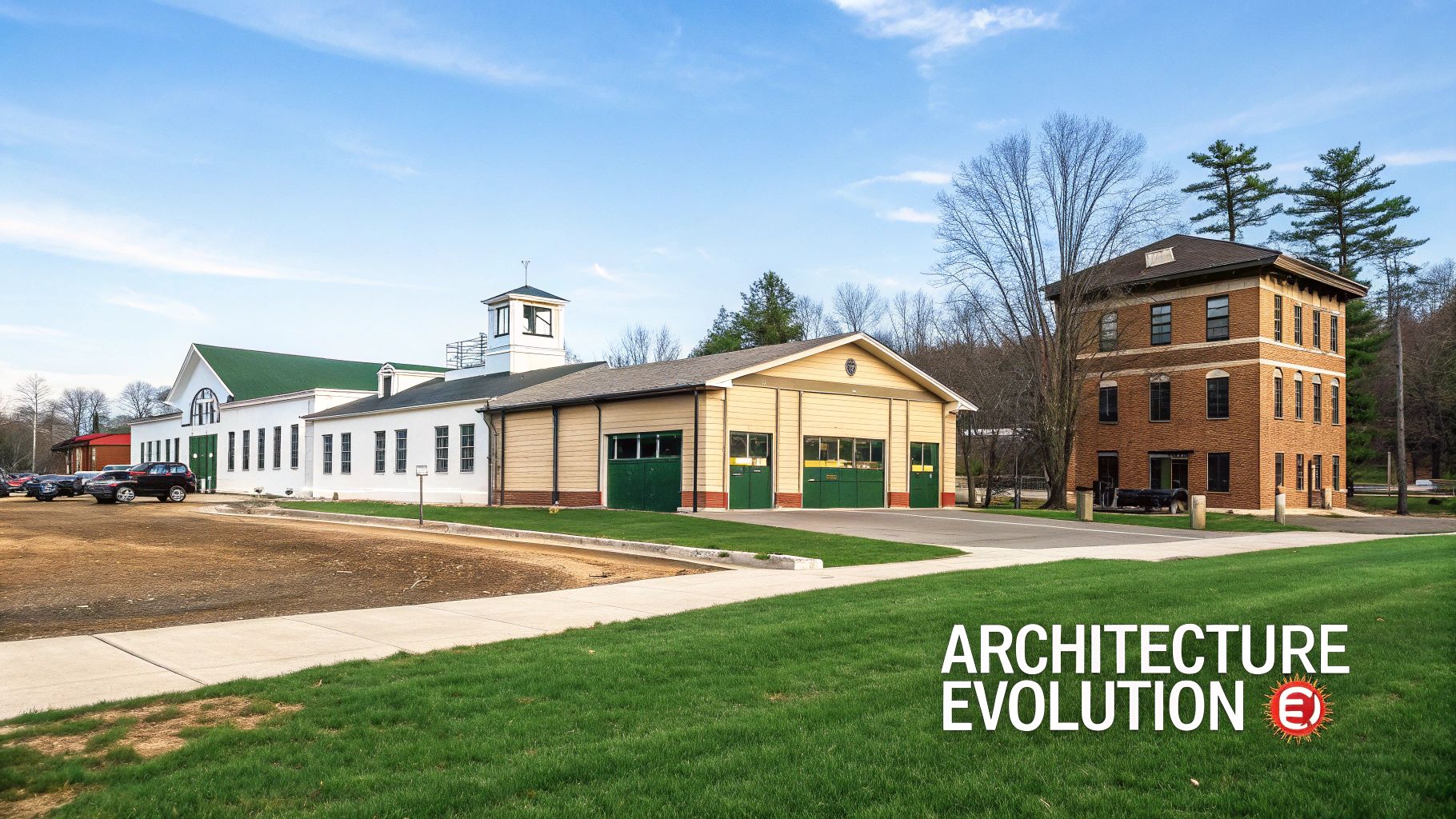
A complex of historic buildings, including a white fire station with a tower and a tall brick building, on a sunny day.

Before we get into the nuts and bolts of today’s designs, it helps to look back. Fire stations have always been a direct reflection of the technology of their time, the needs of their communities, and our ever-growing understanding of what it takes to keep firefighters safe and healthy.

The first "firehouses" were really just sheds or repurposed carriage houses. They held the basics—buckets, ladders, maybe a hand-pumper—and were staffed by volunteers. The only real design consideration was finding a central spot to get to the fire quickly. For centuries, that was about it.

From Horse-Drawn to High-Tech

The first major shake-up came when horse-drawn steam pumpers gave way to motorized engines in the late 19th and early 20th centuries. This wasn't just a simple equipment swap; it completely rewired the DNA of the fire station.

Suddenly, fire station design had to account for vehicles that were bigger, heavier, and needed much wider, taller bay doors. Out went the haylofts and stables; in came maintenance shops and fuel tanks. This is also when we saw the birth of iconic features like the fire pole, a simple but brilliant solution for getting firefighters from the living quarters to the apparatus floor in a heartbeat.

That leap forward set the stage for everything that followed. As fire apparatus continued to grow, the bays had to keep pace with reinforced concrete floors, soaring ceilings, and complex support systems.

Adapting to Modern Demands

But the evolution didn't stop at the garage doors. The firefighter's job description has expanded dramatically, and the station had to expand right along with it. What started as a simple garage has become a dynamic, multi-purpose hub.

Today's fire stations are complex environments that must function as a high-performance workplace, a temporary home, a training facility, and a community safe haven, often all at once.

This shift has totally changed the architectural blueprint. It's now standard to see modern stations include:

  • Dedicated Training Spaces: Think training towers for practicing high-rise rescues or classrooms for EMT certification.
  • Health and Wellness Areas: Fitness rooms are a given, but we're also seeing dedicated quiet zones for mental decompression—a critical tool for fighting the cumulative stress of the job.
  • Community-Facing Elements: Many new stations feature public meeting rooms or designated safe-haven lobbies, strengthening the bond between the department and the people they protect.

The journey from a simple shed to these multi-functional centers is pretty incredible. With nearly 30,000 fire stations across the U.S. serving over a million firefighters, the design process is constantly evolving to incorporate new strategies for health, sustainability, and operational readiness. You can discover more insights about the history of firefighting and its architectural impact. This historical backdrop is exactly why a forward-thinking, holistic approach to fire station design is more critical than ever.

Choosing the Right Site and Layout

So much of a fire station's success is decided long before a single shovel hits the dirt. Picking the right location isn't a guessing game; it's a science, driven by hard data. Think of it as placing a vital organ in the body of a community—its placement determines the health and safety of the whole system. The goal is simple: ensure the fastest possible response when every second counts.

It all starts with a deep dive into community data. We rely heavily on tools like Geographic Information System (GIS) mapping, which lets us layer critical information onto a single, dynamic map. This helps us see the patterns and pressures that tell us exactly where a new station will do the most good.

Pinpointing the Perfect Location with Data

To find that ideal spot, we work with municipal leaders to model how a new station will perform. We're looking for the sweet spot, the location that provides maximum coverage and the quickest response times for the largest number of people and properties.

We zero in on a few key datasets:

  • Historical 911 Call Data: By mapping where calls come from, we can identify "hot spots." The new station needs to be placed strategically to relieve pressure on other stations and cover those high-demand zones.
  • Traffic Patterns and Road Networks: A site might look great on paper, but if it’s on a road that's constantly gridlocked or doesn't have a straight shot to a major artery, response times are dead on arrival. We analyze traffic flow to make sure fire trucks can get out and get moving, fast.
  • Population Density and Future Growth: We're not just planning for today. We have to look at projections for future development to make sure this station will still be in the right place 50 to 75 years from now.

A fire station is a long-term community investment. Siting it based on future growth projections, not just current needs, prevents it from becoming obsolete as the community expands.

When you layer all this information together, a clear picture emerges, pointing to the most strategic zones for the new facility. This data-first approach takes the guesswork out of the equation and ensures public funds are invested in a location that truly enhances safety.

To break it down, here’s a look at the essential criteria we evaluate when vetting potential sites.

Key Factors in Fire Station Site Selection

Factor Description Data Sources
Response Time Coverage The ability of the station to meet established response time goals (e.g., 4-6 minutes) for its designated service area. GIS analysis, 911 call volume maps, population density studies.
Access to Major Roads Direct, unimpeded access to arterial roads and highways is critical for rapid deployment. We avoid sites with traffic congestion or complex intersections. Traffic flow data, municipal road network maps, peak-hour congestion studies.
Site Topography & Size The land must be large and stable enough to accommodate the building, apparatus aprons, parking, and training areas without extensive grading. Topographical surveys, geotechnical reports, zoning regulations.
Future Community Growth The site should be positioned to serve not only the current population but also anticipated future residential and commercial developments. Municipal master plans, economic development forecasts, demographic projections.
Zoning & Land Use The property must be properly zoned for a public safety facility, or the potential for rezoning must be high. Local zoning ordinances, community development plans.

Ultimately, a thorough analysis of these factors ensures the final site selection is based on objective, life-saving criteria, not just availability or cost.

From Site Selection to Building Orientation

Once we've got the land, the focus shifts to how the station will actually sit on the property. This is just as critical as its location on the city map. The building’s orientation and layout will dictate everything from daily workflow and firefighter safety to its long-term energy costs.

Getting the orientation right is crucial. For instance, we always want the apparatus bay doors facing the primary direction of travel. This simple move eliminates awkward turns and shaves precious seconds off every call. It’s a foundational principle in fire station design.

It's not just about speed, either. Smart orientation can make a building much more sustainable. By positioning living quarters and offices with southern exposure, we can capture passive solar heat in the winter and use architectural overhangs to provide shade in the summer. These aren't just feel-good features; they translate into real, long-term savings on utility bills and create a healthier environment for the crew.

Even the landscaping has a job to do. We have to account for zoning setbacks, manage stormwater runoff, and create secure, separate access points for the public and for staff. Every detail, from the turning radius of the driveway to the placement of a security fence, is part of a unified design that makes the station fast, safe, and a good neighbor to the surrounding community.

Designing for Firefighter Health and Well-Being

A fire station is so much more than a garage for big red trucks. For first responders, it’s a second home—the place they eat, sleep, and try to decompress between incredibly stressful calls. The best modern fire station design puts this reality front and center, making the physical and mental health of firefighters a non-negotiable part of the architectural plan. Creating a truly safe and supportive environment isn't an afterthought anymore; it’s the entire point.

One of the biggest leaps forward in this area has been the focus on contamination control. Think of it like a hospital's cleanroom protocol. The mission is simple but critical: stop dangerous carcinogens and other toxic gunk from being tracked from a fire scene into the station's living quarters. The way we do this is by creating very clear, distinct zones inside the building.

Implementing Hot, Warm, and Cold Zones

This zoning strategy is all about creating a deliberate, one-way path for firefighters and their gear when they get back from a call. It’s a workflow designed to systematically strip away contaminants at each stage, protecting their long-term health.

  • Hot Zone: This is the first stop. It's usually the apparatus bay and a dedicated decontamination room. Here, firefighters get the worst of the grime off themselves and their equipment. All turnout gear, helmets, and tools stay in this zone. Period.
  • Warm Zone: This is the transition area. It’s where you’ll find locker rooms—often with separate lockers for dirty gear and personal items—as well as showers and special laundry facilities built to extract contaminants. Firefighters move through this zone after the Hot Zone but before they can enter the clean living spaces.
  • Cold Zone: This is the "clean" side of the station. It includes the kitchen, dayroom, bunk rooms, and offices. Absolutely no contaminated gear or clothing is allowed to cross this threshold. This is what keeps the space safe for rest and recovery.

This whole process—from figuring out where a station should even be built to how its internal zones are laid out—is driven by careful planning and data.
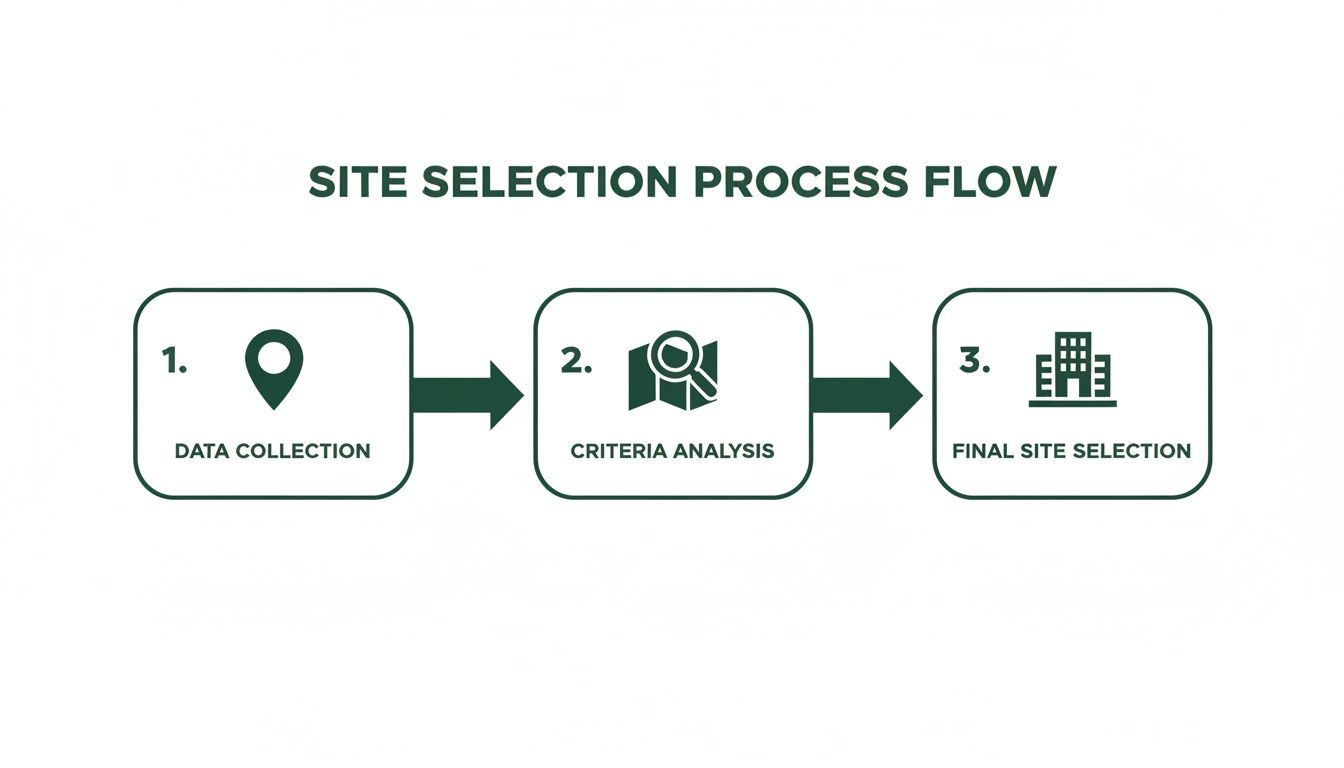
A three-step process flow diagram illustrating site selection from data collection to final choice.

As you can see, good design starts with solid analysis. That data doesn't just influence the station's location; it directly shapes the internal layout needed to keep firefighters healthy.

Beyond Decontamination: Fostering Well-Being

While cancer prevention is a huge priority, a truly holistic approach to firefighter well-being has to tackle both physical and mental health. The design of the living spaces themselves plays an enormous part in lowering stress and building camaraderie.

Layouts that use "hot, warm, and cold zones" are becoming the standard for combating carcinogen exposure, a leading cause of cancer among the 1.1 million U.S. firefighters. With more than 40% of America's 30,000 fire stations being over 40 years old, the need to update these facilities with modern air quality systems and decontamination areas is more urgent than ever.

A well-designed living space is an active tool for mental health support. It provides opportunities for both social connection and private reflection, helping firefighters manage the cumulative stress of their profession.

Here are a few design elements that really move the needle:

  • Acoustic Separation: Getting quality sleep is essential. Using sound-dampening materials and smart layouts to keep quiet bunk rooms isolated from noisy areas like the apparatus bay or kitchen makes all the difference.
  • Natural Light and Views: It's amazing what a little sunlight can do. Maximizing daylight and providing views of nature in dayrooms and offices has been proven to lower stress and lift moods.
  • Ergonomic Kitchen and Dining Areas: The firehouse kitchen is the heart of the station. Designing a space that allows multiple people to cook and eat together helps build that "family" dynamic, which is vital for a cohesive team.
  • Dedicated Fitness Spaces: Staying in shape is not optional in this line of work. A well-equipped and easily accessible fitness area is crucial for maintaining physical readiness and serves as a fantastic outlet for stress. The principles are similar whether you build a home gym or an industrial-grade station facility; the space needs to be functional and inviting.

When we focus on these human-centric design principles, we create fire stations that do more than just enable peak performance. We build facilities that actively protect and support the long-term health of the people who dedicate their lives to serving our communities.

If you think of a fire station as a living entity, the apparatus bay is its powerful, beating heart. It's not just a big garage; it's the launchpad for every single emergency response. This is where the action begins and ends, making its design a masterclass in efficiency, durability, and most importantly, safety.

Every single decision here, from the type of floor drain to the speed of the bay doors, has a direct impact on response times and the well-being of the firefighters. Getting this space right isn't just important—it's everything. And that process starts with a fundamental question: how do the trucks get in and out?
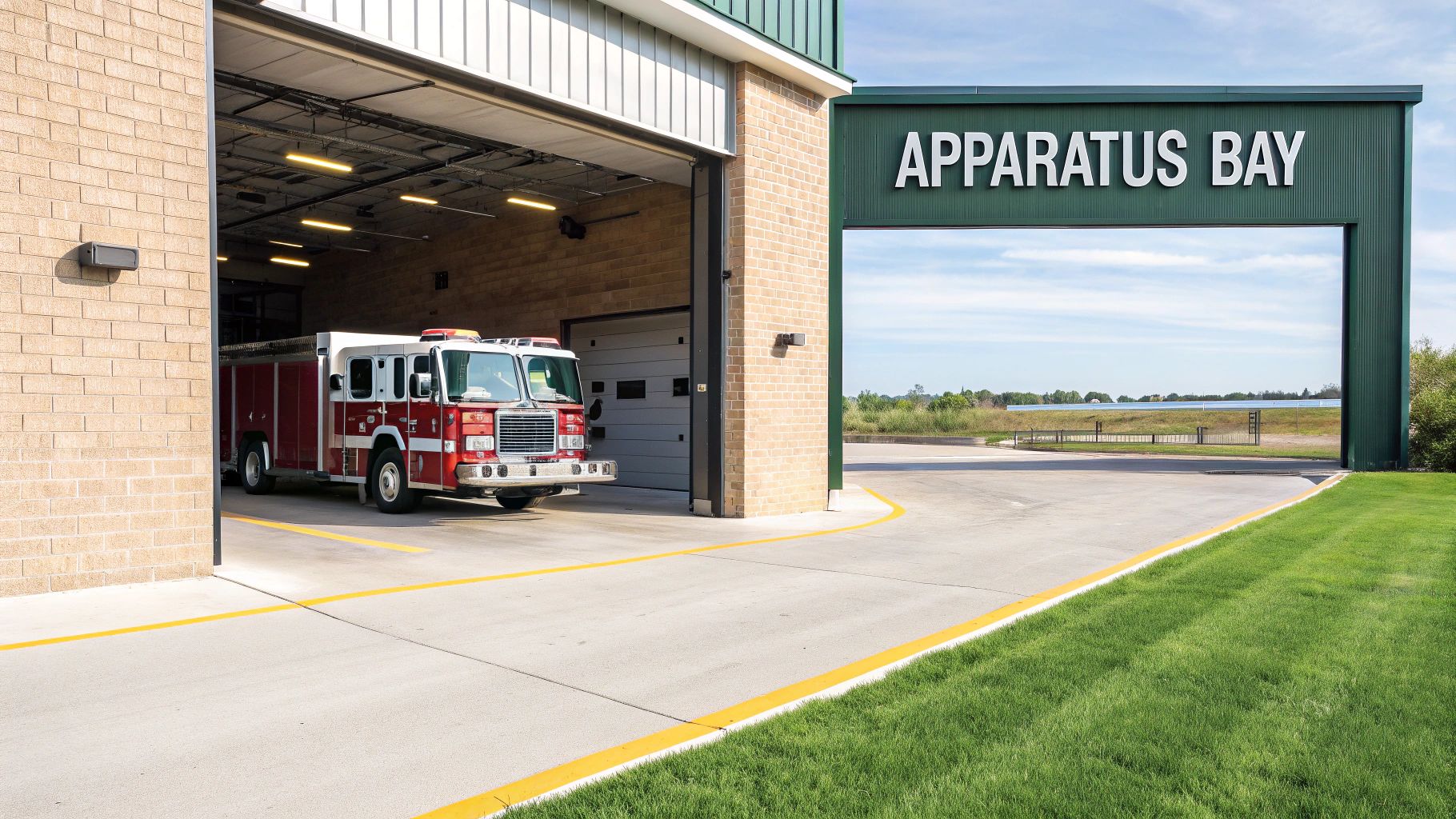
Modern fire station with a red fire truck parked inside the apparatus bay.

Drive-Through vs. Back-In Configurations

The entire flow of the apparatus bay comes down to one big choice: a drive-through layout or a traditional back-in setup. There's no single right answer; the best solution is dictated by the site itself—its size, its shape, and how it connects to the surrounding streets.

  • Drive-Through Bays: This is the gold standard for a reason. It's faster and safer. By allowing fire trucks to simply pull straight in one side and out the other, you eliminate the tricky, time-consuming process of backing a massive vehicle into a tight space. If a site has enough depth or fronts two different streets, this is the way to go.

  • Back-In Bays: Sometimes, you just don't have the space for a drive-through design. Narrow lots or sites with single-street access make a back-in configuration a necessity. While this is common in older stations, modern fire station design makes it much safer with advanced backup cameras, warning sensors, and carefully painted visual guides on the floor.

A drive-through apparatus bay can shave critical seconds off response times by removing the need to back in vehicles. This seemingly small detail is a significant operational advantage that enhances both speed and on-site safety.

Ultimately, whether it's a drive-through or a back-in, the objective is the same: create the straightest, most direct path for an apparatus to leave the station and hit the road.

Building a Foundation for Performance

The floor of an apparatus bay is an unsung hero of structural engineering. It has to be tough enough to handle immense stress day in and day out. We're talking about vehicles that can weigh over 40 tons. This isn't your standard concrete slab. It’s a heavily reinforced foundation, often built thicker and with a higher psi rating to withstand the constant weight and movement.

Drainage is just as critical. The floors are meticulously sloped—usually between 1-2%—to channel water toward robust trench drains. This ensures that water from washing the trucks, snowmelt, or equipment runoff is whisked away quickly. A dry floor is a safe floor, preventing the slips and falls that are a constant risk in this environment.

Essential Systems for a Safe Environment

Beyond the heavy-duty structure, a series of integrated systems turns the bay from a simple storage area into a safe and highly functional workspace.

A non-negotiable feature in any modern station is the vehicle exhaust capture system. These systems hook directly to the apparatus exhaust pipes, pulling toxic diesel fumes out of the building before they can contaminate the air. This isn't a luxury; it’s a critical health and safety measure to protect firefighters from long-term exposure to carcinogens.

Several other design details are just as important:

  • Ceiling Heights and Clearances: You need a lot of vertical space. Ceilings are often 16 to 18 feet high, sometimes more, to accommodate the newest ladder trucks. Just as crucial is leaving plenty of clearance on all sides of the parked vehicles for maintenance access, gear storage, and safe movement.
  • Apparatus Bay Doors: Every second counts, and that includes the time it takes for doors to open. Fast-acting bifold or four-fold doors are a huge upgrade over traditional overhead rolling doors. They open significantly faster and are built to withstand high winds and heavy use without failing.
  • Strategic Storage: An organized bay is an efficient bay. Well-designed, durable cabinetry and clearly marked storage zones for tools, rescue equipment, and medical gear are essential. Keeping everything in its place means it can be grabbed in an instant when the tones drop.

When you meticulously plan every detail—from the slope of the floor to the speed of the doors—the apparatus bay becomes more than just a place to park trucks. It becomes a high-performance machine, engineered to make every response as fast and safe as possible.

Building for Sustainability and Resilience

A modern fire station has to be more than just a garage for fire trucks. It needs to be a rock-solid pillar of the community, the one place that’s guaranteed to be running when everything else fails. This is where resilience becomes a non-negotiable part of the design conversation.

When a hurricane, flood, or massive power outage hits, the fire station can't go down with it. It has to become the command center, a beacon of stability when all other infrastructure is compromised.

This kind of toughness starts with the building envelope itself. We're talking about choosing materials and construction methods that laugh in the face of extreme weather—from high-wind-rated roofing and impact-resistant windows to a reinforced structural frame. Using advanced materials like charred accoya cladding, for example, not only gives the station a distinctive look but also provides an incredibly durable exterior that resists rot, pests, and punishing conditions for the long haul.

Fortifying for Uninterrupted Operation

A tough shell is just the beginning. True resilience comes from having redundant, independent systems that ensure the lights stay on and the water keeps flowing, no matter what’s happening outside. These are the station's lifelines during a crisis.

Some key strategies we always build into the plan include:

  • Backup Power Generation: An on-site generator is absolutely essential, typically running on natural gas or diesel. It needs to be beefy enough to power the entire station—apparatus bay doors, comms, HVAC, everything—for days, not hours.
  • Redundant Utilities: We look for ways to eliminate single points of failure. This might mean installing large on-site water storage tanks or even tapping into two different water mains if possible.
  • Storm-Hardened Infrastructure: Every piece of equipment on the outside of the building, from HVAC units to radio antennas, has to be secured and shielded from high winds and flying debris.

Resilience isn't just about surviving a storm; it's about maintaining full operational capability throughout the event and its aftermath. The fire station must be the one building everyone can count on when disaster strikes.

Thinking this way about robust, self-sufficient infrastructure dovetails perfectly with the larger movement toward sustainability. After all, a resilient station is an efficient one, designed from the ground up to do more with less.

The Financial Case for Green Design

Sustainable design isn't just a feel-good add-on anymore; it's a core component of smart financial planning for any public facility. While green features like a geothermal system or a roof full of solar panels might have a higher price tag initially, they pay for themselves over and over again in long-term operational savings.

That's real money freed up for a municipality to use on other vital services.

High-performance insulation, energy-efficient windows, and smart LED lighting all work together to slash daily energy use. Technologies that once seemed exotic are now proving their worth in demanding 24/7 environments. Geothermal HVAC, for instance, uses the earth’s constant underground temperature to heat and cool the building with incredible efficiency and lower maintenance needs. Solar panels can knock out a huge chunk of a station’s electricity bill and, in some areas, even generate revenue by selling power back to the grid.

A fantastic real-world example is the 25,000-square-foot Kaukauna Fire Station, which opened in 2017. By integrating geothermal, solar panels, and LEDs, they cut their annual energy costs by more than $37,000. That’s a powerful return on investment.

When we design for both resilience and sustainability, we're not just building a fire station. We're creating a public safety asset that is stronger, more reliable, and fiscally responsible for decades to come.

Balancing Budgets with Adaptive Reuse

Let's be honest: building a new fire station is a massive public investment. With costs for a modern facility easily hitting anywhere from $9 million to $14 million, municipal budgets are often pushed to their limits. This financial reality puts a huge premium on smart, cost-conscious planning from day one.

To get a new build across the finish line, project leaders often lean on strategies like value engineering—a formal process for getting the most function for the lowest cost without cutting corners on quality. Another go-to tactic is project phasing, which maps out the construction over several years. This lets a community build what's most critical now, like the apparatus bay, and add things like a new training tower later when more funds are available.

But building from the ground up isn't the only path forward. For communities with older, architecturally significant stations, adaptive reuse offers a compelling alternative that can be both budget-friendly and sustainable.

Breathing New Life into Historic Stations

Instead of tearing down a community landmark, adaptive reuse is all about modernizing it from the inside out. This approach keeps the historic soul of the building and its place in the town’s heart, while completely updating it to handle the intense demands of modern firefighting. It’s a brilliant way to honor the past while equipping heroes for the future.

This process is like solving a complex puzzle—fitting modern systems into a historic shell. It almost always involves:

  • Structural Reinforcements: Old floors weren't designed to hold the immense weight of today's fire engines and ladder trucks.
  • Complete MEP Overhauls: This means ripping out and replacing ancient electrical, mechanical, and plumbing systems with efficient, code-compliant modern ones.
  • Interior Reconfigurations: The challenge is to carve out logical spaces for decontamination zones, contemporary living quarters, and administrative offices within the original footprint.

Turning Heritage into a Financial Asset

One of the biggest wins for this approach is the bottom line. For developers and owners, this trend favors adaptive reuse over demolition. Specialized architecture firms can upgrade systems cost-effectively, preserving historic character while securing tax credits and grants—extending a building’s useful life by 50 to 75 years sustainably. This flips a potential liability into a celebrated community asset. You can discover more insights into modern fire station trends that highlight these financial and community benefits.

By leveraging historic tax credits and preservation grants, municipalities can significantly offset renovation costs. Suddenly, modernizing a legacy station becomes a much more palatable financial choice than starting from scratch.

This strategy doesn't just save taxpayer money and divert materials from the landfill; it preserves the deep sense of civic pride tied to a historic public building. It's proof that with creative design, a station built for horse-drawn steam engines can be reimagined to serve its community for another hundred years.

Frequently Asked Questions About Fire Station Design

When you're tasked with building a new fire station, you're juggling a lot: the crew's safety, the community's expectations, and the city's bottom line. It's a huge responsibility, and naturally, a lot of practical questions come up right away. Let's tackle some of the most common ones I hear from project leaders.

How Long Does a Fire Station Project Take?

Let's be realistic: a new fire station is a long-term commitment. From the first conversations to the day the firefighters move in, you're looking at a multi-year timeline. While every project has its own quirks, they all follow a similar path.

Here’s a general breakdown of what to expect:

  • Design Phase (12-18 months): This is where the vision takes shape. It’s a busy period filled with site evaluations, community meetings, and hammering out the detailed architectural plans and construction documents.
  • Bidding and Permitting (2-3 months): With the blueprints finalized, the project is put out to bid to find the right construction partner. At the same time, the team works to get all the necessary permits lined up with local authorities.
  • Construction Phase (18-24 months): The longest stretch. This covers everything from the groundbreaking ceremony and pouring the foundation to raising the steel, finishing the interiors, and installing all the complex systems a modern station needs.

All told, you can realistically expect the entire process to take three to four years from start to finish. For a real-world example, the planned relocation of Raleigh Fire Station 15 is scheduled to start design in summer 2024 and wrap up construction in spring 2028.

What Is a Realistic Budget for a New Station?

There's no single price tag for a new fire station—the final cost is tied to everything from land prices and local labor to the station's size and special features like a training tower or public meeting space. That said, we can look at recent projects to get a solid baseline.

Right now, construction costs for a new, full-service fire station are generally landing somewhere between $9 million and $14 million. For instance, a proposed station in Huntington, Indiana, saw construction estimates that ranged from $9.54 million to $13.79 million. Keep in mind, these figures are for the building itself. Things like buying the land, architectural fees, and all the equipment are separate costs.

A critical mistake is confusing construction costs with the total project budget. You have to account for "soft costs"—design fees, permits, furniture, fixtures, and specialized equipment—which can easily add another 20-30% to the construction total.

How Can the Community Get Involved?

Bringing the community into the process isn't just a box to check; it’s fundamental to a successful project. When you build an inclusive process, you foster public trust and end up with a building that truly serves its neighborhood.

Here are a few proven ways to make community engagement meaningful:

  • Public Meetings and Workshops: Host open forums early in the design process. This gives residents a chance to see the initial concepts, ask questions directly, and weigh in on how the station will look and function.
  • Advisory Committees: Create a small, dedicated group of community leaders, direct neighbors, and local business owners. They can serve as a sounding board and a direct line of communication throughout the entire project.
  • Surveys and Online Feedback: Digital tools are great for reaching a wider audience. An online survey allows people who can't make a meeting to share their priorities and concerns on their own schedule.

By actively listening to feedback, your team can get ahead of potential issues like traffic flow, noise, or building aesthetics, turning the new station into a point of pride for everyone.


At Sherer Architects, LLC, we specialize in guiding clients through every stage of complex design and construction projects, from new commercial builds to historic preservation. We transform puzzles into beautiful, enduring, and sustainable results. Learn how our expertise can bring your next project to life.
Categories
Uncategorized

A Guide to Material for Interior Design in Commercial Spaces

Choosing the right material for interior design is arguably the most critical decision in any commercial or adaptive reuse project. It’s a choice that shapes everything—from the budget and timeline all the way to the building's long-term performance and how people feel inside it. This isn't just about picking pretty finishes; it's a strategic move that hinges on finding the perfect balance between durability, cost, and sustainability.

Why Material Selection Defines Project Success

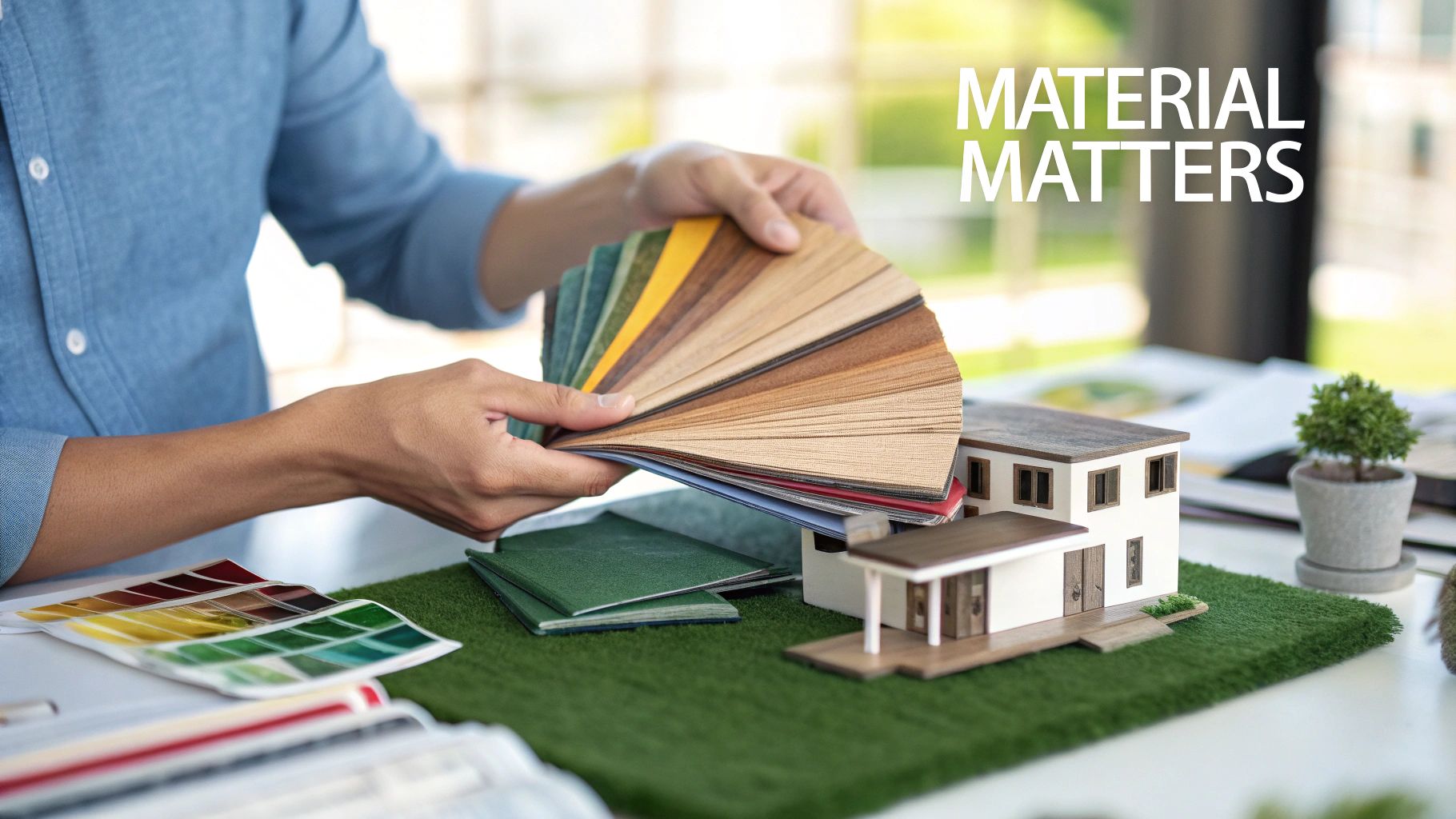
A person holds a fan of wood and color material samples next to a model house, indicating design choices.

Think of a building's interior materials as its core vocabulary. Long before the first piece of furniture arrives, these materials are already communicating the space's purpose, its level of quality, and even the brand's identity. For developers and contractors, these decisions happen early, but their effects are felt through every single phase of the project, from managing construction logistics to writing the final maintenance manual.

Get a material choice wrong, and you could be looking at budget blowouts, frustrating schedule delays, and finishes that wear out far too soon. It’s a surefire way to chip away at the project's return on investment. But when you get it right, the space doesn't just look incredible on opening day—it's built to handle the real-world demands of its users for years to come.

The Impact of Early Decisions

Every single material choice sends ripples through the project. For example, that stunning custom-milled wood paneling for a feature wall might be the perfect aesthetic touch, but if its long lead time isn't meticulously planned for, it can throw the entire construction schedule into chaos. On the other hand, specifying a durable yet elegant flooring for a high-traffic lobby is a direct investment in lowering future maintenance headaches and costs.

This kind of forward-thinking is what's driving major market trends. The global interior design market hit an impressive USD 138.63 billion in 2024, and a huge part of that growth is from the demand for materials that are both beautiful and built to perform. In fact, sustainable materials were used in 65% of new builds, a massive jump from just 45% back in 2020. This isn't just a fad; it's a fundamental shift toward creating spaces with durability and environmental responsibility at their core.

Core Material Categories at a Glance

To start making sense of the thousands of options out there, it helps to organize materials into a few core categories. Each one serves a distinct purpose, and knowing how they work together is the key to creating a design that feels intentional and cohesive.

Here's a quick look at the main families of materials you'll be working with.

Material Category Primary Function Common Examples
Flooring Provides the primary walking surface; sets the foundation for durability, acoustics, and style. Luxury Vinyl Tile (LVT), Polished Concrete, Carpet Tile, Terrazzo, Hardwood
Wall Finishes Defines the vertical planes of a space; adds texture, color, and protection. Paint, Wallcoverings (Vinyl, Fabric), Wood Paneling, Tile, Acoustic Panels
Ceiling Systems Hides building systems (HVAC, electrical); controls acoustics and reflects light. Acoustic Ceiling Tile (ACT), Gypsum Board, Exposed Structure, Metal or Wood Grids
Millwork & Casework Includes custom-built wood or laminate elements for function and aesthetics. Reception Desks, Cabinetry, Built-in Shelving, Wall Paneling, Trim
Fabrics & Textiles Adds softness, color, acoustic absorption, and comfort to furniture and windows. Upholstery, Drapery, Cubicle Curtains, Decorative Textiles
Specialized Systems Materials designed to meet specific code requirements or performance needs. Fire-rated Wall Assemblies, Acoustic Baffles, Moisture-resistant Backers

As you can see, the success of a design project often comes down to mastering the details within each of these categories. For instance, understanding the nuances of Choosing Upholstery Fabric can be the difference between furniture that lasts for a decade and furniture that looks worn out in a year.

Ultimately, mastering the selection of any material for interior design is about expertly balancing these elements. The goal is always to create a space that is not only beautiful but also functional, safe, and truly built to last.

Getting to Know the Core Material Categories

Choosing the right materials for a commercial interior isn't like picking items off a shelf. It's about understanding how each category works as a tool to solve specific problems within a space. Think about the lobby of a new corporate headquarters: the floor has to stand up to hundreds of people walking through every day, while the walls need to look professional and be a breeze to clean.

Every single material choice pulls its weight, shaping how the environment performs and feels. Let's walk through the essential categories, not as a list of products, but as an integrated toolkit for creating a high-functioning design.

Flooring: The Foundation of Every Space

Flooring is the unsung hero of any commercial interior. It takes a constant beating—from relentless foot traffic to heavy rolling carts—and it's a huge factor in acoustics, safety, and how easy the space is to clean. The choice is never just about looks; it’s about matching the material's performance to how the area will actually be used.

Polished concrete, for example, is incredibly tough and gives off a modern, industrial vibe that’s perfect for a busy art gallery or retail store. The trade-off? It’s terrible with acoustics, bouncing sound all over the place and creating a loud, echo-y room. On the flip side, commercial carpet tile is a fantastic sound absorber, making it the go-to for open-plan offices or conference rooms where you need to keep noise under control.

A few key players in commercial flooring include:

  • Luxury Vinyl Tile (LVT): The chameleon of flooring. It's tough, water-resistant, and can convincingly mimic natural wood or stone without the high price tag or demanding upkeep.
  • Commercial Carpet Tile: A top choice for office environments. It dampens sound, feels comfortable underfoot, and you can easily swap out a single tile if it gets stained or damaged. That’s a huge long-term maintenance win.
  • Polished Concrete: Delivers a minimalist aesthetic and will last forever. You just have to be mindful of the acoustics and make sure it's sealed properly to avoid stains.
  • Terrazzo: A classic composite that’s poured in place or precast. It offers incredible design flexibility and is so durable you’ll often find it in high-traffic hubs like airports and government buildings.

Wall Finishes: Setting the Tone and Standing Up to Wear

Wall finishes are what create the visual and tactile feel of a room. They can be simple and practical or intricate and decorative, but in a commercial project, durability and maintenance always come first. A wall in a packed corridor has a much tougher job than one tucked away in a private executive office.

These days, low-VOC (volatile organic compound) paints are the standard for ensuring healthy indoor air quality—a must-have for employee well-being and any project aiming for green building certifications. For areas that get a lot of scuffs and bumps, like hospital corridors or school hallways, you need more than just paint. High-impact wall panels or tough vinyl wallcoverings provide a necessary layer of protection.

A material’s function is dictated by its environment. A delicate fabric wallcovering might be stunning in a low-traffic boardroom, but it would be a maintenance nightmare in a restaurant's main dining area, where cleanability and stain resistance are paramount.

Ceilings: The Unseen Performance Hero

It’s easy to forget about the ceiling, but it’s a critical surface for managing acoustics, integrating lighting, and hiding all the "guts" of the building—the mechanical, electrical, and plumbing (MEP) systems. In a busy open office, a good ceiling system can mean the difference between a productive workspace and a noisy, chaotic one.

Acoustic Ceiling Tiles (ACT) are the common workhorse here. They’re specifically designed to absorb sound and cut down on echo. Plus, their modular grid makes it easy to get to the systems hidden above for maintenance. In other designs, you might see an exposed ceiling structure for an industrial-chic look, but that almost always means you have to add other acoustic elements, like suspended baffles or panels, to make up for the loss of a sound-absorbing surface.

Millwork, Fabrics, and Specialized Systems

Beyond the big three, several other material categories add layers of function and polish to a project.

  • Custom Millwork: This covers all the built-in elements, like reception desks, cabinetry, and striking feature walls. The materials you choose here—from rich wood veneers and durable laminates to sleek solid surfaces—directly shape both the look and the longevity of these high-touch pieces. For a deeper dive into the options, an expert guide on the best materials for kitchen cabinets offers great insights that apply to all types of commercial casework.

  • Performance Fabrics: When it comes to upholstery and drapery in commercial spaces, fabrics are chosen for their report card. We look at durability ratings (like Wyzenbeek double rubs), stain resistance, and fire retardancy to make sure they can handle the demands of public use.

  • Acoustic and Fire-Rated Systems: These are the specialists. They're materials designed to meet specific building codes and solve particular problems. Think of fire-rated drywall assemblies that create safe exit corridors or dedicated acoustic panels placed just right to perfect the sound in an auditorium. Each of these categories gives designers another set of tools to solve the functional puzzles that come with every project.

How to Evaluate Materials with Performance in Mind

Choosing an interior material based only on how it looks is like buying a car for its paint job without ever popping the hood. A beautiful finish that chips, fades, or completely fails within a year isn't just a design mistake; it's a financial drain. To sidestep these costly errors, you need a solid framework for vetting materials where performance is the star of the show.

This means shifting your focus from the initial price tag to the long-term value and resilience of every single surface. It's about asking tougher questions, looking beyond the small sample swatch, and digging into the technical data that predicts how a material will actually behave out in the real world. Think of it as running a thorough background check on every candidate for your project.

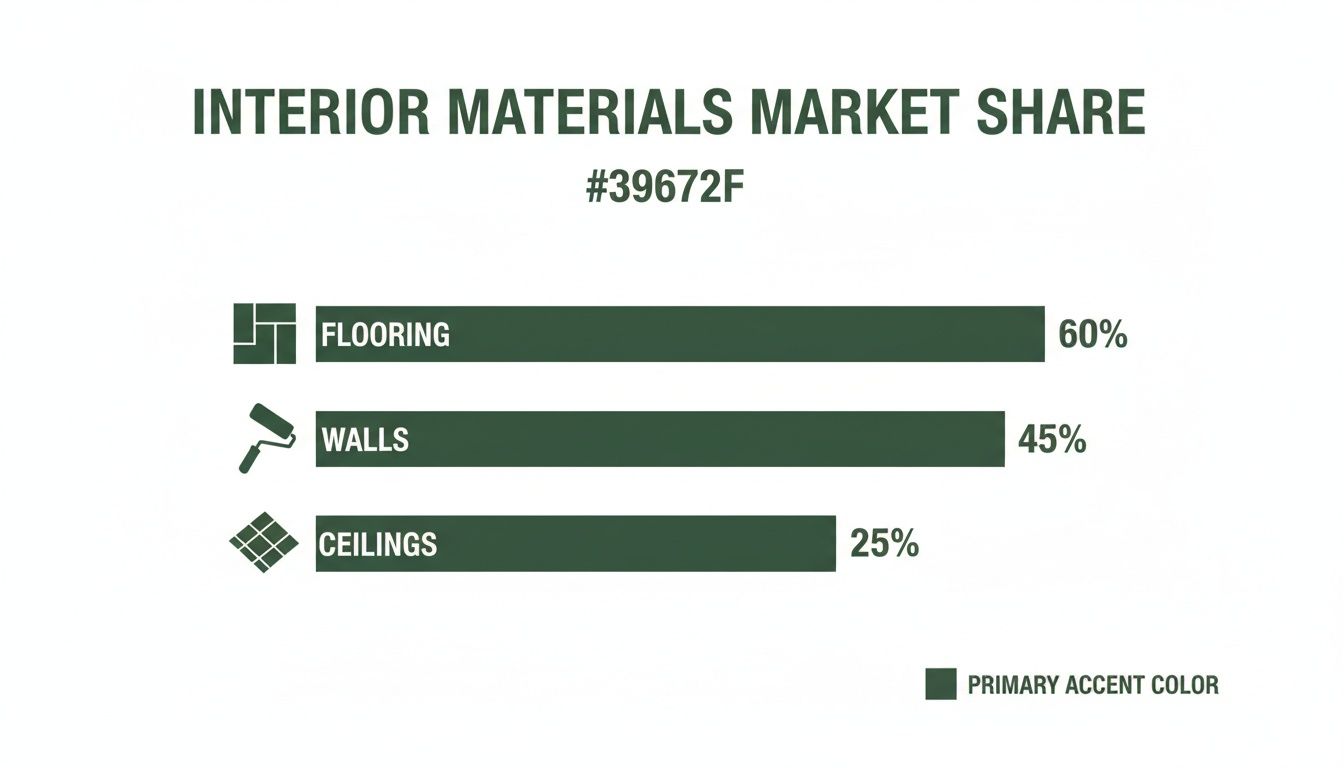
This chart shows just how much of a project's material budget is dedicated to the big three categories. As you can see, flooring is a huge piece of the pie.

Bar chart displaying interior materials market share: Flooring 60%, Walls 45%, and Ceilings 25%.

The fact that flooring commands such a large market share—a whopping 60%—tells you everything you need to know. It's a massive investment, making a rigorous performance evaluation absolutely essential for getting it right.

Durability and Life-Cycle Cost

The first two pillars of any solid material evaluation are durability and life-cycle cost. They go hand in hand. Durability is simply a material’s ability to stand up to daily abuse—scratches, impacts, fading, and stains. For a chaotic hotel lobby or a busy school hallway, a flooring material with a high abrasion resistance rating isn't a "nice-to-have"; it's a must.

But durability is only half the equation. The life-cycle cost is what uncovers the true price of a material over its entire lifespan. This isn't just the upfront purchase price; it includes installation, ongoing maintenance, and the eventual cost of removal and replacement.

That cheaper carpet might save you a few bucks today, but what if it needs professional deep cleaning twice as often as a premium option? And what if you have to replace it in five years instead of fifteen? Suddenly, its life-cycle cost balloons, making the "more expensive" option the smarter financial choice.

Smart material selection is an exercise in financial forecasting. By prioritizing life-cycle value over upfront cost, you are making a direct investment in the long-term profitability and operational efficiency of the building.

Decoding Fire and Safety Ratings

Technical standards can feel a bit overwhelming, but they are your best friends when it comes to ensuring occupant safety and meeting building codes. Fire ratings are completely non-negotiable, especially in commercial spaces and multi-family residential projects.

The main standard you'll run into is the ASTM E84 test, which measures a material's surface burning characteristics. This test spits out two numbers you absolutely need to know:

  1. Flame Spread Index: This measures how quickly fire will race across a material's surface. Lower numbers are always better and safer.
  2. Smoke Developed Index: This tells you how much smoke a material will pump out when it burns. In a fire, smoke is often more dangerous than the flames, so a lower number here is critical for visibility during an evacuation.

These ratings are sorted into classes, from Class A (the most fire-resistant) to Class C. For places like exit corridors, stairwells, and other critical escape routes, building codes will almost always demand Class A materials. Treat these ratings as a material's official safety report card—and never, ever specify a product without checking it first.

Understanding Acoustic Performance

Noise is one of the biggest—and most overlooked—factors impacting occupant satisfaction and productivity. Whether you're designing an open-plan office, a bustling restaurant, or an apartment building, how you manage sound will make or break the experience.

Two key ratings will guide your choices here:

  • Noise Reduction Coefficient (NRC): This rating, scaled from 0 to 1, tells you how much sound a material absorbs. For example, a material with an NRC of 0.75 will absorb 75% of the sound that hits it. Soft, porous materials like acoustic ceiling tiles and thick carpets have high NRC ratings, which makes them perfect for taming echo and ambient noise.

  • Sound Transmission Class (STC): This rating measures how well a material or an entire wall assembly blocks sound from passing through it. A higher STC rating means better sound insulation between rooms. This is the rating you care about for spaces that demand privacy, like conference rooms, private offices, or adjacent apartments.

For example, you'd use a ceiling tile with a high NRC to quiet the chatter inside an office, but you'd need the wall separating two tenants to have a high STC rating to ensure conversations stay private.

To help visualize how different materials stack up, here’s a quick comparison of common commercial flooring options.

Performance Snapshot for Commercial Flooring

This table gives you a comparative look at popular commercial flooring choices, weighing them against key performance metrics that matter on the ground.

Flooring Type Durability Rating Typical Maintenance Average Life-Cycle Cost Acoustic Performance
Luxury Vinyl Tile (LVT) High Low (Sweep, Mop) $$ Moderate
Polished Concrete Very High Very Low (Sealant) $$$ Poor (Echo)
Carpet Tile Moderate to High Medium (Vacuum, Spot Clean) $$ Excellent
Epoxy Flooring Very High Low (Sweep, Mop) $$$ Poor (Echo)
Hardwood Moderate High (Refinishing) $$$$ Moderate
Porcelain Tile Very High Low (Grout Cleaning) $$$ Poor (Echo)

As you can see, there’s no single "best" option—the right choice always depends on the specific demands of the space. A high-traffic retail store might lean toward polished concrete for its sheer resilience, while a corporate office would benefit immensely from the acoustic comfort of carpet tile.

By understanding these core performance metrics, you can move beyond aesthetics and select materials that create an environment that not only looks great but also functions beautifully for years to come.

Balancing Sustainability with Historic Preservation

When you're choosing a material for interior design these days, you're often juggling two big ideas: sustainability and historic preservation. These aren't just buzzwords. They're a real shift in how we think about the spaces we build, pushing us to create interiors that are both responsible and respectful.

It’s about more than just how a space looks. It’s about building healthy, efficient environments that honor their own history. On one side, we’re pushed to pick materials that are better for the planet and the people in the building. On the other, we have a duty to protect the character and story of an older structure. The real magic happens when you find that sweet spot where both of these goals can live together.

Weaving Sustainability into Your Material Palette

Sustainable design is just another way of saying you’re making smart, intentional choices that pay off down the road. It's about investing in the long-term health and value of a property, not just checking a box.

Think about it this way: specifying low-VOC (volatile organic compound) paints and adhesives isn't just an abstract "green" choice—it's a direct investment in better indoor air quality for the people who will work or live there. Choosing countertops made from recycled glass or insulation from reclaimed denim is a tangible way to shrink a project's carbon footprint. These are the kinds of decisions that help projects earn green building certifications like LEED (Leadership in Energy and Environmental Design) or the WELL Building Standard, which tenants and investors are actively looking for.

The market is definitely listening. The global demand for eco-friendly interior materials has been growing at 8.5% annually since 2020. Today, sustainable options like FSC-certified timber make up 28% of all interior materials used worldwide—a massive jump from just 12% in 2015. With 82% of consumers saying they'd pay more for sustainable interiors, this isn’t a niche trend; it’s reshaping the entire industry. You can dig deeper into this shift in the global forecast for interior design.

Sustainable material selection isn't just an environmental choice; it's a strategic business decision. It enhances occupant well-being, increases a building's marketability, and can lead to significant operational savings over time through improved energy efficiency and durability.

Respecting History in Adaptive Reuse Projects

Adaptive reuse projects throw a unique challenge into the mix: how do you bring in modern, high-performance materials without completely stripping away a building's soul? The goal is to create a conversation between the old and the new. You want modern additions to complement the original architecture, not shout over it.

This takes a delicate touch and a real appreciation for the building's past. The first step is usually a "materials audit"—taking stock of what's already there. Can those incredible exposed brick walls, old timber beams, or terrazzo floors be saved and celebrated? These are irreplaceable features that tell the building’s story.

Strategies for Harmonizing Old and New

When you do need to introduce new materials, the key is to be thoughtful. You don't always have to find a perfect historical replica. In fact, sometimes a crisp, modern material is the perfect thing to make the texture and patina of a historic finish truly pop.

Here are a few strategies that work:

  • Source Historically Appropriate Materials: If you're replacing something like wood trim or flooring, do a little digging. Finding out what materials were used originally and sourcing reclaimed wood or a similar species can go a long way in maintaining authenticity.
  • Create a Clear Visual Distinction: Instead of a clumsy attempt to mimic an old finish, let the new material be honestly modern. A sleek steel and glass partition, for instance, can look stunning next to a century-old brick wall. The contrast is what makes it work.
  • Integrate Systems Thoughtfully: Do your best to hide modern systems like HVAC and electrical conduits. If they have to be exposed, treat them like clean, sculptural elements that contrast with the historic fabric instead of trying to blend in.

By balancing these considerations, you can select a material for interior design that not only performs well but also helps create a richer, more meaningful building. It’s this thoughtful approach that ensures the final space is safe, functional, and deeply connected to its own unique history.

A Practical Guide to Material Specification and Sourcing

Overhead shot of a desk with color swatches, laptop, documents, and a smartphone, for material sourcing.

A brilliant design concept is only as strong as its execution. Once you've selected the right material for interior design, the next hurdle is turning that vision into reality without costly mistakes. This is where meticulous specification and smart sourcing become the twin pillars of a successful project, making sure what you designed is exactly what gets built.

Think of the specification document as the project's legal rulebook. It’s a precise, highly detailed set of instructions that leaves zero room for a contractor or supplier to make their own judgment calls. A vague spec is an open invitation for things to go wrong.

Crafting a Bulletproof Specification

A weak specification might just say "White Oak Flooring." A strong one, however, provides a complete blueprint that leaves nothing to chance. It spells out every critical attribute to guarantee quality and consistency across the entire job.

A truly effective specification document should always include:

  • Manufacturer and Product Name: Pinpoint the exact brand, product line, model number, and color code. For instance, "Interface Carpet Tile, Style: Human Nature Collection, Color: HN840 Stone."
  • Performance Criteria: Restate the required fire ratings, acoustic ratings (NRC/STC), and durability metrics. For example, "Must meet ASTM E84 Class A Flame Spread Index."
  • Dimensions and Finishes: Specify sizes, thicknesses, finishes, and sheen levels. For wood, this means detailing the cut (like "rift sawn") and the grade.
  • Installation Instructions: Always reference the manufacturer’s specific installation guidelines. This is key to ensuring a correct application and keeping the warranty intact.

This level of detail is your best defense against the dreaded "or equal" substitution. If a contractor suggests an alternative, your spec sheet gives you a clear, objective checklist to see if it truly measures up.

Navigating the Sourcing Landscape

With your specifications locked in, it's time to source the materials. This involves deciding where to buy everything—a choice that directly impacts your project's budget and timeline. The two main avenues are buying directly from manufacturers or going through distributors.

Each path has its own trade-offs.

Sourcing Channel Pros Cons
Manufacturer Direct Often a lower unit cost, direct line to technical support, and deeper product knowledge. May have high minimum order quantities; can be slower for smaller projects.
Distributor Can consolidate orders from multiple brands, often holds local stock for faster delivery, more flexible on order size. Unit cost may be slightly higher; technical support is one step removed from the source.

Choosing the right partner is about more than just comparing price tags. You have to vet your suppliers. Ask for project references, check their financial stability, and confirm their logistical capabilities. A low-cost supplier who can't deliver on time can end up costing you far more in project delays than you ever saved on materials.

Your supply chain is an extension of your project team. A reliable supplier who communicates clearly about lead times and stock levels is an invaluable asset for keeping a complex construction schedule on track.

The Art of Value Engineering

Finally, let's talk about value engineering. This isn't just code for "finding cheaper stuff." Real value engineering is a systematic process of reducing costs without gutting the design's core performance or aesthetic integrity.

It's about making smart substitutions, not just downgrades. For example, instead of swapping out the high-traffic lobby flooring for something less durable, you might find savings by choosing a more standard—but equally tough—wall base in secondary corridors.

The key is to protect the materials in high-impact areas where quality really matters, while seeking efficiencies in less critical zones. A good supplier can be a fantastic partner here, often suggesting alternative materials with similar performance data at a better price point. This collaborative approach helps bring your project in on budget without compromising its long-term success.

Answering Your Key Questions About Interior Materials

Even when you've got a solid plan, the reality of picking the right material for interior design always brings up a fresh set of questions. Trying to juggle budgets, technical specs, and what happens five years down the road can feel like spinning plates. This is where we get practical and tackle the most common hurdles that developers, contractors, and owners run into.

Think of this as the straight-talk section—clear, direct answers to help you move forward with confidence.

How Do I Balance a Tight Budget with High-Quality Materials?

This is the classic dilemma, isn't it? The secret isn't just about spending less; it's about spending smarter. You have to shift your thinking from the upfront price tag to the long-term life-cycle value. A cheaper material that needs constant repairs or a full replacement in a few years isn't a bargain—it's a liability.

The key is to be strategic. You can’t afford top-tier everything, so focus your budget on the areas that take the most abuse. We're talking about main corridors, lobbies, and reception desks. These high-traffic zones are where durable, resilient materials are absolutely non-negotiable. An investment here will pay for itself over and over.

This is where good old-fashioned value engineering comes in, but not the slash-and-burn kind. It's not about downgrading everything. It's about finding specific spots where a less expensive but equally tough alternative can do the job without wrecking the design. For example, a high-quality luxury vinyl tile (LVT) can beautifully mimic natural stone, giving you a similar look with way better durability and a much friendlier price. Always get multiple quotes and build relationships with suppliers—they can often suggest creative solutions that protect both your wallet and your vision.

What Are the Most Common Mistakes in Material Specification?

After decades in the field, I can tell you the costliest mistakes almost always come down to three things: specs that are too vague, not checking stock and lead times, and skipping the on-site sample review. Any one of these can blow up your budget, throw your schedule off by months, and leave you with a final look that falls flat.

Writing "white oak" on a spec sheet is asking for trouble. Is that rift sawn? What grade? What kind of finish? A professional specification is incredibly detailed because it has to be. Without that precision, you're leaving the final look up to chance.

Vague specifications are the root cause of miscommunication and unmet expectations. A detailed, unambiguous specification document is your single best tool for ensuring the design vision is executed precisely as intended.

Just as critical is confirming availability. That tile you fell in love with might have a six-month backorder, a delay that can bring an entire project to a grinding halt. And finally, never sign off on a material based on how it looks in a showroom. A sample that looks perfect under fluorescent lights can look completely wrong in the actual space. Get physical samples on-site and look at them at different times of day. See how the morning sun or the evening's artificial light changes the color and texture before you commit.

How Do My Material Choices Affect Green Building Certifications?

Your material choices are fundamental to hitting green building targets like LEED (Leadership in Energy and Environmental Design) or the WELL Building Standard. These aren't just feel-good labels; they are rigorous systems that award points for specific attributes that make a building healthier and more sustainable.

For a certification like LEED, what you specify has a direct impact on your score across several categories:

  • Recycled Content: Using materials made from post-consumer or post-industrial waste is a straightforward way to earn points.
  • Regional Sourcing: Choosing materials extracted and made within a certain radius of your project cuts down on transportation emissions.
  • Sustainable Harvesting: For wood products, looking for the FSC-certified label is a must. It guarantees the wood comes from a responsibly managed forest.
  • Low-Emitting Materials: This is a big one. Specifying low-VOC (volatile organic compound) paints, adhesives, and flooring is essential for credits in the Indoor Environmental Quality section.

The WELL standard digs even deeper into human health, scrutinizing materials for specific harmful chemicals and encouraging the use of biophilic design—think natural wood, stone, and plants—to boost occupant well-being. Your material specification sheet essentially becomes your scorecard for these programs.

How Do I Ensure Materials Are Maintained Properly After Handover?

A project isn't truly successful until you know it will still look great years from now. The work doesn't stop when the last contractor leaves. The single best practice is to put together a comprehensive handover manual for the client or their facilities team.

Think of it as the building's owner's manual. It needs to be simple, clear, and detailed, giving the facilities crew everything they need to properly care for every single finish you've selected.

Your manual should absolutely include:

  1. Manufacturer Cleaning Instructions: Don't paraphrase. Include the official spec sheets for everything from the flooring to the wallcoverings.
  2. Product Recommendations: List the approved cleaners, and just as important, call out what not to use. The wrong chemical can permanently damage a finish.
  3. Maintenance Schedules: Lay out a simple calendar for routine care (daily, weekly) and deeper maintenance (quarterly, annually).
  4. Warranty Information: Put all the warranty documents and supplier contacts in one place so they're easy to find when needed.

One last thing: do a final walkthrough with the facilities team. Show them how to care for any particularly unique or sensitive materials. This one-hour investment can prevent thousands of dollars in damage later on, protecting the owner's investment and ensuring your design stands the test of time.


At Sherer Architects, LLC, we believe that thoughtful material selection is the foundation of enduring architecture. Our expertise in commercial projects, adaptive reuse, and historic preservation ensures every choice balances performance, budget, and a deep respect for the building's character. If you're ready to create a space that is beautiful, functional, and built to last, contact Sherer Architects, LLC today to discuss your project.

Categories
Uncategorized

A Practical Guide to Environmentally Conscious Architecture

When we talk about environmentally conscious architecture, we're looking at something much deeper than just slapping on a few solar panels or planting a green roof. It’s a design philosophy that fundamentally rethinks how a building interacts with the world around it. The goal is to minimize—or even reverse—the negative environmental footprint of our buildings.

This means focusing on energy efficiency, choosing sustainable materials, and creating healthier indoor spaces. It’s about moving beyond simple aesthetics to design buildings that actively benefit both people and the planet.

Defining Environmentally Conscious Architecture

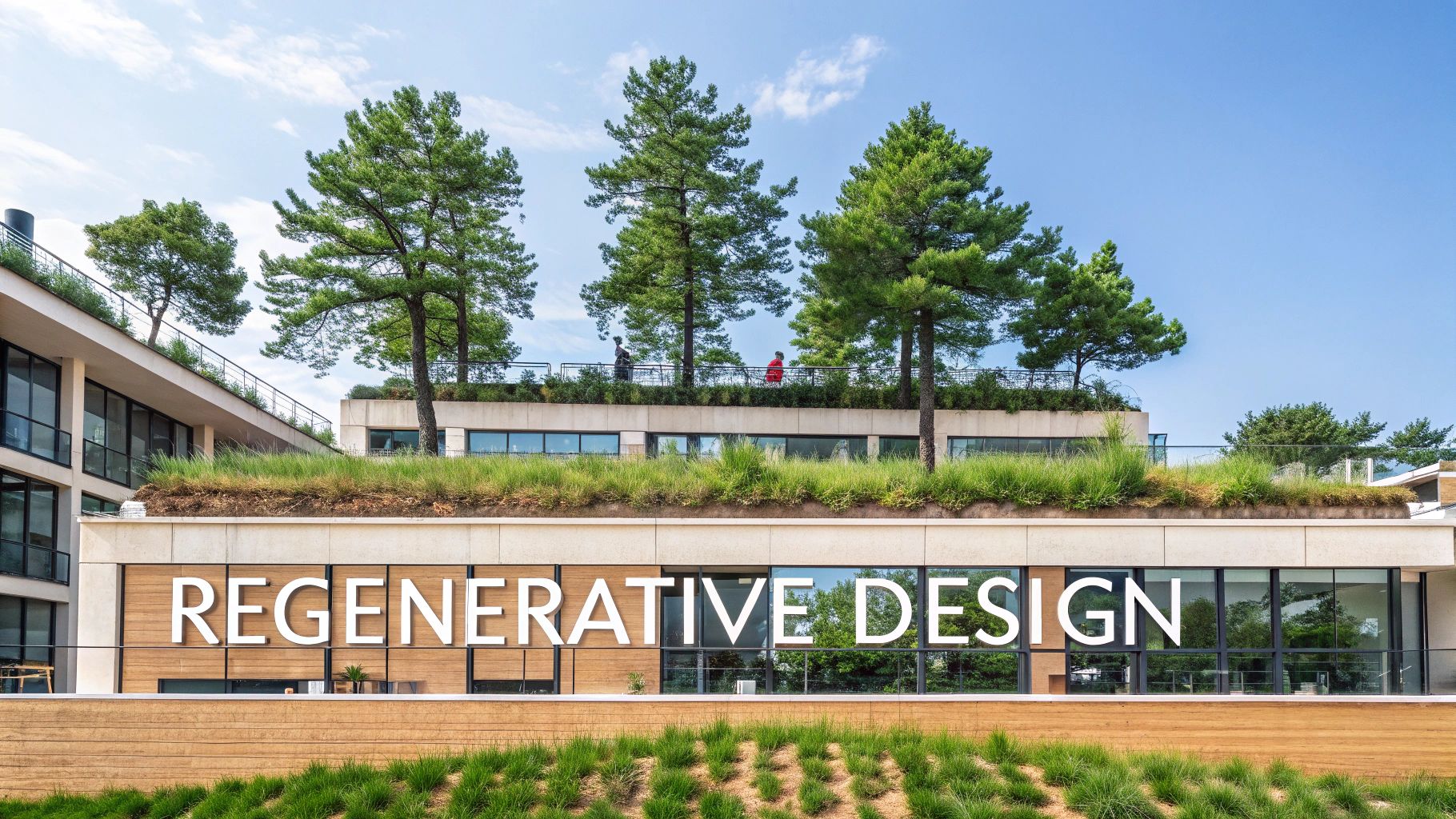
Modern building with lush green roofs, rooftop trees, and "REGENERATIVE DESIGN" text on its facade.

Think of traditional construction like a one-way street: we take resources from the earth, use them to build, and eventually create waste. Environmentally conscious architecture, on the other hand, operates more like a regenerative loop. It's a thoughtful approach that works with nature, not against it, to create structures that are efficient, healthy, and resilient for the long haul.

This isn't just a fleeting trend; it's a fundamental shift in how we approach the built environment. At its core, the goal is to create spaces that reduce environmental harm while simultaneously enhancing the well-being of the people inside and delivering long-term economic value. This is achieved by focusing on a few key pillars.

Core Pillars of Sustainable Design

At its heart, this architectural approach balances three critical elements to achieve its ambitious goals:

  • Smart Design: This is all about leveraging the natural environment. A simple example is orienting a building to maximize sunlight for warmth in the winter and minimize it in the summer, which dramatically cuts down on heating and cooling needs.
  • Material Selection: Making a conscious choice to use materials that are recycled, renewable, or locally sourced reduces a building's environmental footprint right from the start.
  • Energy Efficiency: Integrating high-performance systems for heating, cooling, and lighting ensures the building uses as little energy as possible throughout its entire life.

A key part of this is tackling two distinct types of carbon emissions: operational carbon (the energy a building uses day-to-day) and embodied carbon (the emissions generated from manufacturing materials and the construction process itself).

The Growing Demand for Green Buildings

The momentum behind this shift is undeniable. The global green construction market, valued at USD 711.0 million in 2025, is projected to more than double, reaching an estimated USD 1,508.6 million by 2032.

This explosive growth is a direct response to a hard reality: the building sector consumes over 34% of global energy and is responsible for nearly 10 gigatons of CO₂ emissions every year. As regulations tighten—for instance, the EU now mandates all new buildings be zero-emission by 2030—environmentally conscious architecture is quickly moving from a "nice-to-have" to a market necessity. As you can find in more market growth insights on Coherent Market Insights, this ensures that design promises translate into real-world performance.

By weaving these principles into the design process, environmentally conscious architecture creates buildings that are not only better for our planet but also more economical to operate and healthier for the people who live and work in them every single day.

The Financial Case for Building Green

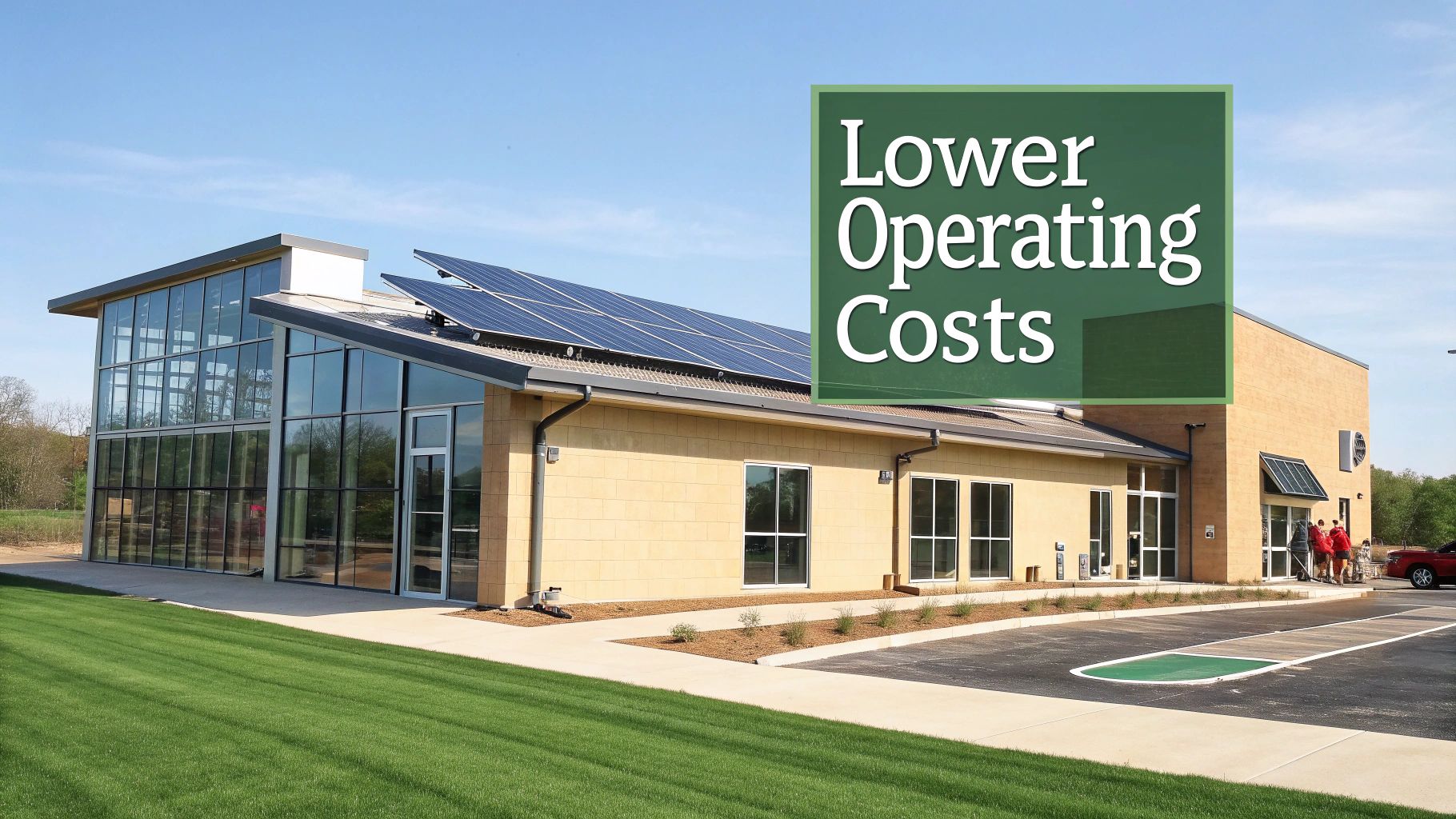
Modern building with solar panels on the roof and large windows, illustrating lower operating costs.

While the environmental and ethical reasons for building sustainably are compelling, the business case is what truly moves the needle. It's time to put the old myth that "green" equals "expensive" to rest. Environmentally conscious architecture isn't just about doing the right thing; it’s a smart financial strategy that pays real dividends over the life of a building.

The key is to shift your perspective from short-term construction costs to the building's entire life-cycle value. When you factor in everything—from day-to-day operations to future resale value—sustainable buildings consistently come out on top as more profitable, more resilient investments.

Slashing Operational Costs Year After Year

The most immediate and obvious financial win comes from lower operating expenses. Think of a well-designed green building as a finely tuned machine, engineered to perform at its peak using minimal resources. By integrating smart energy systems and a high-performance building envelope, these properties simply sip energy instead of guzzling it.

This efficiency shows up right where it counts: on your monthly utility bills. High-performance HVAC systems, smart LED lighting, and water-saving fixtures all work together to drive down costs. For example, in a sunny climate like South Carolina's, you can reduce cooling costs significantly with advanced window films that reject solar heat without sacrificing natural daylight.

Green buildings are not just cost-cutters; they are high-performance assets. Data shows that investing in green building retrofits can cut everyday operating expenses by up to 10% annually, while new green constructions can reduce maintenance costs by 20% compared to traditional structures.

This consistent drop in overhead creates a reliable financial buffer and shortens the payback period on your initial investment, making the property more profitable from the get-go.

Boosting Asset Value and Attracting Tenants

Beyond the monthly savings, environmentally conscious architecture makes your building a more valuable asset in the marketplace. In today's economy, sustainability is a powerful feature that attracts top-tier tenants and commands higher sale prices.

Corporations are increasingly guided by Environmental, Social, and Governance (ESG) goals, and they actively seek out certified green buildings. These tenants are often willing to pay more for spaces that reflect their values and provide a healthier environment for their employees. This creates a clear competitive advantage for property owners:

  • Higher Rental Rates: Green-certified buildings consistently lease for more than their conventional counterparts.
  • Increased Occupancy: Demand for sustainable spaces means lower vacancy rates and quicker lease-up times.
  • Greater Resale Value: As the market continues to prioritize sustainability, these properties appreciate faster and are easier to sell.

The following table breaks down how these advantages stack up against traditional properties.

Financial And Performance Gains Of Green Buildings

Metric Conventional Building Green Certified Building
Operating Costs Standard utility and maintenance bills. Up to 10-20% lower annually.
Rental Rates Baseline market rates. Often command a 5-11% rental premium.
Occupancy Rates Standard market vacancy rates. Typically higher due to strong demand.
Resale Value Standard appreciation. Increased asset value and market appeal.
Tenant Appeal Broad appeal. High appeal to ESG-focused corporations.
Resilience Dependent on grid and infrastructure. More self-sufficient and resilient.

Ultimately, these metrics confirm that green buildings aren't just an ethical choice—they are a superior financial asset designed for long-term performance.

Building Resilience for a Changing World

Finally, sustainable buildings are just plain tougher. They are designed from the ground up to adapt to a future where climate-related risks and volatile energy prices are the new normal.

This built-in resilience is a critical financial advantage. A building that can keep the lights on during an extreme weather event or stay comfortable during a power outage protects business continuity. Features like natural ventilation, superior insulation, and on-site renewables make these structures less dependent on fragile utility grids. This durability safeguards the asset against future shocks, making environmentally conscious architecture a truly forward-thinking and secure investment.

Core Strategies for Sustainable Building Design

Modern building with solar panels and wood facade, showcasing smart, sustainable design strategies.

Now that we've covered the financial upsides, let's get into the nuts and bolts of how environmentally conscious architecture actually works. These aren't just abstract ideas; they're practical, proven design principles that work together to create buildings that perform exceptionally well.

By weaving these four key strategies into a project from the very start, we can dramatically cut a building's environmental footprint while making it a better, more valuable place to be. Think of it as a layered approach to smart design, where each strategy supports the others, creating a building that is efficient, comfortable, and resilient from the ground up.

Embracing Passive Design First

Before you even think about solar panels or high-tech HVAC systems, the most intelligent move is to let nature do the work for you. That's the whole idea behind passive design: using the building’s location, climate, and position to slash energy needs. It’s like a plant instinctively turning its leaves to catch the sun—a building can be designed to do the exact same thing for energy.

By simply paying attention to the sun's path and local wind patterns, an architect can design a building that stays comfortable year-round with very little help from mechanical heating and cooling. This is, without a doubt, the most powerful and cost-effective first step.

  • Strategic Orientation: We position the building to welcome the low winter sun for natural warmth while shielding it from the harsh, high-angle summer sun to keep things cool.
  • Natural Ventilation: Windows and openings are designed to catch prevailing breezes, creating natural airflow that cools the interior without flipping a switch.
  • Daylighting: Large, thoughtfully placed windows, light shelves, and skylights flood the space with natural light, cutting down the need for artificial lighting during the day.

Fortifying the Building Envelope

With a smart passive design in place, the next job is to wrap the building in a high-performance building envelope. Think of the envelope as the building’s technical shell—its skin. Its main purpose is to create a solid barrier, keeping the comfortable conditioned air inside and the outside weather where it belongs.

A leaky, poorly insulated envelope is like wearing a mesh jacket in a blizzard; you're just bleeding energy. A robust envelope is the bedrock of energy efficiency, drastically reducing how hard the heating and cooling systems have to work and delivering huge energy savings over the long haul.

A well-sealed and insulated building envelope is the single most important factor in reducing a building's heating and cooling costs. It's the foundation upon which all other energy efficiency measures are built.

This is achieved with a combination of elements, like advanced insulation, high-performance windows with special low-emissivity (Low-E) coatings, and meticulous air sealing to stop costly drafts and leaks in their tracks.

Optimizing Mechanical Systems

Because passive design and a tight envelope have already done so much to reduce the building's energy demand, the mechanical systems—the HVAC, lighting, and plumbing—can be much smaller, more efficient, and less expensive. Systems optimization is all about choosing the right equipment for the job and making sure it all works together seamlessly.

Instead of just installing oversized, energy-guzzling equipment "just in case," we can right-size the systems to match the building's actual, reduced needs. This could mean smart lighting with occupancy sensors that turn off when a room is empty or high-efficiency HVAC units that use a fraction of the power of older models. It also includes things like low-flow toilets and faucets to cut down on water use.

Selecting Sustainable Materials

The final piece of the puzzle is the careful choice of building materials. Everything that goes into a building, from its concrete foundation to its interior paint, has an environmental history. Sustainable material selection is the practice of choosing products that have a lighter impact across their entire life cycle—from how they're sourced and made to how they're used and eventually disposed of.

This means prioritizing materials that are recycled, renewable, locally sourced, and non-toxic. Using reclaimed wood, for example, not only saves trees but also adds incredible character. Opting for low-VOC (volatile organic compound) paints and finishes dramatically improves indoor air quality, making the building healthier for everyone inside. When implementing core strategies for sustainable design, it's crucial to explore the top eco-friendly building materials available on the market to make informed decisions that align with project goals.

By putting these four strategies together—passive design, a tight envelope, optimized systems, and smart materials—we create buildings that are far more than just the sum of their parts. They become elegantly integrated systems designed from the start to be efficient, healthy, and built to last.

Making Sense of Green Building Certifications

So, a building claims to be “green.” How do you really know? In the world of sustainable architecture, you can’t just take someone’s word for it—you need proof. That's where green building certifications come into play.

Think of them like a nutritional label for a building. They offer a clear, standardized, and independently verified report card on a building’s environmental performance. These aren’t just participation trophies; they are rigorous, data-driven frameworks that score a project across dozens of metrics. For a developer or owner, earning a certification is far more than a plaque for the lobby. It's a powerful statement about the project's quality, efficiency, and long-term value.

LEED: The Industry Benchmark

When people talk about green buildings in North America, they’re often talking about LEED. Developed by the U.S. Green Building Council (USGBC), LEED (Leadership in Energy and Environmental Design) is a globally recognized symbol of sustainability achievement.

It’s built on a straightforward points system. Projects earn points by meeting specific criteria across a range of categories. Add up the points, and you land one of four certification levels: Certified, Silver, Gold, or the highly coveted Platinum.

The system looks at the whole picture:

  • Sustainable Sites: Did you build on a site that minimizes environmental harm? Did you protect natural habitats and manage stormwater effectively?
  • Water Efficiency: How smart is the building with water? This covers everything from low-flow fixtures to water-wise landscaping.
  • Energy and Atmosphere: This is the big one. It’s all about minimizing energy consumption through good design, efficient systems, and renewable energy sources.
  • Materials and Resources: What is the building made of? This category rewards the use of sustainable, recycled, and regional materials, and it pushes teams to reduce construction waste.
  • Indoor Environmental Quality: A green building should be a healthy building. This focuses on clean air, natural light, and creating a comfortable space for the people inside.

A LEED-certified building sends a clear signal to the market: this is a high-performance asset built to last.

Beyond LEED: Other Key Players

While LEED is the heavyweight champion, it's not the only game in town. Other excellent certification systems offer different philosophies and levels of ambition, allowing teams to find the perfect fit for their project.

BREEAM (Building Research Establishment Environmental Assessment Method) is the UK's answer to LEED and is used all over the world. It’s a similarly comprehensive, science-based system but places a particularly strong emphasis on a building’s entire life-cycle performance—from the drawing board all the way through its operational years.

For those who want to push the boundaries of what's possible, there's the Living Building Challenge. This isn't so much a checklist as it is a profound design philosophy. The goal is to create buildings that are truly regenerative, meaning they actually give more back to the environment than they take. To succeed, a project must generate all its own clean energy, capture and treat all its own water, and be built from non-toxic, responsibly sourced materials. It's an incredibly high bar, but it shows what’s achievable.

These certifications are all about accountability. The global construction industry is a massive contributor to carbon emissions. While sustainable design is gaining traction, the pace of change is still too slow. Verifiable standards like these are essential for closing the gap between what we say we’ll build and how a building actually performs.

The Power of Predictive Energy Modeling

How can you be sure a design will hit its energy targets before you even break ground? The secret weapon is energy modeling. This is basically a digital twin of your building, created with sophisticated computer simulation software.

Architects and engineers feed the model all the crucial data: the building’s orientation, the type of windows, the R-value of the insulation, the specs for the HVAC system, and more. The software then runs a year-long simulation using local weather data to predict exactly how the building will consume energy, month by month.

This powerful tool lets the design team test-drive different ideas. What’s the long-term payback on triple-pane windows versus double-pane? How much energy would we save by shifting the building’s orientation by 15 degrees? Energy modeling provides the data to answer these questions, turning aspirational green design into a measurable, predictable reality.

Breathing New Life into Existing Buildings

While shiny new towers often steal the spotlight, one of the most impactful sustainable design strategies doesn’t involve a single shovel of new dirt. It’s built on a simple but powerful idea you'll hear from preservationists and green architects alike: the greenest building is the one already standing.

This isn't just a sentimental thought. It's about a crucial concept called embodied carbon—all the CO2 released just to manufacture the steel, concrete, and glass, and then to haul it all to a site and put it together. When we decide to renovate instead of demolish, we honor that massive upfront carbon investment and sidestep the environmental cost of starting all over.

The Power of Adaptive Reuse

Adaptive reuse is the art of giving an old building a new job. Imagine a historic textile mill in Greenville finding a second life as modern loft apartments, or a forgotten warehouse on the Charleston peninsula being reborn as a bustling food hall. This is more than just recycling; it's a strategic move that saves resources, injects energy into established neighborhoods, and protects our architectural heritage.

The beauty of this approach is twofold. First, you're saving the embodied energy locked into the original structure's bones. Second, you’re often working within existing, walkable communities, which cuts down on the demand for new roads and sprawling infrastructure.

Think of it this way: by adapting an existing structure, you're essentially recycling an entire building. This single choice can slash 50% to 75% of the embodied carbon emissions that would have been generated by new construction.

Historic Preservation Meets Modern Performance

Though a close cousin to adaptive reuse, historic preservation has a slightly different mission. The goal here isn't just to repurpose the space, but to painstakingly protect its historical and architectural soul while making it perform for the 21st century. It's a delicate dance: how do you thread modern, energy-efficient systems into a building without erasing the character that makes it so special?

It's a genuine challenge, but the payoff is huge. Getting it right takes a creative team that knows how to weave the new seamlessly into the old.

A few common strategies include:

  • Window Restoration: Instead of ripping out original wood or steel windows, experts can restore them and add modern weatherstripping or low-profile interior storm panels. This boosts thermal performance without sacrificing the historic look of the facade.
  • Strategic Insulation: Carefully blowing high-performance insulation into attics and basements, or even wall cavities when possible, in a way that works with the original construction and avoids creating moisture problems down the road.
  • Discreet Modernization: Integrating high-efficiency HVAC systems and even solar panels where they won't be seen, like on flat roofs or less prominent building faces.

Financial Incentives for Sustainable Renovation

Choosing to save an old building isn't just good for the planet—it’s also a savvy financial move, thanks to some powerful incentives. Programs like the Federal Historic Tax Credit can offer a substantial credit, often 20% of the total qualified rehabilitation costs, which directly reduces a developer's federal income tax bill.

On top of that, many states, including South Carolina, have their own historic tax credit programs that can be "stacked" with the federal incentive. These financial tools can take a huge bite out of the upfront costs of a renovation, making it a real competitor to new construction. When you combine those credits with the long-term savings from a more efficient, updated building, the business case is hard to argue with.

Your Guide to Local Incentives and Resources

Turning the ideas of environmentally conscious architecture into a real, standing building takes a solid plan. For developers and property owners here in South Carolina, this means getting practical and tapping into local opportunities from day one. Real success is baked in long before the first shovel hits the dirt.

The early planning phase is where you truly set yourself up for both financial and sustainable wins. It’s about more than just finding an open lot; it's about picking a site that plays nicely with our climate and making sure your project goals align with the financial incentives on the table. Getting an experienced architect involved early is the key to making this all click.

Strategic Planning and Design

Every great project starts with clear goals. Are you aiming for a specific LEED certification? Do you plan to capitalize on historic tax credits? Figuring this out upfront guides every single decision that follows and lets your design team craft plans that hit those targets perfectly.

It’s a huge advantage to work with architects who know South Carolina’s specific building codes, energy standards, and green certification programs inside and out. They can help you navigate the maze of local rules and pinpoint the best sustainable strategies for our region, whether that’s designing for optimal sun exposure or managing stormwater like a pro.

A common mistake is treating sustainability as an add-on. For the best ROI, green building goals must be integrated into the project’s DNA from the initial concept, influencing site selection, massing, and material choices.

This flow chart shows how you can take an existing building and transform it into a high-performance, sustainable asset.

A process flow for building reuse, showing assessment, retrofit, and renewal, highlighting environmental and cost benefits.

Moving from assessment to renewal isn’t just about a facelift; it’s about preserving the building’s embodied carbon while giving it a new lease on life with better efficiency and longevity.

Navigating South Carolina Incentives

Getting a handle on the financial side of things is absolutely critical to making your project pencil out. Thankfully, South Carolina has a number of programs meant to encourage sustainable development and historic preservation, which can seriously lighten the load of your initial investment.

Here are a few key resources you should definitely look into:

  • State-Specific Programs: South Carolina offers its own historic preservation tax credits that you can often stack with federal incentives for a major financial advantage.
  • Utility Rebates: Major utility providers like Duke Energy and Dominion Energy frequently provide big rebates for installing energy-efficient HVAC systems, modern lighting, and other high-performance gear.
  • Federal Grants: Don't forget to check for various federal programs that support energy efficiency and renewable energy, as they can add another valuable layer of funding to your project.

When you actively find and weave these incentives into your project’s financial strategy, you can make the vision of environmentally conscious architecture a profitable reality.

Common Questions About Sustainable Architecture

Even with all the clear benefits, it's natural to have questions when you're considering an environmentally conscious approach for the first time. Let's tackle a few of the most common ones we hear from clients to demystify the process and the real-world value of building green.

Does It Cost More Than Traditional Construction?

This is probably the number one question, and the answer isn't a simple yes or no. While some high-performance materials might have a higher price tag upfront, the real conversation is about long-term value and life-cycle savings. The smartest strategies, particularly passive design, often add very little to the initial budget but pay you back for decades.

Think about it: the savings on energy and water bills alone often mean the initial investment pays for itself in just a few years. After that, those savings go straight to your bottom line, year after year. Better yet, powerful incentives like historic tax credits and local utility rebates can dramatically cut the initial cost, making it a smart financial move right out of the gate.

We encourage clients to shift their thinking from "What does it cost to build?" to "What will it cost to own and operate this building for the next 50 years?" Sustainable design is all about maximizing long-term profitability and asset value.

Can an Old Building Really Become Environmentally Friendly?

Absolutely. In fact, giving an existing building a new life is one of the most powerful sustainable moves you can make. This approach, often called adaptive reuse, preserves the massive amount of embodied carbon locked into the original structure—that’s all the energy that was spent manufacturing and transporting every brick, beam, and window.

Modernizing an older building for high performance is a well-established practice. The key is to blend thoughtful upgrades with the building’s original character. Common strategies include:

  • Adding modern, high-performance insulation to the walls and roof.
  • Replacing old, drafty windows with energy-efficient ones that respect the original aesthetic.
  • Swapping out oversized, outdated HVAC equipment with new, efficient systems properly sized for the space.
  • Integrating renewable energy, like discreetly placed solar panels that don't compromise the building's look.

Historic preservation projects are a perfect example of this balance, proving you don't have to choose between character and efficiency. You can have both.

What Is the First Step for a New Green Building Project?

The single most important first step is committing to an integrated design process. This isn't just a buzzword; it's a fundamental shift in how projects are managed. It means getting the owner, architect, engineers, and contractor in the same room from day one, before any lines are drawn.

When everyone is at the table from the beginning, sustainability becomes a core goal of the project, not an expensive feature you try to add later. This early collaboration is where the magic happens. The team can set clear goals (like targeting a specific LEED certification), analyze the site to take full advantage of sun and shade, and use energy modeling to test ideas and make informed decisions.

Starting with this unified vision is the best way to deliver a high-performance building that meets your goals, on time and on budget.


At Sherer Architects, LLC, we specialize in guiding clients through every stage of design and construction, turning complex challenges into beautiful, enduring, and sustainable results. Learn how our expertise in commercial architecture, adaptive reuse, and historic preservation can maximize the value of your next project.

Categories
news

What is commercial architecture? A quick guide

At its core, commercial architecture is the art and science behind designing the buildings where business gets done. We're talking about everything from the high-rise office tower that defines a city's skyline to the cozy local coffee shop on the corner. Unlike a private home, these spaces are built from the ground up to support commerce, welcome the public, and drive economic activity.

Designing the Spaces Where Business Thrives

To really get what commercial architecture is all about, you have to think beyond just the building materials. It's about crafting a strategic environment. A good commercial architect isn't just drawing up a floor plan; they’re creating a functional ecosystem designed to solve a business problem. That might mean designing a retail store layout that naturally guides customers toward key products to boost sales, or it could be an office that encourages spontaneous collaboration.

These buildings are active participants in our economy. They're purpose-built for specific business functions, but they also have a huge responsibility to the public. This dual focus—serving both the business and the people—adds a whole layer of complexity you don't see in other types of architecture. A commercial architect's checklist is long and varied, covering critical points like:

  • Public Safety and Accessibility: This is non-negotiable. It means rigorously following building codes, fire regulations, and accessibility laws like the Americans with Disabilities Act (ADA).
  • Brand Expression: The building itself becomes a physical extension of a company's identity and what it stands for.
  • Economic Viability: It's a constant balancing act between the client's upfront budget, the building's long-term running costs, and the potential for a solid return on investment.

A Tale of Three Architectures

Putting commercial architecture into context helps clarify what makes it so unique. It’s useful to see how it stands apart from its two main counterparts: residential and industrial architecture. While all three involve designing structures, their end goals and the problems they solve are worlds apart. Residential architecture is all about creating personal, private living spaces. Industrial architecture, on the other hand, is driven by process, heavy machinery, and the demands of large-scale production.

Commercial architecture sits squarely in the middle, blending the human-centric focus of residential design with the functional efficiency required by industrial operations. It's a unique discipline that must serve both the business operating within its walls and the public interacting with it.

For a deeper dive into the field, including various applications and considerations, you can explore further resources on commercial design.

The table below breaks down these key differences, showing exactly what makes each field tick.

Commercial vs Residential vs Industrial Architecture At a Glance

Here’s a quick comparison of the three main branches of architecture, looking at their primary purpose, key design considerations, and typical scale.

Attribute Commercial Architecture Residential Architecture Industrial Architecture
Primary Purpose To facilitate commerce, public services, and business operations. To provide private living spaces for individuals and families. To support manufacturing, storage, and industrial processes.
Key Considerations Public accessibility, brand identity, customer flow, building codes, and ROI. Comfort, privacy, aesthetics, personal lifestyle, and family needs. Workflow efficiency, equipment layout, logistics, and durability.
Typical Scale Varies widely, from small storefronts to large mixed-use developments. Typically smaller-scale projects like single-family homes or apartments. Often involves large-scale facilities like warehouses or factories.

As you can see, each discipline operates in its own world, solving for very different human and operational needs.

The Four Pillars of Commercial Design

Every great commercial building, from a massive corporate headquarters to your favorite corner coffee shop, stands on four fundamental principles. I like to think of them as the legs of a table—if one is shaky or missing, the whole thing comes crashing down. These pillars are what architects use to navigate the complex world of balancing a client's dream with the hard realities of construction, public use, and ultimately, the bottom line.

These principles ensure a building is more than just a pretty face. It has to work. It has to do its job, represent the brand behind it, keep everyone inside safe, and make good business sense. Let's break down these four essential pillars that every thoughtful commercial design is built upon.

Functionality and Flow

At its absolute core, a commercial building is a tool for business. Its main purpose is to function flawlessly for the people who use it, whether they're employees, customers, or patients. This is the pillar of functionality and flow, and it's all about how people move and operate within the space.

An architect obsesses over the path people will take through a building. In a retail store, for instance, the layout isn't accidental; it’s carefully crafted to guide you past key products and encourage you to buy. In a modern office, the flow might be designed to spark collaboration, with pathways that naturally lead to common areas and impromptu meeting spots. The goal is to create an experience so intuitive that it feels effortless.

A well-designed space is almost invisible because everything is just where you expect it to be. You know a functional design is a success when people can move through it and get things done without ever feeling lost, confused, or held back by the building itself.

Brand Identity and Aesthetics

A commercial building is one of the most visible, permanent statements a company can make. This second pillar, brand identity and aesthetics, is what turns a generic box into a physical extension of a company’s personality and values. It’s storytelling through architecture.

This is so much more than just slapping a logo on the door. The materials, the colors, the way light fills a room, and the architectural style all work together to send a message. A young tech company might choose an open, industrial look with raw concrete and exposed steel to project a feeling of innovation and transparency. A luxury hotel, on the other hand, will use rich materials and classic forms to communicate elegance and comfort. The building itself becomes a powerful marketing tool, reinforcing the brand for everyone who walks inside.

Safety and Compliance

This third pillar is the one you can't compromise on. It's the absolute foundation of public trust: safety and compliance. Commercial buildings are for the public, and architects have a serious responsibility to protect the health and well-being of every single person who steps inside. This means sticking to a whole host of complex rules and regulations.

This pillar is less about creative flair and more about technical mastery. Key elements include:

  • Building Codes: These are the local and national rulebooks that govern everything from how strong the structure must be to fire safety, proper ventilation, and electrical systems.
  • The Americans with Disabilities Act (ADA): This is a federal law ensuring that public spaces are accessible to everyone. It dictates the design of ramps, doorways, bathrooms, and much more.
  • Public Safety Measures: This covers things like clearly marked fire exits, emergency lighting, and setting limits on how many people can be in a space at one time.

Getting this right requires a deep well of technical knowledge. The architect is the client’s guide through this maze of regulations, making sure the finished building is not only beautiful and functional but, most importantly, legal and safe.

Economic Viability

At the end of the day, commercial architecture has to make financial sense. The pillar of economic viability is what keeps a project grounded, ensuring the design fits the budget, delivers a solid return on investment (ROI), and accounts for long-term running costs. A stunning design that bankrupts the owner is, quite simply, a failure.

Architects work hand-in-hand with clients to find the sweet spot between their vision and their budget. This means making smart choices about materials, construction techniques, and building systems to manage those initial costs. But a good design also has an eye on the future. It incorporates energy-efficient systems and durable materials that will cut down on utility bills and maintenance for years to come. By focusing on economic viability, the architect ensures the project isn’t just a creative achievement but a profitable, long-lasting asset.

Exploring the Diverse World of Commercial Buildings

Commercial architecture isn't one-size-fits-all. It's a collection of specialties, much like how a doctor might focus on cardiology or pediatrics. Architects, too, often develop a deep expertise in specific types of commercial buildings.

Think about it: the design challenges for a bustling shopping mall are worlds apart from those of a sterile hospital. Yet, both are commercial architecture. This variety is what keeps the field so interesting. Let’s dive into a few of the major categories you see every day.

Office Buildings: From Corporate Campuses to Coworking Hubs

Offices are probably the first thing that comes to mind when you hear "commercial building." But the modern office has come a long way from the sea of cubicles we all picture. Today, architects are designing everything from sprawling corporate headquarters for tech giants to flexible coworking spaces for freelancers and startups.

The real puzzle is creating a space that actually supports how a company works. An open floor plan can be great for collaboration, but you also need quiet zones for focused tasks. Things like great natural light, good air quality, and access to amenities aren't just perks anymore—they're essential for attracting and keeping great people.

Retail Spaces: Crafting the Customer Journey

Retail architecture is all about the experience. The goal? To encourage people to buy. Whether it's a massive mall, a tiny boutique, or a big-box store, the design is meant to guide a customer on a carefully planned journey.

Architects who specialize in retail are part psychologist, part merchandiser. They use layout, lighting, and materials to highlight products and build a powerful brand atmosphere.

  • Boutiques: These aim for an immersive, brand-focused vibe that feels exclusive and special.
  • Shopping Malls: They're designed like mini-communities, with traffic flows that ensure shoppers see as many storefronts as possible.
  • Big-Box Stores: Here, it’s all about efficiency. Think wide aisles and clear sightlines to make finding things—and restocking shelves—as easy as possible.

Ultimately, the architecture is there to turn a visitor into a customer by making their shopping trip smooth and enjoyable.

Hospitality and Healthcare: Designing for People

At first glance, hotels and hospitals seem completely different. But they share one critical mission: they are designed entirely around the human experience, often during very important moments in people's lives.

In a hotel or restaurant, the building itself is part of the product. The architecture creates a sense of welcome, comfort, or even luxury. From the grand lobby entrance to the mood of the dining room, every detail is considered to make a guest's stay memorable.

In healthcare, the design priorities shift to patient well-being, safety, and efficiency for the medical staff. A well-designed hospital might use clear signage to reduce stress, place nursing stations for the best patient visibility, and use materials that are both tough and easy to keep sterile. Good architecture can genuinely contribute to healing.

The Rise of Mixed-Use Developments

One of the most powerful trends in commercial architecture right now is the mixed-use development. These projects are like self-contained mini-neighborhoods, blending retail, housing, offices, and entertainment into one seamless complex.

They create vibrant, walkable communities where you can live, work, and play without ever getting in your car. For an architect, this is a fascinating challenge: how do you make these different functions flow into one another to create a lively, energetic urban space?

This growing demand for specialized and diverse commercial spaces is driving a lot of activity. The architectural services market was valued at around $184.1 billion in 2025 and is expected to jump to nearly $330.1 billion by 2033. This boom shows just how vital architects are in shaping how we live and work together. You can read more about the trends driving this architectural services market growth.

The Journey from Concept to Concrete

Turning a great idea for a commercial space into a real, standing building is a marathon, not a sprint. It's a journey with a clear roadmap, moving step-by-step from a rough concept to a fully-realized structure. Think of it less like a single flash of inspiration and more like a carefully orchestrated expedition.

Every stage builds directly on the one before it, ensuring that from the moment you pick a site to the day the final coat of paint dries, every decision serves the project's ultimate purpose. This process is a massive collaborative effort, bringing together clients, architects, engineers, and builders. The architect is like the conductor of an orchestra, making sure everyone is playing in harmony to create a building that works, meets all the rules, and actually delivers on that initial vision.

Let's walk through the five key phases of how it all comes together.

Image

Pre-Design and Feasibility

This is where it all begins—the "is this even possible?" stage. Before a single line is drawn, the architect sits down with the client to hash out the absolute fundamentals: the project's goals, its size and scope, and, of course, the budget. It’s all about asking the tough questions right from the start.

Key activities here are all about due diligence:

  • Goal Setting: Nailing down precisely what this building needs to do for the business. Is it about attracting customers, boosting employee productivity, or streamlining logistics?
  • Site Analysis: Scrutinizing potential locations. This means digging into zoning laws, checking for environmental issues, and making sure there's proper access to utilities and roads.
  • Budgeting: Creating a realistic financial plan that will guide the entire project.

This deep dive ensures the project is built on solid ground—both figuratively and literally. This is also when you start thinking about the physical groundwork, which often means bringing in experienced commercial excavation contractors to prepare the site for construction.

Schematic Design

With the groundwork laid, the creative part really kicks into gear. In Schematic Design, the architect starts translating all those goals and requirements into actual drawings. These aren’t hyper-detailed blueprints yet; they’re more like conceptual sketches, rough floor plans, and basic 3D models that explore the overall look, feel, and flow of the building.

This is the big-picture phase. The architect will often present a few different approaches to see what resonates most. Client feedback is everything here, as the initial sketches are tweaked and refined until they perfectly capture the project’s spirit.

Design Development

Once everyone agrees on the schematic design, it’s time to add the meat to the bones. During Design Development, the architect fleshes out the approved concept with a much deeper layer of detail. This is when decisions are made on major materials, the structural system is locked in, and all the mechanical, electrical, and plumbing (MEP) systems are mapped out.

Think of it like this: Schematic Design is the pencil sketch of a portrait. Design Development is when the artist starts laying down the base colors, defining the shadows, and bringing the subject to life with texture and depth. The basic form is there, but now it’s getting the character and substance that will define it.

Construction Documents

Here's where things get incredibly technical. The architect and the team of engineers produce a massive, highly detailed set of drawings and specifications known as construction documents. These are the official, legally binding instructions for the construction crew. Nothing is left to chance.

These documents spell out everything—from the precise thickness of a wall and the type of bolts to use in the steel frame, to the model number of the light fixtures in the lobby. These blueprints are what the builder will use to price the job, pull permits, and actually build the structure.

Construction Administration

With the plans finalized, the dirt starts to move. But the architect's job is far from over. Their role now pivots from designer to quality control manager. During Construction Administration, the architect is on-site regularly, making sure the builder is following the plans to the letter.

They act as the client’s eyes and ears, answering contractors' questions, reviewing the quality of the work, and signing off on payments. This final, hands-on phase is what guarantees the integrity of the design is carried all the way to the finish line, turning a well-laid plan into a concrete reality.

Future-Proofing Commercial Spaces

Commercial architecture isn’t about building for today; it’s about designing for the next several decades. A great building has to anticipate the twists and turns of technology, culture, and the economy to stay relevant and valuable. This is what we call future-proofing—creating spaces that are resilient and flexible enough to meet tomorrow's needs.

The most successful commercial projects are designed with change baked right into their DNA. They can evolve without needing a gut renovation every few years. This foresight really comes down to mastering three key areas: sustainability, technology integration, and adapting to how people actually live and work. When an architect gets these right, the result isn't just a structure, but a dynamic asset ready for whatever comes next.

Embracing Sustainability and Green Building

Sustainability has moved from a "nice-to-have" feature to a core requirement in modern commercial design. It's what clients and tenants expect. They want spaces that are good for the planet and, just as importantly, healthier for the people inside them. This shift means architects are weaving green building principles into the fabric of a project from the very first sketch.

This isn't just about sticking solar panels on the roof. It’s a comprehensive approach that considers a building’s entire lifecycle, from where the materials come from to how much energy it uses every day. Some of the key strategies include:

  • LEED Certification: Leadership in Energy and Environmental Design (LEED) provides a proven framework for creating buildings that are healthy, efficient, and save money on operations.
  • Net-Zero Energy Goals: The ambition to design buildings that generate as much renewable energy as they consume is no longer a distant dream. It's a tangible goal for many projects.
  • Passive Design: This is just smart design. It means orienting the building to capture natural light and airflow, which drastically cuts down on the need for artificial lighting and HVAC systems.

Integrating Smart Building Technology

Technology is completely rewiring how commercial buildings function. Smart buildings use an interconnected network of sensors and systems—the Internet of Things (IoT)—to gather data and automate everything from lighting to security. The payoff is a massive boost in efficiency and a much better experience for everyone inside.

An architect's job now involves planning the digital backbone that makes this all work. We have to design spaces with integrated sensors that can automatically dim the lights or adjust the temperature when a room is empty, saving a ton of energy. These systems can also monitor air quality, tighten up security, and ensure flawless connectivity for tenants. The end game is to create an environment that’s not just smart, but truly responsive to its occupants.

Adapting to New Lifestyles and Market Realities

The way we work, shop, and live is always changing, and architecture has to keep up. Just look at the rise of hybrid work. It has completely upended traditional office design. Architects are now creating flexible workspaces that blend private offices for focused work with open collaborative zones and comfortable social areas, all to support a workforce that isn't chained to one desk.

This need for flexibility isn't limited to new builds. Adaptive reuse—the art of repurposing old, often historic, buildings for new uses—is a powerful tool for sustainable urban growth. It breathes new life into existing structures, preserving a city's character while serving modern needs.

Market pressures also steer the architectural ship. Global trends in supply and demand are causing huge shifts in what's being built. For example, soaring costs are projected to trigger a 73% decrease in new office completions in the U.S. in 2025. This forces the industry to pivot, with architects focusing more on renovating existing buildings and creating mixed-use developments instead of building new offices from the ground up. It’s a perfect example of how the field evolves with the economic landscape. You can explore more about these global construction trends on HospitalityNet.org.

Choosing the Right Architect for Your Vision

Picking an architect might be the single most important decision you make for your entire commercial project. This isn't just about hiring someone to draw up plans; it's about finding a partner who can take your business goals and turn them into a real, functional, and profitable building. The right firm will be your guide, your advocate, and your creative problem-solver from that first sketch on a napkin all the way to the final punch list.

A flashy portfolio is a nice starting point, but it's just that—a start. You need to dig deeper. You’re looking for a team that gets the nitty-gritty of commercial work, from wrestling with dense zoning codes to keeping a sharp eye on your return on investment.

Evaluating Potential Partners

First things first, look for a portfolio that actually matches what you're trying to do. If you're building a new restaurant, you want a firm that has hospitality design in its DNA. Their past projects are proof they understand the unique headaches of that world, like optimizing kitchen workflow, creating a great customer experience, and satisfying the health inspector.

When you're looking at their past work, try to see beyond the pretty pictures. Ask yourself how their designs solved a business problem. Is there a clear sense of branding? Does the layout make sense for customers and staff? This is where a great commercial architect really earns their fee.

Next up: check their references. This is non-negotiable. Talking to past clients gives you the unvarnished truth about what it’s really like to work with the firm day-to-day.

An architect's talent for design is only half the equation. Their ability to stick to a budget, meet deadlines, and communicate clearly is just as critical. Ask former clients how the architect handled unexpected problems and whether they truly felt heard throughout the project.

Asking the Right Questions

Once you've narrowed it down to a shortlist, it's time for interviews. This is your chance to see if you click and if your visions are truly in sync. Come prepared with questions that get to the heart of how they operate as a business, not just as designers.

Here are a few essential questions to get the conversation started:

  • Budget Management: How do you put together a project budget? More importantly, what's your game plan for keeping us on track financially when surprises pop up?
  • Local Regulations: What's your track record with the local zoning boards, building codes, and permitting offices in this specific area?
  • Collaborative Process: What happens when we disagree on a design choice? Walk me through how you typically communicate with clients and contractors.
  • Fee Structure: Can you break down your fees for me? I want to know exactly what's included and what might end up costing extra down the line.

Finding the right architect is about finding a shared vision. When you connect with a partner who not only gets your goals but also has the street-smart expertise to make them happen, you’re not just building a building—you’re setting your business up for long-term success.

Got Questions About Commercial Architecture? We've Got Answers.

Diving into a commercial building project can feel like you're learning a whole new language, filled with unfamiliar terms and processes. It’s completely normal to have questions. To clear up some of the initial confusion, I've put together some straightforward answers to the questions we hear most often.

Architect vs. Commercial Interior Designer: What's the Difference?

This one comes up all the time. While an architect and a commercial interior designer often work hand-in-hand, their roles are fundamentally different.

Think of the architect as the creator of the building's "bones" and "skin." They're responsible for the core structure, the exterior look, the overall layout, and all the essential systems—plumbing, electrical, HVAC. Their job is to make sure the building is safe, functional, and up to code. They create the foundational canvas.

The commercial interior designer then brings the experience within those walls to life. They focus on everything you touch and see inside: the finishes, furniture, lighting, and how the space flows. Their goal is to support the business's operations, reflect the brand's identity, and create a specific mood for everyone who walks through the door.

In a nutshell: The architect builds the sturdy, functional shell. The interior designer transforms that shell into a living, breathing, branded environment.

How Long Does a Commercial Project Usually Take?

Ah, the million-dollar question. The honest, expert answer is: it really depends on the scale and complexity of your project. There's no single timeline that fits all.

A simple interior renovation for a small coffee shop might be wrapped up in a few months. But if you're talking about designing and building a new multi-story office building from the ground up, you could easily be looking at a timeline that spans several years.

Here are the big factors that always influence the schedule:

  • The Permitting Maze: Getting the green light from local authorities can take anywhere from a few weeks to many, many months.
  • Design Intricacy: A highly custom design with unique technical challenges will naturally take longer than a standard, straightforward one.
  • Surprises on Site: You never truly know what's underground until you start digging. Unexpected soil conditions or other site issues can cause delays.
  • Decision Speed: The project moves at the speed of decisions. Quick, clear feedback from you, the client, is crucial for keeping things on track.

How Are Architectural Design Fees Calculated?

The cost of architectural design isn't a simple, off-the-shelf price. Fees are usually structured in one of two ways: either as a percentage of the total construction cost or as a fixed, flat fee that's agreed upon before work begins.

For percentage-based fees, the rate typically falls somewhere between 5% and 15% of the final construction budget. What determines that percentage? It comes down to a few key things: the project's overall size, the difficulty of the design, and exactly how many services the architect is providing. A large, complex hospital with tons of regulations will, of course, have a higher design fee than a simple, open-plan warehouse.


At Sherer Architects, LLC, our job is to be your guide through every phase, making sure you have total clarity on timelines, costs, and design choices. If you're ready to turn your vision into a real, tangible space, stop by https://shererarch.com to see how our team can help you build something lasting and successful.

Categories
news

Mastering the Design for Buildings Process

Bringing a building from a rough idea to a physical reality is a complex dance of creativity, engineering, and meticulous planning. It's about a lot more than just drawing up some floor plans. This guide breaks down that entire process, giving you a clear, step-by-step look at what it really takes to design a modern building.

We'll cover everything from the very first spark of an idea all the way to the final construction documents that a builder can actually use.

Your Roadmap to a Successful Building Design

Kicking off a new construction project is a huge undertaking. The road from a concept sketched on a napkin to a fully-realized structure is filled with potential pitfalls. True success comes from a design process that’s structured to balance creative vision with the hard realities of technical specs, budgets, and regulations.

Think of it this way: the design process is the foundation you build before you even break ground. Each decision you make early on has a ripple effect on everything that follows. This guide is built to follow that same logical flow, helping you understand not just what to do, but why each stage is so critical to the final building.

Blueprints and architectural tools laid out on a table, illustrating the building design process.

What We'll Cover

Whether you’re a developer eyeing a new commercial project or a business owner looking to build your own space, this walkthrough will give you the practical knowledge you need. We're going to dive into how to:

  • Properly evaluate a site to understand its potential and its constraints.
  • Flesh out a strong concept that truly aligns with your project goals.
  • Navigate the maze of building codes and zoning laws without getting stuck.
  • Incorporate sustainable design for better long-term performance and value.
  • Prepare the construction documents that turn your vision into a buildable plan.

A great building design doesn't just produce a structure that works. It creates a space that genuinely enhances its surroundings, serves the people inside it, and holds its value for years to come.

The Tools of the Trade

These days, bringing a design to life is about more than just pen and paper. Architects and designers rely on sophisticated software to model, test, and perfect their ideas in a digital space long before any dirt is moved. This approach leads to incredible precision and makes it far easier for everyone—from engineers to clients—to stay on the same page.

To really sell a vision and get buy-in, you need the right tools. We're talking 3D models, virtual walk-throughs, and photorealistic images that make the project feel real. Checking out the Top Programs for Architectural Rendering is a great way to see how the pros create the stunning visuals that guide a project from a simple concept to a finished building.

With that, let's start by laying the groundwork for your project.

Starting with the Site and Concept

Every great building starts not with a floor plan, but with the piece of earth it will call home. You can always tell when a structure was designed in a vacuum, without any real connection to its surroundings. The best architecture, however, feels like it grew right out of the land.

This is why a deep-dive site analysis is the non-negotiable first step. It’s far more than just verifying property lines; it’s about getting to know the land’s personality. We're looking for its quirks—the gentle slope you can use to your advantage, the path the sun takes across the sky, and even how the wind behaves on a blustery afternoon.

An architect reviewing site plans and a 3D model, illustrating the conceptual design phase.

Uncovering the Story of the Site

Every site has a story, and our job is to listen. This means blending hard data with simple, careful observation. We’re searching for clues that will directly shape the building’s form, its placement, and its overall feel.

Here’s what a proper site analysis really digs into:

  • Topography and Slope: Is the site pancake-flat or does it have a dramatic grade? A slope isn’t a hurdle; it’s an opportunity. I’ve seen hillside lots become the perfect setting for stunning multi-level homes with walk-out basements that capture incredible views.
  • Solar Orientation: We literally track the sun's path across the property through the seasons. This isn't just for fun—it tells us exactly where to place windows to flood rooms with natural light in the winter and where to use overhangs to block the harsh summer sun, which has a huge impact on energy costs down the line.
  • Prevailing Winds and Climate: Knowing which way the wind blows helps us place windows for cross-ventilation or create sheltered outdoor spaces. Local climate data dictates everything from insulation requirements to the type of exterior cladding that can withstand the elements.
  • Surrounding Context: What’s the neighborhood vibe? A good design respects the scale and materials of the buildings next door without being a carbon copy. We also map out views to capture, noise sources to mitigate, and how people will approach the building.

This isn't just a checklist. It's the raw material for genuine, creative problem-solving.

Translating Site Data into a Strong Concept

With a solid understanding of the site, we can finally start talking about the big idea. This is the conceptual design phase, where raw data gets an architectural soul. The goal here is to land on a core concept that brilliantly marries what the client wants with what the site offers.

Think of the concept as the project's north star—the single idea that guides every decision that follows. We're not drawing walls yet; we're establishing the "why" behind the design.

For example, on a tight urban lot, the concept might be "a column of light," using a central staircase and skylights to pull daylight down through multiple floors. For a retail store on a bustling corner, the concept could be "the community front porch," with massive windows and a welcoming entrance that engages everyone walking by.

The conceptual design is the crucial bridge between raw information and a compelling architectural vision. It ensures the final building isn't just placed on the site, but is truly of the site.

Developing Initial Massing and Layouts

Once the big idea is in place, we start exploring how the building will physically take up space. This is done through massing studies, which are basically simple 3D block models. These aren't fancy renderings; they're quick, iterative tools to figure out the building’s general shape, scale, and position.

These studies help us answer some fundamental questions:

  1. How does our building's size and shape feel next to its neighbors?
  2. Where are the absolute best spots for windows to frame a view or catch the morning sun?
  3. Can we shape the building to carve out a private courtyard or a sunny patio?

At the same time, we begin sketching out preliminary layouts, often as "bubble diagrams." These aren't detailed floor plans, but simple diagrams showing how different spaces relate to each other. In an office, for instance, it helps us map the journey from the public reception area to collaborative zones and quiet, private offices.

This part of the process is all about rapid exploration. We might create dozens of sketches and digital models, testing ideas and refining the approach until something just clicks. Getting this right early on is critical, because it sets the entire strategic direction, ensuring the final design is smart, responsive, and truly connected to its place in the world.

Navigating Building Codes and Zoning Rules

To an outsider, zoning laws and building codes can feel like an impossible web of red tape. But for those of us in the industry, we know they're the bedrock of safe, functional communities. They aren't there to kill your design creativity; they’re a framework to make sure every new building is a good neighbor and, most importantly, a safe place to be.

Getting a handle on this framework isn't just about checking a box for compliance—it's about designing smarter from day one.

Think of it this way: zoning ordinances tell you what you can build and where. They dictate things like land use (is it for homes or shops?), building height, how far you have to set back from the property line, and even how much parking you need. On the other hand, building codes are all about how you build it. They cover the nuts and bolts of construction—structural integrity, fire safety, accessibility, and mechanical systems.

An architect pointing to specific details on a large city zoning map spread across a table.

Weaving these rules into your project from the very start is what separates a smooth permitting process from one that ends in costly, soul-crushing redesigns.

Decoding Local Zoning Ordinances

Before a single line gets sketched, your first move should be to dig into the local planning or zoning department's website. You'll usually find the zoning maps and ordinances right there online, and these documents are your roadmap for what's even possible on a property.

Let’s say you’re designing a small shop in a historic downtown. The zoning code will give you the hard facts:

  • Use Restrictions: Can you even put a retail store here? Sometimes it has to be a "mixed-use" zone.
  • Setbacks: How far back from the sidewalk does the building need to be? In many historic districts, the answer is zero to maintain that classic, continuous streetscape.
  • Height Limits: You might be capped at two or three stories to keep the new structure in scale with its older neighbors.
  • Parking Requirements: The code will have a formula for how many parking spots you need based on your square footage, which can dramatically impact your site layout.

Ignoring these details early on is a classic mistake. I once saw a great project get completely derailed because the initial design didn't account for a required 20-foot rear setback. The entire building footprint had to be redrawn, wasting weeks of work and a lot of money.

Interpreting Major Building Codes

While zoning is intensely local, building codes often stem from standardized models like the International Building Code (IBC). These provide a baseline for safety and performance that local governments adopt, sometimes with their own tweaks.

A huge part of an architect's job is translating these dense, technical manuals into real-world design features. The code influences almost everything, from the minimum width of a hallway to the specific type of fire-rated drywall required between apartments.

The real goal isn't just to meet the bare minimum. It's to understand the "why" behind the rule. That knowledge is what lets you find creative solutions that keep people safe without compromising your design vision.

Energy codes are a perfect example. The push for efficiency is global, but the follow-through can be inconsistent. Between 2022 and 2023, global floorspace grew by about five billion square meters. The problem? In emerging economies where most of that growth happened, over half of the new buildings went up without any energy codes at all. You can get a deeper look at these trends in the full 2024 report on the global status of buildings. It's a stark reminder of how critical robust local codes are for pushing energy performance forward.

A Practical Approach to Compliance

So, how do you actually make this work without getting buried in regulations? It all comes down to being proactive.

  1. Start with a Code Analysis. Early in the schematic design phase, your architect should put together a document that outlines every code that applies to your project. This flags key parameters like building type, occupancy classification, and required fire-resistance ratings right from the start.
  2. Talk to Officials Early. Don't be a stranger. A preliminary meeting with someone from the planning department to walk them through your concept can uncover red flags you might have missed. It also starts building a good working relationship with the very people who will review your final plans.
  3. Document Everything. As you make design decisions to meet code, note them directly on your drawings. This shows the plan reviewer you’ve done your homework and makes their job—and your approval—a whole lot easier.

If you treat codes and zoning as design partners instead of obstacles, you end up with buildings that aren't just beautiful, but are also safe, legal, and a true part of their community.

Integrating Smart and Sustainable Strategies

Great building design today is about more than just a striking look and a functional layout. It's about creating structures that are intelligent, highly efficient, and have a light touch on our planet. Thinking about sustainability isn't an afterthought or a "nice-to-have" anymore; it's a foundational principle that informs every decision, right from the first sketch.

The best approach blends timeless, low-tech wisdom with the sharpest new technology. The result? Buildings that cost less to run, are healthier for the people inside, and are ready for the future.

We always start with passive design strategies. This is about cleverly using the building's orientation, shape, and materials to work with the surrounding environment, not against it. Think of it as giving the building a huge head start on efficiency before a single switch is even flipped.

Once that foundation is solid, we layer in the active systems—the tech that generates and manages energy, like solar panels or high-efficiency HVAC. The final piece is smart building technology, which acts as the building's brain, using data and automation to fine-tune everything in real-time.

This infographic neatly breaks down these three pillars of modern, sustainable design.

Infographic comparing Passive Strategies like Orientation & Shading, Active Systems like Renewable Integration, and Smart BMS with AI Automation.

As you can see, a truly effective design layers these approaches, starting with simple, low-cost passive techniques and building up to sophisticated, data-driven automation.

Laying the Groundwork with Passive Design

Before we even think about specifying a solar panel, the most significant and cost-effective sustainable moves are made by thoughtfully shaping the building itself. These passive strategies are baked directly into the architectural DNA of a project, slashing the building's long-term energy needs from day one.

A perfect example is solar orientation. Here in South Carolina, we can orient a building to maximize sun exposure on its south-facing walls during the winter, giving us free passive heat. Then, we use carefully calculated roof overhangs or external shades to block the high-angle summer sun, which can dramatically cut cooling costs. It's a simple, elegant solution.

Other crucial passive strategies we always consider include:

  • Natural Ventilation: We design floor plans and window placements to encourage cross-breezes. This simple trick can eliminate the need for air conditioning during the milder months.
  • A High-Performance Envelope: This is the building's "skin"—its walls, roof, windows, and foundation. Using superior insulation and high-performance windows creates an airtight seal that prevents heat from escaping in the winter and seeping in during the summer.
  • Thermal Mass: We strategically use materials like concrete or stone that absorb the sun's heat during the day and slowly release it at night. This helps to naturally stabilize indoor temperatures year-round.

"The smartest building is the one that needs the least amount of energy in the first place. Passive design is the art of achieving that by working with nature, not fighting it."

Powering Up with Active Systems

Once our passive strategies have trimmed the building's energy appetite down to a minimum, we bring in active systems to meet the remaining demand as efficiently as possible. This is where modern technology really shines, generating clean energy on-site and using it with incredible precision.

To help you understand the two core philosophies, here’s a quick comparison of passive and active design approaches.

Comparing Passive vs Active Sustainable Design Strategies

This table outlines the key differences, benefits, and examples of passive and active strategies in sustainable building design to help readers understand their distinct roles.

Strategy Type Core Principle Examples Primary Benefit
Passive Uses natural elements and building form to manage energy. Building orientation, natural ventilation, shading, thermal mass. Reduces energy demand from the start with low ongoing costs.
Active Uses technology and mechanical systems to generate or conserve energy. Solar panels, geothermal heat pumps, high-efficiency HVAC. Meets remaining energy needs efficiently with clean sources.

By combining these two, we create a powerful, resilient, and low-impact building.

Sustainability is a global force in design now, influencing everything from regulations to material choices. A major trend is integrating multiple renewable sources—like solar, wind, and geothermal—with better energy storage to get buildings closer to self-sufficiency. You can learn more about how these sustainable building trends are shaping the future on blog.zeroconsulting.com.

Key active systems include:

  • Renewable Energy Generation: Photovoltaic (solar) panels are the most common choice, turning unused rooftops into mini power plants. Geothermal systems are another fantastic option, tapping into the earth's stable underground temperature for super-efficient heating and cooling.
  • High-Efficiency HVAC: Today's heating, ventilation, and air conditioning systems are miles ahead of older models. Technologies like Variable Refrigerant Flow (VRF) systems can deliver heating and cooling to different zones at the same time, using a fraction of the energy.
  • Water Conservation: While low-flow fixtures are a given, active systems take it further. We can design rainwater harvesting systems for landscape irrigation or even greywater recycling systems for non-potable uses, easing the burden on local water supplies.

Optimizing Performance with Smart Building Management

The final, powerful layer is intelligence. A Building Management System (BMS) is the central nervous system that monitors and controls all of a building's mechanical and electrical equipment. Today’s smart BMS platforms, powered by AI and the Internet of Things (IoT), are completely changing how buildings operate.

Instead of just running on a fixed schedule, a smart BMS uses a network of sensors to pull in real-time data on everything from room occupancy to outdoor air quality. For example, sensors can detect when a meeting room is empty and automatically dim the lights and dial back the thermostat.

This AI-driven automation doesn't just cut energy bills; it also creates a healthier, more comfortable environment for occupants. The system can monitor CO2 levels and automatically boost fresh air ventilation when the room gets stuffy. Over time, it learns occupant behavior, anticipates needs, and continually fine-tunes operations for peak efficiency. This constant, quiet optimization is what makes a building truly responsive and sustainable for the long haul.

How AI Is Reshaping Architectural Design

Artificial intelligence isn't some far-off concept anymore; it's a real tool in the modern architect's belt, and it's fundamentally changing how we design buildings. This isn't about AI replacing designers. It’s about arming them with incredible new capabilities to explore, optimize, and create in ways we couldn't just a few years ago.

This shift is helping firms solve incredibly complex problems with remarkable speed and creativity, truly pushing the envelope of what a building can be.

Exploring Possibilities with Generative Design

One of the most powerful applications of AI we're seeing is generative design. Instead of an architect sketching out one idea at a time, we now feed a set of goals and constraints directly into an algorithm. These parameters can be anything—from tight budget limits and material choices to specific structural loads and energy performance targets.

The AI then gets to work, generating thousands of viable design options, each one a distinct solution to the puzzle. This process lets architects stumble upon brilliant, highly optimized solutions they might never have landed on otherwise. Imagine designing a hospital and finding a layout that shaves minutes off nurses' walking times while giving every patient a view of natural light—that's the kind of problem generative design excels at solving.

AI-driven generative design doesn't just make us faster; it blows the doors wide open on creativity. The architect’s role evolves from being the sole creator to a curator, sifting through thousands of possibilities to find the most elegant and effective solution.

This approach gives design teams a huge head start. They can spend their valuable time and expertise refining the best computer-generated options instead of starting every project from scratch.

Making Building Information Modeling Smarter

Building Information Modeling (BIM) has long been the standard for creating detailed, data-rich 3D models. AI is now making those models exponentially more intelligent. By running machine learning algorithms on BIM data, systems can now automatically spot potential conflicts—or "clashes"—with an impressive degree of accuracy.

For example, an AI can flag a design where a new HVAC duct is routed straight through a primary structural beam. Catching that kind of mistake in the digital phase saves a massive amount of time, money, and headaches during construction.

AI also elevates project management within BIM. By analyzing data from past projects, it can generate much more precise construction schedules and cost estimates. It can even identify potential bottlenecks before they bring work to a standstill, leading to a much smoother, more predictable project from start to finish. We're seeing this play out across building systems, with new insights into how AI is transforming HVAC systems for unparalleled efficiency.

Revolutionizing Construction and Fabrication

The influence of AI doesn't stop at the digital model; it extends right onto the job site. AI-guided robotics and 3D printing are paving the way for new construction methods that are faster, safer, and generate significantly less waste.

We're in the middle of a major shift, with firms like Zaha Hadid Architects using AI not just for stunning aesthetics but to fine-tune a building's thermal performance. On the fabrication side, 3D printing guided by AI is completely changing how we use materials. We can now print complex components designed for maximum strength with an absolute minimum of waste.

These technologies make it possible to build complex, organic shapes that would be ridiculously expensive—if not impossible—with traditional methods. A huge win here is material optimization. An AI algorithm can design a structural element using the precise minimum amount of material required to meet all strength and safety codes.

This marriage of AI and fabrication isn't science fiction—it's happening right now, creating a more efficient and sustainable construction industry. As these tools become more common, they’ll continue to unlock new creative paths for designing the buildings of tomorrow.

Answering Your Questions About the Building Design Process

Even with a solid plan, you’re bound to have questions. Designing a building is a complex dance between timelines, professional roles, finances, and technology. Getting clear on these common points of confusion from the start helps demystify everything and gets the whole team—from you to the designers—on the same page.

Let’s tackle some of the most frequent questions that pop up during a project. Think of these as direct, practical insights into what you can really expect.

How Long Does the Building Design Process Typically Take?

This is probably the number one question we get, and honestly, it’s one of the toughest to answer with a single number. The real timeline comes down to a few key things: the project’s size, how complicated it is, and how quickly your local permitting office moves. No two jobs are ever the same.

A custom home, for instance, might sail through design and permitting in 6 to 12 months. But a big commercial project, like a new office building or a multi-family apartment complex, could easily take a few years of planning and approvals before anyone even thinks about breaking ground.

It helps to remember the process is broken into distinct phases, each with its own rhythm:

  • Schematic Design: Getting the big ideas on paper. This usually takes 1-2 months.
  • Design Development: This is where we flesh out the details and systems. Expect another 2-4 months.
  • Construction Documents: Creating the highly detailed blueprints for the builders is a heavy lift, often taking 3-6 months.

The real wild card here is permitting. Depending on your local jurisdiction and how complex the project is, getting all the necessary stamps of approval can take anywhere from a few months to over a year. The best thing you can do is sit down with your architect at the very beginning and map out a realistic schedule to manage everyone’s expectations.

What Is the Difference Between an Architect and a Building Designer?

People often use these terms interchangeably, but there's a major distinction, and it’s legally defined. The main differences boil down to licensing, education, and who is legally on the hook for the final product.

An architect is a licensed professional. You don't just get to call yourself one. The title is earned after completing a demanding, accredited degree, followed by a multi-year internship under other licensed architects, and finally, passing a grueling series of exams. This license legally empowers them to design any type of building, from a small house to a towering skyscraper.

A building designer, on the other hand, usually isn't a licensed architect. While many are very talented and have a ton of experience, their scope is often legally limited to certain projects, like single-family homes or small-scale commercial buildings, depending on state and local laws. An architect’s license is a seal of proven professional competence, and it holds them legally accountable for the health, safety, and welfare of the public.

How Can I Keep My Building Design on Budget?

Keeping a project on budget isn't magic—it's a team effort that starts on day one and doesn't stop until the keys are handed over. The whole game is about proactive communication and making disciplined decisions along the way.

First things first: set a realistic budget and be completely transparent about it with your design team. Your architect should be giving you detailed cost estimates at key milestones, like after the initial concept is done and again after the design is more developed. This gives you a chance to make smart adjustments before you’re too far down a path that’s getting expensive. It's also a good time to make a "must-have" vs. "nice-to-have" list.

The single biggest budget-killer? Late-stage design changes. Deciding to move a wall when the construction documents are nearly finished can create a ripple effect of costly revisions to the structural, mechanical, and electrical plans.

To protect yourself from surprises, always build a contingency fund of 10-15% of the total construction cost right into your budget. Another pro tip: bring a contractor into the loop early on for pre-construction feedback. Their real-world cost insights can be incredibly valuable.

What Is Building Information Modeling and Why Is It Important?

Building Information Modeling, or BIM, is a 3D model-based process that has become an absolute cornerstone of modern design. It’s so much more than just a digital drawing. A BIM model is an intelligent, data-rich digital version of the building itself.

Unlike a simple 3D model that just shows shapes, a BIM model has layers upon layers of information embedded within it. Every single element—from a wall to a window to a light fixture—carries data about its material, manufacturer, and even its cost. It effectively creates a "digital twin" of the physical building.

BIM is a game-changer for a few huge reasons:

  1. It boosts collaboration. Architects, engineers, and contractors can all work from a single, coordinated model, which cuts down on miscommunication and mistakes.
  2. It finds problems before they happen. The software can automatically run a "clash detection" to see where building systems conflict—like a pipe scheduled to run right through a structural beam. Catching this stuff on a screen saves a fortune compared to finding it on the construction site.
  3. It helps manage the building for life. After the project is built, the owner can use the BIM model for ongoing facility management, tracking maintenance, and planning future renovations.

Navigating the world of building design, from the first sketch to the final walkthrough, requires a partner with deep expertise and a genuine commitment to your vision. The team at Sherer Architects, LLC brings decades of experience to every project, ensuring your commercial, adaptive reuse, or historic preservation goals are met with precision and creativity.

Learn how Sherer Architects, LLC can bring structure to your vision and guide you through every stage of the design process.