
Sustainable design isn't just about bolting on a few solar panels and calling it a day. It’s a complete design philosophy that considers a building’s environmental footprint, its economic performance, and, most importantly, the well-being of the people inside it. It’s about designing and constructing buildings that are genuinely efficient, healthy, and resilient from their very foundation.
Rethinking Architecture Beyond Aesthetics
For a long time, "green" building was seen as a fringe movement, something that came with a high price tag and experimental, sometimes odd, designs. That perception has been turned completely on its head. Sustainable design is no longer a "nice-to-have" add-on; it's now an essential practice. The shift is driven by hard economic realities, stricter regulations, and a growing recognition of the massive impact our buildings have on the world.
This isn’t just about surface-level changes or chasing a green certification. It’s a fundamental rethinking of how buildings are supposed to work and how they serve their occupants and the wider community over their entire lifetime.
At the heart of sustainable design is a simple but powerful set of core principles. We've outlined them below to provide a quick reference for the foundational ideas we'll be exploring.
Core Principles of Sustainable Architecture
| Principle | Objective |
|---|---|
| Conserve Energy | Minimize the building's reliance on non-renewable energy through passive design, efficient systems, and on-site renewables. |
| Work with Climate | Design structures that respond to the local climate, harnessing natural light, wind, and shading to reduce energy needs. |
| Minimize New Resources | Reduce consumption of new materials by prioritizing reuse, recycled content, and responsibly sourced materials. |
| Respect the Site | Preserve or restore the site's natural ecosystems and manage water responsibly to minimize environmental disruption. |
| Holistic Approach | Integrate all design elements—from site planning to material selection—into a cohesive, high-performing system. |
This framework shows how every decision contributes to a larger, integrated goal: creating a building that works better on every level.
The Triple Bottom Line in Building Design
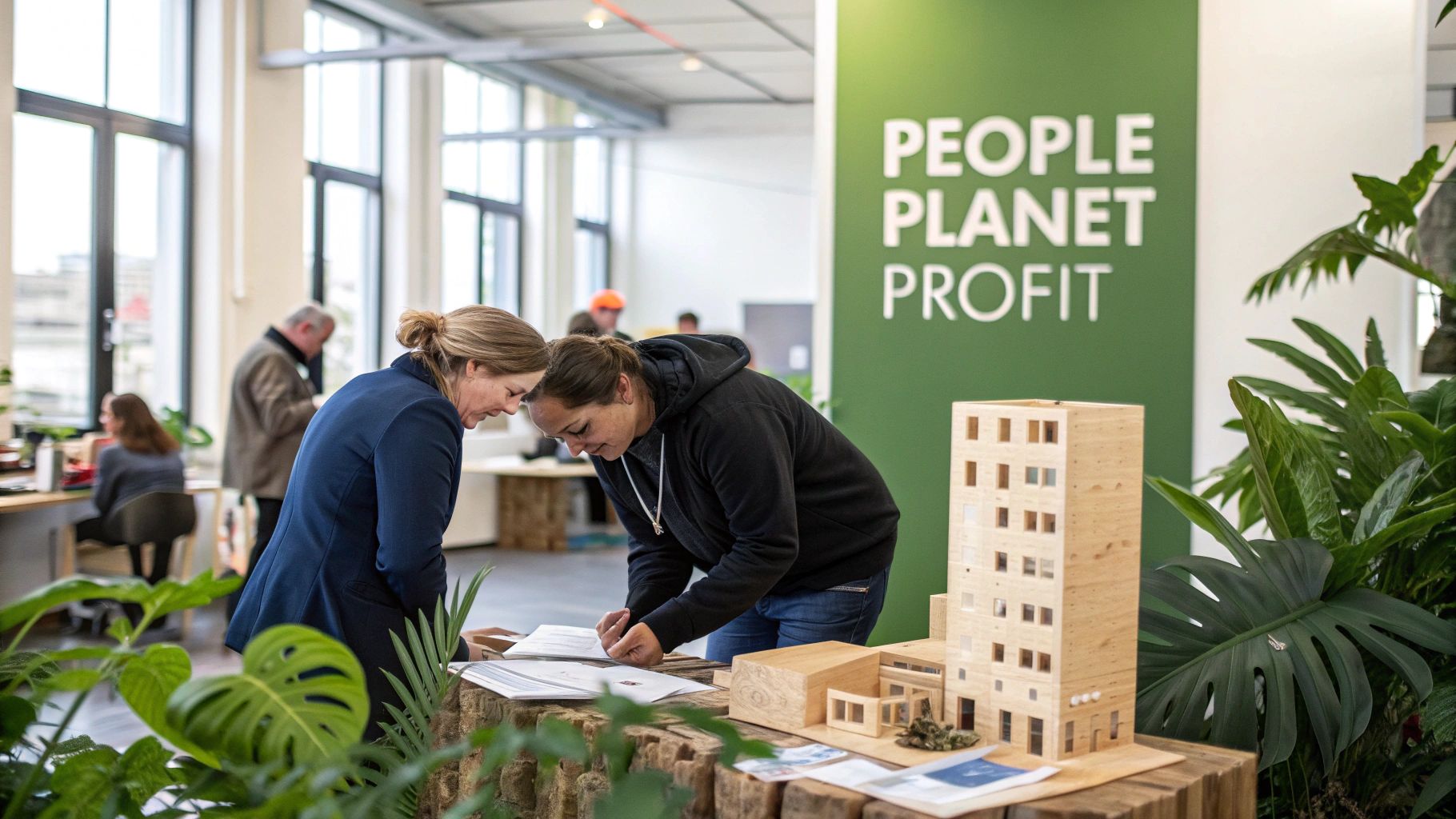
At its core, true sustainable design runs on the "triple bottom line"—a framework that measures success not just by financial returns, but by its positive impact on people and the planet. When you apply this lens to architecture, you start to see how to create real, lasting value.
- People: This is all about human well-being. A sustainable building actively promotes health and productivity with clean indoor air, abundant natural light, and a connection to the outdoors. It's a place people want to be in.
- Planet: This pillar tackles environmental responsibility head-on. It’s about shrinking a building's carbon footprint by slashing energy and water use, choosing materials that are sustainably sourced, and cutting down on waste.
- Profit: This is the economic engine. Sustainable buildings deliver clear financial wins through lower utility bills, reduced maintenance costs, higher property values, and an enhanced ability to attract and keep tenants.
Sustainable architecture is not a limitation on creativity. Instead, it is a powerful framework that guides architects to create smarter, more resourceful, and ultimately more impactful structures that deliver measurable, performance-driven results for owners and occupants alike.
A Framework for Smarter Structures
Looking at architecture this way changes everything. Decisions about a building’s orientation on a site, the type of insulation in its walls, or the efficiency of its HVAC system are no longer just technical line items. They become strategic choices that directly impact long-term operational costs, occupant satisfaction, and the building's overall resilience.
The market is responding in a big way. The global green building sector is set to explode, growing from $618.58 billion in 2025 to a projected $1,374.23 billion by 2034. This growth isn't a fluke; it's fueled by rising energy costs, stronger corporate sustainability goals, and the undeniable need for buildings that can stand up to future challenges. You can explore the latest green building trends here to see just how strong this momentum is.
This powerful economic shift confirms it: sustainable design is simply the new standard for intelligent, forward-thinking architecture.
Why Smart Buildings Are Sustainable Buildings
Making the move to sustainable design isn't just an environmental statement anymore; it's a strategic business decision with a clear, measurable bottom line. When you weave intelligent technology and forward-thinking design into the fabric of a building, it stops being a static shell and starts acting like a dynamic, high-performing asset. This is exactly where sustainability delivers its most powerful financial and operational punch.
At its heart, a smart building uses technology to automate and fine-tune everything from heating and cooling to lighting and security. When these systems are designed with sustainability as the goal, they work together beautifully. What you get is a structure that not only shrinks its environmental footprint but also boosts its economic value and becomes a better place for people to be.
Driving Down Operational Costs
The most immediate and concrete win from sustainable design is a massive cut in day-to-day running costs. Let's face it, buildings are energy hogs, and those utility bills make up a huge chunk of a property's lifelong expense. Smart, sustainable design tackles this problem head-on.
- Energy Efficiency: Think of high-performance insulation, energy-smart windows, and intelligent HVAC systems as a team working to slash heating and cooling bills. Add in automated sensors that adjust lights and temperature when a room is empty, and you stop paying to heat or light empty space.
- Water Conservation: Simple additions like low-flow fixtures, rainwater harvesting systems, and smart irrigation for landscaping can cut water use by 30% or more. That's a huge saving on your water bill.
- Reduced Maintenance: When you choose durable, high-quality materials and design systems to last, you spend less time and money on repairs and replacements. This keeps long-term maintenance budgets in check and avoids disruptive downtime.
A sustainable building isn’t an expense; it’s an investment in radical efficiency. By designing for lower consumption from day one, you create an asset that pays you back every month through reduced utility bills and maintenance costs.
Increasing Asset Value and Mitigating Risk
Looking past the monthly savings, sustainable design is really about future-proofing your investment. In a market that’s growing more aware of climate risks and new regulations, green buildings are simply more valuable and resilient. It’s no surprise that properties with verified green credentials often fetch higher rental rates and sale prices.
This extra value comes from their built-in ability to handle risk. As energy codes get tighter and carbon taxes become a reality, a high-performance building is already ahead of the curve, saving you from expensive retrofits later. To get a full picture of these benefits, it’s worth exploring the various smart building solutions available that can seriously elevate a building's environmental performance. These technologies also make a property far more attractive to savvy investors and top-tier tenants who care about corporate responsibility and predictable costs.
Enhancing Health and Productivity
Maybe the most important benefit of all is the positive effect sustainable design has on people. The very things that make a building green—plenty of natural light, clean indoor air, and a connection to the outdoors—also happen to be the things that help people thrive. This human-centric approach delivers incredible returns.
Study after study shows that people working in green buildings report getting sick less often and being more productive. Things like low-VOC (volatile organic compound) paints, advanced air filtration, and biophilic design elements directly create a healthier place to be. For any commercial property, that's a huge competitive edge, helping you attract and keep the best talent. A building that takes care of its people is a building that performs better on every single level.
Practical Strategies for Green Building Design
Putting sustainable design principles into practice isn't about lofty ideals; it's about using a proven toolkit of actionable strategies to create buildings that truly perform. Architects draw from a few key playbooks, and each one plays a distinct role in a building's overall efficiency and the health of the people inside it.
You can think of it like building a high-performance race car. Some of the most important gains come from the car's fundamental shape—its aerodynamics—which helps it slice through the air with less resistance. Then you have the advanced engine and smart electronics that fine-tune fuel use for maximum power. Great architectural design works the same way, blending foundational passive strategies with sophisticated active systems.
Harnessing Nature with Passive Design
The smartest and often most budget-friendly place to start is with passive design. This is all about making the building work with its natural environment instead of fighting against it. It means using free, abundant resources like sunlight and airflow to do the heavy lifting that would otherwise demand energy-guzzling mechanical systems.
Here are some of the cornerstones of passive design:
- Building Orientation: This is the first and most critical move. Simply positioning a building to capture the sun's warmth in the winter while shielding it from the intense summer sun can slash heating and cooling costs right from the start.
- Daylighting: Thoughtfully placed windows, light shelves, and skylights can fill a space with natural light. This dramatically cuts down on the need for artificial lighting, which is a huge energy drain in most commercial buildings.
- Natural Ventilation: Designing for cross-breezes with operable windows and vents allows fresh air to cool the building naturally, reducing the strain on air conditioning systems.
- Thermal Mass: Materials like concrete, brick, and stone are fantastic for regulating indoor temperatures. They act like thermal batteries, absorbing heat during the day and slowly releasing it at night to keep the space comfortable.
This infographic does a great job of showing how these kinds of strategies translate directly into benefits for building owners and the people who use the space.
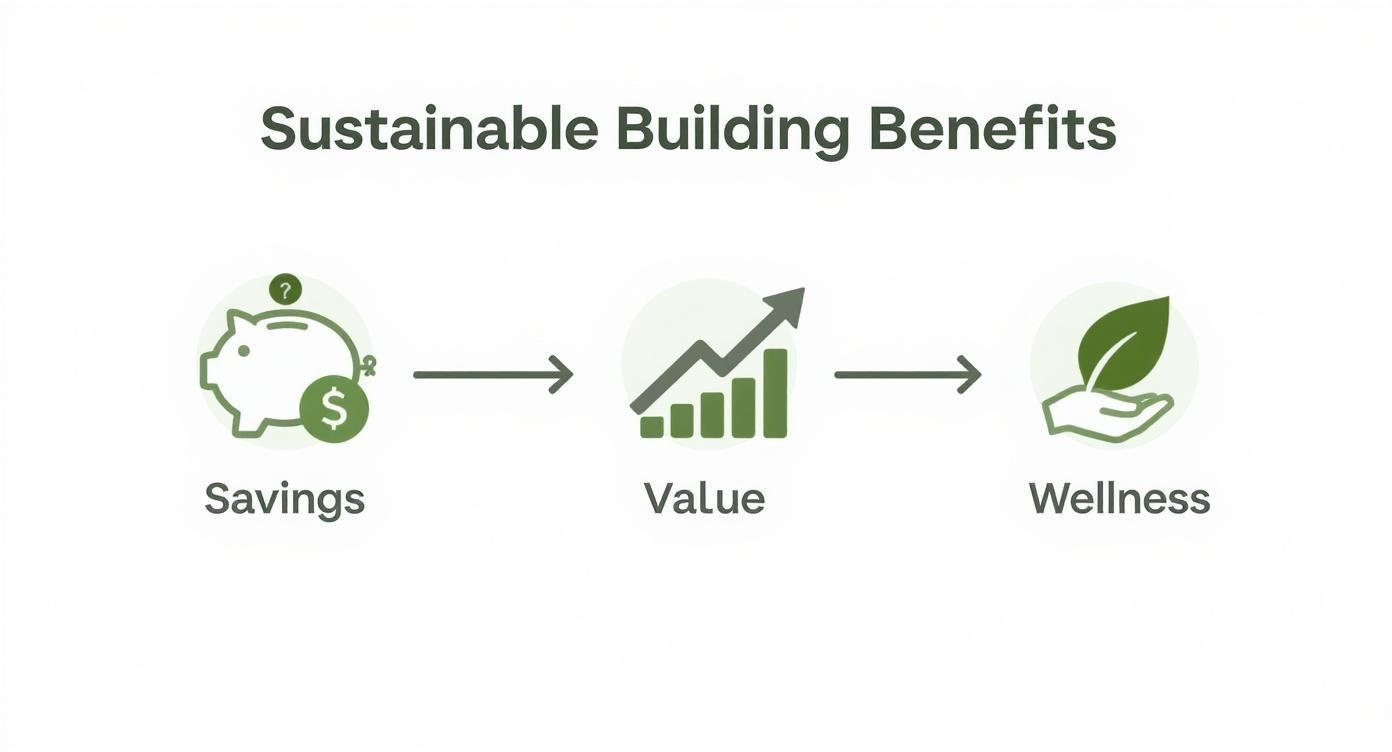
As you can see, the connection is clear: smarter design choices lead to real-world financial savings, higher property values, and healthier, more productive environments.
The Role of Passive vs. Active Strategies
To really grasp how these pieces fit together, it helps to see them side-by-side. Passive strategies are the "good bones" of the building, while active systems are the "smart muscles" that do the work when needed.
Passive vs. Active Sustainable Design Strategies
| Strategy Type | Examples | Primary Benefit |
|---|---|---|
| Passive | Building orientation, daylighting, natural ventilation, thermal mass, high-performance windows, green roofs. | Reduces the fundamental energy demand of the building before any mechanical systems are turned on. |
| Active | High-efficiency HVAC, geothermal systems, solar panels, low-flow plumbing fixtures, LED lighting with sensors. | Optimizes energy and resource consumption through efficient technology and renewable sources. |
A well-designed building leans heavily on its passive features first, significantly reducing the load—and the cost—of the active systems it needs.
Optimizing with Active Systems
While passive strategies lay the groundwork, active systems are the high-tech components that push performance to the next level. These are the technologies that consume energy, so the entire goal is to make them as lean and efficient as possible. When we design green buildings, integrating energy-saving measures like innovative alternative heating sources becomes a key part of the conversation.
Active systems should complement, not compensate for, poor passive design. An efficient HVAC system in a well-insulated, properly oriented building works far less and costs much less to run.
We're talking about technologies like geothermal heat pumps, high-efficiency HVAC units that recover energy from exhaust air, and intelligent building automation systems that adjust lighting and temperature based on who is in the room. The final layer is often renewable energy, like solar panels, which allow a building to generate its own clean power right on-site.
Choosing Smarter Materials
Every single material that goes into a building has an environmental footprint—from how it was sourced and manufactured to what happens to it when the building's life is over. Sustainable material selection is about choosing materials with the best lifecycle story. This is often guided by a life-cycle assessment (LCA), which is a deep dive into a material's impact from cradle to grave.
We prioritize materials that are:
- Reclaimed or Recycled: Using salvaged wood, recycled steel, or crushed concrete reduces the demand for brand-new resources.
- Locally Sourced: This minimizes transportation emissions and boosts the local economy.
- Low-VOC: Choosing paints, adhesives, and flooring with low or no Volatile Organic Compounds is critical for maintaining healthy indoor air quality.
- Sustainably Harvested: Products like Forest Stewardship Council (FSC) certified wood guarantee that they come from responsibly managed forests.
Buildings are responsible for roughly 37% of global carbon emissions, so our material choices matter immensely. This is where we see a major push toward eco-friendly materials like plant-based fibers, natural stone, and certified wood, alongside smart tech like Building Management Systems (BMS) that optimize resource use in real-time.
Managing Every Drop of Water
Finally, sustainable design treats water as the precious resource it is. Smart water management focuses on two things: reducing consumption and reusing water whenever possible.
This includes straightforward steps like installing low-flow fixtures and faucets, as well as more integrated solutions like designing landscapes with native, drought-tolerant plants. On a larger scale, we can implement systems for rainwater harvesting to use for irrigation or greywater recycling for non-potable needs like flushing toilets.
Measuring What Matters in Sustainable Design
In sustainable design, good intentions only get you so far. To make a real difference, we have to move past abstract goals and into the world of hard numbers. How do you actually prove a building is efficient, healthy, and kind to the environment?
It all comes down to measurement.
Think of it like a fitness tracker for your building. You monitor steps and heart rate to understand your personal health, right? We do the same for buildings, using specific metrics to gauge their performance. These data points turn "sustainability" from a fuzzy concept into tangible, trackable outcomes that demonstrate real-world value.
The Numbers That Tell the Story
When we want to know a building’s true environmental footprint, we focus on a few critical benchmarks. These metrics create a common language for setting and hitting sustainability goals, making it clear to everyone—from architects to investors—what success actually looks like.
Three of the most important are:
- Energy Use Intensity (EUI): This is basically the building’s miles-per-gallon rating. It measures the total energy a building uses over a year, divided by its square footage (kBTU per square foot per year). A lower EUI means a more efficient building, which translates directly to smaller utility bills and a lighter carbon footprint.
- Embodied Carbon: This metric uncovers the hidden environmental toll of a building before it even opens. It accounts for all the greenhouse gas emissions tied to making, shipping, and installing the materials—from the concrete in the foundation to the glass in the windows. Choosing materials with low embodied carbon is one of the most powerful moves we can make to cut a project's upfront climate impact.
- Indoor Environmental Quality (IEQ): This one is all about the people. IEQ measures the things that make a space healthy and comfortable: air quality, thermal comfort, access to daylight, and acoustics. High IEQ scores are directly linked to happier, more productive people and fewer sick days. It’s a win-win.
Performance data is what separates genuine sustainable design from "greenwashing." Without credible numbers from metrics like EUI and IEQ, sustainability is just a marketing slogan. With them, it becomes a verifiable asset.
Why Third-Party Certifications Matter
While individual metrics are crucial, comprehensive certification systems offer a holistic, third-party stamp of approval. These programs provide a trusted roadmap for designing a green building and give owners a respected seal of approval to prove it.
Think of them as different standards of excellence. Each has a slightly different focus, but they all share the same goal: promoting better buildings. They lend credibility and make it much easier for owners to market their property’s sustainable features to savvy tenants and investors.
A Quick Look at the Major Certification Systems
Several globally recognized systems exist, and knowing their core focus helps you pick the right one for your project’s specific goals.
Here’s how the big ones stack up:
| Certification | Primary Focus | Best For |
|---|---|---|
| LEED | A balanced, market-driven approach covering energy, water, materials, and IEQ. It’s the most widely recognized system in North America. | Commercial projects that need broad, credible validation to gain a competitive edge. |
| BREEAM | A highly detailed, science-based assessment popular in Europe that digs deep into a wide range of sustainability categories. | Projects that demand a rigorous, evidence-based approach to performance, especially in international markets. |
| Living Building Challenge | The most ambitious standard out there, pushing for regenerative buildings that actually give more back to the environment than they take. | Visionary projects aiming for the absolute peak of sustainability, like becoming net-positive for energy and water. |
These frameworks aren't just checklists; they're powerful tools for holding everyone accountable. They ensure that a project’s green design is a verified reality, not just a plan. By embracing these measurement tools, we can create buildings that aren't just beautifully designed—they're measurably better for people, the planet, and the bottom line.
Making the Financial Case for Going Green
When we talk about sustainable architecture, the conversation often centers on environmental good. That’s important, but for developers and property owners, the most powerful argument is usually financial. Deciding to build green isn't just about altruism anymore; it's a hard-nosed business decision driven by regulations, powerful incentives, and a solid return on investment.
The regulatory landscape is constantly shifting under our feet. Building and energy codes are getting stricter every year. If you design a building to meet only the bare minimum standards of today, you’re setting yourself up for expensive, mandatory retrofits down the line. It’s a classic case of being penny-wise and pound-foolish.
Navigating Codes and Unlocking Incentives
This is where smart design comes in. By proactively designing beyond current codes, you not only protect your asset from future regulatory headaches, but you also open the door to a whole suite of financial incentives. These programs are specifically designed to make sustainability profitable.
Think of them as a financial toolkit to get your project off the ground:
- Federal and State Tax Credits: These are a huge deal. They offer dollar-for-dollar reductions on your tax bill for things like renewable energy, major efficiency upgrades, and even sustainable practices within historic preservation projects.
- Utility Rebates and Grants: Don't overlook your local utility company. They often offer direct cash rebates for installing high-efficiency HVAC systems, LED lighting, or better insulation, which immediately cuts your project costs.
- Expedited Permitting: Time is money, right? Many cities will fast-track the permitting process for projects that meet specific green building standards, getting you to construction sooner.
These programs are game-changers. They help close the cost gap between a standard build and a high-performance one, making the financial choice a lot simpler.
Calculating the Long-Term ROI
Incentives help with the upfront investment, but the real financial muscle of sustainable design shows up over the life of the building. The long-term ROI is all about slashing operational expenses and boosting your asset's value.
A sustainable building is an asset engineered for performance. Every design choice aimed at reducing energy and water consumption directly translates into lower utility bills, creating a predictable and continuous financial return for the owner.
People often overestimate how long it takes to see a payback on green features. When you factor in lower utility bills, reduced maintenance from using more durable materials, and even improved productivity from happier tenants, the numbers start to look very attractive. For commercial properties, these savings—combined with the ability to attract and keep high-quality tenants—drive up net operating income and, ultimately, the building's market value.
The push for better building codes is happening worldwide. Still, there’s a long way to go, as over 50% of new global construction isn’t covered by any mandatory energy efficiency codes. Initiatives like the Buildings Breakthrough Agenda are working to change that, aiming to make near-zero emission buildings the global standard by 2030. You can learn more about these global efforts to advance building codes and see where the industry is headed.
Ultimately, sustainable design isn't just about checking a box. It’s about positioning your property to win in a market that demands efficiency, resilience, and proven financial performance.
Sustainable Design Principles in Action
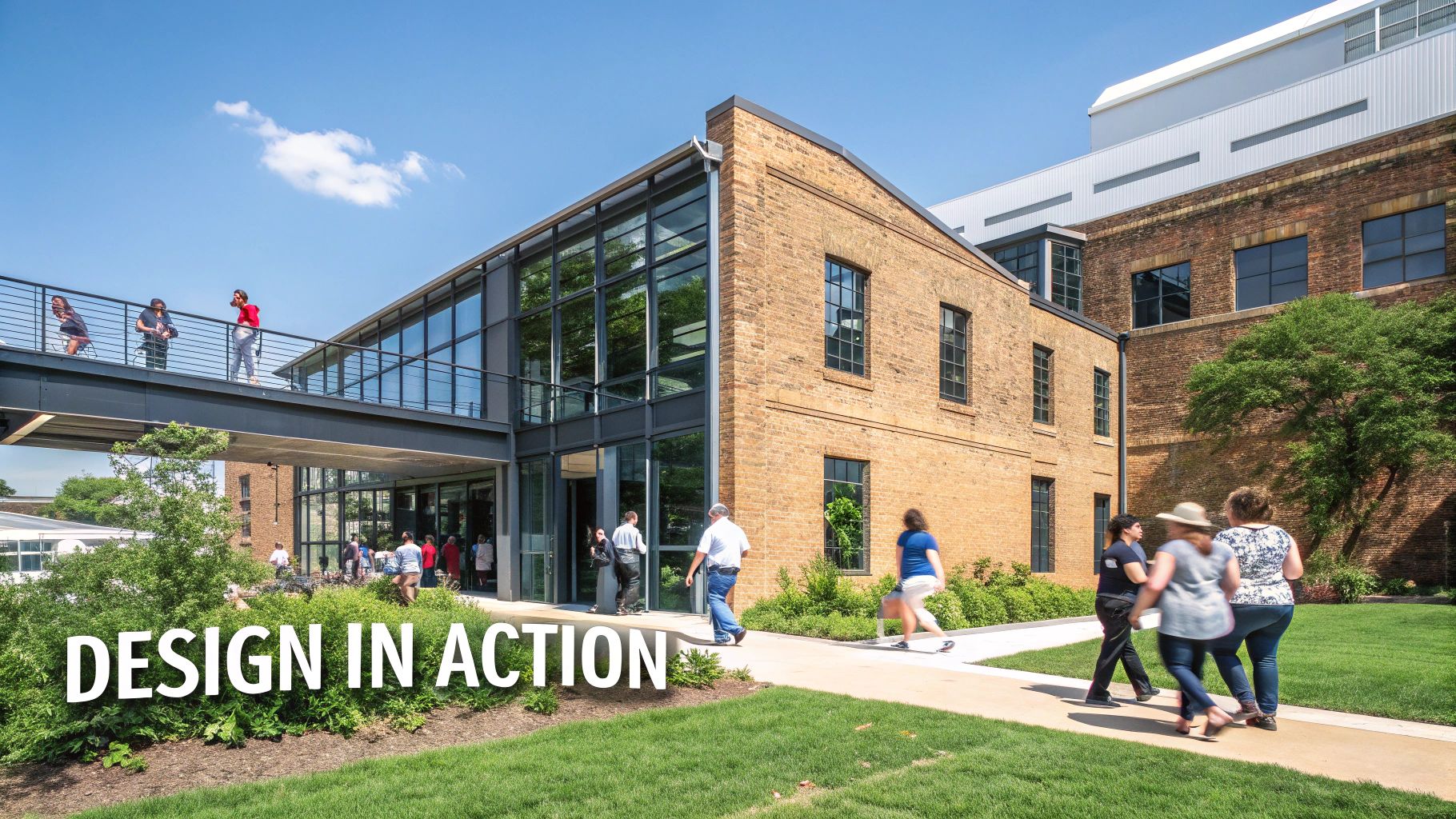
It’s one thing to talk about sustainable principles in theory, but it’s seeing them solve real-world problems that truly shows their power. Here at Sherer Architects, our portfolio is less a collection of projects and more a series of stories—stories of how smart design helped our clients achieve their business goals while creating beautiful, high-performing buildings that give back to their communities.
Every project is a fresh opportunity to apply these ideas, whether it's a brand-new commercial building or a careful historic renovation. The objective is always the same: to create a structure that's more efficient to run, healthier for the people inside, and gentler on the planet.
This isn't about chasing the latest trend. It’s about delivering lasting value through resourceful solutions built to stand the test of time.
Balancing Preservation and Performance
Adaptive reuse is one of our passions. It's the ultimate act of sustainability because it saves the massive amount of embodied carbon already locked into an existing building. The challenge, and the fun, is weaving modern performance into a historic structure without losing its soul.
Take a recent project we handled: converting a century-old warehouse into contemporary office space. The client loved the historic brick and old-growth timber framing but needed a building that could keep up with modern energy codes.
We focused on a few key moves:
- High-Performance Insulation: By adding high-R-value insulation to the inside of the exterior walls and roof, we dramatically improved the building’s thermal performance without touching the historic brick facade.
- Energy-Efficient Windows: We had windows custom-milled to match the original historic profiles, but with modern, low-e coated, insulated glass. This one change made a huge difference in cutting down heating and cooling needs.
- Variable Refrigerant Flow (VRF) Systems: Instead of trying to force bulky, inefficient ductwork into the old structure, we used a VRF system. Its small refrigerant lines were easy to route, giving us zoned, highly efficient heating and cooling.
The final result is a building that celebrates its history while being fully ready for a high-performance future. By threading the needle between preservation and smart upgrades, we gave this structure a new lease on life for decades to come.
New Construction Designed for Efficiency
When we're starting from scratch on a new commercial building, we can optimize for performance right from day one. A great example is a new retail center we designed where the owner’s top priority was keeping long-term operating costs as low as possible.
We treat every commission like a puzzle, aligning all the pieces to deliver beautiful, enduring, and sustainable results. In new construction, passive design strategies are the cornerstone of that puzzle.
Our whole approach began with the basics of passive solar design. We oriented the building to soak up the low winter sun for passive heat, then used carefully calculated overhangs to block the high summer sun and ease the load on the air conditioning. Simple, but incredibly effective.
We layered on top of that foundation with daylighting controls, high-efficiency LED lighting, and a reflective "cool roof" to bounce away heat. Put it all together, and the final building uses about 40% less energy than a similar building constructed just to meet minimum code. That’s a direct savings of thousands of dollars every year for the owner, proving that great design is one of the smartest investments you can make.
Answering Your Questions About Sustainable Architecture
Even as sustainable design moves into the mainstream, it’s natural to have questions. Getting clear on the real-world costs, the lingo, and how it all comes together is key to moving forward with any project. Let's tackle some of the most common things we hear from clients and developers.
Does Sustainable Architecture Cost More?
This is the big one, and the answer isn't a simple yes or no. While some high-performance materials or systems might have a higher price tag upfront, a smart sustainable design process often finds savings elsewhere, like through more efficient material use. The real story, though, is about the long game.
The true financial benefit unfolds over the life of the building. You’ll see significant, predictable savings on energy, water, and maintenance that deliver a powerful return on your initial investment.
And that's before you even consider the financial incentives. When you factor in tax credits, utility rebates, and other programs, the business case for building sustainably becomes incredibly strong, often completely balancing out any higher initial costs.
What's the Difference Between "Green Building" and "Sustainable Design"?
People often use these terms interchangeably, but there's a helpful way to think about the distinction.
It really comes down to the "what" versus the "why."
- Green Building is the "what." It points to the tangible things you can see and touch—the high-efficiency HVAC, the recycled steel beams, the low-flow plumbing fixtures. These are the products.
- Sustainable Design is the "why" and the "how." It's the overarching philosophy that guides all those choices. This approach zooms out to consider the building’s entire lifecycle, from where the materials came from to how it operates day-to-day, its connection to the community, and what happens to it at the end of its life.
So, a green building is really the end result of a thoughtful, holistic sustainable design process.
Where Does Adaptive Reuse Fit In?
Adaptive reuse isn't just a component of sustainable architecture—it's one of its most impactful expressions. When we choose to renovate and repurpose an existing building, we are directly preserving its embodied carbon.
Think of embodied carbon as all the energy and emissions that were already spent to create the building in the first place—to manufacture the steel, fire the bricks, transport the materials, and put it all together. Demolishing a building essentially throws all of that away.
By opting for adaptive reuse, you sidestep the massive carbon footprint of both demolition and new construction. It's a triple win: you keep waste out of landfills, breathe new life into established neighborhoods, and save the unique character that makes a place special. Honestly, saving an existing building is often the most sustainable move you can make.
At Sherer Architects, LLC, we're passionate about making these principles work for our clients, creating buildings that are both profitable and high-performing. Whether you're planning a new commercial build, an adaptive reuse project, or a historic preservation effort, we're here to guide you. Learn how we can bring structure to your vision and create a beautiful, durable, and truly sustainable building.