
Turning an old Greenville warehouse into a living, breathing theater isn't just a construction project—it's an act of urban alchemy. This is how you transform a relic of our industrial past into a vibrant cultural hub, revitalizing a neighborhood and creating a landmark that pays dividends for the community and your bottom line.
From Industrial Grit to Theatrical Grandeur in Greenville
Greenville is hungry for unique cultural experiences, and the idea of a warehouse theater taps right into that demand. It’s about more than just a renovation; it's about crafting a destination. Those old industrial bones—the high ceilings, the sprawling open floors, the raw brick and steel—they aren't limitations. They're the perfect blank canvas for creating the kind of immersive performance space that modern audiences flock to.
This guide is your practical roadmap. We're going to skip the fluff and get straight to the real-world, actionable steps you need to take. This is about turning a raw, cavernous building into a profitable and culturally essential venue. Adaptive reuse isn't just a buzzword for preservation; it's a smart, sustainable strategy that extends a building's life and often proves more cost-effective than building from the ground up.
The Value Proposition of Adaptive Reuse
So, why a warehouse? The advantages are huge, touching everything from your budget to the fabric of the community itself.
- Inherent Character: You can't fake the authentic industrial vibe of a historic warehouse. Integrating that character into your design creates a memorable atmosphere that a new build could never replicate.
- Economic Catalyst: A new theater doesn't exist in a vacuum. It becomes an anchor, pulling in crowds that spill over into local restaurants, bars, and shops, creating a ripple effect that lifts the entire area.
- Smart Money: Many of Greenville's older warehouses are prime candidates for historic preservation tax credits. Tapping into these federal and state programs can dramatically reduce your rehabilitation costs.
The process might seem complex, but it follows a logical path: you assess the potential, design with purpose, and then build with precision.
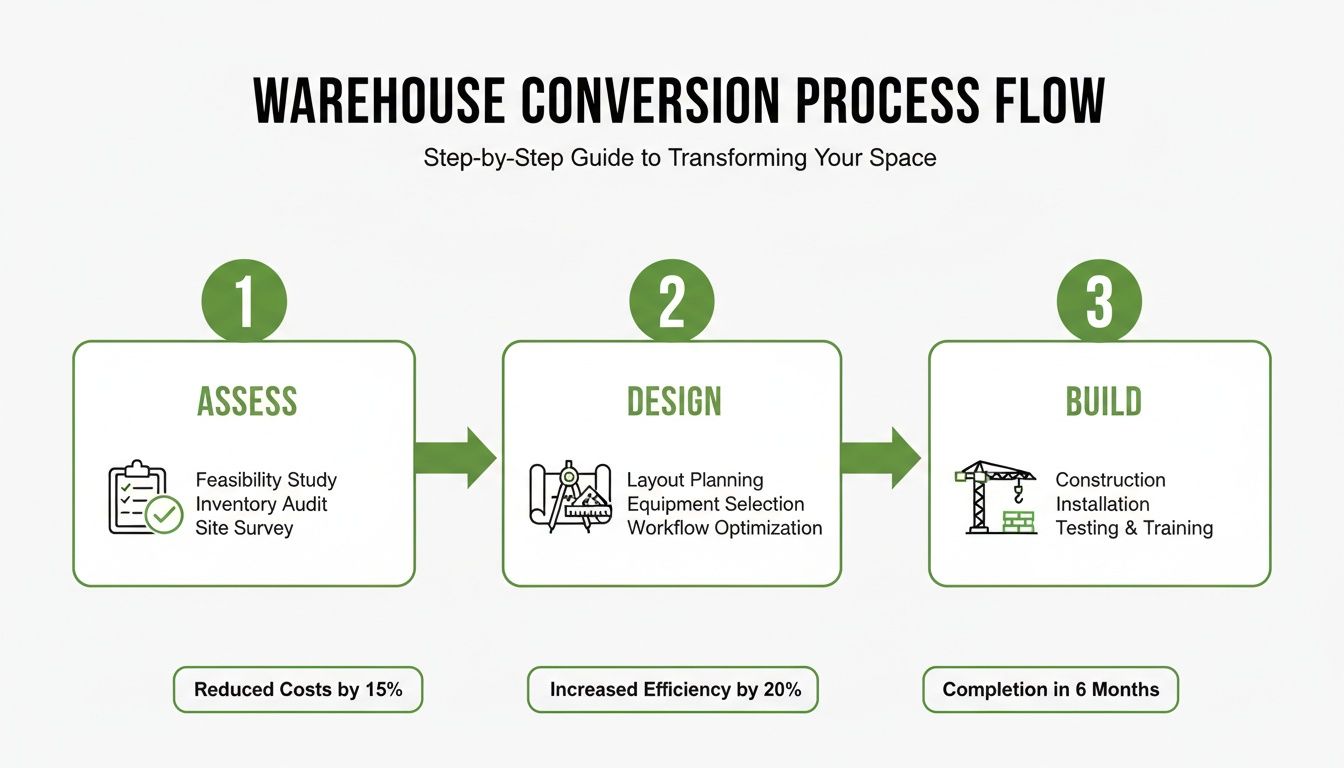
This journey from a forgotten industrial space to a celebrated cultural landmark is built on a foundation of careful assessment, thoughtful design, and precise execution. Each stage sets up the next, ensuring the final venue is not only a creative success but also a sound, viable business.
By embracing adaptive reuse, you're building more than just a theater; you're building a community asset. It becomes a landmark, a gathering place, and a testament to Greenville's creative spirit—driving both cultural and economic growth for years to come.
Getting Through Greenville's Zoning and Regulatory Maze
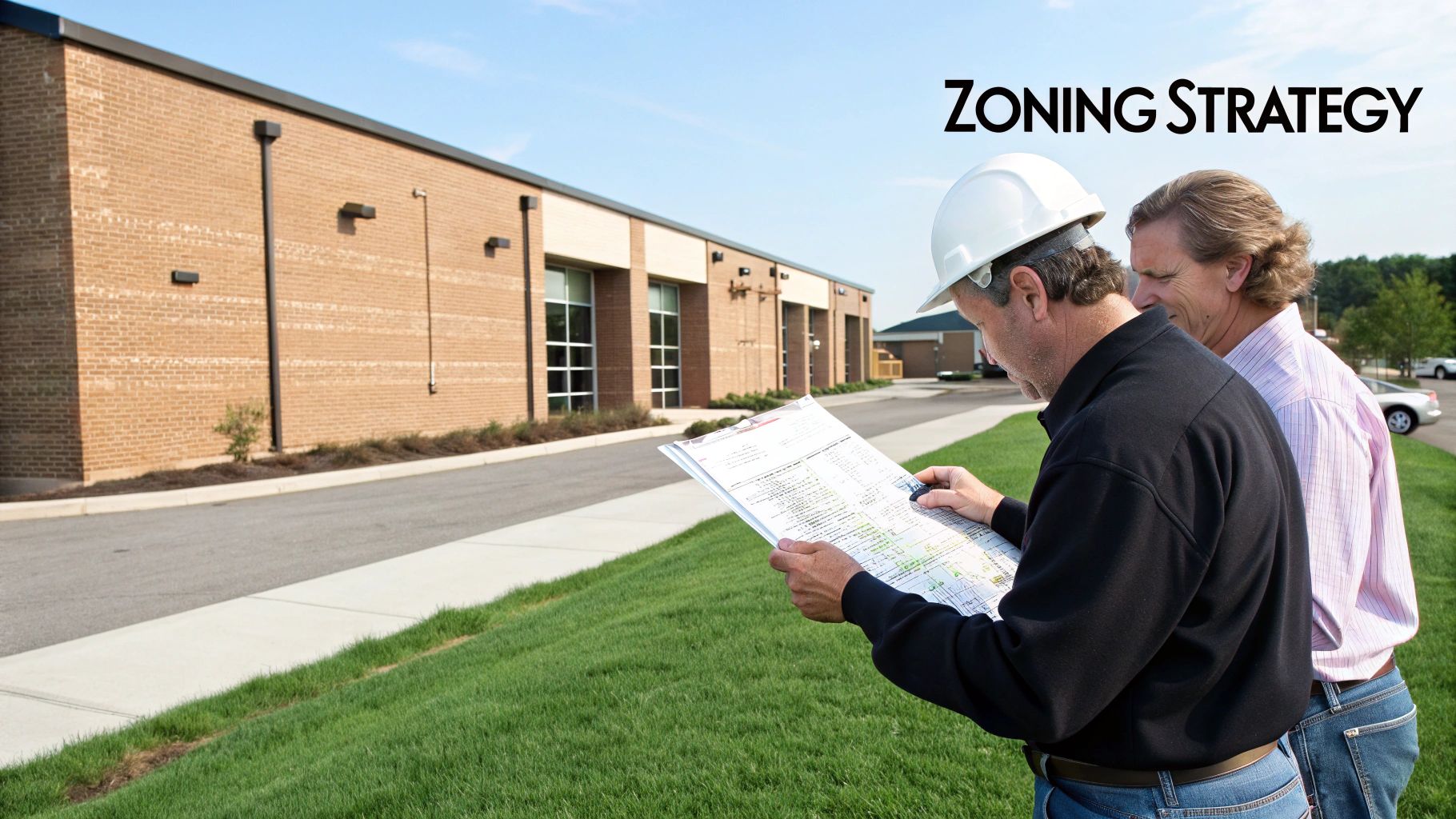
Let’s be honest: the biggest thing standing between your vision and opening night isn't finding the perfect old warehouse. It’s the bureaucracy. Before you can even think about hanging lights or building a stage, you have to navigate Greenville's complex web of zoning ordinances, land use rules, and building codes. This is where dreams get a solid legal foundation—or get stopped in their tracks.
Many of the best warehouses for this kind of project are in areas zoned for industrial use, usually I-1 (Industrial, Light) or maybe S-1 (Service District). Your first big mission is to change that designation to one that allows a "place of public assembly." This is a major change of use, and it opens up a whole new level of much stricter requirements.
This isn't just about filling out a form. It's a strategic process that demands clear communication with city officials and a solid understanding of what they need to see to give you the green light.
Land Use, Rezoning, and Making Your Case
The journey starts with a deep dive into the property's zoning. You need to figure out if you're looking at a full rezoning, a special exception, or a variance. In Greenville, that often means pleading your case before the Planning Commission and, eventually, City Council.
Let's walk through a real-world scenario. Say you’ve found the perfect brick warehouse just outside the Village of West Greenville. It’s zoned I-1, which was great for its old life as a textile distribution hub but is a non-starter for a theater.
Your architect's first job is to put together a comprehensive application. Think of this less as a request and more as a compelling argument for why your warehouse theater in Greenville is a win for the community. It should include:
- A Detailed Site Plan: Show them everything—parking, landscaping, how the building fits in with its neighbors.
- A Traffic Impact Study: Get ahead of the inevitable questions about increased traffic and show you have a plan.
- A Statement of Intent: Clearly explain the cultural and economic value the theater will bring to the neighborhood.
By doing this work upfront, you show city planners you’ve thought through the impacts and have credible solutions. That alone can make the approval process go a lot smoother.
The Design Review Board and Historic Districts
If your dream warehouse happens to be in one of Greenville’s historic districts, like the iconic West End, you've got another layer of oversight to deal with: the Design Review Board (DRB). The DRB’s entire job is to protect the area's architectural character. Any changes you want to make to the outside—from new signs to different windows—will be looked at with a magnifying glass.
Your presentation to the DRB has to strike a delicate balance. You need to respect the building’s history while making a strong case for the changes needed to turn it into a working theater. This means proposing modifications that feel compatible with the original materials and design.
The secret to a successful DRB review is to show how your project enhances the historic fabric of the neighborhood, rather than detracting from it. Frame your plans as giving a historic building a vibrant, sustainable new life.
This is a conversation, not a fight. Bringing on an architect who has experience presenting to the Greenville DRB is invaluable here. They know how to turn a potential roadblock into a productive dialogue.
Meeting South Carolina's Tough Building Codes
Once you clear the zoning and design hurdles, the focus shifts to the South Carolina Building Codes, which are based on the International Building Code (IBC). The rules for a public assembly space are worlds away from what's required for a simple warehouse.
The code governs everything, from the number and width of your emergency exits to the fire-resistance rating of the walls. Your maximum seating capacity will be determined by occupancy load calculations, which in turn drives dozens of other design choices. And when it comes to the complex stage lighting and sound systems you'll need, it's critical to build a control panel to UL standards to ensure you meet all safety and regulatory codes.
Here are the big-ticket items you absolutely have to nail:
- Egress: You must have clear, unimpeded exit paths from every single seat. This often means cutting new doors and building dedicated emergency corridors—a major structural and financial task.
- Fire Suppression: A full sprinkler system is pretty much a given for a theater. This is a significant plumbing project that requires close coordination with the local fire marshal.
- Accessibility (ADA): From the parking lot to the restrooms to the seating, every inch of your venue must be fully accessible. This is non-negotiable and needs to be baked into your design from day one.
Getting through this regulatory maze is all about having a methodical, expert-led plan. It’s the critical phase where a building with potential becomes a fully compliant, legally sound project, clearing the way for the real fun of design and construction to begin.
Getting to Grips with the Building's Bones: Structural and MEP Systems
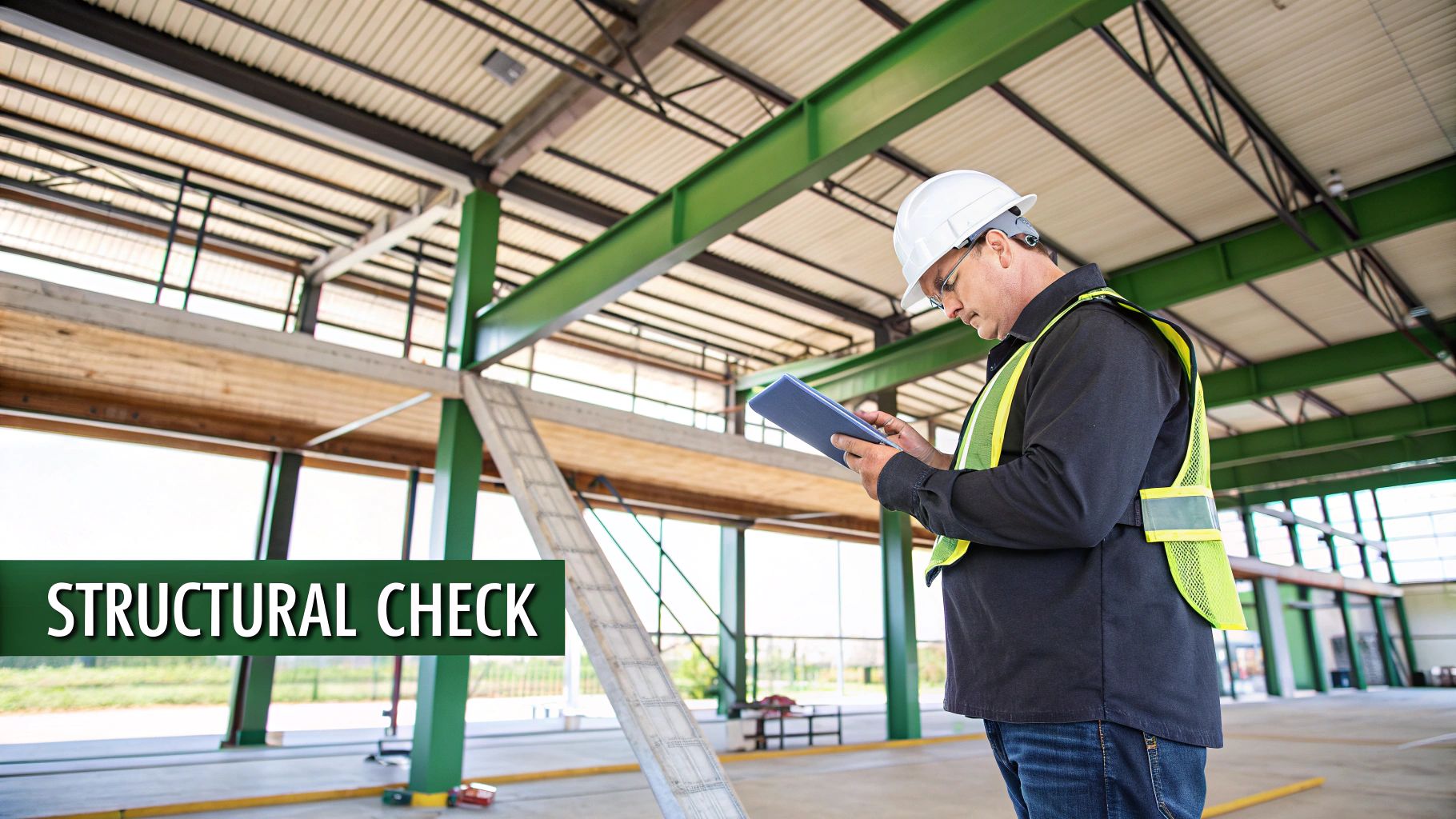
Alright, you've got the city's blessing. Now, the real work begins. This is the point where theoretical plans collide with the raw, physical reality of your building—its steel skeleton, concrete floors, and ancient utility lines. A warehouse isn't a theater in disguise; turning it into one demands a deep, often complex overhaul of its core systems.
Your first order of business is getting a structural engineer to give the place a thorough shakedown. Warehouses are designed for static, evenly spread loads, like stacks of pallets. A theater, on the other hand, concentrates immense, dynamic loads in spots the original builders never dreamed of.
This isn't just a quick look-see. It's a forensic investigation. The engineer will scrutinize every column, beam, and roof truss to figure out exactly what it can handle. They're trying to answer one critical question: can this frame safely hold up everything a modern performance venue needs?
Can the Skeleton Handle the Show?
The new weight you're adding is no joke. We're talking about a theatrical rigging grid hanging from the roof, heavy lighting bars, massive speaker arrays, and potentially one or more catwalks for your crew. Each one of these elements puts a tremendous amount of stress on very specific points in the structure.
Your engineer will be running a lot of calculations and might even need to do some on-site stress tests to be sure. Based on what they find, you should be prepared for some significant structural upgrades.
- Beefing Up Roof Trusses: This could mean welding extra steel plates or angles onto the existing trusses to boost their strength.
- Adding New Support Columns: Sometimes, the only way to handle the load from the rigging grid is to add new columns that transfer that weight straight down to the foundation.
- Strengthening the Foundation: If you're adding new columns, you'll almost certainly need to pour new concrete footings underneath them.
There's no cutting corners here. A structural failure isn't just a catastrophic safety risk; it's a project-ending, bank-breaking disaster. Get this part right from the absolute start.
Think of the structural upgrades as the unseen star of your production. The audience will never notice the reinforced steel beams, but they are what makes the entire theatrical experience—from the lighting to the sound—possible and, most importantly, safe.
Powering the Performance: MEP Systems
Once you're confident the building won't fall down, the focus shifts to its lifeblood: the mechanical, electrical, and plumbing (MEP) systems. Frankly, a warehouse's MEP setup is a joke compared to what a theater needs. This part of the project is almost always a complete gut-and-replace job.
The electrical system is probably the biggest leap. A standard warehouse has basic lighting and a few outlets. A warehouse theater in Greenville needs a massive power upgrade to handle the incredible draw from stage lighting, professional audio equipment, and digital projectors. More often than not, this means getting a brand-new, higher-capacity electrical service hooked up by the utility provider.
Following strict electrical wiring standards is non-negotiable for safety and reliability. You’ll also need to plan for separate, isolated circuits for your sound and lighting gear. It’s a classic rookie mistake not to, and the resulting electrical hum and buzz can completely ruin a performance.
Climate Control and Crowd Comfort
Next up is HVAC. Warehouse heating and cooling systems are built for big, empty spaces with a few workers. They are loud, clunky, and utterly unsuitable for a theater, where a silent background is essential.
You'll need a new system engineered for a packed house that is also whisper-quiet. This means sourcing HVAC units with very low decibel ratings and tucking them away from the performance space, usually on the roof or in a dedicated mechanical room. The ductwork itself needs to be oversized and lined with acoustic insulation to kill any noise from the airflow.
Finally, let's talk plumbing. Your warehouse might have a couple of basic toilets in a back corner. A theater needs multi-stall public restrooms for men and women, plus fully accessible facilities, all designed to handle the mad rush during intermission. This means running extensive new plumbing lines. Map all this out before you pour any new concrete for tiered seating or lobby floors. Getting that sequence wrong is a surefire way to waste a ton of time and money on rework.
Designing for the Audience: Acoustics, Sightlines, and Accessibility
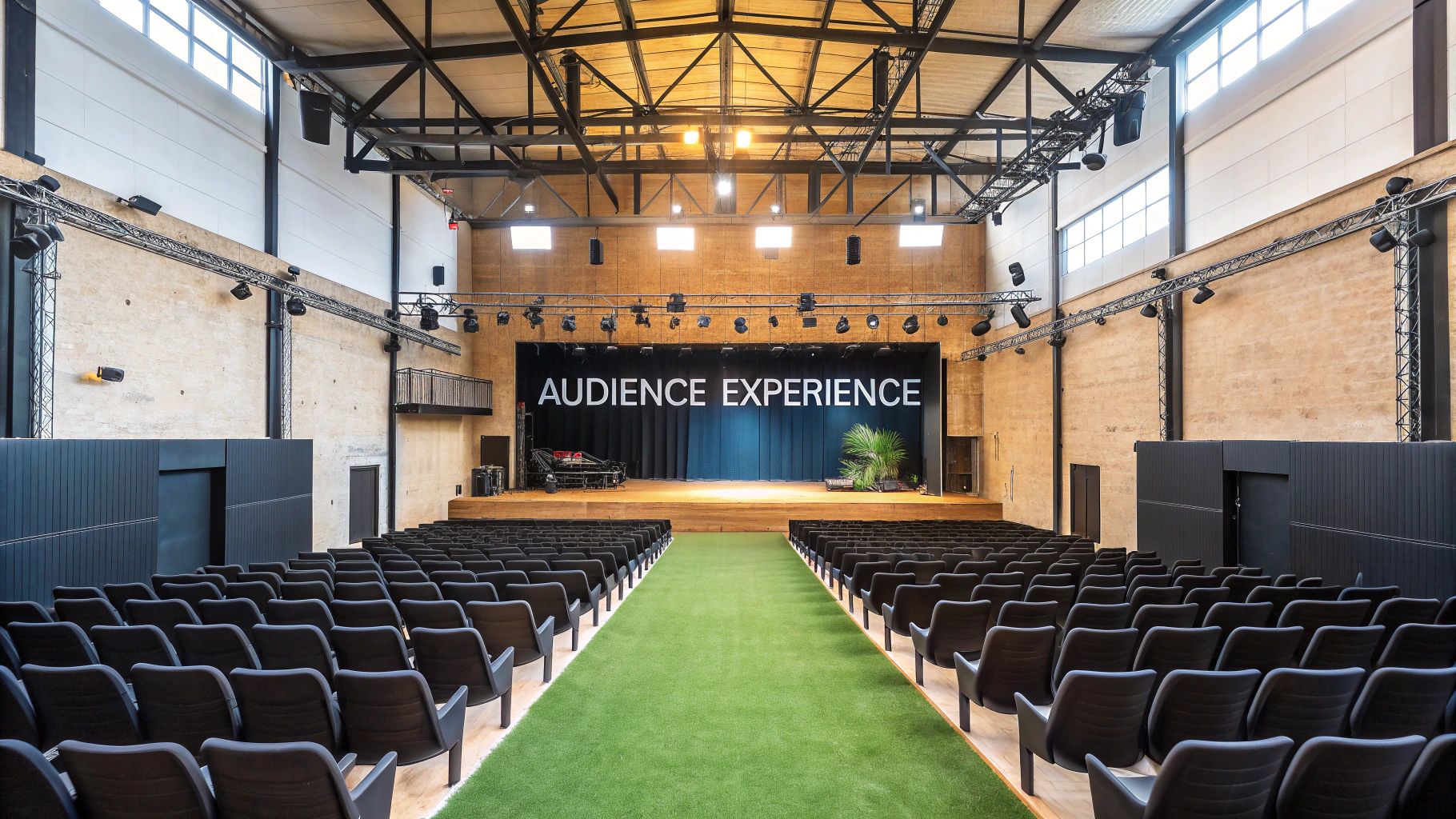
Once the structural bones are sound and the MEP systems are mapped out, we get to the fun part—the phase where a raw building starts to breathe and feel like a real theater. This is all about shaping the audience's experience, a delicate blend of art and physics where every decision impacts what people see, hear, and feel.
Ironically, a warehouse's greatest assets—its soaring ceilings and vast open space—are also its biggest acoustic headaches. Left untreated, these spaces are echo chambers. Sound waves will ricochet off concrete floors, brick walls, and steel trusses, turning crisp dialogue into an indecipherable mess. Taming that reverberation is your first and most critical design challenge.
Taming the Echo for Pitch-Perfect Sound
You can't just hang a few curtains and call it a day. This requires a serious, strategic approach to sound absorption and diffusion. You’ll absolutely need an acoustical consultant on your team to model how sound will behave in your specific space and then prescribe the right treatments.
Your main goal is to achieve acoustic clarity. You want every word, every note, every subtle sigh from the stage to reach every single seat with pristine quality. This usually means a multi-layered strategy.
Here are some of the tools of the trade:
- Acoustic Wall Panels: These are the workhorses. Fabric-wrapped panels filled with sound-absorbing material go on the walls to soak up all those pesky mid- and high-frequency reflections.
- Ceiling Baffles or Clouds: You have to do something about that massive, flat ceiling. Panels suspended from above, known as baffles or clouds, are perfect for breaking up that surface and stopping sound from bouncing straight down.
- Heavy Velour Curtains: More than just decoration, strategically placed heavy drapes can help "tune" the room's sound while adding that classic theatrical feel.
- Sprayed Acoustic Insulation: For huge, hard-to-reach surfaces like the underside of a metal roof deck, a sprayed-on cellulose insulation can work wonders for sound dampening.
Remember, the aim isn't to create a dead, anechoic chamber. A little natural life in the room feels good. The key is to control it precisely so the focus always remains on the performance.
Every Seat, a Great Seat
After you’ve solved for sound, you have to tackle sight. Nothing ruins a show faster than a bad view. That big, flat warehouse floor is your enemy here—anyone sitting more than a few rows back will spend the night staring at the back of someone's head.
You have two main ways to fix this and create great sightlines for everyone.
- Tiered Seating: This is the most common solution. You build a permanent, multi-level structure (called a riser) where each row of seats is elevated higher than the one in front of it. It’s a significant construction job that needs careful engineering, but it guarantees a clear view.
- A Raked Stage: The other option is to leave the audience floor flat and build the stage on an incline, sloping it up toward the back. While less common today, a raked stage can be a smart, flexible solution, especially for smaller or more experimental venues.
Your architect will run a detailed sightline study, using 3D models to simulate the view from every single seat. This is non-negotiable. It lets you tweak riser heights and stage angles with incredible precision, catching any potential blind spots long before a single 2×4 is cut.
"A truly great theater is democratic—it offers a compelling experience from every seat, not just the expensive ones. Investing in proper sightline design is a direct investment in your audience's long-term loyalty and satisfaction."
Designing for Everyone
A modern warehouse theater in Greenville must be a welcoming place for every single person in the community. This means going far beyond the minimum ADA requirements and embracing the principles of universal design. The goal is an environment that’s intuitive and easy for everyone to use, no matter their age or ability.
This philosophy should touch every part of your design.
| Accessibility Feature | Design Consideration | Why It Matters |
|---|---|---|
| Wheelchair Seating | Integrate wheelchair-accessible spaces throughout the seating banks, not just shoved in the back. | This provides choice and a far better, more inclusive experience for patrons. |
| Assistive Listening | Install a modern assistive listening system (like an induction loop or RF system). | It ensures patrons with hearing impairments can fully enjoy every moment. |
| Accessible Routes | Make sure the path from the parking lot to the seats, restrooms, and bar is clear and obstruction-free. | This creates a seamless, stress-free visit for everyone from the moment they arrive. |
| Low-Profile Counters | Design the box office and concession counters with lower sections for wheelchair users. | It’s a simple touch that promotes independence and dignity for all your patrons. |
This commitment to inclusive design is what separates a good venue from a great one. A fantastic local example is The Warehouse Theatre. Its evolution from a cramped storage annex into a professional 150-seat venue is a masterclass in adaptive reuse. The project not only transformed the theater's footprint—earning it an AIA Greenville Merit Award—but also helped anchor the West End's revitalization as a true arts district.
By carefully weaving together acoustics, sightlines, and accessibility, you do more than just renovate a building. You transform an industrial shell into an intimate, professional, and genuinely welcoming home for the arts.
Breathing New Life into Old Walls: Historic Preservation and Financial Incentives
When you're looking at an old warehouse, the exposed brick and aged timber are what catch your eye. But for a savvy developer in Greenville, the real magic—and the real money—is in the building's history. Choosing a historically significant warehouse for your theater project isn't just about aesthetics; it's a strategic financial move that can completely change your project's economics.
These aren't just small grants we're talking about. These are powerful programs designed to reward the reuse of historic buildings. They can slash a massive chunk off your total rehab costs, often making a project that seemed out of reach suddenly very possible. The trick is knowing how to play the game from the very beginning.
This means you can't just slap a design together and apply for funds later. It's a process. You have to weave historic preservation principles into your plans from day one, making sure every decision you make aligns with what the state and federal gatekeepers are looking for.
The Power Couple: Federal and State Historic Tax Credits
The biggest financial levers you can pull are the Federal and South Carolina Historic Preservation Tax Credits. Using them together is a game-changer for your budget. The federal program alone offers a 20% income tax credit for the certified rehab of a historic, income-producing building. Then, South Carolina jumps in with its own state credit, sweetening the pot even more.
Of course, not every old building qualifies. Your warehouse has to be a "certified historic structure." That means it's either already on the National Register of Historic Places or it sits within a registered historic district and is considered a "contributing" building to that district's character.
The renovation work itself also has to get the stamp of approval from the National Park Service, which works closely with the South Carolina State Historic Preservation Office (SHPO). This means your entire project must follow the Secretary of the Interior's Standards for Rehabilitation—a set of ten principles that are all about respecting the building's original character while adapting it for modern use.
A word of advice from the trenches: Think of the SHPO as your partner, not your adversary. The single best thing you can do is bring them into the conversation early in the design phase. A collaborative, open approach will save you from expensive redesigns and agonizing approval delays down the line.
They'll help you figure out how to preserve what makes the building special while still creating a modern, functional theater.
More Than Just Tax Credits: Finding Grants and Rallying the Community
While tax credits are the heavy hitters, don't stop there. A well-planned warehouse theater Greenville project has the potential to pull funding from several other places, creating a much more resilient financial foundation.
- Local Arts Grants: Don't overlook organizations like Greenville's Metropolitan Arts Council (MAC). They often have project grants that can help you pay for specific things, like a new lighting grid or a public art piece for your lobby.
- Public-Private Partnerships: If your theater is poised to become a major community asset, the City of Greenville might be interested in a partnership. This could look like help with infrastructure, parking, or other forms of public investment.
- Community Fundraising: A theater is something people get excited about. It's a natural rallying point for local pride. Launching a capital campaign can bring in a surprising amount of money from local residents and businesses who want to be part of creating a new cultural landmark.
This last point is especially true in Greenville, where the arts scene is incredibly vibrant and well-supported. We’ve seen local arts groups achieve stunning results here, with individual giving jumping by as much as 109 percent in a single year. A new theater with a budget pushing a million dollars, employing hundreds of local artists each season, becomes an economic engine people are eager to get behind. You can see just how dynamic the scene is in this report on Greenville's arts and culture milestones.
By stacking federal and state tax credits with local grants and genuine community buy-in, you build a financial plan as solid as the old-growth timber beams above your head. This isn't just about saving a building; it's a smart investment strategy that delivers a great ROI while giving Greenville a cultural gift that will last for generations.
Your Next Act: Partnering for a Successful Conversion
Bringing a Greenville warehouse from a raw, industrial space to a stage set for standing ovations is no small feat. We've walked through the whole process—from untangling local zoning laws and engineering the structure to designing incredible audience experiences and chasing down financial incentives. It's a complex performance, and every scene requires a specialist.
Navigating all of this really calls for an architectural partner who’s been there before. You need someone with deep expertise in commercial adaptive reuse, a genuine passion for historic preservation, and a practical understanding of South Carolina's specific regulatory hurdles. Our firm lives and breathes this work, ready to guide your project from the first napkin sketch all the way to opening night, making sure every detail fits your vision and your budget.
A great warehouse theater becomes more than just a venue; it’s a cultural engine for the community. Just look at how some local theaters run educational tours or produce incredible free programming like the Upstate Shakespeare Festival. They make professional art accessible to everyone and, in doing so, weave a stronger creative fabric for our entire community. You can see this kind of impact firsthand on the Warehouse Theatre's website.
Your vision for a new cultural landmark in Greenville deserves a team that understands both the art of design and the brass tacks of development. The right partnership doesn't just solve problems—it turns potential roadblocks into strategic advantages.
If you're a developer, property owner, or investor with a vision, let's talk. We invite you to connect with our team for a consultation. Let's start the conversation about making your Greenville warehouse theater a celebrated success.
Common Questions About Turning a Warehouse Into a Theater
If you're thinking about a warehouse-to-theater conversion in Greenville, you probably have a million questions running through your mind. It’s a big undertaking. Let's tackle some of the most common ones I hear from clients to give you a clearer picture of what to expect.
What's a Realistic Budget for This Kind of Project?
This is the big one, isn't it? The honest answer is: it depends entirely on the building you start with and the vision you have for the end result.
That said, a good rule of thumb for a full conversion is anywhere from $250 to over $500 per square foot. That range covers just about everything—major structural work, all-new MEP systems, the specialized theatrical gear, seating, and the final fit and finish. The only way to nail down a truly accurate number for your project is to bring in an experienced architect for an early feasibility study.
How Long Does This Process Actually Take?
Patience is key here. From the first sketch to opening night, you're realistically looking at 18 to 24 months. It's a marathon, not a sprint.
Here’s a rough breakdown of how that time gets spent:
- Due Diligence & Early Design: 3-6 months
- Detailed Construction Plans: 4-6 months
- Getting City Permits: 2-3 months
- Construction: 9-12 months
And a word of caution: if you're chasing historic tax credits or need a major rezoning, you'll need to build extra time into that schedule for navigating the required boards and agencies.
Don't mistake a simple-looking structure for a simple project. Turning an industrial space into a place for public assembly adds layers of regulatory and technical complexity. You have to plan for that and give yourself a realistic timeline.
What Kind of Warehouse Makes the Best Theater?
Not all warehouses are created equal. The best candidates for a theater conversion have a few things in common.
You'll want to look for buildings with impressive height—a clear height of 20+ feet is a fantastic starting point. A wide-open, clear-span interior with as few columns as possible is also a huge plus. Solid concrete foundations are a must.
Beyond the structure itself, think about the audience experience. Is there ample public parking nearby? Are there restaurants and other attractions to make it a destination? Finding a property in a district already zoned for commercial or mixed-use can also be a massive head start, saving you significant time and headaches with the city.
At Sherer Architects, LLC, we specialize in guiding developers through every stage of complex adaptive reuse projects, from initial feasibility to final construction. Start the conversation about your next project with us today.