
When you’re making a big purchase—whether it’s a major piece of equipment or a multi-million dollar building—it's easy to get fixated on the price tag. But that initial number is just the tip of the iceberg. Life cycle cost analysis (LCCA) is the practice of looking below the surface to understand the true cost of an asset over its entire life, from the day you buy it to the day you're done with it.
It's about shifting your mindset from "How much does it cost now?" to "How much will it cost me in total?"
Seeing Beyond The Sticker Price
Think of it like buying a car. You have two options for your company fleet. Car A is cheap off the lot, but it’s a notorious gas-guzzler with a reputation for needing frequent, expensive repairs. Car B costs 25% more upfront, but it sips fuel and is known for its bulletproof reliability.
If you only look at the sticker price, Car A seems like the obvious choice. But an LCCA acts like a financial crystal ball. It forces you to account for all the other costs you'll incur over the next ten years: fuel, insurance, routine maintenance, and the likely cost of major repairs.
Suddenly, Car B—with its minimal running costs—starts to look like the far smarter financial decision. That’s the core of LCCA: it gives you the complete picture so you can make decisions based on long-term value, not just short-term savings.
The True Cost of Ownership
This all-encompassing view is often called the Total Cost of Ownership (TCO). It's a cornerstone concept in smart project management, especially in fields like commercial real estate where decisions have consequences that last for decades. TCO provides a structured way to think about every direct and indirect cost tied to an asset.
When we apply this to a building, what are we actually looking at? It’s so much more than the construction contract. The analysis pulls in a whole spectrum of expenses:
- Initial Costs: This is the upfront investment—design fees, land acquisition, permits, and the actual construction.
- Operating Costs: These are the daily and monthly bills required to keep the lights on, like energy, water, and janitorial services.
- Maintenance Costs: The budget needed for routine upkeep and predictable repairs to keep everything from the HVAC to the elevators running smoothly.
- Replacement Costs: The big-ticket items you know you'll have to replace down the road, like a new roof or a chiller system.
- Disposal Costs: Any expenses associated with demolishing or decommissioning the building at the end of its useful life, minus whatever you can get back from salvaged materials.
Thinking through these future costs is a critical part of reducing total cost of ownership and is essential for making sound financial decisions.
Why The Price Tag Is Only Part of The Puzzle
To get a clearer view of this shift in perspective, let's compare the two approaches directly.
Initial Cost Vs Life Cycle Cost: A Comparison
| Factor | Initial Cost Focus (Short-Term View) | Life Cycle Cost Analysis (Long-Term View) |
|---|---|---|
| Time Horizon | Immediate purchase price | Entire operational lifespan (e.g., 30-50 years) |
| Cost Scope | Acquisition, design, and construction | All costs: initial, operating, maintenance, replacement, and disposal |
| Decision Driver | Lowest upfront bid | Best long-term value and lowest total expense |
| Typical Outcome | Potential for high long-term operational and repair costs | Optimized performance, reliability, and financial predictability |
| Key Question | "What's the cheapest way to build this now?" | "What's the most cost-effective solution over the long run?" |
As the table shows, focusing only on the initial bid is a common but costly mistake. It often pushes project teams toward cheaper materials and systems that become a constant financial headache. Poor energy performance, frequent breakdowns, and shorter lifespans can completely wipe out any upfront savings.
A short-term view on cost savings often creates long-term financial liabilities. The goal of LCCA is to identify the option that provides the lowest total cost over a designated period, ensuring the best possible value for the investment.
This isn't just a theoretical exercise; the real-world impact is massive. A study by the American Society of Civil Engineers (ASCE) found that prioritizing low initial costs can lead to long-term expenses that are 2-3 times higher for major projects.
For example, an asphalt highway might be cheaper to lay down than a concrete one, but its heavy maintenance and resurfacing needs can inflate the total cost by more than 50% over its lifetime. It’s a classic case of a small saving today creating a much bigger bill tomorrow.
Why You Can't Afford to Ignore Life Cycle Costing
Let's get practical. Life cycle cost analysis isn't just an academic exercise; it's the financial engine behind buildings that are truly sustainable, profitable, and built to last. Think of it less as an accounting task and more as a strategic crystal ball, giving developers and owners the confidence to make smart, value-driven decisions that will pay off for decades.
It fundamentally changes the conversation. Instead of just asking, "What's the cheapest way to build this today?" it prompts the far more important question: "What investment will deliver the best possible value over the entire life of this asset?"
Turning a Potential Liability Into a High-Performing Asset
A building is a living, breathing financial entity. Without a long-term game plan, what looks like a great deal on day one can quickly morph into a money pit, bleeding cash through sky-high energy bills, constant system failures, and unplanned, expensive repairs.
LCCA flips that script entirely. By mapping out future costs, you can make strategic upfront investments in materials and systems that reduce operational headaches and boost performance for the long haul.
This is especially true for the big-ticket items that can make or break a building's operating budget:
- HVAC Systems: That high-efficiency HVAC unit might have a bigger price tag, but the massive energy savings it delivers year after year can easily pay for the difference—and then some.
- Lighting Solutions: Modern LED lighting combined with smart controls costs more to install than basic fixtures. But the dramatic drop in electricity use and the near-elimination of replacement costs make it a clear financial winner.
- Building Envelope: Spending more on high-performance windows and superior insulation feels like a big expense during construction, but it slashes heating and cooling costs for the entire life of the building.
By putting real numbers to these decisions, LCCA builds an undeniable, data-driven case for quality. It ensures your project becomes a valuable asset, not a constant drain on your resources.
The Financial Case for Sustainability
Today, everyone's talking about sustainability and energy efficiency, and LCCA is where the rubber meets the road. It provides the financial proof that "green" design isn't just about feeling good—it's about being smart with your money. To get a top certification like LEED, you have to demonstrate long-term performance, and LCCA is the tool that quantifies it.
Life cycle cost analysis provides the financial backbone for sustainable design. It proves that green buildings aren't just good for the planet—they are fundamentally good for the bottom line.
This isn't just theory. According to the Whole Building Design Guide (WBDG), energy consumption alone can eat up 40% of a building's total life cycle cost. It's a staggering figure. We've seen this play out in the real world for years; buildings put up before LCCA was standard practice often suffered from crippling operational costs. In one powerful example, VA hospitals managed to cut their 25-year costs by 25% just by using LCCA to choose better HVAC systems. You can explore more WBDG resources on facility performance to see just how impactful this can be.
Better Predictability and a Stronger ROI
When you map out future costs, you bring a powerful dose of predictability to your project. LCCA helps owners budget intelligently for major replacements down the line—you'll know that roof is coming due in year 20 or the boiler will need replacing in year 25. This foresight prevents nasty financial surprises and makes managing the asset much smoother.
Ultimately, this all leads to a much stronger Return on Investment (ROI). A building with lower, more predictable operating costs is simply more profitable. It can command higher rents, attracts better tenants, and holds a much higher resale value. LCCA helps transform a construction project into a high-performing investment, proving that the smartest move is always to look beyond the initial price tag.
How to Perform a Life Cycle Cost Analysis
Thinking about a life cycle cost analysis might seem complicated, but it's really just a logical process. It breaks down what feels like a massive financial puzzle into a series of manageable, clear-cut steps. The goal is to move beyond guesswork and get to concrete, data-driven decisions that show you the true long-term value of your options.
The whole methodology is built around one core idea: translating all future costs into today's dollars. This allows for a true apples-to-apples comparison between different choices, giving you a clear picture of what you'll really spend over the life of a building or a system.
Establish the Ground Rules
Before you even think about crunching numbers, you have to define the scope of your analysis. This is the foundation. Without it, you're just comparing apples and oranges. It’s all about getting everyone on the same page by answering a few key questions.
First, what alternatives are you actually comparing? Are you deciding between two different HVAC systems? Three types of roofing materials? Or are you making the much bigger call between renovating an existing building and starting from scratch? Define each option clearly.
Next, you need to set the study period. This is the timeframe you’ll use to compare the costs. It needs to be long enough to capture major replacement cycles and give you a realistic view of the asset's service life. For most major public or federal projects, a 40-year study period is the standard.
Identify and Gather All Cost Data
With the framework in place, it's time to go on a data-gathering mission. This is where you dig in and identify every single cost tied to each alternative over the entire study period. If you miss a cost category here, you can completely skew the results and end up making the wrong call.
Here’s a look at the different types of costs you'll need to track down and estimate.
Key Cost Categories In A Life Cycle Cost Analysis
| Cost Category | Description | Example |
|---|---|---|
| Initial Costs | The upfront investment to get the asset up and running. | Purchase price, shipping, site prep, installation fees, and initial staff training. |
| Operating & Maintenance | The recurring expenses to keep the asset functioning day-to-day. | Energy bills, water usage, janitorial services, routine maintenance, and predictable repairs. |
| Replacement Costs | Major, planned capital expenses to replace key components at their end-of-life. | Replacing a commercial chiller after 20 years or a roof membrane after 25 years. |
| Residual Value | The estimated salvage or resale value of the asset at the end of the study period. | Selling used equipment or the scrap value of materials. This is treated as a credit. |
The goal here is simple: be thorough. A solid LCCA accounts for every dollar spent—or saved—from the day you buy something to the day you get rid of it. This detailed accounting is what turns a gut feeling into a smart financial projection.
For instance, government agencies running an LCCA on infrastructure projects use formulas that add all these factors up. A typical federal analysis might look like this: LCC = Initial Costs + Replacements – Residual Value + Energy + Maintenance. It even accounts for less obvious things, like user delay costs during road repairs, which can be 15-25% of the total project cost. You can dive deeper into these calculations by reviewing federal guidelines for pavement analysis.
The diagram below shows how following this methodical process leads to smarter, more sustainable decisions.
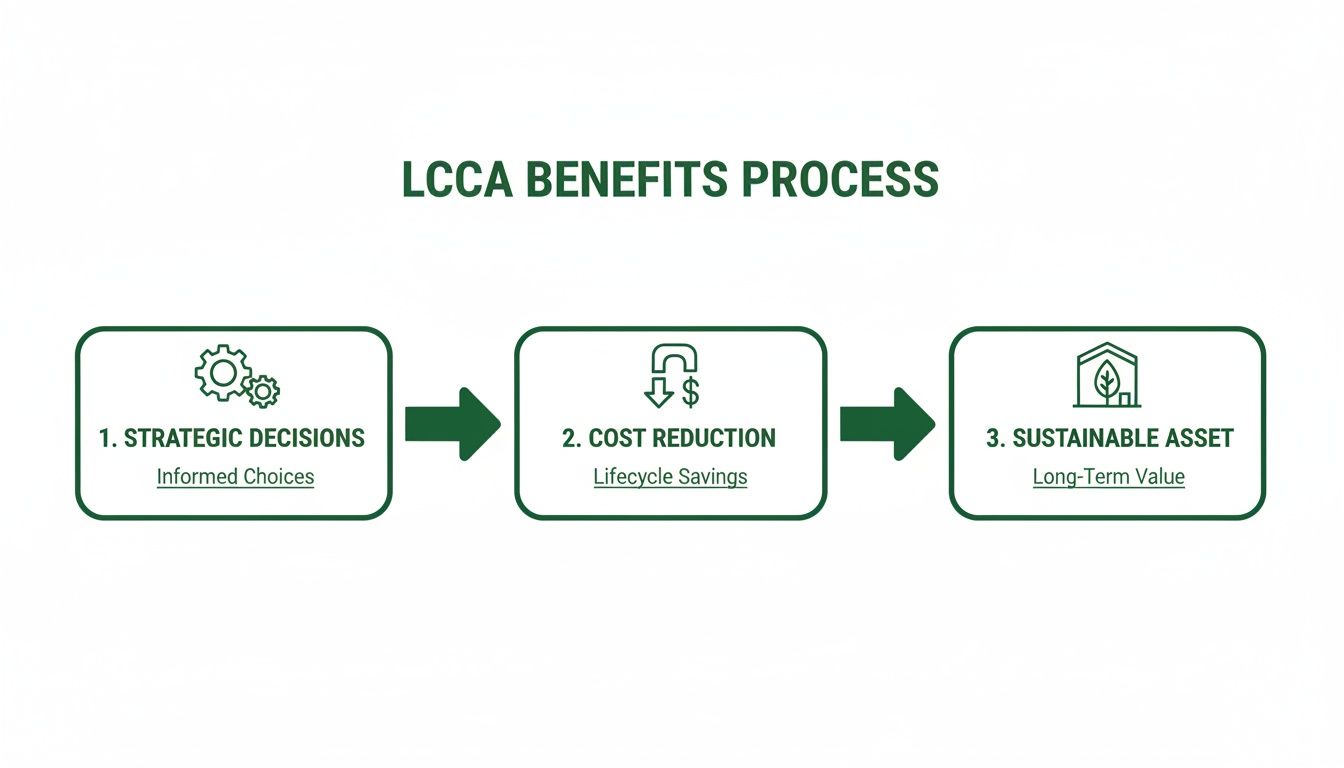
As you can see, a structured LCCA process is the bridge between initial ideas and strategic, cost-effective asset management for the long haul.
Discount Future Costs to Present Value
This is easily the most critical—and most misunderstood—part of the whole analysis. You can't just add up all the costs over 40 years and call it a day. Why not? Because of the time value of money. A dollar in your hand today is worth more than a dollar you'll get ten years from now. That's because of inflation and the potential to earn interest on the money you have now.
To make a fair comparison, you have to convert every future cost into its equivalent value in today's dollars. This is done with a financial calculation called discounting, which gives you the Net Present Value (NPV) of each expense.
Here’s an analogy. If you know you have to pay a $1,000 maintenance bill ten years from now, you could invest a smaller amount today—say, $700—and let it grow over time to cover that future expense. That $700 is the Net Present Value of that future cost.
By discounting every future expense—from the annual energy bill to that big roof replacement in year 20—you can finally add them all up. This gives you a single, comparable number for each of your alternatives. The option with the lowest total NPV is your most cost-effective choice over the long run, giving you the hard data you need to make the right financial move for your project.
LCCA in Action: A Real-World Scenario
Theory is one thing, but seeing a life cycle cost analysis play out in a real-world decision is where the lightbulb really goes on. Let's walk through a classic dilemma for a commercial building owner: choosing the right roofing system for a property they just acquired.
This simple comparison shows exactly how the "cheaper" option today can easily become a major financial headache down the road.
Imagine the owner needs to replace a failing roof on a 10,000-square-foot building. They've got two quotes and need to make the smartest financial move over a 40-year study period—a pretty standard timeframe for analyzing a major building system like a roof.
Setting Up the Comparison
The choice boils down to two very different materials, each with its own unique cost structure and performance profile.
- Option A: The Standard TPO Roof. This is a common thermoplastic polyolefin (TPO) system. It's reliable and, more importantly, budget-friendly upfront. It has an estimated service life of about 20 years.
- Option B: The Premium Metal Roof. This is a high-quality, standing-seam metal roof. The initial sticker price is significantly higher, but it’s built to last for 50+ years and even offers energy savings thanks to its reflective surface.
Just looking at the initial bids, the TPO roof seems like a no-brainer. But an LCCA forces you to look beyond that first invoice and consider every single cost over the next four decades.
Crunching the Numbers
Let's break down the lifetime costs for each option. For this example, we’ll keep it simple and use today’s dollars, but a formal analysis would discount all future costs back to their Net Present Value (NPV).
Option A: TPO Roof (20-Year Lifespan)
- Initial Installation Cost: The contractor’s bid comes in at $100,000.
- Annual Maintenance: Routine inspections and minor repairs are estimated at $1,000 per year. Over 40 years, that’s $40,000.
- Major Replacement Cost: Here's the kicker. Since this roof only lasts 20 years, it will have to be completely torn off and replaced at the 20-year mark. Assuming costs are similar, that’s another $100,000 hit.
Option B: Premium Metal Roof (50+ Year Lifespan)
- Initial Installation Cost: The upfront investment is much steeper at $180,000.
- Annual Maintenance: Metal roofs are incredibly durable and need far less upkeep, estimated at just $300 per year. Over 40 years, that adds up to only $12,000.
- Energy Savings: That reflective surface isn't just for looks. It’s projected to cut cooling costs by $2,000 annually. Over 40 years, that’s a whopping $80,000 in savings, which we treat as a credit.
- Replacement Cost: With a 50+ year lifespan, this roof will easily outlast our 40-year study period. That means the replacement cost is $0.
This long-term mindset applies to almost every component of a building. Take insulation, for example. An LCCA would compare the initial price against long-term thermal performance and energy savings when evaluating insulation alternatives like spray foam vs. blown-in. It’s the same principle, just a different system.
The Final Verdict
Okay, let's put it all together and see which option truly provides the best long-term value over our 40-year window.
| Cost Component | Option A (TPO Roof) | Option B (Metal Roof) |
|---|---|---|
| Initial Cost | $100,000 | $180,000 |
| Total Maintenance | $40,000 | $12,000 |
| Replacement Cost | $100,000 | $0 |
| Energy Savings | $0 | -$80,000 |
| Total Life Cycle Cost | $240,000 | $112,000 |
The results couldn't be clearer. Despite costing 80% more upfront, the premium metal roof’s total life cycle cost is less than half that of the "cheaper" TPO system.
This is the power of LCCA in a nutshell. It forces a crucial mental shift from focusing on the short-term price tag to understanding long-term value. By running this analysis, the building owner avoids a costly mistake and makes a strategic investment that saves a projected $128,000. This is how you use data to build more profitable, sustainable, and resilient buildings.
Finding The Right Data And Tools
A life cycle cost analysis is only as good as the numbers you feed it. While the math itself is straightforward, the real work lies in sourcing accurate costs and realistic service life estimates. This is what transforms a vague guess into a financial forecast you can actually bank on.
Think of it like cooking a gourmet meal. The recipe might be simple, but the quality of your ingredients makes all the difference. In LCCA, your data is the raw ingredient—get it wrong, and the final result will be disappointing, no matter how well you follow the steps.
Where to Find Credible Cost Data
To build a solid LCCA, you need reliable data for everything from initial material and labor costs to the expected lifespan of a boiler. The best place to start is with established industry benchmarks. You don't have to reinvent the wheel.
Here are a few of the go-to resources we use:
- RSMeans Data: This is pretty much the gold standard for construction cost data in North America. RSMeans offers incredibly detailed cost info on materials, labor rates, and equipment, making it essential for nailing down those initial and replacement cost estimates.
- Government Resources: You’d be surprised what you can find from agencies like the Department of Energy (DOE) and the National Institute of Standards and Technology (NIST). They publish mountains of data on the energy performance and expected service life for all sorts of building systems.
- Manufacturer Specifications: When you're looking at a specific piece of equipment, like a high-efficiency HVAC unit or a particular roofing system, the manufacturer is your best friend. They provide the nitty-gritty details on performance, maintenance needs, and expected lifespan.
Using these sources gives your LCCA a strong, evidence-based foundation and lends a ton of credibility to your final numbers.
Software That Does The Heavy Lifting
Look, nobody wants to manually calculate the Net Present Value for 30 years of operating expenses in a spreadsheet. It’s tedious and a recipe for human error. This is where specialized software comes in to save the day (and your sanity).
The screenshot below shows the homepage for the Building Life-Cycle Cost (BLCC) programs, which were developed by NIST.
This is a fantastic example of a tool designed to take the pain out of the process. It's used by everyone from federal agencies to private developers to automate those complex discounting calculations and get a clear picture of long-term cost-effectiveness.
Handling The Inevitable Uncertainty
Even with the best data in the world, you can't predict the future. Inflation might spike, energy prices could swing wildly, or a brand-new system might fail years ahead of schedule. A good LCCA doesn't ignore this; it confronts it head-on.
The goal isn’t to predict the future with perfect accuracy. It’s to make an informed, defensible decision based on the best information we have today, while fully understanding the potential risks.
To manage this uncertainty, one of the most critical steps is to run a sensitivity analysis. This just means you re-run the numbers using different assumptions. What if the discount rate is higher? What if energy savings are 15% lower than you projected?
If your preferred option still looks like the winner across a range of different scenarios, you can move forward with much greater confidence. It’s also crucial to keep your assumptions transparent. Documenting your data sources and clearly stating your logic ensures everyone involved understands exactly how you got from A to B.
Integrating LCCA Into Your Next Project
Knowing what a life cycle cost analysis is is one thing; actually weaving it into your project workflow is where the real magic happens. This isn't about tacking on another complicated step. It's a fundamental shift in how you make decisions, steering every choice toward the long-term financial health of the building right from the get-go.
If there’s one rule to follow, it’s this: start early. The real power of an LCCA is unlocked during the initial design and planning stages. If you wait until later, you’ve already missed the best opportunities to make a difference.
A Roadmap for Action
Bringing LCCA into your process isn't a solo effort. It demands collaboration and a forward-thinking attitude, grounded in a clear, proactive approach to gathering information and making smart calls.
Here’s a practical way to get started:
-
Assemble the Right Team Early: Get your architect, engineers, and contractors in the same room from day one. Their combined experience is absolutely essential for pulling together realistic cost data and service life estimates for everything from the HVAC system to the roofing materials.
-
Define Your Goals and Study Period: What are you trying to achieve with this building, financially and operationally? Once you know that, agree on a study period that makes sense—it should be long enough to see at least one major replacement cycle for the building's key components.
-
Use LCCA as a Communication Tool: Don't present the analysis as a way to slash the budget. Frame it as a strategy to optimize value. Use the numbers to clearly show clients and investors how a slightly higher upfront cost can generate massive long-term savings and a much healthier ROI.
A well-executed life cycle cost analysis completely changes the conversation with stakeholders. It shifts the focus from short-term budget headaches to long-term asset value, backing up higher-quality investments with hard, undeniable financial data.
Fostering a Lifecycle Costing Mindset
Ultimately, making LCCA a habit is about nurturing a new perspective. It’s about seeing that every single choice made during design and construction sends financial ripples decades into the future.
This way of thinking allows you to look past the initial price tag and focus on creating buildings that are more sustainable, resilient, and profitable over their entire lives.
By making LCCA a standard part of your development process, you’re not just building better buildings—you’re building a powerful competitive advantage. You deliver projects that meet today's budget and perform beautifully for years, solidifying your reputation for delivering exceptional, lasting value.
Frequently Asked Questions About LCCA
Even after breaking it all down, it's natural to have a few questions when you start applying a concept like life cycle cost analysis in the real world. Here are some of the most common ones we hear from owners and developers, along with some straightforward answers.
What’s the Difference Between LCCA and TCO?
You'll often hear these two terms pop up in the same conversation, and it’s easy to see why—they're two sides of the same coin.
Think of Total Cost of Ownership (TCO) as the big-picture goal. It’s the total, all-in cost of owning something, from the day you buy it to the day you get rid of it.
Life Cycle Cost Analysis (LCCA) is the specific method you use to figure out that TCO. It's the structured, nuts-and-bolts process—the financial modeling that includes discounting future costs to their present value so you can make a true apples-to-apples comparison. TCO is the destination; LCCA is the map you use to get there accurately.
How Long Should the Study Period Be for an LCCA?
There’s no magic number here; the right timeframe really depends on what you're analyzing. But there are some solid rules of thumb that can point you in the right direction.
For a whole building or a major piece of public infrastructure, a 40-year period is often a good, robust standard. When you're looking at individual components, the trick is to set a timeframe that’s long enough to see at least one full replacement of the shorter-lived option you're considering.
Example: Let's say you're comparing a standard roof with a 15-year warranty against a premium roof built to last 30 years. You need to run the analysis for at least 30 years. Anything less, and you’d miss the massive cost of tearing off and replacing that first roof—a detail that completely changes the financial outcome.
Is LCCA Just for New Buildings?
Not at all. Actually, LCCA is an incredibly valuable tool for renovations and adaptive reuse projects. It’s what gives you the hard financial data to justify making smart upgrades to an existing building.
For instance, should you keep patching up that old, inefficient HVAC system, or does it make more financial sense to replace it? LCCA lays it all out. It pits the high ongoing energy and maintenance bills of the old unit against the upfront investment and long-term savings of a new one. This is how you build a rock-solid business case for sustainable upgrades, proving exactly when it’s time to invest in efficiency for the long haul.
At Sherer Architects, LLC, we build life cycle cost analysis right into our design process. It’s how we make sure every project, from a brand-new commercial build to a complex historic renovation, delivers the greatest possible value over its entire lifetime. Explore how our architectural expertise can optimize your next investment.