When developers hear the term “value engineering,” their minds often jump straight to cost-cutting. They picture swapping out high-quality materials for cheaper alternatives or slashing features to meet a shrinking budget. But that common assumption misses the mark entirely.
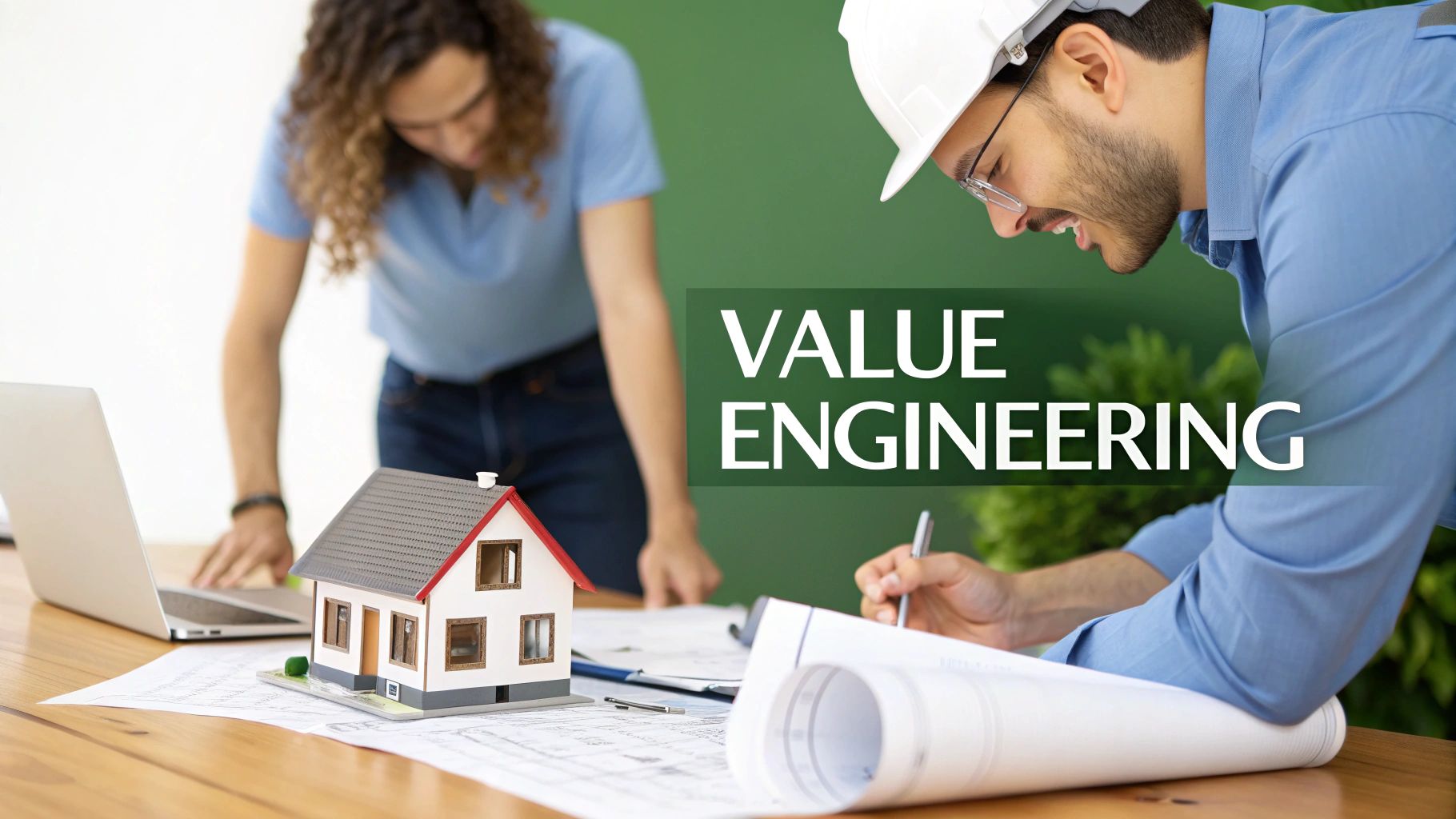
True value engineering (VE) isn't about making things cheaper; it's about making them smarter. It’s a systematic method for getting the most value out of every dollar spent by focusing on function, not just cost, without ever compromising on quality, safety, or performance.
Unpacking the Core Concept of Value Engineering
Think of it like a master chef refining a signature dish. The goal isn't just to make it cheaper. The chef wouldn't simply swap out fresh herbs for dried ones. Instead, they might discover a new cooking technique that intensifies the natural flavors, allowing them to use less of an expensive ingredient while actually making the dish taste better.
That’s value engineering in a nutshell. It’s a creative, proactive, and analytical process that seeks to boost the overall value of a project, not just trim its initial price tag.
Function Over Form
At its heart, VE begins by asking one simple but powerful question about every single element of a project: “What does it do?”
This function-first approach forces the project team to look past the blueprints and think about the fundamental purpose of each component. For instance, a wall isn't just a wall. Its primary functions are to provide structural support, act as a thermal barrier, and block sound. Once you define those functions, you can start exploring different—and potentially better—ways to achieve them.
A VE workshop typically involves a few key activities:
- Analyzing Function: Pinpointing the essential purpose of every system, material, and method.
- Creative Brainstorming: Thinking outside the box to generate alternative designs or materials that fulfill the same function.
- Life Cycle Costing: Looking beyond the initial purchase price to consider long-term expenses like maintenance, energy consumption, and eventual replacement.
The goal is to find the sweet spot where performance, quality, and cost intersect to create the highest possible value for the owner. It’s about making smarter, more informed decisions from the ground up.
To better grasp the core ideas, let’s break down the fundamental principles that separate true value engineering from simple cost reduction.
Core Principles of Value Engineering at a Glance
| Principle | Description | Example in Construction |
|---|---|---|
| Focus on Function | Prioritize the purpose of an element over its physical form or specification. | Instead of just specifying a "brick exterior," define the function as "durable, weather-resistant cladding with a classic aesthetic." This opens the door to evaluating advanced composite panels or engineered brick systems. |
| Maintain or Improve Quality | Any proposed change must meet or exceed the original performance and quality standards. | Switching from a specified HVAC unit to a different model that not only costs less upfront but also offers 20% better energy efficiency and a longer warranty. |
| Consider Life Cycle Costs | Evaluate the total cost of ownership, including initial construction, maintenance, operations, and disposal. | Choosing LED lighting over cheaper fluorescent options. While the initial cost is higher, the savings in energy bills and bulb replacements over 10-15 years deliver superior long-term value. |
| Promote Innovation | Encourage creative, multi-disciplinary thinking to find novel solutions to design challenges. | Instead of a traditional stormwater drainage system, a team might propose a green roof and permeable pavers to manage runoff, which also adds amenity space and reduces the heat island effect. |
These principles guide the entire process, ensuring that every decision genuinely adds value rather than just removing cost.
Interestingly, this whole methodology has its roots in a time of crisis. It was developed during World War II at General Electric, where an engineer named Lawrence D. Miles was tasked with maintaining production despite severe material shortages. He had to find innovative ways to achieve product function without the usual components, sparking a systematic approach that evolved into the VE we use today. You can find more about its origins and modern applications in resources from industry experts like Gordian.com.
The Real-World Benefits of Value Engineering
So, why should a developer or project owner actually care about value engineering? It's a fair question. The simple answer is that it delivers real, measurable returns that you'll feel long after the ribbon-cutting ceremony.
While it’s often mistaken for just another way to slash budgets, a properly run VE process does something far more valuable. It turns a good project into a high-performing asset built for long-term success.
The most obvious win is a reduction in initial construction costs. When you get a team to analyze the function of every single component, you start finding some serious savings. For instance, a VE workshop might reveal that a prefabricated structural system delivers the exact same performance as building it on-site, but with far less material waste and fewer labor hours. That's real capital freed up for other priorities or dropped straight to the bottom line.
Slashing Long-Term Operating Expenses
But here's where value engineering really shows its power: its intense focus on life cycle costs. A building's sticker price is just the beginning of the story. VE forces you to look at the whole picture—decades of operational and maintenance expenses.
This kind of forward-thinking pays off big time in a few key areas:
- Energy Efficiency: Suggesting a more efficient HVAC system or better insulation might add a little to the upfront cost, but it can easily cut utility bills by 15-20% for the entire life of the building.
- Maintenance Reduction: Think about swapping out carpet in high-traffic areas for polished concrete. It's a simple change that eliminates years of cleaning and replacement costs.
- Improved Durability: By selecting a truly robust roofing system from the start, you're not just buying a roof; you're preventing a future of expensive leaks and repairs that chip away at the building's value.
The core idea here is moving past the temptation of the cheapest upfront option and instead focusing on genuine, lasting value. It's about making smarter decisions by looking at the project from every angle, not just the initial price tag.
This shift in mindset is crucial. When a team evaluates all the considerations beyond the lowest bid, they're actively protecting the asset from future headaches and financial drains.
Enhancing Project Quality and Performance
It's not all about the money, either. Often, the VE process just leads to a flat-out better building.
By challenging old assumptions and pushing for creative solutions, the process uncovers smarter ways to do things. A team might discover an alternative site layout that dramatically improves traffic flow, or suggest a different window glazing that floods the space with natural light and makes it a more pleasant place to be.
These aren't just small tweaks. They are fundamental improvements that boost the building's function, make tenants happier, and ultimately increase the property's market value. By optimizing the relationship between function and cost, VE ensures every dollar you spend is working hard to create a more durable, efficient, and valuable asset.
How the Value Engineering Process Unfolds
Don't mistake value engineering for some chaotic, free-for-all brainstorming session. It’s a highly structured and disciplined process—a methodical treasure hunt where a diverse team follows a clear map to uncover hidden value in a project.
This systematic approach ensures every decision is backed by solid data and directly supports the project's core functions. The entire process is broken down into six distinct phases that guide the team from a high-level analysis all the way to specific, actionable recommendations. When done right during the design stage, studies show this can lead to cost savings of 5% to 15% of the total project cost, all without compromising quality or safety. You can dig deeper into these outcomes by checking out value engineering resources on Gordian.com.
The Six Phases of a VE Study
The VE job plan provides a repeatable framework that keeps everyone focused. Let’s walk through each stage using a practical example: choosing the right HVAC system for a new commercial office building.
-
Information Gathering: This is the bedrock of the whole process. The team starts by gathering every relevant project document they can get their hands on—design plans, cost estimates, material specifications, and the owner’s project requirements (OPR). For our HVAC example, this means collecting hard data on the building’s size, expected occupancy, insulation R-values, and local climate patterns.
-
Function Analysis: Next, the team asks a deceptively simple question: "What does this component actually have to do?" They boil down its purpose into a simple two-word, verb-noun phrase. For an HVAC system, the primary function is to "condition air." Secondary functions might include things like "circulate air," "control humidity," and "filter particulates."
-
Creative Brainstorming: Once the core functions are crystal clear, it’s time to generate alternatives. No idea is a bad idea at this stage. For the HVAC system, the team might throw out ideas ranging from a traditional rooftop unit to a variable refrigerant flow (VRF) system, geothermal heat pumps, or even a cutting-edge hybrid design with natural ventilation.
The whole point of this exercise is to turn cost optimization into real, tangible project value, as this flowchart shows.
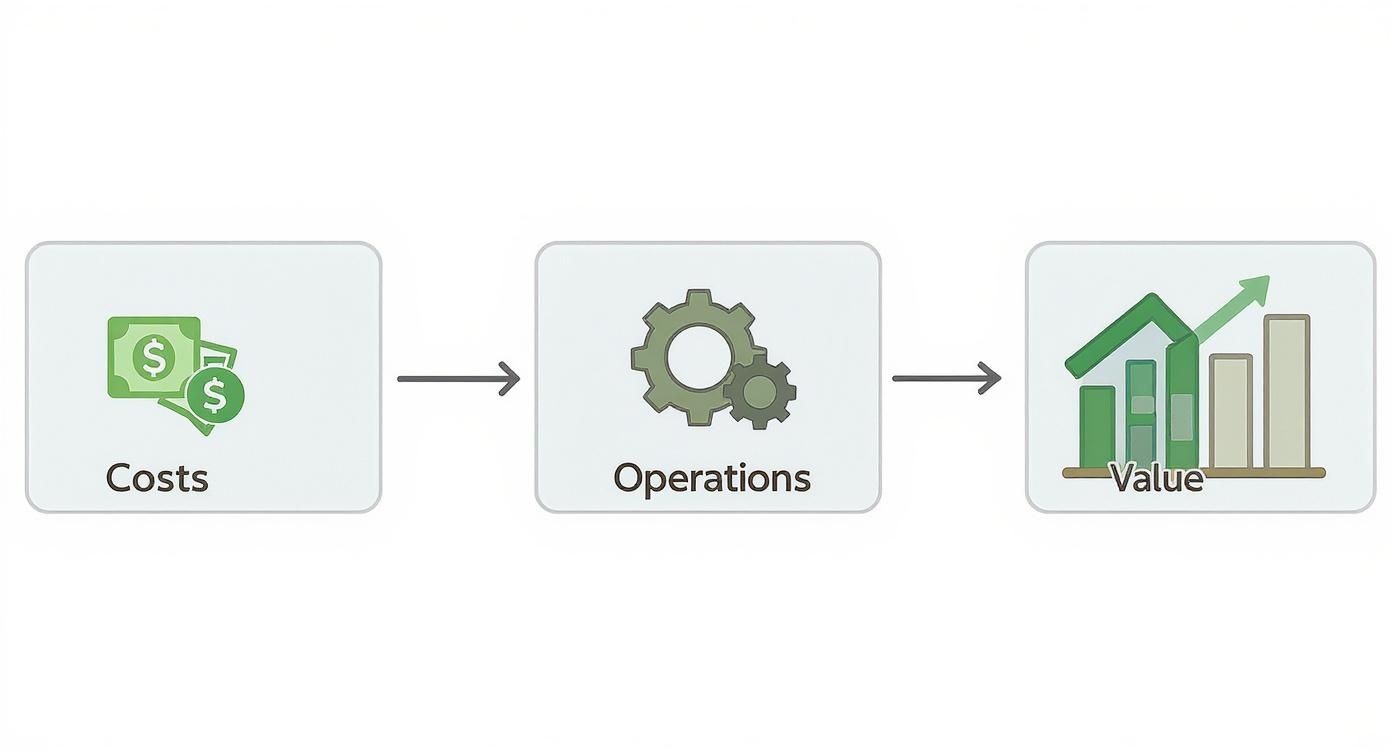
As you can see, trimming both initial and long-term operational costs directly boosts the overall project value, creating a more profitable and sustainable asset for the owner.
From Ideas to Implementation
With a list of creative ideas in hand, the team’s next job is to systematically filter and refine them to find the true winners.
- Evaluation: Here, the team gets critical. They sift through the brainstormed ideas, weighing them against key criteria like cost, feasibility, and performance. The geothermal system might get tossed out because of its high upfront cost, while the VRF system gets flagged as a strong contender thanks to its incredible energy efficiency and zoning flexibility.
This is where abstract ideas collide with real-world constraints. The goal isn't just to find a cheaper option but to pinpoint the one that delivers the best possible balance of cost, performance, and long-term reliability.
-
Development: The top-ranked ideas get fleshed out. This involves detailed technical analysis and, most importantly, life cycle cost calculations. For our HVAC example, the team would build a side-by-side financial model comparing the traditional unit to the VRF system, projecting everything from upfront installation costs to energy savings over 20 years and anticipated maintenance expenses.
-
Presentation: Finally, the VE team presents its formal recommendations to the project owner and other key stakeholders. They don’t just offer an opinion; they make a data-driven case for the proposed changes, demonstrating exactly how their chosen alternative—the VRF system in this case—will deliver far superior value over the building's entire life.
Assembling Your Value Engineering Team
A successful value engineering workshop is a team sport. It absolutely depends on bringing diverse expertise and a spirit of open collaboration together to uncover the best solutions. The process thrives when different perspectives challenge the status quo. Think of it like assembling a special ops team for your project—each member brings a unique skill set critical for the mission's success.
Just gathering architects and engineers in a room isn't going to cut it. A truly effective VE team pulls together individuals who see the project through completely different lenses, from high-level design concepts all the way down to on-the-ground construction realities. This blend of viewpoints is what sparks the creative problem-solving at the heart of value engineering.
Key Players and Their Contributions
Every role on the team is distinct, and every one of them is essential. The real magic happens when the architect’s design vision meets the contractor’s practical knowledge of material costs and labor, all guided by the owner's strategic goals.
This collaborative dynamic is what breaks down siloed thinking. It ensures that any proposed changes are not just innovative but also genuinely practical. After all, a great idea on paper is useless if it can't be built efficiently or doesn't align with what the owner actually needs long-term.
The strength of a value engineering team lies in its diversity. When designers, builders, and owners work together, they can identify cost-saving opportunities that would be invisible from a single viewpoint.
So, let's break down the primary roles and what each person brings to the table.
A well-structured team ensures that every angle of the project is considered, from big-picture goals to the smallest construction details. Here’s a look at who typically sits around the value engineering table and the part they play.
Value Engineering Team Roles and Key Contributions
| Role | Primary Responsibility | Example Contribution |
|---|---|---|
| VE Team Facilitator | Guides the workshop, keeps the process on track, and fosters an environment of open communication and creative thinking. | Mediates a debate between the architect and engineer, helping them find a middle ground on a structural change that satisfies both design intent and budget. |
| Project Owner/Client | Defines the project's goals, budget, and what "value" truly means. They are the ultimate decision-maker on which recommendations to accept. | Clarifies that long-term energy efficiency is a higher priority than the lowest possible initial cost, guiding the team's focus toward life cycle savings. |
| Design Team (Architects & Engineers) | Provides deep knowledge of the design intent, technical specifications, and performance requirements for all project systems. | Explains the functional requirements of the building envelope, allowing the team to brainstorm alternative materials that still meet performance criteria. |
| Contractor/Construction Manager | Offers real-world insights into constructability, labor costs, material availability, and current market pricing for potential alternatives. | Points out that a specified flooring material has a 6-month lead time, suggesting a readily available and equally durable alternative to avoid project delays. |
Ultimately, the goal is to create a dynamic where the collective knowledge of the group is greater than the sum of its parts. This collaborative approach is what turns a standard project review into a powerful value-finding exercise.
Let's See Value Engineering in Action
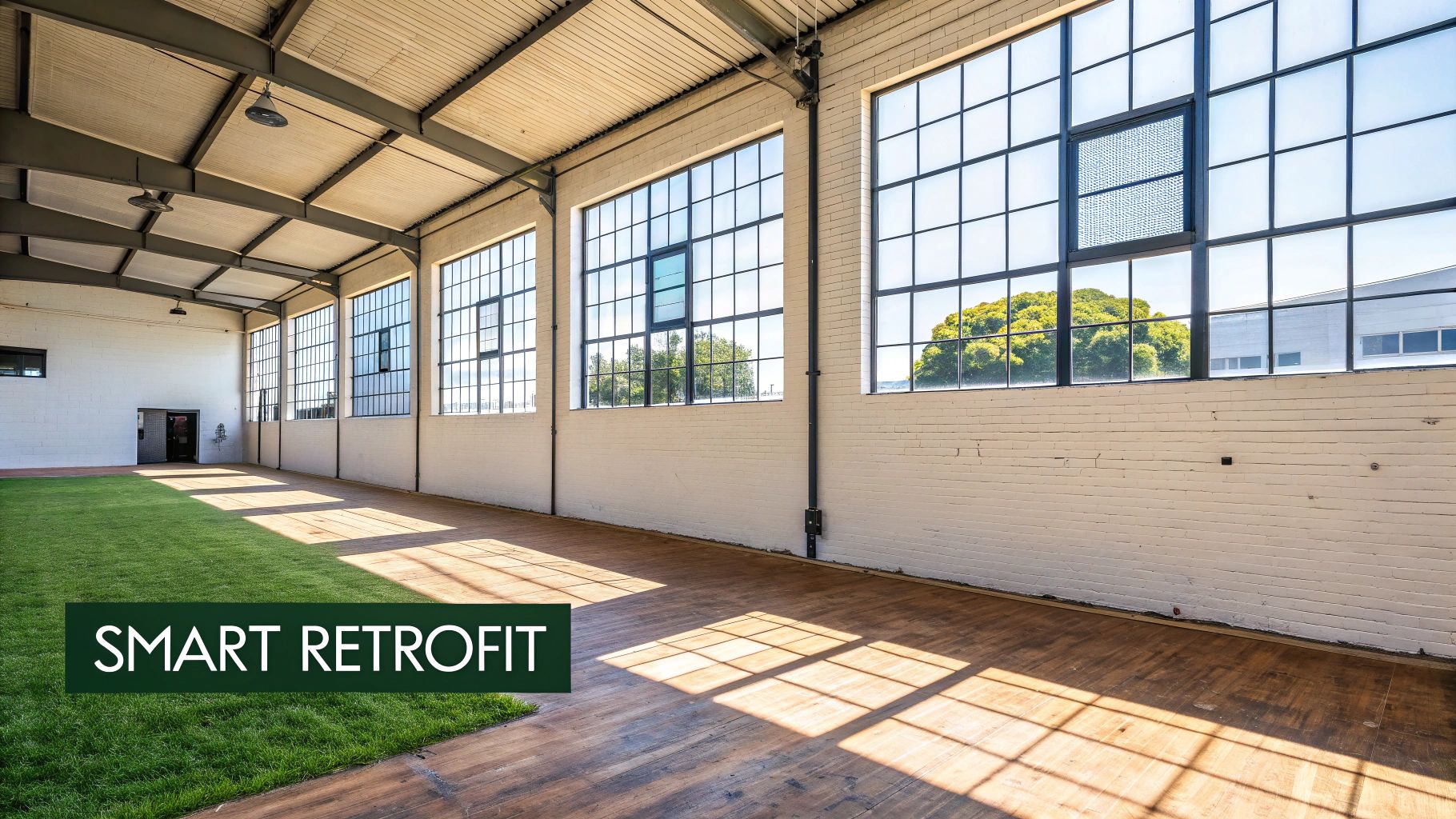
Theory is one thing, but seeing how this all plays out on a real job site is where it clicks. Let's walk through a classic scenario for commercial developers: turning an old, forgotten warehouse into a high-end, modern office space. This kind of adaptive reuse project is a perfect sandbox for a sharp VE team to work their magic.
The architect’s initial plans were stunning. They called for a massive, all-glass curtain wall system to replace the old brick facade. It looked incredible on paper and promised to drench the interior in sunlight, but the price tag was eye-watering. Worse, the design had terrible energy performance, locking the future owner into sky-high utility bills for decades.
Thinking in Functions, Not Just Features
This is where the value engineering team steps in. They didn't just see a "glass wall." They immediately started breaking it down into its core functions. What does this facade actually need to do?
- Let natural light deep into the building.
- Create a premium look that attracts top-tier tenants.
- Provide a solid thermal barrier against the elements.
- Act as the building's structural skin.
By defining the jobs the wall needed to perform, the team could start thinking outside the box. The all-glass design was a home run on light and aesthetics, but it struck out completely on insulation and cost.
This is the heart of value engineering: You stop asking, "What is it?" and start asking, "What does it do?" That simple shift opens up a world of creative possibilities that aren't chained to one specific, expensive material.
After some brainstorming, the team came back with a hybrid approach. Their design used high-performance insulated metal panels for a large portion of the facade, which immediately sent the building's R-value through the roof. But they didn't sacrifice the vision. They strategically placed larger, triple-pane window units that still created that bright, airy feeling and funneled daylight far into the office.
The Winning Outcome
The results spoke for themselves. The hybrid facade didn't just slash the upfront construction budget; it was also projected to deliver a 30% reduction in annual heating and cooling costs. That’s a powerful one-two punch that directly increases the property's net operating income and overall asset value.
And this isn't a one-off. This same thinking applies across the board. On huge infrastructure jobs like highways, VE workshops regularly find savings between 8% to 12% just by questioning standard materials and construction methods. You can see more on the proven track record of value engineering from Gordian.com.
In the end, the warehouse project was a massive success because the VE team delivered a solution that was smarter, not just cheaper. They preserved the architect's core vision while making the entire project more profitable and sustainable.
Clearing Up Common Value Engineering Myths
If you’ve been around the construction industry long enough, you’ve probably heard some strong opinions about value engineering. Unfortunately, a lot of what gets passed around misses the point entirely, framing VE as a desperate, last-minute budget hack.
Let’s set the record straight and tackle a few of the biggest myths head-on. The truth is, value engineering is a powerful strategic tool when you understand what it really is.
The most damaging myth is that value engineering is just a fancy term for cost-cutting. This is a fundamental misunderstanding. Cost-cutting is a reactive hatchet job—slashing expenses, often at the expense of quality, function, or long-term performance.
True value engineering is proactive. It’s a deep dive into the value ratio of a project, which is simply a function divided by its cost. The goal isn't just to make things cheaper; it's to find smarter ways to achieve the same—or better—function for less money.
Think of it this way: a cost-cutter might see high-end windows on the spec sheet and immediately swap them for a cheaper, lower-grade model to save a few bucks. A value engineering team looks at the purpose of those windows—daylighting, thermal performance, aesthetics—and might find a completely different solution. Maybe the answer is a redesigned facade with fewer but larger, more efficient windows that achieve all the original goals for a lower overall cost. It's about ingenuity, not just subtraction.
Timeliness and Efficiency
Another common misconception? "It’s too late for VE, the design is already done." While it’s absolutely true that the best time for a VE workshop is early on, you can find opportunities for improvement at almost any stage.
A sharp contractor can spot significant savings during construction by suggesting an alternative building method or a readily available material that doesn’t require a major redesign. It’s never a lost cause.
The core principle is continuous improvement. A well-run value engineering process doesn't slow projects down; it prevents the costly delays and change orders that arise from discovering problems late in the game.
Finally, there’s the fear that VE will bog down the project schedule. A formal VE workshop is a highly focused, short-term sprint, not a months-long committee meeting. By getting the right people in a room to challenge assumptions early, you actually prevent the kind of time-sucking, budget-killing change orders that plague projects down the line.
This systematic focus on long-term value is precisely why so many public agencies have made it standard practice. In countries like the UK and Australia, where VE has been part of the process for years, it's estimated that every $1 invested in a study can return anywhere from $10 to $30 in lifecycle savings. You can learn more about how value engineering drives smarter, data-driven decisions at Gordian.com.
Those numbers prove VE isn't about trimming the fat; it’s a powerful tool for making a strategic investment in your project’s future.
Frequently Asked Questions
Even after you get the hang of the theory, some very practical questions always come up. Let's tackle a few of the most common ones I hear from developers and project teams.
What Is the Difference Between Value Engineering and Cost Cutting?
This is the million-dollar question, and the distinction is crucial. Cost-cutting is purely reactive. It’s about slashing the upfront budget, often by swapping in cheaper materials or eliminating features, which can seriously compromise quality and long-term performance.
Value engineering, on the other hand, is a proactive, disciplined process. It’s not about finding a cheaper widget; it's about asking if we even need that widget in the first place. VE dissects the function of every component to find smarter, more efficient ways to get the same or better result, often for a lower total cost over the building's life.
The core difference is the question you're asking. Cost-cutting asks, "How can we make this cheaper?" Value engineering asks, "How can we achieve this function more effectively?"
When Is the Best Time to Perform a VE Study?
The simple answer? As early as possible. The sweet spot is during the schematic or early design development phase. Think about it: it’s infinitely cheaper and easier to move a line on a digital drawing than it is to tear down a freshly poured concrete wall.
Making fundamental changes at this early stage has a massive ripple effect on savings. While a sharp general contractor can still spot opportunities during construction, the potential for big-impact savings shrinks the further along you get.
Can Value Engineering Be Applied to Smaller Projects?
Absolutely. People often think VE is only for massive, nine-figure projects, but the principles scale beautifully. A smaller commercial build or tenant fit-out won't need a formal, multi-day workshop with a dozen consultants.
Instead, a focused half-day meeting with the owner, architect, and builder can achieve the same goal. The function-first mindset is what matters, and it can uncover huge value and prevent costly mistakes on projects of any size.