
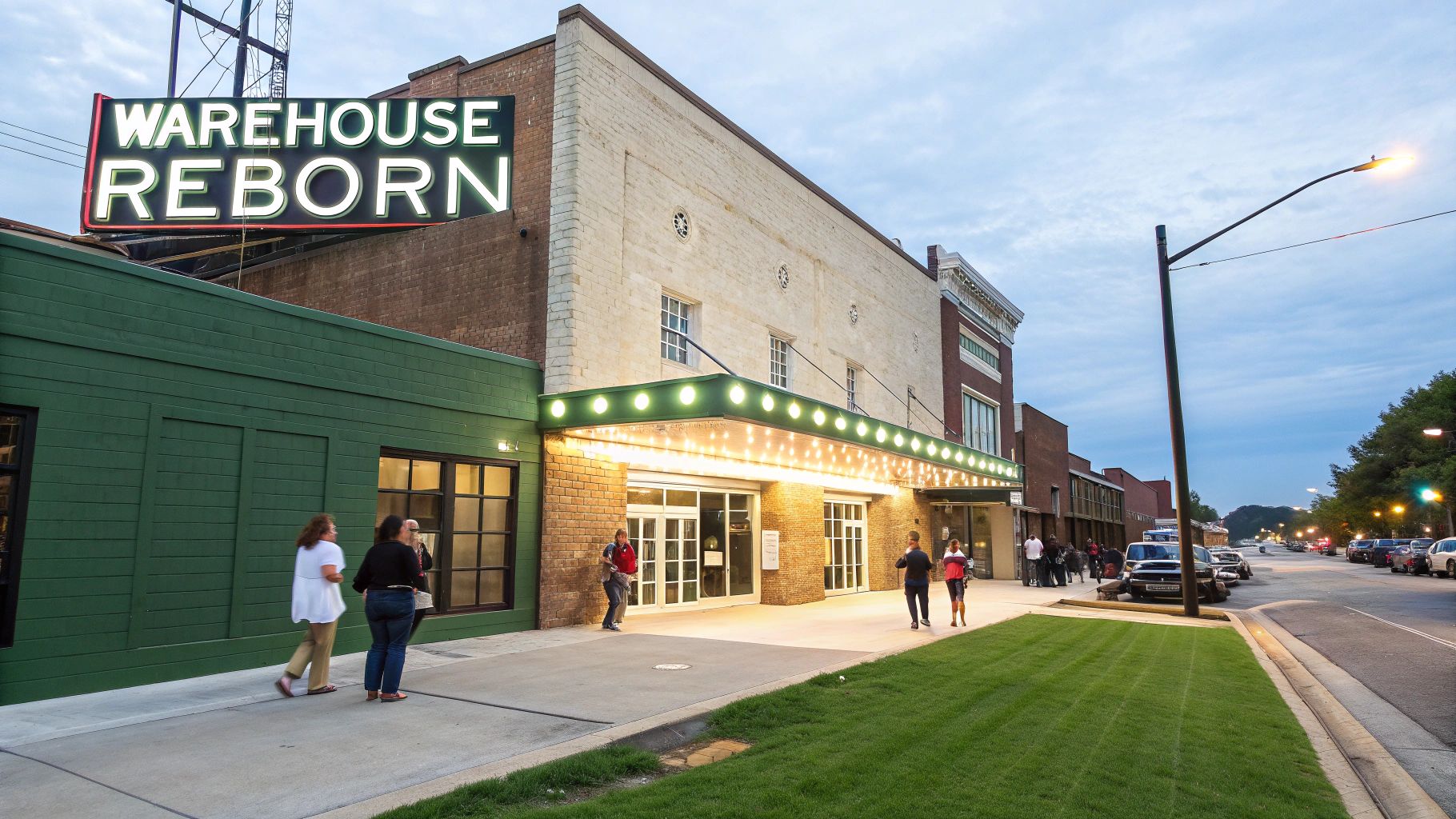
Greenville, South Carolina's Warehouse Theatre is a masterclass in adaptive reuse. It stands as a brilliant example of how you can breathe new life into a historic textile warehouse, transforming it into a buzzing cultural hub.
For developers and property owners, this project isn't just a success story; it's a practical blueprint. It shows how to perfectly blend historic preservation with a smart, profitable investment. This is a story of vision, community, and some really sharp design.
Unpacking the Warehouse Theater Blueprint
We’re going to use the Warehouse Theatre as our core case study. Think of it as a detailed roadmap for anyone looking to turn an old industrial building into a thriving community asset. Its journey—from a basic textile storage space to a cultural and economic linchpin for Greenville’s West End—offers some incredibly valuable lessons.
We'll walk through the entire lifecycle of this project, from the first spark of an idea to its current status as a local landmark. This is about more than just saving an old building; it’s about unlocking the massive potential trapped inside its walls.
From Humble Beginnings to Cultural Anchor
The Warehouse Theatre's story is all about ambition. It was started back in 1973 by a handful of local artists and a Furman University professor who found a rent-free black box space to get going. Fast forward to 1998, and they made the move to their current home in the West End, taking on the challenge of converting historic mill buildings into a modern performance venue.
This project did more than just save a piece of Greenville’s textile heritage. It gave the building a new purpose and extended its life for decades to come.
Why This Model Works for Developers
The Warehouse Theatre’s success offers a compelling argument for developers and investors for a few key reasons:
- Economic Viability: It proves that cultural venues can be profitable ventures, attracting patrons and driving real dollars into the local economy.
- Community Integration: Creating a space that people genuinely love generates immense goodwill. It becomes a landmark, not just a building.
- Sustainable Practice: Adaptive reuse is, at its heart, a sustainable choice. You sidestep demolition costs and drastically reduce the project's environmental footprint.
Of course, before you dive headfirst into a project like this, you have to do your homework. It’s absolutely essential to assess the project’s viability and understand the potential hurdles. The first step is to conduct a feasibility study. This is the foundation for a solid financial and operational plan, making sure every move you make is backed by solid data.
The Financial Case for Adaptive Reuse Theaters
Beyond the cool architecture and the good feelings, converting a warehouse into a theater has to make financial sense. Developers and investors need to see hard numbers that show a clear path to a solid, lasting return. At the end of the day, the data has to tell a story of real growth and profitability.
For a project like a warehouse theater in Greenville SC, success is measured by more than just ticket sales. You have to look at audience growth, how deeply the community is involved, and whether the venue can pull in money from different sources. A smart conversion becomes an economic driver for the neighborhood, not just a place to see a show.
The Warehouse Theatre's recent track record gives us a fantastic real-world example of this in action. It’s a perfect case study of how a strategic adaptive reuse project can meet market demand and deliver impressive financial results, making a strong argument for similar investments.
Measuring Success in Greenville
Greenville’s vibrant arts scene is the perfect backdrop for a project like this. In a standout year, the Warehouse Theatre saw its audience jump by a massive 32%. That’s a powerful sign of its growing appeal and importance to the community.
This wasn't just a fluke in one area. The growth was across the board—from main stage shows to educational programs and community events. In fact, their education initiatives hit their highest-ever revenues and attendance numbers.
This isn't happening in a vacuum. Other local arts venues have also been reporting record-breaking years and seeing a big uptick in donations from individuals. This all points to a healthy, supportive market for the performing arts in Greenville. It’s tangible proof that putting money into cultural venues pays off. You can get more details on these impacts directly from the Warehouse Theatre's success story.
A thriving arts venue does more than sell tickets; it becomes a destination. The increased foot traffic benefits surrounding businesses, boosts property values, and contributes to the overall economic vitality of a district, creating a halo effect for investors.
Key Performance Indicators for a Cultural Adaptive Reuse Project
For developers and investors, looking beyond a simple profit and loss statement is crucial. The following table highlights the tangible growth metrics from the Warehouse Theatre, providing a benchmark for what a successful cultural adaptive reuse project can deliver.
| Metric | Warehouse Theatre Performance | Implication for Developers |
|---|---|---|
| Audience Growth Rate | 32% increase in patrons served in a single year. | Demonstrates strong market penetration and growing brand loyalty. A clear sign of a sustainable customer base. |
| Revenue Diversification | Highest-ever revenues from educational programming and community events. | Multiple income streams reduce risk and create financial stability beyond the box office. |
| Community & Donor Support | Significant jumps in individual giving across the local arts scene. | Strong community buy-in and philanthropic support validate the project's cultural value and reduce financial risk. |
| Local Economic Impact | Increased foot traffic and evening commerce in the surrounding district. | Creates a "halo effect," boosting neighboring property values and making the entire area more attractive for future investment. |
These KPIs show a project that's not just culturally significant but is also a sound, data-backed investment. They paint a clear picture of how a well-executed adaptive reuse theater can become a cornerstone of both community and commerce.
Tackling the Core Design Puzzles of Conversion
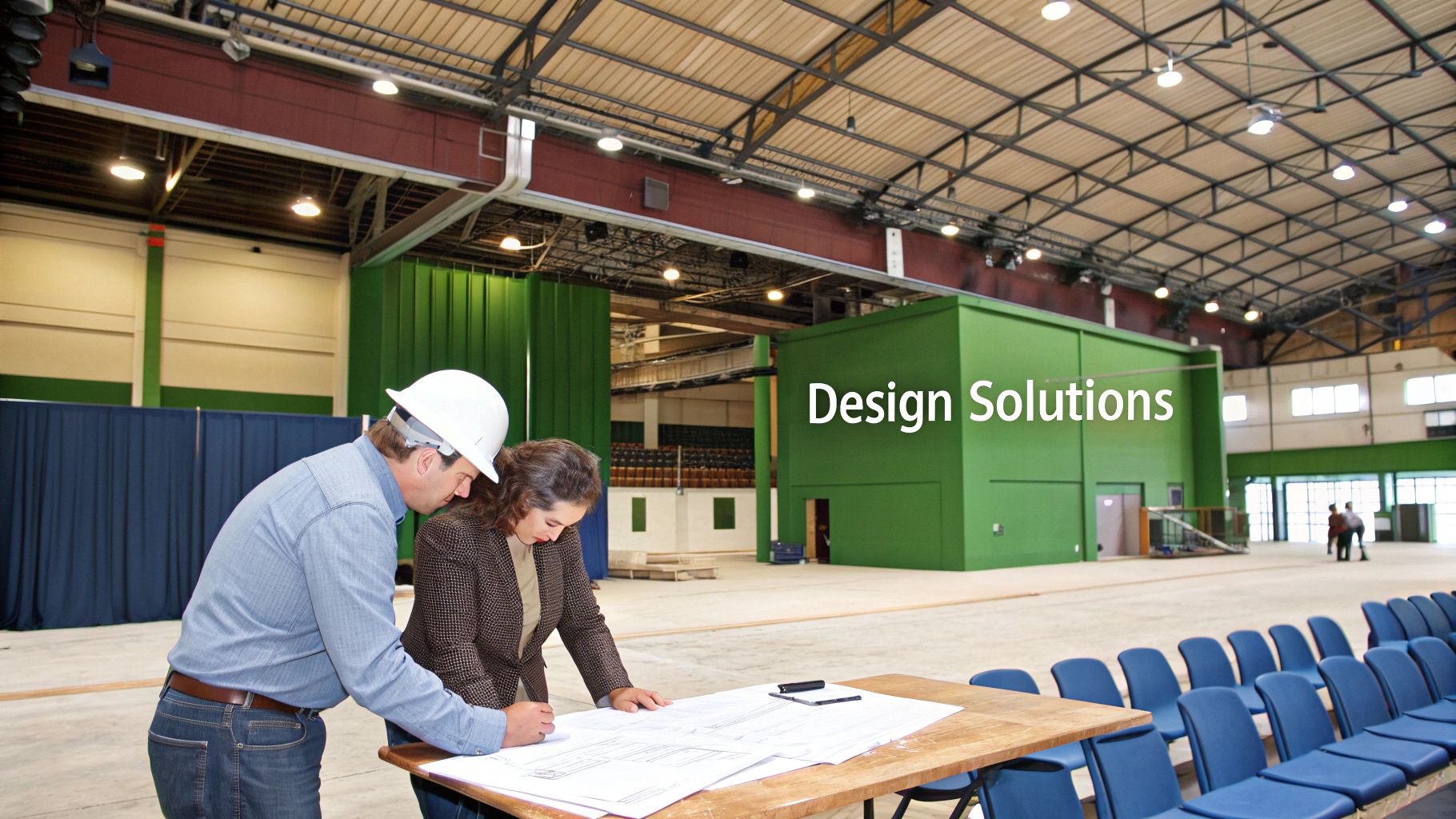
Turning an industrial shell into a place of performance isn't just a renovation; it's like solving a giant, three-dimensional puzzle. Every piece, from the steel beams overhead to the way sound travels through the room, has to fit together perfectly. For any warehouse theater in Greenville SC, getting these foundational, technical details right from the start is what separates a successful venue from a failed experiment.
The first, and arguably most important, challenge is the building's skeleton. Warehouses are built for the simple, static weight of goods, not the dynamic loads of lighting rigs, catwalks, and hundreds of people. A deep-dive structural analysis is always step one, figuring out exactly where we need to add muscle to the original frame to carry the weight of a modern theater safely.
From Echo Chamber to Acoustic Sanctuary
Let's be honest: the very things that give a warehouse its character—soaring ceilings, concrete floors, and hard, flat walls—are an acoustic disaster. They create a massive echo chamber where sound just bounces around endlessly. For a theater, where the clarity of every line and note is paramount, this is a non-starter.
Taming that chaotic sound requires a layered approach, not just a single fix. We have to bring in a combination of strategies to absorb and scatter sound waves.
- Acoustic Paneling: You'll see these installed strategically on walls and ceilings. Their job is to act like sponges, soaking up stray sound before it can reflect back into the room.
- Irregular Surfaces: We intentionally break up those big, flat planes by adding varied textures and angles. This scatters the sound, preventing harsh echoes and creating a much warmer, more intimate feel.
- Smart Layout: Even the way we arrange seating and interior walls can help. A good design directs sound right where you want it—to the audience's ears. When planning a new warehouse theater, it’s vital to consider every element, including carefully choosing the right stage that complements the unique acoustic fingerprint of the space.
Weaving in the Modern Essentials
Beyond sound, a performance venue needs a whole network of complex systems that do their job without anyone noticing. HVAC (heating, ventilation, and air conditioning) is a perfect example. You need a system that keeps a full house comfortable but remains completely silent. That’s a world away from the loud, clunky industrial units you usually find bolted to the roof of an old warehouse.
A great adaptive reuse project respects the soul of the original building while making it ready for today. The real artistry is in weaving in modern life-safety systems—like fire suppression and accessible exits—without erasing the historic industrial character that drew you to the space in the first place.
This means designing custom ductwork, often lined with sound-dampening material, and picking air handlers that are whisper-quiet. At the same time, we have to meet all current codes for fire safety and accessibility. This involves integrating ramps, accessible restrooms, and clear emergency egress routes in a way that feels like it was always part of the building's design, not just tacked on.
It’s a delicate dance between preservation and modernization. The best projects make these critical upgrades feel so natural that you'd never guess they weren't part of the original plan, resulting in a venue that’s safe, welcoming, and full of history.
Navigating Approvals and Maximizing Incentives
Taking an old building and giving it new life as a modern venue means you're stepping into a world of regulations and financial strategy. For anyone looking at a project like a warehouse theater in Greenville SC, this part of the process can feel daunting. But with the right team, what looks like a mountain of bureaucratic hurdles can actually become your biggest financial advantage.
The trick is to see zoning ordinances, Design Review Board presentations, and historic preservation rules not as roadblocks, but as a roadmap. When you know how to navigate it, this process can actively lower your project costs and significantly improve your return on investment. It's less about fighting red tape and more about lining up your project's goals with what the city and preservation groups want to see. You just have to learn how to make the system work for you.
Turning Regulations into ROI
Let's be clear: the regulatory maze isn't there to kill projects. It's designed to make sure development is safe, sustainable, and genuinely adds value to the community—and in a historic area like Greenville's West End, that's doubly true. Think of the approvals process as your first, best chance to prove that your project respects the neighborhood's character while breathing new economic life into an old building.
For example, when you stand in front of a Design Review Board, you’re not just checking a box. A well-researched presentation showing how you'll save the original brickwork or restore those iconic old windows builds incredible goodwill. That proactive approach signals you're a partner in preservation, not just another developer, and can make every subsequent step a whole lot smoother.
And that partnership mentality is precisely what unlocks the real financial wins.
A project that nails the balance between modern needs and historic preservation doesn't just get a green light. It gets a key to a powerful set of financial incentives that can completely change the numbers on your pro forma. These aren't handouts; they're rewards for doing it right.
Unlocking Historic Tax Credits and Grants
This is where the financial picture gets really interesting. Programs like the Federal Historic Preservation Tax Incentives program and South Carolina's own state-level credits are game-changers. They can be incredibly lucrative, but they don't mess around—you need precision and real expertise to qualify.
Getting these benefits isn't a simple form-fill. It involves a few critical steps:
- Deep-Dive Documentation: First, you have to meticulously research and document the building's original bones—how it was built and what materials were used. This research becomes the foundation of your entire preservation plan.
- Smart, Sensitive Design: Your architectural plans have to be clever. They need to show exactly how you'll integrate modern systems like HVAC and electrical with the least possible impact on the historic fabric of the building.
- Airtight Application: The application process is rigorous. You need to provide clear, undeniable proof that your renovation follows the Secretary of the Interior's Standards for Rehabilitation to the letter.
The story of The Warehouse Theatre is a perfect real-world example. It's set to celebrate 52 years in 2025, and its journey from a scrappy black box experiment in 1973 to a top-tier professional theater shows what’s possible when vision and preservation come together. The theater got its start with a grant from the South Carolina Arts Commission, proving how smart financing and a commitment to preservation build lasting value.
This history shows that knowing how to navigate design reviews and tap into historic tax credits can reduce costs by 50-75% compared to just tearing the building down. You can dig into their foundational story to see how those early grants and community buy-in laid the groundwork for decades of success.
5. Budgeting and Timeline: The Bottom Line on Your Warehouse Conversion
When you're looking at a project like this, it really boils down to two things: how much is it going to cost, and how long is it going to take? For a developer, getting these answers right is everything. A predictable budget for a warehouse-to-theater conversion isn't about guesswork; it's about building a detailed financial roadmap from the very beginning.
Think of it less as a single price tag and more as a series of building blocks. You have your big-ticket items, like buying the property and paying for the architectural design. But then you start layering in the unique challenges of adaptive reuse—things like beefing up the structure for theatrical loads, installing specialized acoustic treatments, and wiring up the sophisticated lighting and sound systems that make a performance space come alive. A solid budget for a warehouse theater in Greenville, SC, has to account for all of it.
Breaking Down the Major Cost Centers
One of the easiest traps to fall into is underestimating the "soft costs" and forgetting to build in a healthy contingency fund. A well-planned budget expects the unexpected. Old buildings always have secrets, so you need to be prepared.
Here's how we typically break it down:
- Hard Costs: This is the steel, the concrete, the drywall. It covers all the physical construction—structural work, HVAC, electrical, plumbing, interior finishes, and all the specialized theater gear like rigging and seating.
- Soft Costs: These are the professional services that get the project off the ground and keep it on track. Think architectural and engineering fees, permits, legal reviews, and insurance.
- Contingency Fund: This is your safety net. We recommend setting aside 10-15% of the total construction cost for those inevitable surprises, like discovering hidden structural damage or dealing with unforeseen site conditions.
The process of securing approvals and incentives plays a huge role in your financial planning. As the flowchart below shows, these steps aren't just bureaucratic hurdles; they're gateways to unlocking real money for your project.
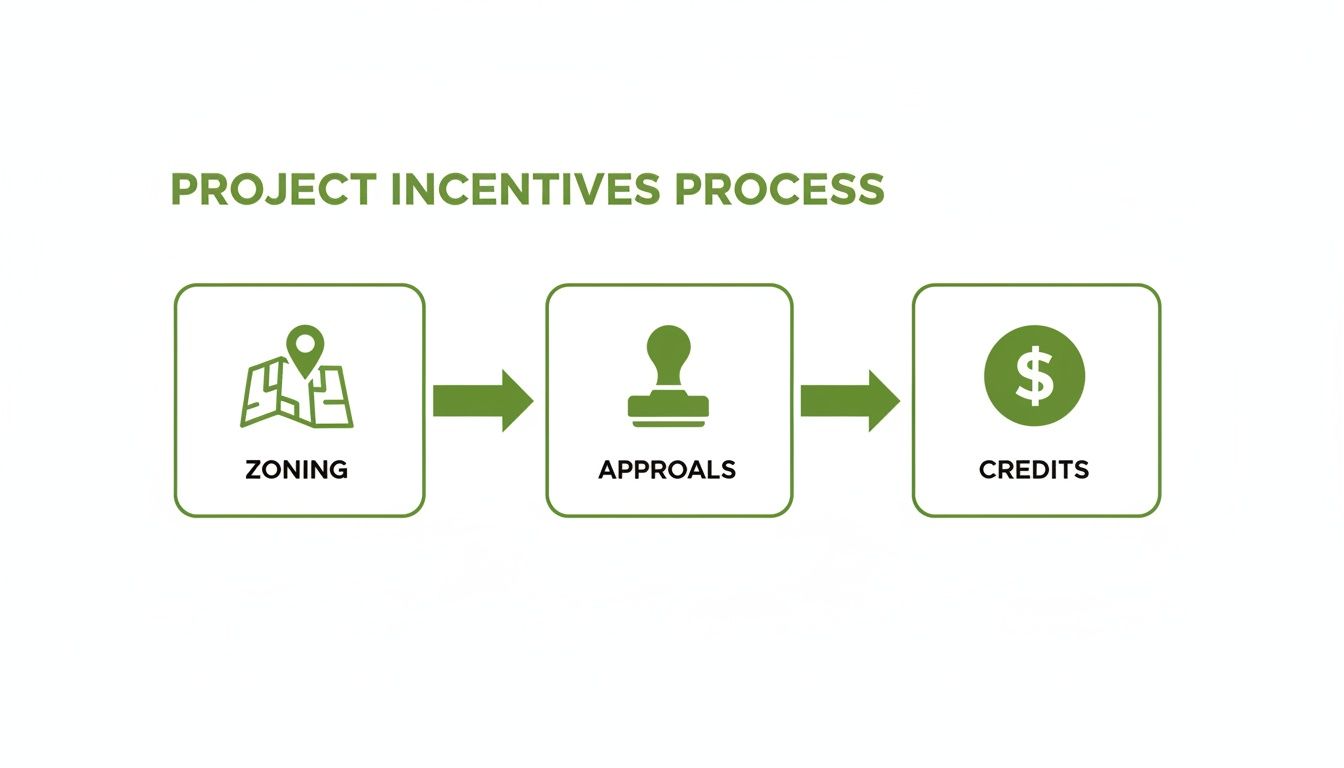
As you can see, getting your zoning and historic designations locked in early is the key. Those foundational steps are what allow you to tap into financial credits, turning what feels like red tape into a real benefit for your budget.
Adaptive Reuse vs. New Construction: A Cost and Timeline Overview
To really understand the trade-offs, it helps to see how a warehouse conversion stacks up against starting from scratch. Here’s a high-level comparison to help you weigh the financial and scheduling implications.
| Factor | Adaptive Reuse (Warehouse) | New Construction (Theater) |
|---|---|---|
| Upfront Costs | Acquisition + major retrofitting. Can be variable based on building condition. | Land acquisition + ground-up build. Often higher initial capital outlay. |
| Design & Approval | More complex upfront; involves historic reviews, structural analysis, and creative problem-solving. | More straightforward design process but can face lengthy zoning and site plan approvals. |
| Construction Time | Generally faster once permits are secured, as the primary structure already exists. | Longer construction phase from foundation to finishing. |
| Incentives | High potential for historic tax credits, grants, and other revitalization funds. | Limited to standard development incentives; no historic benefits. |
| Contingency Needs | Higher (10-15%) due to the potential for unforeseen conditions in an existing structure. | Lower (5-10%) as conditions are more controlled and predictable. |
| Marketability | Strong narrative appeal; unique character and historic charm can be a major draw. | A blank slate; appeal is based entirely on new design and amenities. |
While the numbers can vary wildly from one project to the next, this table gives you a framework for thinking about the decision. Adaptive reuse often presents a compelling case, especially when you factor in the speed to market and the financial perks.
Phasing Your Project for a Predictable Path
A realistic project timeline is just as crucial as the budget. We always advocate for a phased approach, starting with feasibility studies and design development before ever breaking ground. This methodical process helps prevent the kinds of costly delays that can sink a project.
The real value of adaptive reuse shines when you compare it to new construction. While initial costs can sometimes be similar, the accelerated timeline, potential for tax credits, and the built-in character of a historic space often deliver a superior long-term ROI.
This is where having an experienced architectural partner becomes invaluable. By performing thorough due diligence at the outset and drawing on a deep well of experience with local regulations and incentive programs, a good firm can cut through the uncertainty. They help mitigate risks and keep the project on a steady, financially sound path—from that first concept sketch all the way to opening night.
Lessons Learned: Your Blueprint for a Successful Theater Project
Taking an old, forgotten building and turning it into a cultural cornerstone is an ambitious journey. But as the story of the Warehouse Theatre in Greenville, SC, shows, it’s a journey that can be incredibly successful when you blend a great vision with a smart financial plan. Here are the key takeaways from that project that can guide your own.
If there's one thing to take away from our experience, it's this: do your homework upfront. A deep-dive feasibility study before you even think about design is absolutely critical. This is where you uncover the hidden structural gremlins, the regulatory roadblocks, and the real financial picture.
Getting this right from the start is the difference between building on solid rock and building on quicksand. It saves you from those heart-stopping, budget-blowing surprises down the line.
You Can't Do It Alone: Building Your A-Team
Adaptive reuse projects are team sports, and the Warehouse Theatre is a perfect example of what happens when you get the right players on the field early. Your project's success truly depends on the specialists you bring to the table from day one.
Your core team should absolutely include:
- A Preservation-Savvy Architect: You need someone who not only has a great design eye but also knows how to navigate the complex world of historic tax credits and respect the soul of the original building.
- An Acoustician: Old industrial spaces are notorious echo chambers. An acoustician is the magician who turns that cavernous space into an intimate venue where every word from the stage is crystal clear.
- A Creative Structural Engineer: This is the person who figures out how to make a century-old frame support modern lighting grids and seating without gutting its historic character.
The most successful projects are the ones that become part of the community's fabric. Think beyond the four walls. The goal is to create a destination that pulls people in, drives foot traffic, and becomes a place the neighborhood can't imagine living without.
Ultimately, your architectural partner is your quarterback through this entire game. They’re the ones who see the whole field—coordinating the design, wrangling the permits, managing the budget, and overseeing construction. With a solid team and a clear vision, your own warehouse theater in Greenville SC can be more than just a beautifully restored building. It can become a thriving, profitable hub for your community for years to come.
Got Questions? We've Got Answers
If you're looking at an old warehouse in Greenville and thinking "theater," you're not alone. It's an exciting idea, but it also comes with a lot of questions. We've been through this process many times, and a few key concerns always come up.
Let's walk through some of the most common questions developers and property owners ask when they're on the fence about turning an industrial shell into a cultural landmark.
What's Going to Surprise Me on the Budget?
The biggest budget-busters are almost always the things you can't see. When you peel back the layers of an old building, you might find structural issues that need serious reinforcement, old wiring that can't handle a modern theatrical load, or even hazardous materials like asbestos that have to be professionally removed.
These aren't just about meeting today's building codes; they're about supporting the intense demands of a performance space. The best money you can spend upfront is on a deep, thorough assessment with an architect who knows what to look for. It’s how you turn "unforeseen costs" into a predictable line item.
Here's a hard-won piece of advice: don't treat the theater-specific systems as an add-on. Things like theatrical lighting, rigging, and especially acoustic treatments, are core infrastructure, not just finishes. If you budget for them like an afterthought, you risk blowing your budget and compromising the entire reason you're building the theater in the first place.
How Can I Actually Use Historic Tax Credits in South Carolina?
South Carolina offers some fantastic incentives for bringing historic buildings back to life, but you have to play by the rules. The big ones are the state and federal historic tax credits. To get them, your building first needs to be on the National Register of Historic Places.
Then comes the critical part: every single piece of renovation work has to follow the Secretary of the Interior's Standards for Rehabilitation. This isn't a suggestion—it's a strict requirement. You absolutely need an architect who has been through the wringer with the State Historic Preservation Office (SHPO). They'll know how to design a project that meets the standards and helps you get the most out of these powerful financial tools.
Is My Smaller Warehouse Big Enough?
You bet. In fact, some of the most compelling performance spaces are created in smaller warehouses. A building in the 5,000 to 10,000 square foot range can be the perfect candidate for an intimate, flexible black box theater.
When looking at a smaller space, here’s what really matters:
- Look Up: Do you have enough ceiling height for a lighting grid? This is non-negotiable for a real theater experience.
- Look Around: Is the main space a wide-open, clear span? The fewer columns, the more freedom you have to arrange seating and staging.
- Look Next Door: Is there enough room for the essentials? You'll need a lobby, restrooms, and at least a small dressing room area.
A smaller project can be a smart, cost-effective way to get into the adaptive reuse game and create something truly special for the community.
Tackling an adaptive reuse project takes more than just a blueprint; it requires a partner who understands the soul of old buildings and the demands of new ones. At Sherer Architects, LLC, we've spent decades helping developers navigate this exact journey, from the first feasibility sketch to the final curtain call. We make sure your vision becomes a building that's beautiful, functional, and built to last. Find out how we do it at https://shererarch.com.